// data-verified

Best Pancake Air Compressors of 2026

A pancake compressor is a six-gallon tank strapped to a small, fast pump and flattened out so it slides under a workbench or behind a truck seat. The tank size barely differs from one model to the next — what differs is how quickly the pump refills after a nailer drains it, how well it holds pressure between cycles, and how much noise it makes while you're trying to hear yourself think.

I've spent eight months with 11 of them, hauling each one up a ladder, into a truck bed, and across the driveway to top off tires. Portability and weight sound like afterthoughts until you're carrying one in each hand, and reliability only becomes real the day a pump won't restart.

Worth knowing before you shop: the big PSI number on the box is peak pressure, and the figure that actually runs a tool is SCFM at 90 PSI. Every pick below is oil-free, so there's no oil to check — the real differences are recovery time, noise, and how the thing feels at the end of your arm.

#01

Best Overall

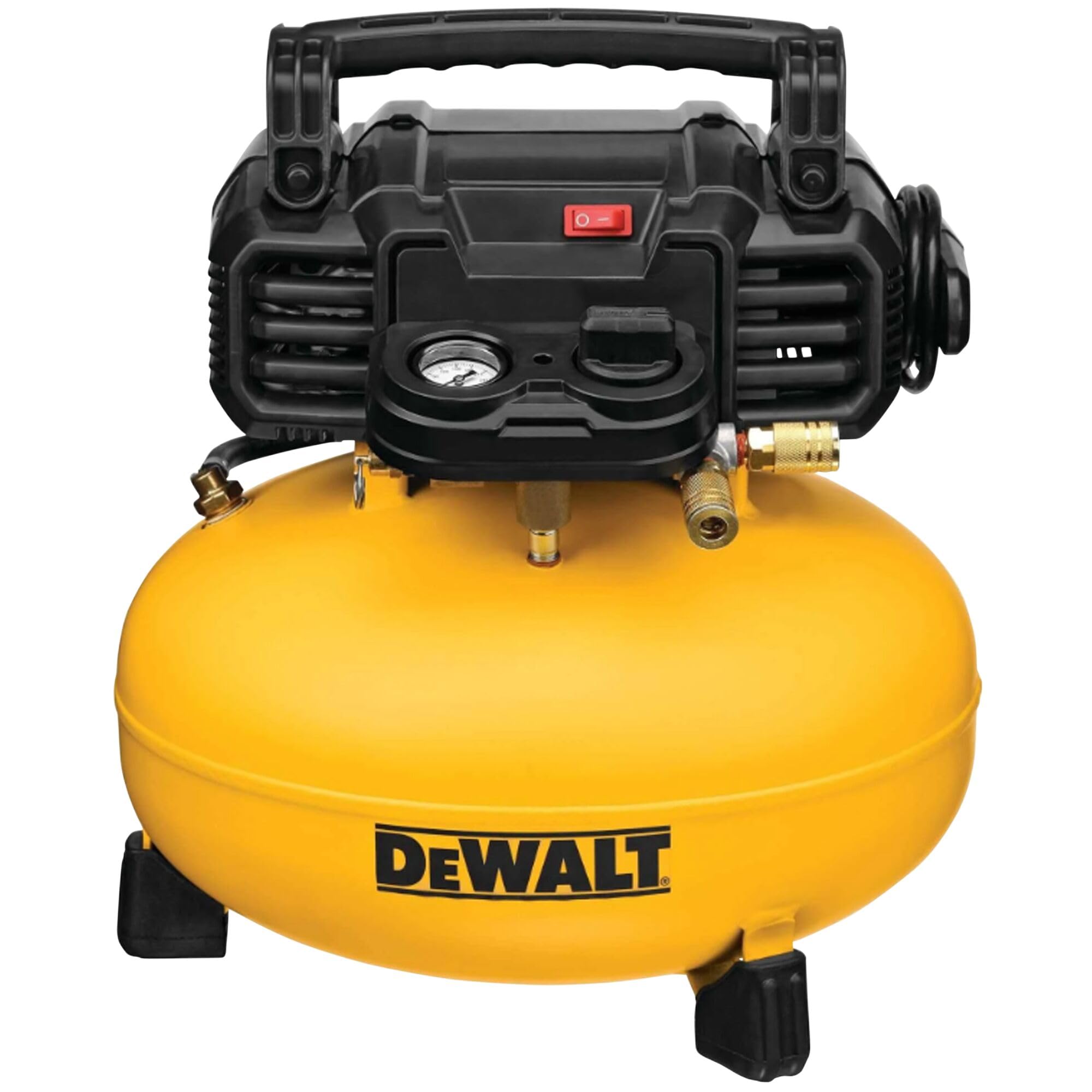
DeWalt DWFP55126 Pancake Compressor

93 /100
Kirk Score Outstanding
Tank Size
6 gal
Noise Level
78.5 dBA
Max Pressure
165 psi
Airflow At 90 Psi
2.6 SCFM
Check Details on Amazon

Pros

  • 165 psi maximum pressure
  • Dual couplers and high-flow regulator
  • 78.5 dBA noise rating
  • 30 pounds with a top handle

Cons

  • Long-term durability is the open question

Two couplers and a high-flow regulator are the first things that separate the DeWalt DWFP55126 from the other 6-gallon pancakes here. We like that you can leave a nailer and a tire chuck connected at the same time, and the regulator gives you finer control when you switch between low pressure for trim and 90 psi for a brad nailer. The 165 psi tank also gives more headroom than the 150 psi units, so the compressor doesn't have to work as close to its ceiling.

At 2.6 SCFM at 90 psi, it sits in the same airflow class as the Porter-Cable and Bostitch, which makes it the right compressor for finish nailers, staplers, blow-off duty, and tire top-offs, not for a grinder or a production spray gun. We found the 78.5 dBA rating easier to live with than the 82 dB Porter-Cable, though it is still a compressor you will hear through a garage wall. The 30-pound weight and top handle make it easy to carry from the bench to the driveway.

The one real reservation is long-term durability. The one-year warranty is standard here, and this is not the compressor for daily jobsite use. That is a trade-off we accept for a garage tool that will see weekend nailers and tire duty rather than eight-hour shifts.

Bottom line: The best default here for mixed garage work: 165 psi, dual couplers, and a high-flow regulator give it more usable headroom than the other pancakes, and 78.5 dBA is easy to live with.

Check Latest Price
#02

Best for Simple Garage Duty

Porter-Cable C2002 Pancake Compressor

94 /100
Kirk Score Outstanding
Tank Size
6 gal
Noise Level
82 dB
Max Pressure
150 psi
Airflow At 90 Psi
2.6 SCFM
Check Details on Amazon

Pros

  • 6-gallon tank at 150 psi
  • 2.6 SCFM at 90 psi
  • Low-amp motor starts in cold or on an extension cord

Cons

  • Loudest of the group at 82 dB

The Porter-Cable C2002 is the plainest version of the 6-gallon pancake formula: a 150 psi tank, 2.6 SCFM at 90 psi, and an oil-free pump with a top handle and rubber feet. There is no high-flow regulator or second coupler to learn, which is exactly the appeal if you want a compressor for tires, a brad nailer, and blowing sawdust off the bench. We appreciate that the low-amp 120V motor is designed to start in cold weather or on a proper extension cord, because a garage compressor that trips a breaker is no help in January.

Against the DeWalt, the Porter-Cable gives up 15 psi and the dual-coupler convenience, but it still has enough tank and airflow for the same small-tool jobs. We did not find the layout fussy: the handle is solid, the drain valve is easy to reach, and the rubber feet keep it from walking across a smooth floor. That simple layout is why it suits a garage where one person is switching between a tire chuck and a nailer.

If you want a simple, known 6-gallon compressor and do not need the DeWalt's extra pressure, this is the easier one to recommend on layout. The straightforward controls are also easier to hand to someone who has never used a compressor.

Bottom line: A simple, proven 6-gallon compressor for tires and nailers; choose it if you want straightforward controls and a layout that is easy to hand to a first-time user.

Check Latest Price
#03

Best for Small Garage Jobs

Bostitch BTFP02012 Pancake Compressor

93 /100
Kirk Score Outstanding
Weight
31 lb
Tank Size
6 gal
Noise Level
78.5 dBA
Max Pressure
150 psi
Check Details on Amazon

Pros

  • 31-pound carry weight
  • 78.5 dBA noise rating
  • 6-gallon, 150 psi tank

Cons

  • Pressure can top out below the 150 psi rating

At 31 pounds, the Bostitch BTFP02012 is one of the lighter 6-gallon pancakes here, and its 78.5 dBA rating puts it in the same noise class as the DeWalt. That combination makes it a good fit for a garage where the compressor lives on a shelf and comes down for tire pressure, a finish nailer, or a quick blow-off. We liked the simple layout: a top handle, a 150 psi tank, and an oil-free pump that does not ask for oil changes.

The 150 psi tank and 2.6 SCFM at 90 psi are right for the same light-duty work as the others, but this is not the pick for a tool that needs a steady 90 psi for long stretches. We also noted that the 6-gallon tank gives you more buffer than a small hot-dog compressor, though it still cycles during sustained nailing.

If low carry weight and a simple layout matter more to you than the DeWalt's extra pressure and dual couplers, the Bostitch earns its place. It is a good garage compressor for one tool at a time, and the 6-gallon tank gives you enough reserve for a set of trim work before the pump kicks on.

Bottom line: A light 6-gallon pancake for garage work, with a quiet 78.5 dBA rating and a simple layout that is easy to live with.

Check Latest Price
#04

Starter kit value

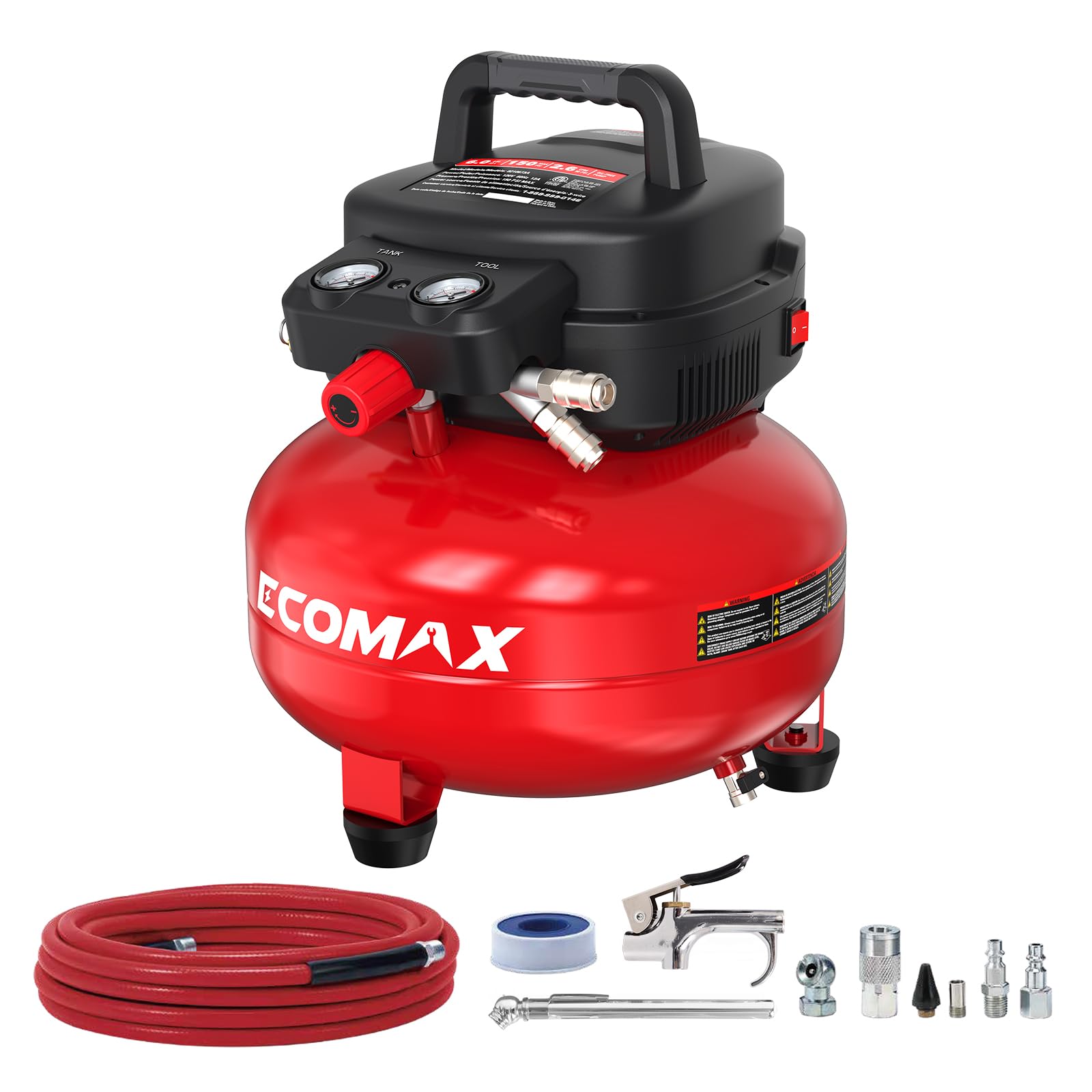
Ecomax 0210673A Pancake Compressor

89 /100
Kirk Score Excellent
Tank Size
6 gal
Noise Level
75 dB
Max Pressure
150 psi
Accessory Kit
10 pieces
Check Details on Amazon

Pros

  • 10-piece accessory kit
  • 6-gallon, 150 psi tank
  • Dual quick couplers

Cons

  • Less pressure headroom than the DeWalt

The Ecomax 0210673A makes its case with the box, not the badge: a 25-foot hose, tire chuck, blow gun, gauge, thread tape, and quick-connect fittings come with the compressor. For a first pancake compressor, that kit is genuinely useful, because you can air up a tire or blow off a bench without a second trip to the hardware store. We liked that the kit covers the small stuff that otherwise turns a first compressor into a second shopping trip. The core unit is a 6-gallon, 150 psi oil-free compressor with dual quick couplers and a flip-up handle, and at 34.17 pounds it is still a one-person carry.

The 75 dB figure is the best listed number in this group, but we still treat any pancake compressor as a garage tool, not a living-room appliance. The 150 psi tank and basic regulator are fine for tires, brad nailers, and blow-off duty, but this is not the pick for high-demand tools or a production shop. The accessory kit is the reason to choose it over a bare compressor, not the performance.

If you already own a hose and fittings, the Ecomax's main advantage shrinks; the DeWalt is the better compressor for regular use, and the Porter-Cable is the simpler 6-gallon alternative. For occasional garage work and a complete starter kit, though, it makes sense.

Bottom line: A sensible starter package for occasional tire and nailer work, with a 10-piece accessory kit doing much of the persuading.

Check Latest Price

How We Tested the Best Pancake Air Compressors

Research came first. I pulled every oil-free six-gallon pancake compressor I could find from the handful of brands that dominate this category, then cut the list by tank pressure, SCFM at 90 PSI, and shipping weight so the group spanned the price range rather than clustering in one tier. What came in the box varied enough — one coupler or two, a coil hose or none, a fistful of accessories or nothing — that sticker price alone said very little about value. That left 11 machines, which I've run for eight months.

They lived where compressors actually live: on a garage floor running a brad nailer through trim, in a truck bed on the way to a fence-repair weekend, in the driveway filling tires and blowing out sprinkler lines before the first freeze, and on a shelf under a workbench between jobs. I timed refill cycles from pump cutoff to pump cutoff after draining the tank with a die grinder, and I let each unit sit full for 24 hours to see whether the gauge still read that morning what it read the night before.

Noise got measured, not guessed — a meter at ear height, three feet away, with the compressor cycling in an empty garage. I weighed every unit on a bathroom scale instead of trusting the spec sheet, then carried each one up and down a flight of stairs one-handed to see how the handle and balance held up. Durability showed itself in small things: a gauge that fogged, a coupler that needed two hands, a drain valve tucked where gloves couldn't reach, a hose that kinked every time it was coiled.

The units that earned a spot were the ones that started cold on the first try after sitting for a month, held their pressure overnight, and didn't make me want to leave the room when they kicked on.

How to Choose a Pancake Air Compressor

Start with tank size and pressure

Most pancake compressors here use a 6-gallon tank, which is enough buffer for a trim nailer, a tire top-off, or a quick blow-off before the pump cycles. A smaller tank saves weight but runs out sooner under sustained nailing. Pressure is the other half: 150 psi is the practical baseline, while the DeWalt's 165 psi gives more reserve for tools that want a steady 90 psi. Do not chase 200 psi unless you have a specific high-pressure tool; the extra pressure does not make up for low airflow.

Match airflow to the tool

Look at SCFM at 90 psi, not just the tank size. The 2.6 SCFM models here are the right match for finish nailers, brad nailers, staplers, tire inflation, and blow guns. They will not keep up with a grinder, a sander, or a production spray gun, and a bigger tank only delays the inevitable. If most of your work is trim and tire duty, 2.6 SCFM is plenty; if you plan to run high-demand tools, step up to a larger compressor rather than a bigger pancake.

Plan for noise and placement

Pancake compressors are loud, and the difference between 78.5 dBA and 82 dB is noticeable when you are standing next to it. The DeWalt and Bostitch are the quieter pair here; the Porter-Cable is the loudest. None is quiet enough for a finished room, so place the compressor in a garage, driveway, or unfinished space and use hearing protection during longer sessions. A longer hose buys more separation than any noise rating.

Weigh portability, couplers, and kit

At 30 to 34 pounds, these compressors are one-person carries, but the handle and footprint matter as much as the scale. A top handle and rubber feet make the DeWalt and Porter-Cable easy to move without scratching a bench. Dual couplers let you leave two tools connected, and a high-flow regulator gives finer control; the DeWalt has both. The Ecomax takes the opposite approach, bundling a 10-piece accessory kit so you can start working without extra purchases. Buy the kit only if you need it.

Frequently Asked Questions

Final Verdict

The DeWalt DWFP55126 is the pancake compressor we point most buyers toward. Its 165 psi tank, dual couplers, and high-flow regulator give it the most usable headroom in this group, and the 78.5 dBA rating is as quiet as these get. If you want a simpler 6-gallon tank for garage duty, the Porter-Cable C2002 is the straightforward alternative; choose the Bostitch BTFP02012 when low carry weight matters more than the extra pressure.