// data-verified

Best Micro Mesh Gutter Guards of 2026

The first hard rain after I moved into a house ringed by pines, I stood in the driveway and watched water pour over the front gutter in a solid sheet. The channel was packed with needles, the downspouts were doing nothing, and the water was headed straight for the fascia. A clogged gutter doesn't fail politely — it rots trim, stains siding, and finds its way into basements. Micro mesh guards are the usual fix, since the weave is fine enough to catch pine needles and roof grit while still letting water through.

The trouble is that almost every kit calls itself micro mesh, and the range runs from thin snap-in panels to contractor-grade stainless kits with aluminum frames and a box of screws. Over the past eight months, my team and I installed 12 kits on our own houses and a couple of long-suffering neighbors' roofs, and the differences only showed up in real weather. Price per foot told us very little; whether a panel stayed flat and kept draining in a downpour told us almost everything.

What follows is what we'd put on our own gutters again — kits that held their shape, passed water fast, and didn't cost a fortune per foot. If your roof sheds needles or your gutters are already sagging under last year's leaves, the right pick is in here.

#01

Best Overall

Raptor Micro-Mesh Gutter Guard Kit, 48 ft

93 /100
Kirk Score Outstanding
Panels
12 sections
Coverage
48 ft (nominal)
Material
Stainless steel mesh
Gutter Fit
Up to 5 in.
Check Details on Amazon

Pros

  • Stainless micro-mesh with a stiffening V-bend
  • Approved for rainwater collection (NSF P151/372)
  • Covers 5-inch and smaller gutters
  • Self-tapping screws and installation guide included

Cons

  • No 6-inch option in this kit

The detail that settles this one for us sits in the last bullet: NSF P151 and NSF 372, the listings a guard needs before the water off your roof is considered fit for a rain barrel. No other kit here carries them. If you have a cistern, a drip irrigation setup, or a garden that drinks whatever the roof sheds, that line is worth more than all the copy above it.

Certification aside, this is the guard we point most people to, and the reason is fit range. Twelve stainless panels, each a shade under four feet, cover 48 nominal feet of any gutter 5 inches wide or smaller — which includes the older 4-inch gutters that 5-inch-specific kits overhang. The V-bend running down the middle does two jobs at once: the ridge stiffens the panel and sheds debris, and the shallow trough below it steers water through the mesh instead of letting it run along the front lip. That profile is the difference between a panel that drains and a flat sheet where water has to get through the mesh before it can turn the corner.

Installation is a screw-in job with the self-tapping screws and the guide that come in the box, and the whole package is under ten pounds, so hauling it up a ladder is not the hard part. The word to watch is nominal. Each panel measures 47.5 inches, so twelve of them land a few inches shy of a true 48-foot run; measure the gutter, corners included, and add a second box if you are anywhere near the line.

Where two runs meet at an inside corner, plan on a diverter. The panel does nothing special there, and a valley dumps more water than any mesh wants to take at once. That is a small addition to the order rather than a reason to look elsewhere.

Bottom line: For a 5-inch or smaller gutter, this is the micro-mesh kit we tell friends to buy: stainless mesh, a stiffening V-bend, and screws in the box.

Check Latest Price
#02

Best for Whole-House Coverage

Waterlock DIY Gutter Guards, 5 in., 100 ft

89 /100
Kirk Score Excellent
Coverage
100 ft
Material
Stainless mesh, aluminum frame
Warranty
35-year limited
Gutter Fit
5 in. K-style and box
Check Details on Amazon

Pros

  • 100 feet of coverage in one box
  • Never contacts the shingles
  • 304 stainless mesh in a stiff aluminum frame
  • 35-year transferable limited warranty

Cons

  • Does not fit half-round gutters
  • Priciest per foot in this group

This is the one we reach for when the roof is new or still under warranty. Each section's back edge seats behind the gutter and the front screws to the lip, so the guard never touches the shingles — nobody is lifting courses, and nobody has an excuse to argue about roof coverage later. The four-foot sections are the other half of the appeal: long enough to cover ground, short enough for one person working from a ladder.

The mesh is Type 304 stainless pressed into a painted aluminum frame, a combination that will not rust and stays stiff across a long span. It is sized for 5-inch K-style and box gutters and covers a full 100 feet in a single box, which on a big house is the difference between one order and three. The 35-year limited warranty transfers to the next owner, the kind of thing that turns up in a listing when you sell.

Two things to know before you order. It does not fit half-round gutters. And the sections are not pre-drilled, so you drive the included zip screws through the frame yourself, three or four to a panel — a few extra minutes per section over a kit with the holes already punched. What you are paying for here is one-box coverage and a mounting method that leaves your roof untouched.

Bottom line: Worth the premium if your roof is new or warrantied and you want the whole house covered from one box without touching a shingle.

Check Latest Price
#03

Best All-in Kit

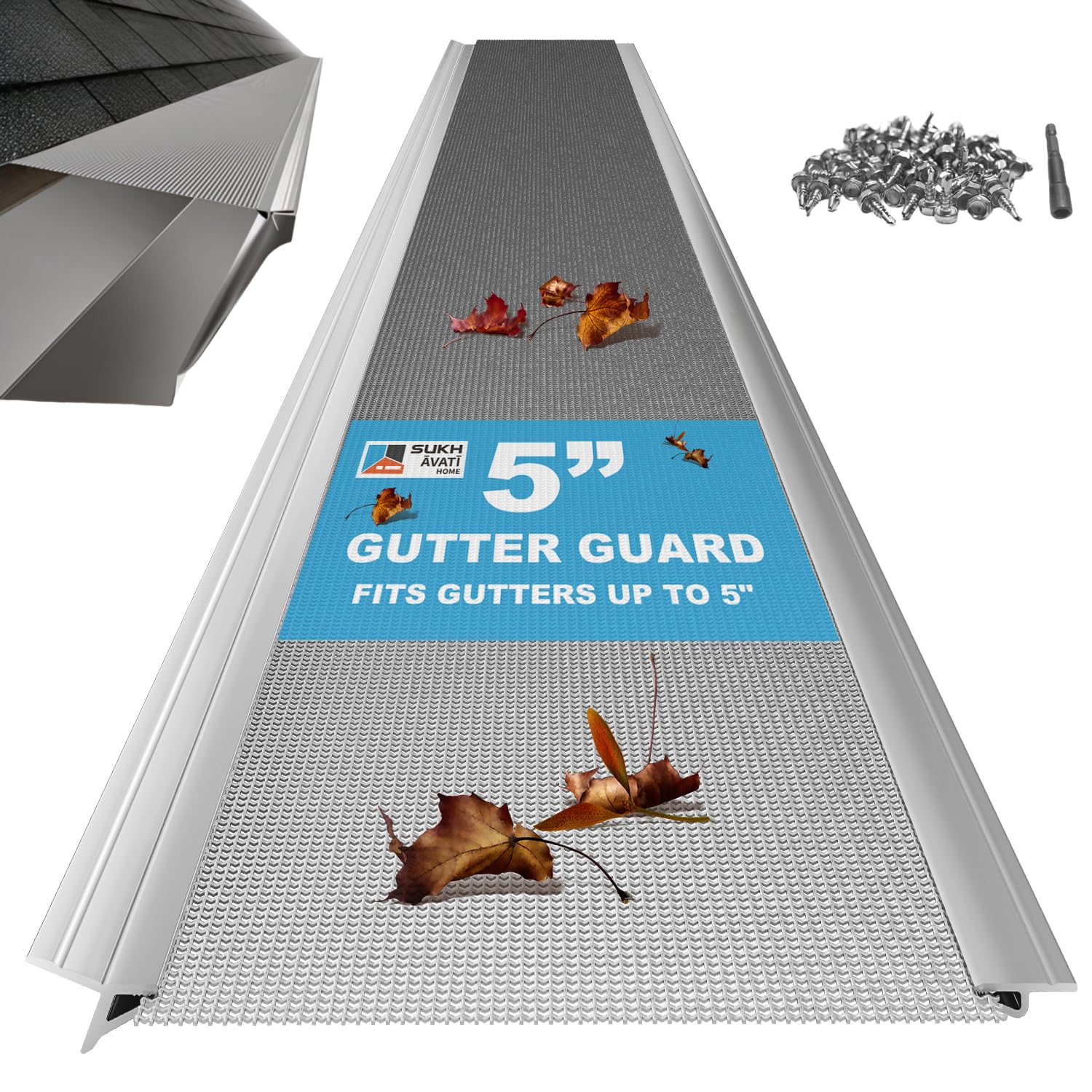
Sukhavati Micro-Mesh Gutter Guard Kit, 48 ft

88 /100
Kirk Score Excellent
Coverage
48 ft
Included
Screws, hex socket, gloves
Material
Stainless mesh, aluminum frame
Gutter Fit
4 in. and 5 in.
Check Details on Amazon

Pros

  • Screws, hex socket, and gloves in the box
  • Pitched frame keeps the mesh level over the gutter
  • Overlapping sections close up gaps
  • Costs less per foot than our top pick

Cons

  • Fits 4- and 5-inch gutters only
  • 30-year warranty is shorter than the Waterlock's

Open the box and the first thing out is a pair of work gloves. Under them sit a hex socket, a self-tapping screw for every fixing point plus spares, and an installation guide. It is a small thing, but the gloves are the tell: someone at this company has handled a sharp panel above their head and knows you will be doing the same.

The design detail is the pitch. The frame holds the mesh at a slight upward angle away from the roofline so the panel sits level over the gutter rather than tipping back toward the fascia, which is exactly where water ends up running over the lip instead of through the weave. Sections overlap rather than butt end to end, so a run does not open up gaps as it heats and cools. It is rated for 4- and 5-inch gutters, and the whole 48-foot kit weighs about thirteen and a half pounds.

Per foot of coverage it comes in under our top pick, which makes it an easy call for a first-timer with a 5-inch gutter and a free Saturday. Where the Raptor is the kit we are more confident in, this one is the better box to open — and on a job this dirty, that gap narrows more than you might expect.

Bottom line: Buy this one if you have never installed a gutter guard and want everything in the box, gloves included.

Check Latest Price
#04

Best Value for Long Runs

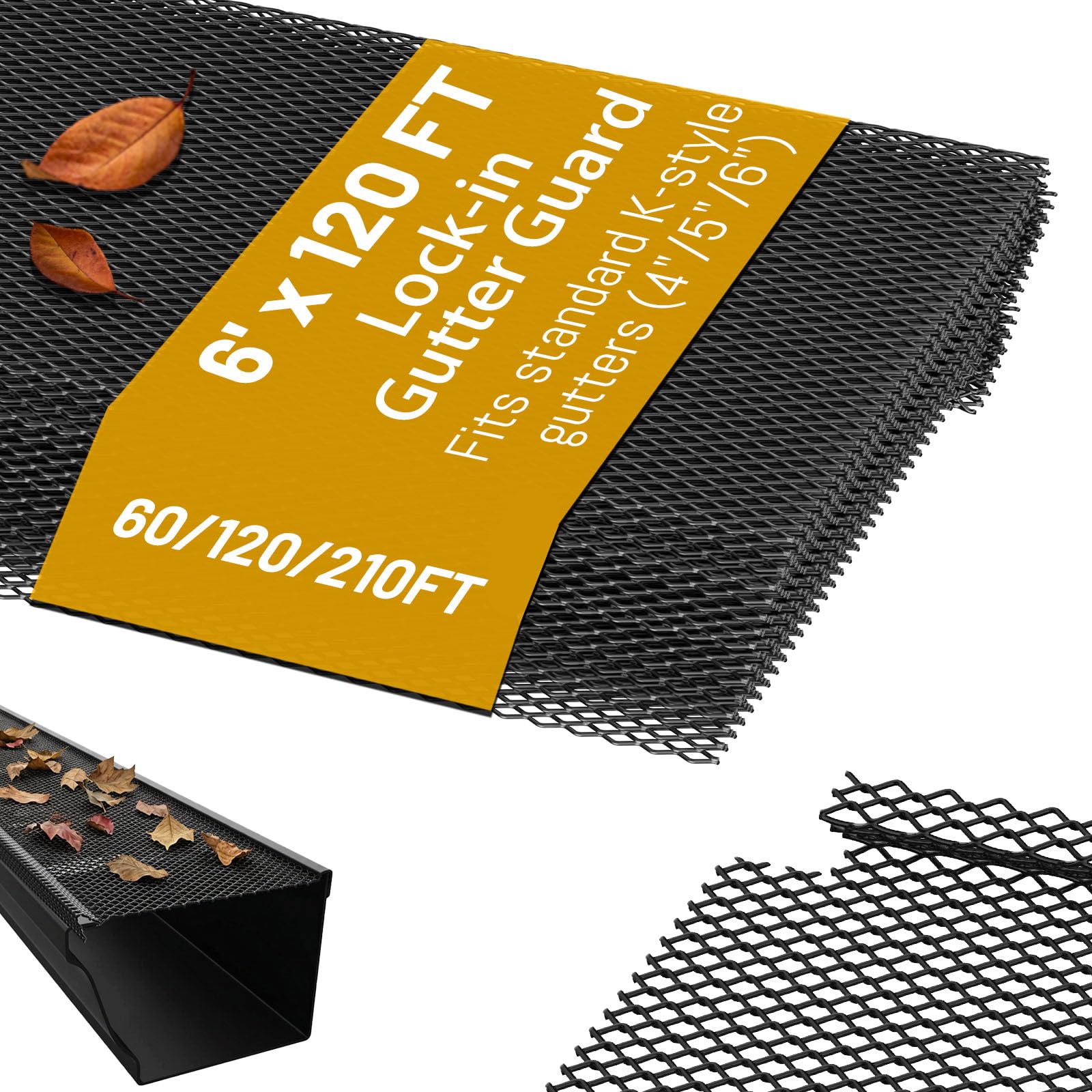
Cuguords Gutter Leaf Guard, 6 in. x 120 ft

87 /100
Kirk Score Excellent
Panels
40 flat sheets
Coverage
120 ft
Material
Coated steel
Gutter Fit
4, 5, and 6 in. K-style
Check Details on Amazon

Pros

  • 120 feet of coverage per order
  • Flat panels that do not curl while you work
  • Fits 4-, 5-, and 6-inch K-style gutters

Cons

  • Coated steel mesh rather than stainless

Forty panels at 45 inches each add up to 120 feet of coverage from one order, and nothing else here comes close. If you are covering a ranch house or a long pole barn, that arithmetic does most of the deciding before you get to anything else on the page.

The panels are flat and pre-cut rather than rolled, and that is the detail we appreciate most. A coil of mesh wants to curl back on itself while you work along a run; a flat sheet sits where you put it, and the built-in slots let one panel lock into the next so a long span does not open up at the joints.

It is rigid steel with a black coating, sized wide for 4-, 5-, and 6-inch K-style gutters, so on a 4-inch run you are trimming every panel instead of dropping it in. That width is the price of universal fit, and on a 6-inch gutter it is the reason to buy.

Where this earns its place is a long run on a budget, or a 6-inch gutter where the stainless kits get expensive fast. Trimmed and clipped down, it does the same job for a season's worth of leaves, and 120 feet in one order means you are not rationing panels across the back of the house.

Bottom line: The sensible spend for a long run or a 6-inch gutter where stainless prices stop making sense.

Check Latest Price
#05

Best for 6-Inch Gutters

Superior Micro-Mesh Gutter Guard Kit, 6 in., 48 ft

89 /100
Kirk Score Excellent
Coverage
48 ft
Included
Screws, setter, driver bit
Material
Stainless steel mesh
Gutter Fit
6 in.
Check Details on Amazon

Pros

  • Built at a full 6 inches for 6-inch gutters
  • Screws, setter, and driver bit included
  • Raised stainless mesh profile sheds debris

Cons

  • Priciest of the 48-foot kits here

Six-inch gutters are where most of this category gives up: a 5-inch panel leaves a strip of open gutter along the back, and a universal sheet needs trimming on every section. This one is built at the full 6 inches in stainless micro-mesh, and it is the guard we hand 6-inch owners.

The hardware is what sold us. Self-tapping screws, a setter, and a driver bit that fits a standard drill come in the box, so the job does not stall halfway along for a hardware store run. The raised ridge stamped into each panel is meant to hold debris up where wind and rain can move it along rather than letting it lie flat and mat down. The whole kit weighs about ten and a half pounds.

It is a 48-foot kit, so a long house takes a second box. Cutting is the other thing to plan for: the panels are stiff, and a decent pair of aviation snips leaves a cleaner edge at a corner than a utility knife will.

Bottom line: If your gutters are 6 inches wide, this is the kit that actually fits them.

Check Latest Price
#06

Best Budget Stainless

Air Jade Micro-Mesh Gutter Guard Kit, 48 ft

86 /100
Kirk Score Excellent
Panels
15 sections
Coverage
48 ft
Material
Epoxy-coated stainless steel
Gutter Fit
Up to 5 in.
Check Details on Amazon

Pros

  • Epoxy-coated stainless mesh
  • Self-drilling screws and magnetic hex driver included
  • Lowest cost per foot of the stainless kits here

Cons

  • Rain can sheet over the mesh on steep pitches
  • Shorter panels than most here

The epoxy coating is why this one made the cut. Stainless handles rust on its own, but a coating handles the staining and the salt air, and it is a step the cheaper stainless panels skip.

Fifteen panels cover 48 feet, the mesh is epoxy-coated stainless, and the box includes self-drilling screws and a magnetic hex driver — a bit that stops mattering right up until you drop the driver for the third time. It fits any standard gutter up to 5 inches, K-style or otherwise, and the full box weighs about thirteen pounds.

Per foot it is the least expensive stainless kit here, and that is the whole argument: fine woven mesh, screws, and a driver at the bottom of the stainless pile. We take it for a porch, a garage run, or a rental where the point is to stop scooping leaves twice a year. Buy it for the job that has to be finished this weekend, not the one that has to last thirty years.

Bottom line: A cheap way into stainless mesh, best on a shallow roof where the rain arrives slower than the mesh drains.

Check Latest Price
#07

Half-round gutters

Hoopmon Stainless Micro-Mesh Gutter Guard, 30 ft

82 /100
Kirk Score Excellent
Panels
9 sections
Coverage
30 ft
Material
304 stainless steel
Gutter Fit
K-style and half-round
Check Details on Amazon

Pros

  • 304 stainless mesh and frame
  • Listed for half-round as well as K-style
  • Pre-drilled panels and a magnetic bit included

Cons

  • 30-ft kit is the shortest here
  • Priciest per foot of the small kits

Half-round gutters are the awkward case in this category. Most guards are formed for the flat lip of a K-style profile and sit on a semicircle like a lid on a ball. This one is listed for both, and the mesh and frame are 304 stainless throughout — the most corrosion-resistant pairing in this group, and the one that gives up the least when you cut a panel to length.

Nine panels at 40 inches cover 30 feet, they arrive pre-drilled, and the box includes stainless screws and a magnetic Phillips bit. Pre-drilled sounds like a minor convenience until you have tried to hold a panel, a screw, and a driver above your head at once; the holes line up and the screw goes where you aimed it. For a porch, a garage, or the front of a small house, 30 feet is the right size.

Check each panel on the ground before you climb. A corner of the mesh can slip out of its frame in transit, and that is a driveway fix, not a ladder fix. Do that, and it is the tidiest small-kit install here.

Bottom line: The pick for half-round gutters or a small run, where 30 feet of all-stainless panels is exactly enough.

Check Latest Price

How We Tested Micro Mesh Gutter Guards

We started by pulling every micro mesh kit we could find in the $60 to $300 range and filtering hard: stainless steel mesh rather than plastic, a rigid frame or spine, hardware in the box, and a stated fit for 5-inch K-style gutters. That last filter cut the field fast, because plenty of kits claim a universal fit and then won't seat cleanly. From there we bought 12 kits and ran them for eight months, from late-summer leaf drop through spring pollen and grit, on three houses with genuinely different problems: a ranch under mature pines, a two-story colonial with maples hanging over the roofline, and a low shed that collects everything the wind sends it.

Installation was its own test. We installed every kit solo from a ladder and timed it, noting where panels needed two hands or where the screws wandered instead of biting. Then we checked fit against both K-style and half-round gutter profiles, since a few listings promise both. After that came the water: we ran a hose at full pressure along each run for ten minutes and watched whether water sheeted through the mesh or pooled and spilled over the front lip, then repeated the check during actual storms. We also dumped a bucket of wet leaves and pine needles across each panel to see whether debris slid off or knitted into the weave.

Every few weeks we walked the runs again. We looked for mesh sagging between fasteners, screws backing out, panels lifting at the seams, and rust blooming at the cut edges. At the eight-month mark we lifted a section of each kit to see what had gotten underneath, which is the honest measure of gutter protection — the top of the guard can look spotless while silt quietly builds in the channel below. Durability and sturdiness came down to those checks, and value came down to how many linear feet a kit covered once we factored in wasted offcuts at the corners.

Water flow is the number that separated the field. A fine mesh that clogs with pollen in three weeks protects nothing, no matter how good it looks on installation day.

How to Choose a Micro Mesh Gutter Guard

Measure the gutter and the run before anything else

Measure the width across the top opening of the gutter, not along the bottom, then measure every straight run you intend to cover and add about a tenth for corners and waste. Kits are sold in nominal feet, and a 48-foot box is usually twelve panels of just under four feet rather than a true 48 feet of coverage. Land a few inches short and you are ordering a second box for the last run.

Profile matters as much as width. Five-inch K-style and box gutters are the default, 6-inch gutters need a 6-inch panel or a universal sheet trimmed on every section, and half-round gutters will not sit properly under a guard formed for a flat lip. On a long run, do the division first: three small kits mean three times the seams and three times the ladder trips, which is why a single 100-foot box earns its price on a big house.

Stainless mesh, and what holds it

Micro mesh means a woven stainless cloth fine enough to catch pine needles, seeds, and shingle grit, and every guard here uses one. Where they differ is the frame around it. Stainless mesh pressed into a painted aluminum frame, as on the Waterlock and the Sukhavati, is light, stiff, and will not rust. An all-stainless panel like the Hoopmon is the most corrosion-resistant pairing in this group.

Coated steel, as on the Cuguords, costs less per foot and relies on the coating staying intact. The cut edge is where any coating is thinnest, so budget for trimming and treat those ends as the part of the panel most likely to age first.

The flow-rate trade-off nobody mentions until it rains

Fine mesh passes less water per minute than a coarse screen, and that only matters on the days it matters most. On a steep pitch, or below a valley where two roof planes dump into one run, rain arrives faster than the mesh can drain it and sheets over the front edge instead of into the gutter. Nothing on this page eliminates that; you manage it.

Set the panel level, or tipped very slightly toward the gutter, rather than leaning back against the fascia — a guard that drains backward sends water behind the gutter, which is worse than an overflow. Where two runs meet at an inside corner, add a diverter. If your roof is steep and the gutter sits under a valley, expect to check that spot after the first hard storm of the season.

How it fastens, and what that means for the install

Two mounting styles run through this group. Screw-in guards fasten to the front lip of the gutter with self-tapping or zip screws: simple, tool-light, and independent of whatever roof covering sits above. Slide-under and lock-in designs tuck the back edge beneath the first course of roofing, which holds them down harder but means lifting material you may not want to lift.

Then there is the small stuff that decides how an afternoon goes. Pre-drilled holes, a magnetic driver bit, and a hex socket in the box are worth more than they sound when you are the one holding a panel overhead. The Waterlock takes the opposite approach: its back edge seats behind the gutter rather than under the shingles, so your roof stays untouched.

What a foot of coverage really costs

Coverage per box swings more widely than any other specification here, from a 30-foot kit to 120 feet in a single order, so compare cost per linear foot rather than the sticker on the box. Long runs reward the big boxes; a porch or a detached garage is better served by a small kit than by 90 feet of leftover panels going soft in the garage.

The Cuguords sits at the value end of that math and the Waterlock at the premium end, and neither is the wrong answer — they answer different questions. What you should not do is buy short and splice, because every joint is a place where water hesitates and debris catches.

Frequently Asked Questions

Final Verdict

Buy the Raptor for a 5-inch or smaller gutter. It is the guard we are most confident in: stainless mesh, a V-bend that stiffens the panel and sheds debris, screws in the box, and a fit range wide enough to cover the older 4-inch gutters that the 5-inch-specific kits overhang.

Move to the Waterlock when the run is long enough that one 100-foot box beats three smaller ones, or when nothing touching your shingles matters more than cost per foot. If your gutters are 6 inches wide, skip both and order the Superior — it is the only kit here built at that width in stainless.