// data-verified

Best Moisture Meters for Drywall of 2026

That tan ring on the ceiling is the moment most people start shopping for a moisture meter. Mine appeared in a hallway corner below the upstairs bath, and pressing a palm against the drywall told me nothing — the paper felt cool either way. A meter settles the question in about two seconds by measuring how much water is actually in the board, so you can tell a stain that dried out from one that's still growing behind the paint.

Over the past four months, my team and I have run 14 meters across ceilings, baseboards, and window sills that had real reason to be damp. The thing that surprised me most: the number on the screen is relative, not gospel, and pin and pinless meters disagree more than their spec sheets admit. Pins read the paper face and leave two small holes; pinless pads read deeper without marking anything but can be fooled by a metal corner bead or a stud behind the board. The picks below are the ones that stayed consistent no matter which I reached for.

#01

Best Overall

Proster PST199-P

91 /100
Kirk Score Outstanding
Alert
Audible tone plus 3-color LED bar
Power
9V battery (included)
Scan Depth
Up to 3/4 in. (19 mm)
Measuring Range
5-75% wood; 5-70% wall and masonry
Check Details on Amazon

Pros

  • Reads through half-inch drywall into the cavity behind
  • Tone and LED bar let you sweep without watching the screen
  • Wall and masonry modes sit alongside wood
  • Backlit display for basements and crawl spaces

Cons

  • Runs on a 9V battery, not rechargeable
  • No pin probe for confirming a reading

Three-quarters of an inch is the specification that decides this one for drywall. Standard interior board is half an inch thick, so a pinless sensor rated to 19 mm reads past the gypsum and the paper face into what's behind it - insulation, framing, the back of a shower surround. That's the difference between knowing an old stain is dry and knowing the leak is still running.

Of the meters here, this is the one we recommend as a default, and the reason isn't a single headline figure. It carries the highest rating in this group, but what settled it for us is how it delivers a reading: a backlit color LCD for the number, a three-color LED bar for the direction of travel, and a tone that rises as moisture climbs. Sweeping a wall in a grid, we listened instead of watching, which turns a slow inspection into a quick one when you're working above your head.

One button cycles the material modes, and the wall and masonry settings are the useful ones on drywall; wood mode takes over if the same leak reached a stud or a cabinet back. Readings hold long enough to write down. Auto power-off saves the battery between inspections, sometimes at the worst moment - press the button and re-seat the plate rather than trusting whatever is left on the screen.

The number on a wall setting is a relative index, not a moisture content you can line up against a lumber figure. Take one reading on a stretch of the same wall you know is dry and treat everything else as higher or lower than that. It's the technique that makes any pinless meter useful, and this one makes it easy.

Bottom line: The meter we point a homeowner toward first: it reads through half-inch board, sounds off as the reading climbs, and leaves the paint untouched.

Check Latest Price
#02

Best Rechargeable

RDINSCOS MT35 Rechargeable

91 /100
Kirk Score Outstanding
Power
Rechargeable lithium battery
Alerts
Adjustable threshold, visual and audible
Weight
7 oz
Material Modes
6
Check Details on Amazon

Pros

  • Alarm threshold you set yourself
  • Rechargeable lithium battery, no 9V to buy
  • Six material modes including drywall and concrete
  • Seven ounces, easy to hold overhead

Cons

  • No pin probe, so readings stay at the surface
  • Ships without a case or pouch

The setting we leaned on hardest is the alarm threshold. You choose the moisture level that bothers you, and the MT35 beeps and goes red when a surface crosses it, which turns a spot checker into something you can run across a whole basement wall without stopping to read the numbers. It's the feature that separates it from the cheaper pinless meters in this guide, and it's why this is our pick for a room-sized problem rather than one suspicious patch.

Six material modes cover wood, drywall, and general wall surfaces. The sensor wants to sit flat with your hand clear of the plate, and that matters more than usual here: a threshold you've set yourself only helps if the contact is consistent from one reading to the next. Run it in a grid rather than in circles and the readings settle down.

The battery is a built-in rechargeable lithium cell rather than a 9V, which is the practical advantage over the Proster - no spares to buy, and no dead meter because you forgot. At seven ounces it's light enough to hold overhead in one hand while you mark the edge of the wet zone with the other. The other place it earns its keep is a floor: run it over a slab or a cement floor after a flood and the readings tell you which end of the room is still holding water.

Bottom line: Pick this one if you want to set your own moisture limit and let an alarm do the sweeping - it's rechargeable, so there's no 9V to remember.

Check Latest Price
#03

Best 2-in-1

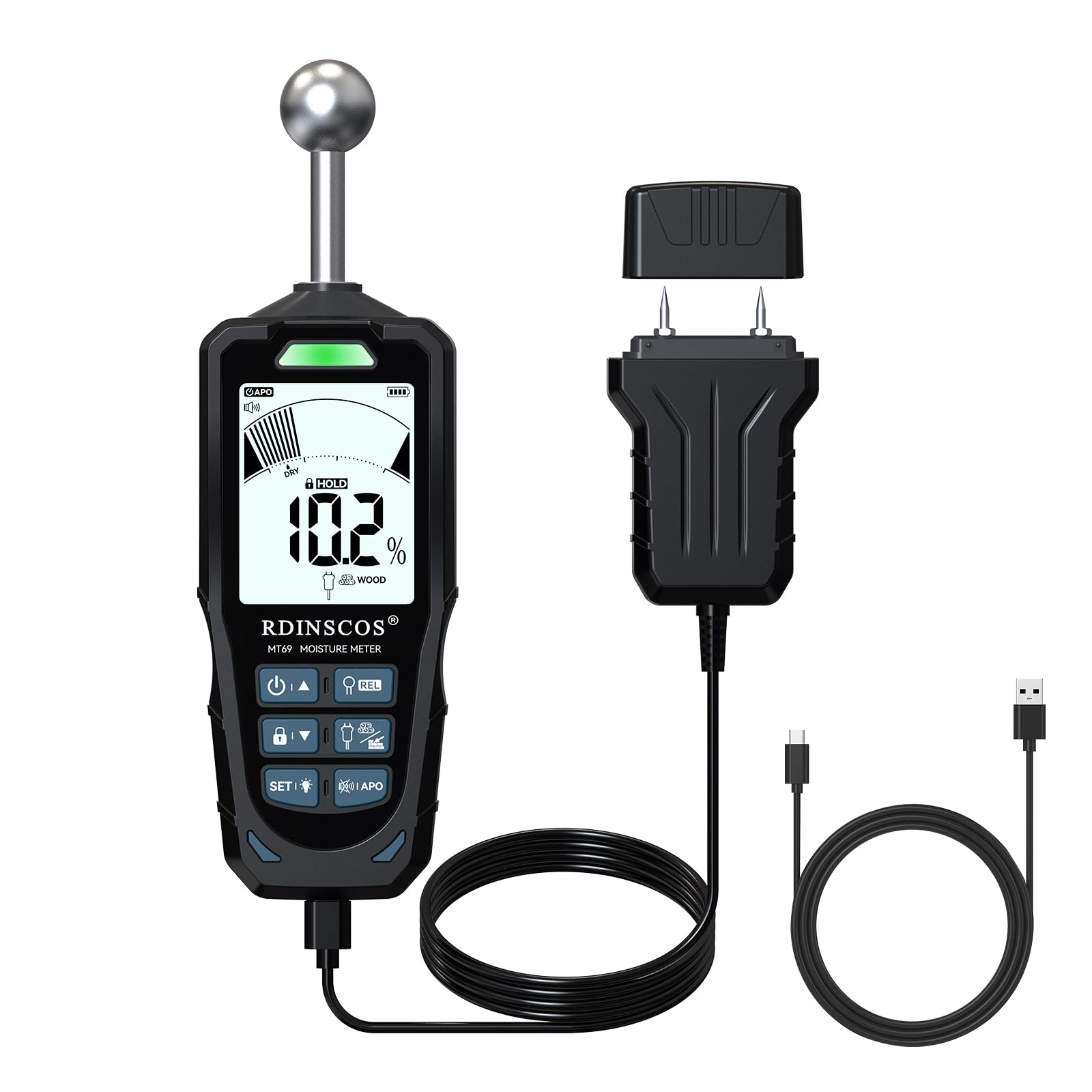
RDINSCOS MT69 2-in-1

91 /100
Kirk Score Outstanding
Power
Rechargeable, USB cable included
Alerts
Adjustable alarm threshold
Weight
1.21 lb
Sensing
Pinless plate plus detachable pin probe
Check Details on Amazon

Pros

  • Pinless plate plus detachable pin probe in one housing
  • Rechargeable, with a USB charging cable included
  • Pinless scanning also covers plaster and concrete

Cons

  • Most expensive meter in this guide

A pinless meter tells you where a wall is wet. It can't tell you how wet the framing inside is, and that's the question that decides whether you're running a dehumidifier or reaching for a pry bar. The MT69 is the only meter in this guide that answers both, with a pinless sensing plate on the back of the housing and a detachable pin probe for a direct measurement.

The workflow suits it. We scanned until the readings climbed, taped the edge of the wet zone, then took a pin reading at a spot that was coming out anyway - a baseboard line, a corner behind a cabinet - so the hole cost nothing. Having the probe detach matters more than it sounds: put it away and the plate slides flat against the wall with no spike in the way.

For renovation and insurance work, we think it's the most useful meter here, and the rechargeable battery with an included USB charging cable keeps the kit self-contained. At 1.21 pounds it's a two-handed tool, which suits a job where you're stopping to read a screen and mark a wall.

Its pinless plate handles plaster and concrete as well as drywall, so the same meter can follow a leak from a plaster ceiling down onto a slab without switching tools. That range is what you're paying for, and on a job with a contractor involved it's easy to justify.

Bottom line: Worth the premium when the wall is coming open anyway: scan to find the wet zone, then take a pin reading to learn what's actually soaked.

Check Latest Price
#04

Best Pin-Type Display

TopTes TS-630

90 /100
Kirk Score Outstanding
Power
3 AAA batteries
Scales
7 calibration scales, 0-57%
Display
2.25 in. tricolor backlit LCD
Warranty
3 years
Check Details on Amazon

Pros

  • Largest display here with a color-coded verdict
  • Spare pins, pouch, and wrench included
  • Three-year warranty, the longest in this guide
  • No calibration routine before a reading

Cons

  • Pin holes in finished drywall need filling

A 2.25-inch screen doesn't sound like much until you're crouched in a dim basement reading a number at arm's length. The TS-630 has the largest display in this guide, and the backlight shifts color - green, amber, red - so the meter settles the dry-or-wet question before you've focused on the digits.

That's the part we appreciated most. Seven calibration scales and two material modes cover wood species as well as building material, and readings settle quickly enough to move from spot to spot without waiting. The buttons are firm, the carry pouch comes in the box, and there's a spare pair of pins and a small wrench included for the day one bends.

The three-year warranty is the longest of any meter here, which counts for something on a tool with two thin steel points sticking out of the end. It runs on three AAA batteries and weighs 148 grams, so it disappears into a tool bag until you need it.

Set the scale for the material, push the pins in until they bite, and read. There's no calibration routine to run first, which is what makes a pin meter pleasant on a job where you're taking a dozen readings across a stack of lumber or a run of framing.

Bottom line: A pin meter with the clearest screen here: green, amber, or red answers the dry-or-wet question before you've read a single digit.

Check Latest Price
#05

Best Budget

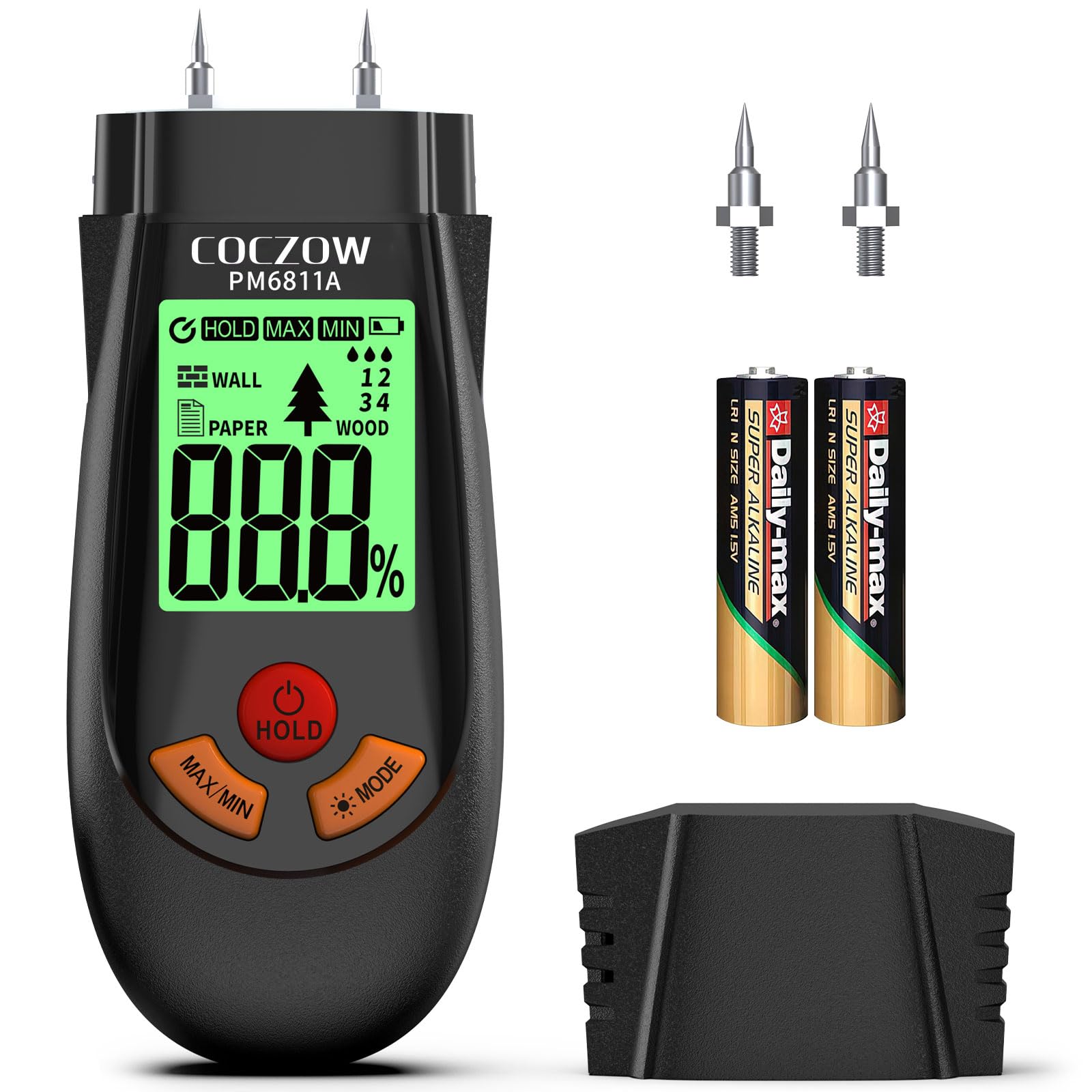
coczow PM6811A

89 /100
Kirk Score Excellent
Type
Pin type, stainless steel pins
Range
2-75% wood; 1.5-30% building
Scales
6 calibrated
Weight
5 oz
Check Details on Amazon

Pros

  • Least expensive meter in this guide
  • Pen-shaped five-ounce body fits a shirt pocket
  • Wide 2-75% wood range with six scales

Cons

  • Pins only - no scanning mode for finished walls

Five ounces and about five inches long, the PM6811A is closer to a pen than to the boxy meters that make up most of this guide. That shape is why it's the one we keep within reach between checks - it drops into a shirt pocket and the stainless pins are at the tip when you pull it out. It's also the least expensive meter in this guide, which matters when the question is a single leak rather than a career.

Six calibrated scales cover wood from 2.0% to 75.0% and building materials from 1.5% to 30%, and the backlight runs green, yellow, red as the reading climbs. Spare pins and a small wrench for changing them come in the box, which is generous at this end of the price range.

Set the material, push the pins in, read, move on - a few seconds per reading, which is what you want when you're working through a stack of framing or checking a subfloor after a leak. The slim body also reaches into places a bigger meter won't, like the gap above a door frame or behind a cabinet kick panel.

Bottom line: The one to keep in a pocket: the least expensive meter here, and it still covers wood from 2% to 75%.

Check Latest Price
#06

Wood-first checks

Mecurate WMM

89 /100
Kirk Score Excellent
Range
6-60% wood; 1.5-33% building
Extras
Ambient temperature readout
Scales
8 wood calibrations, 2 modes
Resolution
0.1%
Check Details on Amazon

Pros

  • Eight wood species calibrations
  • 0.1% resolution for drying lumber
  • Printed species index on the housing
  • Ambient temperature readout in F or C

Cons

  • Wall work is secondary to its wood calibrations

There's a wood-species index printed on the back of the housing - match your lumber to a scale number and you're set without digging out the manual. It's a small thing that tells you what this meter was built around: measuring wood accurately, with wall readings as the second job.

Eight calibrations cover wood species, and a second mode handles building material from 1.5% to 33%; wood runs 6% to 60%, at 0.1% resolution. There's a hold button, a low-battery icon, a water-resistant pouch, and a pair of replacement pins in the box. It reads ambient temperature in Fahrenheit or Celsius too, which is handy on a job where both the wood and the room are variables.

For a floor going down, or a stack of lumber you're bringing to a target before milling, the finer resolution is worth having. On drywall that extra decimal is noise - moisture moves in whole percentage points on a wall - but on a species calibration it's exactly the kind of difference you're watching as lumber dries. That's the split we'd draw with this one, and it's why it sits behind the pinless meters for a wall problem.

Physical buttons rather than a touch panel is the right call for something you'll handle with damp hands, and the index on the back means the species setting takes seconds rather than a manual. At 0.21 kg it rides on a tool belt without complaint.

Bottom line: Best for wood first and wall second: eight species calibrations, a temperature readout, and a printed index that saves the manual.

Check Latest Price

How We Tested Drywall Moisture Meters

We built the shortlist from listings and spec sheets, filtering for meters that name drywall, plaster, or wall as a material mode, that offer some kind of alert or color band, and that sit in the range a homeowner would reasonably spend on a single diagnostic tool. That left 14 units, which we used for four months in my house, a neighbor's seepy basement, and a friend's rental after a storm. Every meter saw the same walls: a ceiling stain under a bathroom, baseboards along a foundation wall, window sills, and a patched section I deliberately wetted.

Accuracy got the most attention. I soaked scrap pieces of drywall with measured amounts of water so I'd have a known-dry, a slightly damp, and a genuinely wet sample, then checked whether each meter ranked them in the right order and how far apart its numbers landed from the others on the same spot. I also noted where a pinless pad jumped high over bare drywall versus painted or textured board, and how often it read a stud or a corner bead as moisture. We recorded the exact percentage where each color band flipped and whether the audible alarm carried across a room.

For ease of use, I timed each meter from power-on to first reading and counted button presses to reach the drywall setting, then read the display from arm's length in a dim basement to see how legible the numbers and backlight really were. We judged the manuals on whether material modes and calibration were explained in plain language. Durability came from a waist-high drop onto concrete and a week rattling in a tool bag, and we counted what shipped in the box — battery type, pouch, whether it recharges — to sort out which ones were worth the money.

How to Choose a Moisture Meter for Drywall

Pinless, Pins, or Both

A pinless meter sends a field into the material and reads what comes back, so you can sweep paint, wallpaper, and a finished ceiling without leaving a mark. A pin meter drives two points into the surface and measures between them, which reads the material directly but costs you two small holes per spot. For drywall in a room you intend to keep, pinless is the sensible default.

Pins come into their own on lumber, subfloor, and anything getting covered up or cut open anyway. A 2-in-1 takes both routes, and the pin probe is worth having when the reading is what decides whether a wall gets opened.

What the Reading Actually Means

On gypsum, a pinless reading is a relative index, not a moisture percentage you can compare with a lumber figure, and not a pass or fail. Take a baseline on a stretch of the same wall you know is dry, then work outward and watch where the number or the bar graph climbs.

Plan for metal. Corner bead, screw heads, studs, and pipes behind the board all push a reading up, so keep the plate flat against the surface, stay off the metal, and re-check any sudden jump a few inches to either side before you believe it.

Scanning Depth

The figure that matters is around three-quarters of an inch - 19 mm on most of the meters here - because that carries the sensor through half-inch board and into the cavity behind it. On 5/8-inch board or a double layer you're near the limit of what a pinless meter can see, so press the plate flat and treat the reading as directional rather than exact.

Pin meters sidestep depth entirely: they measure the material between the two points. That's why the two designs work well together on a leak that runs from a ceiling down into a wall.

Alerts, Backlights, and Hold

A number alone is slow to read when you're up a ladder. A three-color bar graph or a tone that rises with moisture lets you sweep with your eyes on the wall instead of the display, and an alarm does the same job in a crawl space where you can't see the screen at all.

A backlit display earns its keep in basements and behind cabinets, and a hold button matters when you're sketching readings onto a floor plan. If you plan to scan whole rooms, an adjustable alarm threshold is the feature worth paying for; for one patch, a bar graph is enough.

Power, Pins, and Upkeep

Nine-volt meters are cheap to feed, but keep a spare in the bag - a meter that dies mid-sweep is worse than no meter. Rechargeable models trade that for a charging routine. On pin meters the tips are the wear item, and a spare set in the box is the difference between a tool that lasts and one that ends up in a drawer.

Whichever you buy, give it a pouch or a bag. These are small instruments with a display and a sensor that don't enjoy rattling around a toolbox.

Frequently Asked Questions

Final Verdict

Start with the Proster. It's the meter in this group that does the drywall job with the least fuss: it reads through half-inch board, sounds off as moisture climbs, and leaves nothing behind on a finished wall.

Spend more only for a reason you can name. The RDINSCOS MT35 if you want to set your own alarm threshold and stop buying 9V batteries, or the MT69 if the wall is coming open and you want a pin probe to confirm what the scan found.