// data-verified

Best Water Filters for Well Water of 2026

The first time I watched a glass of water from a well-fed tap settle out a ring of fine grit, I understood why people go looking for a sediment filter. Well water doesn't arrive clean — it carries sand, silt, rust, and sometimes a sulfur note that makes the kitchen smell like a struck match. A good cartridge catches all of that before it reaches your fixtures, your water heater, or the glass you're about to drink from.

Here's what nobody tells a first-time buyer: a tighter micron rating is not a leaderboard. Finer filtration isn't automatically better, it just loads up sooner and costs you more swaps. Over the past eight months my team ran 12 cartridges and prefilters on a working well system, and the differences in fit, install time, and how quickly each one clogged showed up within weeks.

Size is where most people get burned — the same housing takes a slim 10-inch cartridge or a wider 4.5-inch body, and those are not interchangeable. The picks below cover both, plus carbon options for taste and odor and reusable mesh prefilters that flush clean instead of getting thrown away. They're chosen for gritty, real well water, not for municipal supplies that never needed this kind of help.

#01

Best Overall

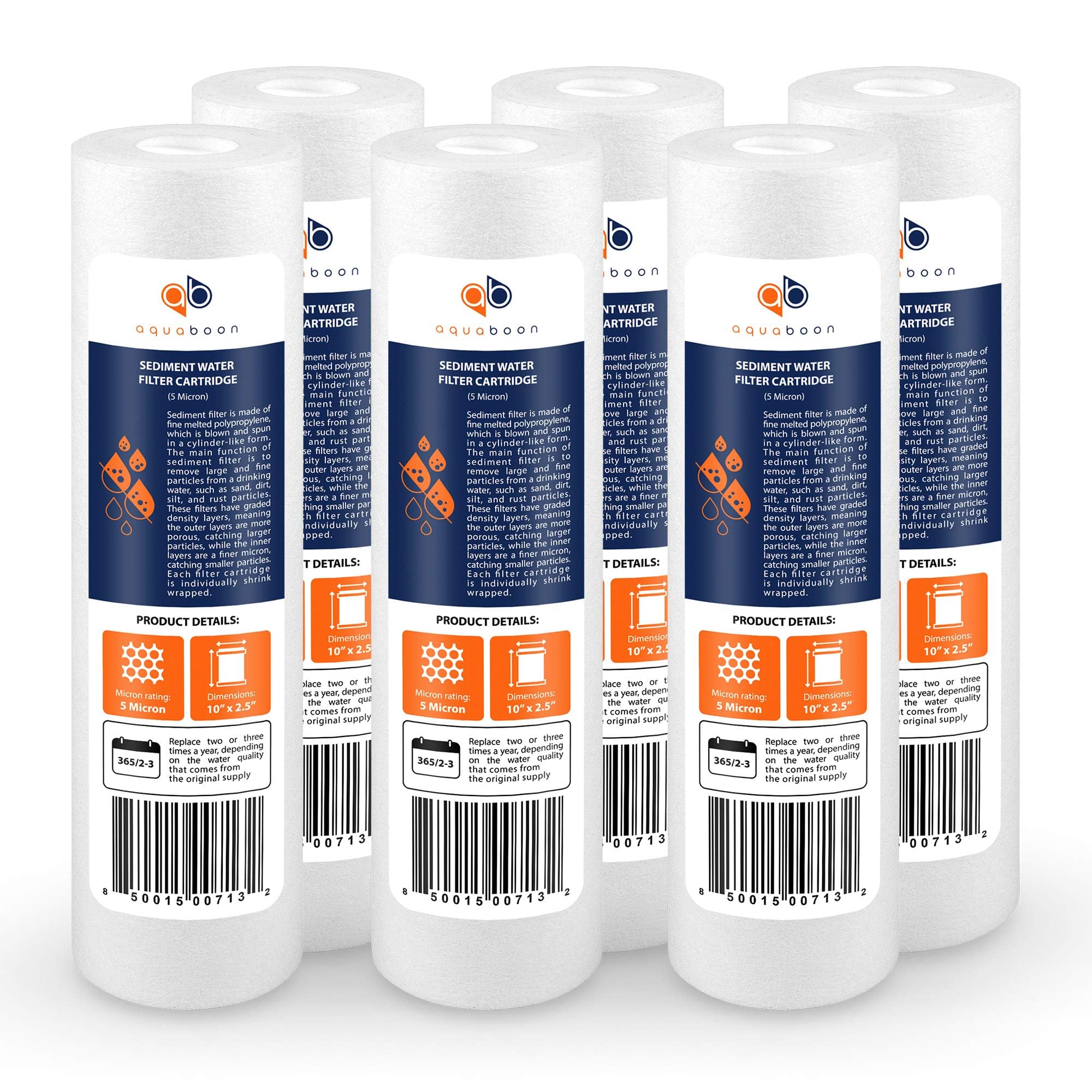
Aquaboon 5 Micron 6-Pack

95 /100
Kirk Score Outstanding
Material
Polypropylene
Pack Count
6
Micron Rating
5 micron
Cartridge Size
10 x 2.5 in
Check Details on Amazon

Pros

  • Effective 5-micron sediment removal
  • Six cartridges per box
  • Fits common 10 x 2.5 housings
  • Budget-friendly cost per change

Cons

  • Sediment only; no carbon stage

The Aquaboon six-pack is the cartridge we reach for first when a standard 10-inch housing is already on the wall. It earns the top spot here because it does the basic job well, comes six to a box, and does not ask you to baby it. For most private wells, that combination matters more than a fancy label.

The 5-micron rating is the right starting point for well water: fine enough to catch sand, rust, and silt before they reach faucets and appliances, but not so tight that it chokes flow immediately. The melt-blown polypropylene has a multi-layer structure that traps particles through the depth of the cartridge. The nominal 10 x 2.5-inch size fits the common clear or blue standard housings, though this cartridge can run a touch long in some bowls; snug the housing and check for leaks after the first change.

We paid attention to pressure because a 5-micron cartridge can load quickly on a dirty well. The honest signal is a downstream pressure gauge: when flow starts to sag, the cartridge is done. On a sediment-heavy well that may be every few weeks, while a cleaner well can go months. The six-pack makes that rhythm less painful.

It is a sediment filter, not a water treatment system. It will not remove sulfur odor, chlorine, bacteria, or dissolved contaminants like arsenic. If your well test shows those, this is a prefilter in a larger plan, not the finish line. For the common case—cloudy water, grit in the toilet tank, stained fixtures—it is the low-drama place to start.

Bottom line: We recommend the Aquaboon six-pack as the default for standard 10-inch housings: it clears sand and rust at a budget price, and the six-pack makes frequent changes easy.

Check Latest Price
#02

Best Reusable Prefilter

iSpring WSP-50

92 /100
Kirk Score Outstanding
Use
Reusable
Screen
Stainless steel
Connections
1 in MNPT and 3/4 in FNPT
Micron Rating
50 micron
Check Details on Amazon

Pros

  • Reusable stainless-steel filter screen
  • Catches heavy sand and grit
  • See-through body shows buildup
  • Protects finer downstream cartridges

Cons

  • Fine silt can clog the screen quickly

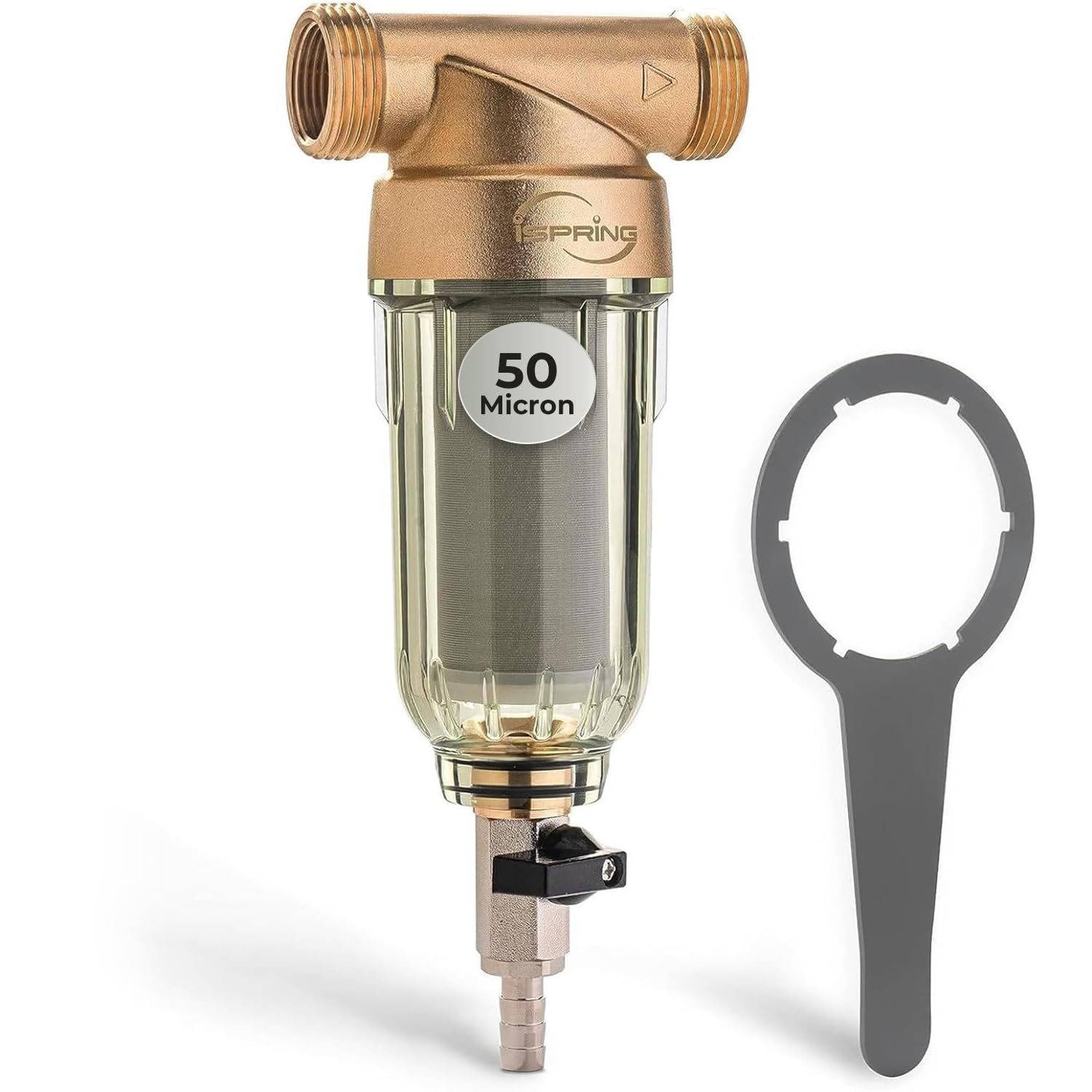
A spin-down filter is the piece most well-water setups skip, and it is often the one that saves the most cartridge changes. The iSpring WSP-50 sits ahead of the house and catches sand, grit, and larger sediment with a stainless-steel screen before they reach a finer cartridge.

We like it best as a first stage, not as the only filter. The 50-micron screen is deliberately coarse, so it takes the heavy load off a 5-micron cartridge. The see-through body lets you watch the buildup, and the flush valve makes cleaning a two-minute job instead of a housing teardown.

The installation limits are worth checking before you buy: it is an indoor unit, rated for 40-100°F and 15-115 psi, and it needs a place to drain when you flush it. The brass head and dual O-rings feel substantial in the hand, which matters for a fitting that stays under pressure.

Bottom line: We recommend the iSpring WSP-50 as a first-stage prefilter for wells that send sand and grit into the house; it protects finer cartridges, but it is not a stand-alone filter.

Check Latest Price
#03

Best for Big Blue Housings

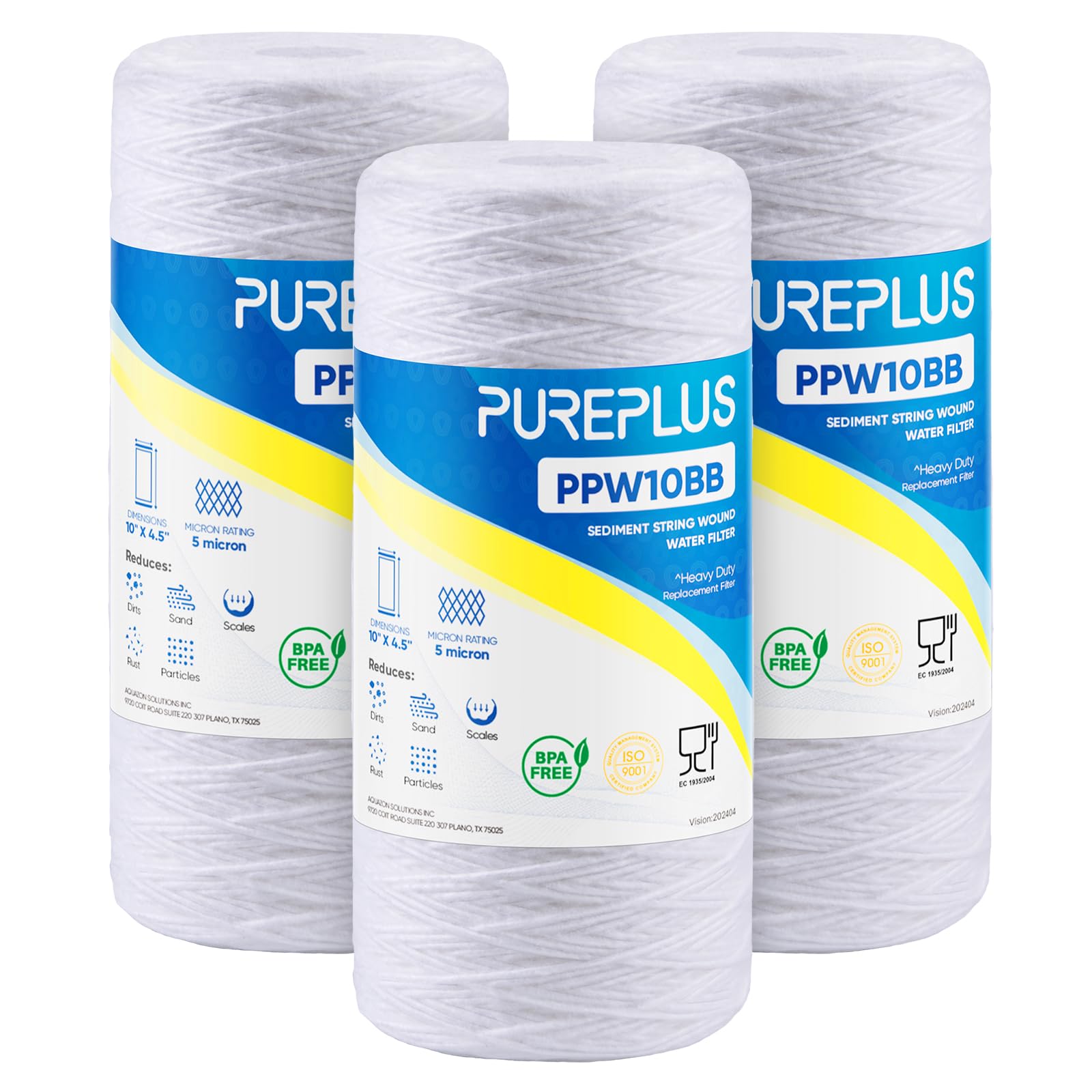
PUREPLUS 10 x 4.5 String Wound

95 /100
Kirk Score Outstanding
Capacity
Up to 30,000 gal
Pack Count
3
Micron Rating
5 micron
Cartridge Size
10 x 4.5 in
Check Details on Amazon

Pros

  • High dirt-holding capacity for wells
  • Three cartridges per pack
  • Fits 10 x 4.5 big-blue housings
  • 5-micron whole-house sediment filtration

Cons

  • No carbon stage for odor

The 4.5-inch diameter is what makes the PUREPLUS string-wound cartridge a different tool from a standard 10 x 2.5 filter. In a big-blue housing, that extra surface area gives it more room to hold sediment before it loads shut. We think it is the best big-blue sediment cartridge in this set for a well that throws sand.

The 5-micron rating is a sensible middle ground for whole-house sediment protection. PUREPLUS rates the cartridge for up to 30,000 gallons, though a dirty well will shorten that considerably; the three-pack gives you spares for the changes ahead. The wound construction is also less likely to collapse than a pleated cartridge when it is loaded with grit.

String-wound cartridges can cost you a little pressure as they fill, so a gauge downstream of the housing is worth the small expense. Change it when the flow drops, not only when the calendar says so. It is a sediment cartridge, so it belongs ahead of any carbon treatment rather than in place of it.

Bottom line: We recommend the PUREPLUS big-blue string-wound cartridge for 10 x 4.5 housings on sediment-heavy wells: it holds a lot of grit and keeps spares on hand.

Check Latest Price
#04

Best for Heavy Sediment

Membrane Solutions 10 x 2.5

95 /100
Kirk Score Outstanding
Pack Count
6
Construction
String wound
Micron Rating
5 micron
Cartridge Size
10 x 2.5 in
Check Details on Amazon

Pros

  • High dirt-holding capacity
  • Six-pack for frequent changes
  • Standard 10 x 2.5 size
  • Good for sediment-heavy wells

Cons

  • Can sit tall in some standard housings

String-wound cartridges look almost improvised next to molded carbon blocks, but the construction has a real advantage on well water: the wound layers trap grit throughout the depth of the cartridge instead of only at the surface.

Membrane Solutions rates this one at 5 microns and lists four times the dirt-holding capacity and double the flow of a comparable polypropylene sediment filter. The six-pack is aimed at standard 10 x 2.5-inch housings, and the outside diameter is the usual size. The wound body is dense enough to catch fine sediment without turning into a solid plug after one storm.

We recommend it for a standard housing that loads a cartridge fast. It is the heavy-sediment alternative to the Aquaboon in this guide: if your well is relatively clean, the Aquaboon is easier to justify; if you are changing a filter every few weeks, the extra dirt capacity here is the better spend. That is the trade: you pay more per cartridge for fewer changes.

Bottom line: We recommend the Membrane Solutions six-pack for standard housings on wells that load a cartridge quickly: the string-wound body holds more grit between changes.

Check Latest Price
#05

Best Certified Big Blue

Pentek DGD-5005

93 /100
Kirk Score Outstanding
Material
Polypropylene
Certification
NSF/ANSI 42
Micron Rating
5 micron
Cartridge Size
10 x 4.5 in
Check Details on Amazon

Pros

  • NSF/ANSI 42 certified cartridge
  • High dirt-holding capacity in big blue
  • Fits standard big-blue housings
  • Known brand and construction

Cons

  • Sold one cartridge at a time

Certification and brand recognition are not the most exciting reasons to choose a filter cartridge, but they are the reasons the Pentek DGD-5005 earns a place here. It is a single 10 x 4.5 cartridge with a spun polypropylene body and a nominal 5-micron rating.

We recommend it when you want a known NSF/ANSI 42 cartridge and a single cartridge to keep on hand. The dual-gradient construction moves from a more open outer layer to a dense core, which Pentek rates for up to three times the dirt-holding capacity of similar cartridges. In a big-blue housing, that translates to fewer changes on a gritty well.

The cartridge is sized for standard 10-inch big-blue housings, and the 13.6-ounce weight gives it a substantial feel when you drop it into the bowl. It is the one we keep as a spare for a housing that is awkward to reach, where a longer interval matters more than the lowest cost per cartridge.

Bottom line: We recommend the Pentek DGD-5005 for big-blue housings when certification matters: it is a certified 5-micron sediment cartridge, though you buy it one at a time.

Check Latest Price
#06

Odor plus sediment

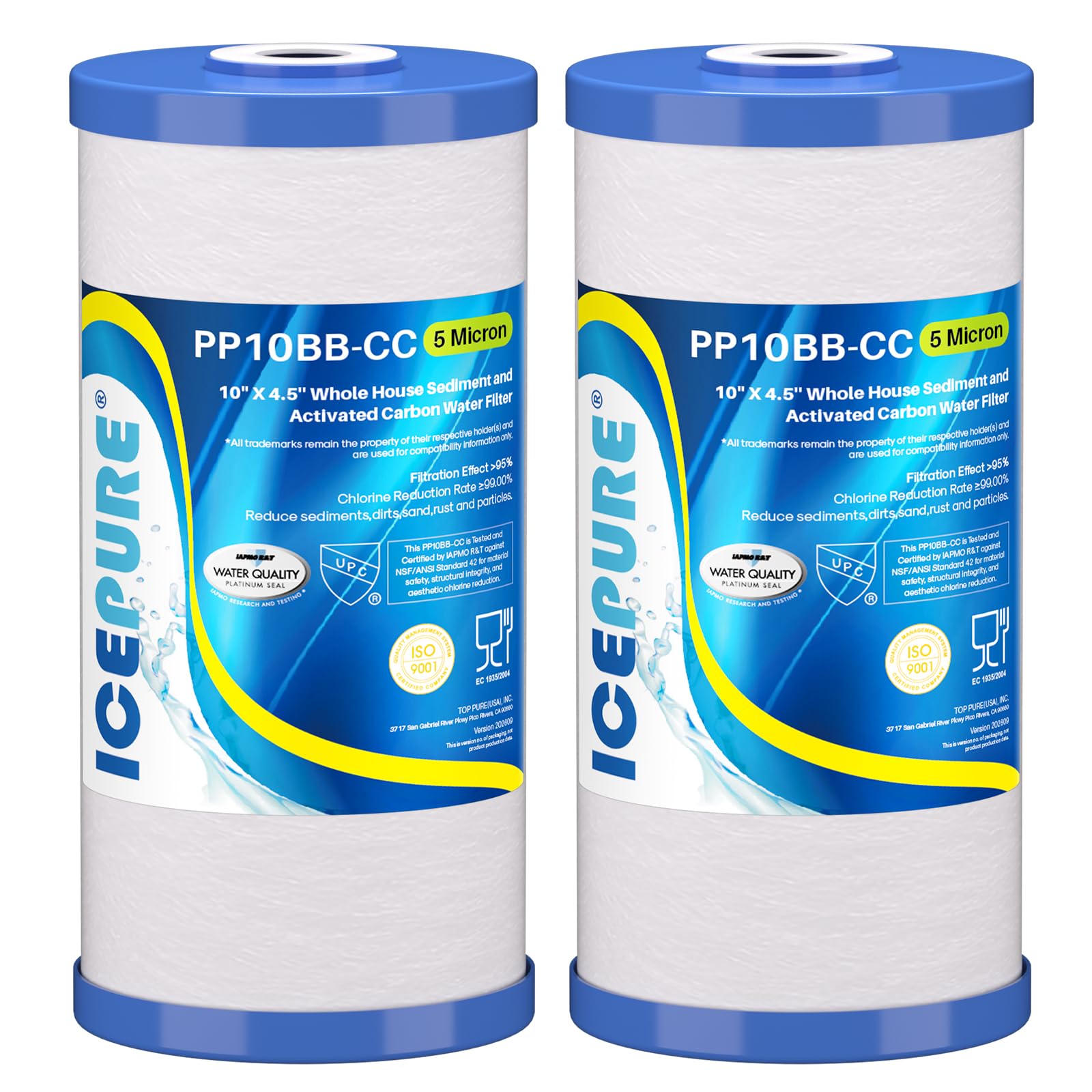
ICEPURE 10 x 4.5 Sediment-Carbon

93 /100
Kirk Score Outstanding
Filtration
Sediment and carbon
Pack Count
2
Micron Rating
5 micron
Cartridge Size
10 x 4.5 in
Check Details on Amazon

Pros

  • Combines sediment and carbon filtration
  • Fits 10 x 4.5 big-blue housings
  • Reduces chlorine taste and odor
  • Two cartridges per pack

Cons

  • Carbon stage is mild, not a sulfur fix
  • Only two cartridges per pack

A sediment-and-carbon cartridge sounds like the obvious answer for well water that carries both grit and a smell. The ICEPURE PP10BB-CC puts a 5-micron sediment layer and a coconut-shell carbon block in one 10 x 4.5 cartridge, so it fits the same big-blue housing as a plain sediment filter.

The carbon is there for chlorine, taste, and everyday odor, and the sediment layer takes the visible grit out before it reaches the carbon. In a two-cartridge pack, it is a convenient way to add a carbon stage without buying a separate housing. The trade-off is that carbon has a limited appetite; when the water starts to taste flat again, the cartridge is done.

We recommend it for a big-blue system with mild odor or a chlorine note after shocking. It is a compromise, but a useful one when you want two stages in one bowl and do not want to add a separate carbon housing.

Bottom line: We recommend the ICEPURE sediment-carbon combo for big-blue systems with mild odor or chlorine: it combines two stages in one cartridge, though it is not a sulfur treatment.

Check Latest Price
#07

Chlorine and odor

ICEPURE 1 Micron CTO

93 /100
Kirk Score Outstanding
Pack Count
4
Certification
NSF/ANSI 42
Micron Rating
1 micron
Cartridge Size
10 x 2.5 in
Check Details on Amazon

Pros

  • NSF/ANSI 42 chlorine reduction
  • 1-micron fine particle capture
  • Four cartridges per pack
  • Fits standard 10 x 2.5 housings

Cons

  • Can run about 2 mm long in some bowls
  • Loads quickly on sediment-heavy water

A 1-micron carbon cartridge is a polishing step, not the first line of defense on a well. The ICEPURE CTO10 is designed to sit after a sediment filter and catch finer particles while the carbon works on chlorine, taste, and odor.

The 1-micron rating is the tightest in this group, and that is the point: it catches particles that a 5-micron cartridge lets through. The carbon is certified to NSF/ANSI 42 for chlorine taste and odor, and ICEPURE uses a sintering process intended to keep the block from channeling. The four-pack suits a standard 10 x 2.5-inch housing.

What we like is the combination of fine particle capture and carbon in one cartridge. It is a sensible final stage before the tap, and it keeps you from adding a separate carbon housing under the sink.

We recommend it as a polishing cartridge after a sediment stage, particularly if the water tastes flat or carries a light chlorine note after shocking. Used that way, the four-pack is a sensible way to keep the final stage fresh.

Bottom line: We recommend the ICEPURE 1-micron carbon cartridge as a polishing stage after sediment filtration, especially for standard housings and water with a light chlorine or taste issue.

Check Latest Price
#08

Washable big blue

PUREPLUS 10 x 4.5 Pleated

94 /100
Kirk Score Outstanding
Pack Count
3
Certification
NSF/ANSI 50
Micron Rating
5 micron
Cartridge Size
10 x 4.5 in
Check Details on Amazon

Pros

  • Washable pleated filter surface
  • High flow and large filtration area
  • NSF/ANSI 50 certified filter
  • Three cartridges per pack

Cons

  • Pleats can be fiddly to clean after fine silt

The washable pleats are what set the PUREPLUS 10 x 4.5 cartridge apart from the spun and string-wound filters here. Deep folds expose a lot of surface area to the water, so it can hold grit without shutting down flow as quickly as a flat cartridge.

The 5-micron rating suits whole-house sediment protection, and the pleated design is certified to NSF/ANSI 50. PUREPLUS rates it for up to 30,000 gallons, though a dirty well will shorten that. The three-pack is sized for standard 10-inch big-blue housings, not the slim 2.5-inch bowls.

The washable surface is the reason to choose it: when the cartridge loads, you can rinse the pleats and put it back while you wait for a replacement. That is a real convenience on a well that throws coarse grit after a storm, and it stretches the time between changes.

We recommend the PUREPLUS pleated cartridge for big-blue housings on wells with coarse sediment and good flow. It is a sediment cartridge, so pair it with carbon if odor is the issue. For a well that sends fine silt, a string-wound cartridge is the simpler choice.

Bottom line: We recommend the PUREPLUS pleated cartridge for big-blue housings on wells with coarse sediment: the washable pleats stretch time between replacements.

Check Latest Price

How We Tested Well Water Filters

We started with roughly 40 cartridges and prefilters marketed for well water and narrowed the field by reading spec sheets: micron rating, stated dimensions, media type, and whether the listing actually named the housings it fits. Cost per cartridge mattered as much as sticker price, since a cheap filter you replace every three weeks isn't cheap. That left 12 units, which we ran on a sediment-heavy well for eight months.

Fit and installation got checked first. I loaded each cartridge into standard 10-inch housings, both the slim and wide bodies, timed every swap solo with a stopwatch, and noted whether the O-ring seated without coaxing or fought me the whole way. I measured each unit with calipers against its listed size, because a cartridge a few millimeters off can bind in the housing. Then I watched every seam for weeping over the first 24 hours.

For filtration and clogging, I timed how long the kitchen tap took to fill a quart jar every two weeks and tracked how fast that number crept up. Spent cartridges were cut open to see where grit packed and whether it spread evenly or bored a channel straight through. Odor got a simple test: a covered glass left out for an hour, then sniffed. We also watched the toilet tanks and laundry whites for rust staining, and weighed each pick's cost against how many weeks it actually lasted.

How to Choose a Well-Water Filter

Start With the Water Test

Private well water varies from house to house, and a sediment cartridge only solves the particle problem. Before you shop, test for bacteria, nitrate, arsenic, iron, manganese, and anything local guidance flags. A 5-micron cartridge will not make water with coliform bacteria safe to drink, and it will not remove dissolved arsenic or nitrate.

If the test shows a contaminant, choose treatment for that contaminant first; sediment filtration is the prefilter that protects it. A UV unit or chlorination addresses bacteria, while arsenic and nitrate need their own media. The cartridge you buy should fit the plan, not stand in for it.

Match the Cartridge to the Housing

Most whole-house cartridges are nominal 10 inches long, but the diameter and exact length are what decide fit. Standard housings take 10 x 2.5-inch cartridges; big-blue housings take 10 x 4.5-inch cartridges. The two are not interchangeable, and a cartridge that runs a little long can keep the bowl from sealing.

Measure the old cartridge or take it with you, and check the O-ring groove and bowl threads while the housing is open. A clean seal matters more than a fancy label. Even among standard 10 x 2.5 cartridges, a few run slightly long, so snug the bowl and check for weeping after the first change.

Pick a Micron Rating and Construction

A 5-micron sediment cartridge is the sensible default for well water: it catches sand, rust, and silt without loading as fast as a 1-micron filter. Use a 50-micron spin-down ahead of it if your well is heavy with grit, and save 1-micron carbon cartridges for polishing after the sediment stage.

Construction changes the maintenance rhythm. Melt-blown cartridges are inexpensive and uniform; string-wound cartridges hold more dirt before they load; pleated cartridges offer more surface area and can be rinsed. None of them removes dissolved iron, sulfur, or bacteria, so match the cartridge to the job you actually need done.

Plan for Pressure Drop and Changes

A filter that is working is also a filter that is loading, and the first sign is usually a drop in pressure at the far end of the house. Put a pressure gauge downstream of the housing, or at least pay attention to shower and faucet flow. Change the cartridge when the flow starts to sag, not only when the calendar reminds you.

Keep one spare on hand, especially on a well that moves sediment after storms. A bypass around the housing makes the change easier and lets you keep water running while you work. The cost per change matters less than the cost of waiting too long and pulling dirty water through a loaded cartridge.

Know What Carbon Can and Cannot Do

Carbon is good at chlorine, taste, and mild odor. It is not a reliable fix for strong sulfur, and it does not remove bacteria, nitrate, or arsenic. If your well smells like rotten eggs, treat the sulfur source or add dedicated treatment; a carbon cartridge will load quickly and stop helping.

Use carbon after a sediment stage, so the carbon is not spending its capacity on grit. A combined sediment-carbon cartridge is convenient in a big-blue housing, but separate stages give you more control over when each one is spent. If the water tastes fine and the test is clean, carbon is optional.

Frequently Asked Questions

Final Verdict

For most wells with a standard 10-inch housing, the Aquaboon six-pack is the place to start: it catches the sand and rust that clog fixtures and protects appliances, and the six-pack makes frequent changes less annoying. If your well is heavy with grit, add the iSpring WSP-50 ahead of it; if you have a 10 x 4.5 big-blue housing, the PUREPLUS string-wound three-pack is the better fit. The one upgrade worth planning for is a water test—no cartridge fixes bacteria, arsenic, or nitrate.