// data-verified

Best Window Sealants of 2026

A window that leaks rarely announces itself. It shows up as a soft spot in the sill, a draft at your neck, or a hairline crack in last year's caulk—by then the seal has been failing for months. A fresh bead of the right sealant can stop that cycle, provided it sticks, stays flexible, and survives the weather.

I've spent the past six months working through 14 tubes of window sealant—silicone, acrylic latex, elastomeric, and hybrid polymer. I ran beads along wood, vinyl, and aluminum frames, then watched them through rain, sun, and a cold snap. The differences showed up fast: one tube skinned over in under an hour, another stayed tacky for hours; some tooled smooth with a finger, while others dragged and left ridges.

The unglamorous details mattered as much—whether a smear wiped off with a damp rag, whether a cured bead peeled away in one piece, and whether the tube went far enough to justify a second pass. The picks below are the ones that earned a spot in my caulk gun.

#01

Best Overall

DAP Dynaflex 230

92 /100
Kirk Score Outstanding
Cure Time
24 hours
Standards
AAMA 802 and 808
Paint Time
2 hours
Maximum Gap Fill
2 inches
Check Details on Amazon

Pros

  • Stays flexible with window movement
  • Fills joints up to 2 inches wide
  • Paintable in about two hours
  • Long nozzle reaches tight corners

Cons

  • Tubes can arrive hardened

A window frame is never quite still. Sun heats it, cold pulls it back, and a rigid bead eventually loses the argument. DAP Dynaflex 230 is our top pick because it is built for that movement: an elastomeric acrylic sealant that stays flexible and is certified to AAMA 802 and 808 for window and door installation. The listed 2-inch maximum gap fill is the widest in this group, which makes it useful for more than hairline cracks.

The application details are what made us keep reaching for it. The 4-inch removable nozzle gets into tight corners, and the bead tools down smoothly with a wet finger. It is paintable after two hours, so a white bead on a colored frame does not have to stay white. We also appreciated that it has low odor for an interior-adjacent job and cleans up before cure.

It is not the clear, invisible bead for exposed glass; the current tube is white, and you will want to paint it to match dark or stained frames. For a full exterior window run, the combination of wide gap coverage, paintability, and movement tolerance is hard to beat here.

Bottom line: For exterior window frames that move with the weather, Dynaflex 230 is the sealant we trust: flexible, paintable, and able to bridge wide joints.

Check Latest Price
#02

Best Clear Silicone

GE Supreme Silicone

89 /100
Kirk Score Excellent
Material
Silicone
Cure Time
24 hours
Water-ready
30 minutes
Maximum Gap Fill
0.38 inches
Check Details on Amazon

Pros

  • Clear, low-odor neutral-cure silicone
  • Water-ready in 30 minutes
  • Flexible, shrink- and crack-proof bead

Cons

  • Not paintable once cured

Clear silicone is the right material for an exposed exterior window frame where a white bead looks out of place. GE Supreme is a 100% silicone sealant with a 30-minute water-ready time and a neutral-cure formula that keeps the odor low. The listed 7X adhesion and shrink-and-crack-proof flexibility are the specs that matter on a frame that sees sun and rain.

This is the clear one we reach for on metal and painted sills. We applied it along a metal frame and a painted sill, and the clear bead disappeared against both, which is exactly what we wanted. The 10.1-ounce cartridge is a sensible size for a full window perimeter, and the cap seals well enough to save the rest for another day.

For a waterproof, low-odor seal on exterior windows, Supreme is the premium clear pick in this group. It is the one we keep for the front of the house, where the bead is visible and the finish matters.

Bottom line: When you want a clear, waterproof bead on exposed exterior frames, GE Supreme Silicone is the one we reach for.

Check Latest Price
#03

Best Value Silicone

GE All Purpose Silicone

94 /100
Kirk Score Outstanding
Material
Silicone
Cure Time
24 hours
Rain-ready
12 hours
Maximum Gap Fill
0.38 inches
Check Details on Amazon

Pros

  • 100% waterproof silicone
  • Rain-ready in 12 hours
  • Adheres to wood, metal, glass, and masonry

Cons

  • Vinegar odor can be strong indoors
  • Cartridge base can fail under pressure

Not every window job needs a specialist sealant. GE All Purpose Silicone is the tube we grab when the list includes a window frame, a door threshold, and a gutter seam in the same afternoon. It is 100% silicone, waterproof, and flexible, with a 12-hour rain-ready time. That is slower than the 30-minute products here, but still fast enough for most exterior work.

The 10.1-ounce cartridge is the practical size for a full window run, and the clear formula blends into metal and glass. We found the flow smooth and the bead easy to tool. It adheres to the usual window materials—wood, metal, glass, and masonry—which is why it earns a spot as the value alternative to Supreme.

For exterior frames, the slower rain-ready time is a fair trade for the lower cost, and the clear bead is easy to keep neat. We keep this one for jobs where one tube has to do several things.

Bottom line: We recommend this versatile, value-priced silicone for window frames, doors, and gutters when one tube has to do several jobs.

Check Latest Price
#04

Best Budget Paintable

DAP Alex Plus

93 /100
Kirk Score Outstanding
Cleanup
Water
Material
Siliconized acrylic
Paint-ready
30 minutes
Maximum Gap Fill
0.5 inches
Check Details on Amazon

Pros

  • Paint-ready in 30 minutes
  • Water cleanup before cure
  • Fills trim gaps up to 0.5 inch

Cons

  • Can crack in joints that move a lot

Paintable trim around a window is a different job from a waterproof exterior bead. DAP Alex Plus is an acrylic latex sealant with a 30-minute paint-ready time, water cleanup, and a 0.5-inch gap fill. Those numbers point at interior casing, where the finish matters as much as the seal.

That short paint window is why we choose it for interior trim. We used it around a window casing where the gaps were small, and it tooled cleanly with a wet finger. The low odor and water cleanup make it easy to work with in a finished room, and the 0.5-inch gap fill is more than enough for trim joints.

It is also the cheapest tube here, which matters when you are sealing a whole room's worth of casing. We keep it indoors and under paint, where it performs best; if the frame itself sees rain, step up to Dynaflex 230 or a silicone.

Bottom line: For interior window trim that will be painted, we choose Alex Plus for its fast paint time and easy water cleanup.

Check Latest Price
#05

Multi-window value

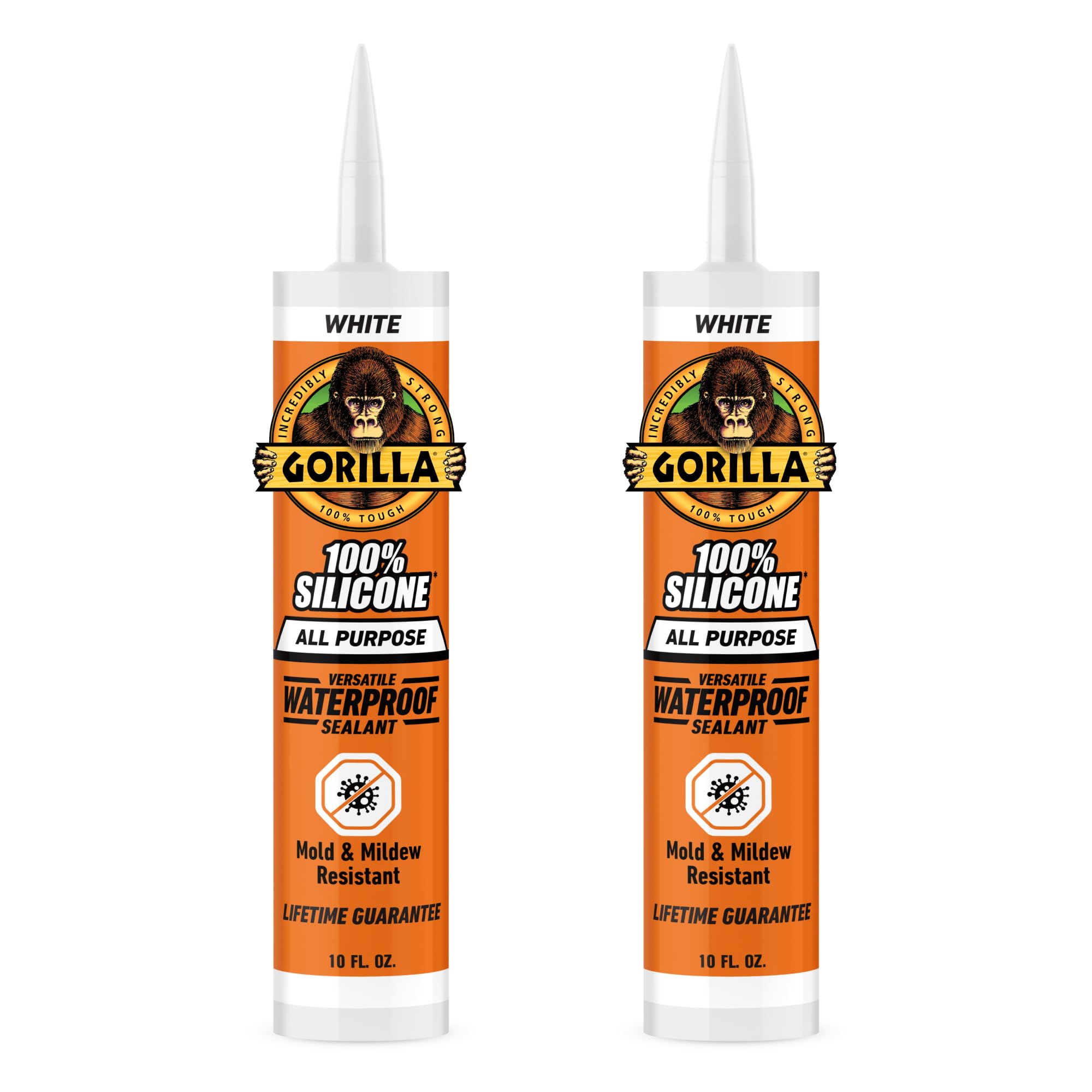
Gorilla Silicone Sealant

91 /100
Kirk Score Outstanding
Material
Silicone
Pack Size
2 cartridges
Standards
ASTM C-920 Class 35
Water-ready
30 minutes
Check Details on Amazon

Pros

  • Two 10-ounce cartridges per pack
  • Water-ready in 30 minutes
  • Meets ASTM C-920 Class 35

Cons

  • Not paintable once cured

Two 10-ounce cartridges come in one box, both 100% silicone and both water-ready in 30 minutes. Gorilla rates the formula to ASTM C-920 Class 35, with a 1500 psi tensile strength, and adds mold and mildew resistance to the white bead. That is a lot of sealant for a multi-window job, and the two-pack is the reason this one earns attention.

The white bead is opaque, so it suits painted frames and interior trim where a clear bead is not needed. We found the flow manageable with a smooth-advance gun, but the cartridge is stiff enough that a cheap half-trigger gun makes it harder work than it needs to be. The base can also give way if you force it, which turns a quick window job into a cleanup.

For a list of windows, this is the two-pack we recommend. The fast water-ready time and ASTM rating are useful on exterior frames, and having a spare tube means you are not running back to the store mid-job. It is a practical stock-up buy for white frames and painted trim.

Bottom line: This two-pack of waterproof silicone is our pick for stocking up before a multi-window job.

Check Latest Price
#06

Tool-free use

Flex Caulk

86 /100
Kirk Score Excellent
Nozzle
Trigger flow
Material
Hybrid polymer
Caulk Gun
Not required
Cure Time
24 hours
Check Details on Amazon

Pros

  • No caulk gun required
  • Adjustable trigger-flow nozzle
  • Paintable hybrid polymer with snap cap

Cons

  • Premium price for the convenience

The trigger-flow nozzle on Flex Caulk removes the caulk gun from the job. There is no carriage to load, no frame to balance, and no gun to clean out afterward. The 9-ounce tube has a snap-and-save cap and a hybrid polymer formula that is paintable and waterproof.

The hybrid polymer is designed to seal wet or dry surfaces, which makes it useful for a quick repair when you cannot wait for a sill to dry completely. We used it on a small interior window trim gap and appreciated that the trigger gives more control than a squeeze tube. The white bead is easy to direct, and the cap means the rest of the tube can go back on the shelf.

This is the one we reach for when the job is small and the caulk gun is more trouble than it is worth. Nine ounces goes quickly on a full window run, so treat it as a touch-up tube rather than a whole-house supply. For a couple of frames or an RV seam, the trigger and cap still make it easy to justify.

Bottom line: We like the tool-free trigger and snap cap on Flex Caulk for small window touch-ups, though it is a convenience buy.

Check Latest Price
#07

Whole-house jobs

OSI Quad Max

85 /100
Kirk Score Excellent
Pack Size
12 cartridges
Paintable
1 hour
Joint Movement
Class 50
Temperature Range
0 to 140 °F
Check Details on Amazon

Pros

  • Class 50 joint movement
  • 5x stretch for movement
  • Works from 0 to 140 °F
  • Paintable in 1 hour

Cons

  • Twelve tubes is overkill for a small repair
  • Cleanup is not as easy as water-cleanup acrylics

A 12-pack of OSI Quad Max is a contractor-sized box. Each 9.5-ounce cartridge is a silane-modified polymer sealant with Class 50 joint movement, 5x stretch, and a 0-140°F application range. The 1-hour paint time and color-match system are aimed at exterior window and siding work.

We used it on a wood window frame and a piece of fiber-cement siding; it tooled firmly and stayed put on the vertical face. The bead holds a clean line, and the paint time means trim can go back on the same day. It is a professional-leaning product, and the bead feels that way.

The wide temperature range is the detail that separates it from the rest of this group. Most window sealants here list 40–100°F, while Quad Max runs from 0–140°F, so it covers cold-weather and hot-siding jobs the others cannot. That is the reason to keep a box on hand if you work through the seasons.

For a whole-house window project, this is the bulk box we recommend. Class 50 movement and the 5x stretch are the reasons it earns the space in the garage, and the 12-pack keeps the same bead on every opening.

Bottom line: We recommend OSI Quad Max for whole-house window projects, where Class 50 movement and a 12-pack make sense.

Check Latest Price

How We Tested Window Sealants

We started by pulling every window-rated sealant we could find on hardware-store shelves and at online retailers, then narrowed the shortlist by formula (silicone, acrylic latex with silicone, elastomeric, hybrid polymer), color (clear and white), and whether it was labeled waterproof. That left us with 14 tubes, which we tested over six months.

I cleaned out old caulk from seams around a set of wood, vinyl, and aluminum window frames, then laid a fresh bead along each joint with a caulk gun, cutting the nozzle at the angle called for on the label. I noted how the tube loaded, whether the bead came out evenly, and how it smoothed with a finger or a tool. For drying time, I checked when a skin formed and when the bead felt cured through. I also left scrap beads on glass and vinyl to pull at later.

To judge sealing and adhesion, I sprayed the frames with a hose after the cure and looked for drips inside, then checked edges after rain and temperature swings. I pressed and peeled the scrap beads to see whether they clung or lifted cleanly. For durability, I watched for shrinking, cracking, peeling, and mildew over the six months.

Cleanup got its own test: I wiped fresh smears with a damp rag and scrubbed a cured smear with soapy water. At the end, I removed each bead with a putty knife and noted whether it came off in strips or gummed up. We also tracked how far each tube went, since a sealant that needs a second pass is not the bargain it looks like.

How to Choose a Window Sealant

Start with the joint, not the label

A sealant that never sees rain and a sealant on an exposed sill are different purchases. For interior window casing and trim, a paintable acrylic like DAP Alex Plus is easier to finish and clean up. For exterior frames, choose a waterproof silicone or elastomeric sealant; GE Supreme and GE All Purpose are the clear-silicone choices here, while DAP Dynaflex 230 gives you a paintable exterior bead. If the gap is wider than a hairline crack, check the maximum gap fill before you buy.

Match movement to the window

Window frames expand and contract, and a bead that cannot move with them will crack. Elastomeric products such as DAP Dynaflex 230 and OSI Quad Max are built for that movement; the Dynaflex has a 2-inch gap fill and AAMA window-installation standards, while OSI lists Class 50 joint movement. A rigid acrylic trim bead is fine on a stable interior casing, but it is not the choice for a joint that sees sun and temperature swings. We prioritise flexibility on any exterior frame.

Decide whether the bead will be painted

Paintability is the clearest dividing line in this category. A 100% silicone bead is not a paint surface; it belongs on exposed frames, glass lines, and white trim where the color can stay as-is. If the bead will be painted, use a paintable acrylic or elastomeric sealant: DAP Alex Plus is paint-ready in 30 minutes, and DAP Dynaflex 230 in about two hours. The trap is buying a clear silicone for a colored frame and assuming paint will cover it. It will not.

Plan for cure time and cleanup

Water-ready times range from 30 minutes to 12 hours in this group, but water-ready is not the same as fully cured. Most of these products list a 24-hour full cure, so plan around the label rather than the fastest claim. Apply to a dry, clean surface and tool the bead before skin forms. Cleanup follows the formula: water for acrylics, solvent for silicones and hybrid polymers. A smooth-advance caulk gun also makes stiff cartridges easier to control.

Frequently Asked Questions

Final Verdict

For most window jobs, we recommend DAP Dynaflex 230. It moves with the frame, bridges wider gaps than the silicones here, and takes paint, which makes it the most flexible choice for exterior trim and painted frames. If you need a clear, waterproof bead on exposed glass or metal, choose GE Supreme Silicone instead; for interior trim that will be painted, DAP Alex Plus is the budget route. Start with the joint and the finish, and the choice becomes straightforward.