// data-verified

Best Ratcheting Wrench Sets of 2026

There's a bolt in every engine bay that only turns a quarter of the way before something blocks the handle — which is why ratcheting wrenches exist. The gear in the box end grabs and releases in a few degrees instead of a full swing, so you can snug a nut where a standard combination wrench simply won't fit. But a mechanism that skips under load, or a flex head that drops at the wrong moment, rounds a fastener faster than the old wrench did.

We've spent six months with 12 sets — garages, driveways, one patient living room — on brake calipers, bike stems, flat-pack furniture, and a water pump that fought back. Tooth count is the number every listing leads with, but coverage is what keeps a set in your hands: one that jumps from 15mm to 17mm ends up back in the drawer no matter how smooth the ratchet feels.

Grip and storage matter more than they sound, too — a wrench that goes slick in oily hands, or disappears into an overstuffed pouch, is one you stop reaching for. The sets below are the ones that didn't.

#01

Best Overall

GEARWRENCH 35720 20-Piece Set

96 /100
Kirk Score Outstanding
Weight
5.5 lb
Box End
12-point, pass-thru
Swing Arc
5° (72 teeth)
Size Coverage
SAE 1/4–3/4 in, metric 6–18 mm
Check Details on Amazon

Pros

  • Covers SAE and metric in one 20-piece set
  • 5-degree arc from a 72-tooth box end
  • Pass-thru head works down long threaded rod
  • Thin head and beam reach confined areas

Cons

  • No case or roll included

Half the fasteners on a modern car are metric and the other half are whatever the parts supplier had that day, which is why a set covering both standards earns the default spot. GearWrench's 35720 gives you twenty wrenches — ten SAE from 1/4 to 3/4 inch, ten metric from 6 to 18 mm — and we think that breadth is worth more than any single feature on this list.

What sits underneath the coverage is a good ratchet. The 72-tooth box end needs 5 degrees of swing, which is the difference between moving a nut and not moving it when there's a bracket two inches away. The head and beam are slim, and the pass-thru box end slides down any length of threaded rod, so a nut buried on a long stud turns into a job rather than a saga.

Off-corner loading is the other design detail we appreciate. The 12-point box end grips the flats of a fastener rather than its corners, which matters on the second or third removal, when the corners have already started to round. The polished finish wipes down easily and the sizes are stamped at both ends of the beam, so identifying one in a drawer takes a glance rather than a lens.

The ratchet is the part that decides how long any of these lasts, and a 3/4-inch box end asked to crack a rusted bolt is doing work no ratcheting mechanism was designed for. Break the fastener loose with a plain wrench or a breaker bar first, then let the ratchet run the thread; that habit is worth more than any warranty claim.

Bottom line: We recommend this set to anyone whose work crosses both fastener standards — twenty wrenches, a 5-degree arc, and a pass-thru box end make it the most useful default here.

Check Latest Price
#02

Best for Tight Spaces

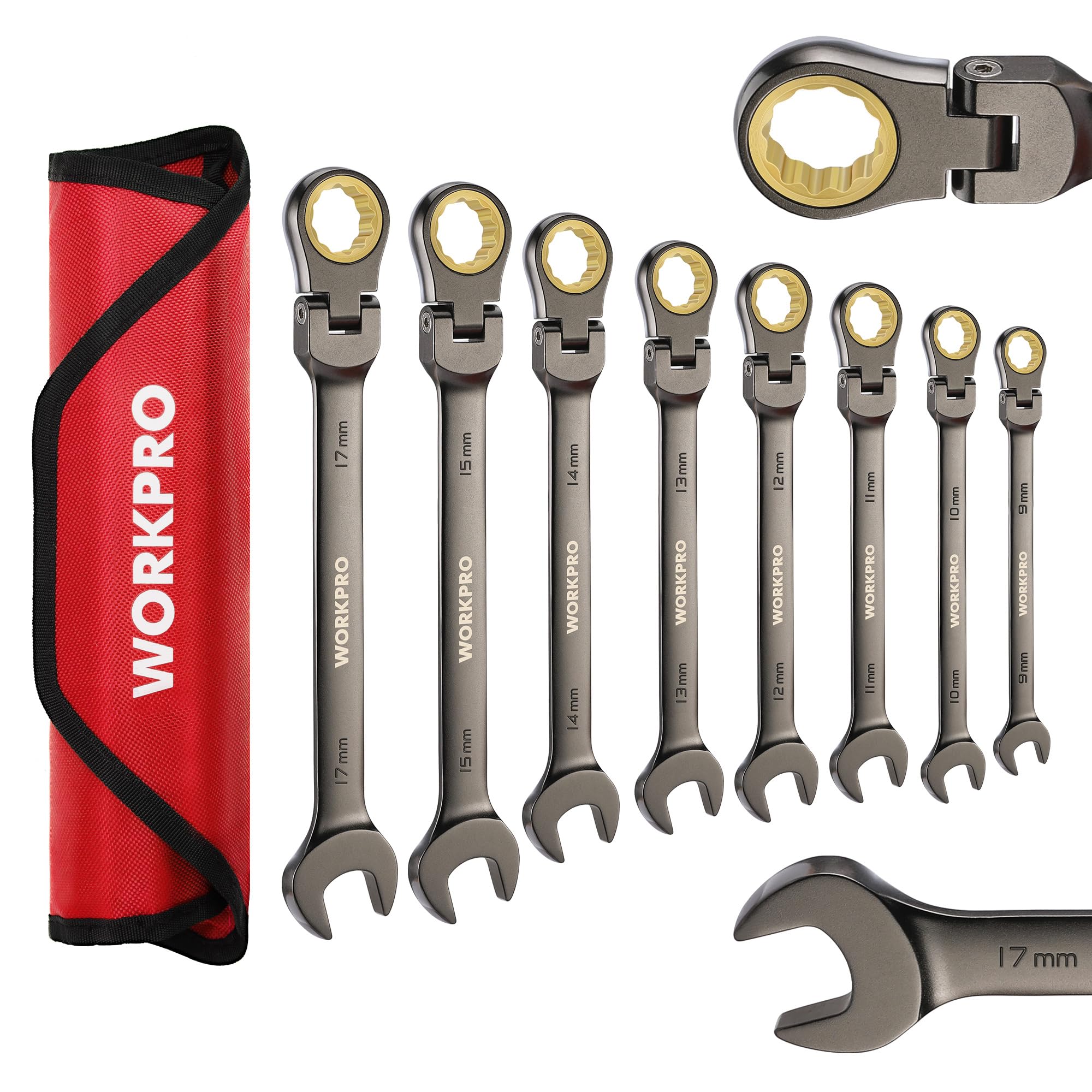
WORKPRO 8-Piece Flex-Head Set

95 /100
Kirk Score Outstanding
Head
180° flex
Weight
2.3 lb
Swing Arc
5° (72 teeth)
Size Coverage
Metric 9–17 mm
Check Details on Amazon

Pros

  • 180-degree flex head clears obstructions
  • 5-degree swing arc from 72 teeth
  • Light enough to hang on a pegboard

Cons

  • Metric only, 9 to 17 mm

A head that pivots through 180 degrees is only worth having if it goes where you point it, so the joint is the first thing we look at on a flex-head set. This one moves freely rather than clicking into set angles, and that single fact shapes everything the set is good at.

Angle the head up and your knuckles stay clear of a manifold, a firewall, or whatever else is crowding the bolt, and the 72-tooth box end inside still gives you a 5-degree arc once you're seated. We found ourselves reaching for it on hose clamps and bracket bolts where a straight wrench would have meant fetching the socket set instead.

What it gives up is control. A head that swivels without locking can roll off the flats mid-swing, so on anything blind or overhead we seat the box end with one hand and turn with the other. The nickel plating on ours has taken knocks without flaking, and at 2.3 pounds the whole set hangs on a hook without pulling the pegboard out. The pouch is an organization bag rather than a case, which is fine in a drawer and thin protection in a toolbox.

Bottom line: This is the set we reach for when a fastener is buried behind something sharp — the flex head buys access the straight sets here can't match, as long as you can live with a joint that swings freely.

Check Latest Price
#03

Best Metric and SAE Value

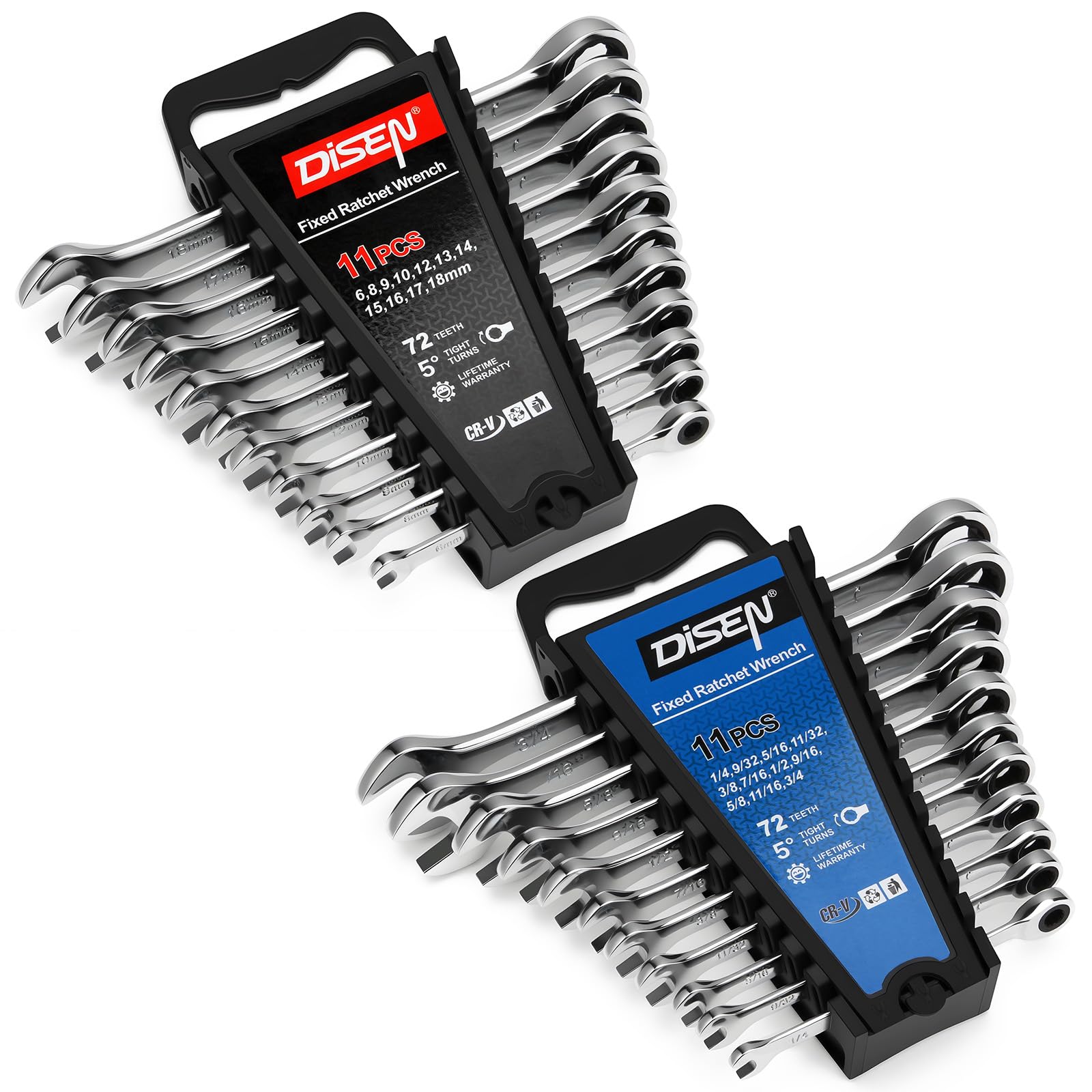
DISEN 22-Piece Set

93 /100
Kirk Score Outstanding
Box End
12-point
Swing Arc
5° (72 teeth)
Size Coverage
Metric 6–18 mm, SAE 1/4–3/4 in
Stated Torque
120 N m
Check Details on Amazon

Pros

  • 22 wrenches across metric and SAE
  • 72-tooth box end with a 5-degree arc
  • Size printed at every slot in the roll
  • Stated 120 N m torque rating

Cons

  • No reversing lever
  • Fabric roll only, no hard case

Eleven metric wrenches from 6 to 18 mm, eleven SAE from 1/4 to 3/4 inch, every one of them a combination wrench with an open end and a ratcheting box end. That's the coverage most households actually need, and it arrives in a roll with the size printed beside every slot.

We think this is the best value in the group. You get the same 72-tooth, 5-degree box end that defines the category, a stated 120 N m torque rating, and a 12-point box end cut squarely enough to sit flat on a nut instead of rocking on it. Nothing here feels like a shortcut taken to hit a number.

The mirror polish looks sharp and wipes down easily, though it's also slick, so a greasy hand has less to hold onto than with a matte beam. Both ends are finished cleanly and the open jaws sit flat against a fastener without the rock you get on cheaper stampings — useful, because the open end is what you grab when a bolt is too tight for the ratchet.

Sizing is where any set like this can let you down, so match the wrench to the nut rather than to its slot: the stamped number is what counts, and a box end that feels loose on a fastener is the wrong size no matter what the pouch says. The fabric roll keeps the wrenches from rubbing each other on the shelf, and it takes up about as much room as a folded towel.

Bottom line: If you want one roll that handles whatever the last homeowner left behind, this is the set we'd point you to — full metric and SAE coverage at midrange money, without a reversing lever.

Check Latest Price
#04

Best for Stubborn Bolts

WORKPRO 10-Piece Extra-Long Set

94 /100
Kirk Score Outstanding
Weight
6.26 lb
Swing Arc
5° (72 teeth)
Size Coverage
Metric 8–19 mm
Longest Wrench
19.69 in
Check Details on Amazon

Pros

  • 19.69-inch longest wrench for leverage
  • Anti-slip box teeth grip rounded fasteners
  • Ten metric sizes from 8 to 19 mm
  • Sizes marked on a roll pouch

Cons

  • Metric only, 8 to 19 mm
  • No open end anywhere in the set

The longest wrench in this set is listed at 19.69 inches, and that number is the entire reason to own it. A rusted caliper bracket bolt that shrugs off a standard-length wrench comes free with a long handle and steady pressure, and we reached for this set every time something needed persuading rather than finessing.

Both ends are box ends, sized differently, and both carry the anti-slip tooth pattern that bites into a fastener with rounded shoulders. The 72-tooth gear holds the swing arc to 5 degrees even with all that handle behind it, and the black electrophoretic coating on ours has stayed put through a season of brake work, which is more than we expected from a finish that isn't chrome.

Long handles bring their own discipline. A ratcheting box end is not a breaker bar, so crack the fastener with a steady push and keep the ratchet for running the thread out. The set rolls into a heavy-duty pouch with the sizes marked and a hanging rope, and at 2.84 kilograms it's something you carry to a job deliberately rather than tuck in a pocket.

Bottom line: This is the set for the bolt that won't move: nearly twenty inches of handle and anti-slip box teeth do what a standard wrench can't, and metric-only coverage is the price of admission.

Check Latest Price
#05

Best for Pros

MOUNTAIN RM6 5-Piece Set

95 /100
Kirk Score Outstanding
Length
12 in
Box End
Universal spline, double box
Reversing
Lever on body
Swing Arc
4° (90 teeth)
Check Details on Amazon

Pros

  • 90-tooth ratchet needs only 4 degrees
  • Spline heads fit 6-point, 12-point, Torx
  • Reversing lever changes direction in place
  • Extra-long body reaches past obstructions

Cons

  • Premium price for five wrenches
  • Metric only, five sizes

Five double-box wrenches for more than most twenty-piece sets here cost takes some justifying. The justification is a 90-tooth ratchet that needs 4 degrees of swing, the tightest arc in this group and about as little room as a hand tool can ask for.

The spline ends are the other half of the argument. They grip 6-point, 12-point, Torx, square and half-rounded fasteners, so instead of hunting for the right style of wrench you grab the nearest size that fits. Both ends ratchet, and a lever on the body reverses direction without pulling the head off the nut — on a 12-inch wrench buried behind an engine mount, that's worth a great deal.

For a technician working flat rate, the extra cost buys real time. A bolt you can only reach with a quarter-inch of handle travel is a bolt you cannot turn with a 5-degree wrench at all, and the offset heads on these reach past obstructions that stop a straight combination wrench. For weekend work, most of that capability sits unused.

The smallest spline heads are the ones to watch. A spline bites into a fastener that's already rounded, and on a small, soft nut that bite can turn into a slip under load, so keep the tiny sizes for light duty and put a six-point box end on anything already chewed up. Nothing else here does what this set does in a gap that tight.

Bottom line: Five wrenches at a premium only makes sense if you're paid by the job — the 4-degree arc and spline heads get onto fasteners nothing else on this list can reach.

Check Latest Price
#06

Best Budget

DURATECH 5-Piece Double-Box Set

93 /100
Kirk Score Outstanding
Finish
Matte black electrophoresis
Offset
25°
Reversing
Lever at both ends
Size Coverage
SAE 1/4–7/8 in
Check Details on Amazon

Pros

  • Ten SAE sizes on five wrenches
  • Reversing lever at both ends
  • 25-degree offset clears obstructions
  • Off-corner loading protects fastener flats

Cons

  • No metric sizes
  • Soft roll, no hard case

Five wrenches, ten sizes. Each of these is a double-box wrench with a different size at each end, running from 1/4 inch up to 7/8 inch, and each end carries its own small reversing lever so you never pull the wrench off to change direction.

The 25-degree offset is what makes the design work. Tilt both ends away from the handle and you can clear a raised boss, a recessed fastener or a pipe without hunting for a wobble extension — the sort of thing you notice on the third plumbing job rather than the first. Off-corner loading on the 12-point rings keeps the grip on the flats instead of the corners.

The finish is a matte black electrophoresis coat, which doesn't show every scratch the way polished chrome does and gives a slightly tacky grip when your hands are damp. It's a working finish on a working tool rather than a showpiece, and it won't blind you under a work light.

At the bottom of the price range here, this is the set we'd put in the hands of someone who wants a ratcheting wrench for fence work, plumbing and general jobs and doesn't want to think about it again. Ten sizes on five wrenches also means about half the drawer space of a full combination set, which matters in a small garage.

Bottom line: For SAE work on a tight budget, this is the set we hand people — ten sizes on five reversible wrenches, and a 25-degree offset that gets past what a flat wrench can't.

Check Latest Price
#07

Light household jobs

Amazon Basics 5-Piece Flex-Head Set

91 /100
Kirk Score Outstanding
Head
180° flex
Finish
Chrome
Swing Arc
5° (72 teeth)
Size Coverage
8, 10, 13, 14, 17 mm
Check Details on Amazon

Pros

  • 180-degree flex head at the lowest cost here
  • 72-tooth ratchet with a 5-degree arc
  • Slim chrome beam wipes down easily

Cons

  • Five sizes leave gaps at 11, 12, 15 and 16 mm

Eight, 10, 13, 14 and 17 mm — five wrenches, each with a head that tilts through 180 degrees and a 72-tooth ratchet needing 5 degrees of swing. That's the specification list, and it's short in exactly the places you'd expect at the bottom of the market.

What you get is a genuinely useful flex head. Angle it up and your knuckles clear the obstacle; keep it straight and it behaves like an ordinary combination wrench. The chrome is bright and wipes clean with a rag, and the beam is slim enough to slip into a cramped engine bay or behind a radiator without scratching your hand on the way in.

We think of it as the set for the kitchen drawer — occasional jobs, light duty, and no great loss if it walks off to a friend's house. The pivot is the part to watch, because a flex head without a lock depends entirely on joint tension; keep a thumb on the head until it's seated and it stays predictable. A chair that needs tightening, a bike rack, a leaky tap fitting: that's this set's natural habitat.

Bottom line: A sensible first ratcheting wrench for light household work: the flex head and 5-degree ratchet do real work, and the short size run keeps the cost down.

Check Latest Price
#08

One-case organization

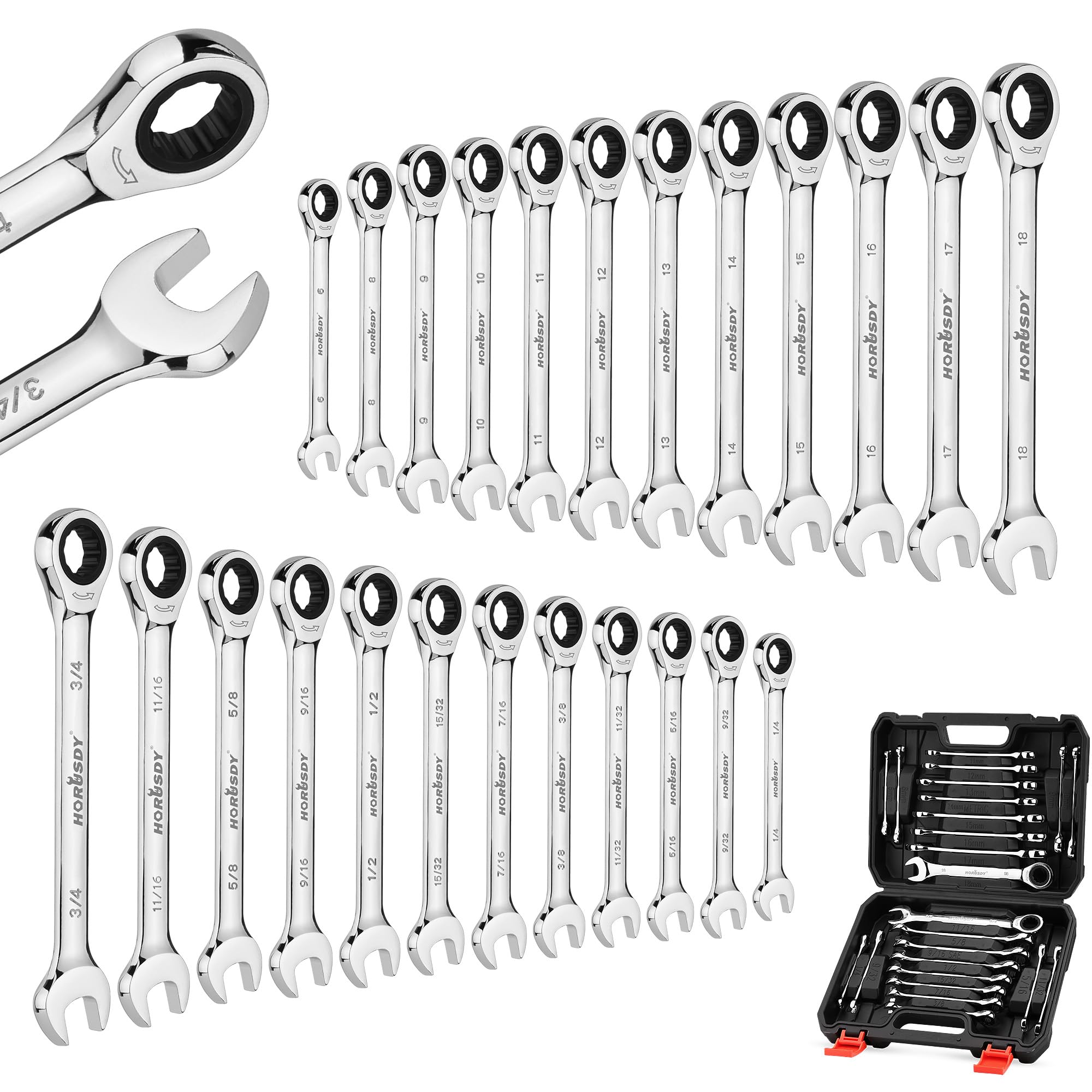
HORUSDY 24-Piece Set

93 /100
Kirk Score Outstanding
Pieces
24
Ratchet
72-tooth
Storage
Hard carry case
Size Coverage
Metric 6–18 mm, SAE 1/4–3/4 in
Check Details on Amazon

Pros

  • 24 pieces across metric and SAE
  • Hard carry case with individual slots
  • Slim beam with a mirror finish

Cons

  • Heavy at 7.1 pounds in its case

Twenty-four wrenches is the largest count here, and the count isn't the interesting part — the hard case is. Every size has its own slot, the internal layout is loose enough that a wrench comes out without a fight, and the whole thing stacks on a shelf instead of unrolling across the garage floor.

The wrenches themselves are chrome vanadium with a mirror finish and a slim beam, 72-tooth ratchets with the same 5-degree arc the rest of this group uses, and sizes running from 6 to 18 mm and 1/4 to 3/4 inch. For a first serious set that covers both standards, that's a lot of ground for the money.

The small ratchet ends are the ones carrying the most stress relative to their size, and a set this broad will get used on jobs it wasn't designed for — a 9/16 box end is not the tool for a corroded exhaust clamp. Give the little sizes an honest push rather than a jerk and the mechanism stays crisp; that goes double for anything that's been sitting outside.

What we keep coming back to is the container. A set that lives in a labeled box gets picked up more often than one that lives in a heap, and this is the only pick here that solves storage and coverage at the same time. Just park it somewhere it doesn't have to move, because 7.1 pounds in a hard case is a two-hand carry.

Bottom line: The most complete set here in the most useful container — 24 wrenches across both standards in a slotted hard case, best for a garage that wants everything in one place.

Check Latest Price

How We Tested Ratcheting Wrench Sets

We started where a shopper does — reading listings, comparing stated size ranges, tooth counts, offsets, and flex designs — then cut any set that skipped sizes inside its own stated range. That left 12 sets: fixed and flex-head, long-pattern double box, standard length, SAE, metric, and several that cover both, packed in roll pouches, molded cases, and organizer trays.

Those sets lived in the garage for six months. They came out for a brake job on an old truck, a water pump replacement, bike stem and seatpost adjustments, an afternoon of furniture assembly, and the kind of under-sink plumbing that requires lying on your back. We used them the way you would: with oily hands, in bad light, and once in the rain because the job wasn't finished.

At each job I taped a stripe on a bolt head and marked how far the handle had to travel before the gear caught, then repeated it after a hundred or so cycles to see whether the mechanism had gone sloppy. Grip was judged with grease on our hands, and durability by leaving every set in an unheated garage through a wet spring to see which finishes spotted and which mechanisms picked up grit. We laid every size out on a bench and looked for holes in the run, then closed each pouch one-handed to see whether we could pull a 13mm without dumping the rest. Flex heads were scored on whether they held the angle we set or sagged under their own weight, and value came down to coverage — whether a set filled a real range or padded itself with duplicates.

How to Choose a Ratcheting Wrench Set

Metric, SAE, or Both

Most fasteners on anything built in the last forty years are metric; plenty of what's bolted to your house, your mower, and a neighbor's older truck is not. A set that covers both standards is the one you stop thinking about, because the alternative is discovering the gap with a bracket half off. If you work on one vehicle you already know the answer. If you work on a house, buy both.

The gear here splits cleanly: the GEARWRENCH 35720, the DISEN 22-piece, and the HORUSDY 24-piece cover both systems, while the WORKPRO flex set is metric only and the DURATECH double-box set is SAE only. A single-standard set is a fine second purchase and a frustrating only purchase.

What Tooth Count Actually Buys You

A ratchet needs room to swing before it engages again. A 72-tooth box end needs 5 degrees; a 90-tooth head needs 4; a plain wrench needs 30. Getting from 30 down to 5 is the whole point of the category. Getting from 5 down to 4 is worth paying for only if you regularly work in the last inch of clearance — an engine bay, a transmission tunnel, a valve cover bolt tucked under a cowl.

Teeth in a fat head are no help at all. Slim heads get onto the fastener in the first place, which is why the thin-beam sets here reach places a chunky one won't regardless of arc.

Head Style Decides What You Can Reach

A combination wrench pairs a ratcheting box end with a plain open jaw, and that open end is what you use when a box won't fit over the nut or when you need to crack a seized bolt without loading the ratchet. Double-box wrenches trade that open end for a second ratcheting size, which is more coverage in less drawer space but useless where you can't come at the fastener from above.

Flex heads add an angle, and extra-long bodies add leverage. The trap with flex is the joint: a head that swings freely is only as good as its pivot tension, and it can roll off the flats while you're swinging. Seat it with one hand and turn with the other.

Reversing Levers vs. Flipping the Wrench

A reversing lever changes direction with the wrench still on the nut; without one you lift the wrench, flip it, and reseat it. On a short wrench in open space that costs a second. On a 19-inch handle buried behind a suspension arm it costs considerably more, which is why the long sets that lack a lever are best used for running threads rather than tight-quarters work.

The mechanism lives inside the head, so check head thickness before assuming a lever is free. On a set going into a tight engine bay, a slimmer flip-to-reverse head can beat a lever you can't fit in the gap.

What the Set Arrives In

A hard case keeps every size in a labelled slot and gets the set used; a roll or pouch is lighter and takes up less shelf; a bare tray is the one that ends up loose in a drawer within a month. Two of the sets here come with no case or roll at all, which is a small annoyance until you're hunting a 14 mm under a workbench.

Weight follows storage. A 20-piece set runs about 5.5 pounds; an extra-long 10-piece runs close to 6.3; a 24-piece in a hard case runs over 7. If the set lives on a shelf and comes out for jobs, that's fine. If it goes to job sites, a roll you can sling is worth more than a case you have to carry with two hands.

Frequently Asked Questions

Final Verdict

The GEARWRENCH 35720 is the set we point most people at. Twenty wrenches across both measurement standards, a 5-degree arc, and heads slim enough to reach the nut rather than the nearest obstruction — that combination covers the jobs a home mechanic actually meets, and it's why it sits at the top.

If every fastener you touch is metric, the DISEN 22-piece covers similar ground for less, and if you're fighting rusted suspension bolts, the extra-long WORKPRO set is the better second purchase. Buy for the fasteners you actually meet, and treat swing arc and head style as the tiebreakers.