// data-verified

Best Screw Extractor Sets of 2026

A bolt shears off flush with the bracket, and a twenty-minute job comes to a dead stop. I've been there, hunched over a rusted seat mount with a drill and a bad attitude, and the only thing that got me out was an extractor that bit on the first try. That's the whole job description: grab ruined metal hard enough to turn it, without snapping off in the hole and making a bad afternoon worse.

So we stopped counting pieces and started counting saves. Over four months my team worked through 14 sets — hand-driven multispline extractors, socket-style bolt removers, kits with left-hand drill bits in the case, kits that assume you already own a drill — on rusted trailer hardware, stripped deck screws, and a rounded bleeder fitting that had already beaten two other tools. Size coverage, steel, and case quality all matter, but none of it matters if the flutes won't bite. The sets that earned a spot are the ones I'd hand to a friend mid-repair, and they're below.

#01

Best Overall

THINKWORK 54-Piece Bolt Extractor Kit

92 /100
Kirk Score Outstanding
Drive
3/8-inch square
Pieces
54
Material
Chrome molybdenum steel and HSS
Extractor Sizes
6–19mm
Check Details on Amazon

Pros

  • Covers socket, spiral, and left-hand bit work
  • 3/8-inch square drive fits ratchets and extensions
  • Hex heads give a second way to apply torque
  • Case keeps the two extractor families apart

Cons

  • Premium price for occasional use

Damaged fasteners come in two shapes and need two different tools. A rounded bolt head or a rusted nut wants a multispline socket hammered over it; a chewed screw wants a fluted spiral extractor fed into a pilot hole. This THINKWORK kit is the most complete version of that idea in this group: 54 pieces covering 6–19mm socket extractors, spiral extractors, and a matched set of left-hand drill bits, all in one blow-molded case.

That breadth is why it earns the top spot. Whatever you are facing, a rounded oil drain plug, a stripped deck screw, a snapped stud, one of the two styles in the box will reach it, and the left-hand bits mean you are not stopping mid-job to hunt for the right drill size. A standard 3/8-inch square drive takes a ratchet, a breaker bar, or an extension, so the same socket works under a car and on a bench.

The hexagon heads are the detail we appreciated more than we expected. On a fastener you can reach with an open-end wrench, the hex gives you a second way to apply torque when a ratchet will not fit. The compact socket bodies help in the same tight spots, and we like that the case keeps the two families apart instead of tipping 54 loose pieces into one tray.

Where it rewards care is at the narrow end. The smallest extractors are the pieces that shear when a job turns into a fight, so drill the pilot hole to the depth the bit allows and let the flutes bite rather than leaning on the tool. Treated that way, the smallest three behave like precision instruments rather than disposable ones.

Bottom line: We recommend this to anyone who wants one case that covers a rounded nut and a stripped screw head without a second purchase.

Check Latest Price
#02

Best for High-Torque Bolts

IRWIN 25-Piece Multi-Spline Extractor Set

91 /100
Kirk Score Outstanding
Drive
Hex head, multi-spline
Pieces
25
Warranty
Limited lifetime
Extractor Sizes
1/8–7/8 inch
Check Details on Amazon

Pros

  • Hex head takes a wrench, socket, or breaker bar
  • Sizes and drill sizes etched on each tool
  • Runs from 1/8 to 7/8 inch
  • Limited lifetime warranty

Cons

  • No left-hand drill bits in the case
  • Nothing for screws broken below the surface

If your problem is a bolt rather than a screw, start here. The whole kit is one family of hex-head multispline extractors from 1/8 to 7/8 inch, which means every piece is built for what sockets do best: driving onto a rounded or corroded head and turning it with real leverage. The THINKWORK kit above covers more ground, but this one bites harder on big, stuck fittings.

The hex head is the part we value most. It takes a socket, a wrench, or a ratchet, so you can hang a longer bar on a stubborn fitting without an adapter between you and the bolt. Each tool also carries its own size and the recommended drill bit size etched on the shank, which matters when the case is across the garage and you are matching a bit by eye.

The coverage stops short of small work: there are no left-hand drill bits in the case and nothing here for a screw broken off below the surface, so this is a companion to a screw-focused set rather than a replacement for one. Watch the three smallest extractors, which are the pieces that let go first if the pilot hole is shallow.

Bottom line: For rusted bolts and fittings rather than screws, this is the set we hand people first, and its lifetime warranty backs the call.

Check Latest Price
#03

Best Compact Set

Mayhew 37332 5-Piece Screw Extractor Set

88 /100
Kirk Score Excellent
Pieces
5
Material
Tool steel, black oxide
Screw Sizes
1/4–5/8 inch
Extractor Diameters
1/8–3/8 inch
Check Details on Amazon

Pros

  • Made in the USA with a lifetime warranty
  • Five sizes cover 1/4 to 5/8-inch screws
  • Fluted edges bite into the screw shaft
  • Pouch fits a drawer or glovebox

Cons

  • No drill bits or adapters included
  • Only five sizes, so matching is coarse

Not everyone needs fifty pieces. If the fasteners you damage are the ones on small engines, appliances, and furniture, five well-made extractors in a pouch cover the same ground as a big case, and this Mayhew set is the one that earns drawer space. It is made in the USA, carries a lifetime warranty, and the black-oxide finish looks like a machinist's tool rather than a gadget.

What we like is the honesty of the sizing. The five extractors run from 1/8 inch to 3/8 inch in diameter and are matched to screw sizes from 1/4 to 5/8 inch, so the choice is quick: take the largest one whose flutes will seat in the damaged head and tap it in. The fluted cutting edges cut into the screw shaft instead of skating across it.

The pouch is the trade you accept. It holds five tools and nothing else, no drill bits, no sockets, no adapter, so pilot holes come from whatever bits you already own. A well-seated extractor can also wedge hard into the screw it just removed, so keep pliers within reach for the separation.

Bottom line: If your stripped fasteners are small screws, this pouch does the job of a big case with better steel and a lifetime warranty.

Check Latest Price
#04

Best Midrange Kit

THINKWORK 39-Piece Screw Extractor Set

88 /100
Kirk Score Excellent
Drive
3/8-inch
Pieces
39
Material
Chrome molybdenum steel and HSS 6542
Extractor Sizes
2–21mm
Check Details on Amazon

Pros

  • Range runs from 2mm to 21mm
  • HSS 6542 bits with a harder 68 HRC rating
  • Adds punch, bit holder, and two adapters
  • User guide covers the two-step method

Cons

  • Narrowest bits can break under heavy load

The smaller THINKWORK kit is worth a look if the 54-piece case is more tool than you want to store or pay for. It trades some pieces for a wider working range: 2mm to 21mm against the bigger kit's 6mm to 19mm, so it reaches a tiny screw in a hinge as readily as a 21mm nut the other set tops out below.

The range is not the only difference. The drill bits here are HSS 6542 at 68 HRC rather than the more common HSS 4341, and the case adds a knockout pin, a drill adapter, an extractor adapter, and a bit holder. For a midrange set that is a sensible bundle: the adapters let you drive the sockets from a drill chuck, the punch is what starts a center point on a snapped stud, and a short user guide walks through the two-step method.

Expect to work carefully with the narrow extractors, which are the first to chip when a job fights back, and check the hex heads against your sockets before committing to a tight-space repair, because they do not map cleanly onto every SAE or metric size.

Bottom line: This is the midrange THINKWORK we point people to when the top pick is too much kit, and its wider 2-21mm range is the reason.

Check Latest Price
#05

Best for Impact Use

toolant 46-Piece Impact Bolt Extractor Set

89 /100
Kirk Score Excellent
Pieces
46
Adapters
3/8 to 1/2 inch
Warranty
One year
Socket Sizes
1/4–3/4 inch
Check Details on Amazon

Pros

  • Deep sockets swallow studs snapped above the surface
  • Sockets run 1/4 to 3/4 inch with metric matches
  • 3/8-to-1/2-inch adapters fit existing tools
  • One-year warranty on the set

Cons

  • Heavy case that stays in the shop
  • Aggressive bite loads thin surrounding metal

A stud that snaps off above the surface is a different problem from a head that has rounded: you need a socket deep enough to swallow the stub before anything can grip it. This toolant set is built around that job, with deep bolt extractors alongside the standard sockets and multispline extractors, plus a punch for starting a center point.

Forty-six pieces goes a long way: bolt extractor sockets from 1/4 inch to 3/4 inch with their metric equivalents, multispline extractors from 1/8 inch up, and 3/8-inch-to-1/2-inch adapters so one socket can go on whichever wrench or impact you own. That adapter pair is the detail we appreciate most, because it is the difference between a set that works with your tools and one that makes you buy another drive size.

Chrome molybdenum construction and a one-year warranty are what you hope for at this level. This is a shop-cabinet resident rather than a glovebox one: the case runs about 15 inches and the set is listed at just over seven pounds, which is the cost of carrying deep sockets and adapters in every size.

This is the set we reach for when the fastener is big, seized, and sitting on an engine or a suspension rather than in a cabinet. The sockets bite hard, hard enough that on a corroded bolt you should watch what the reaction does to the part around it, because that grip does not ease off just because the bolt has stopped turning.

Bottom line: Buy this one for seized engine and suspension fasteners, where deep sockets and impact-ready adapters matter more than small-screw coverage.

Check Latest Price
#06

Maximum coverage

coobeast 72-Piece Bolt Extractor Kit

88 /100
Kirk Score Excellent
Pieces
72
Material
Chrome molybdenum steel
Drill Bits
Titanium-coated HSS, 135-degree
Extractor Types
Multi-spline, spiral, deep bolt
Check Details on Amazon

Pros

  • Three extractor families in one case
  • Every left-hand bit matched to its extractor
  • Titanium-coated 135-degree HSS drill bits
  • Sizes laser-etched on each tool

Cons

  • Most expensive set in this group

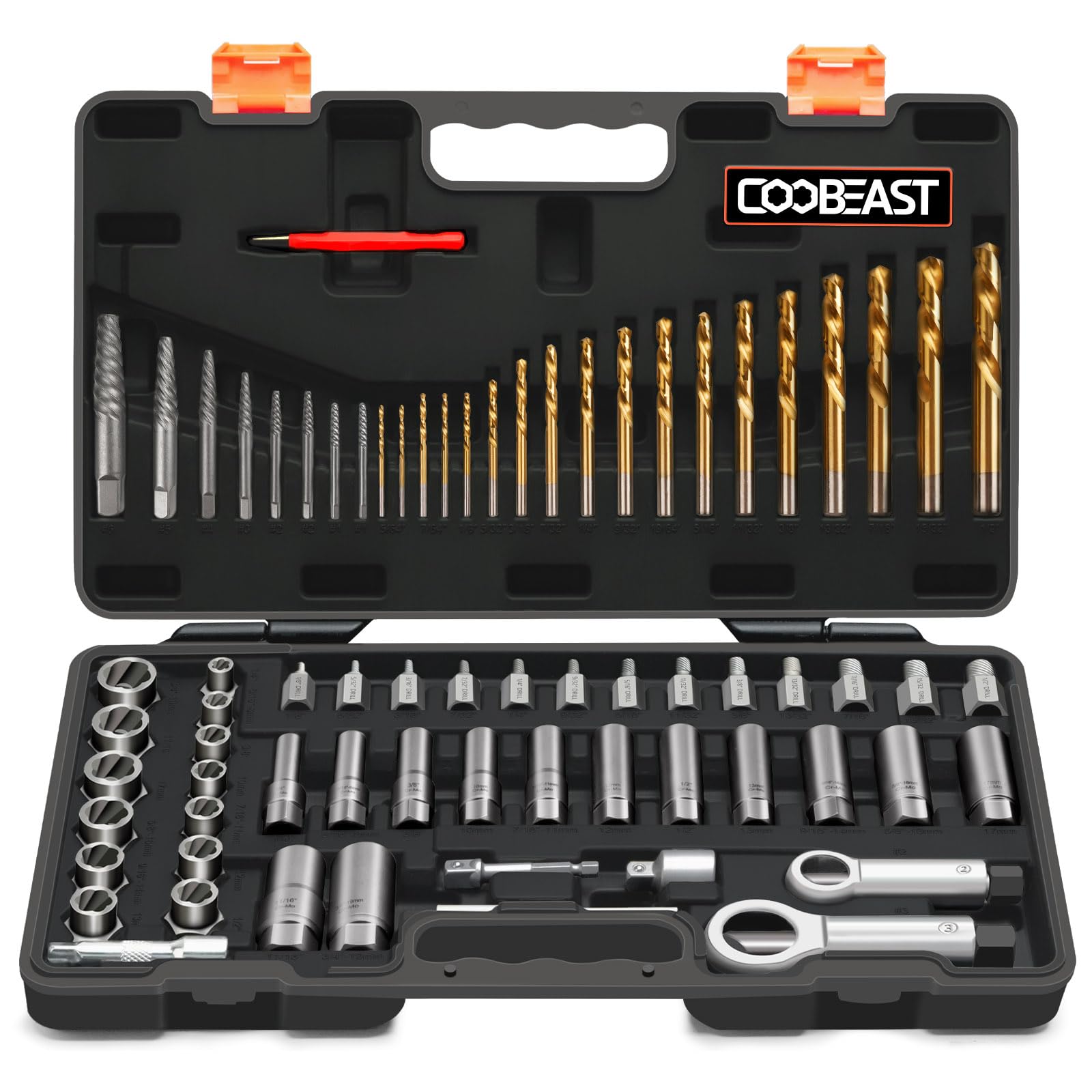
The biggest kit here is also the most expensive, so the question is whether 72 pieces buys anything a 40-piece case does not. Mostly it does: this case holds three separate families, with 13 multispline extractors matched to 13 left-hand drill bits, six spiral extractors for recessed screws, and 13 deep bolt extractors for studs that snap above the surface.

The drill bits are titanium-coated HSS with a 135-degree point, the geometry you want for starting on a curved or awkward surface without wandering. Sizes are laser-etched on the tools, and the Cr-Mo extractors get a sandblasted finish that holds better in the hand than polished steel. What we like most is the one-to-one matching between each left-hand bit and its extractor, because that pairing is what turns a two-step job into a single motion.

Where we hesitate is the price. Nothing here feels cheap, but the premium is real, and it is a lot of kit to buy before you have needed a deep socket even once. If your work is automotive and varied, the coverage justifies it; if you chase one stripped screw a year, the smaller THINKWORK kit or the Mayhew pouch does the same job for far less.

Bottom line: Worth the money for varied automotive work, where three extractor families and matched left-hand bits save more than they cost.

Check Latest Price
#07

Value multispline

NEIKO 04204A 25-Piece Extractor Set

87 /100
Kirk Score Excellent
Flutes
3
Pieces
25
Material
Chrome molybdenum steel
Extractor Sizes
1/8–7/8 inch in 1/32-inch steps
Check Details on Amazon

Pros

  • Sizes step in 1/32-inch increments
  • Covers 1/8 to 7/8 inch with 25 sockets
  • Chrome molybdenum steel with three flutes
  • Costs far less than the IRWIN set

Cons

  • No drill bits, punch, or adapters included

Extractor sizing is a Goldilocks problem: too small and it never reaches the damaged flats, too large and it skates. NEIKO's answer is to step the 25 multispline sockets in 1/32-inch increments from 1/8 inch to 7/8 inch, which gives you 25 chances to find a socket that drives onto the head with a hammer and still cuts.

Chrome molybdenum steel and three flutes per socket put it in the same territory as the IRWIN set on paper, and the hex shank means a socket or wrench can drive it. It is a plain kit, though: no drill bits, no adapters, no punch, so plan to supply those if they are not already in your toolbox.

For the money this is the version of the multispline format we recommend to someone who owns a full drill index and just wants the extractors. It will not do anything the IRWIN cannot, but it costs far less, and on occasional jobs that difference is unlikely to show up in the work.

Bottom line: A sensible buy for someone who already owns drill bits and wants the multispline format at the lowest sensible cost.

Check Latest Price
#08

Budget socket set

GRLCOOD 14-Piece Bolt Extractor Kit

87 /100
Kirk Score Excellent
Pieces
14
Adapter
3/8-inch hex
Material
Alloy steel
Socket Sizes
3/8–3/4 inch (10–19mm)
Check Details on Amazon

Pros

  • Covers 10mm to 19mm in one set
  • Left-hand spiral bites harder as torque rises
  • Works with a ratchet or impact driver
  • Small case that fits a toolbox drawer

Cons

  • Steel is soft enough to shave on corroded bolts
  • Nothing for screw heads below 3/8 inch

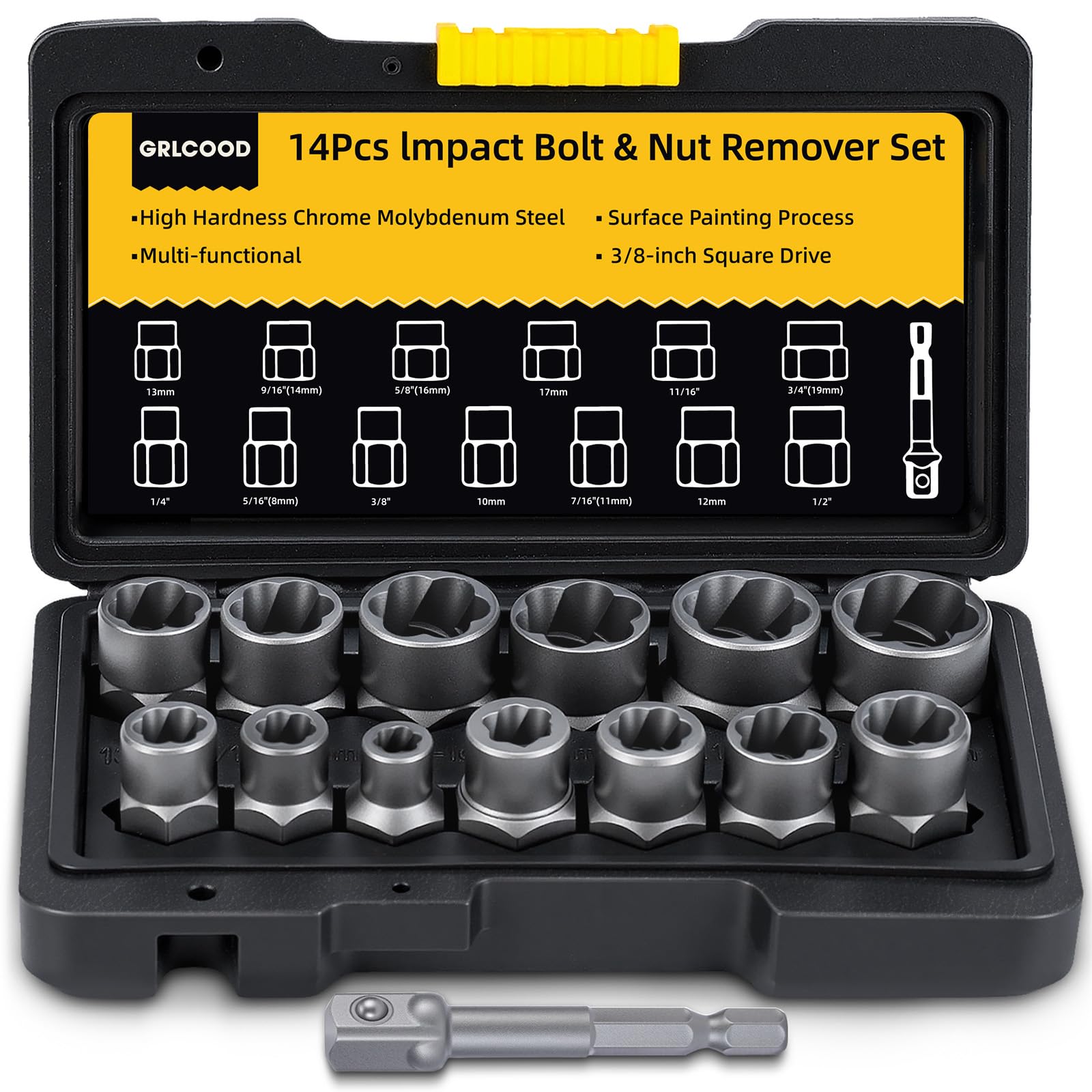
There is nothing in this kit for a screw. The 13 working pieces are socket-style bolt extractors spanning 3/8 inch to 3/4 inch, or 10mm to 19mm, plus a hex adapter, which makes it a set for rounded nuts, drain plugs, and lug nuts rather than the stripped deck screw that sent you looking.

Framed that way, it is a lot of coverage for very little money. The sockets use an internal left-hand spiral so they bite harder as you turn, and the sizing covers both SAE and metric heads in the range most home and automotive jobs actually use. The adapter lets you drive them from a 3/8-inch ratchet or an impact, and the whole thing lives in a small blow-mold case.

Where it gives ground is the steel. These are the sockets most likely to shave rather than bite, and a soft extractor on a corroded bolt can round the head further instead of removing it. Soak the fastener in penetrating oil first, keep the drive square, and save this set for heads you can see and reach.

Even so, this is the kit we point a first-time buyer toward, because one successful drain plug pays for it several times over and a failure teaches you exactly what a better set needs to do.

Bottom line: A cheap way to find out whether socket extractors suit you, as long as the fastener is a nut or bolt rather than a screw.

Check Latest Price

How We Tested the Best Screw Extractor Sets

We started by pulling every set we could find that covered the fastener sizes people actually break: quarter-, five-sixteenths-, and three-eighths-inch bolts, plus the small heads that snap off inside hinge plates and appliance panels. We cut anything with holes in the size run, anything with no way to drive it — no hex head, no square drive, no socket adapter — and anything whose photos showed the same extractor repeated under three part numbers. That left 14 sets, which we used for four months.

Testing happened where the failures happen: a garage workbench on weekends, a rusted utility trailer, and a stack of household repairs I'd been putting off. For each set we drilled the pilot hole, seated the extractor, and counted turns until it grabbed, then watched whether it held or cammed out and opened the hole wider. We logged which ones spun in a drill chuck, which adapters wobbled on a three-eighths drive, and which sizes missed a common fastener by a hair.

Durability got the ugly test. We kept turning until the bolt moved or the tool gave up, and noted anything that rounded at the tip, flattened its flutes, or snapped off in the hole — the worst outcome, since now you're drilling hardened steel. We timed each removal from first drill to freed bolt, and afterward counted how many pieces in each case we'd actually touched, because a huge kit that only ever uses nine of them isn't a bargain. The sets that finished without drama are the ones we still reach for.

How to Choose a Screw Extractor Set

Two families of extractor, and two kinds of damage

A rounded bolt head, nut, or pipe fitting wants a multispline socket: a hardened, fluted cap you drive over the head with a hammer and turn with a ratchet, so the teeth cut their own flats. A screw with a chewed recess, or one snapped below the surface, wants a fluted spiral extractor fed into a pilot hole and wound counterclockwise until it bites.

The trap is buying a set that only does one. A socket has nothing to grab on a screw head sunk below the surface, and a spiral extractor spins uselessly on a rounded nut. If you work on cars, appliances, and furniture alike, look for both families in the case; a socket-only kit is a specialist tool, not a general one.

Left-hand drill bits are not a bonus

The pilot hole is where most extractions are won, and the bit that cuts it should turn counterclockwise. A left-hand bit not only prepares the hole for the extractor, it often walks a lightly seated screw out on its own, which is the best result you can get. A right-hand bit can tighten the fastener instead.

A set with matched left-hand bits saves you buying them separately and guessing at sizes. If the set you like does not include them, check your drill index before the job, because a standard set of bits will not do this work.

The tip is the part that fails

Extractors are hard, and hard steel is brittle. The narrowest sizes in any set are the ones that chip or shear, and the usual causes are a pilot hole that is too shallow and a tool held off square so the tip is levered sideways rather than turned. Drill to full depth, keep the drive in line with the fastener, and keep hand-style spiral extractors out of an impact driver.

Know which failure you are buying into. A snapped tip is hardened steel sitting in the hole, and an ordinary drill bit will not touch it. Slow and square beats force every time.

Drive type decides where the set is usable

Square-drive sockets, usually 3/8 inch, take a ratchet, breaker bar, or extension, which is what you want under a car. Hex-head extractors take a socket or an open-end wrench and are the better choice when you need to hang a longer bar on a rusted fitting. Adapters that step between 3/8 and 1/2 inch matter if you already own impact tools.

Then think about reach. Deep sockets swallow a stud snapped off above the surface; shallow ones get further into a recess. Neither shape covers both jobs, which is why the larger kits carry both.

How many pieces, and which sizes

Piece count is the least informative number on the box. What matters is whether the sizes step finely enough to seat on your fastener: a multispline set running 1/8 to 7/8 inch in 1/32-inch increments fits more heads than the same range split into eight coarse jumps.

For small work such as appliances, small engines, and furniture, 1/4 to 5/8 inch covers most screw shanks. For automotive and plumbing fittings, 2mm to 21mm or 1/8 to 7/8 inch is the useful span. Etched or laser-marked sizes earn their keep when the case is open and your hands are full.

Frequently Asked Questions

Final Verdict

For most people the THINKWORK 54-piece kit is the one to buy. It is the most complete of the sets here that handle both rounded bolt heads and stripped screw heads, and the included left-hand drill bits mean the job does not stall halfway through.

If your damaged fasteners are small screws rather than big bolts, the Mayhew pouch covers 1/4 to 5/8-inch sizes with a lifetime warranty and far less bulk. If you are fighting rusted engine fittings, the IRWIN multispline set bites harder than anything else in this group.