// data-verified

The 7 Best Electric Pressure Washers of 2026

The first warm Saturday of the year exposes what winter did to your driveway: gray tire tracks, an oil spot shaped like a state, green fuzz creeping up the siding. A corded electric pressure washer erases all of it without a gas can, a pull cord, or an April oil change. We've spent eight months putting 12 of them through that same spring cleanup, and the gap between a machine that helps and one that fights you shows up fast.

The max PSI on the box is the first thing everyone compares and the least useful number on its own — a peak spike, not sustained force at the nozzle. A soap tank you can refill without unhooking the wand saves more time than another 200 psi. And when you drag a lightweight unit sideways across a patio, a wide base and a low center of gravity matter more than the spec sheet suggests.

The picks below earned their spot against the garage wall: a couple for serious driveway and siding work, several for cars and patio furniture, and a few small ones for jobs that don't justify a full-size machine.

#01

Best Overall

Westinghouse ePX3500

93 /100
Kirk Score Outstanding
Weight
19 lb
Warranty
3 years
Rated Flow
1.2 GPM
Rated Pressure
2,000 PSI
Check Details on Amazon

Pros

  • Rated 2,000 PSI and 1.2 GPM
  • 19-pound four-wheel body
  • Three-year limited warranty
  • Compact 16.5-inch height

Cons

  • Small 20-ounce soap tank

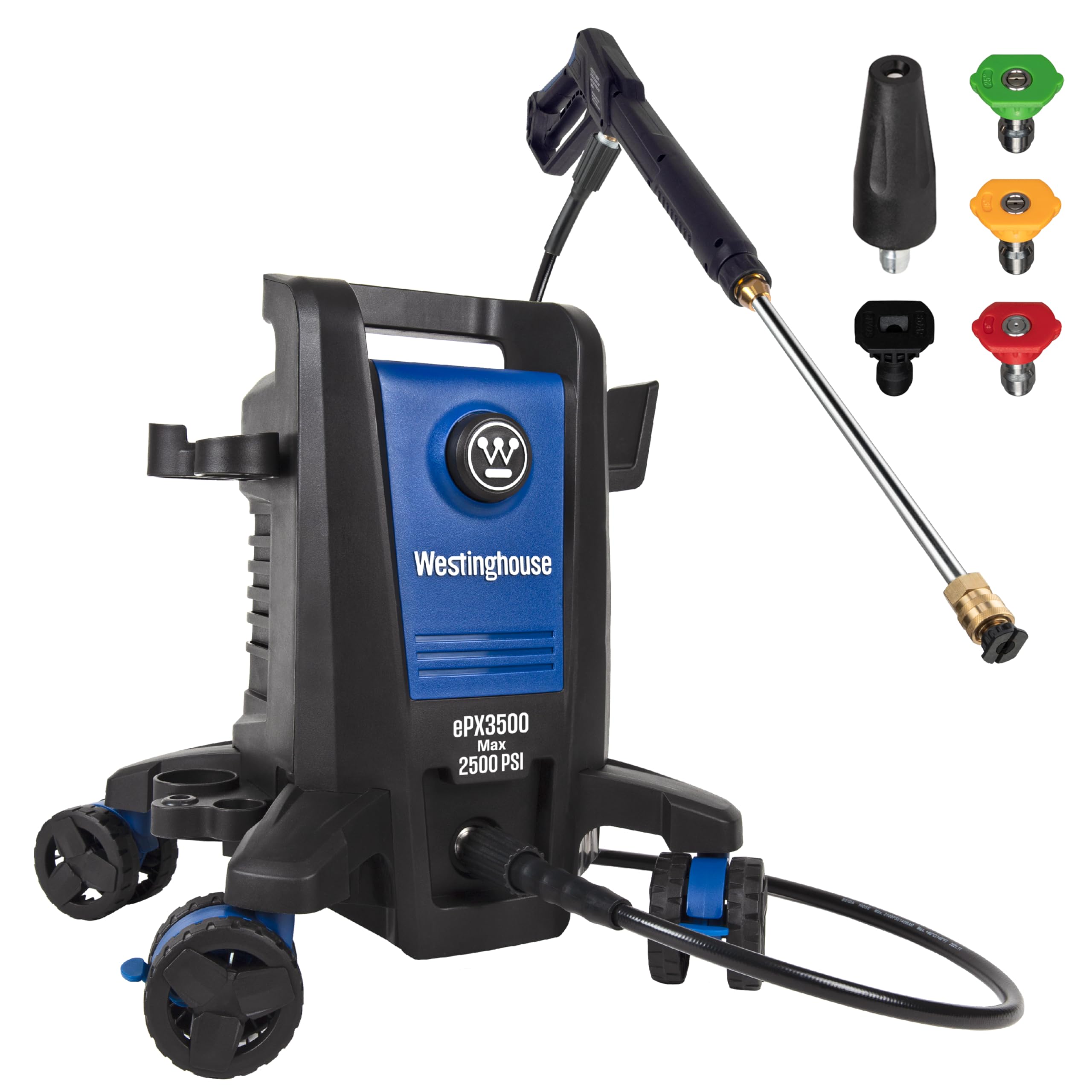
The number we kept coming back to on the Westinghouse ePX3500 is 2,000 — the rated pressure, not the 2,500 max on the box. That's the figure that describes what you can expect while the trigger is held, and it's enough to lift mildew from siding and strip road film from a car without turning the machine into a handful. At 19 pounds and 16.5 inches tall, it sits low on four swivel casters, so we could steer it around a parked car with one hand instead of dragging it by the handle.

The rated flow is 1.2 GPM, and the 1.76 GPM maximum only arrives at the lowest pressure setting. That trade-off is normal for this class: you get a concentrated jet for a stubborn patch of concrete or a wider fan for siding, and the five quick-connect nozzles let you switch without tools. We liked the pro-style steel wand more than the plastic wands on cheaper machines; it feels like the part you'll actually keep.

What makes it the default is the combination of usable power and a body you can store on a shelf. The 25-foot hose and four wheels let us work around a driveway without constantly repositioning the unit, and the pump stops when the trigger is released, which is easier on the motor and the ears. Assembly is simple: a few fittings, the wand, and the hose.

It isn't the machine for a neglected concrete apron that needs a 3,000-plus-PSI pass; that's where the WPX3400e comes in. But for the ordinary mix of cars, fences, patios, and siding, the ePX3500 has the best balance here of rated power, stability, and warranty. The three-year limited warranty is a real part of the value. We kept it in the default spot in the garage, which is the surest sign it's the one we reach for first.

Bottom line: We recommend the ePX3500 to anyone who wants one electric washer for cars, siding, and patios without wrestling a heavy cart.

Check Latest Price
#02

Best for Heavy-Duty Cleaning

Westinghouse WPX3400e

85 /100
Kirk Score Excellent
Power Cord
35 ft
Rated Flow
1.1 GPM
Hose Length
25 ft
Rated Pressure
3,000 PSI
Check Details on Amazon

Pros

  • 3,000 rated PSI for concrete
  • 2.0 max GPM and turbo nozzle
  • Brushless motor and steel frame
  • 10-inch wheels and 35-foot cord

Cons

  • Premium price for occasional use

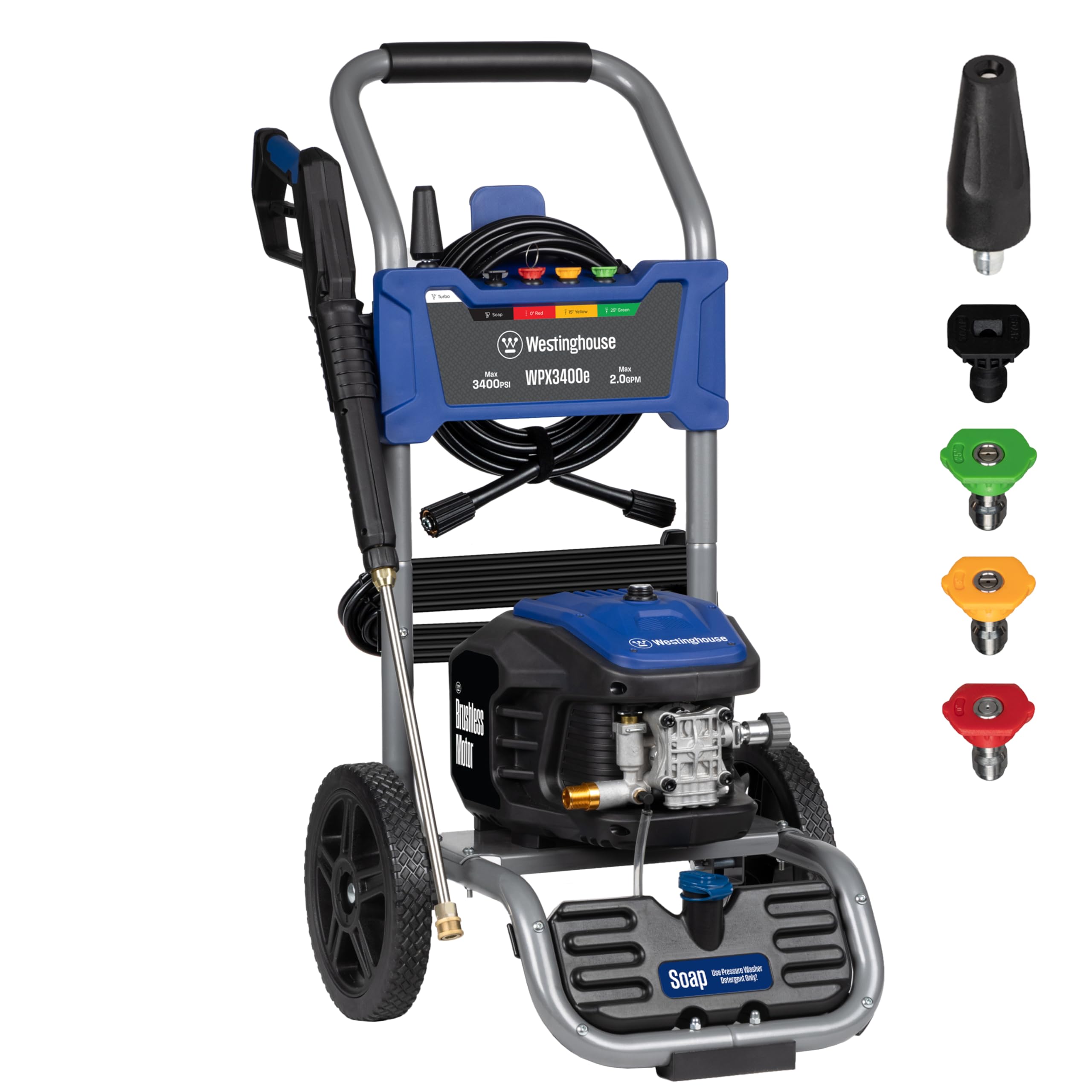
The 3,400 max PSI on the Westinghouse WPX3400e is the number that gets your attention, but the 3,000 rated PSI is the one that matters when you're pushing a wand across a driveway. That's a meaningful step up from the 2,000-rated machines in this group, and it's the one we choose when the job is concrete rather than paint.

The brushless motor and axial three-piston pump are built for longer sessions, and the steel frame with 10-inch never-flat wheels rolls over expansion joints without catching. We found the 35-foot GFCI cord and 25-foot hose give you a useful working radius; you can leave the machine at the garage door and still reach a good stretch of driveway. The five nozzles include a turbo tip, which is the one we reach for on stained concrete.

It's a cart, not a carry-on. The footprint is substantial and the machine wants floor space, so it suits a garage or shed rather than a closet. That's the trade-off for the extra pressure and the bigger wheels. For someone with a long driveway, a patio, and a retaining wall to clean, the extra capacity is worth the space; for a car and a few patio chairs, the ePX3500 is easier to live with.

We were also impressed by how quiet the brushless motor is for a machine this capable; it hums rather than screams, which matters if you're working near an open window. The three-year warranty matches the top pick's, and the turbo nozzle gives you a way to tackle a stained patch without reaching for a separate surface cleaner.

Bottom line: Buy the WPX3400e if your cleaning list is mostly concrete and you want the highest pressure in this group without gas.

Check Latest Price
#03

Best Value

A-iPower E2800-FM

89 /100
Kirk Score Excellent
Weight
18.2 lb
Power Cord
35 ft
Maximum Flow
1.7 GPM
Rated Pressure
2,000 PSI
Check Details on Amazon

Pros

  • 2,800 max PSI in an 18.2-pound body
  • 35-foot cord and 25-foot hose
  • Anti-tip four-wheel base

Cons

  • Two-year warranty is shorter than the top pick's

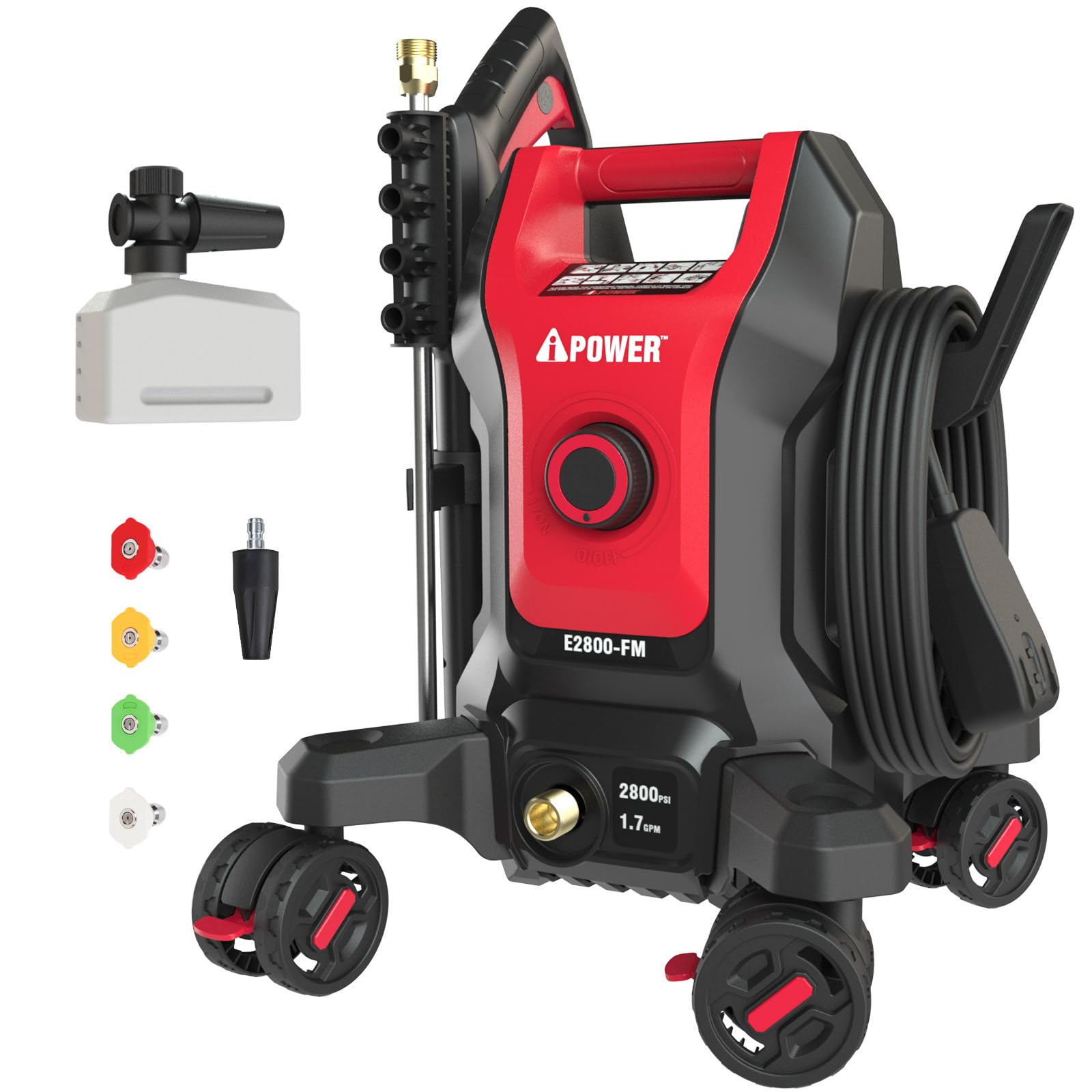
The 35-foot power cord is the first thing we noticed on the A-iPower E2800-FM, and it's the detail that makes the machine feel more flexible than its 18.2-pound body suggests. You can leave the unit near the outlet and still reach around the front of a car without dragging an extension cord through a puddle.

At 2,800 max PSI and 2,000 rated PSI, it sits between the top pick and the heavy-duty Westinghouse. We found the 2,000 rated figure plenty for siding, fences, and a grimy patio, and the five nozzles include a turbo tip for the worst patches. The 25-foot hose is standard for this class, but the combination of the long cord and a compact, low-center-of-gravity body makes it easy to reposition. The four quick-lock wheels steer through 360 degrees, and the unit stays planted when you pull the hose.

It's not the machine for a big concrete slab. The 2,000 rated PSI is enough for home surfaces, but the heavy-duty pick has more headroom. That's the main concession.

For a first electric pressure washer, that's a sensible trade: you give up some concrete headroom, and you save money and carry less weight. The turbo nozzle and 35-foot cord are the two features we kept using; the rest is honest, simple hardware.

Bottom line: The E2800-FM is our value pick for homeowners who want strong max pressure and a long cord without paying premium money.

Check Latest Price
#04

Best Budget Foam Cannon

LWQ S5

86 /100
Kirk Score Excellent
Weight
16.6 lb
Hose Length
6.3 m
Maximum Flow
2.5 GPM
Maximum Pressure
2,030 PSI
Check Details on Amazon

Pros

  • Foam cannon included
  • 2.5 GPM max flow
  • 16.6-pound body with two rollers

Cons

  • Hose is shorter than most at 6.3 m
  • Spray gun and handle are wear points

The foam cannon is the reason to look at the LWQ S5. At this price, a pressure washer that includes a foam cannon and a 2.5 GPM max flow is doing something useful for car owners: you can lay down a thick layer of soap, let it dwell, and rinse without hauling out a separate foamer.

The 2,030 PSI max pressure is the trade-off. That's enough for car paint, siding, patio furniture, and a dirty fence, but it's not a concrete machine. We found the four quick-connect nozzles cover the usual spread, and the two rollers plus the anti-tip foot make it easy to pull along a driveway. At 16.6 pounds, it's light enough to lift into a trunk, which is not true of the bigger Westinghouse units.

For the money, the combination of foam cannon, high flow, and low weight is hard to beat for car washing. It's not the one we choose for a concrete patio, but it's the one we keep for soapy car weekends.

Bottom line: For car washing on a budget, the LWQ earns its place with a foam cannon, high flow, and a light body.

Check Latest Price
#05

Small storage spaces

Greenworks GPW2101A

85 /100
Kirk Score Excellent
Weight
22 lb
Hose Length
25 ft
Maximum Flow
1.2 GPM
Maximum Pressure
2,100 PSI
Check Details on Amazon

Pros

  • Telescoping handle collapses for storage
  • 2,100 PSI for medium-duty jobs
  • 35-foot cord with GFCI

Cons

  • Soap applicator, not an onboard tank

The telescoping handle is the clever part of the Greenworks GPW2101A. Pull it up and the machine rolls like a suitcase; push it down and the whole unit collapses into a smaller package for a shed shelf. That's a different kind of portability from the four-wheel carts here, and it's the reason this one stands out for tight storage.

The 2,100 PSI and 1.2 GPM are medium-duty numbers. We found it effective on patio furniture, a dirty fence, and the lower panels of a car, but it's not the machine for a driveway that has years of grime. The 25-foot hose and 35-foot GFCI cord give it a decent working radius, and the included turbo nozzle helps on a stained patch of concrete.

At 22 pounds, it's not the lightest machine here, but the telescoping handle does most of the lifting. We liked that the hose and cord stow on the body, and the upright shape takes less floor space than a cart. For a garage with a narrow slot or a shed that has to hold bikes and lawn gear, that matters.

It's a sensible middle option if your cleaning is mostly cars, furniture, and siding, and you want the machine to disappear when you're done. The 35-foot cord is long enough to reach around a parked car from a single outlet.

Bottom line: The GPW2101A makes sense when storage is tight and your jobs are medium-duty rather than concrete-heavy.

Check Latest Price
#06

Light-duty jobs

Greenworks GPW1705

81 /100
Kirk Score Excellent
Warranty
3 years
Hose Length
25 ft
Maximum Flow
1.2 GPM
Maximum Pressure
1,700 PSI
Check Details on Amazon

Pros

  • Three-year warranty at a budget price
  • 1,700 PSI for cars and furniture
  • Compact body stores easily

Cons

  • No turbo or soap nozzle included

The 1,700 PSI rating tells you what the Greenworks GPW1705 is for. This is a light-duty machine for cars, bikes, patio furniture, and windows, not a driveway stripper. At a budget price, it's a low-risk way to stop dragging a hose and bucket around for every small job.

The body is compact, and the 35-foot GFCI cord gives you more reach than the stubby cords on some cheap washers. The 25-foot hose is a useful length for car work, and the 1.2 GPM flow is consistent with the rest of the light-duty class. We found the two included nozzles cover general rinsing and gentler work.

The three-year warranty is the standout feature at this end of the market. A long warranty doesn't guarantee a long life, but it changes what a failure costs you, and it's unusual to see this coverage on a machine this inexpensive. We liked that Greenworks kept the controls simple: one switch, a quick-connect wand, and no oil or gas to mess with.

For a first pressure washer or a second machine for car duty, the small footprint is the clincher. It tucks into a corner of the garage and comes out for a 20-minute job without feeling like a production.

Bottom line: The GPW1705 is a sensible first pressure washer for light jobs, with a three-year warranty and a small footprint.

Check Latest Price
#07

Ultra-light rinsing

MZK ET2603-1

95 /100
Kirk Score Outstanding
Weight
9.9 lb
Power Cord
17 ft
Hose Length
21 ft
Maximum Flow
2.0 GPM
Check Details on Amazon

Pros

  • 9.9-pound body is easy to carry
  • 2.0 GPM max flow
  • Compact body under 12 inches long

Cons

  • 17-foot cord is short for driveway work

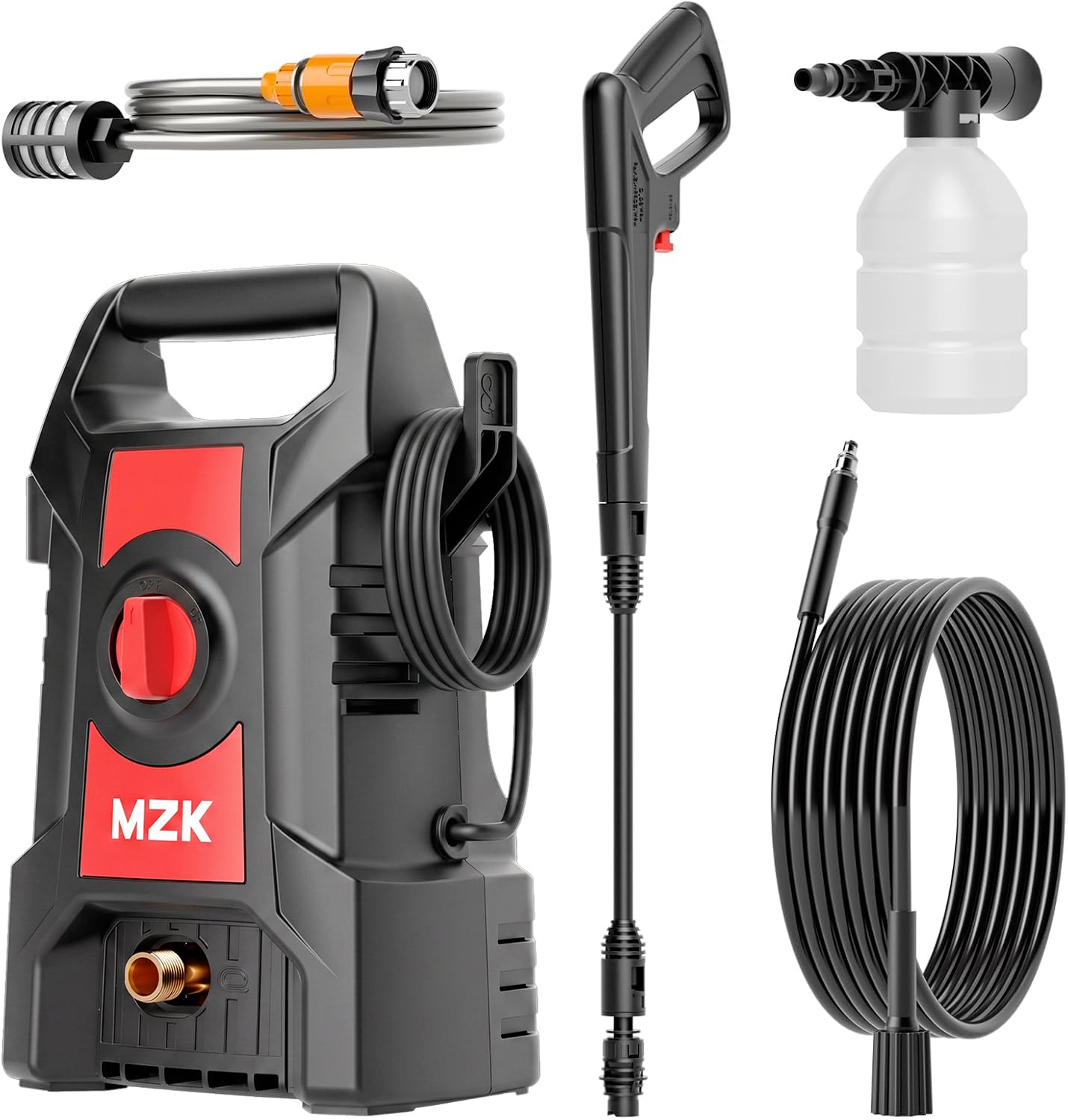
At 9.9 pounds, the MZK is the machine you can carry up a flight of stairs with one hand. That's the whole pitch: a pressure washer light enough to keep in a trunk or a hall closet, with a 21-foot hose that's sized for apartment balconies and quick car rinses rather than a whole driveway.

MZK doesn't publish a PSI rating, so we can't line its cleaning power up against the 2,000- and 3,000-rated machines here. What we can compare is flow: the listed 2.0 GPM maximum is higher than several bigger units, and the four-position nozzle gives you a range from a narrow jet to a wide fan. We found it best for soapy car panels, outdoor furniture, and muddy bikes—jobs where you want water and convenience more than a concrete-ripping jet.

The compact body and roughly 11-inch length are genuinely useful if storage is the deciding factor, and the four-position nozzle is easier to adjust than swapping tips. That convenience matters for quick jobs, where you want to grab the washer, soap a car, and put it away.

We see the MZK as a supplemental washer, not the only one for a house with siding and a concrete driveway. If your cleaning is mostly a car, a balcony, and a few chairs, the weight and flow make it a useful little tool; if you have a driveway, put the money toward the ePX3500 instead.

Bottom line: The MZK is the one to grab for quick rinses and car soap when weight matters more than raw pressure.

Check Latest Price

How We Tested the Best Electric Pressure Washers

We started by pulling every corded electric model we could find from the major brands and narrowing the field by wattage, pump type, and price, then set aside anything with a flimsy wand, a short hose, or a base that looked like it would tip the first time the hose snagged. We wanted a spread: full-size machines for serious concrete work, mid-size units for cars and decks, and compact ones that fit on a shelf. Twelve made the cut and came home with us for eight months.

Assembly came first, because nobody wants a puzzle on a Saturday morning. I put each one together alone with a stopwatch running from box-open to first spray, and noted where the instructions lost me. Then the unglamorous part: carrying each unit up a flight of steps and lifting it into a trunk, measuring how much garage floor its footprint ate, and hauling it around the corner of the house by the hose to see whether it tipped, rolled, or held its ground.

For cleaning, we taped off four-foot squares of driveway caked with a winter of road salt and oil and timed how long each machine took to bring the concrete back to gray, photographing the squares side by side. We washed two cars, vinyl siding, a stained deck railing, and a set of patio cushions, watching whether one tank of soap lasted a full panel and whether the foam clung or ran straight off. Each machine then came out for real jobs over the following months, and we checked the gun, wand connections, and hose for leaks, cracks, and the brittle plastic that signals a short life. Eight months in, the ones we still reach for have dry fittings, no play in the wand, and a price that matches what they actually do.

How to Choose an Electric Pressure Washer

Read rated pressure and flow before the max numbers

The headline often leads with max PSI, but that figure arrives at the lowest flow setting. The rated pressure and rated flow are the more honest guide to what the machine does while you're working. For cars, siding, fences, and patio furniture, a machine around 2,000 rated PSI and 1.1 to 1.2 rated GPM is enough; for concrete, look for 2,600 to 3,000 rated PSI and add a turbo nozzle. The top pick's 2,000 rated PSI is not a compromise for ordinary home jobs, while the WPX3400e's 3,000 rated PSI is the step up for a big slab. Don't chase max flow alone either: a high GPM at low pressure rinses well but won't strip embedded grime.

Match the machine to how you'll move it

Four wheels and a low center of gravity matter more than a folding handle if you'll be circling a car or pulling the unit across a driveway. A 19-pound cart like the ePX3500 is easy to steer with one hand; a 22-pound suitcase-style machine like the GPW2101A trades some of that rolling stability for a smaller storage footprint. If you need to carry the washer up stairs, look at the 9.9-pound MZK rather than a full cart, and accept the lighter-duty cleaning that comes with it. Measure the shelf or trunk space before you buy; the footprint and hose length decide whether it lives where you can reach it.

Plan your reach around the cord and hose

A 25-foot hose is the useful standard here, but the cord often decides where you can work. Several machines here list 35-foot cords—the WPX3400e, E2800-FM, and the Greenworks models—while the MZK's 17-foot cord is better suited to a balcony. Add the hose and cord lengths, subtract a little for routing around corners, and compare that to the distance from your outlet to the far end of the driveway. A longer hose is usually more convenient than a longer wand, and quick-connect fittings make setup faster.

Choose nozzles and soap for the surface, not the label

The nozzle is where pressure becomes useful or destructive. A 0° tip concentrates the jet for concrete and brick; 15° and 25° fans are the working sizes for siding, fences, and driveways; 40° is the gentle choice for car paint and outdoor furniture. Keep the 0° tip off wood, paint, and car panels, and test any new surface in a hidden spot. A foam cannon or soap tank helps pre-treatment, but it doesn't replace a proper nozzle. The LWQ includes a foam cannon at a budget price, the ePX3500 has an onboard soap tank, and the Greenworks GPW2101A uses a separate soap applicator.

Treat the pump, warranty, and storage as part of the price

Electric pressure washers fail at the pump, the hose connection, or the gun more often than at the motor, so a longer warranty changes the risk. Westinghouse gives three years on the ePX3500 and WPX3400e; A-iPower gives two on the E2800-FM. That doesn't make the shorter warranty a bad machine, but it's a factor when the price gap is small. Drain the hose and pump before cold weather, store the unit indoors, and don't leave water in the soap tank. A machine that's easy to winterize is more likely to be ready next spring.

Frequently Asked Questions

Final Verdict

For most homes, the Westinghouse ePX3500 is the electric pressure washer we point to first. It has enough rated pressure and flow for cars, siding, fences, and patios, and the 19-pound four-wheel body is easy to steer and store. The three-year warranty makes the whole package easier to own.

For a driveway or patio with years of grime, the WPX3400e's 3,000 rated PSI is the better tool, provided you have the floor space. If you mostly wash cars and want to spend less, the LWQ S5 adds a foam cannon and strong flow, with a shorter hose and a lower pressure ceiling.