// data-verified

Best Pressure Washers of 2026

Every pressure washer is a negotiation between muscle and hassle. Gas machines will strip a season of grime off concrete in a couple of passes, but you're yanking a starter cord, mixing fuel, and shouting over the engine. Electric ones plug in and quiet down, and then you spend the afternoon walking an extension cord around the yard. What the right machine actually buys you is time: a driveway that took a Saturday with a stiff brush and a garden hose becomes a forty-minute job.

The number that matters less than you'd think is PSI. What happens at the nozzle — and which nozzle you've got on the end of the wand — decides whether a machine lifts grime or etches a pressure-treated board. We've spent eight months with ten pressure washers, washing my driveway, a mildewed fence, patio furniture, and the car, and the winners separated themselves on assembly, control, storage footprint, and whether they were still sealed tight by month seven. The picks below are sorted by the kind of cleaning you're signing up for.

#01

Best Overall

Westinghouse ePX3500

93 /100
Kirk Score Outstanding
Weight
19 lb
Warranty
3 years
Max Pressure
2500 PSI
Rated Pressure
2000 PSI
Check Details on Amazon

Pros

  • 19 pounds on four swivel casters
  • 2000 rated PSI handles concrete, siding, and cars
  • Pump stops when you release the trigger
  • Three years of parts and labor coverage

Cons

  • Hose is stiff until it's been used a few times

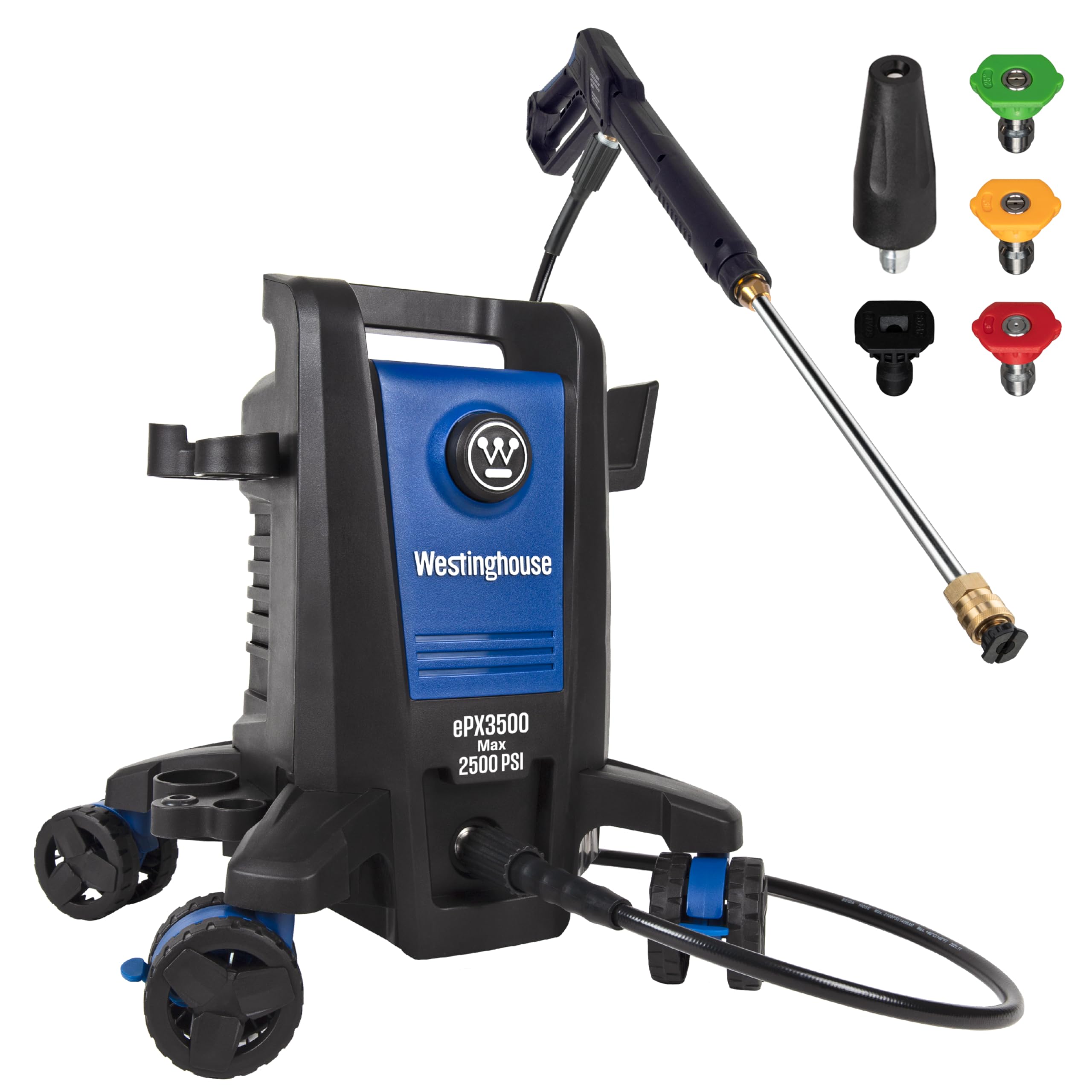
At 16.5 inches tall and 19 pounds, the ePX3500 is the machine we point first-time buyers to. It sits on four 360-degree casters with the motor mounted low, so it follows you down a driveway on its own wheels rather than being carried, and it doesn't lurch when the hose catches on a corner. Compare that with the 63-pound gas unit below, which wants a hand on the handle and a plan for where it's going to sit.

Westinghouse lists 2500 max PSI and 1.76 max GPM, then 2000 rated PSI and 1.2 rated GPM in the same breath — and it's the second pair you should hold against anything else on this page. That is enough to lift a season of algae off concrete, clear dirt from vinyl siding at a couple of feet of distance, and wash a car without reaching for a narrow tip. We were also impressed by the auto-stop pump: let go of the trigger and the machine goes quiet, so setting the wand down mid-job doesn't mean listening to it run.

Soap is the compromise. The 20-ounce tank is small for a whole car and the soap nozzle dilutes the mix heavily, so we reach for a foam cannon on the quick-connect wand instead and get a much thicker layer to work with. Beyond that the ownership picture is easy: three years of limited service, labor, and parts coverage, a 25-foot hose that handles one side of a car at a time, and a body that stores on a shelf. Give the hose its own ten minutes on the first job — it arrives tight and wants a few sessions before it lays flat.

Bottom line: If you want a car, a patio, and a stretch of siding cleaned without a machine that turns into a storage problem, this is the easiest one here to live with — and our default recommendation.

Check Latest Price
#02

Best Gas

Westinghouse WPX3400

91 /100
Kirk Score Outstanding
Engine
212cc 4-stroke
Weight
63 lb
Max Flow
2.6 GPM
Max Pressure
3400 PSI
Check Details on Amazon

Pros

  • 3400 PSI and 2.6 GPM for big concrete
  • No cord to manage across a driveway
  • 12-inch never-flat wheels and steel frame
  • Three-year limited warranty

Cons

  • Around 63 pounds before you add fuel
  • Loud, and it needs fuel, oil, and a dry carburetor

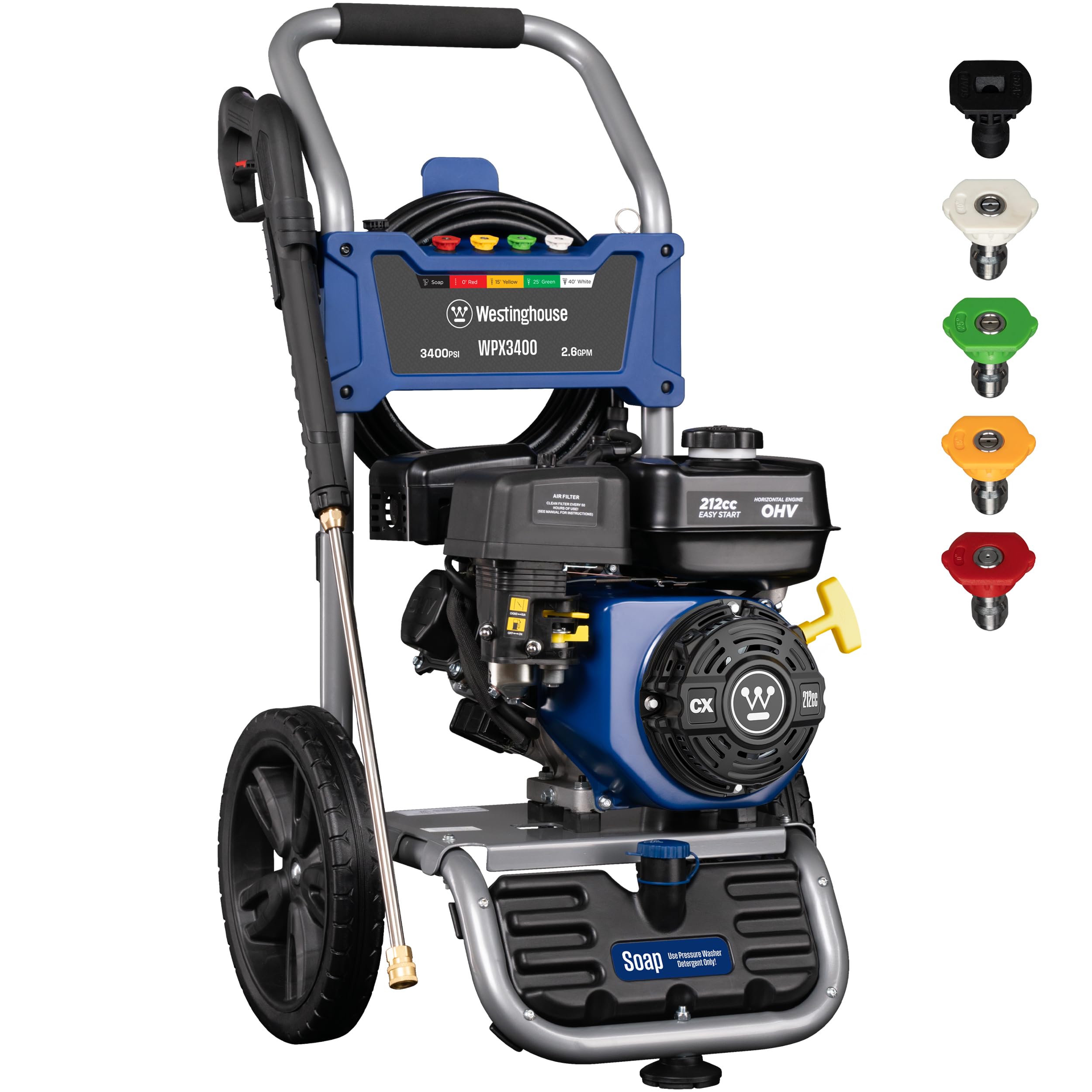
There's a stretch of stained concrete where an electric washer makes you patient and a gas one doesn't. At 3400 PSI and 2.6 GPM, the WPX3400 clears gray grime in one overlapping pass instead of three, and with no cord to chase you're working a straight line across a driveway rather than leapfrogging an extension cord. If square footage is the problem you're trying to solve, this is the pick here.

Everything an engine brings comes with it. The machine runs around 63 pounds before you add fuel, it's loud enough that the neighbors will notice, and it can't be run in a garage because of carbon monoxide. You're also signing up for the rituals — checking oil, filling the tank, running the carburetor dry before it goes into the shed. What you get in return is a steel frame on 12-inch never-flat wheels that rolls over lawn edges and gravel, and five quick-connect nozzles that cover the same range as the electric units here.

The hose and the brass fitting where the soap line meets the pump are the two places to watch; a spare reinforced hose is cheap insurance against losing a Saturday to a split line. Westinghouse includes the engine oil, a funnel, and the tools, so the first start happens the same afternoon the box arrives. The 25-foot hose matches the electrics — you're paying for flow and runtime here, not accessories.

Bottom line: When the job is a long run of stained concrete and a cord is the thing slowing you down, the WPX3400's flow and runtime are worth the fuel, the noise, and the weight.

Check Latest Price
#03

Best Cordless for Small Jobs

KEEPEAK Cordless Pressure Washer

79 /100
Kirk Score Very Good
Weight
2.18 lb
Max Flow
3.0 GPM
Batteries
Two 4.0Ah
Max Pressure
1450 PSI
Check Details on Amazon

Pros

  • Two 4.0Ah batteries, no outlet needed
  • 2.18 pounds with a hard storage case
  • Adapters for faucet, bucket, pool, or hose
  • 6-in-1 nozzle and foam cannon in the kit

Cons

  • Runtime is about 30 minutes per pair of batteries
  • Short 5-meter hose keeps you near the water source

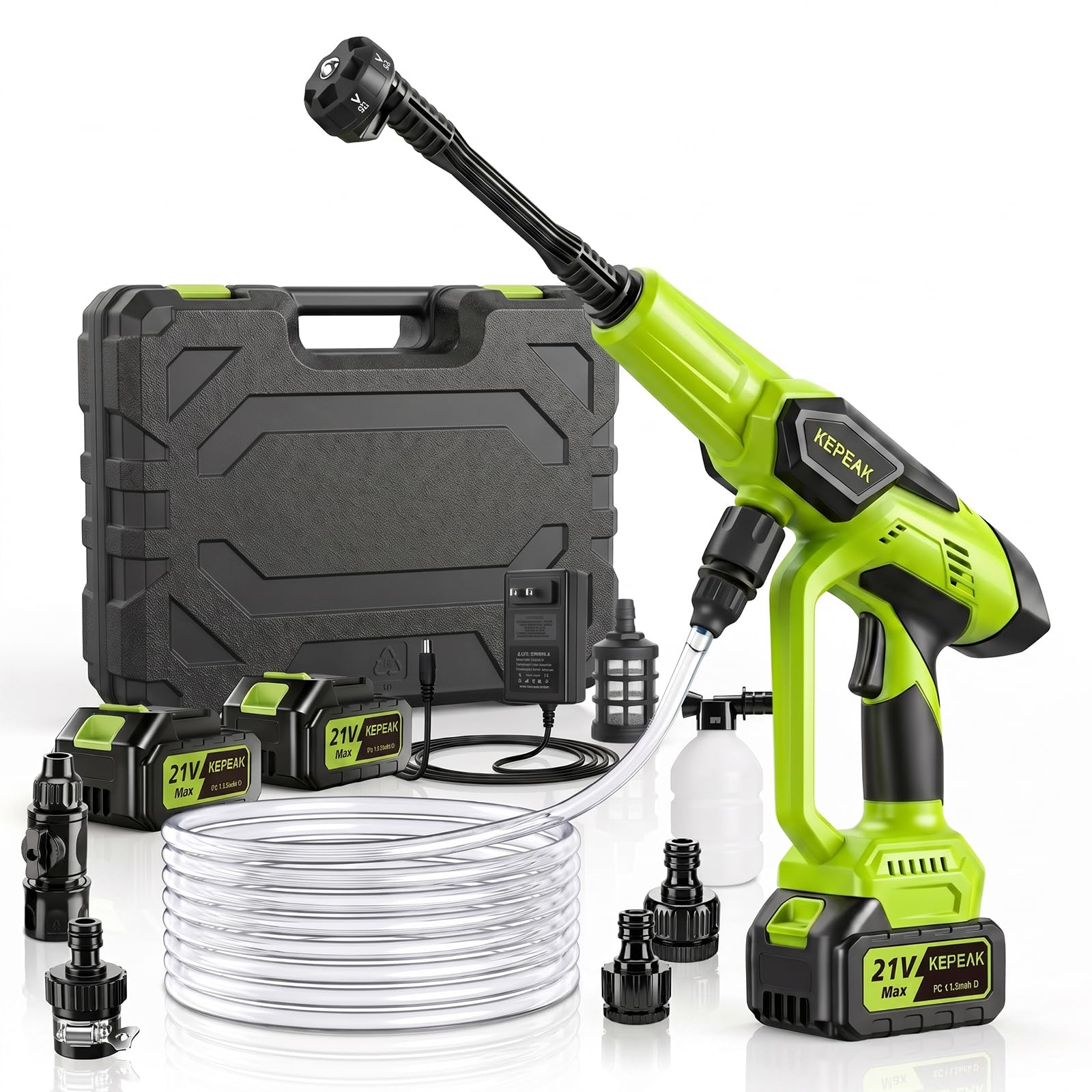
The kit arrives in a molded hard case sized more like a toolbox than a pressure washer: the unit, a foam cannon, a 6-in-1 nozzle, and two 4.0Ah batteries. The washer on its own weighs 2.18 pounds. Nothing else on this page packs down that small or runs without an outlet, which is the entire reason it's here.

A 1450 PSI machine is a car-wash and balcony tool, not a driveway tool, and that's exactly how it behaves. On its widest setting the 6-in-1 nozzle is a controlled rinse for patio furniture, screens, and garden tools; narrowed down it lifts road film and bug splatter off paint without the risk of a 0-degree tip. The listed 3.0 GPM is generous for a battery unit, so plan on the lower end of both figures as the charge drops.

The adapters are the genuinely clever part — faucet, bucket, pool, or garden hose — which is what makes it useful in a storage lot or a shared courtyard with no spigot anywhere. Because the washer weighs 2.18 pounds, you can carry it in one hand and guide the wand with the other, which stops mattering right up until you're crouching next to a wheel arch. Both batteries run off the same charger, so topping up the spare between jobs is the habit that makes the whole thing work.

Bottom line: For a car washed where there's no spigot and a balcony with no outlet, this is the only machine here that solves both problems — as long as you're not expecting driveway-grade pressure.

Check Latest Price

How We Tested Pressure Washers

We started by gathering the electric, gas, and battery-powered machines that turn up most often in owner reviews and on store floors, then cut the list by pressure and flow claims, price, footprint, and whether the thing was realistically storable in a garage. Ten made it through. Each one lived in my garage for eight months and was used the way a homeowner uses one, not the way a lab does.

We assembled every machine out of the box with a stopwatch running and the manual open, noting which ones needed tools, which ones fought us at the hose connection, and which had us washing within ten minutes. Power got measured in passes rather than numbers: how many slow strips it took to clear a section of concrete, whether the fan tip could lift mildew off a fence without chewing the wood, and whether a narrow turbo tip saved time or just made a mess of the siding.

Nozzle changes and soap got the same treatment. We swapped tips with wet hands, refilled onboard soap tanks mid-job, and watched whether the siphon actually pulled detergent or just dribbled it onto the concrete. Compact size mattered at the end of the day, when we had to haul each unit up a step and find it a home on a shelf — weight with a full tank counted for far more than weight in the box.

Durability was the last thing we judged and the one that moved rankings the most. After eight months we checked every fitting for weeping, every trigger for stiffness, every o-ring and nozzle for scoring, and whether the storage setup kept the accessories where we'd left them. Value came down to how many of those jobs a machine could handle without asking anything extra of us.

How to Choose a Pressure Washer

Rated pressure beats the headline number

Every listing leads with max PSI, but that figure is taken with the machine barely moving water. Look for the rated pressure and rated flow: the ePX3500, for example, is sold as 2500 PSI but rated at 2000 PSI and 1.2 GPM. When only a max figure is published, expect the number you actually clean at to sit meaningfully below it.

Multiplying the two together gives a rough sense of cleaning speed, because pressure loosens grime and flow carries it away. For a car, a patio, and siding, a rated 2000 PSI is plenty — spending up buys you speed on large concrete, not a cleaner car.

Electric, gas, or battery

Corded electric is the value choice: no fuel, no oil, no pull start, and the most pressure per dollar. The catch is that the cord sets your working radius, and a big property means moving the machine and the extension cord together. Gas buys unlimited runtime and real flow — the WPX3400's 2.6 GPM — in exchange for weight, noise, exhaust, and upkeep.

Battery sits at the other end. It frees you from cords and spigots entirely, which is the right answer for a balcony, a storage lot, or a shared courtyard, as long as you accept lower pressure and roughly half an hour of run time per charge. Match the power source to where the water and the power actually are, not to the spec sheet.

Wheels, reach, and where it lives

Weight matters less than how the machine moves. A 19-pound unit on four swivel casters follows you around a driveway; a 63-pound gas unit on 12-inch wheels rolls over lawn edges but wants a hand on the handle. Add the hose length to the cord length to get your real working radius — 25 feet of hose disappears once it's looped around a car — and plan on repositioning the machine once or twice per job.

Measure the shelf or corner you intend to store it in before you order. A 16.5-inch-tall body slots under a workbench; a steel cart on 10-inch wheels needs floor space of its own. Compact in a listing means it fits somewhere, not that it cleans a long driveway.

Nozzles, soap, and the surface in front of you

Red 0-degree tips are for concrete and nothing else — that stream will etch wood, strip paint, and dull car paint. Start at 25 degrees on siding and keep a couple of feet of distance, drop to 15 degrees for stained concrete, and save 40 degrees for rinsing and gutters.

Soap tips dilute detergent heavily, so a foam cannon on the quick-connect wand gives you a far thicker layer for car washing. If a driveway is the main event, budget for a surface cleaner: it's almost always sold separately, and it needs decent flow to spin properly.

Frequently Asked Questions

Final Verdict

The ePX3500 is the one we point most people to: 2000 rated PSI in a 19-pound body that rolls on four casters, with three years of coverage behind it. It handles the car, the patio, and the siding without turning into a storage problem.

Step up to the WPX3400 when your cleaning is measured in long runs of stained concrete rather than a car and a patio — the extra flow and the missing cord are worth the noise, the fuel, and the weight. And if there's no spigot or outlet anywhere near where you park, the KEEPEAK is the only machine here that solves that.