// data-verified

Best Jumper Cables of 2026

A dead battery never picks a convenient moment. It's a dark parking lot after a late shift, or a cold morning when the starter clicks and the dash lights dim. Good jumper cables turn that into a ten-minute inconvenience instead of a tow truck — provided the set in your trunk reaches the other car, carries enough current, and clamps down hard enough to stay put while you're standing in the rain.

We've spent six months jumping cars with 14 sets, and the differences show up fast. Gauge numbers run backward, so a 4-gauge is thicker than a 6-gauge and a 0-gauge thicker still — that thickness is what carries current into a big engine. Length cuts both ways: extra feet buy reach but add weight and a little voltage drop, and a heavy coil is no fun to untangle in the dark.

The picks below are the ones that clamped without slipping, came with a bag that survived the trunk, and still looked sound after months of use. Some suit a compact sedan, others a diesel truck — it depends what's parked outside.

#01

Best Overall

Cartman 4-Gauge 20 ft

96 /100
Kirk Score Outstanding
Length
20 feet
Included
Carry bag, gloves, terminal brush
Wire Gauge
4 gauge
Coiled Weight
5.47 lb
Check Details on Amazon

Pros

  • Twenty feet of reach for awkward parking
  • 4-gauge wire suits SUVs and half-ton trucks
  • Clamps fit top- and side-post terminals
  • Gloves and terminal brush included

Cons

  • Cold rating stops at -13°F

Twenty feet of 4-gauge cable is what earns this set the top spot. That length covers the situations that actually strand people: batteries on opposite corners of two engine bays, a car parked at an angle on a shoulder, a van with the battery tucked behind a seat. And 4-gauge is thick enough that a full-size SUV or a half-ton pickup does not sit there cranking while the cable warms up. Sets that undercut this one on price are almost always shorter, thinner, or both.

The clamps are what we kept coming back to. They are rubber-insulated and open wide enough to sit on a top post or grip a side-post terminal, which is the difference between a two-minute jump and ten minutes of working around a plastic battery cover. The springs hold tension, and the jaws have real teeth rather than a smooth stamping, so a clamp stays where you set it while you walk to the other car.

At 5.47 pounds it disappears into a trunk, and it ships with a bag, a pair of gloves, and a terminal brush. The brush is the underrated part of the kit. A dirty post will waste a jump no matter how good the cable is, and most sets leave you scrubbing at a corroded terminal with a rag while the light goes flat.

Where it stops is engine size. On a diesel work truck or a tractor, 4-gauge will labor and the 0-gauge sets further down are the right call. For everything a passenger car, SUV, or half-ton pickup asks for, this is the set we hand people, and it is affordable enough that putting one in each vehicle is not a decision worth agonizing over.

Bottom line: The set we recommend to most drivers: 20 feet of 4-gauge, clamps that fit top- and side-post terminals, and a terminal brush in the bag.

Check Latest Price
#02

Best Budget

Energizer 16 ft 6-Gauge

96 /100
Kirk Score Outstanding
Length
16 feet
Wire Gauge
6 gauge
Cold Rating
-40°C
Coiled Weight
3.67 lb
Check Details on Amazon

Pros

  • Low price for a 16-foot set
  • Stays flexible down to -40°C
  • Light enough to leave in the trunk
  • Long record of reliable, simple use

Cons

  • Case is tight and can tear at the seam

Six-gauge wire is the thinnest cable in this guide, and the Energizer set is priced accordingly. That is not a knock so much as a design brief: 16 feet of 6-gauge, spring clamps with vinyl-coated handles, a carry bag, and 3.67 pounds that you will not notice tucked beside the spare tire.

What that buys and what it costs. Six-gauge is fine for a four-cylinder or a V6 with a battery that is tired rather than stone dead; it will be slower and warmer on a big V8 or a battery that has been flat for a week. The 16-foot length is the practical minimum, enough for two cars parked the ordinary way and not enough for a clever angle. The jacket is rated to stay flexible down to -40°C, which is better cold-weather behavior than several thicker sets here can claim.

So the pitch is simple: a small or mid-size car, a set that lives in the trunk, and no drama when a battery finally gives up in a parking lot in January. If there is a truck in the driveway, spend more and get 4-gauge. If there is not, this is the one we would buy and then forget about until it matters.

Bottom line: Buy this if you drive a compact or mid-size car and want a decent set in the trunk for the few times a decade you need one.

Check Latest Price
#03

Best Warranty

TOPDC 4-Gauge 20 ft

96 /100
Kirk Score Outstanding
Length
20 feet
Warranty
5 years
Wire Gauge
4 gauge
Coiled Weight
5.15 lb
Check Details on Amazon

Pros

  • Five-year quality guarantee
  • 4-gauge wire with 20 feet of reach
  • Jagged jaws with stiff springs

Cons

  • No gloves or terminal brush included

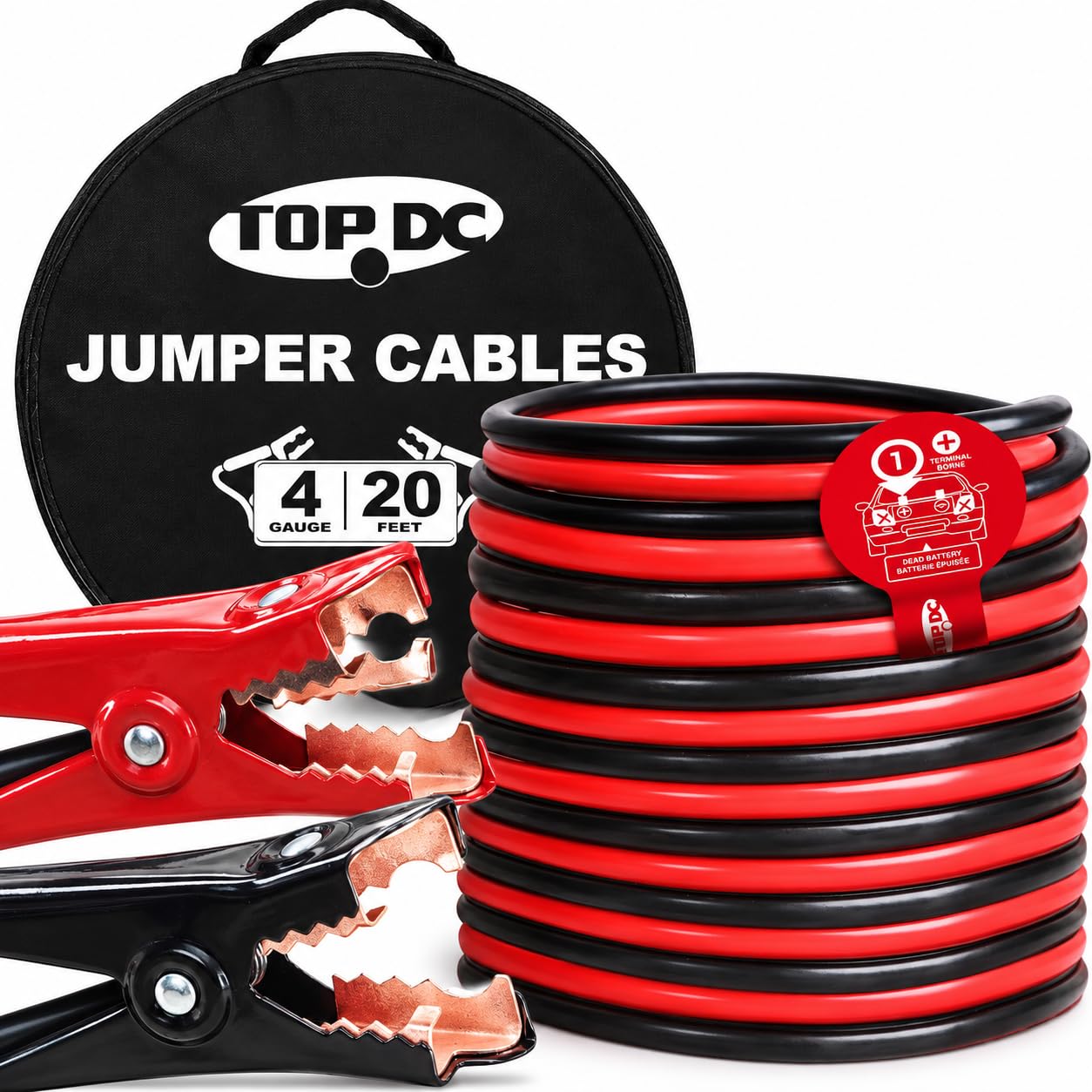
TOPDC's set is the nearest thing here to a twin of our top pick: same 4-gauge wire, same 20 feet, same kind of carry bag, and a price that lands in the same bracket. On paper the two are hard to tell apart, which is why the small differences decide it.

The clamps are four alligator jaws with jagged teeth and stiff springs, the kind that bite into a post and stay there. The PVC jacket is sold as resistant to freezing, cracking, and folding, and the 5.15-pound coil feels dense rather than hollow when you pick it up. Grip and reach are not where this set loses anything.

What is in the box is shorter: you get the bag, not the gloves and the terminal brush. That matters less than it sounds until the first time you are cleaning a corroded post with your sleeve, but it is the honest trade if the two sets are sitting next to each other.

The reason to pick it anyway is the five-year quality guarantee, easily the longest coverage in this group, and exactly the thing you want on a product that lives under a seat and gets pulled out twice a year in the rain. Choose on that promise or on the extras in the bag; either way you end up with 4-gauge and 20 feet.

Bottom line: Buy it for the five-year guarantee on a 4-gauge, 20-foot set; buy the top pick instead if you want gloves and a brush in the bag.

Check Latest Price
#04

Best for Diesel Trucks

NOONE 0-Gauge 25 ft

94 /100
Kirk Score Outstanding
Length
25 feet
Wire Gauge
0 gauge
Peak Current
1000 A
Coiled Weight
11.3 lb
Check Details on Amazon

Pros

  • Alarm warns and cuts current on reversed hookup
  • 0-gauge, 1000-amp hardware for big engines
  • 25 feet of reach
  • Gloves, brushes, and goggles included

Cons

  • Eleven-pound coil takes real trunk space

Hook these up backwards and they tell you: a red light comes on, a buzzer sounds, and the current cuts out. That one feature is why this set is here. If you are the person in the family everyone calls, or you jump strangers in parking lots, the alarm is worth more than the difference in price between this and a bare 0-gauge set.

The rest of it is diesel-grade hardware. Zero-gauge conductors, 25 feet of reach, and a 1000-amp peak rating, with rubber-covered clamps that are big enough to swallow a heavy-duty post. On a cold morning with a flat battery in a work truck, that extra metal is doing real work rather than sitting in the trunk looking serious.

The kit is more complete than most: gloves, brushes, and goggles, all in a bag that takes the coil without a fight. Goggles are the item you did not know you wanted until you are leaning over a battery in the dark with your face a foot from the terminal.

Bottom line: The set to buy if you jump diesels or other people's cars: 0-gauge current and an alarm that cuts power when the clamps go on backwards.

Check Latest Price
#05

Best for Small Trunks

Goodyear 4-Gauge 16 ft

95 /100
Kirk Score Outstanding
Case
PVC hard case
Length
16 feet
Wire Gauge
4 gauge
Coiled Weight
4.66 lb
Check Details on Amazon

Pros

  • Hard case fits small trunks
  • Lightest 4-gauge set in this group
  • Real 4-gauge wire, not 6- or 8-gauge

Cons

  • Reach stops at 16 feet

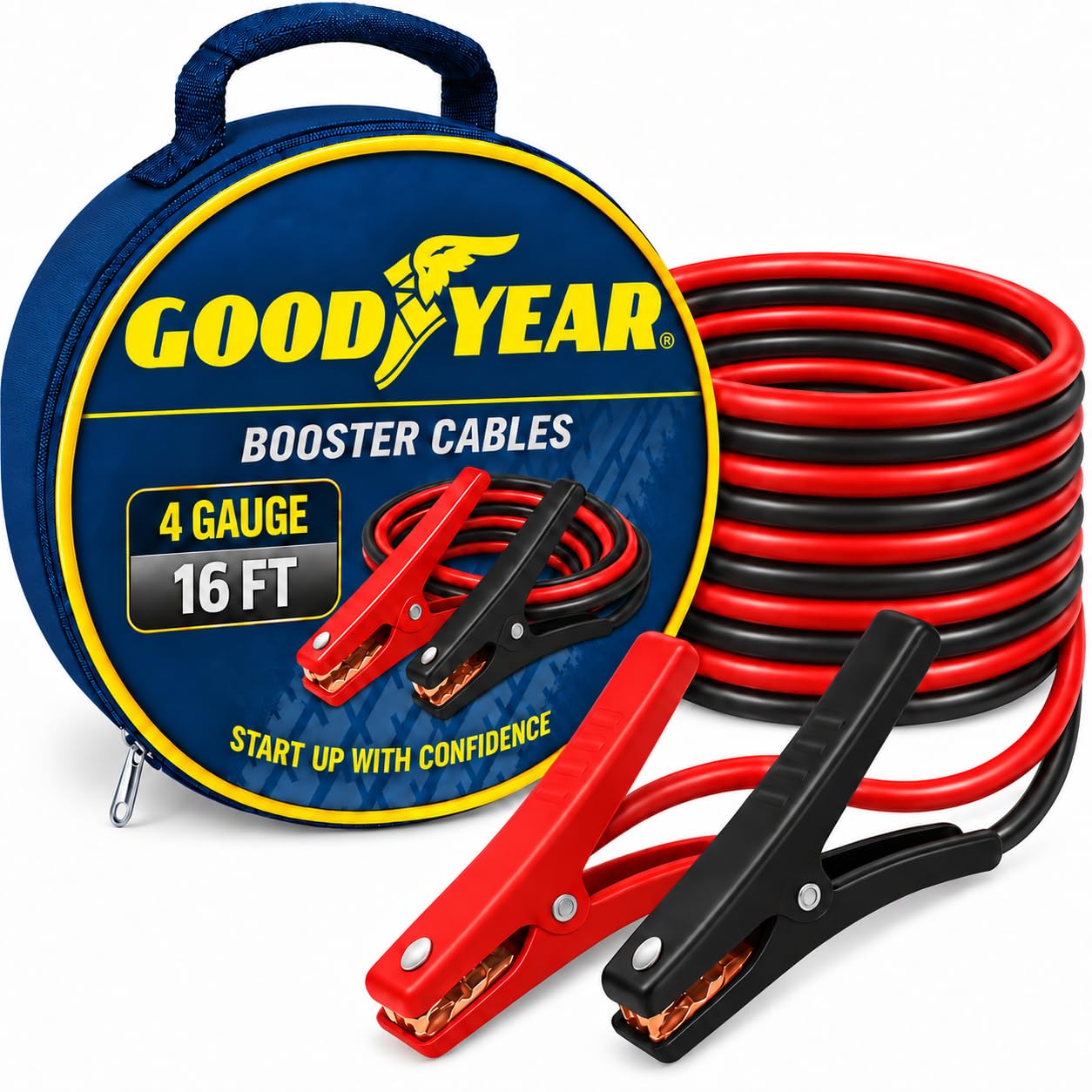
A hard PVC case is unusual in a category where most sets arrive in a nylon sack, and it is the reason this Goodyear set is worth a look when the trunk is already full. It wedges beside a hatchback's wheel arch instead of sliding around on top of the groceries, and it will not let the clamps poke through the side.

Inside is 16 feet of 4-gauge cable with PVC insulation. At 4.66 pounds it is the lightest 4-gauge set here, light enough that it stays in the car rather than migrating to a garage shelf after the first flat battery. The clamps grip properly, and 16 feet covers two cars parked the ordinary way.

That hard case has a sting. It is sized tightly, so getting the coil back in takes a couple of tries with the clamps held in the middle and the cable wound around them. You learn the knack after the first jump, but this is not the set you stuff back into a case in a hurry at the side of a road.

Buy it for the footprint, then. If your priority is a set that fits where nothing else does, this is the one worth the repacking ritual. If you want to pack up without thinking about it, a soft bag is the easier life, and the top pick is where to find one.

Bottom line: Buy this if trunk space is the deciding constraint: a hard case that fits where a soft bag will not, with genuine 4-gauge cable inside.

Check Latest Price
#06

Best Long-Reach Value

HORUSDY 25 ft 1-Gauge

94 /100
Kirk Score Outstanding
Length
25 feet
Wire Gauge
1 gauge
Peak Current
800 A
Certification
ETL listed
Check Details on Amazon

Pros

  • 25 feet of 1-gauge reach
  • Reverse-polarity indicator with OK light
  • ETL certified
  • Copper clamps with strong bite

Cons

  • Bag is too small to repack easily

Twenty-five feet of 1-gauge cable with a reverse-polarity protector, for noticeably less than the 0-gauge sets here. That is the whole pitch, and it holds up: the step from 1-gauge to 0-gauge matters at the margins, while the gap in price is easy to feel.

The details back it up. ETL certification, an indicator that shows green when the connection is good, full-copper clamps with a real bite, and a PVC jacket sold as staying pliable in cold weather. At 9.52 pounds it is heavy enough to feel like equipment and light enough to lift out of a trunk one-handed.

The bag is the weak point. It is small, and coaxing 25 feet of 1-gauge back into it takes patience and a decent coil. We would still pay that price for the reach, because this is the set for someone who wants long-cable ability and a wrong-hookup warning without moving into the top price bracket.

Bottom line: A long-reach set for someone who wants 25 feet and reverse-polarity protection without paying premium 0-gauge money.

Check Latest Price
#07

Maximum reach

POADTOR 0-Gauge 30 ft

91 /100
Kirk Score Outstanding
Length
30 feet
Wire Gauge
0 gauge
Engine Range
8L gas, 6L diesel
Peak Current
1000 A
Check Details on Amazon

Pros

  • 30 feet reaches equipment nothing else here can
  • 0-gauge, 1000-amp rating for large engines
  • Extra-thick PVC sheath

Cons

  • Clamps feel lighter than the cable deserves

Thirty feet is the longest cable here by five feet, and it exists for one scene: a truck that cannot get within 25 feet of the machine that needs a boost. Equipment yards, a trailer buried behind a shed, a car nose-first into a snowbank with no room to maneuver another vehicle alongside.

If that is your life, the length earns its keep, because nothing else in this group reaches that far. If you park in a driveway and jump a sedan twice a winter, you are paying for cable you will never uncoil, and a 20-foot set does the same job for less.

The rest is 0-gauge, 1000-amp hardware rated for 8-liter gas and 6-liter diesel engines, with serrated clamp teeth and an extra-thick PVC sheath. The clamps feel lighter in the hand than the cable would suggest, which is the compromise we noticed, and it is the sort of thing that matters most when a terminal is awkward to reach.

Bottom line: The set for someone who cannot park next to what needs jumping: 30 feet of 0-gauge, and the length is the entire reason to buy it.

Check Latest Price
#08

Compact cars

NOONE 10 ft

91 /100
Kirk Score Outstanding
Length
10 feet
Voltage
12/24 V
Peak Current
200 A
Coiled Weight
1.7 lb
Check Details on Amazon

Pros

  • 1.7 pounds fits a glovebox
  • Lowest-priced set recommended here
  • Rubber-covered clamps and handles

Cons

  • 200-amp rating suits small engines only

Ten feet is short. It works when the two vehicles are nose to nose or side by side, and it stops working the moment either one is parked at an angle, which at the side of a road is most of the time. If you cannot guarantee a tight pairing, the extra length on any other set here is the better spend.

Within that limit, this is a reasonable glovebox set. It weighs 1.7 pounds, the handles are rubber-covered, and it is the least expensive way here to have cables in the car at all. In a compact hatchback or a small coupe, where you park close and the battery is small, it is enough.

The rating tells you the rest: 200 amps peak for 12- or 24-volt systems, which is small-engine territory. Treat it as the set that gets a four-cylinder started on a cold morning and do not ask it to pull a truck out of trouble, because the wire and the clamps are built to that smaller job.

Bottom line: The cheapest way to keep cables in a small car, as long as you can count on parking nose to nose when the battery dies.

Check Latest Price

How We Tested Jumper Cables

We started with a few dozen sets and narrowed them by gauge, length, clamp construction, whether a carry bag came in the box, and price, landing on 14 to test. The range ran from a 10-foot, 6-gauge set up to a 30-foot, 0-gauge kit, which let us compare how much cable and copper you actually get at each end of the market.

For six months those sets lived in trunks and under seats and came out whenever a battery died: my driveway on a Sunday, a colleague's car in an office garage, a neighbor's truck on a 20-degree morning. We timed each jump from opening the bag to pulling the clamps off, and noted how long a cold coil took to untangle.

Clamping got its own check. We hooked each set to a battery post, gave the jaws a firm pull, and watched whether they shifted or bit in. We also looked at how clearly the jaws were marked for positive and negative, and how the reverse-polarity protection on the sets that offer it behaves if you cross the leads.

After every few jumps we ran a finger along the jacket for nicks, checked the clamps for corrosion, and felt the cable insulation for warmth. We weighed each set and tried packing it into a spare-tire well, because a set that won't fit where you keep it is a set you leave at home. Value came down to gauge, reach, and hardware rather than sticker price alone.

How to Choose Jumper Cables

Match the Gauge to the Engine

Gauge measures wire thickness, and the numbers run backwards: 8-gauge is thin, 4-gauge is substantial, 0-gauge is a garden hose. Thin cable has more resistance, so it heats up and delivers less current, which shows up as a slow, labored crank on a big engine. Six- and 8-gauge sets are fine for compact and mid-size cars. For a full-size sedan, an SUV, or a half-ton pickup, 4-gauge is the sensible floor.

If you drive a diesel, jump equipment, or jump other people's cars regularly, 1- and 0-gauge sets earn their extra weight. Every set recommended here uses copper-clad aluminum conductors, which is standard in this price range and fine for occasional jumps; pure copper is better and costs accordingly.

Buy More Length Than the Parking Space Suggests

Reach is about geometry. Ten feet only works nose to nose or side by side. Sixteen feet covers most ordinary parking. Twenty to 25 feet lets you stay out of a traffic lane or work with one car angled into a spot, and that is the range we would choose for a vehicle that gets driven on highways. If the battery sits on the far corner from the other car's, add five feet to whatever you were planning.

The catch is that longer, thicker cable is heavier and takes longer to coil, so a 30-foot set is a specialist's tool rather than a default. Buy the length your parking habits actually require, not the longest number on the shelf.

Look at the Jaws and the Jacket, Not the Color

Clamp jaws need to open wide enough for the terminal in front of you. Top posts are easy; side-post and recessed terminals are not, and a jaw that will not clear the post forces you onto the bolt that holds it. Stiff springs and rubber-covered handles matter too, because a clamp that slips off a post while the other end is live is the moment people remember.

Cold is the other test: PVC stiffens, and cable that will not bend is miserable to route around an engine bay. Look for a stated low-temperature rating; the sets here range from -13°F to -40°F. If you are buying for someone who rarely jumps a car, reverse-polarity protection is worth paying for, since it warns and cuts the current when the clamps go on the wrong posts.

The Bag Decides Whether They Stay in the Car

Cables that will not go back into their case end up loose in the trunk, tangled around a jug of washer fluid, and eventually left in the garage. Check that the case is sized for the coil rather than just the clamps; a hard case saves space but demands a tidier coil, while a soft bag forgives a hurried one and can tear at the seam.

Extras are worth a look as well. Gloves keep battery acid and grime off your hands, goggles sound like overkill until you are leaning over a bubbling battery, and a terminal brush is the most useful item in any kit, because a dirty post wastes a jump no matter how good the cable is.

Frequently Asked Questions

Final Verdict

The Cartman 4-gauge 20-foot set is what we tell most people to buy. It has the reach for awkward parking, thick enough wire for an SUV or half-ton pickup, clamps that fit whichever terminal your car has, and a kit that includes the brush most sets leave out.

Two changes move the recommendation. Jump diesels, a tractor, or other people's vehicles often, and the NOONE 0-gauge 25-footer adds reverse-polarity protection and diesel-grade current, at the cost of eleven pounds in the trunk. Keep the cables in a compact car and the Energizer covers that job for less, as long as you accept its thinner 6-gauge wire.