// data-verified

Best Jump Starters of 2026

A dead battery never picks a good time. It usually happens in a dim parking garage after a late shift or on a cold morning when you are already running late. A jump starter turns that moment from a tow-truck wait into a short, self-contained fix, provided it has enough power, holds its charge, and is light enough to actually keep in the car. We spent six months with 12 jump starters, from compact glovebox units to larger power-bank-style boxes, and the differences showed up fast.

The spec sheet is only part of the story. A bright display, light, and USB ports are handy, but the clamps, cable length, and how a unit behaves after weeks in a trunk matter more. I also came to care about weight and packed size more than I expected—if a jump starter is a hassle to carry, it stays home. The picks below are the ones that balanced real jumping power with the battery life, durability, ease of use, and value that make them worth keeping close.

#01

Best Overall

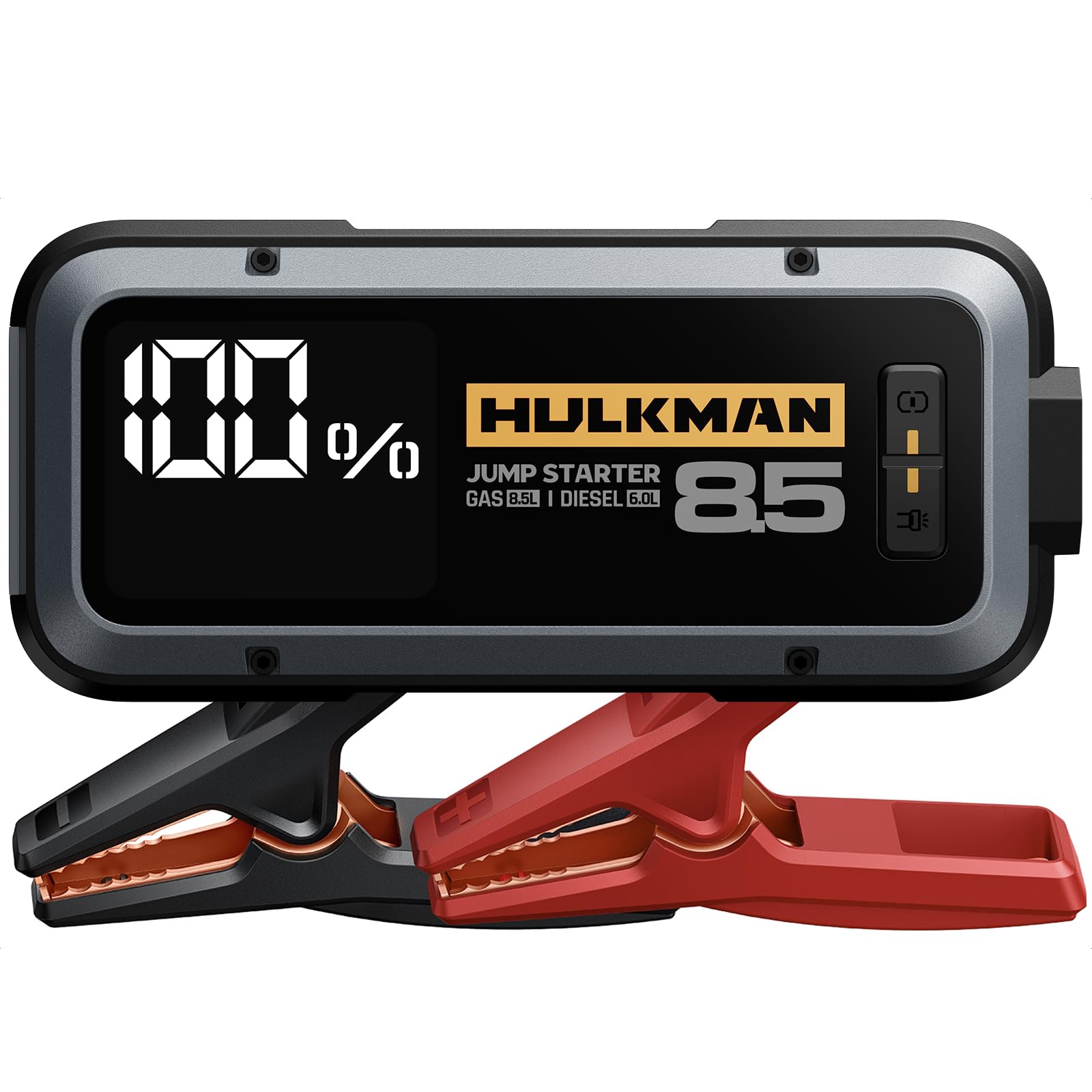
Hulkman Alpha85

95 /100
Kirk Score Outstanding
Weight
4.5 lb
Peak Amps
2000 A
Rated Engines
8.5L gas / 6.0L diesel
Recharge Time
0% to 80% in 1 hour
Check Details on Amazon

Pros

  • Full charge in about 90 minutes
  • Screen shows charge level and errors
  • Rated for 8.5L gas and 6.0L diesel
  • Two-year warranty

Cons

  • No carrying case in the box
  • 4.5 pounds, heavier than the compact picks

Ninety minutes on the charger takes the Alpha85 from empty to full, and the 3.3-inch screen tells you exactly where the pack stands before you open the hood. That pairing is why it's our pick. A jump starter spends most of its life doing nothing in a trunk, so the two things that decide whether it saves your morning are whether it kept its charge and whether you can tell that it did, and this one answers both in numbers rather than four cryptic blinking lights.

The output holds up its end too: 2000 peak amps and a rating of 8.5 liters of gas or 6.0 liters of diesel, which covers a compact car, a V6 crossover, and a full-size pickup without asking you to do displacement math at the side of the road. The clamps are the smart, spark-proof type with ten layers of protection and a manual override for a battery too flat to be recognized. We've hooked it up in the dark without drama, which is about the highest compliment jumper clamps can earn.

At 4.5 pounds and roughly nine inches long it isn't the smallest box on this list; it slides under a seat or into a door pocket and that's the end of it. The clamps, a 65-watt wall charger, and a USB-C cable all come in the box, and the screen keeps reporting when you plug a phone into the power-bank port.

The gap is the case, because there isn't one, so the clamps ride loose unless you supply a bag. Everything else is ready on day one, and the two-year warranty is the longest coverage in this group, which counts for something on a lithium pack that will spend its life in a hot trunk.

Bottom line: Buy the Alpha85 if you want one box that will start a commuter or a pickup and still show you a charge level months later.

Check Latest Price
#02

Best for Daily Drivers

NOCO Boost GB40

93 /100
Kirk Score Outstanding
Peak Amps
1000 A
Rated Engines
6.0L gas / 3.0L diesel
Recharge Time
3 hours
Starts Per Charge
Up to 20
Check Details on Amazon

Pros

  • Small enough for a glove box
  • Spark-proof, reverse-polarity clamps
  • Power bank and 7-mode light built in

Cons

  • Short jumper cables limit reach
  • One-year warranty is the shortest here

If you drive a sedan or a crossover and want the box to disappear into the glove box, this is the shape to look for. The GB40 comes with a microfiber bag, a 100-lumen light with seven modes including SOS, and a USB-C port for topping up a phone, so it earns its space even in the months it isn't jumping anything.

A 1000-amp rating and a 6.0-liter gas, 3.0-liter diesel ceiling are plenty for a four-cylinder or a V6, and the spark-proof, reverse-polarity clamps make a backwards connection close to impossible. That's why it's the box we teach people on. The catch sits between emergencies: a pack this size can sit for months and quietly lose its charge, and a flat jump box is a paperweight with a flashlight. Put a reminder in your phone every three months and glance at the charge indicator before a long trip.

The jumper cables are short, so a battery tucked under a cowl or behind a side-mounted terminal takes some patience, and the one-year warranty is the shortest in this group. Neither changes our view for a normal car, because being the least intimidating box here is worth more to most drivers than another thousand amps.

Bottom line: Buy the GB40 for a daily driver: it's small enough to live in the glove box and safe enough to hand to a teenager.

Check Latest Price
#03

Best Budget

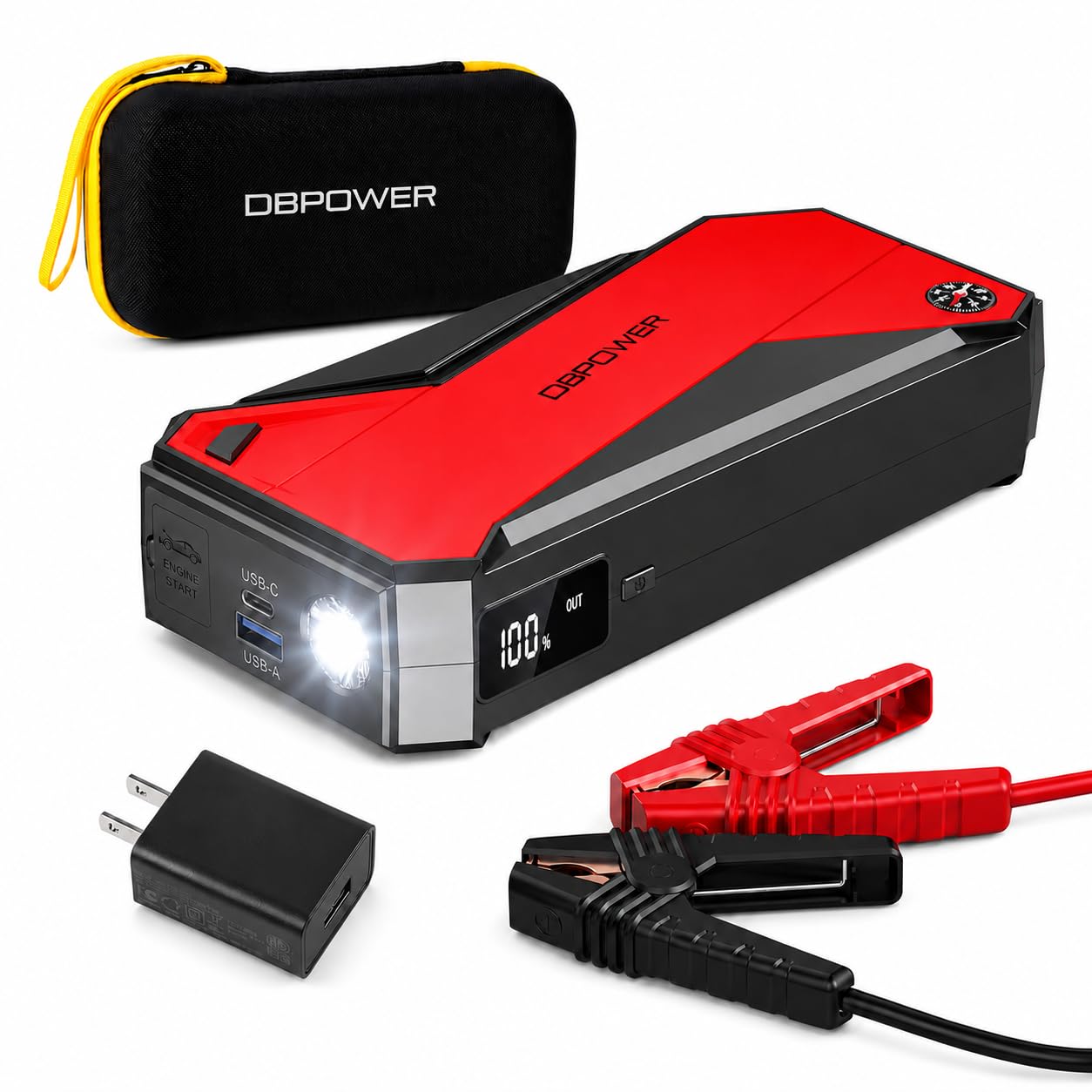
DBPOWER 3000A

91 /100
Kirk Score Outstanding
Weight
1.1 lb
Peak Amps
3000 A
Rated Engines
8.0L gas / 6.0L diesel
Battery Capacity
18000 mAh
Check Details on Amazon

Pros

  • Hard case, LCD, and light included
  • 1.1 pounds, the lightest pack here
  • 3000A rating at the lowest price here

Cons

  • Loses charge after months in storage

Bang for the buck is the whole argument here. For the least money in this group you get a hard case with room for the clamps and cables, an LCD showing how much charge is left, a light, USB ports, and a compass on the top that we have never once needed.

The 3000-amp rating and the 8.0-liter gas, 6.0-liter diesel ceiling are ambitious numbers for a 1.1-pound pack, and we treat them as a ceiling rather than a promise. This is the box for a four-cylinder commuter, a mower, or a motorcycle, not for rescuing a tired diesel on a January morning. Within that job it earns its place as a pack you can leave in a second car and forget about.

The case is the part we underrated. It keeps clamps, cables, and the charging cord together instead of tangling in a grocery bag, which is how cheap jump starters usually end up lost or damaged. For a teenager's first car, a weekend vehicle, or a boat trailer, that tidy package near the bottom of this group's price range is a sensible place to start.

Bottom line: The cheapest way into a real jump starter: light, well equipped, and up to the job on a four-cylinder car.

Check Latest Price
#04

Best for Big Diesels

GOOLOO GP4000

93 /100
Kirk Score Outstanding
Weight
3.9 lb
Peak Amps
4000 A
Rated Engines
All gas / 10.0L diesel
Battery Capacity
24000 mAh
Check Details on Amazon

Pros

  • 4000A with a 10L diesel rating
  • 24,000 mAh doubles as a power bank
  • EVA case and 12V adapter included

Cons

  • Durability trails the rest of this group

Four thousand peak amps is the headline, and the number it buys that actually matters is a 10-liter diesel rating, the equal of the WOLFBOX and the highest diesel ceiling in this group. If you're cranking a farm truck, a box van, or a diesel pickup that has been parked since spring, that headroom is the whole reason to look here.

The 24,000 mAh battery is a serious power bank in its own right, a cigarette-lighter adapter lets you recharge from the vehicle, and the whole thing rides in an EVA case at 3.9 pounds. Ten protection circuits and metal clamps keep it in the same safety conversation as boxes that cost more.

What you're buying is cranking power per dollar rather than long-term polish, and the dimensions that suffer are covered in the list below. The 18-month warranty is longer than NOCO gives on its compact box, which is a fair signal about how the two companies view their own batteries. Top it up monthly, run a test jump before winter, and it does the job it was bought for.

Bottom line: Buy the GP4000 when you need 10 liters of diesel capability and would rather spend the difference on fuel.

Check Latest Price
#05

Best for Cold Weather

WOLFBOX MegaVolt24

93 /100
Kirk Score Outstanding
Weight
3 lb
Peak Amps
4000 A
Rated Engines
10.0L gas / 10.0L diesel
Operating Range
-4 to 140°F
Check Details on Amazon

Pros

  • Stated -4 to 140°F operating range
  • 65W PD charger in the box
  • LCD plus one-touch boost

Cons

  • Fewer starts per charge than the listing claims

The MegaVolt24 is the only box here that publishes an operating range: -4 to 140°F. For a car that sits outside through a Minnesota winter or an Arizona summer, that line on the specification list isn't a footnote, it's the reason to pick this one over a cheaper pack with no stated limits.

Behind the rating sits 4000 peak amps, a 10-liter gas and diesel ceiling, an 88.8-Wh battery, and an HD LCD that reports charge and status in plain numbers. A one-touch boost handles a battery too flat for the clamps to recognize, and the kit includes a 65-watt PD charger rather than a phone-sized brick that takes all night.

It carries like a tablet at 3 pounds and about nine inches long, and the USB-C port runs both directions, so one cable charges the pack and then charges a laptop. The caution is the one that applies to every lithium box and to this one more than most: leave it sitting for months and it can be flat when you unzip the case. Check the gauge the night before a trip and it won't surprise you.

If your car sleeps in a heated garage, the temperature rating buys you nothing and the Alpha85 is the better spend. If it doesn't, this is the box, and the screen and fast charger make everyday ownership easier than the raw numbers suggest.

Bottom line: For a car that parks outside in real winter, the MegaVolt24's stated temperature range and readable display make it the one to buy.

Check Latest Price
#06

Best for Shops and Fleets

Clore JNC660

93 /100
Kirk Score Outstanding
Weight
18 lb
Battery
22Ah AGM
Peak Amps
1700 A
Cable Length
46 in.
Check Details on Amazon

Pros

  • 22Ah AGM battery and 46-inch cables
  • Voltmeter and 12V DC socket
  • Serviceable, replaceable internal battery

Cons

  • 18 pounds and it wants a shelf near an outlet

Eighteen pounds is either the reason to buy the JNC660 or the reason to walk past it, and we lead with it because everything else follows from that weight: a 22Ah AGM battery, 46 inches of number 2 gauge cable, and a case built to be dragged across a shop floor. This is the professional's jump box, not the glove-box one.

The output is 1700 peak amps, and a voltmeter on the front tells you the state of the internal battery without a charger or a phone. A 12-volt DC socket runs a work light or an inflator. Two practical notes: no charging cord comes in the box, so plan on an extension cord, and the one-year warranty is short for something built this heavily.

Where it earns its keep is routine, high-volume use. A shop likes a box that can be topped up on a bench charger, left in a cold truck between calls, and re-battered instead of retired when the battery finally gives up, because the lead-acid cell inside is a serviceable part rather than a sealed one. For a commuter car that needs help twice a year, all that iron is dead weight.

Bottom line: Buy the JNC660 if the box will be used weekly in a shop, a fleet, or a plow truck rather than twice a year in a driveway.

Check Latest Price
#07

Occasional use

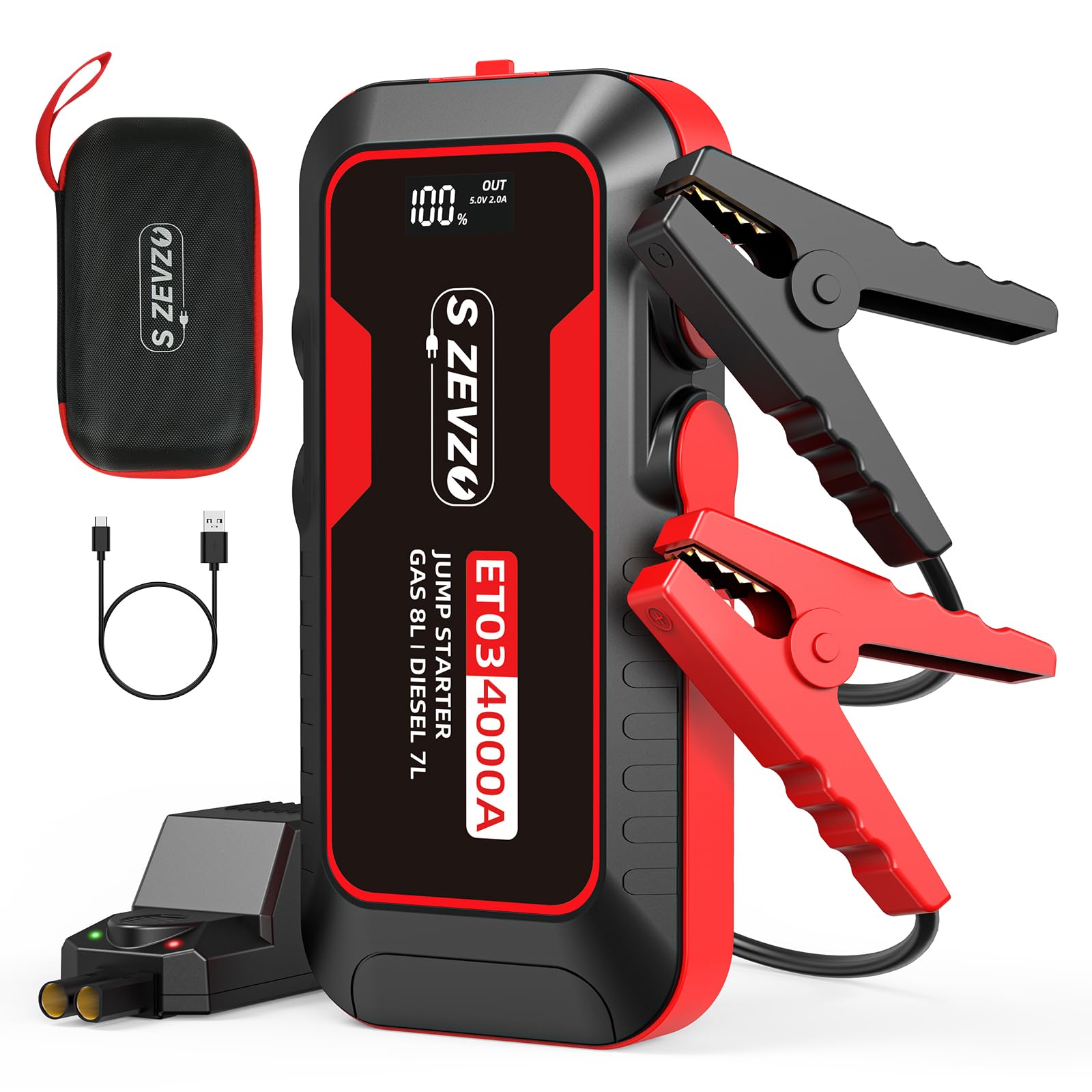
S ZEVZO ET03

93 /100
Kirk Score Outstanding
Weight
1.4 lb
Peak Amps
4000 A
Rated Engines
8.0L gas / 7.0L diesel
Battery Capacity
74 Wh
Check Details on Amazon

Pros

  • Force-start for zero-volt batteries
  • 4000A and a 7L diesel rating in 1.4 pounds
  • 74-Wh power bank, 500-lumen light, case

Cons

  • Charging is the weak spot
  • Long-term durability trails the group

A battery flat enough to read zero volts won't wake up a smart clamp, and that's the situation the ET03 was built for: its force-start function lives in the clamps and pushes power into a battery the electronics would otherwise refuse to touch.

The rest of the package is the best value in this group. A 4000-amp peak rating and an 8.0-liter gas, 7.0-liter diesel ceiling come in a 1.4-pound body, with a 74-Wh battery, a 500-lumen light, USB ports, and a carrying case. That's near the top of this set for cranking capability and near the bottom for weight, a harder combination to pull off than the price suggests.

The soft spot is staying power. Charging is where this one is least convincing, and a pack that won't take a full charge is the failure to watch for. The two-year warranty covers early failures; a monthly top-up and a test jump before a road trip cover the rest.

There's a second use worth knowing about: the 74-Wh battery and USB ports make it a decent camping power bank, and the 500-lumen light is bright enough to work by. For a camper, a second car, or a kid heading off to college, that's a lot of utility in a package that fits a seat pocket.

Bottom line: Buy the ET03 if you want big-box cranking power in a seat-pocket package and you'll actually check its charge.

Check Latest Price
#08

Long road trips

TOPDON JS3000

93 /100
Kirk Score Outstanding
Peak Amps
3000 A
Light Output
400 lumens
Rated Engines
9L gas / 7L diesel
Battery Capacity
24000 mAh
Check Details on Amazon

Pros

  • IP54 fire-resistant enclosure
  • 100% copper clamps
  • DC port plus PD45W USB-C

Cons

  • The most expensive box in this group

The enclosure is what separates the JS3000 from the rest of this list: an IP54-rated, fire-resistant case with 100% copper clamps and heavy-duty cables, the sort of build you expect from a company that makes shop diagnostic gear.

The numbers hold up their end: 3000 peak amps with a 750-amp two-second rating, a 9-liter gas, 7-liter diesel ceiling, a 24,000 mAh battery, a 400-lumen light, two QC 3.0 USB ports, a 16.8-volt DC output, and a bi-directional USB-C PD45W port that charges the pack or a laptop. There's a boost function for a dead-flat battery, an EVA case, and a claim of up to 45 jumps per charge.

It's also the most expensive box here, and that's the honest reason it sits below the Alpha85: the Hulkman covers a similar engine range with a screen and a two-year warranty for less money. Where the TOPDON earns its price is on a service truck or in a rig where the sealed case, the DC port, and the copper clamps matter more than a battery readout.

Bottom line: Buy the JS3000 if you want a sealed, shop-grade box with a real DC output and don't mind paying the most here for it.

Check Latest Price

How We Tested the Best Jump Starters

We started with a longer list of jump starters and narrowed it by engine-size claims, safety protections, clamp quality, and the way each unit was meant to be stored—glovebox, trunk, or garage shelf. We ruled out models with vague charge indicators or flimsy-looking cables, then bought 12 units to test over six months. Each one was charged fully, and we noted how long it took from a wall outlet and a car charger, plus how readable the display was when we checked it a week and a month later.

For the jump tests, we used a sedan, an SUV, and a riding mower with deliberately drained batteries. We connected each unit, listened for slow cranks versus clean starts, and repeated the jump several times to see how quickly it recovered. We also checked clamp grip, cable reach, and whether the safety features—reverse-polarity protection and spark-proof claims—held up when we intentionally misaligned a clamp on a protected test battery. Ease of use got judged with cold hands and in a dim garage: could we read the screen, seat the clamps, and pack everything back into its case without a flashlight?

To test durability and portability, every unit rode in a trunk for a month, got knocked off a workbench onto concrete, and was carried in a glovebox, center console, and backpack. We weighed each packed kit and noted whether it actually fit where the listing implied it would. At the end, we compared the whole package—clamp quality, cable length, case, display, charging speed, and charge retention—against what each unit asked you to pay. The winners were not always the biggest or the loudest on paper; they were the ones that started an engine reliably and still felt easy to live with.

How to Choose a Jump Starter

Read the Engine Rating, Not the Peak Amps

Peak amps are measured differently by every brand, so a 3000-amp budget pack and a 2000-amp premium one aren't ranked by that figure alone. The number worth comparing is the displacement rating. A 6.0-liter gas ceiling covers most sedans, crossovers, and V6 pickups, while 8.5 liters and up is where full-size V8s and diesel trucks live.

Buy a rating above your engine rather than one that just equals it; a cold morning and a tired battery eat the margin. If you own two very different vehicles, size for the larger one and accept the extra pounds.

Assume the Charge Will Leak

Lithium packs lose charge sitting in a car, and a flat jump box is worse than jumper cables because it takes up space and gives you false confidence. This is the single most common way a good jump starter lets someone down, and it has nothing to do with how many amps it claimed on day one.

Look for a readout you can check at a glance, such as the Hulkman's screen, the WOLFBOX's LCD, or the Clore's voltmeter, and put a top-up on your calendar every three or four months plus one before any long drive.

Check the Clamps and the Boost Button

Spark-proof, reverse-polarity clamps make a mistake harmless: the box refuses the connection instead of sending current the wrong way. That matters if someone nervous is going to be the one using it in a parking lot at night.

A manual boost matters too. A battery flat enough to read near zero volts won't trigger a smart clamp, and the override pushes power in anyway. On most boxes the routine is connect the clamps, wait for the ready light, then crank.

Plan Where It Lives and How Far the Cables Reach

A one-pound pack fits a glove box; an 18-pound shop box needs a shelf or a floor. Decide where yours will live before you buy, because a jump starter stored at home never helps you in a parking garage.

Then check cable length against your battery location. Long leads like the Clore's 46 inches reach most engine bays, while compact packs such as the NOCO GB40 make you work around a battery tucked under a cowl or behind a side terminal.

Read the Contents List Before You Compare Prices

Cases, wall chargers, and 12-volt adapters are where cheap kits cut corners. A hard case keeps the clamps from tangling and protects the pack, a wall charger means you aren't hunting for a USB brick, and a cigarette-lighter adapter lets you top up from the car.

Warranties here run from one year to two, which is a fair signal of how long the maker expects the battery to last. On a lead-acid box, ask whether the internal battery can be replaced rather than the whole unit thrown out.

Frequently Asked Questions

Final Verdict

Most people should buy the Hulkman Alpha85. It has the engine rating for a commuter car or a full-size pickup, a screen that tells you the pack is charged before you open the hood, and a recharge short enough that topping it up stops being a chore.

If your car is small and you want the least intimidating box in the glove box, the NOCO GB40 is the friendlier first jump starter. A shop, a fleet, or a plow truck changes the answer to the Clore JNC660.