// data-verified

Best Natural Gas Garage Heaters of 2026

The first winter I tried to build a workbench in my garage, I lasted about forty minutes before my fingers numbed and the glue quit curing. A plug-in space heater on an extension cord just tripped the breaker. What actually fixes a cold garage is a gas heater sized to the room, and the category splits two ways: blue flame models that warm the air, and radiant plaques that heat the tools and whoever stands in front of them.

We've spent the past eight months with 10 natural gas garage heaters — vent-free wall units, freestanding models on base feet, and one vented shop heater — through a full cold season. What's printed on the box explains less than you'd think. Odor, thermostat accuracy, and how loud a unit is when it cycles on shaped daily life far more than a few thousand BTU.

Worth knowing before you shop: vent-free heaters add moisture to the air and can smell faintly when they first fire, while a vented unit needs a flue and power but keeps combustion byproducts outside. Both kinds are below, sorted by how much space you're heating and how much fuss you'll tolerate.

#01

Best Overall

Mr. Heater 30,000 BTU Blue Flame

91 /100
Kirk Score Outstanding
Mounting
Wall mount, hardware included
Heat Output
30,000 BTU
Heating Method
Blue flame convection
Heating Coverage
Up to 1,000 sq ft
Check Details on Amazon

Pros

  • Runs without electricity
  • 1,000-square-foot coverage suits a two-car garage
  • Wall mounting hardware and thermostat included

Cons

  • Pilot and thermostat are the parts that need attention
  • Faint gas smell possible at the lowest setting

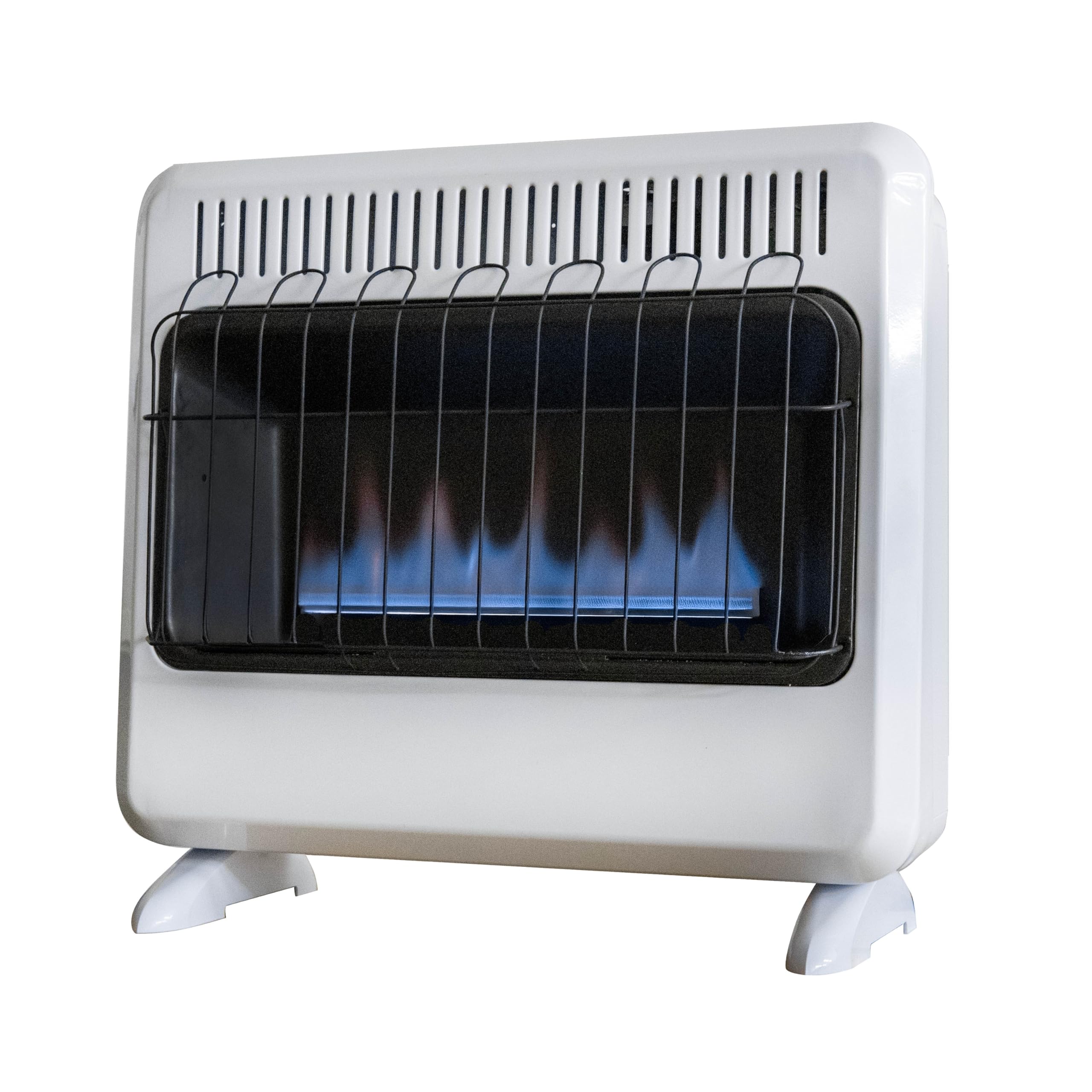
No electricity is the detail that makes this the heater we recommend first for a garage. The ignition runs on a battery, the thermostat is mechanical, and the burner keeps going when the power is out — which is precisely when an unheated garage stops being usable. Behind that is a plain specification list: 30,000 BTU, coverage up to 1,000 square feet, and a white cabinet that hangs on the wall with the mounting hardware in the box. For a two-car garage with decent insulation, that is the balance we settled on.

Blue flame means convection. It warms the air, which then moves around the room, rather than beaming heat at whatever stands in front of it. That is slower than radiant and better suited to a garage you want held at a temperature rather than heated for ten minutes at a bench. The adjustable thermostat is what makes it practical: set it low and leave it, and the burner cycles to hold the room near that setpoint instead of running flat out. It is also close to silent — no fan, no blower, just the flame — which matters if the garage shares a wall with a bedroom.

One thing to know before you hang it. This is a vent-free burner, so combustion moisture goes into the room along with the heat. In a drafty garage with a window cracked that is a non-issue; in a sealed, insulated shop it is the reason to look at the vented Modine instead. A carbon monoxide alarm belongs in the plan either way.

Bottom line: This is the one we recommend to most garages — 30,000 BTUs, a built-in thermostat, and no electricity required, so a power cut doesn't leave you cold.

Check Latest Price
#02

Best for Finished Garages

Dyna-Glo 30,000 BTU Blue Flame

89 /100
Kirk Score Excellent
Fuel
Natural gas or liquid propane
Mounting
Wall mount
Heat Output
30,000 BTU
Heating Coverage
1,000 sq ft
Check Details on Amazon

Pros

  • Dual fuel
  • Thermostatic control without any wiring
  • Black cabinet looks intentional on a finished wall
  • 30,000 BTU covers up to 1,000 square feet

Cons

  • Plain dial thermostat with no scheduling
  • Burner is audible while it runs

Most garage heaters look like appliance parts. This one does not: a black cabinet, a caged burner front, and a shape that sits flat against the wall, which is the reason to choose it for a garage that doubles as a workshop, a gym, or somewhere people actually sit. Underneath the finish it is the familiar 30,000 BTU formula — up to 1,000 square feet, wall mount, thermostatic knob, no electricity required.

Thermostatic control and dual-fuel operation are what make the black cabinet more than decoration. The knob holds a setpoint on its own, so nobody has to walk out and relight anything, and because the burner is listed for liquid propane as well as natural gas, it is the pick when you are not yet sure which fuel line you will have. We choose it for a finished garage where the heater is visible and the fuel question is still open.

The dial is a dial. There is no programming and no setback schedule, which suits a garage and rules out warming the shop before a 6 a.m. start. At 28 pounds it goes onto the bracket without much drama. The burner also has a voice — a low rush of gas while it is lit, quiet enough to talk over but not silent.

Bottom line: We pick this one for a finished garage, where the black cabinet earns its keep and dual-fuel operation keeps the door open on propane.

Check Latest Price
#03

Best for Spot Heat

Mr. Heater 30,000 BTU Radiant

89 /100
Kirk Score Excellent
Mounting
Floor pedestal or wall mount
Heat Output
30,000 BTU
Heating Method
Radiant
Heating Coverage
1,000 sq ft
Check Details on Amazon

Pros

  • Radiant heat you feel as soon as it lights
  • Pedestal or wall mount, no electricity needed
  • Rated for up to 1,000 square feet

Cons

  • Thermostat doesn't always cut the burner at the setpoint

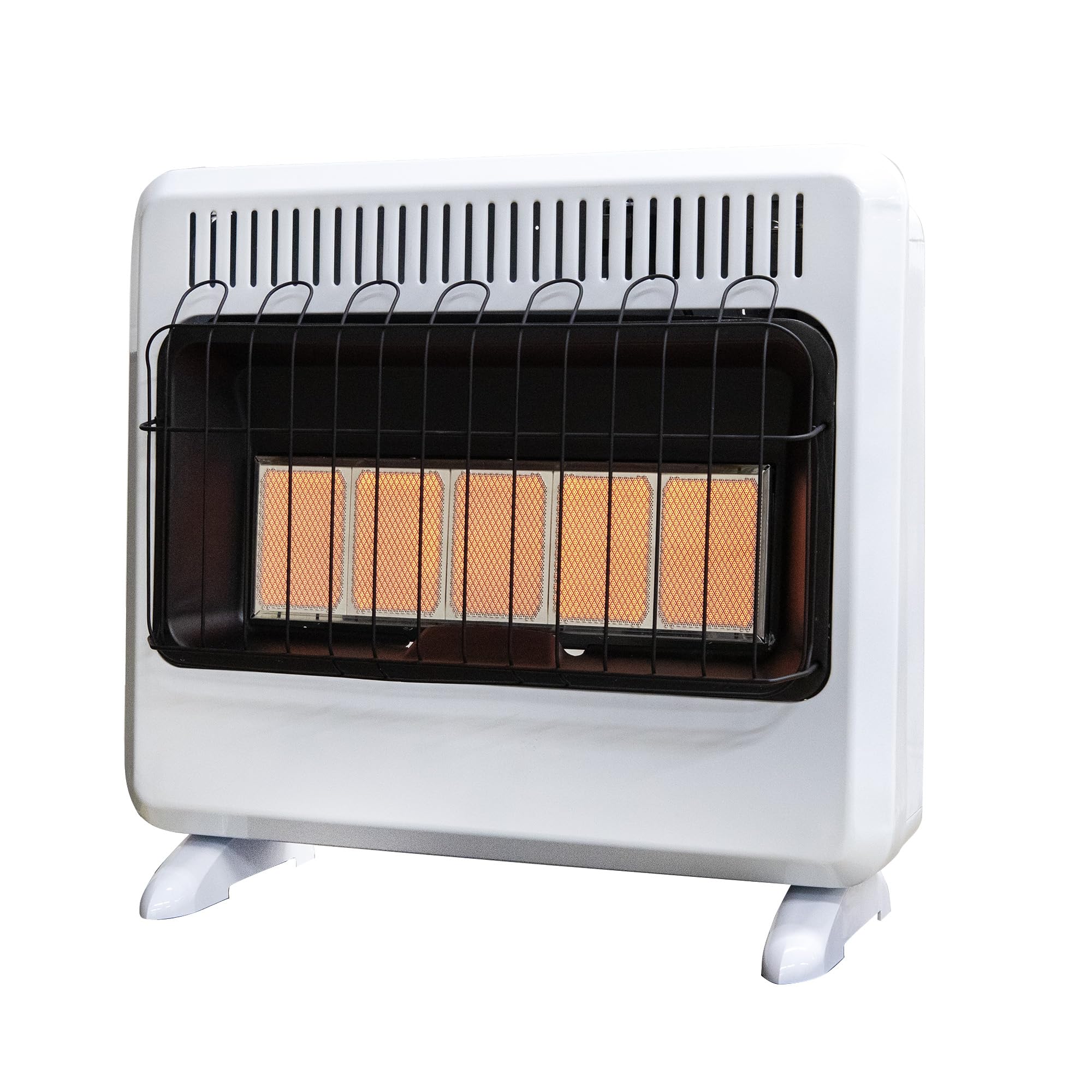
Radiant heat is a different sensation from the warm air a blue flame heater makes. Light this one and the warmth lands on your face and hands while the air around you is still cold — it heats objects and people first, which is why a radiant heater can make a freezing garage feel workable long before the air temperature has moved.

The hardware is the same as its blue flame sibling: 30,000 BTU, a 1,000-square-foot rating, battery ignition, a mechanical thermostat, no electricity required. What changes is the mounting and the aim. It comes with a floor pedestal as well as wall hardware, weighs about 26 pounds, and works best pointed at the place you actually stand — a bench, a lift, the door you are forever opening.

Where it loses to our top pick is evenness. Radiant heat is directional, so step out of the beam and the room is still cold, and the cabinet runs warm to the touch in a way a convection unit does not — worth thinking about in a garage with kids in it. It is at its best in a shop used in bursts, a couple of hours at the bench on a Saturday, rather than one you are holding at temperature all week.

Bottom line: Radiant heat puts warmth on you instead of the air, which makes this the pick for a workbench in a garage you use in bursts.

Check Latest Price
#04

Best Budget

ProCom 30,000 BTU Infrared

87 /100
Kirk Score Excellent
Mounting
Wall mount or base feet
Heat Output
30,000 BTU
Heating Method
Infrared plaque
Heating Coverage
1,400 sq ft
Check Details on Amazon

Pros

  • Least expensive pick in this group
  • Oxygen depletion sensor shuts the burner down
  • Wall mount and base feet both included
  • No electricity required

Cons

  • 1,400-square-foot rating assumes an insulated room
  • Pilot light can need coaxing to stay lit

This is the least expensive way onto the wall here, and it does not feel like a compromise. Thirty thousand BTU, an infrared plaque burner, push-button ignition, and an oxygen depletion sensor that shuts the unit down if carbon monoxide or low oxygen is detected — plus both a wall mount and base feet included. We recommend it without hesitation to anyone whose budget is the deciding factor.

The 1,400-square-foot rating needs translating. Thirty thousand BTU is thirty thousand BTU, and the bigger number assumes a tight, insulated room; in a garage with an uninsulated door and bare block walls, expect it to behave like the other 30,000 BTU heaters here. Fine for a two-car space, not for a barn. The plaque glows and radiates instead of blowing warm air, so there is no fan and nothing to hear but the gas.

Two practical snags before you order. The gas inlet size is not spelled out in the listing, so confirm your fitting and line length first. And this is a natural gas unit — some of the accessories sold around it assume propane, including a fan that does not fit every cabinet — so match parts to this model number rather than to the family.

Bottom line: The one we point to when the budget decides: 30,000 BTUs, an oxygen depletion sensor, and both a wall mount and base feet in the box.

Check Latest Price
#05

Best Vented

Modine Hot Dawg 45,000 BTU

86 /100
Kirk Score Excellent
Venting
Power vent, side wall or roof
Heat Output
45,000 BTU
Heating Method
Forced air
Heating Coverage
700 sq ft
Check Details on Amazon

Pros

  • Sealed combustion keeps moisture and odor outdoors
  • 45,000 BTU forced air recovers a cold shop fast
  • Low-profile ceiling cabinet clears the floor

Cons

  • Premium price before venting and electrical work
  • Requires a vent penetration and ceiling power

Everything about this heater is a different class of installation. It hangs from the ceiling, needs 115-volt power at the unit for the blower and the power vent, and exhausts through a small-diameter pipe out a side wall or the roof. Sixty pounds of cabinet means two people and something to stand on, and the vent is a hole in your building rather than a bracket on a wall.

What you get for that work is combustion sealed off from the room. No moisture, no gas smell, no oxygen depletion sensor to think about, because everything goes outside — which is why we point to this one for a workshop where somebody spends a full day. Forty-five thousand BTU through a forced-air coil brings a cold shop up quickly, and the low-profile cabinet keeps it tight to the ceiling and clear of a lift or a door track.

The cost is the other half of the story: a premium unit before venting, a gas line, and an electrician's visit are added on. Modine's 700-square-foot rating sits oddly beside 45,000 BTU of output and looks conservative, so size it against your insulation rather than treating 700 as a hard ceiling. And it is not silent — the blower is audible, so do not hang it directly over the bench where you take phone calls.

Bottom line: We think it is worth the extra work when the garage is a workshop you heat every day: sealed combustion, no moisture indoors, and forced air for the whole room.

Check Latest Price
#06

Manual control

Dyna-Glo IR30NMDG-1 Infrared

87 /100
Kirk Score Excellent
Controls
Low, medium, high
Heat Output
30,000 BTU
Heating Method
Infrared
Heating Coverage
1,000 sq ft
Check Details on Amazon

Pros

  • Radiant heat without any electricity
  • Simple three-position control
  • Wall-mounts in a small 25-pound footprint

Cons

  • No thermostat
  • Natural gas only; fuel conversion not permitted

There is no thermostat on this one. The control is a low-medium-high knob, three fixed positions, and the listing says so plainly — worth knowing, because thermostatic is the word most shoppers are scanning for by the time they have compared three of these. If you want a heater to hold a low setpoint in an empty garage all winter, this is not it.

What it is: a 30,000 BTU infrared wall heater rated for natural gas, carrying a 1,000-square-foot rating, a 25-pound cabinet, and no need for electricity. Radiant output warms the person and the tools in front of it, and the three positions give real range — low to take the edge off, high to bring a cold garage up before you start work.

We like it for a garage where the heater goes on when you walk in and off when you leave. That is the use the three-step control actually serves, and there is one less mechanism to fail than on a thermostatic unit. The trade is real: without a thermostat you will be walking back out to turn it down, and if it stops lighting cleanly the thermocouple is the first thing to look at.

Bottom line: Buy it if you will walk over and turn a knob; skip it if you want a thermostat holding 50 degrees in an empty garage all winter.

Check Latest Price
#07

Slim walls

ProCom 30,000 BTU Blue Flame

84 /100
Kirk Score Excellent
Controls
High, medium, low thermostat
Heat Output
30,000 BTU
Heating Method
Blue flame convection
Heating Coverage
1,400 sq ft
Check Details on Amazon

Pros

  • Eight-inch cabinet fits a tight wall
  • Wall mount and base feet included
  • No electricity needed for ignition or control

Cons

  • Stepped high-medium-low control rather than a setpoint dial
  • 1,400-square-foot claim assumes an insulated room

ProCom sells two 30,000 BTU natural gas heaters that cost about the same and claim the same 1,400 square feet. This is the blue flame one; the other is the infrared plaque. The difference is how the heat reaches you — convection warms the air and spreads it through the room, radiant warms whatever it is pointed at.

Around that burner sits a slim white cabinet, eight inches deep, that hangs on a wall or stands on the base feet in the box, with high, medium, and low thermostat control and the same push-button ignition and oxygen depletion sensor as its sibling. No electricity, no fan, and no noise beyond the flame.

We prefer the blue flame of the two ProComs for a room you occupy, for the simple reason that it is the gentler heat: it takes longer to make a cold garage feel warm, and it does the better job of holding the space once it gets there — the trade you make for a heater that will not cook one side of your face while your feet stay cold.

Where it gives ground to the other blue flame heaters here is control: three steps rather than a dial you set to a temperature, so you will be managing it by feel on a cold morning. It earns its place when the eight-inch depth is what solves the wall problem — between a door and a bench, say — and the Dyna-Glo earns it when you want the dial.

Bottom line: A good second ProCom: gentler convection heat than the infrared's glow, in a slim cabinet that hangs close to the wall.

Check Latest Price

How We Tested Natural Gas Garage Heaters

We started by sorting the market on BTU rating, vent-free versus vented design, and whether a unit hangs on the wall or stands on base feet, then cut anything with a thin service record or vague clearance specs. Ten heaters made the cut, and each one ran for eight months across a full heating season in detached garages ranging from a tight one-car to a two-and-a-half-car shop.

Every heater went through the same routine. We mounted or set it up ourselves and timed the job, noting whether the gas connection landed somewhere sensible and how much clearance the manual demanded around shelving and rafters. Each morning we fired it cold and listened — vent-free blue flame units run close to silent, while vented heaters bring a blower you can hear from the house. We logged odor at ignition and again an hour in, since that first-light smell is the thing people remember.

Temperature control got the closest look. With one thermometer at bench height and another at floor level, we timed how long each heater took to lift a 45-degree garage to 60, then set the thermostat and watched the swing across a week of near-freezing nights. We also counted how often the burner kicked back on, which is where fuel management and real operating cost show up. Units that short-cycled, drifted more than a few degrees, or needed fiddling to relight fell out of contention.

How to Choose a Natural Gas Garage Heater

Size the Heater to the Building, Not the Box

The coverage figure on the box assumes a closed, insulated room, and most garages are neither. An uninsulated door, bare block walls, and a ceiling that leaks heat will eat a size's worth of output before the heater has done anything useful. As a rule, 30,000 BTU is a fair match for a well-sealed two-car garage, and 45,000 BTU of forced air suits a three-car space or a shop you work in all day. If you are not ready to insulate, size up rather than expect the rating to hold.

Vent-Free or Vented — the Decision You Can't Undo Later

A vent-free heater hangs on the wall, connects to the gas line, and needs no flue, which is why six of the seven picks here are vent-free. It also releases combustion moisture and byproducts into the room, so ventilation and a carbon monoxide alarm are part of the installation rather than optional extras.

A power-vented unit like the Modine pushes the exhaust outside and needs a wall or roof penetration, mains power at the ceiling, and a professional install. If you will be in the garage for full days at a time, price the vented route before you commit to a wall heater.

Blue Flame, Radiant, or Forced Air

Blue flame heaters are convection units: they warm the air and let it circulate, which makes them the right choice for holding a room at a temperature, especially with a thermostat doing the cycling. Infrared and radiant models warm objects and people directly, so the heat arrives immediately and stays local — good over a bench, less good for the far corner. Forced air moves the most heat fastest and adds fan noise to the room. Match the type to how you use the space: all evening, an hour at a time, or a full working day.

Clearances, Gas Supply, and the Install You Can Do

Every one of these units carries minimum distances to combustibles in its manual, and vent-free does not mean hang it anywhere. Check what is above and beside the unit and whether your gas line can reach it with the right size and a shutoff. Hanging a 25- to 60-pound cabinet is a two-person job; the gas connection is where most of us should stop and call a licensed fitter, and where a permit is usually required. Confirm what your local code allows before the crate arrives.

Frequently Asked Questions

Final Verdict

Most garages want the same thing: a heater on the wall, a thermostat, and no electricity involved. The Mr. Heater 30,000 BTU blue flame delivers exactly that for a two-car space, and it is the one we recommend first. If the garage is finished and the heater is going to be looked at, the Dyna-Glo blue flame is the better-looking twin with the same controls.

And if the garage is a workshop you heat for whole days rather than an hour at a time, skip vent-free altogether and pay for the Modine and its vent. Sealed combustion is worth the installation when you are the one standing in the room.