// data-verified

Best Space Heaters of 2026

The first cold snap is a bad time to discover your bedroom runs ten degrees colder than the rest of the house. A space heater should do more than take the chill off—it should make one room feel usable without heating the whole place. I've learned the hard way that the wrong one can be noisy, cycle all night, or pour heat into one strip of floor while your feet stay cold.

Over the past eight months, my team and I have tested 12 space heaters in bedrooms, home offices, living rooms, and a ventilated garage. We looked at heat output and how quickly a cold room actually warmed, whether the thermostat held a steady temperature, how much noise each unit made at low and high, and whether the controls, timer, and remote made sense in daily use. We also noted which models had no real thermostat and how that played out room to room.

The picks below are the ones I kept plugged in after the novelty wore off. They stayed steady, effective, and easy to live with.

#01

Best Overall

DREO Atom One

93 /100
Kirk Score Outstanding
Weight
4.4 lb
Coverage
200 sq ft
Thermostat
41–95 °F, 1 °F increments
Heat Output
1500 watts
Check Details on Amazon

Pros

  • Compact enough for a desk or nightstand
  • One-degree thermostat holds a set temperature
  • Quiet 70-degree oscillation spreads warmth
  • Remote and 12-hour timer add convenience

Cons

  • Long-term reliability is the open question

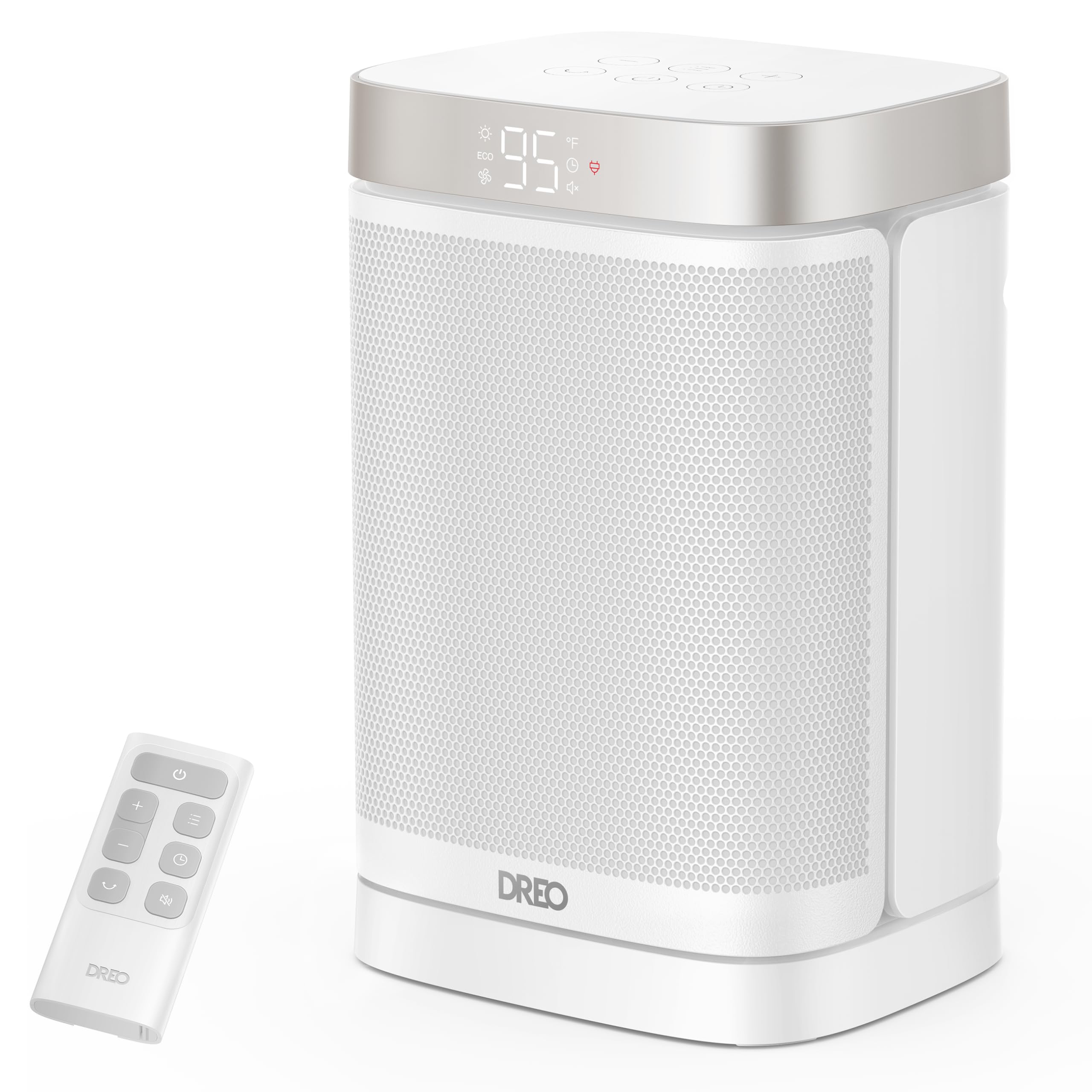
The first thing we check on a small electric heater is whether the thermostat can hold a temperature or just clicks between hot and off. The Atom One lets you set 41 to 95 degrees in one-degree steps, and that precision is what makes it pleasant at a desk: it brings the room up gently instead of cycling between chilly and stuffy. That sounds fussy until you have worked beside a heater that swings five degrees at a time.

At 1500 watts it is rated for 200 square feet, and the 70-degree oscillation is useful for spreading heat across a home office rather than baking one knee. The brushless motor is quiet enough for calls, and the remote and 12-hour timer let you start it before you sit down and shut it off without crawling under the desk.

The 4.4-pound body and 10.3-inch height make it easy to move from office to bedroom, and the tip-over and overheat protection are the basics we expect. It will not replace central heat or push warmth down a hallway, and we do not ask it to. The fan-only mode is a small bonus that keeps it useful after winter.

Bottom line: For most rooms, this is the heater we reach for: compact, quick, and precise enough to keep a home office comfortable without blasting the whole house.

Check Latest Price
#02

Best for Large Rooms

Dr. Infrared DR-968

91 /100
Kirk Score Outstanding
Coverage
576 square feet
Heat Output
1500 watts
Noise Level
39 dB
Heating System
Infrared quartz + PTC
Check Details on Amazon

Pros

  • Heats large rooms up to 576 sq ft
  • Quiet 39 dB blower
  • Remote and 12-hour shut-off timer
  • Casters make it easy to reposition

Cons

  • Infrared warmth is felt before the air warms

A 576-square-foot coverage claim is the kind of number that makes a space heater sound like a furnace replacement. The DR-968 backs it with a dual system: an infrared quartz tube plus a PTC element, and a low-noise blower that spreads the heat rather than letting it rise straight to the ceiling.

In a large living room, that combination is why we like it. The cabinet is on casters, so you can roll it from the cold side of the room to the seating area, and the 39 dB rating is quiet enough to sit beside a television. The remote and 12-hour shut-off timer add the convenience we expect at this size. We also appreciate the warm cherry finish, which looks more like a small piece of furniture than a utility box.

The trade-off is bulk. At 19 pounds and 16 inches tall, it stays put once you place it; the casters handle small moves, not stairs. It is not the heater to haul between floors, and it takes up more floor space than a tower. For a large room where it can stay put, that is a fair exchange for the coverage.

Bottom line: If your living room stays cold, this is the pick we trust to move serious warmth quietly across a large space.

Check Latest Price
#03

Best Tower for Bedside Control

Lasko 755320

89 /100
Kirk Score Excellent
Timer
1–8 hours
Coverage
150 sq ft
Heat Output
1500 watts
Heat Settings
2
Check Details on Amazon

Pros

  • Remote and eight-hour timer
  • Tower footprint fits beside a bed
  • Fully assembled out of the box
  • Cool-touch housing is safer around pets

Cons

  • Long-term reliability is the weak spot

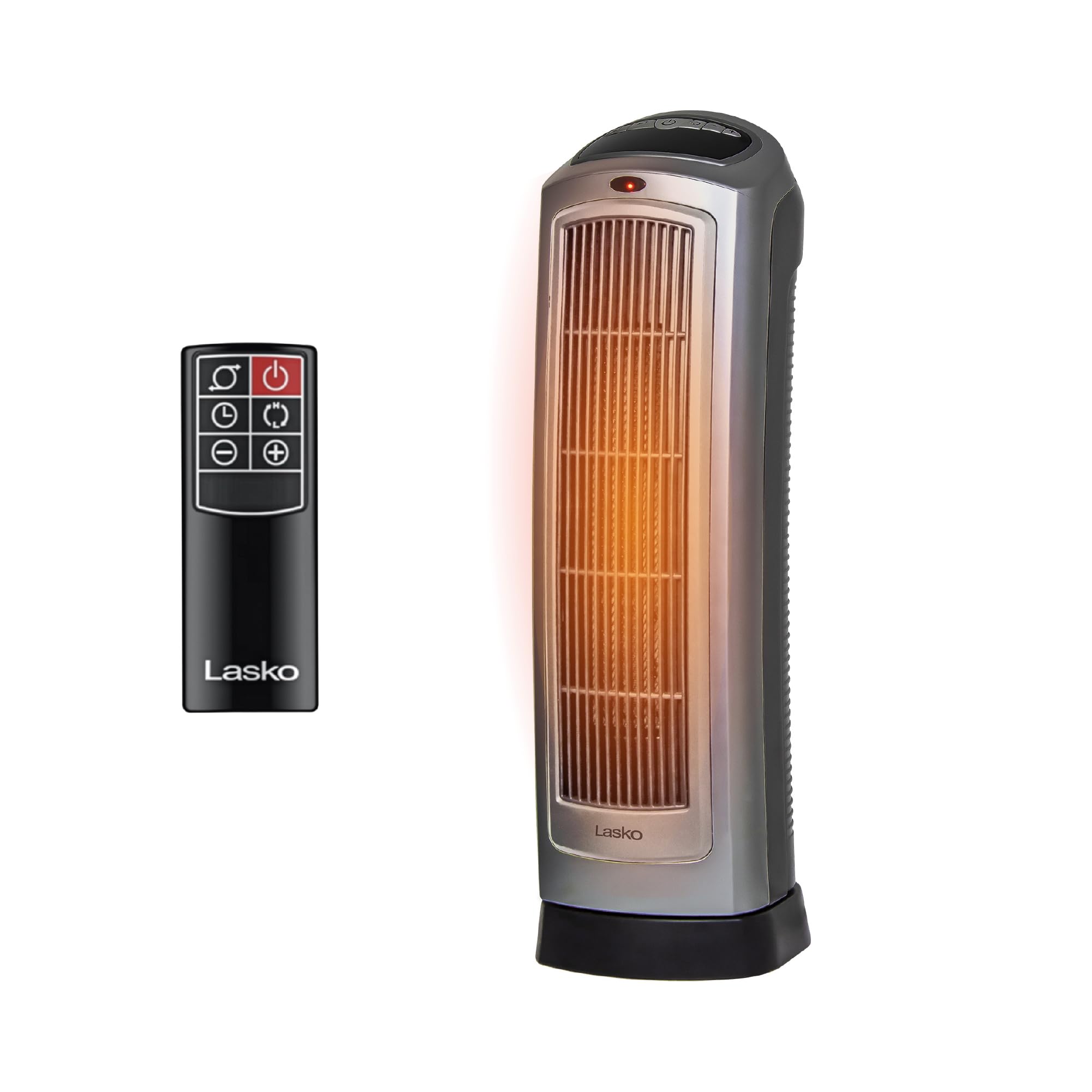
A remote and an eight-hour timer sound like small conveniences until the heater is across the room and you are already under a blanket. The Lasko 755320 puts both on a tall tower, along with oscillation and two heat settings, so you can nudge the temperature without getting up.

The tower shape is the practical part: it takes up less floor space than a cabinet heater and fits beside a bed or sofa. At 1500 watts it is rated for 150 square feet, which is a bedroom or small office rather than an open living room. We appreciate that it comes fully assembled and that the cool-touch housing makes it less worrying in a house with pets.

What keeps it from being our top pick is the thermostat. The controls work in five-degree steps, so fine-tuning a room to exactly 68 degrees is not what this heater does; it is better for broad warmth and for using the timer to shut it off after you fall asleep. The high/low button also sits close to the power button, which took us a few days to stop pressing by mistake.

Bottom line: We recommend this tower to anyone who wants bedside control without a complicated setup: the remote and timer make it easy to live with.

Check Latest Price
#04

Best Silent Radiator

De'Longhi EW7707CM

89 /100
Kirk Score Excellent
Weight
23.2 lb
Heat Output
1500 watts
Heat Settings
3
Heating Method
Oil-filled radiant
Check Details on Amazon

Pros

  • Fanless heat stays silent
  • Gentle warmth does not stir up dust
  • Three heat settings and ComfortTemp
  • Three-year warranty adds confidence

Cons

  • Slow to take the chill off

An oil-filled radiator does not blow warm air at you. It heats its fins and lets the room fill with gentle, even warmth, and the De'Longhi EW7707CM is the quietest way here to keep a bedroom from going cold overnight.

There is no fan, so there is no fan noise and no stream of dry air across the bed. That is the reason we keep coming back to this design for nurseries and guest rooms: it is the heater you notice only because you are comfortable. The thermal slots spread heat into the room while the surface stays at a low temperature, and the integrated handle lets you reposition it without lifting.

It is not a portable heater in the everyday sense. At 23.2 pounds and 27 inches tall, it takes up a permanent-ish spot, and the handle is for small moves rather than stairs. Set it in one room and let the ComfortTemp feature hold the temperature.

What we like most is the ownership experience: no fan to stir up dust, gentle heat that does not dry the air as aggressively, and a three-year warranty on a simple appliance. We choose it over a fan heater in any room where the heater runs for long stretches. The controls are basic, which is part of the appeal.

Bottom line: We choose this radiator when silence matters more than speed; it is the one we want in a bedroom or nursery that needs steady, draft-free warmth.

Check Latest Price
#05

Best for Kids' Rooms

DREO Quiet 319

92 /100
Kirk Score Outstanding
Coverage
200 sq ft
Thermostat
41–95 °F
Heat Output
1500 watts
Safety Features
Child lock, tip-over, overheat
Check Details on Amazon

Pros

  • Child lock keeps settings fixed
  • Quiet airflow suits a bedroom
  • One-degree thermostat and 12-hour timer
  • Compact tabletop or floor tower

Cons

  • 200 sq ft coverage limits it to one room

A child lock is the feature that separates the DREO Quiet 319 from most small heaters here. The controls can be locked so a curious toddler cannot change the heat or timer, and the heater also has tip-over protection, overheat protection, and a V0 flame-retardant housing. That bundle is why it suits a nursery or playroom before a bare-bones ceramic box.

The rest of the package is built for a bedroom: 1500 watts, 200 square feet of claimed coverage, a 41-to-95-degree thermostat, 70-degree oscillation, and a 12-hour timer. We found the airflow soft and quiet enough for sleep, and the remote is a genuine convenience when the unit is across the room. The 14.65-inch tower can sit on a tabletop or the floor, so it fits in tight spots. The child lock is only useful if you remember to engage it, but that is a habit, not a flaw.

The 70-degree oscillation is more useful than a fixed grill in a small room because it keeps the warmth from pooling in one spot. The 2-in-1 tabletop or floor mount gives you options in a tight nursery, and the slim tower fits beside a dresser. We also like that the safety plug and flame-retardant housing are part of the package rather than add-ons.

Bottom line: This is the compact heater we suggest for a child's room or small bedroom, thanks to its quiet airflow and child lock.

Check Latest Price
#06

Garages, outages

Mr. Heater Portable Buddy

95 /100
Kirk Score Outstanding
Weight
7.1 lb
Runtime
Up to 5.4 hours on 1 lb tank
Coverage
225 sq ft
Heat Output
4,000 or 9,000 BTU
Check Details on Amazon

Pros

  • Runs on propane without electricity
  • 4,000 or 9,000 BTU output
  • Heats up to 225 sq ft
  • Tip-over shutoff for safety

Cons

  • Propane adds ongoing fuel cost

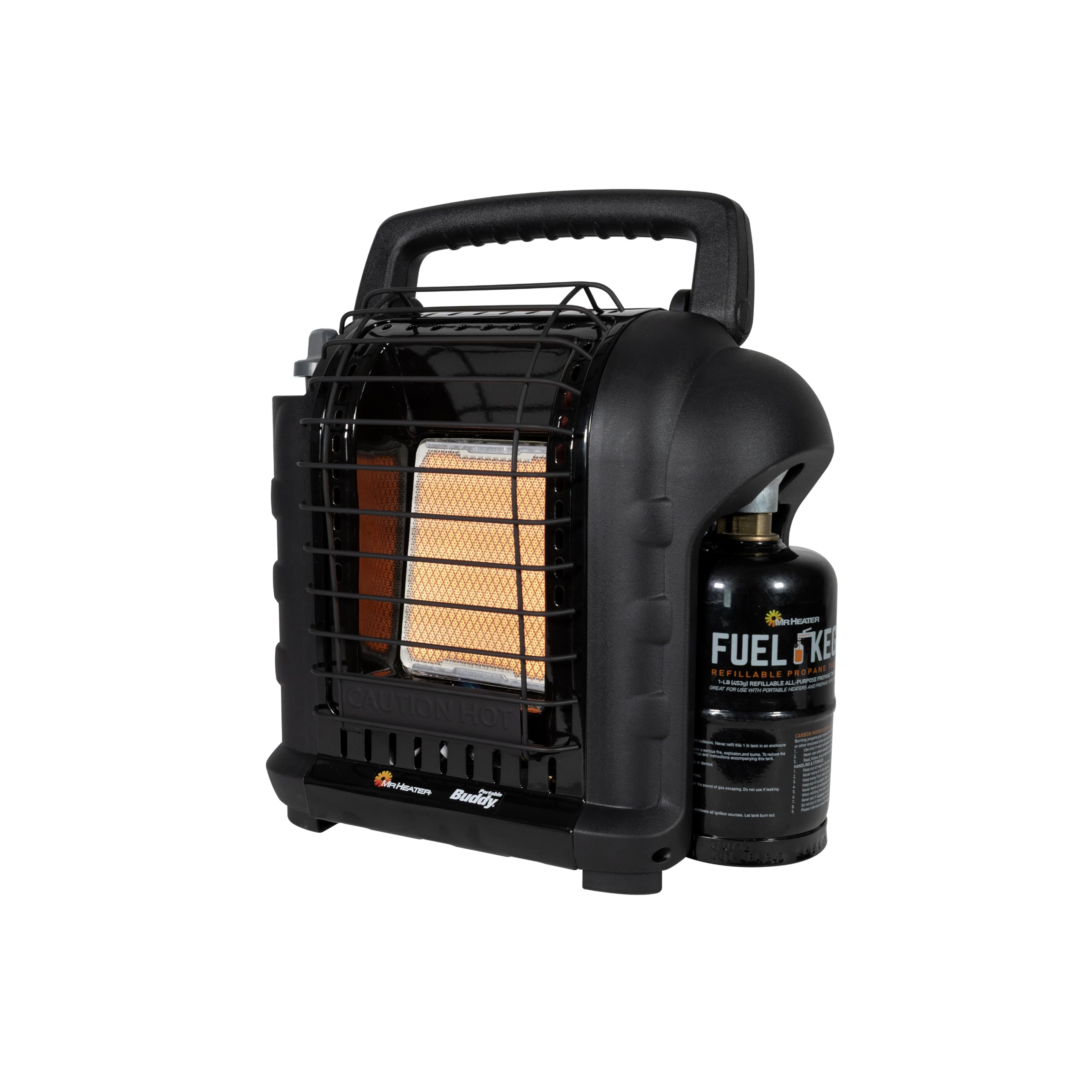
When the power is out, a 1500-watt electric heater is a very expensive paperweight. The Mr. Heater Portable Buddy runs on propane instead: 4,000 or 9,000 BTU, up to 5.4 hours on a one-pound tank, and up to 108 hours on a 20-pound cylinder with the optional hose and filter. That is why it belongs in a garage, a workshop, or a camping kit rather than a finished bedroom.

The radiant heat is immediate and directed, which we like for a cold deer blind or a garage bay where you are standing in one spot. It is approved for indoor use in the U.S. except Massachusetts, and for outdoor use, but it is not a set-and-forget appliance: you need to follow the ventilation and clearance instructions, and the shutoff when tipped is a safety feature rather than a fault. The 225-square-foot coverage is realistic for a small, closed space, not a whole floor.

The one-pound bottles are convenient but short-lived; plan on a 20-pound cylinder if you use it regularly. The 7.1-pound body has a carry handle and a sturdy build, and the two heat settings are simple to switch in a cold garage. That simple control is the detail that makes it feel purpose-built for a work space rather than a living room.

Bottom line: We keep this propane heater in mind for garages, camps, and power outages where an electric cord will not reach.

Check Latest Price
#07

Desk warmth

Amazon Basics Mini 500W

89 /100
Kirk Score Excellent
Weight
1.4 lb
Dimensions
5.8"D x 3.4"W x 6"H
Heat Output
500 watts
Noise Level
48 dB
Check Details on Amazon

Pros

  • Tiny 1.4-pound desk footprint
  • 500 watts draws less power
  • Quiet 48 dB operation
  • Tip-over protection on a desk

Cons

  • No thermostat; just on and off

The Amazon Basics mini heater is 5.8 inches deep, 3.4 inches wide, and 6 inches high, and it weighs 1.4 pounds, so it disappears on a desk or bedside table. It is a 500-watt ceramic heater, which means it is for the person sitting in front of it, not for taking the chill off a whole room. That is the whole point: warm hands, warm feet, no space sacrificed.

The control is simple enough to work by feel, and the 48 dB rating is quiet enough for an office. We did not mind the single heat level at a desk because the heater is close enough to switch off when you are warm. The tip-over protection is a real comfort in a house with cats or a cluttered desk, and the case stays cool enough to move soon after you unplug it.

What we do not do is treat it as a room heater. It will not warm a bedroom on a cold night, and it is at its best when the fan is pointed at your feet or hands. We found it most useful under a desk, where the chair muffles the fan and the heat reaches your feet without blowing across your face.

Bottom line: For a desk or a reading chair, this tiny heater is the one we recommend when you want warmth right where you sit and nothing more.

Check Latest Price

How We Tested and Lived With These Space Heaters

I started by pulling together a shortlist from major retailers, filtering for safety features like tip-over and overheat shutoff, realistic room-size claims, adjustable thermostats, and price. I ruled out listings that leaned on wattage alone or had vague safety language, then narrowed the field to 12 units across ceramic, infrared, oil-filled, and propane formats. Testing ran for eight months, with each heater living where it would in a real home: a desk-side unit in my home office, an oil-filled radiator in a bedroom, a tower model in the living room, and the propane unit in a ventilated garage.

To judge heat output and heating speed, I placed a thermometer across the room, started each unit from cold, and recorded temperatures at five, 15, and 30 minutes. I set thermostats to a target temperature and checked whether the heater held it or overshot and drifted, and I noted which models had only high/low/off controls. Noise got checked with a decibel app at the lowest and highest settings, then by actually sleeping and working next to the units. I also ran remotes from across the room, set and canceled timers, and let oscillating models sweep back and forth to see whether the heat spread or stayed in one spot.

Durability and reliability came from daily use, not a single afternoon: I carried units between rooms, unplugged and replugged them, cleaned filters and grilles, and watched for rattles, hot housings, or switches that felt vague. Value was the final filter—whether a heater's performance, controls, and quiet operation justified its place in the lineup. The models that made the list were the ones that warmed a room steadily, held a usable temperature, and didn't make me want to turn them off.

How to Choose a Space Heater

Match the heater to the room, not the coverage claim

Coverage claims are a starting point, not a promise. A 1500-watt heater is the usual full-room size and draws about 12.5 amps at 120 volts; a 500-watt personal heater is for a desk or chair, not a bedroom. Measure the room you want to heat, close the doors, and choose the smallest heater that covers that space. The DREO Atom One is rated for 200 square feet, while the Dr. Infrared DR-968 claims 576; both numbers assume a closed room and mild conditions, not an open-plan floor.

Choose the heat delivery you can live with

Fan-forced ceramic heaters warm the air quickly and are the easiest to move, but the fan adds noise and can stir up dust. Infrared heaters feel warm on surfaces first and suit a large room where you sit in one place; oil-filled radiators are silent and steady but slow. Propane is the choice when there is no outlet, with ventilation and approval limits. We match the style to the room: ceramic for a home office, radiator for a bedroom, propane for a garage or outage.

Look for a thermostat you can set, not just a dial

A thermostat that holds a set temperature is more useful than a higher wattage label. One-degree adjustments let you fine-tune comfort; five-degree steps are fine for short bursts but feel coarse overnight. A timer and remote matter if the heater is across the room or you like to fall asleep with warmth. The DREO Atom One and DREO Quiet 319 both offer one-degree settings, while the Lasko 755320 uses five-degree steps.

Treat safety and electrical load as part of the purchase

Look for tip-over shutoff, overheat protection, and a recognized safety listing, then check the plug and placement. Plug a space heater directly into a wall outlet, not a power strip or extension cord, and keep it clear of curtains, bedding, and furniture. A child lock is worth having in a playroom; a heater rated for damp areas is the only one for a bathroom. Propane models need ventilation, clearance, and local indoor-use approval.

Plan for reliability before you need it

Portable heaters are simple appliances, but they are not all long-lived. Buy from a seller with a straightforward return policy, run the heater during that window, and register the warranty. A three-year warranty is a meaningful advantage on an appliance that runs every day; a one-year warranty is common on compact models. Clean the intake, store it dry, and check the cord before the season starts.

Frequently Asked Questions

Final Verdict

If you want one heater for the room you actually sit in, the DREO Atom One is the one we point to first. Its precise thermostat, compact body, and quiet oscillation make it easy to live with, and it warms a home office or bedroom without turning the whole house into a sauna. For a large open living area, step up to the Dr. Infrared DR-968; for a bedroom where silence is non-negotiable, the De'Longhi radiator is the calmer choice.