// data-verified

Best Tool Carts of 2026

A tool cart looks like a simple purchase until you're standing in the aisle doing math. The carts that swallow the most gear are usually the heaviest to push once they're loaded, the ones that fold flat against a wall are often the ones that feel shaky at the handle, and two carts with nearly the same footprint can behave completely differently depending on how big their casters are. What you're really buying is fewer trips back to the bench with your arms full.

Over the past six months, my team and I assembled, loaded, and rolled 12 utility carts through garages, basements, and workshop corners to see which ones held up. The pattern that kept surfacing: shelf lips and deep trays matter more than the capacity number on the box, and a brake on at least two casters is the difference between a cart you trust on a sloped driveway and one you don't.

Not every cart here folds, and not every folding cart earns the space it saves — we sorted that out too. Value in this category isn't the lowest sticker price; it's the cart still rolling smoothly after a year of hauling paint cans and socket sets. The picks below are organized around how you'll actually use one.

#01

Best Overall

WEN 73002 Service Cart

94 /100
Kirk Score Outstanding
Casters
5-inch swivel
Shelf Size
30 x 16 x 4 inches
Load Capacity
500 lb
Assembled Size
40 x 17 x 33.5 inches
Check Details on Amazon

Pros

  • 500 pounds on four-inch lipped trays
  • Handle compartments plus a cup holder
  • Five-inch casters roll quietly indoors
  • Fits through a standard doorway

Cons

  • Feels tippy under a top-heavy load

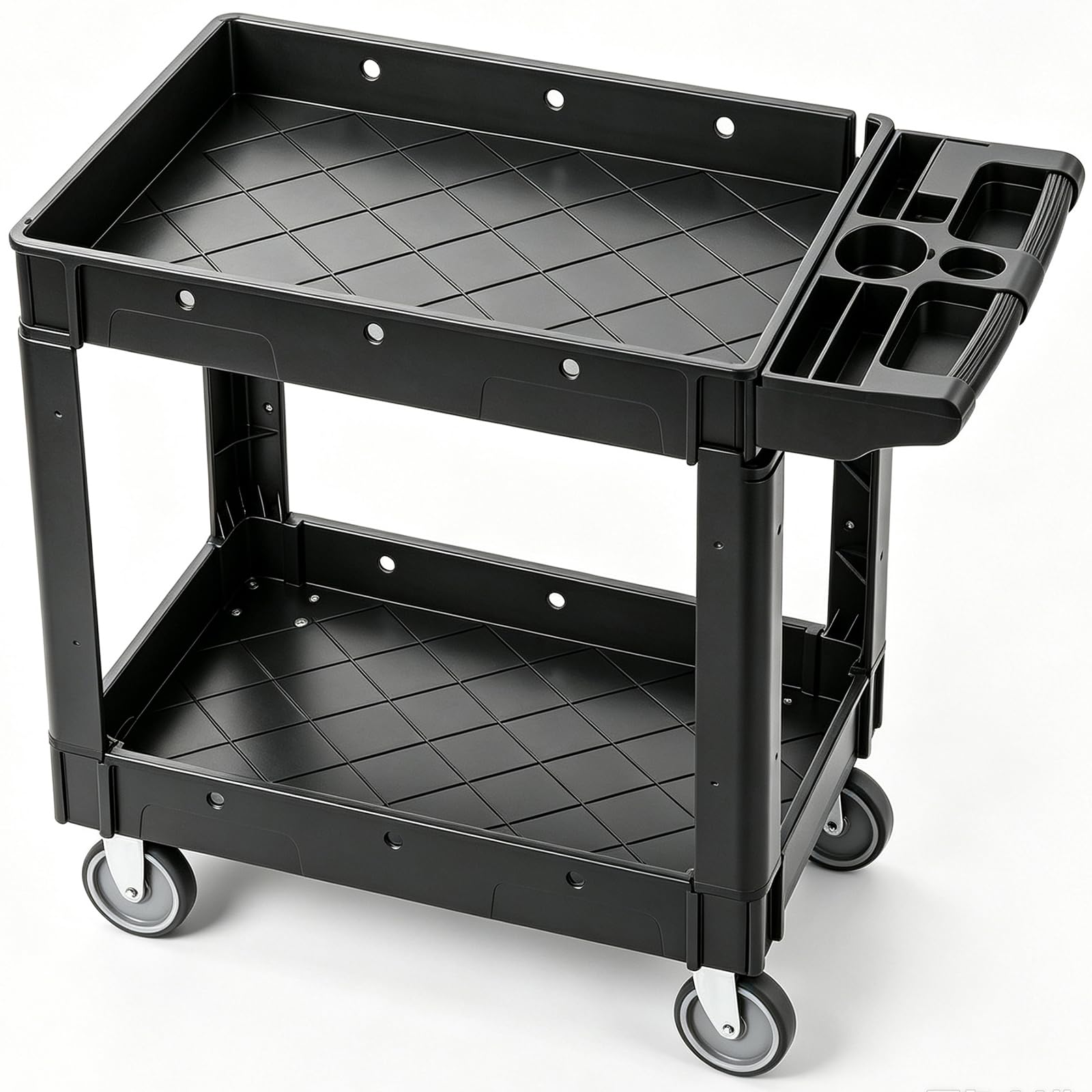
Five hundred pounds is a number plenty of carts print and few earn. On the WEN it comes with the shelves to back it up: two 30-by-16-inch polypropylene trays with a four-inch lip molded into every edge, so a box of screws doesn't skate off the first time you take a corner. That pairing — real capacity and a lip that actually holds — is the difference between a cart you load once and a cart you use all afternoon.

The handle is what we kept noticing. It's molded into the top tray at hip height with a cup holder and a row of small compartments along the back, which turns out to be the right home for a pencil, a utility knife, and the screws you just took out of something. On a cart that crosses the garage a dozen times in an afternoon, that isn't a gimmick; it's the difference between pockets full of hardware and a clear bench.

The five-inch non-marring casters do the rest. They roll quietly on a sealed floor, they don't dig into a rubber mat the way smaller wheels do, and the 30-pound cart tracks straight when it's loaded. At 40 inches across including the handle it still clears a standard doorway, which matters once the cart parks in one corner and the work happens in another.

One figure to plan around: the trays are 30 inches long, but the cart measures 40 inches overall once the handle is counted, so measure the parking spot against the bigger number. Get that right and the cart disappears into the rhythm of a shop — loaded at the bench, pushed to the job, wiped down, put back.

Bottom line: This is the cart we recommend first for a garage: a real 500-pound rating, lipped trays that keep hardware on board, and a handle that doubles as a parts tray.

Check Latest Price
#02

Best Folding

Olympia Tools 85-188

93 /100
Kirk Score Outstanding
Shelves
3 collapsible
Item Weight
4.4 lb
Load Capacity
150 lb
Folded Thickness
8 inches
Check Details on Amazon

Pros

  • Folds to eight inches for storage
  • 4.4 pounds, carries in one hand
  • Three tiers with locking casters

Cons

  • 150-pound limit rules out a loaded toolbox
  • Tray edges can crack under load

Eight inches is what the Olympia measures folded, and 4.4 pounds is what it weighs — thin enough to stand behind a door, light enough to carry in one hand. In a one-car garage where every square foot is spoken for, that is most of the argument.

Three shelves give you more layers than the two-shelf service carts, and that suits tools better than materials: drivers and pliers up top, parts in the middle, anything heavy on the bottom. All four casters swivel and two of them lock, the aluminum frame won't rust, and a lever on the side collapses the whole thing into a package you can hang on a hook. We reach for this one when the job moves — a repair inside the house, a detailing session in the driveway — because it goes where the work is and then gets out of the way.

The folding lever takes a bit of feel; you squeeze and lift at once, and the first few attempts won't take. The three-inch casters are the other adjustment — fine across a shop floor, less happy on an extension cord or the lip of a garage threshold, where lifting beats shoving. Learn those two moves and the cart does exactly what it promises, which is to be invisible until the moment you need it.

Bottom line: Buy this if storage space is tighter than your workload: it folds to eight inches, carries like a briefcase, and holds a project's worth of hand tools.

Check Latest Price
#03

Best for Heavy, Awkward Loads

ELAFROS 2-Tier Service Cart

94 /100
Kirk Score Outstanding
Casters
5-inch swivel, 2 locking
Shelf Size
30.5 x 16.3 x 2.4 inches
Load Capacity
550 lb
Assembled Size
34.4 x 16.7 x 32.5 inches
Check Details on Amazon

Pros

  • 2.4-inch tub shelves contain spills
  • 550-pound capacity
  • Two locking five-inch casters

Cons

  • Wheels can arrive stiff or wobbly
  • Tips when only the top shelf is loaded

The 2.4-inch tub walls are the reason to pick this cart over a flat-tray service cart. Washers, a bottle of solvent, a paint can you're ferrying between rooms — all of it stays inside the walls instead of sliding off the edge when the cart rolls over a cord. Containment is worth more than any figure on the page, and it's why this is the one we point at for messy or awkward loads.

Underneath the tubs it's a 550-pound two-shelf cart on a 34.4-by-16.7-inch footprint, with five-inch casters and two that lock. The push handle is molded into the top shelf with a storage compartment built in, and the side holes take hooks for a bag or a hanging tool. Polypropylene means a spill wipes up and a dropped wrench dents nothing.

Setup is a short job — legs, handle, casters, done — and the whole cart is 28 pounds, light enough to tip onto its side and rinse. What the tub design costs you is the ability to slide a long case straight across; these shelves want things that fit inside them. Within that boundary it's the most useful two-shelf cart here for a painter, a mechanic, or anyone whose work generates drips.

Bottom line: Choose this when the load is wet, loose, or round: the 2.4-inch tub walls hold what flat trays drop, and 550 pounds matches the heaviest two-shelf carts here.

Check Latest Price
#04

Best No-Assembly

WORKPRO W083076 Folding Cart

94 /100
Kirk Score Outstanding
Item Weight
13.4 lb
Load Capacity
210 lb
Assembled Size
24 x 17-3/8 x 34-7/8 inches
Shelf Capacity
70 pounds each
Check Details on Amazon

Pros

  • No assembly
  • Folds flat for a corner or a van
  • 13.4 pounds, easy to lift alone
  • Rubber casters with two brakes

Cons

  • 70 pounds per shelf suits hand tools only

Nothing on the WORKPRO needs assembling. It comes out of the carton as one folding frame, and the only work is fitting the four casters — no bolts, no hex key, no evening lost to it. That's a small thing until you've spent one putting a service cart together, and it's why this is the cart we pull out for short jobs while the big ones stay parked.

Three shelves sit on an aluminum frame, and the whole cart weighs 13.4 pounds, so it goes into a truck bed or up a flight of stairs without a second person. The casters are rubbery rather than hard plastic, which is why it rolls quietly across a shop floor and doesn't skid on a smooth one. Two of them have brakes, which matters on a light cart: 13 pounds is easy to nudge out of place if you lean on it.

Where it earns its place is the fold. The shelves collapse into a slim stack that stands in a corner or lies flat in a van, and the triangular brace that locks it open feels more solid than the weight suggests. We reach for it on house calls and for jobs that move room to room, where a full-size service cart is more furniture than help.

Bottom line: If you have nowhere to keep a full-size cart, this one folds into a corner, sets up in seconds, and still carries a serious hand-tool load.

Check Latest Price
#05

Best for Cordless Tools

JUNNUJ Power Tool Organizer Cart

90 /100
Kirk Score Outstanding
Outlets
8 AC
Cord Length
6 feet
Drill Storage
Up to 8 drills
Assembled Size
34.3 x 17.7 x 11.8 inches
Check Details on Amazon

Pros

  • Eight outlets on a six-foot cord
  • Holds up to eight drills
  • Rolls between bench and outlet

Cons

  • Wheels are a weak point under load
  • Smaller in person than the photos suggest

Eight outlets, a six-foot cord, and a 1,500-watt rating: the JUNNUJ is a rolling charging station that happens to have shelves. Three tiers plus a drill-holder layer take up to eight drills, the steel frame stands 34.3 inches tall and just under a foot deep, and all four casters swivel so it turns in the space between a bench and a wall.

The moment it earns its keep is the end of a workday, when six batteries are flat and the chargers are scattered across the bench. Roll the cart to an outlet, plug in once, and everything charges where the tools live instead of on the floor by the door. Remember what it is: a power strip, not a charger, with eight outlets sharing 1,500 watts and a cord that tethers the cart to a socket within six feet. Choose its parking spot with that in mind.

It also does plain storage duty. The shelves take cases, spare chargers, and a couple of tool bags, and the drill layer keeps the ones you use most at chest height instead of in a drawer. In a garage where the bench is the only flat surface and it's never clear, that's the useful half of the purchase.

Bottom line: For a garage where every flat surface is covered in chargers, this rolls the whole charging setup into one spot and holds eight drills while it does it.

Check Latest Price
#06

Best Value

VEVOR 2-Shelf Service Cart

90 /100
Kirk Score Outstanding
Casters
5-inch swivel, lockable
Shelves
2 lipped
Load Capacity
550 lb
Check Details on Amazon

Pros

  • 550 pounds at the bottom of the price range
  • Two locking five-inch casters
  • Three-step assembly

Cons

  • Shallower shelf lips than the tub carts

Two shelves, 550 pounds, and five-inch casters with two that lock: the VEVOR's list reads like the more expensive two-shelf carts in this group, at the bottom of the price range. If capacity is what you came for, this is the cheapest route to it here.

The trays are molded polypropylene with a lip, the push handle has a storage compartment, and the sides are drilled to take hooks for a broom or a bag of rags. Assembly is a three-step job with instructions that match the parts, and upkeep is a wipe-down — the shelves won't rust, chip, or need oiling.

What the money doesn't buy is trim. There's one open compartment in the handle rather than a row of molded pockets, no holsters, and a plainer finish than the carts above it here. We're happy to trade all of that for the capacity and the locking wheels, which are the parts you touch every day, and it makes a sensible second cart for the basement or the back wall of the garage.

Bottom line: If the load rating is the whole point and the trim is not, this is the least you can pay here for 550 pounds and wheels that lock.

Check Latest Price
#07

Best Commercial-Grade

Rubbermaid Brute Medium Cart

93 /100
Kirk Score Outstanding
Casters
5-inch rubber swivel
Shelves
2 lipped
Load Capacity
500 lb
Assembled Size
45.25 x 25.88 x 33.25 inches
Check Details on Amazon

Pros

  • Curved handle at a comfortable push height
  • Molded compartments, holsters, and hooks
  • Quiet non-marking rubber casters

Cons

  • Priciest cart in this group

The handle is the first thing you notice: a wide curve molded into the top tray at a height that keeps your wrists straight when you push. That's structural foam doing what it's good at — 500 pounds of capacity on two lipped shelves from a cart that weighs 39.4 pounds, so it takes a load without feeling like a load to move.

Around the handle, the details are the ones you'd spec for a stockroom: molded compartments and holsters in the top tray, hooks and notches down the sides, and five-inch thermoplastic rubber casters that roll quietly on tile and leave no marks. Nothing about the cart rattles, and the corners are rounded rather than sharp, which matters the twentieth time you squeeze past a bench.

It's the biggest cart here — 45.25 inches long, 25.88 wide — and it clears a standard doorway, though not by much. Assembly is the longest of the group because the uprights drive into both trays, so use a cordless driver rather than a hand tool and it turns into a short job.

The case for it is hours in motion. In a shop where the cart gets pushed every day for years, the curved handle, the quiet casters, and the molded pockets come back to you in fewer trips and less back trouble. That's a different calculation from a home garage that wheels it out on Saturday mornings — and for that garage, our top pick does the same hauling.

Bottom line: This is the cart for a shop that pushes one every day: a curved handle, quiet rubber casters, and molded pockets built to take years of it.

Check Latest Price
#08

Shop floors

MaxWorks 80855 Service Cart

94 /100
Kirk Score Outstanding
Casters
5-inch non-marring swivel
Material
Polypropylene
Load Capacity
500 lb
Assembled Size
40 x 17 x 30 inches
Check Details on Amazon

Pros

  • 500-pound capacity for less than our top pick
  • Five-inch casters clear cords and bolts
  • Straightforward bolt-up assembly

Cons

  • Some arrive with cracked trays or uprights

In most of the ways that matter, the MaxWorks is our top pick's twin: 500 pounds, two polypropylene trays, five-inch non-marring casters, a 40-by-17-inch footprint. The specification is nearly the same; the money isn't.

The casters are the part that impresses. At five inches they roll over an extension cord or a stray bolt on a concrete floor instead of stopping dead, and the trays take a dropped wrench without a mark. Assembly is a straightforward bolt-up with one caveat: seat the trays square before you tighten anything, or the frame can sit off-square and the cart will crab sideways.

Shop work is what it's for — a rolling tray of sockets beside the lift, parts going from bench to driveway, the tools for one job gathered in one place. At 30 pounds it's light enough to lift over a hose, and the trays are long enough to lay a job out instead of stacking it.

It finishes second to the WEN here on fit and finish rather than function: the same capacity, the same caster size, a frame that's a little rougher at the joints. As a second cart for a garage, or the first one for a shop on a strict budget, it does everything asked of it.

Bottom line: A near-copy of our top pick for less money: the same 500-pound load and big casters, with a rougher finish that shows up close.

Check Latest Price

How We Tested the Best Tool Carts

We started with every utility and service cart we could find at home centers and online — roughly 40 listings — and cut the field by shelf dimensions, stated capacity, caster size, whether the cart folded, and price. Models with undersized casters or shelves with no lip got dropped early, since those are the two things that make a loaded cart genuinely irritating. That left 12 carts, which we built and put to work over six months.

Assembly was timed solo, from opening the box to the first push, and we noted which ones needed a second set of hands to line up a shelf or start a bolt. Then each cart went into real use: loaded with power tools, paint cans, and loose hardware, rolled across garage floors, over door thresholds and driveway seams, and parked between jobs. We watched for shelf flex under weight, whether the handle felt solid or gave when the cart was full, and whether screws and drill bits stayed put through a quick turn.

Stability got its own pass — we parked each loaded cart on a slight slope and leaned on one corner to see if it wanted to tip, then checked whether the brakes actually held it. Foldable models were folded and unfolded every time we put them away, so by month four we knew which hinges had gone loose. At the end we went back over casters, welds, and shelf plastic for cracks, flat spots, or rust, and weighed the wear against what each cart cost.

How to Choose a Tool Cart

Start with the load, then the shelf shape

In this group, capacity runs from 150 pounds to 550, and the honest question is which figure you'll reach on a normal Saturday. Filling a 550-pound cart takes a stack of cases, a loaded toolbox, and a bucket or two; a three-tier folding cart rated between 150 and 210 pounds is for hand tools and supplies, not for the toolbox you can barely lift off the floor.

Shelf shape matters just as much. Deep tubs, like the 2.4-inch walls on the ELAFROS, contain spills, washers, and round parts; flat lipped trays let you slide a case on and off without lifting it over a wall. Match the shape to the load rather than to the photograph.

Casters do more for a cart than anything else

Five-inch casters roll over extension cords, threshold strips, and the grit on a concrete floor. Three-inch wheels stop dead on the same debris and make a loaded cart feel heavier than it is. All four swiveling lets the cart turn in its own length between a bench and a wall, and two locking casters are worth having if you'll ever use the top shelf as a work surface.

If your floor is coated epoxy or vinyl, check that the wheels are called non-marking before you buy. Hard plastic casters are the ones that leave gray arcs across a clean floor.

Measure the gap it has to pass

The number to check is not the shelf size. Overall length includes the handle, and that's what decides whether the cart clears the shop door: our top pick's trays are 30 inches long, but the cart measures 40 inches across. Measure the narrowest point on the route and the spot where the cart will park, because a cart that has to be lifted over a threshold every trip stops being convenient.

If floor space is the real constraint, a folding cart that stands eight inches deep behind a door solves a problem no full-size cart can.

Look at the handle and the power

Handle storage is the difference between a cart and a shelf on wheels. Molded compartments hold pencils, bits, and the fasteners you just took out of something; a cup holder keeps coffee off the tray where the work happens.

Onboard power is the newer option. The JUNNUJ runs eight outlets from a six-foot cord so cordless batteries charge where the tools live. Remember that it's a power strip, not a charger: the outlets share the strip's rating, and the cord tethers the cart to a wall socket, so plan the parking spot around an outlet.

Assembly, folding, and lifting

Most of these carts arrive flat and go together with a screwdriver; one unfolds from the box with nothing to bolt on, which is worth a lot if you want the job finished the day it lands. Weight matters if the cart goes up stairs or into a van — 4.4 pounds carries in one hand, 39.4 pounds doesn't.

A folding frame always costs capacity somewhere, so decide which you need before you fall for a compact footprint.

Frequently Asked Questions

Final Verdict

The WEN 73002 is the cart we recommend first. Five hundred pounds of capacity, trays with a lip that keeps hardware where you put it, five-inch casters that roll quietly, and a handle that holds your coffee and your screws — it covers the whole job for a home garage or a small shop.

If floor space is the scarce thing, the Olympia folds to eight inches behind a door and carries like a briefcase. If what you haul is wet, loose, or round, the ELAFROS tub shelves contain what flat trays drop.