// data-verified

Best Garden Hoses of 2026

The worst garden hose doesn’t announce itself in the store. It waits until you’ve dragged it around a rose bush, then pinches shut at the faucet and turns a ten-minute watering job into a wrestling match. After six months with 12 hoses—vinyl, hybrid, stainless-steel, and expandable styles—I can tell you the difference usually comes down to whether it kinks under pressure, how much it weighs when full, and whether the couplings stay dry.

I used them in my own yard for everything from filling raised beds to washing off the driveway, and my team ran each one through the same chores. Weight matters more than shoppers expect: a 100-foot hose that feels fine on the shelf can become a slog by the third trip across the lawn. Flexibility is the other quiet factor—some stiffen in cool morning air, while others coil easily around a reel. Appearance counts too, especially on a patio, but I’d trade a pretty color for dry fittings. The picks below are the ones that survived the dragging, the coiling, and the July sun.

#01

Best Overall

Continental Premium Rubber Garden Hose

88 /100
Kirk Score Excellent
Length
100 ft
Weight
19 lb
Material
Heavy-duty rubber
Inside Diameter
5/8 in.
Check Details on Amazon

Pros

  • Rubber body and brass ends that hold up outdoors
  • Stays supple from -40 to 190 degrees F
  • Full 5/8-in. flow across the whole 100 ft

Cons

  • Kinks on tight corners like any rubber hose
  • No nozzle or quick-connect in the box

Nineteen pounds is the first thing you notice, and it is the whole argument. The Continental is a heavy-gauge rubber hose, 5/8 inch inside and 100 feet long, with brass male and female fittings, and it carries the kind of weight that tells you the wall is thick before you have run a drop of water through it.

That mass is why we put it at the top. Rubber is the material that survives being left out in the sun, dragged over a brick edge, and coiled wet, and it keeps its give in cold weather instead of stiffening into a length of pipe. The brass ends are the other half of the story: they take a wrench without deforming, and they come off a spigot in the fall instead of galling onto it the way aluminum can after a season outdoors.

At 100 feet a 5/8-inch bore is doing real work. Water arriving at the far end still has enough volume to fill a bucket in a reasonable time or drive an oscillating sprinkler, which is more than the narrow metal hoses here manage. The trade is that you feel every gallon when you move it, so a reel or a big hook stops being optional; our routine became pull it out flat, water, coil it back, rather than hauling it around the beds in loops.

If you have a small yard, a balcony, or a stair to carry a hose up, this is more hose than the job needs, and the Flexzilla gives you the same length and bore in something you can lift with one hand. What you are buying here is the end of the replacement cycle. The detail that sold us is small: the couplings have enough shoulder on them to grab with a wrench, so a fitting that has been outside since spring still comes apart when you put the hose away.

Bottom line: We recommend the Continental to anyone who is done replacing a hose every other summer: rubber and brass that shrug off weather, at a weight you will feel.

Check Latest Price
#02

Best All-Weather Flexibility

Flexzilla Garden Hose

88 /100
Kirk Score Excellent
Length
100 ft
Material
Hybrid polymer
Warranty
Limited lifetime
Inside Diameter
5/8 in.
Check Details on Amazon

Pros

  • Stays soft and coilable when the temperature drops
  • Lays flat with zero memory of the coil
  • Limited lifetime warranty

Cons

  • Kinks under pressure at tight bends

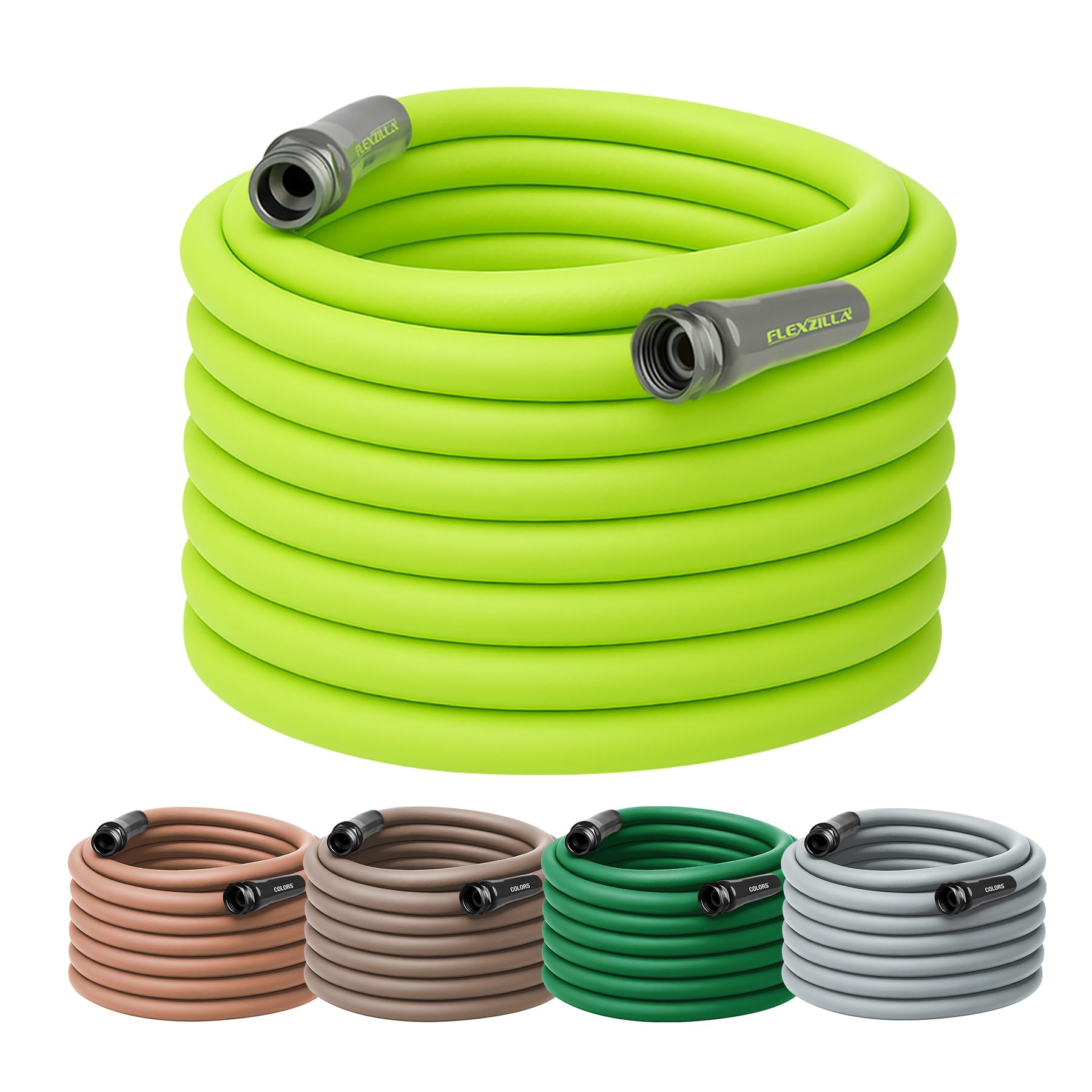
A cold morning is where a cheap hose gives itself away, going stiff enough that coiling it becomes a fight. The Flexzilla does not do that. The hybrid polymer stays soft when the temperature drops, and at 6.8 pounds for 100 feet it is light enough to loop one-handed at the end of a session, which is why we reach for it for shoulder-season watering and for any yard where the hose has to snake around trees and beds.

It also lies flat with no memory of the shape it was stored in, so you are not fighting a corkscrew the first time you pull it out in spring. The 5/8-inch bore moves water like a full-size hose, and the ends seal on an O-ring rather than relying on the washer alone. That O-ring is the part to look after: a nicked or missing ring is where a drip starts, and it is the first thing to check before you blame the hose.

The junction between hose and fitting is the known weak spot. It is where a hybrid hose tends to give out first, and pulling the hose along by the coupling is how you speed that up. Flexzilla covers this hose with a limited lifetime warranty, which is what makes us comfortable recommending it anyway. Lift it rather than drag it by the end, and it will outlast the vinyl it replaced.

Bottom line: Our pick when the hose has to go around trees and beds in cool weather: it stays soft, coils in one hand, and the lifetime warranty backs the ends.

Check Latest Price
#03

Best Lightweight 100-Footer

Bionic Steel Metal Garden Hose

89 /100
Kirk Score Excellent
Length
100 ft
Weight
3 lb
Max Pressure
500 psi
Inside Diameter
5/8 in.
Check Details on Amazon

Pros

  • Three pounds for a full 100 feet
  • Steel sleeve resists tangles, thorns, and teeth
  • Full 5/8-in. interior with a 500 psi burst rating

Cons

  • Included nozzle can start dripping before the hose does

Three pounds is the whole 100-foot hose, less than a gallon of water, and it is why this is the one we hand to anyone with a big property and a sore shoulder. Dragging it across a yard feels closer to pulling a rope than to hauling a hose.

The steel shell is a memoryless sleeve over an inner tube, so it lays flat, refuses to tangle, and slides over gravel and around shrubs without snagging on every stem. That outer layer is also why it survives the things that shred rubber: thorns, a chewing puppy, being stepped on. And unlike an expandable hose it does not thin out under pressure. The interior is a full 5/8 inch with a 500 psi burst rating, so the stream at the far end is still a stream.

The trade is real. The part that eventually fails is the inner tube, usually near a fitting, and once it goes there is nothing to repair. We treat this as a replace-not-repair hose and are happy to, because no other 100-footer here is this easy to move. If you want the hose you keep for a decade, that is the Continental; if you want to cross half an acre without your arms aching, it is this one.

Bottom line: The 100-footer we hand to anyone with a big property and a sore shoulder: three pounds, no tangles, and a steel shell that survives gravel and dogs.

Check Latest Price
#04

Best for Easy Handling

zero-G Garden Hose

86 /100
Kirk Score Excellent
Length
100 ft
Weight
8.4 lb
Max Pressure
600 psi
Inside Diameter
5/8 in.
Check Details on Amazon

Pros

  • About half the weight of a vinyl hose
  • Rated drinking water safe and lead free
  • 600 psi burst rating
  • Rolls onto a caddy without fighting

Cons

  • Inner tube can burst and cannot be repaired
  • Fittings can drip where the coupling meets the hose

The zero-G does not look like a hose. The jacket is a flat woven fabric, gray and a little dull, and it lies on the ground like a strap rather than a tube, which is exactly why it slides through a flower bed without catching on every stem.

At 8.4 pounds for 100 feet it comes in at about half the weight of a commercial vinyl hose the same length, and the difference shows up in your forearm by the end of a watering session. It rolls onto a caddy neatly, hangs on a hook without knotting itself, and carries a 600 psi burst rating, so ordinary household pressure is not a worry.

Kinking is less of a problem than with a soft rubber hose, because the fabric jacket gives it just enough stiffness to resist folding at the tap. Pull it around a corner under full pressure and it will still bend, but it straightens without holding a crease, which is the difference between an annoyance and a split.

Where it earns its place in this list is the drinking-water rating: this hose is stated to be drinking water safe and lead free, and most of the picks here say nothing either way. That matters if you fill a kiddie pool, top up a birdbath, or water tomatoes you eat off the vine. Add the weight and it is the hose we suggest to a household where one person does all the dragging.

Bottom line: We suggest the zero-G for a household where one person does all the dragging, especially if the hose fills a kiddie pool or waters food crops.

Check Latest Price
#05

Best 50-Foot Metal Hose

Cesun Metal Garden Hose

89 /100
Kirk Score Excellent
Length
50 ft
Nozzle
10 patterns
Fittings
Brass
Material
304 stainless steel
Check Details on Amazon

Pros

  • Ten usable spray patterns with a thumb control
  • Light metal hose at 5.6 pounds
  • Stainless body with brass fittings

Cons

  • Couplings can leak under constant pressure

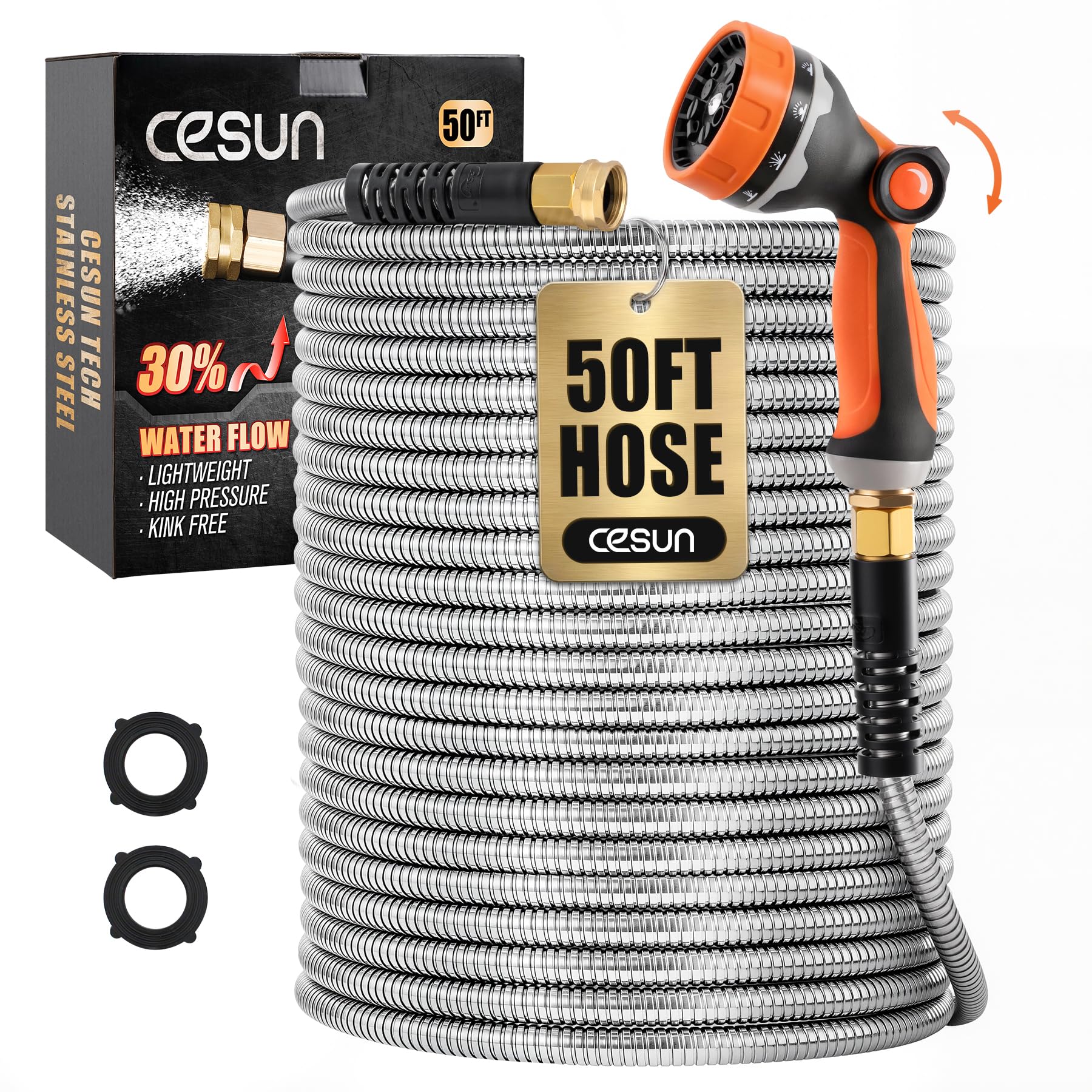
Ten spray patterns, a thumb control, and a rubber-wrapped head: the nozzle that ships with the Cesun is better than most of the ones sold alongside hoses, and it is why this 50-footer works as a single purchase rather than a hose plus a second shopping trip.

Fifty feet of 304 stainless with brass fittings at 5.6 pounds hits a useful middle, long enough to reach the far bed from the back tap and short enough that coiling it takes half a minute. The thumb trigger is the part we appreciate most: you can dial down to a trickle for seedlings without walking back to the spigot, and the ten settings run from a mist for seed trays to a jet for cleaning a patio.

It is also the length that suits a patio, a couple of raised beds, or a camper hookup where 100 feet would be a nuisance to store. The standard fittings take a timer, a sprinkler, or any nozzle you already own, and if you already have a nozzle you like, the included one makes a decent spare.

Bottom line: Fifty feet of stainless with a good nozzle in the box makes this the simplest single purchase for a patio, raised beds, or a camper hookup.

Check Latest Price
#06

Reel-mounted daily use

Giraffe Tools Garden Hose

88 /100
Kirk Score Excellent
Length
100 ft
Weight
14.7 lb
Warranty
2-year limited
Inside Diameter
5/8 in.
Check Details on Amazon

Pros

  • Two-year limited warranty in writing
  • Swivel handles at both ends
  • 600 psi burst rating with a UV-resistant cover

Cons

  • Twists and kinks when pulled around beds
  • Heaviest 100-foot hybrid here at 14.7 pounds

A two-year limited warranty, spelled out in writing, is a rare thing in a category where the fine print usually covers normal wear and not much else. That is where we start with the Giraffe.

The hose is a 100-foot hybrid polymer with a 5/8-inch bore, an abrasion- and UV-resistant outer layer, and a 600 psi burst rating. The detail we like best is the swivel handle at each end: the fitting turns instead of the hose, so connecting to a spigot tucked behind a shrub does not take three attempts and leave a twisted length lying on the ground.

Where it makes sense is on a reel, pulled out and put back most days, by someone who wants hybrid flexibility without rubber-hose money. The warranty is the deciding factor. Choose it over the cheaper metal 100-footers if you want a stated term and a number to call when an end starts weeping in the second season.

Bottom line: We point to the Giraffe when someone wants a stated warranty on a 100-foot hybrid, and has a reel to keep it on.

Check Latest Price
#07

Pots and small beds

SPECILITE Metal Garden Hose

89 /100
Kirk Score Excellent
Length
50 ft
Nozzle
8 patterns
Material
304 stainless steel
Inside Diameter
3/8 in.
Check Details on Amazon

Pros

  • Light and easy to coil
  • Eight-pattern nozzle included
  • Rubber gaskets at both ends

Cons

  • Couplings are the first thing to fail

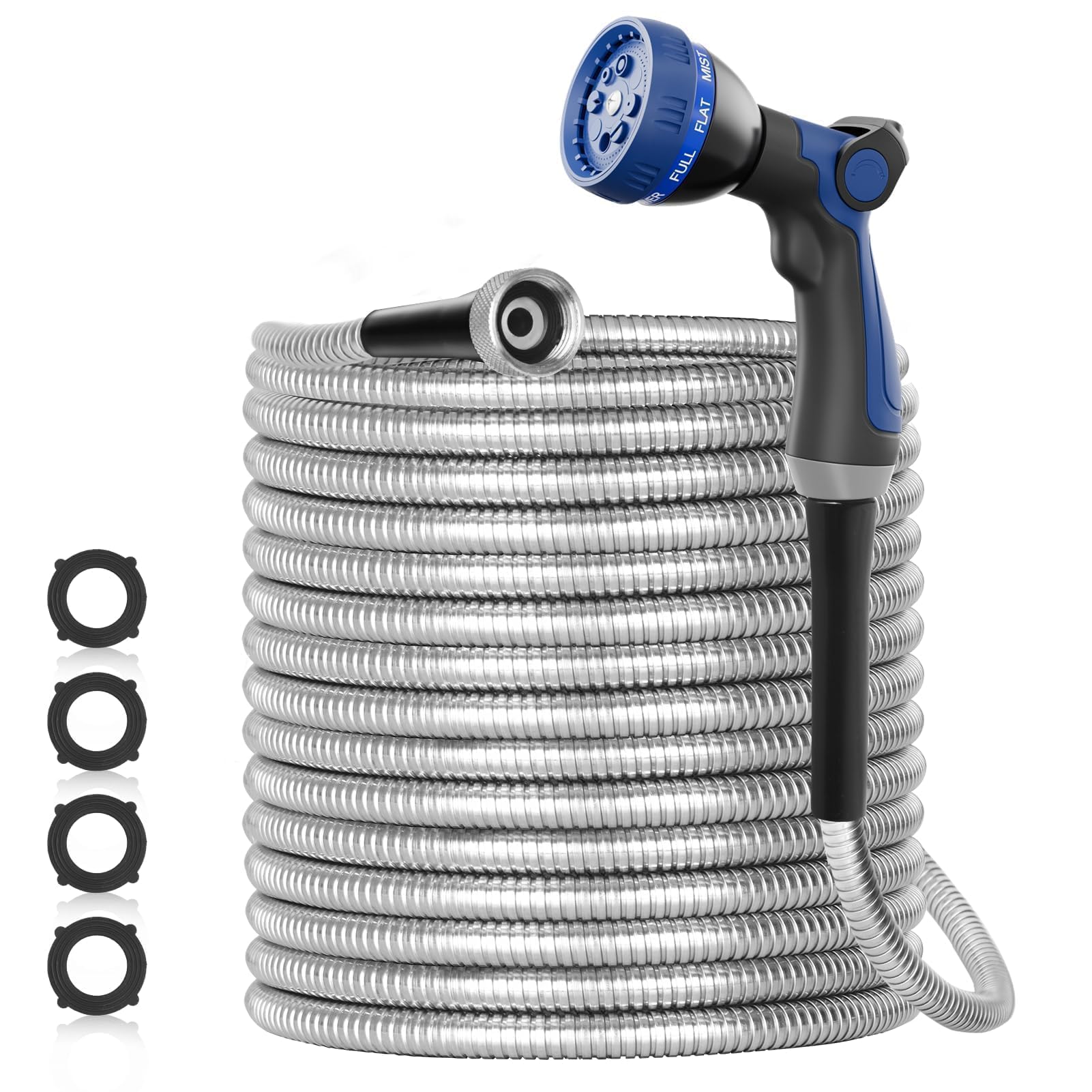
The least expensive metal hose here is also one of the lightest, and for a patio, a handful of pots, and the occasional car wash, that is a combination worth taking seriously. Fifty feet of 304 stainless with a rubber-wrapped eight-pattern nozzle in the box covers more small jobs than the price suggests.

It is light enough to carry in one hand, uncoils without drama, and hangs on a bracket without pulling it out of the wall. The rubber gaskets at both ends do their job once the couplings are snug, and the nozzle is comfortable enough to hold for the ten minutes it takes to water a border.

The limitation is in the bore. Inside, this is a 3/8-inch hose wearing a 5/8-inch jacket, so the stream is thinner than a full-size hose at the same pressure: fine for hand-watering pots and beds, frustrating if you are trying to drive a sprinkler across a lawn or fill a wading pool before lunch. Buy it for small jobs and it is a great deal of hose for the money; buy it for coverage and you will be disappointed.

Bottom line: We like the SPECILITE for pots, a patio, and the car, as long as you are not expecting it to drive a sprinkler across a lawn.

Check Latest Price
#08

Tiny storage spaces

Pocket Hose Ballistic

88 /100
Kirk Score Excellent
Connector
360-degree swivel
Outer Sleeve
Ballistic fiber
Expanded Length
50 ft
Check Details on Amazon

Pros

  • Shrinks small enough to carry in one hand
  • 360-degree swivel at the faucet
  • Light enough to hang on a balcony

Cons

  • Can burst or spring a pinhole leak within months
  • Does not always shrink back to its original length

Turn the water off and the Pocket Hose shrinks back, collapsing from a working 50-footer into a bundle you can carry in one hand. That is the entire proposition, and it is a good one when storage is your problem rather than durability.

In use it is genuinely light, and the 360-degree swivel at the faucet end lets the whole length turn with you instead of twisting against the spigot. The outer sleeve is a woven fabric reinforced with ballistic fiber, meant to keep the inner tube from bulging through when the pressure comes on, and the thumb control on the nozzle is easy to work one-handed.

Where this kind of hose lives is a balcony, a small patio, or a shed with no room for a reel. Nothing rigid here stores in as little space, and because it shrinks down small and comes inside with you, it is not trailing water through the kitchen on the way to the hook.

This is not a whole-yard hose, and it is not meant to be. It is a balcony, camper, or back-patio hose that has to disappear when you are finished, and the swivel fitting makes connecting it less of a wrestling match than the price of entry suggests.

Bottom line: For a balcony or a shed with no room for a reel, we think the Pocket Hose is the practical answer, as long as you accept a shorter life.

Check Latest Price

How We Tested Garden Hoses

We started by narrowing a long list to hoses in the 5/8-inch diameter most households use, in 50- and 100-foot lengths, then filtered by construction, coupling type, and price. The final group was 12 hoses, tested over six months across vinyl, hybrid, stainless-steel, and expandable designs. Each one had to handle the same routine: watering garden beds, filling buckets, washing a car, and getting dragged around corners and over concrete.

Kinking was the first thing we watched. We pulled each hose around a tree and across a lawn to see whether it pinched at the spigot or folded on itself, and whether it sprang back without a fight. We lifted every hose full of water to judge weight, coiled it on a cool morning to check flexibility, and noted how easily it connected, disconnected, and moved with one hand. Leakage got its own check: we ran each hose at full pressure and watched the couplings and nozzles for drips.

After dragging them over concrete and leaving them in the sun, we looked for scuffed covers, loose fittings, faded color, and any change in how they handled. We also compared what each hose cost against how it performed, since a cheap hose that leaks or kinks is no bargain. The hoses that scored best did the boring things well—staying dry, coiling without a fight, and feeling manageable when full.

How to Choose a Garden Hose

Length and bore before anything else

Length is the easy half. Measure the longest run from the spigot to the furthest bed, add a few feet of slack, and stop there; every extra ten feet is more hose to drag and more water sitting in the sun. Bore is where people get caught.

A 5/8-inch hose moves noticeably more water than a 3/8-inch one at the same household pressure, and over 100 feet that gap is the difference between a sprinkler that throws and one that dribbles. Plenty of metal hoses are 3/8 inch inside wearing a 5/8-inch jacket, so the outside of the hose tells you nothing. Look for the inside diameter, and if a listing will not state it, assume it is on the narrow side.

Weight is the trade you are actually making

Rubber is heavy and it lasts. Metal is light and replaceable. Hybrid polymer sits in the middle, and expandable fabric is the lightest of all and the shortest-lived. That is the market in a paragraph, and it means a hose promising both lightweight and durable is promising a compromise somewhere.

We take the extra three pounds over hauling a dead hose to the curb in a season or two. But if the hose has to go up a flight of steps or across half an acre every evening, the three-pound metal hose earns its shorter life. Be honest about which of those two yards you actually have.

Kink resistance is a design, not a promise

Anything sold as kink-free will kink eventually; the question is what the hose does next. A memoryless steel sleeve resists kinks and straightens without leaving a crease. Hybrid polymer recovers its shape. Rubber bends at a kink but does not permanently deform, so it survives being hauled around a corner. Thin vinyl and expandable hoses crease, and then split at the crease.

Technique matters as much as material. Pull the full length out straight before you water, coil with the hose's natural curve rather than against it, and lift the hose rather than dragging it by the nozzle, which is how most couplings get ruined.

Where leaks actually start

Nearly every drip we have chased was at a coupling, not in the body of the hose. Brass holds up better than aluminum, which corrodes and seizes onto a spigot after a season outdoors; a fresh rubber washer or a properly seated O-ring fixes most spigot drips in under a minute.

Tighten by hand, then a quarter turn with a wrench: enough to compress the washer, not enough to distort it. If a hose is going to sit pressurized on a timer all summer, buy on the strength of the fittings rather than the cover, and expect to change a washer once a season.

Storage, warranty, and year three

A hose left full of water in direct sun is aging at double speed. Drain it, coil it, keep it out of the sun, and bring it in before the first hard freeze, since even a cold-rated rubber hose lasts longer stored dry. Where it hangs matters too: a heavy hose needs a bracket in a stud, not a hook in siding.

Then read the warranty, because it tells you what the maker expects the hose to do. Limited lifetime terms are common on rubber and hybrid hoses, two-year terms on the mid-range hybrids, and a matter of weeks on some of the cheaper metal ones. The term is not a durability guarantee, but it is the clearest statement of confidence you get before you buy.

Frequently Asked Questions

Final Verdict

The Continental is the hose we point people to when the last three have failed at the fitting: real rubber, brass ends, a full 5/8-inch bore over 100 feet, and enough weight that you will want a reel for it. It is the most expensive route here and the longest-lasting one.

If that weight is the problem, the Flexzilla delivers the same length and bore in a hose that stays soft in cold and coils in one hand, and the Bionic Steel drops the whole 100 feet to three pounds for a yard where the hose gets dragged rather than carried. Buy the rubber one for the lawn you plan to keep; buy the light one for the yard you have to cross.