// data-verified

Best Garden Sprayers of 2026

For something so simple — a tank, a pump, a nozzle — a garden sprayer has a surprising number of ways to wreck an afternoon. A seal gives out halfway down a bed of weeds and you're wearing the herbicide. Pressure fades after six pumps. The nozzle clogs, and your mix sits cooking in the sun while you go hunting for a paperclip. The right one just keeps spraying: a steady pattern, no drips at the cap, and pressure that holds to the last quart.

I've filled sprayers with tomato fungicide, fertilizer, deck cleaner, and a bleach solution I immediately regretted, and tank size is the least interesting thing about them. What matters is whether the seals survive your chemistry, whether the pump or the battery lasts to the end of the job, and whether you can carry the thing full without your forearm burning. We've spent the past four months testing 14 of them — one-liter handhelds, two-gallon tanks, a backpack, a hose-end dial — and the gap in reliability was wider than I expected.

The difference shows up fast: how it feels to haul a full tank around the yard, whether the spray pattern still looks even at the end of a fence line, whether cleaning it out takes two minutes or twenty. The picks below are the ones that held up.

#01

Best Overall

Scotts 190567

89 /100
Kirk Score Excellent
Tank Volume
2 gallons
Power Source
Battery Powered
Battery Runtime
Up to 12 tanks per charge
Maximum Pressure
21 psi
Check Details on Amazon

Pros

  • No pumping during application
  • Up to 12 tanks per charge
  • Three-year warranty

Cons

  • Battery and pump reliability can be uneven

The first thing we noticed about the Scotts 2-gallon is what's missing: the pump handle. A rechargeable lithium-ion pump keeps pressure steady, and Scotts rates it for up to 12 full tanks per charge. For a typical home lawn, that changes the job from a series of pump-and-spray pauses into one continuous pass. The three-year warranty is the other detail that made us comfortable recommending it as the default here.

At 2 gallons and 4.7 pounds empty, it's easy to carry around beds and borders. The 21-inch wand and lock-on shut-off let you keep spraying without squeezing, and the pressure-release valve lets you bleed air before opening the cap. The 21 psi ceiling is lower than a manual pump, so we see this as a lawn-and-bed sprayer rather than a tall-tree or thick-coating rig.

The in-line filter is a small thing that saves a lot of stopping and starting, and the wide mouth makes filling and rinsing less messy. We also appreciated that the wand clips to the tank for storage, so it doesn't roll around in the shed. It isn't the sprayer for an orchard or a fence line that needs a long reach, but for the average suburban lot it hits the sweet spot.

Bottom line: For most home lawns and garden beds, the Scotts 2-gallon is the battery sprayer we recommend: no pumping, steady pressure, and a three-year warranty.

Check Latest Price
#02

Best Manual Backpack

Field King 190328

91 /100
Kirk Score Outstanding
Tank Volume
4 gallons
Power Source
Manual
Maximum Pressure
150 psi
Nozzles Included
6
Check Details on Amazon

Pros

  • Internal pump keeps chemicals off your back
  • 150 psi and six nozzles
  • Comfortable padded straps
  • 4-gallon tank cuts refills

Cons

  • Seals and tank threads are the long-term weak point

Four gallons and 150 psi put the Field King in a different class from the handheld sprayers here. The internal piston pump is the design detail that matters most: because the pump sits inside the tank, chemicals don't drip down your back while you work. The 21-inch poly wand, six nozzles, and brass shut-off give you more ways to aim the spray than most homeowners will need.

We found the backpack comfortable enough to keep on through a long pass, and the side-mounted pump is easy to work while the tank is on your back. The 150 psi output and six nozzles make it the strongest manual option in this group for fruit trees, fence lines, and larger beds. A full tank is heavy, but the padded straps and back pad distribute it better than a carry handle.

The six nozzles include a foaming tip and several fan widths, which is more coverage than the smaller sprayers offer. The fill opening is wide enough to fill from a bucket, which matters when you are mixing several tanks in a row. For a large property, the refill savings are worth the weight, and the comfort straps are the reason this one stays on your back instead of on the ground.

Bottom line: For a large yard, orchard, or fence line, the Field King is the manual backpack we recommend: 4 gallons, 150 psi, and six nozzles.

Check Latest Price
#03

Best Value Pump Sprayer

Roundup 190260

91 /100
Kirk Score Outstanding
Warranty
5-year limited
Hose Length
36 inches
Tank Volume
2 gallons
Power Source
Manual
Check Details on Amazon

Pros

  • Five-year limited warranty
  • Three nozzles for different jobs
  • Pressure-release cap for safer opening

Cons

  • Wand and connections can develop leaks

Five years of warranty is unusual in a garden sprayer, and it's the first thing that makes the Roundup worth a look. The 2-gallon tank, 36-inch hose, and lockable shut-off cover the basics, while the pressure-release cap sends liquid and vapors down and away when you open the top. That's a small design choice we appreciate every time we refill.

The three nozzles are the practical part: an adjustable poly tip, a high-volume flat fan, and a foaming nozzle. We used the fan tip for deck and siding cleaning and the adjustable tip for bed edges, and the difference is obvious enough to justify swapping nozzles rather than fighting one pattern. The 3.9-pound empty weight is light enough to carry one-handed between beds.

The five-year limited warranty is the reason this one ranks above the cheaper 2-gallon sprayers for us. It doesn't make the sprayer unbreakable, but it gives you a path if the pump or shut-off fails. The Roundup is the manual pick for someone who wants a familiar pump sprayer with more nozzle options and a longer warranty than the budget tanks.

Bottom line: The Roundup is the manual 2-gallon we recommend for value: three nozzles, a pressure-release cap, and a five-year warranty.

Check Latest Price
#04

Best Hose-End

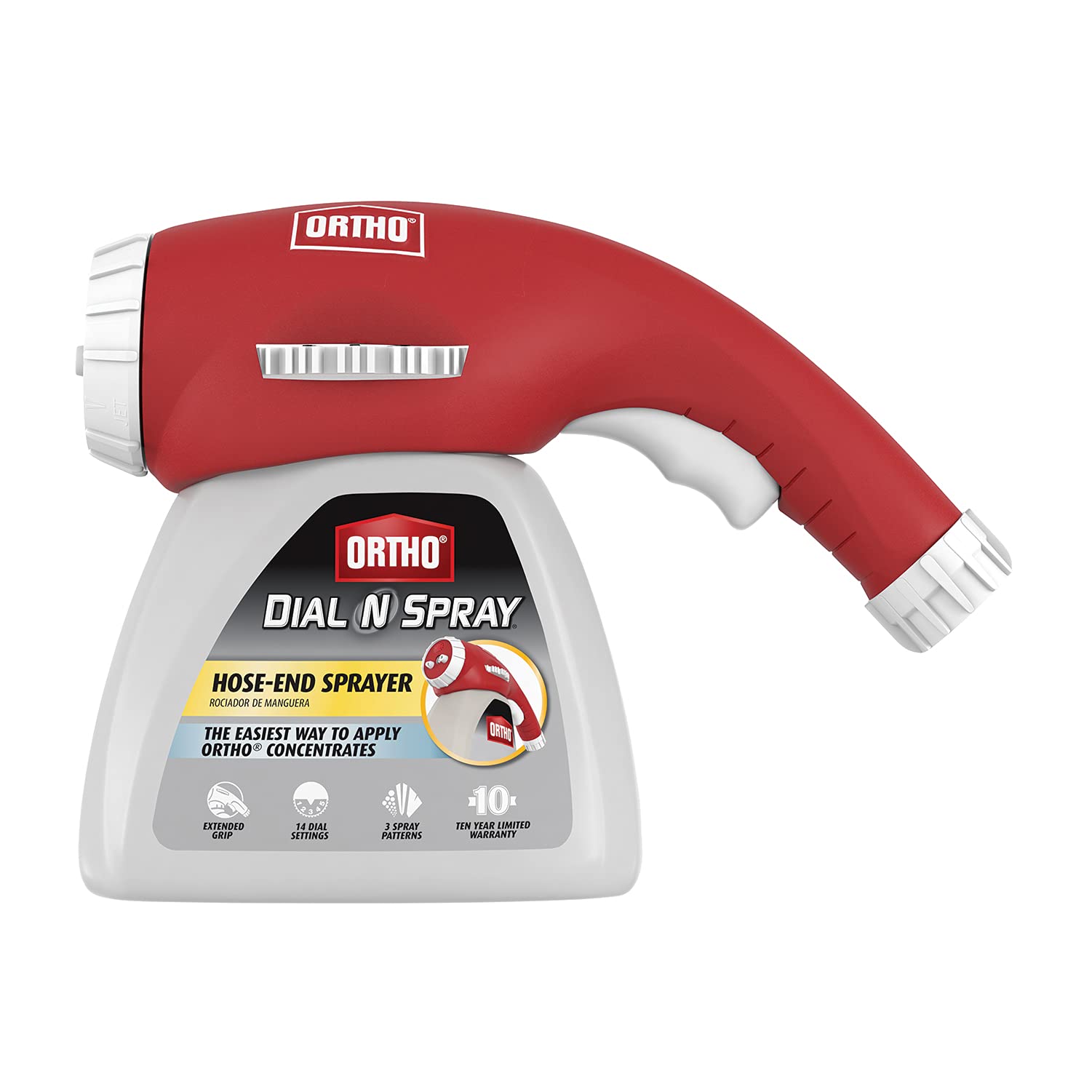
Ortho Dial N Spray

89 /100
Kirk Score Excellent
Item Weight
11.2 oz
Liquid Volume
2 gallons
Spray Patterns
3
Dilution Settings
14
Check Details on Amazon

Pros

  • 14 dilution settings
  • Three spray patterns
  • No mixing for hose-end application

Cons

  • Handle and hose connection can leak

Dialing a concentrate from teaspoons to ounces per gallon is the whole point of the Ortho Dial N Spray. The jar attaches to a hose, and the dial gives you 14 dilution settings, so you can feed, weed, or spray fungicide without mixing a tank. The three spray patterns cover broadcast, jet, and a softer rinse.

We like it best for jobs where the hose is already out: feeding a lawn, spraying a fence line, or hitting weeds along a driveway. The extended-grip handle and rotating hose connector make it less awkward to aim than a jar with a short neck. The stream setting reaches high spots, and the trigger is easy to hold for short passes.

The jar is clear enough to see when it's empty, and the dial comes off for rinsing, which matters when you switch from fertilizer to weed killer. The trigger can cramp your hand during a long session. Those are the trade-offs for a hose-end sprayer that costs far less than a battery tank.

For a homeowner who already owns a hose and wants to stop mixing fertilizer in a watering can, the Ortho is the hose-end sprayer we recommend. It isn't the tool for a property without a spigot nearby, but it is the fastest way to apply a measured dilution over a wide area.

Bottom line: For hose-end feeding and weed control, the Ortho is the one we recommend: 14 dilution settings and three spray patterns without mixing.

Check Latest Price
#05

Best for Small Jobs

SOLO 418

93 /100
Kirk Score Outstanding
Item Weight
9.9 oz
Tank Volume
1 liter
Power Source
Manual
Product Dimensions
7.5 x 5.25 x 10 inches
Check Details on Amazon

Pros

  • Fine mist and adjustable stream
  • One-hand trigger with lock
  • Compact 1-liter tank
  • Easy to fill and pump

Cons

  • Nozzle can crack and leak

A one-liter sprayer sounds like a toy until you use it on a shelf of houseplants. The SOLO 418 is small enough to hold in one hand, but it pumps up to a fine mist or a straight stream that reaches across a patio. We like the trigger lock because it lets you keep spraying while you pump, which is the difference between a spot treatment and a hand workout.

The adjustable nozzle covers more ground than the size suggests: a mist for seedlings, a shower for pots, and a stream for spot weeds in cracks. The 9.9-ounce empty weight is light enough to carry around the balcony, and the translucent bottle lets you see how much is left. It is the sprayer we reach for when a full tank is overkill.

The one-liter capacity means refills if you are treating a whole bed, so it's a spot sprayer rather than a lawn sprayer. The bottle is easy to fill from a watering can, and the nozzle cleans up with a quick rinse. For indoor plants, seedlings, and small patio jobs, that trade-off is easy to accept.

Bottom line: For houseplants, balcony pots, and spot spraying, the SOLO 418 is the small sprayer we recommend: a fine mist, a strong stream, and one-hand control.

Check Latest Price
#06

Best for Bleach and Cleaning

Chapin 20075

88 /100
Kirk Score Excellent
Hose Length
34 inches
Tank Volume
1 gallon
Recommended Use
Bleach solutions and fungicides
Maximum Pressure
60 psi
Check Details on Amazon

Pros

  • Bleach-resistant seals
  • Pressure-release valve
  • Anti-clog filter
  • 1-gallon tank for cleaning jobs

Cons

  • Plastic handle and pump can break

Bleach is hard on sprayer seals, which is why the Chapin 20075 exists. The 1-gallon tank uses bleach-resistant seals and gaskets, and the pressure-release valve lets you bleed air before opening the cap. The in-tank anti-clog filter and adjustable nozzle are the same kind of practical touches Chapin builds into its garden sprayers.

We used it for siding and deck cleaning, where a dedicated bleach tank saves you from contaminating a sprayer you also use for fertilizer. The 34-inch hose gives you enough reach to get above a deck rail, and the 60 psi output is strong for a 1-gallon tank. The wide mouth makes filling from a measuring cup less messy.

The adjustable nozzle goes from a mist for mold to a stream for siding, which is the range a cleaning sprayer needs. A dedicated cleaning sprayer still needs to be rinsed and stored dry, and the 1-gallon size is right for a bathroom, a small deck, or a patch of siding, not a whole house. If you already own a garden sprayer, this is the one to keep separate for bleach. The pressure-release valve is the feature we appreciate most when it is time to open a tank that has been sitting in the sun.

Bottom line: If you are spraying bleach, mold killer, or fungicide, the Chapin 20075 is the dedicated sprayer we recommend: bleach-ready seals and a pressure-release valve.

Check Latest Price
#07

Tight budgets

Flo-Master 24101

88 /100
Kirk Score Excellent
Nozzle
Adjustable poly cone
Warranty
1 year
Hose Length
34 inches
Tank Volume
1 gallon
Check Details on Amazon

Pros

  • Low-cost 1-gallon tank
  • Adjustable cone nozzle
  • Simple fill-and-pump design

Cons

  • One-year warranty is short

The Flo-Master is the sprayer we keep for the job that doesn't deserve a premium tank. The 1-gallon translucent tank, 34-inch hose, and adjustable poly cone nozzle cover small beds, hanging baskets, and a quick pass on the deck. It is simple in the way a good utility sprayer should be: fill, pump, twist the nozzle, and go.

We appreciate the cone nozzle because it moves from a fine mist to a stream without a drawer full of extra tips. The tank is light enough to carry with one hand, and the wide opening makes it easy to rinse after a mild cleaner. It isn't the sprayer for a half-acre lawn, but it is the one we grab for a ten-minute job.

The 34-inch hose gives you enough reach to water a hanging basket without moving the tank. The 1-gallon capacity means refills on bigger jobs, which is why it sits in the budget slot rather than the top tier. For a spare sprayer or a first tank for small jobs, the low cost and simple design make it an easy yes. The nozzle is easy to clear if a bit of debris gets through, and the tank empties completely so it doesn't leave a puddle in the shed.

Bottom line: For a spare sprayer for small beds, watering, or mild cleaners, the Flo-Master is the budget pick we recommend.

Check Latest Price

How We Tested These Garden Sprayers

We started with a list of roughly 40 sprayers and narrowed it by type and by tank: manual pump, battery-powered, backpack, and hose-end; one-liter handhelds up to four-gallon tanks; clear bodies and opaque ones. We ruled out fixed nozzles and any sprayer whose seals weren't rated for the solutions people actually put in them. That left 14, and each one spent four months with us, through spring bed prep, container fertilizing on the patio, a long fence line of weeds, and a Saturday of deck and siding cleaning.

Every sprayer got the same first job: a tank of plain water and a stopwatch. We counted pumps to first pressure, sprayed a 30-foot run along a fence, and noted exactly where the pattern turned from mist to spatter or started streaking. We kept going until the tank ran low to see whether pressure held or sagged, timed how long a full tank lasted, and weighed each one full before carrying it up a slope. After every fill we wrapped a paper towel around the cap, the wand connection, and the nozzle — a leak shows up there long before you feel it on your shoes.

Then the chemistry. A bleach mix sat overnight in the sprayer rated for it so we could check whether the seals swelled or went tacky, a thick fertilizer solution went through the rest to see what clogged at the pickup tube, and every unit got a rinse-and-dry to see how much residue stayed behind. The battery-powered model sprayed continuously until it quit so we could time a realistic charge, and we watched whether it brought pressure back up as the tank emptied. Four months of refills, plus a few accidental drops off the tailgate, told us which ones were built to last and which ones only looked it.

How to Choose a Garden Sprayer

Start with tank size and full weight

Tank size should follow the area you treat, not the biggest number on the shelf. A 1-gallon tank is right for spot spraying, patio pots, and small cleaning jobs; 2 gallons is the practical middle for most home lawns and beds; 4 gallons only pays off when refilling is the bottleneck. Weight matters as much as capacity: a gallon of water weighs about 8 pounds, so a full 4-gallon backpack adds more than 30 pounds before you count the sprayer. We prefer a 2-gallon tank for most suburban lots, and a backpack only when the property is genuinely large.

Choose manual, battery, or hose-end

Manual pumpers cost less and can build high pressure, but you pay for it in pumping breaks. Battery sprayers trade peak pressure for steady output and less effort; the Scotts 2-gallon is the easiest of the battery tanks here, though its 21 psi ceiling suits lawns and beds more than tall trees. Hose-end sprayers eliminate the tank entirely and meter concentrate into the water stream, which is why the Ortho is so good for feeding and weed control near a spigot. Pick the power source by the job, not by the feature list.

Pressure, seals, and leak points

Peak pressure is less important than holding pressure through a pass. The lid gasket, pump seal, hose, and wand connections are where most sprayers start to lose it, and a pressure-release valve saves you from wrestling a charged tank open. We look for a clean lid seat and a pump that threads smoothly before anything else; a gritty thread or a dry gasket is a leak waiting to happen. If you spray bleach, check for bleach-resistant seals, as on the Chapin 20075, rather than risking a standard garden tank.

Nozzles and dilution control

A single adjustable cone covers mist to stream and is enough for most beds and spot spraying. A fan nozzle spreads material faster across a lawn or deck, while a foaming tip shows exactly where weed killer lands on a hard surface. Hose-end sprayers add a dilution dial, and the Ortho's 14 settings take the arithmetic out of mixing. More nozzles are useful only if you will actually swap them; otherwise a good adjustable tip is simpler to clean and harder to lose.

Chemical compatibility and dedicated tanks

We keep separate tanks for bleach, weed killer, and fertilizer when the budget allows. Residue from one job can damage the next, and bleach is especially hard on standard seals. If you clean siding or decks regularly, a dedicated bleach sprayer like the Chapin 20075 is worth the shelf space. For everyone else, rinse the tank and run clean water through the wand after each use, then store the sprayer dry with the cap loose. That habit does more for longevity than any single feature.

Frequently Asked Questions

Final Verdict

For most home lawns and garden beds, the Scotts 2-gallon is the sprayer we recommend. It takes the pumping out of the job, holds a steady 21 psi, and backs the battery and pump with a three-year warranty. If you are spraying a large property, the Field King's 4-gallon backpack and 150 psi are worth the extra weight; if you want a simple manual tank, the Roundup's three nozzles and five-year warranty make it the better value.