// data-verified

Best Outdoor Extension Cords of 2026

A 16-gauge cord is a pleasure to carry around the yard, right up until you plug a leaf blower into the far end of it. Lighter cords are easier on your shoulder and harder on your tools: the longer the run and the thinner the wire, the more the power sags by the time it reaches the business end. We spent four months with 14 outdoor cords, and wire gauge, jacket quality, and what's on the ends separated the good ones from the irritating ones.

Length deserves more thought than it gets: a 25-footer reaching the hedge and a 100-footer reaching the back fence solve different problems, and picking wrong means a second cord and a second connection point. Weight is the honest cost of the good stuff — heavy 12-gauge cords stay put in wet grass and don't flinch when a compressor kicks on, but you feel them by the end of the afternoon. A lighted end plug is the most underrated feature here; at dusk, in a tangle of cords, it's the difference between finding your connection and hunting for it with a phone flashlight.

#01

Best Overall

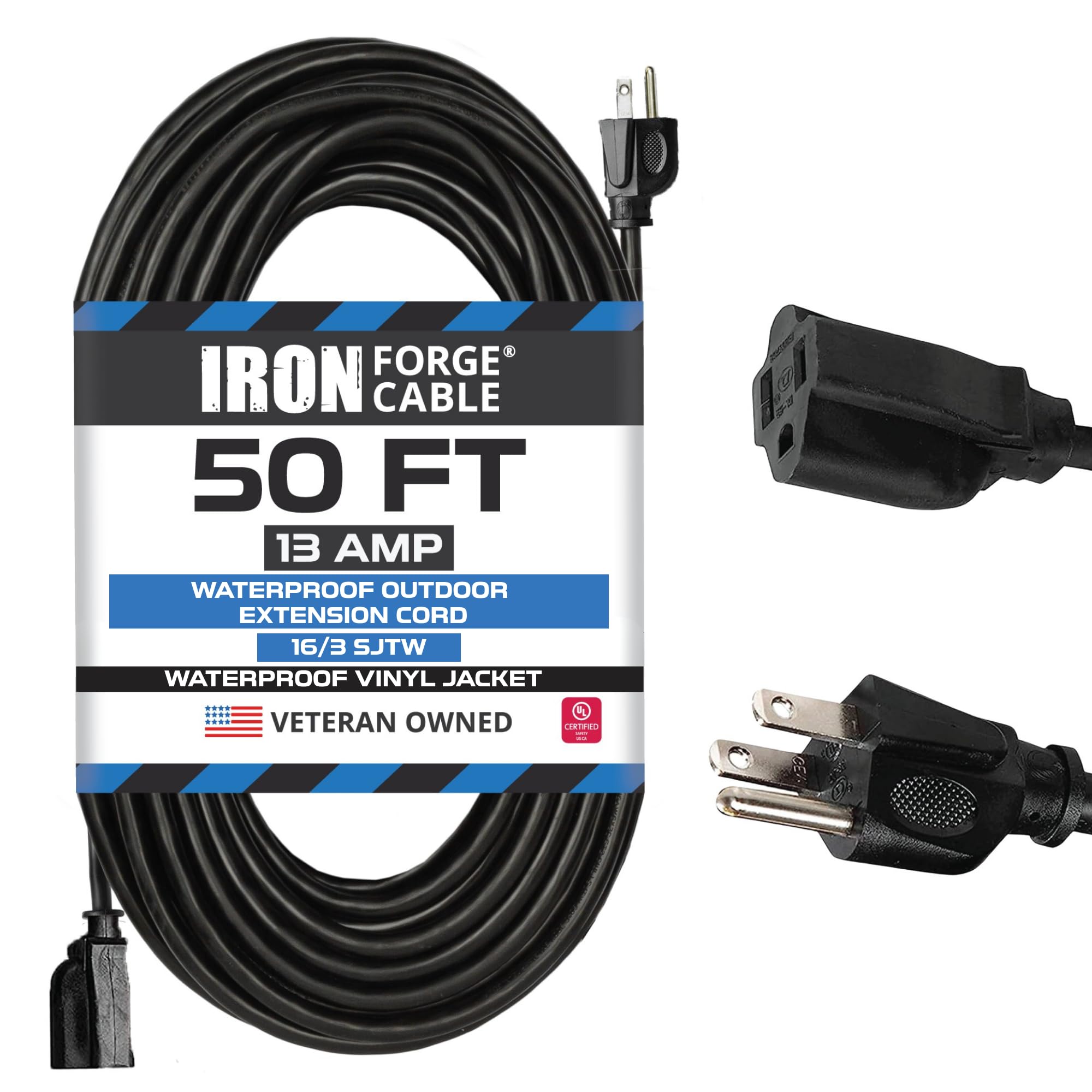
Iron Forge Cable 16/3 50 ft

96 /100
Kirk Score Outstanding
Gauge
16/3
Length
50 feet
Power Rating
13 amps / 1,625 watts
Certification
UL
Check Details on Amazon

Pros

  • UL listed, 13 amps over a full 50 feet
  • Reinforced nickel-coated blades resist bending
  • SJTW vinyl jacket handles sun, rain, and abrasion

Cons

  • No lighted end for finding it after dark

The ends of a cord are where it usually fails, and Iron Forge builds these better than the price suggests. The blades are nickel-coated and reinforced so they do not fold over when someone yanks the plug out by the cable, and the plug bodies are molded onto the jacket in one piece rather than assembled from parts that can work loose.

On paper it is a 16-gauge cord rated 13 amps, 125 volts, and 1,625 watts, which is the right place to be for most yards: enough for a leaf blower, a hedge trimmer, string lights, or a shop vac, as long as you check the tool's own label first. Fifty feet is the sweet spot too, long enough to cross a driveway and short enough that you are not dragging slack through the shrubs.

The jacket is the part that earns its keep outdoors. It is SJTW vinyl, the rating you want for a cord that lives on a hook by the back door, and it is sold as resistant to moisture, abrasion, and sunlight, which are the three things that actually kill a cord left outside. It is UL certified, and that listing is what we check before anything goes out in the rain.

What settles it for us is balance: enough capacity for anything a homeowner plugs in, a jacket that handles weather, and plugs that survive being pulled out by the cable. Nothing here is exotic and nothing needs to be. If a lighted end matters more to you than plug quality, the GoGreen below is the same idea in orange.

Bottom line: Our default pick for a yard: UL listed, 13 amps over 50 feet, and noticeably sturdier at the plug ends than the price suggests.

Check Latest Price
#02

Best Heavy-Duty

Southwire 12/3 SJTW 50 ft

96 /100
Kirk Score Outstanding
Gauge
12/3
Length
50 feet
Lighted End
Yes
Power Rating
15 amps / 1,875 watts
Check Details on Amazon

Pros

  • 15 amps and 1,875 watts over a full 50 feet
  • Lighted female end shows the circuit is live
  • Bright yellow jacket is easy to spot outdoors
  • Reinforced blades protect the prongs

Cons

  • The most expensive cord in this group

Pick this cord up and the first thing you notice is how much of it there is. That is 12-gauge copper, well over twice the metal in a 16-gauge cord, and it is why the Southwire is rated 15 amps and 1,875 watts over a full 50 feet instead of 13.

The rest is built for weather and for finding it again: a yellow jacket that stands out against grass and gravel, a lighted female end that glows whenever the circuit is live, and reinforced blades that do not fold when a plug gets stepped on. Cold-weather duty is where it earns its keep, and this is a snow-blower cord as much as a string-light cord.

For anything with a real motor, paying more here is the right call. Fifteen amps over 50 feet means the tool gets close to the current it was designed for, and the cord stops being the weak link in the chain.

Our reservation is handling. Twelve-gauge cable is stiff, and in cold weather it is stiffer; coiling 50 feet of it at the end of a job is a chore, and we do not bother. This is the cord that stays where you leave it, on a hook or under the eaves, until the next time you need it.

Bottom line: Anything with a big motor, a compressor, a table saw, a snow blower, wants 12-gauge copper, and this is the cord we buy for it: 15 amps over a full 50 feet, plus a lit end.

Check Latest Price
#03

Best Multi-Outlet

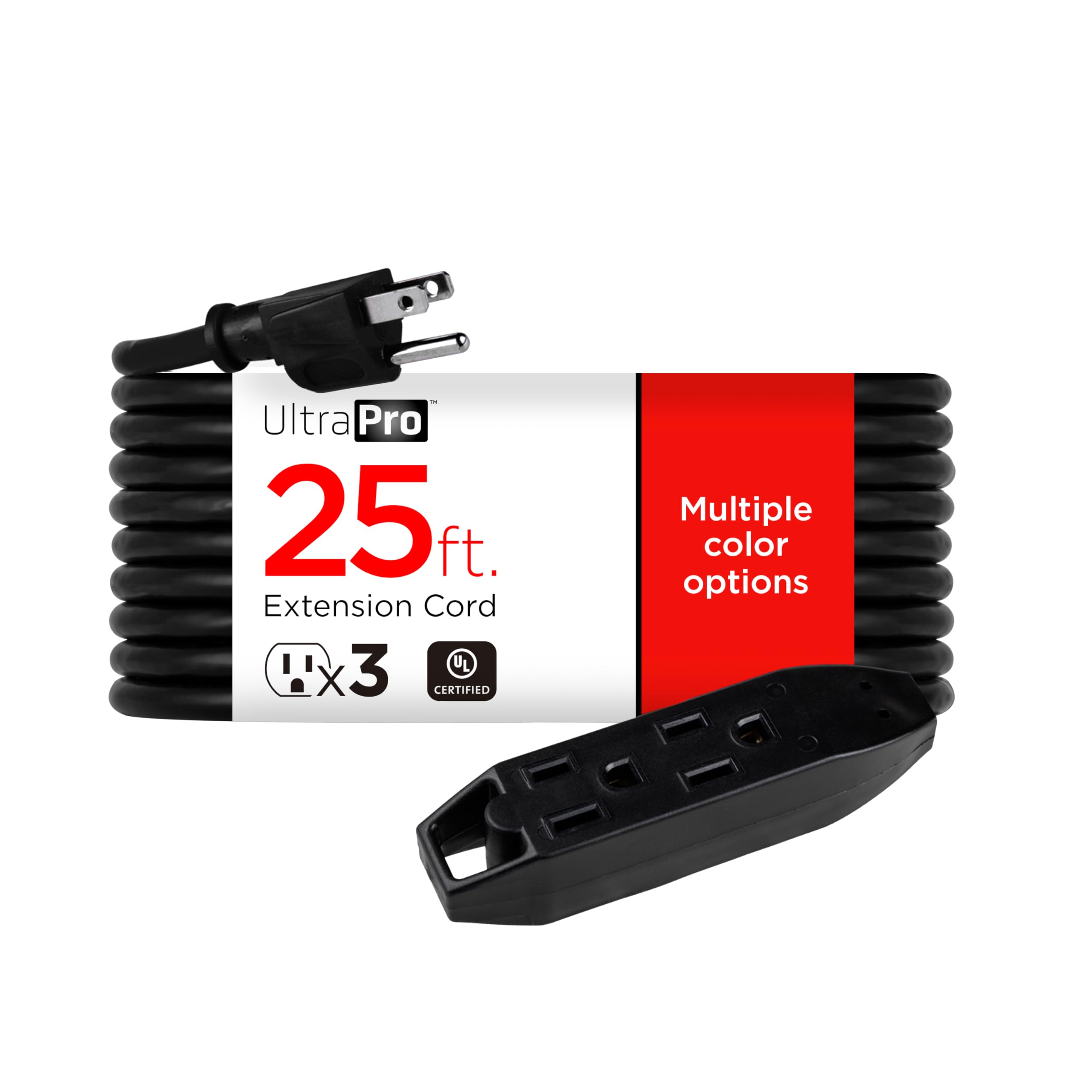
UltraPro 3-Outlet 25 ft

96 /100
Kirk Score Outstanding
Gauge
16
Length
25 feet
Outlets
3
Power Rating
13 amps / 1,625 watts
Check Details on Amazon

Pros

  • Three grounded outlets from one cord
  • ETL listed, 13 amps and 1,625 watts
  • Double-insulated jacket at under two pounds

Cons

  • All three sockets sit in one block

The head at the end of this cord takes three grounded plugs, which turns one outdoor outlet into a small power station for a deck, a garage, or a work corner. It is 25 feet of 16-gauge rated 13 amps and 1,625 watts, ETL listed, with a double-insulated jacket that shrugs off a wet lawn, and at just under two pounds it coils onto a hook without a fight.

The limitation is geometry: all three sockets sit in one block, so whatever you plug in piles up in the same spot. That is fine for a charger, a pump, and a work light, and it is genuinely convenient when the devices live together anyway. It is not how you light a fence line, though, and the DEWENWILS splitter below is the tool for that job.

Bottom line: Buy this when three things need power in one place, chargers, a pump, a work light, and we think one cord beats a nest of them.

Check Latest Price
#04

Best for Long Reach

Amazon Basics 16/3 100 ft

95 /100
Kirk Score Outstanding
Gauge
16
Length
100 feet
Power Rating
10 amps / 1,250 watts
Certification
ETL
Check Details on Amazon

Pros

  • 100 feet of reach from one cord
  • ETL listed with a grounded three-prong plug
  • Orange jacket is easy to find in grass

Cons

  • Rated 10 amps, not 13, over its length

A hundred feet of cord is a different tool from a 50-footer. It is the one that reaches the lights on the far fence, the fountain at the back of the lot, or the inflatable at the end of the driveway without a chain of joints lying in the grass.

The number to understand is 10 amps. Sixteen-gauge wire in a short cord is usually rated 13 amps; stretched to 100 feet, this one is rated 10 amps and 1,250 watts, because voltage drops as the run gets longer. That is plenty for lights, a bug zapper, a fountain pump, or a battery charger, and it is not the cord for a table saw at the far end of the yard.

The female end is chunky, and that trips up some tools: the molded block will not seat into the recessed inlet on every mower or trimmer. Check the inlet on your machine before you count on this cord for it. A short adapter solves it, and so does plugging the tool into a shorter cord.

For what most people use a 100-footer for, holiday lights, landscape lighting, a pond pump, none of that matters, and the orange jacket is easy to find in grass when you go to roll it up. It is the least expensive way here to get power to the back of a property.

Bottom line: We buy this for the far corner of the property: 100 feet of ETL-listed cord for lights and low-draw gear, with an honest 10-amp ceiling.

Check Latest Price
#05

Best for Holiday Lighting

DEWENWILS 1-to-3 Splitter 25 ft

95 /100
Kirk Score Outstanding
Gauge
16/3
Outlets
3
Cord Layout
7-foot lead plus three 6-foot branches
Power Rating
13 amps / 1,625 watts
Check Details on Amazon

Pros

  • One outlet becomes three spread-out sockets
  • Each outlet has its own safety cover
  • 16-gauge SJTW rated 13 amps for wet locations

Cons

  • Three outlets share one 13-amp ceiling

The 25 FT on the package is the total amount of cord, not the distance you get from the outlet. The layout is a 7-foot lead followed by three 6-foot branches, so the furthest decoration sits about 13 feet from the wall. It is a sensible design once you know that; it is just not what most people picture when they read the number.

For a yard full of decorations, though, it solves a real problem. One run from the outlet feeds three separate things, a lit arch, a set of stakes, an inflatable, without three cords fighting for one socket, and each of the three outlets has its own cover for wet weather. The cord is 16-gauge, 13 amps, 1,625 watts, and SJTW rated.

The green jacket disappears into shrubs in daylight, which is the point, and the 16-gauge stays workable in cold weather when you are setting up in December. Plan the layout outward from the outlet rather than end to end, and this is one of the tidier ways to light a yard.

Bottom line: For holiday lights we reach for this splitter first: one outlet becomes three spread-out sockets, as long as you read the length honestly.

Check Latest Price
#06

Lights and trimmers

GoGreen Power 16/3 50 ft

96 /100
Kirk Score Outstanding
Gauge
16/3
Length
50 feet
Lighted End
Yes
Power Rating
13 amps / 1,625 watts
Check Details on Amazon

Pros

  • Lighted female end shows power at a glance
  • Orange jacket is visible in grass
  • 50 feet of 13-amp SJTW cord

Cons

A socket that glows when the power is on is a small thing that saves a lot of walking. Plug this cord into a live outlet and the female end lights up, so when the string lights go dark you know in one glance whether the problem is the lights or the circuit. The jacket is orange, which matters more than it sounds when you are dragging a cord through tall grass at dusk.

The rest is a straightforward 50-foot 16-gauge cord rated 13 amps and 1,625 watts, cETL listed, with a vinyl jacket sold as moisture, abrasion, and sunlight resistant, which are the three things that kill a cord left outside. It is the one we point to for lights and small tools where you want to see at a glance that it is live. Save the 12-gauge for the motors.

Bottom line: A glowing socket and a hi-vis orange jacket make this the easiest cord here to troubleshoot after dark, and it is the one we point to for lights and small tools.

Check Latest Price
#07

Short heavy-duty runs

HUANCHAIN 12/3 25 ft

96 /100
Kirk Score Outstanding
Gauge
12
Length
25 feet
Lighted End
Yes
Power Rating
15 amps / 1,875 watts
Check Details on Amazon

Pros

  • 15 amps and 1,875 watts in a 25-foot cord
  • Molded hook on the socket end
  • Lighted end and strain relief at both plugs
  • Stays flexible in cold weather

Cons

  • Thicker and heavier than 16-gauge cords

Twelve-gauge cable is what you want behind a big motor, and 25 feet is often all the length you need. This cord is rated 15 amps and 1,875 watts, the same capacity as a 50-foot 12-gauge, in a package you can carry in one hand.

The details are better than the price point suggests. The socket has a molded hook, so you can hang the live end off a ladder or a fence instead of leaving it in a puddle; the ends have strain relief where the jacket meets the plug; and the female end lights up to show the circuit is live. It is rated waterproof, and it stays flexible in cold weather, which is unusual for cable this thick.

Where it fits: a table saw on the driveway, a heater in the garage, an RV on a pad, a miter saw near the door. Anywhere the outlet is close and the draw is heavy, 15 amps at 25 feet is more useful than 13 amps at 50. The Southwire above buys you twice the reach for a good deal more money; if you do not need the reach, this is the easier cord to live with.

Bottom line: When the outlet is close and the tool is thirsty, this is the short one we hand over: 15 amps without 50 feet of cable to drag around.

Check Latest Price
#08

Patios and porches

PLUGTUL 16/3 25 ft

96 /100
Kirk Score Outstanding
Gauge
16/3
Length
25 feet
Power Rating
13 amps / 1,625 watts
Certification
ETL
Check Details on Amazon

Pros

  • Black jacket blends with siding and fences
  • ETL listed with plated brass blades
  • Hook-and-loop strap included

Cons

  • No lighted end

Black is the right choice for a cord that lives against a fence, a porch post, or the siding of a house, and this one is unobtrusive enough that you stop noticing it. It is 25 feet of 16-gauge rated 13 amps and 1,625 watts, ETL listed, with nickel-plated brass blades that resist corrosion, which is the detail that matters when a cord spends the summer outdoors.

The length is the sensible middle: enough to get from an outlet to a patio table, a string-light run, or an outdoor TV, short enough that you are not coiling 50 feet for a 12-foot job. A hook-and-loop strap comes with it, which sounds trivial until you have stored a cord without one. This is the cord for a permanent spot rather than one you will be hunting for in the dark.

Bottom line: We like it best against siding and fences: 13 amps, ETL listed, in a black jacket that does not shout from across the yard.

Check Latest Price

How We Tested the Best Outdoor Extension Cords

We started with roughly 40 cords — the ones on every hardware aisle endcap plus a handful of farm-and-ranch names — and cut that to 14 on wire gauge, jacket rating, three-prong grounding, and whether the listing actually specified what the jacket was made of. Price per foot was recorded but never used to eliminate anything, since a cheap 16-gauge cord and a premium one can fail in exactly the same way. We made sure each length bracket had multiple entries, and that the features you'd actually compare — lighted end plugs and cords that split one outlet into three — were represented more than once rather than tested once and generalized.

Everything happened in real yards from early spring into late summer, not on a bench. Cords were dragged over gravel, through wet grass, and around garage corners, running leaf blowers, string trimmers, an electric mower, and a pressure washer. A few stayed strung out for weeks of holiday lighting, rain included. Every cord got coiled and uncoiled on a cold morning to see whether the jacket stiffened and held the shape of the coil.

Under load, we read voltage at the far end with a multimeter to see how much actually arrived. Each coil went on a kitchen scale, then got carried the full length of a driveway to judge whether the weight was a nuisance or a dealbreaker. We unplugged by the cord far more times than felt comfortable to see whether the blades or the jacket gave first, loaded the three-outlet cords with bulky adapters to check whether one plug blocked its neighbors, and confirmed that outlet covers closed on their own. Lighted ends were judged at dusk, from across a dim yard.

How to Choose an Outdoor Extension Cord

Match the Gauge to the Tool

Sixteen-gauge cords are rated 13 amps and 1,625 watts, which covers string lights, leaf blowers, hedge trimmers, and most hand tools. Twelve-gauge cords are rated 15 amps and 1,875 watts, and that is what a table saw, a compressor, or an RV hookup wants. The label on the tool tells you the draw; the label on the cord tells you what it can carry.

When the two are close, go thicker. A cord running near its ceiling gets warm, and the tool at the far end gets less than its rated power. We would rather see a 12-gauge cord doing an easy job than a 16-gauge cord doing a hard one.

Buy the Reach, Not the Number on the Package

Measure from the outlet to the farthest thing you need to power, then add a few feet of slack. A cord pulled tight across a walkway is a trip hazard and a strain on both plugs.

Watch how length is quoted. Splitters and multi-outlet cords sometimes advertise total cord rather than distance from the wall: the DEWENWILS 25-footer here gives you roughly 13 feet of reach because the rest is spread across three branches. And the same gauge carries less over a longer run. Our 100-foot pick is rated 10 amps where its 50-foot equivalents are rated 13.

Take the Weather Rating Seriously

An outdoor cord needs a jacket rated for it: look for SJTW on the jacket or an explicit outdoor and wet-location rating, and treat water resistant and waterproof as different claims. Water resistance handles rain and splashes; waterproof means the jacket is built for full exposure.

Either way, the connection is the weak point. Keep the joint off the ground and out of puddles, and hang the live end if you can. A socket with a molded hook, like the one on our 12-gauge HUANCHAIN pick, makes that easy.

Lighted Ends, Color, and Finding It Again

A lighted female end tells you at a glance whether the circuit is live, which turns are the lights broken into a five-second check. Color does similar work: orange and yellow show up in grass and gravel, while black disappears against siding and fences.

We care about both more than the numbers suggest. The cord you cannot find at dusk is the cord that gets left out all winter, and a cord left out by accident is the one that fails.

Plan for Cold and for Coiling

Twelve-gauge cable is stiff, and cold weather makes it stiffer. If the cord is going to stay put through the winter, that matters less; if you coil it every evening, it matters a lot, and 16-gauge is the easier cord to handle and hang.

Whichever you buy, uncoil it fully before you put a load on it. A tight coil under load holds heat, and heat is what shortens a cord's life.

Frequently Asked Questions

Final Verdict

For one cord by the back door that handles lights, blowers, and trimmers without fuss, we recommend the Iron Forge 16/3 in 50 feet. The plugs are the reason it wins: reinforced blades, molded ends, and a UL listing behind a 13-amp rating that covers nearly everything a homeowner plugs in.

If a big motor is involved, go 12-gauge: the Southwire when you need 50 feet of reach, the HUANCHAIN when 25 is enough and you would rather not drag the extra cable. And if the yard is a holiday display, the DEWENWILS splitter saves you running three cords to three decorations.