// data-verified

Best Outdoor Flood Lights of 2026

The flood light on my garage had one job, and it failed nightly: a raccoon crossed the driveway, the lamp fired, and the beam swung straight through my bedroom window. That's the thing about outdoor flood lights — brightness is easy; aiming them and getting the trigger right is what separates a good fixture from a nuisance. Get it right and your driveway, back step, and side gate light up the moment you need them, whether you're hauling in groceries or letting the dog out at eleven.

Over the past eight months we've mounted 12 of them on garages, fences, and shed walls — hardwired and solar — and the pattern showed up fast. The lumen figure on the box is measured at the LED, not at the ground where you're standing, so a well-aimed 4,000-lumen fixture beat a 7,500-lumen one pointed at the sky. Color temperature matters too, and so does the sensor: whether it reaches the far end of the drive, resets before you've found your keys, and stays dark when a cat crosses the lawn. There's a pick below for a front porch, a long driveway, and the black corner behind the shed.

#01

Best Overall

LUTEC 72W Motion Flood Light

92 /100
Kirk Score Outstanding
Heads
3 adjustable
Power
72W hardwired, 120V
Light Output
7500 lumens
Motion Range
180°, up to 69 ft
Check Details on Amazon

Pros

  • 7500 lumens
  • Three aimable heads cover wide ground
  • Dusk-to-dawn and manual override modes
  • Aluminum body with a three-year warranty

Cons

  • Large housing crowds a tight eave or corner

Seven thousand five hundred lumens is the number that settles most of the argument. This LUTEC throws roughly double what the 40W floods here manage, split across three heads you can point separately, so a driveway, a gate, and the dark corner behind the garage all get covered by one fixture. We aimed the center head down the drive and the outer two along the fence, and the flashlight stopped living by the back door.

The modes are what make it worth the money rather than just the output. Security mode gives full brightness on motion; dusk-to-dawn holds a dimmer steady glow and jumps to full when something moves; manual override burns steady for a set period. We ended up living in dusk-to-dawn, which is enough light to see the steps without turning the yard into a parking lot every time a raccoon crosses.

The housing is aluminum and IP65 rated, and at 2.4 pounds it wants two hands and someone steadying the bracket while you drive the screws. Sensing is quoted at 180 degrees and up to 69 feet, with sensitivity and on-time both adjustable at the fixture — worth doing before the ladder goes back in the garage.

Spend your setup time on sensitivity. Turned up, ours caught cars at the curb; turned down, someone had to be halfway up the walk. The 5000K white is also easier to live with than the colder solar units here — white rather than blue against siding. Just know that 72W is a real draw if you leave it at full brightness for hours at a stretch.

Bottom line: For a driveway or big yard with a junction box already in place, this is the fixture we point people to: the brightest and most flexible hardwired flood here.

Check Latest Price
#02

Best for Doors and Side Yards

LEPOWER 40W Motion Flood Light

93 /100
Kirk Score Outstanding
Power
40W hardwired, 120V
On-time
1, 5, or 10 minutes
Light Output
4000 lumens
Motion Range
180°, up to 72 ft
Check Details on Amazon

Pros

  • Straightforward swap onto an existing electrical box
  • Clean 5500K white with even coverage
  • On-time adjustable at 1, 5, or 10 minutes

Cons

  • Motion detection can lag or miss at the edges of its view
  • 4000 lumens is modest for a long drive

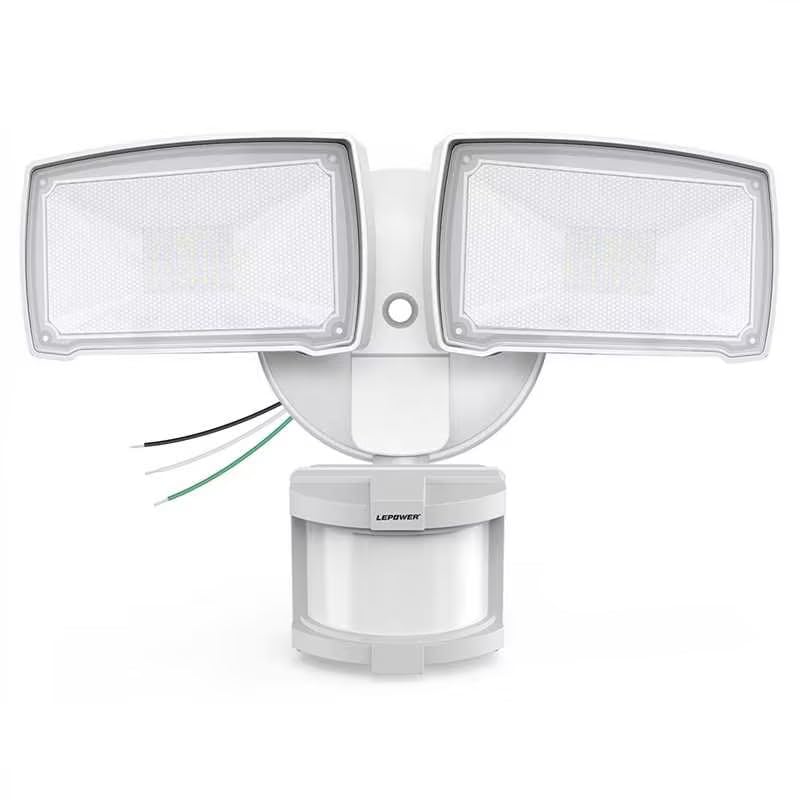
Half the output of our top pick and half the bulk: 4000 lumens from two heads plus a separate sensor, in a 1.6-pound white housing that swaps onto an existing box single-handed. Over a side door, a garage wall, or a small patio, that's the sane amount of light — the 72W LUTEC in the same spot would bounce off the siding and into the neighbor's kitchen.

As a replacement for an old incandescent flood it's the least fussy install here: two screws, a gasket, three wire nuts, and a dial for the on-time instead of an app. We appreciated that the sensor head moves independently of the lamps, so detection covers the approach while the light lands where you want it. ETL listing and a twelve-month warranty are the right paperwork for something wired into a house.

Where it gives ground is aim. The lamp arms swivel and the sensor head moves on its own, but travel is modest — mount it in a tight inside corner and you can light the wall or the path, not both. Range is generous enough for a drive at a normal mounting height; adults are picked up well before the steps.

The light itself is clean. 5500K reads as white rather than blue, coverage is even across the two heads with no hot spot in the middle, and the aluminum body feels like a fixture rather than a plastic box. Two of these cover a typical front and back door for about the price of one big three-head unit.

Bottom line: A well-made 4000-lumen motion light for doors, garage walls, and small patios — the pick when the top pick's output would be more glare than help.

Check Latest Price
#03

Best Switch-Controlled

LEPOWER 40W Switch Flood Light

95 /100
Kirk Score Outstanding
Heads
2 adjustable
Power
40W hardwired, 120V
Control
Wall switch only
Light Output
4500 lumens
Check Details on Amazon

Pros

  • Even, wide 4500-lumen coverage
  • Full aluminum housing, powder coated
  • Heads adjust independently
  • Simple swap onto an existing switch leg

Cons

  • Not dimmable

No motion sensor, no photocell, no dusk-to-dawn: this one is wired to a wall switch and does exactly what the switch says. That reads like a step backwards until you've lived with a motion light that fires every time a shrub moves. For a garage approach, a shop door, or a driveway where you want light on demand, dumb and switchable is the better design.

It's the fixture we've had the least to argue with. 4500 lumens from two wide heads at 5500K, spread rather than hotspotted, in a full aluminum body that won't chalk over the way plastic does. Coverage is better than the wattage suggests, and the heads adjust independently — one down the path, one across the door.

Install is a like-for-like swap when a switch leg is already there: two screws, three connections, done. What decides whether it lasts is the seal rather than the wiring, so snug the gasket and run a bead of exterior caulk around the plate while you're on the ladder. Put it on a smart switch or a mechanical timer and it covers a driveway on a schedule.

At 40 watts it's cheap to run and it comes on instantly in cold, which is more than the old halogen floods on the same circuit managed. Point the heads outward rather than at a nearby wall, though — at close range 4500 lumens is a great deal of light in a small space.

Bottom line: Buy it if the light goes on a switch you'll actually use: bright, even output and no sensor to second-guess you, for less than the motion fixtures here.

Check Latest Price
#04

Best Solar

LYWALT Solar 4-Head Light

89 /100
Kirk Score Excellent
Pack
2 lights
Power
Solar powered
Coverage
270° wide angle
Light Output
3000 lumens
Check Details on Amazon

Pros

  • Highest solar output here at 3000 lumens
  • Four aimable heads cover a wide fan
  • Tempered glass panel charges efficiently

Cons

  • Sealed battery

Setup is a bracket, two screws, and a ladder — no breaker, no wire nuts, no electrician. The panel is tempered glass and noticeably larger than the plastic-topped solar floods here, which is the part that matters: more panel recovers more charge on a short winter day. All four heads swivel, so you fan them across a yard instead of pooling light in one spot.

Three thousand lumens is the highest solar output in this guide, and on a full charge it's enough to make a driveway feel lit rather than decorated. We ran ours on motion mode through the week and let the dim all-night setting handle weekends. The four heads cover a wide fan of ground, and the dual sensors pick up movement from the side as well as head-on.

Solar has a bill attached, and it's paid in placement. A panel that spends the afternoon in shade leaves you with a light that dims by nine, and a run of gray days cuts runtime before it cuts brightness. Aim the panel south if you can, keep it off a north-facing wall, and accept that December is not July.

Mounting height is the other decision. Low enough to reach the mode button, high enough that the sensor sees a person rather than their shoes — head height on a fence post has worked for us. Two lights in the box means a gate and a shed can both be covered, which is more than most single-fixture solar units manage.

Bottom line: The solar pick for a gate, shed, or fence line where running cable isn't happening — bright enough to matter and simple enough to hang in an afternoon.

Check Latest Price
#05

Best Budget Solar

daphino Solar 3-Head Light

91 /100
Kirk Score Outstanding
Pack
2 lights
Power
Solar powered
Light Output
2500 lumens
Detection Range
Up to 40 ft
Check Details on Amazon

Pros

  • Two lights at a budget price
  • Three aimable heads with 270° spread
  • Panel tilts separately from the light

Cons

  • No remote
  • Runtime drops after several gray days

Two lights, brackets, and screws for less than one hardwired fixture — this is the cheapest route here to 2500 lumens on a wall without an electrician. Each unit carries three heads across a 270-degree spread and a panel that tilts independently of the light, which matters more than it sounds: point the panel at the sun and the heads at the path.

The button on the back cycles three modes under a waterproof cover, and there's no remote. We counted that as a plus — nothing to lose, nothing to pair, nothing to fail. Setup is two screws and a bracket per light, and a day of sun is the only commissioning they need.

Detection is rated to about 40 feet, which handles a gate or a path but won't spot a car at the top of a long drive. The 6500K white is genuinely cold: crisp on gravel and fencing, less flattering on a patio where people sit. These are lights for a corner of the yard, not a substitute for something with a cord.

Bottom line: If you want light on a fence or a back gate tomorrow and there's no wiring in sight, this pair is the cheapest way here to get there.

Check Latest Price
#06

Patios and entries

LUTEC 6222W Dual-Head Flood

92 /100
Kirk Score Outstanding
Heads
2 adjustable, 360°
Power
32W hardwired, 120V
Light Output
3500 lumens
Color Temperature
5000K
Check Details on Amazon

Pros

  • Compact metal body suits patios and entries
  • Two heads with a wide rotating arc
  • 5000K white is easy on the eyes

Cons

  • No motion sensor or photocell on this model
  • 3500 lumens won't reach the end of a long drive

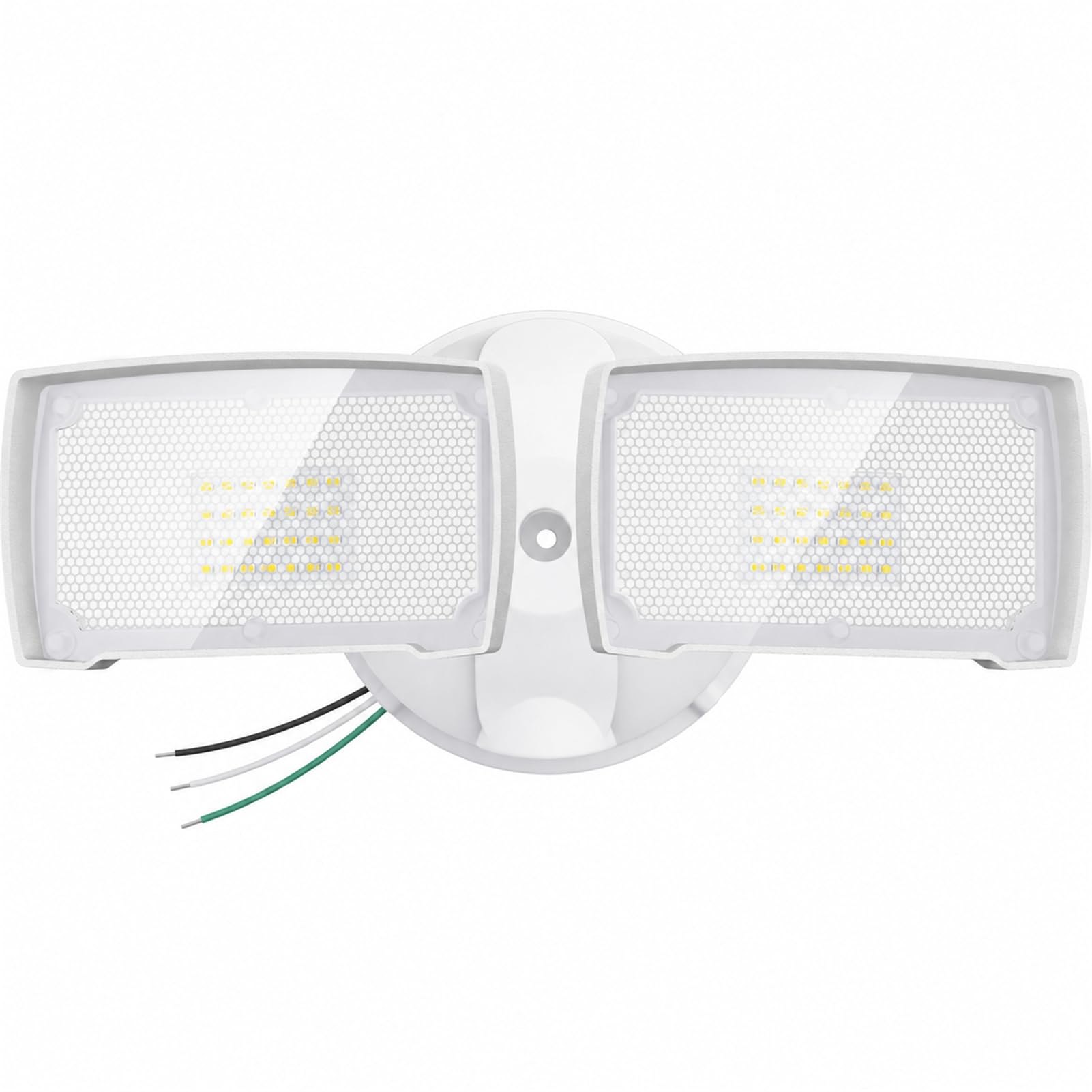
Replacing a dead two-head flood over a patio or back door is the job this LUTEC was built for: same footprint, same wall box, 3500 lumens at 5000K from 32 watts. It's painted aluminum with a clean white finish, and it reads as a light fixture rather than a security camera housing — which is why we put it on a porch wall instead of one of the three-head units.

The heads rotate through a wide arc and stay where you leave them, so one washes the patio and the other the steps. At 5000K it's the warmest white in this guide — still daylight, but without the blue edge of the 6500K solar picks. Where people sit and eat, that difference is worth more than another thousand lumens.

Mounting is a two-screw job on the existing box, and the gasket seats against the plate the way it should. Under an eave or on a sheltered wall, the painted metal finish is the part that keeps it looking deliberate a few summers in, which is not something you can say for a plastic flood housing.

Bottom line: The pick for a patio or entry where a big security light would be overkill: it looks like a fixture, throws a comfortable 3500 lumens, and swaps onto the old box.

Check Latest Price
#07

Fences and sheds

HMCITY Solar Wall Lights 6-Pack

89 /100
Kirk Score Excellent
Pack
6 lights
Power
Solar powered
Light Output
960 lumens each
Color Temperature
6500K daylight
Check Details on Amazon

Pros

  • Six fixtures for one modest outlay
  • No wiring
  • Front button for mode changes without tools

Cons

  • Plastic housings feel light-duty
  • Each unit needs its own sun exposure

Six small solar wall lights for less than one hardwired flood. That framing tells you what the set is for: not lighting a driveway, but putting a pool of light at the shed door, the side gate, the alley corner, and the three spots where you keep meaning to run cable.

Each unit is a 960-lumen downlight with a PIR sensor and three modes, and the front button is reachable without tools, so the mode you pick is the mode it stays in. The housing is plastic, the rating is IP65, and the panel is monocrystalline rather than the amorphous film on cheap sets — the more efficient of the two common solar cell types.

What it isn't is a flood light. At 960 lumens a unit, one fixture won't light a driveway, and mounted high on a wall the light falls in a downlight cone rather than a wash across the ground. Spread six of them along a fence line, though, and the whole run reads as lit, which is the point of a six-pack.

Everything about them is light-duty: plastic housings, small panels, a fixture you could knock off a fence post with a ladder. The 18-month warranty is more cover than the price suggests, and they go up with a drill and a level in an afternoon — which is the whole appeal.

Bottom line: Buy the six-pack to light a fence line, shed, or rental perimeter cheaply — just don't expect any one of them to behave like a flood light.

Check Latest Price

How We Tested 12 Outdoor Flood Lights, From Wiring to Winter

We started by pulling every fixture that kept turning up in listings and customer reviews, then cut anything without a weatherproof rating, anything whose heads didn't adjust independently, and anything whose solar cable couldn't reach sun from the mount. That left 12 units — hardwired and solar, two to four heads — mounted over eight months on a garage wall above a driveway, a fence line, a shed gable, and the wall beside a side gate.

Installation was timed, solo, with a drill and a screwdriver — whether an existing junction box made a hardwired job a fifteen-minute one or an afternoon, and for the solar units, how long the panel took to reach full charge. We aimed each head at the walkway and driveway rather than the sky, then took light-meter readings at 10 and 25 feet to see how much light landed where feet go, noting hot spots and the dark gaps that open up between heads.

The motion sensors got the most attention, since they're what you live with. We approached each fixture from three directions to find where it first fired, stood still to time how long it stayed on, and kept a week's tally of false triggers from cars, branches, and animals. Solar units got a second ledger: how many nights they ran on a charge in low winter sun, and whether they dimmed to a night-long glow or went dark by 2 a.m.

Finally, we left them alone. After months of rain, a freeze, and a hailstorm, we checked lenses for fogging, housings for water, and mounts for corrosion, and noted whether the heads still held their aim. What stayed bright, what stayed sealed, what stopped triggering, and whether the price bought more usable light or just a bigger number on the box — that's what the picks below rest on.

How to Choose an Outdoor Flood Light

Hardwired or Solar, and What Your Wall Already Has

A hardwired fixture needs a junction box and a switch leg. If you're replacing an old flood, both are already there and a like-for-like swap is an afternoon with a screwdriver and the breaker off. Solar skips all of that and asks one thing in return: a panel that sees direct sun for most of the day.

A north-facing wall, a deep eave, or a tree line will leave even a good solar light dimming by mid-evening, and no wattage on the box fixes that. If the spot gets sun, solar is genuinely useful for gates, sheds, and fence lines. If it doesn't, run cable or choose a different wall.

Match Output to the Space, Not to the Box

For a patio, side door, or walkway, 3000 to 4500 lumens is plenty — more bounces off siding and into the neighbor's window. Save 7000-plus for driveways and long yards where the light has distance to travel before it lands on anything.

Head count matters as much as the total. Two aimable heads cover a path and a door; three or four make sense when the area is wide, as with the LUTEC 72W. Head travel is the specification nobody prints, so mount first and aim before you commit to a height.

The Sensor Is the Part You'll Actually Adjust

Sensitivity and on-time decide whether a motion light is useful or maddening. Set too high, every passing car, cat, and swaying branch triggers a full-brightness blast; set too tight, someone is at the door before it fires.

Aim the sensor across the approach rather than at the street, start in the middle of the range, then walk the path after dark and tune from there. One to two minutes of on-time suits a driveway; longer settings are for a yard where you're carrying things in.

Build, Sealing, and What Year Three Looks Like

Cast aluminum sheds heat and holds its finish; plastic housings are lighter and cheaper and go chalky in sun. Either way, the weak points are the joints — swivel heads, gaskets, and the plate against the wall — so seat the gasket and run exterior caulk around the top and sides at install.

The LED arrays are sealed, which means a failed head is a new fixture rather than a new part. That makes the warranty a real feature rather than paperwork, and it makes a longer term worth paying a little for when two lights otherwise look similar.

Plan the Install Before You Buy

Check what's behind the old fixture first. A 4-inch round or octagon box with a switch leg is a straight swap; a box that's cracked, buried in siding, or fed by damaged wire is an electrician's job, not a Saturday one.

Height is the other decision. Mount high enough that the sensor sees a person rather than their feet, low enough to reach the controls without hauling the ladder out for every mode change. Under an eave, check the heads have room to swing before you drill.

Frequently Asked Questions

Final Verdict

For most yards with a junction box and a genuinely dark driveway, the LUTEC 72W is the answer. It's the brightest fixture here, the three heads cover what a single head can't, and the dusk-to-dawn setting means it does something useful every night instead of only when someone walks past.

Where the light hangs over a patio or a side door, go smaller: the LUTEC 6222W looks like a fixture rather than a deterrent, and the switch-controlled LEPOWER 40W gives you more output on the same simple wiring. If there's no cable to run — a gate, a shed, a rented yard — start with the daphino pair and step up to the LYWALT when you need the extra reach.