// data-verified

Best Post Hole Diggers of 2026

A post hole digger looks like something off a farm-stand wall: two steel blades on a hinge, a long shaft, and a whole lot of your own effort. What separates a good one shows up about a foot down, where the clay hardens and the blades either bite in or skate uselessly across the top. Get it right and a fence post sits plumb for years; get it wrong and you're backfilling a crater.

I've dug fence lines by hand and behind a gas auger, and there's a tradeoff nobody mentions at the register. Manual diggers are cheap, quiet, and never fail to start, but they punish your shoulders in heavy soil; powered augers cut a hole in a fraction of the time and then hand you the weight, the starting ritual, and the fuel. Over six months, my team put 13 of both kinds into real ground to sort out which ones were worth the trouble.

The other thing I'd tell a first-timer is that depth beats width — a tight, straight hole the full length of your post holds better than a wide, shallow one. That's what we measured for, and it shaped the picks below.

#01

Best Overall

Fiskars 60-Inch Steel Posthole Digger

90 /100
Kirk Score Outstanding
Blade
14-gauge hardened steel
Weight
10.5 lb
Warranty
Full lifetime
Overall Length
60 inches
Check Details on Amazon

Pros

  • Offset pivot keeps the hole narrow all the way down
  • Sharp 14-gauge blades cut roots and rocky soil
  • Handles set wide for knuckle clearance
  • Full lifetime warranty on an all-steel tool

Cons

  • A 10.5-pound head tires your shoulders

A traditional clamshell makes you widen the top of a hole to get the blades back in, so a hole meant for a 4x4 ends up as wide as a dinner plate at ground level. The Fiskars does not do that. The pivot sits low between offset handles, so the blades keep closing at the bottom instead of skating across the surface, and Fiskars rates the design at up to a foot more depth than a straight-handled digger. Nothing in our digging contradicted that, and this is the digger we hand people first.

The handles earn their keep as well. They are set wide enough that your knuckles clear the dirt and you do not have to spread your hands to open the tool, which sounds like a small thing until you have made forty holes in an afternoon. The blades are 14-gauge hardened steel with a real edge on them, and they shear a thumb-thick root rather than bouncing off it.

All that steel weighs 10.5 pounds, and the weight is doing work: the head drops into clay under its own momentum and you guide it rather than drive it. The one place to watch is the welded joint where each handle meets the pivot. It is the only spot on an otherwise all-steel tool that can crack, and it cracks when the digger is levered sideways against a buried rock instead of lifted and re-seated. Dig with it, do not pry with it.

Everything else about it is maintenance-free in a way no engine can match: no fuel to mix, no cord to drag, no carburetor to clean come spring. The full lifetime warranty tells you how confident Fiskars is in those welds, and nothing on the tool dries out, gums up or needs a service between projects.

Bottom line: Our default for anyone who does not know what their soil will do: offset handles and sharp steel blades that cut deep, straight holes where an auger stalls.

Check Latest Price
#02

Best Electric

XtremepowerUS 1500W Electric Auger

90 /100
Kirk Score Outstanding
Motor
1500W, 10.9 amp
Torque
90 ft-lb at 270 RPM
Auger Bit
6-inch bit, 3/4-inch shaft
Check Details on Amazon

Pros

  • 1500W motor makes short work of a fence line
  • Safety lock prevents accidental starts
  • Light powerhead with anti-vibration grips
  • Costs less than a weekend auger rental

Cons

  • ⚠️ No clutch, so it kicks hard when the bit binds
  • Needs an outdoor outlet and a long cord

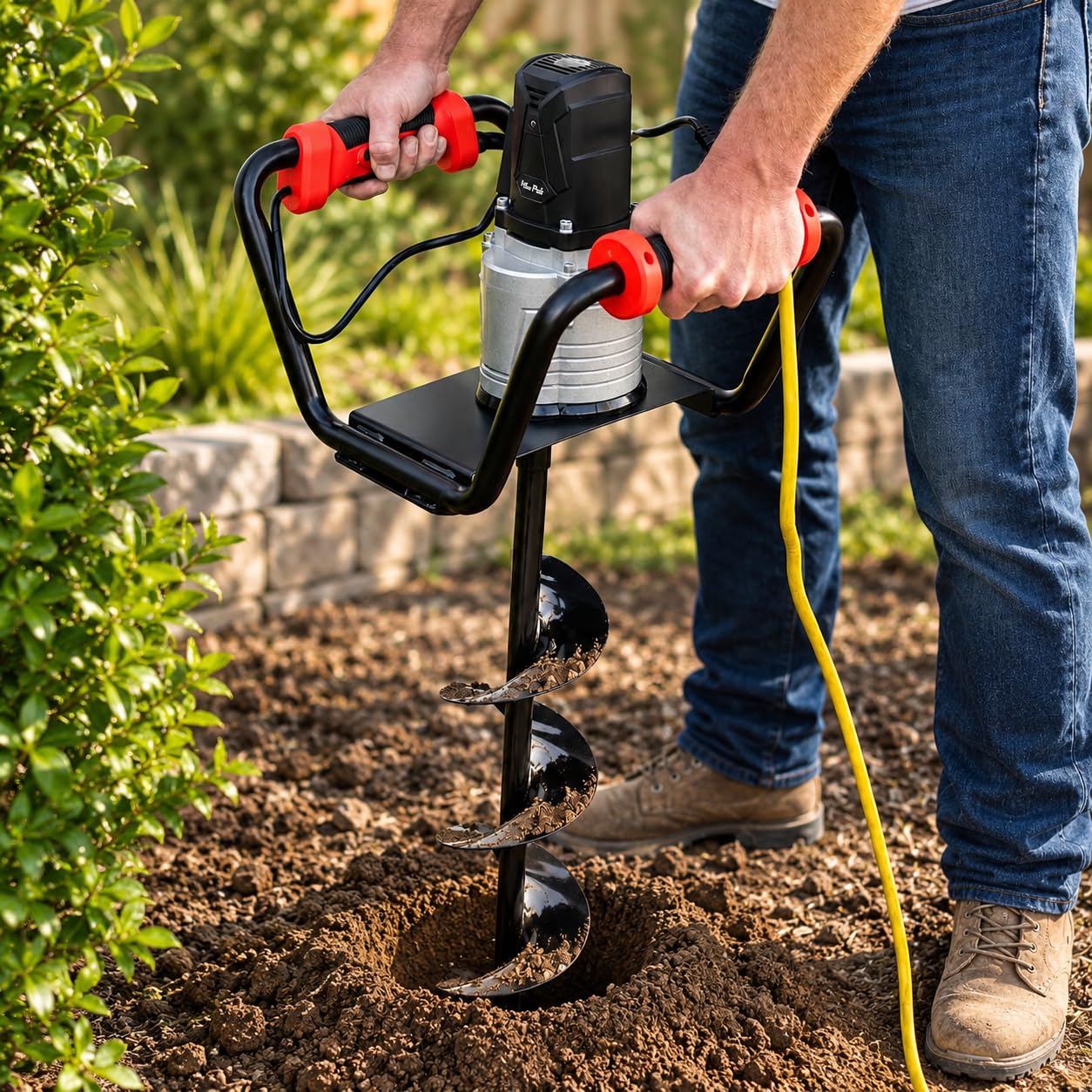
A 1500W motor spinning a 6-inch bit at 270 RPM makes quick enough work of a post hole that the job stops being a weekend. What that same motor does when the bit hits a root is the part that decides whether you get along with this tool, and it is worth understanding before you buy rather than after.

In soil you can push a spade into, we got along with it very well. It starts instantly, throws no fumes, and the 6-inch bit is the right size for 4x4 posts; the safety lock keeps it from firing up when you set it down between holes. For anyone setting a real fence line with an outlet within reach of a cord, this is the pick, and it costs less than renting a gas auger for a weekend, which is the arithmetic that matters if the job is one fence rather than a career.

Binding is where it demands respect. There is no clutch between motor and bit, so when the flutes jam on a root the reaction goes straight into your wrists. Keep the speed down, lift and clear the bit every few inches instead of boring one long pass, and wear nothing loose enough to catch the shaft. Treat it as a two-handed tool that rewards patience and it will dig all day.

Then there is the cord: you need an outdoor-rated extension long enough to reach the furthest post, and you will spend the day stepping over it. The aluminum body is light enough to carry from hole to hole without complaint, and the two grips are designed to soak up vibration, which they mostly do.

Bottom line: For a long fence line in workable soil, plug this in: 1500W sets posts in minutes, as long as you brace hard when the bit grabs.

Check Latest Price
#03

Best Gas-Powered

Earthquake E43 Gas Auger

88 /100
Kirk Score Excellent
Engine
43cc 2-cycle Viper
Weight
34 lb
Warranty
5-year limited
Auger Bit
8-inch, 36 inches long
Check Details on Amazon

Pros

  • Easy pull start on a 43cc engine
  • 36-inch auger lets you drill standing upright
  • Shock absorber softens the kick when it binds
  • Five-year limited warranty

Cons

  • Two-stroke fuel to mix and store
  • 34 pounds to carry from hole to hole

Thirty-four pounds is what an engine, a gearbox and an 8-inch steel bit weigh, and the Earthquake carries it in a way one person can manage: welded steel handlebars to lift by, foam grips that soak up vibration, and a fingertip throttle under the right hand. The 36-inch auger is the detail we appreciate most. It is longer than most bits in this class, which lets you start a hole standing up rather than crouched over the gearbox.

The 43cc Viper engine drives through a 30:1 transmission on ball bearings and alloy gears, and the fishtail point pulls the bit down instead of letting it wander. Above the flighting there is a flex coil shock absorber that takes some of the snap out when the bit catches, a small piece of hardware that makes a real difference to your forearms by the twentieth hole.

Where it makes sense is a property without a handy outlet and a project big enough to justify mixing fuel. It starts as easily as any two-stroke we have pulled, and the five-year warranty is the longest on any powered tool here. Rock is the limit. Buried stone stops an auger of any size, and when it does you are lifting the unit out mid-hole, where a clamshell would have been quicker on that ground from the start.

The upkeep is the trade: fresh two-stroke mix, a carburetor that dislikes stale fuel, and somewhere to store it upright between jobs. Look after those three things and the engine is the least of your worries.

Bottom line: The gas auger we trust for a fence line off the grid: 43cc that starts easily, a 36-inch bit that keeps you upright, and a 5-year warranty behind it.

Check Latest Price
#04

Best Multi-Bit Kit

Prowoo 72CC Auger Kit

89 /100
Kirk Score Excellent
Engine
72cc 2-stroke
Starter
Manual recoil
Auger Bits
4, 6 and 12 inch
Extensions
2 rods
Check Details on Amazon

Pros

  • Three bit sizes cover planting through deck footings
  • Two extension rods reach deeper without a second tool
  • 72cc engine is the largest in this guide
  • Fuel-mixing bottle and tool kit included

Cons

  • Cold starting can take several pulls
  • Three bits and two rods to keep track of

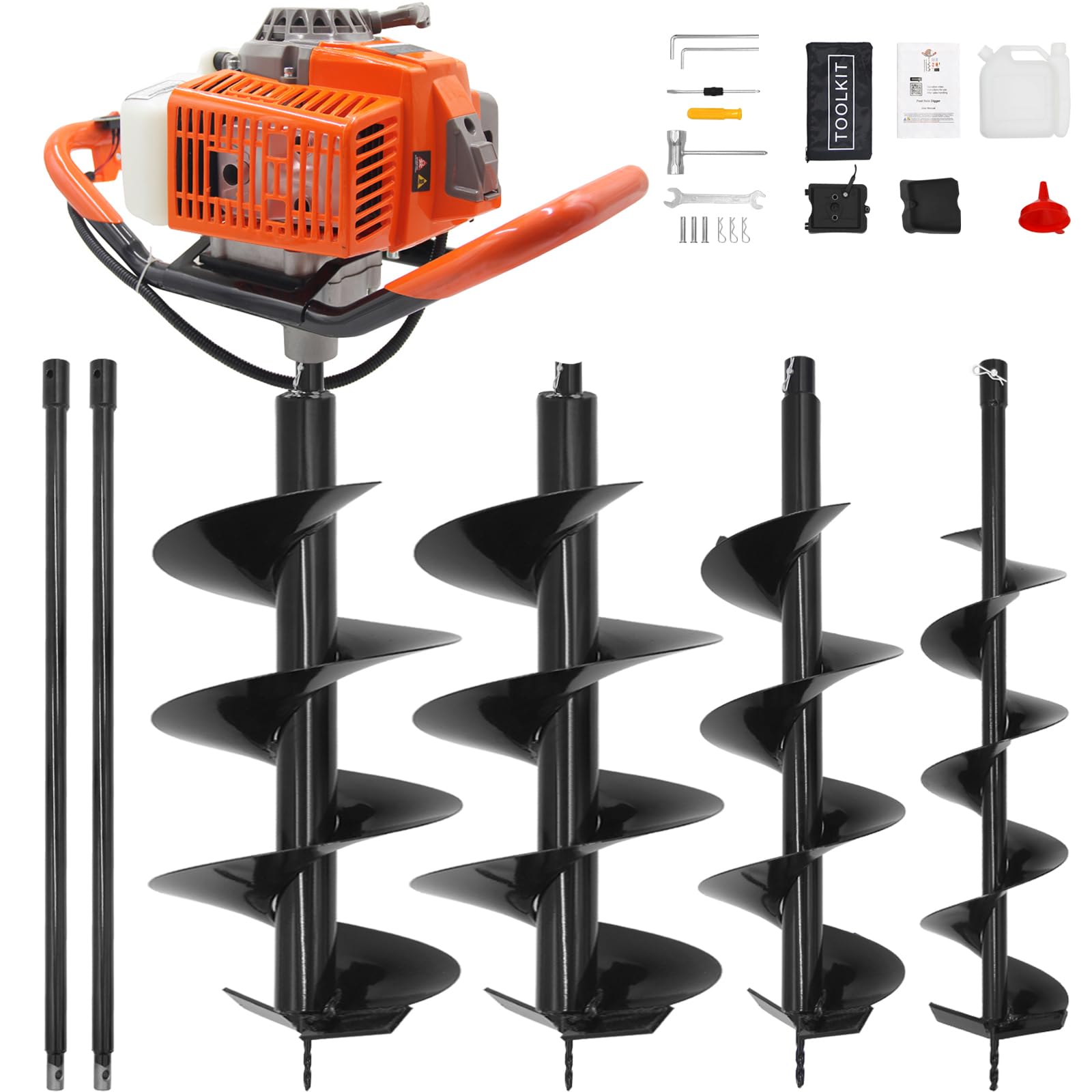
Three auger bits and two extension rods in one box is the reason to look at this one. A 4-inch bit for shrubs and bulbs, a 6-inch for standard 4x4 fence posts, a 12-inch for deck footings and 6x6 posts, and two rods to follow a hole down past the length of the flighting. Bought piece by piece, the bits and extensions would eat most of the difference in price.

The engine is the largest in this guide at 72cc, and displacement is what you feel in clay: it holds rpm where smaller powerheads bog and stall. It is a two-stroke with a manual recoil start, a fuel-mixing bottle and a small tool kit in the box. Nothing about it is complicated, and nothing about it is electric either.

Check the cutting edges before the first hole. The bits do not arrive as sharp as they could, and ten minutes with a file on the leading edge changes how the 12-inch bit starts in hard ground. The cutter blade welded to the flighting is the other place to watch; keep the bit out of rock and it stays put.

As a package it is the most versatile gas tool here, and the one we point at for a project with planting and posts in the same month. It is also more machine than a dozen holes in soft loam needs, and for those a manual digger will be quicker to pick up than this is to fuel.

Bottom line: Buy the kit if your project needs more than one hole size: three bits, two extensions and the biggest engine here for less than the premium gas auger.

Check Latest Price
#05

Best for Deep Narrow Holes

Seymour S500 Iwan Auger

91 /100
Kirk Score Outstanding
Point
Step point
Handle
Hardwood T-handle
Weight
7.4 lb
Cutting Diameter
6 inches
Check Details on Amazon

Pros

  • Screws a deep 6-inch hole with minimal lifting
  • Lightest tool here at 7.4 pounds
  • Step point starts the hole without skating
  • Steel blade riveted to a pliable iron yoke, made in USA

Cons

  • Fixed 6-inch diameter
  • Handle can work loose in the shaft

It does not lift dirt; it screws into it. A 6-inch steel blade on a steel shaft with a T-handle on top, turned clockwise, pulls itself into the ground and leaves the spoil around the rim for you to pull out at the end. For a mailbox post, a line of fence posts or a planting hole, that is less effort than any other manual tool here asks of you, and it is why we rate it above every clamshell for a deep, narrow hole.

At 7.4 pounds it is the lightest tool in this guide and the least fussy to store: a T-handle takes less shed wall than 60 inches of clamshell. The step point starts the hole without skating, the single spiral flute clears as it goes, and the shaft keeps feeding as you turn, so depth is limited by how far you can reach rather than by the blades' spread.

Two things are worth knowing. The handle fits through the top of the shaft and can work loose, so check the fit before you start and tighten it if it turns freely in your hands. And it only makes a 6-inch hole, which is right for a 4x4 and wrong for a deck footing. Buried rock is the other limit; a stone stops the screw where a clamshell might lever past it.

Bottom line: The best tool here for a narrow hole that has to go deep: it screws in instead of lifting dirt, so your back does a fraction of the work.

Check Latest Price
#06

Best Budget Manual

VNIMTI 58-Inch Post Hole Digger

90 /100
Kirk Score Outstanding
Blades
Heavy-duty steel
Weight
9.6 lb
Handles
Fiberglass, non-slip grip
Overall Length
58 inches
Check Details on Amazon

Pros

  • Heavy steel head moves dirt quickly
  • Fiberglass handles resist weather and splitting
  • Reinforced joints hold up to hard use
  • Lowest price of the manual diggers here

Cons

  • 9.6-pound head tires you over many holes

Fifty-eight inches, 9.6 pounds, a heavy steel head on two fiberglass handles joined with double-reinforced collars and finished with non-slip grips. None of that is unusual on its own; what is unusual is getting it at the bottom of the manual-digger price range without the head feeling like stamped tin.

We rate it as the digger for the jobs that are not a fence: a shrub, a mailbox, a post that came out in a storm. It opens a clean hole in ordinary soil in a handful of strokes, the fiberglass does not swell or splinter the way wood does after a wet season, and the grips give you somewhere to hold when your palms are muddy.

The blades are sharp enough to cut roots without being so thin that they chip in gravel, and they will take a file when they dull. In hard, dry clay, plan on working for the depth; that is the ground where a heavy head and a sharp edge are the whole difference between a hole and a bad temper.

Bottom line: Spend the least and still get a heavy steel head and fiberglass handles: our pick for planting holes, mailbox posts and the odd fence repair.

Check Latest Price
#07

Traditional wood feel

AMES 2701600 Post Hole Digger

91 /100
Kirk Score Outstanding
Blade
Tempered steel
Handle
North American hardwood
Warranty
15-year limited
Overall Length
58.75 inches
Check Details on Amazon

Pros

  • Depth scale printed up the handle
  • North American hardwood handles
  • Tempered steel blade takes an edge
  • 15-year limited warranty

Cons

  • Wooden handles are the weak link under hard leverage

There is a measuring scale printed up one handle, and it is the kind of small idea that changes how you dig: you watch the hole instead of a tape measure. For fence posts that need consistent depth, that is genuinely useful, and it is what separates this from every other wooden-handled digger here.

The rest is traditional: North American hardwood handles, an oversized cushion grip at the top, and a tempered steel blade. The handles run 58.75 inches, long enough to keep you out of the dirt, and the warranty runs 15 years, which is the longest on any manual tool we looked at here.

Wood is the decision you are making. It is warmer in the hand than steel or fiberglass on a cold morning, and it does not flex the way fiberglass does, which some diggers prefer. If you want the depth scale and the traditional feel, we think this is the one; if longevity matters more than either, the fiberglass diggers here are the safer buy, and the VNIMTI costs less besides.

Bottom line: A traditional hardwood digger with a depth scale up the handle, worth it if you want to read your hole's depth at a glance and like wood in your hands.

Check Latest Price
#08

Tight storage

True Temper 2704200 Post Hole Digger

89 /100
Kirk Score Excellent
Blade
Atlas pattern steel
Handle
Fiberglass
Depth Gauge
Ruler on handle
Handle Length
48 inches
Check Details on Amazon

Pros

  • 48-inch handle stores almost anywhere
  • Atlas pattern blade starts and holds soil
  • Fiberglass handles need no upkeep
  • Lowest price in this guide

Cons

  • Shorter handle means more bending

Forty-eight inches is four to twelve inches shorter than everything else in this guide, and that changes two things. It stores easily, lying across a car trunk or standing in the corner of a small shed, and it asks more of your back, because you are closer to the ground on every stroke. We handled it beside the 58- and 60-inch diggers, and the drop in reach is the first thing you notice.

The blades are True Temper's atlas pattern, a rounded steel scoop with a sharp point that starts a hole cleanly and holds the spoil until you lift it clear. Fiberglass handles, a cushion end grip, and a build that feels less like a bargain tool than the price suggests.

Fiberglass is the right call at this price. It does not dry out, swell or need oiling, and it shrugs off a season left out in the rain. The steel is heavy enough that the head falls through loam on its own, which is the part of digging a shorter handle does not take away from you.

If you are tall, the longer tools here will save your back and this one will not. For a shorter digger, a small yard or a shed with no room, it is the sensible buy, and it is the least expensive tool on this page.

Bottom line: The shortest and least expensive digger here: a good fit for shorter users, tight storage and a handful of posts.

Check Latest Price

How We Tested 13 Post Hole Diggers in Real Ground

We started with roughly 40 diggers pulled from manufacturer specs and retailer listings, then narrowed by handle material, blade gauge, auger bit diameter, engine size, and price until we had 13 worth testing. Six were manual, with steel, fiberglass, and hardwood handles; seven were powered, a mix of electric and gas. Everything ran for six months across two fence lines and a run of tree plantings, in heavy clay and in looser loam threaded with roots.

The manual diggers got the hardest work. I counted how many drops it took each one to reach 24 inches, checked that depth with a tape rather than trusting the markings on the shaft, and measured hole width against the post going into it. I watched whether the blades carried a full load of soil or spilled it on the way up, how stiff the hinge felt through work gloves, and whether the handle stayed tight after a few hundred cycles or started to twist.

With the augers, the first test was simply getting them running — I counted pulls from cold, then timed how long each took to drill a clean 24-inch hole and noted whether the bit wandered, bound up, or clogged in wet clay. I lifted every unit with a full tank, since "one-person operation" on the box doesn't always survive contact with fuel, and ran each solo to feel how much the torque pulled back on my wrists.

Durability came last. The manual diggers sat out through rain, I drove every auger into a buried root on purpose, and afterward I checked blade edges and welds for rolling or cracking. We scored weight and handle length against how the tool actually swung and carried, and weighed price against how many holes each one would realistically dig in a season. What follows is what held up.

How to Choose a Post Hole Digger

Start With Your Soil

Everything else follows from this. Loose loam and sandy soil suit any tool on the page; clay rewards torque and a sharp edge; rock and old roots defeat augers of every size. If your ground has produced fist-sized stones before, plan on a clamshell and a mattock, and rent an auger only for the holes the clamshell cannot finish.

A powerhead does not make rocky ground easier, it makes the stop more violent, because the bit jams instead of yielding. That is the single most useful thing to know before you spend money on an engine.

Manual or Powered: What the Effort Buys

A clamshell costs your muscle and nothing else. For a handful of posts that is the right trade: no fuel, no cord, no storage ritual, and it works in the rain and after a season in the shed. The Fiskars and the VNIMTI here do that job at two different prices.

A powered auger earns its keep on a fence line. The corded XtremepowerUS and the gas Earthquake both turn a weekend into an afternoon. Count your holes before you choose: a dozen or fewer rarely justifies an engine, and a full property boundary makes one hard to argue with.

Diameter, Depth and Extensions

Size the bit to the post, not to the biggest number on the box. A 6-inch bit leaves room to set and brace a 4x4; 8- and 12-inch bits are for 6x6 posts, deck footings and anything that needs concrete around it. Buying a 12-inch bit when every hole is for a 4x4 just means moving twice as much dirt.

Depth is usually a matter of length. The 36-inch auger on the Earthquake keeps you upright while you drill, and extension rods let a powered unit follow a hole down past its flighting. On a manual tool it is the geometry that matters: the Fiskars offset pivot keeps cutting at three and four feet, where a straight-handled digger has to widen the top to get its blades back in.

Handles, Weight and the Kick

Handles are where these tools fail. Wood is warm in the hand and traditional and gives out under hard leverage; fiberglass flexes and lasts; welded all-steel tools are strongest everywhere except at the weld itself. Look at the joint, not the paint.

Weight is a working part: a 9- or 10-pound head does the falling for you, and 34 pounds of gas auger is a two-handed carry between holes. Any powered bit can also bind, and when it does the reaction goes straight into your wrists. Keep the speed down, clear the flutes every few inches, and stay braced with both hands.

Frequently Asked Questions

Final Verdict

Buy the Fiskars 60-inch and you have the one tool here that works in any soil without fuel, a cord or a technique lesson. Its offset handles leave a narrow, deep hole, which is exactly what a fence post needs, and nothing about it needs servicing between projects.

If you are setting a long run and the ground is clear, the corded XtremepowerUS will do in an afternoon what the Fiskars does in a weekend, as long as you brace it hard when the bit grabs. Where there is no outlet at all, the Earthquake is the gas auger to carry.