// data-verified

Best Concrete Sealers of 2026

Water beading on a driveway looks like a small trick of physics, and it sort of is: a penetrating sealer soaks into the slab and lines the pores so water can't wick in, while a film-forming one sits on top and takes the wear instead. Get it right and rain, road salt, and freeze-thaw stop turning hairline cracks into real ones; get it wrong and you're left with a chalky haze or a coating that flakes by the second winter.

We've spent the past eight months putting twelve sealers onto driveways, a garage floor, brick steps, and a patio's worth of pavers. What separated them wasn't whether water beaded at first, because most did. It was everything you notice with the bucket open: whether the liquid goes down evenly or separates in the tray, how long the odor hangs in a closed garage, and whether the finish dries invisible or patchy.

One thing worth knowing before you buy: coverage claims run optimistic, especially on broom-finished concrete, which drinks far more sealer than a smooth slab does. Buy for the surface you have, not the number on the label. The picks below are the ones I'd put down again.

#01

Best Overall

Armor SX5000 WB Sealer

91 /100
Kirk Score Outstanding
Finish
Clear, no color change
Formula
Water-based silane-siloxane
Coverage
175–225 sq ft/gal
Stated Protection
Up to 7–10 years
Check Details on Amazon

Pros

  • Dries invisible
  • One five-gallon pail covers a full driveway
  • Labeled for up to 7–10 years of protection
  • Water-based, so cleanup is soap and water

Cons

  • Won't refresh faded, stained, or patchy concrete
  • Needs bare, unsealed concrete to soak in

What we noticed first about the SX5000 WB is how little it leaves behind. Spray it on clean, unsealed concrete and the surface looks like concrete when it dries — same tone, same texture, no sheen sitting on top. That's the whole point of a silane-siloxane that reacts below the surface instead of coating it, and it's why this pail goes in front of most people first. The label claims up to a 95 percent reduction in water absorption and seven to ten years of protection, and unlike an acrylic film there is nothing here to peel, scuff, or yellow.

Five gallons is the other reason. At 175 to 225 square feet per gallon it covers a full driveway in one purchase, so the job is one pail, one sprayer, and an afternoon instead of a second trip to the store. We applied with a pump sprayer and back-rolled with a half-inch nap roller to even out the excess, and the milky look flashed clear as it dried. Put down two flood coats. A light misting on thirsty concrete is how thin spots happen, and thin spots are where a driveway quietly starts absorbing water again.

What it won't do is improve how the slab looks. Faded, patchy, or stained concrete stays faded, patchy, and stained — nothing here fills, covers, or brightens, and that is the price of an invisible finish. Buy it because you like the concrete you already have. It also has to go on bare: an existing sealer, a curing compound, or a hard-troweled surface will keep it from soaking in, so prep matters more here than with a coating that simply sits on top.

Bottom line: We start here for a driveway you want to keep looking like plain concrete: one pail covers it, and the protection is measured in years rather than seasons.

Check Latest Price
#02

Best for Salt and Winter Weather

Siloxa-Tek 8500 Sealer

88 /100
Kirk Score Excellent
Formula
Water-based silane-siloxane
Approval
DOT approved
Coverage
Up to 250 sq ft/gal
Salt Resistance
Resists deicing salts and chlorides
Check Details on Amazon

Pros

  • DOT-approved resistance to chlorides and deicing salts
  • Covers up to 250 square feet per gallon
  • Dries clear with no color change
  • Water-based with easy soap-and-water cleanup

Cons

  • Less effective on smooth, troweled interior slabs
  • Sold only in single gallons

Freeze-thaw damage is what sends most northern driveways to the scrapper, and road salt is what accelerates it. That's the job the Siloxa-Tek 8500 was built for: a water-based silane-siloxane carrying DOT approval, formulated to resist chlorides and deicing salts along with the cracking, spalling, and pitting they cause. If your town salts the street and the plow throws it onto your apron, this is the jug we point at.

It goes on clear and stays clear — no wet look, no amber cast — and it covers up to 250 square feet per gallon, which changes the buying math. A single gallon handles a walkway, a stoop, a garage apron, or the strip between the curb and the house, and you don't have to buy a five-gallon pail for a job that size. There's no solvent smell to plan around and cleanup is soap and water.

Where we hold back is smooth, power-troweled concrete. This one wants something to bite into, and a burnished garage slab offers very little; a rough broom-finished sidewalk or a patio is where it earns its keep. Inside the garage or the basement, a densifier does more good than a water repellent, which is why the Lithi-Tek is in this guide as well.

Bottom line: We keep this one for salty winters: DOT-rated chloride resistance in a jug small enough for a walkway, though a burnished garage slab gives it nothing to grab.

Check Latest Price
#03

Best Wet Look

Armor AR350 Sealer

92 /100
Kirk Score Outstanding
Size
5 gallons
Finish
Low-gloss wet look
Formula
Solvent acrylic, 700 VOC
Coverage
175–225 sq ft/gal
Check Details on Amazon

Pros

  • Brings color back to faded stamped concrete and pavers
  • Low-gloss wet look without a mirror finish
  • Five gallons covers a large patio or pool deck
  • Non-yellowing clear acrylic for UV exposure

Cons

  • Darkens the concrete
  • Needs recoating as the film dulls

Start with the decision this sealer forces. The AR350 darkens concrete. It's a solvent acrylic built to bring color up — the label calls the result a low-gloss wet look — and on stamped, dyed, or exposed-aggregate hardscape it reads as depth and saturation. On plain gray concrete it reads as darker gray, and it stays that way. If you want the slab to look exactly as it does now, skip this card and take the SX5000 WB instead.

What you get for that trade is a finish that makes tired hardscape look cared for. Two coats on a sun-bleached patio read closer to a resurfacing than a sealing: the color comes back up and the low gloss catches light without turning the surface into a mirror. At 175 to 225 square feet per gallon, a five-gallon pail handles a large patio or a pool deck in one purchase, and the acrylic is non-yellowing, which is the thing to check on any clear film that will sit in UV for years.

The real cost of a solvent acrylic lands on application day rather than at checkout. This is a 700 VOC product with a genuinely strong smell, so plan a breezy morning, a chemical-vapor respirator, and a stretch when the garage doors stay open. It rolls or sprays on easily and self-primes, so the work itself is quicker than the fumes suggest — it's the day after that you'll notice.

Bottom line: We reach for this when the concrete needs to look better, not just survive: it deepens color and lays a low-gloss finish that makes old stamped work look new.

Check Latest Price
#04

Best for Basement Floors

Lithi-Tek 9500 Sealer

88 /100
Kirk Score Excellent
Size
1 gallon concentrate (makes 5)
Coverage
Up to 1,000 sq ft
Function
Waterproofer and densifier
Surfaces
Basement floors, garage slabs
Check Details on Amazon

Pros

  • Hardens and dust-proofs soft, chalky slabs
  • One gallon mixes into five, treating 1,000 sq ft
  • Reduces moisture vapor and efflorescence
  • Applies with a plain garden sprayer

Cons

  • Not for surfaces exposed to deicing salts

A basement floor that powders under a broom and drinks a spilled bucket isn't dirty — it's soft, and no water repellent fixes that. The Lithi-Tek 9500 is a densifier first. It reacts within the slab, and the label claims it strengthens concrete by up to 50 percent while cutting abrasion, water vapor transmission, and the efflorescence that comes with moisture moving through. That makes it the pick for a garage or basement floor rather than for the driveway out front.

The concentrate is the clever part. One gallon makes five, treating up to 1,000 square feet, so you carry a jug rather than a pail and mix on site. It goes on with a plain garden sprayer and soaks in rather than sitting up on the surface, and a second coat disappears into concrete that looked saturated after the first.

Application discipline matters more here than anywhere else in this guide. Over-apply and the excess can dry as white spots, which shows worst on pavers and on colored concrete. Keep the passes even, don't let product pool in joints or against a wall, and stop while the surface still looks damp rather than wet.

Where it earns its keep is indoors and underfoot: basement floors, poured walls, garage slabs, and the damp, dusty concrete that ruins a storage room. Watching water bead on a floor you had written off is a genuinely satisfying afternoon's work.

Bottom line: Our answer to a dusty, soft slab is a densifier, and this is the one we name: it hardens the surface, shuts down dust and vapor, and a single jug mixes into five gallons.

Check Latest Price
#05

Best Value for a Full Driveway

Rain Guard SP-4005 Sealer

86 /100
Kirk Score Excellent
Finish
Clear, filmless
Coverage
Up to 200 sq ft/gal
Dry Time
About 1 hour at 75°F
Stated Protection
Up to 5 years
Check Details on Amazon

Pros

  • A full driveway from one modestly priced pail
  • No color change and no film to peel
  • Dries in about an hour at 75°F
  • Low-odor, water-based formula

Cons

  • Stated life is shorter than the premium penetrants here

Five gallons of ready-to-use silane-siloxane for less than the premium pails cost is the entire pitch, and it holds up. Rain Guard's SP-4005 is a filmless waterproofer — no gloss, no color change, nothing to peel — rated for up to five years and dry to the touch in about an hour at 75°F. For a first-time sealer with a long driveway and a free Saturday, that combination is hard to argue with.

The coverage number is why it stays in the guide. At up to 200 square feet per gallon, the pail reaches a full driveway in two flood coats, and the fast dry time means the second coat goes down the same morning instead of the next day. Spray it and then back-roll or broom it in so it doesn't puddle in low spots, and work in sections small enough to keep a wet edge.

Two things to know going in. Give the pail a thorough stir and a look before you load the sprayer — settled white solids are the one consistency issue that shows up, and straining costs you a minute. And this is not the longest-lived sealer in this group: five years is the label's figure, against seven to ten from the Armor pail. On a rental, a flip, or a driveway you plan to reseal anyway, that trade is easy to take.

Bottom line: Our value pick for a whole driveway: filmless, fast-drying, and the least expensive way here to cover a full slab, even if it needs redoing sooner.

Check Latest Price
#06

Small stone jobs

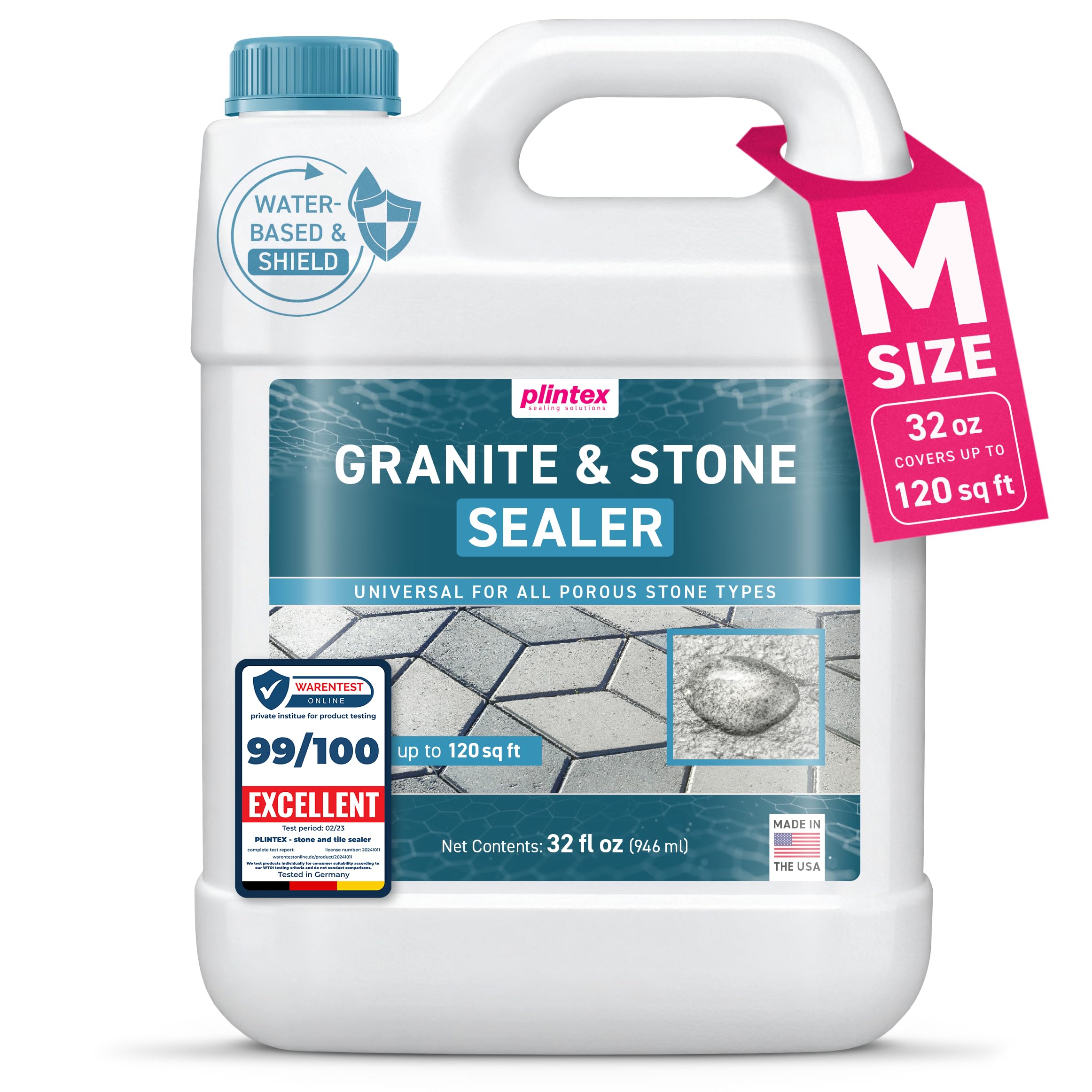
PLINTEX Penetrating Sealer

87 /100
Kirk Score Excellent
Size
1 quart
Finish
Invisible natural finish
Coverage
120 sq ft
Surfaces
Concrete, brick, natural stone
Check Details on Amazon

Pros

  • Invisible, film-free finish that won't peel or yellow
  • Rated for indoor stone as well as outdoor steps
  • Works across sandstone, travertine, limestone, and brick

Cons

  • A quart covers 120 sq ft
  • Needs absorbent, unsealed stone or concrete

Most of this guide is about driveways, so it's worth saying plainly that a quart is sometimes the right size. PLINTEX's penetrating sealer covers 120 square feet — a stoop, a hearth, a garden step, a single run of pavers — and it does it without laying a film. If you have ever bought five gallons to treat a doorstep, you already know why that matters.

The finish is what makes it useful indoors as well as out. It's a silane-siloxane that leaves no gloss, no wet look, and no slippery coating, which suits surfaces you walk on barefoot and surfaces you simply don't want altered — sauna stone, a bathroom floor, a mudroom step. The label also lists sandstone, travertine, limestone, flagstone, and brick, a wider spread of absorbent stone than most concrete sealers bother to name.

Where it stops is scale. This is a quart, and 120 square feet runs out fast on anything bigger than a landing, so it is genuinely the bottle for the small job you have been putting off rather than the driveway. It also wants absorbent, unsealed material; a polished or previously coated surface won't take it in. On an outdoor step, the freeze-thaw protection is the part we care about most, since that's where spalling starts.

Bottom line: We keep a quart of this for the small stuff — stone steps, a sauna floor, a hearth — where a film would show and a five-gallon pail would be absurd.

Check Latest Price
#07

Near plantings

Eco Advance Waterproofer

87 /100
Kirk Score Excellent
Use
New and existing concrete
Size
1 gallon
Formula
Water-based siloxane
Application
Pump sprayer
Check Details on Amazon

Pros

  • No solvent fumes near plantings, pets, or windows
  • Breathable enough for new concrete and masonry
  • Ready to use in a standard garden sprayer
  • Covers concrete, brick, stucco, stone, and pavers

Cons

  • Sold by the single gallon only

Sealing a patio with a bed of hydrangeas two feet away changes what you are willing to spray. Eco Advance's waterproofer is the one we reach for in that situation: water-based, non-flammable, and labeled as not harming landscape plantings, with no solvent smell drifting into the house. It goes on with a standard garden pump sprayer and dries clear.

The detail that surprised us is the breathability. Because it stays vapor permeable, it can go on new concrete and masonry — unusual, since most sealers want a fully cured slab — so the surface keeps drying from underneath while the top resists water, oil, stains, deicing salts, and pool chemicals. The label covers concrete, brick, stucco, natural and synthetic stone, EIFS, and pavers, which is a longer list than most products in this category attempt.

The technique is where this one goes wrong for people. Two coats, and the second goes on before the first dries — the label is explicit about not applying over a dried coat, so work in sections you can finish in one pass and keep the sprayer moving. Flooding the joints is the other way to waste a gallon.

It's also the pick when fumes rather than water are the problem: a basement wall, a garage floor, a room where you can't leave the doors open for two days. That's a narrower job than a driveway, and it's the one this product is genuinely good at.

Bottom line: We spray this where the garden is close and the windows are open: no solvent smell, no harm to plantings, and a breathable finish fresh concrete can take.

Check Latest Price
#08

Mid-size pours

MasonryDefender Sealer

85 /100
Kirk Score Excellent
Size
2.5 gallons
Finish
Clear, non-glossy
Formula
Water-based silane-siloxane
Coverage
90–150 sq ft/gal
Check Details on Amazon

Pros

  • Clear, non-glossy finish keeps concrete's natural look
  • 2.5-gallon size suits small and mid-size pours
  • Aimed at freeze-thaw, chlorides, and efflorescence
  • No odor to plan around

Cons

  • Lowest coverage per gallon of the penetrating picks here

Two and a half gallons is the awkward middle of this category, and that's exactly who MasonryDefender is for: a single-car apron, a small patio, a side walk that isn't worth a five-gallon buy and is far too much for a quart. It's a water-based silane-siloxane that leaves a clear, non-glossy finish — no wet look, no film, nothing to trap moisture.

Here's the number that decides it. At 90 to 150 square feet per gallon it covers less ground per gallon than anything else in this guide, so the pail works out to roughly 225 to 375 square feet for the whole container — not the long driveway the size suggests. On a broom-finished apron that's plenty. On a wide, thirsty slab you will be ordering more.

Evenness is the other thing to watch. Where a spray pass is uneven or product pools, areas can dry with a white residue or a blotch that shows against the rest of the slab, and it looks worst once the concrete gets wet again. Keep your passes overlapping steadily, work in one direction, and don't let the pail sit in a single spot.

The fundamentals are all there otherwise: water beads, the surface stays breathable, and the formula is aimed at freeze-thaw cycles, chloride ions, and efflorescence. It's a sound sealer for the right-size pour; the container simply promises more ground than the coverage figure delivers.

Bottom line: For a pour too big for a quart and too small for a pail of Armor, this water-based sealer does the job invisibly — just expect fewer square feet per gallon than anything else here.

Check Latest Price

How We Tested Concrete Sealers (and What We Looked For)

We started by reading spec sheets and hundreds of reviews, then narrowed to twelve products, balancing penetrating silane-siloxane sealers against film-forming acrylics and mixing ready-to-use jugs with concentrates. The filters were practical: how much square footage a container actually claims, whether it can go on slightly damp concrete, how much odor we'd be signing up for in a closed space, and whether the finish is meant to disappear into the surface or change its look.

Each product went onto its own marked section of a concrete driveway, a garage floor, brick steps, and a paver patio, all applied by one person with a roller or sprayer so we could judge ease of application honestly. We timed a 10-by-10-foot pass, noted whether the material pooled or flashed off before we finished, whether a sprayer clogged, and whether edges needed back-rolling to avoid lap marks. Every batch got poured into a tray first so we could see if it stayed uniform or separated and whether it went down like water or like syrup; the odor we logged with the garage door closed, timing how long it took to clear.

Then we watched. We poured measured cups of water onto each section at one month, three months, and eight months and timed how long before it soaked in, and we left a marked square of de-icing salt on every slab through the winter to check for flaking and spalling after the thaw. Oil, leaf tannin, and a rusty patio chair leg tested staining. We photographed each section dry at the same time of day to catch discoloration or that milky bloom, and we compared the square footage we actually covered against the label to see which containers were worth the money.

How to Choose a Concrete Sealer

Penetrating or Film-Forming? Decide This First

Penetrating sealers — silane, siloxane, or a blend — soak into the pores and react below the surface. They leave concrete looking like concrete, they can't peel, and they need bare, absorbent material to work. Film-forming acrylics sit on top: they darken the slab and give it a low-gloss or high-gloss wet look, and they are the choice when the concrete needs to look better, not merely last longer.

Our test for the split is simple. If you like the slab as it is, buy penetrating. If you want the color back in faded stamp work, buy acrylic, and accept that the change is permanent. Either way, a sealer applied over an existing coating is money in the wrong direction.

Match the Formula to the Job the Slab Does

A driveway that wears road salt is a different problem from a dusty basement floor. Chloride resistance is what the Siloxa-Tek's DOT approval buys, and it's the gap between a surface that survives ten winters and one that spalls. A soft, chalky slab — typically a garage or basement floor — wants a densifier, which hardens the concrete itself instead of only repelling water from it.

Patios and pavers are the easy case. Any breathable, invisible water repellent does the work there, and a penetrating product won't trap moisture under a skin the way a film can on a slab that's still drying.

Do the Coverage Math Before You Buy

Coverage per gallon swings widely here, from roughly 90 square feet at the low end to 250 at the top, and porous, broom-finished concrete drinks far more than a troweled surface. Two flood coats means halving whatever the label suggests for one coat — the number on the pail is a best case.

The trap is assuming bigger is better value. A two-and-a-half-gallon pail that covers 90 square feet per gallon can run dry halfway down a long drive, and a five-gallon pail is wasted money on a doorstep. Match the container to the pour, not to the price.

Plan the Application Day, Not Just the Purchase

Most of these go down with a pump sprayer and a roller or broom to even them out, and two coats is standard. Water-based products dry fast — one here is walkable in about an hour at 75 degrees — while solvent acrylics need a breezy day, a chemical-vapor respirator, and somewhere for the smell to go.

Don't over-apply. Pooled product is where white spotting and blotching come from, especially with densifiers, and the fix afterward is far harder than an even pass on the day.

Frequently Asked Questions

Final Verdict

Weight the decision by what you want to see out the window. If the concrete should stay exactly as it looks today, the Armor SX5000 WB is the one we recommend: it dries invisible, a five-gallon pail covers a driveway, and the protection is rated in years rather than seasons.

Two situations change the answer. A driveway under road salt wants the Siloxa-Tek 8500's DOT-rated chloride resistance even at a higher cost per gallon, and a slab that's dusty and soft rather than exposed wants the Lithi-Tek densifier, which hardens the concrete instead of only repelling water from it.