// data-verified

Best Concrete Paint of 2026

Concrete paint has a reputation problem, and most of it is earned. Coatings blister, peel, and lift under a warm car tire — but the failure usually starts underneath the paint, not in it. Concrete is porous and holds moisture, so a good coating has one job: hold water out on a vertical wall, or grip and wear evenly underfoot. Those are two different cans.

My test case was the steps off my back door, already shedding gray flakes onto the lawn when I moved in. Over six months my team and I painted 12 concrete coatings onto garage floors, basement walls, a patio slab, and those steps, judging coverage, application, drying time, color, appearance, and durability under real use.

One thing worth knowing before you buy: the color range is narrow — mostly grays and whites — and a gray that looks like warm stone indoors can read blue in outdoor shade, so look at a sample in daylight. The picks below are the ones that took a second coat cleanly and were still intact at month six.

#01

Best Overall

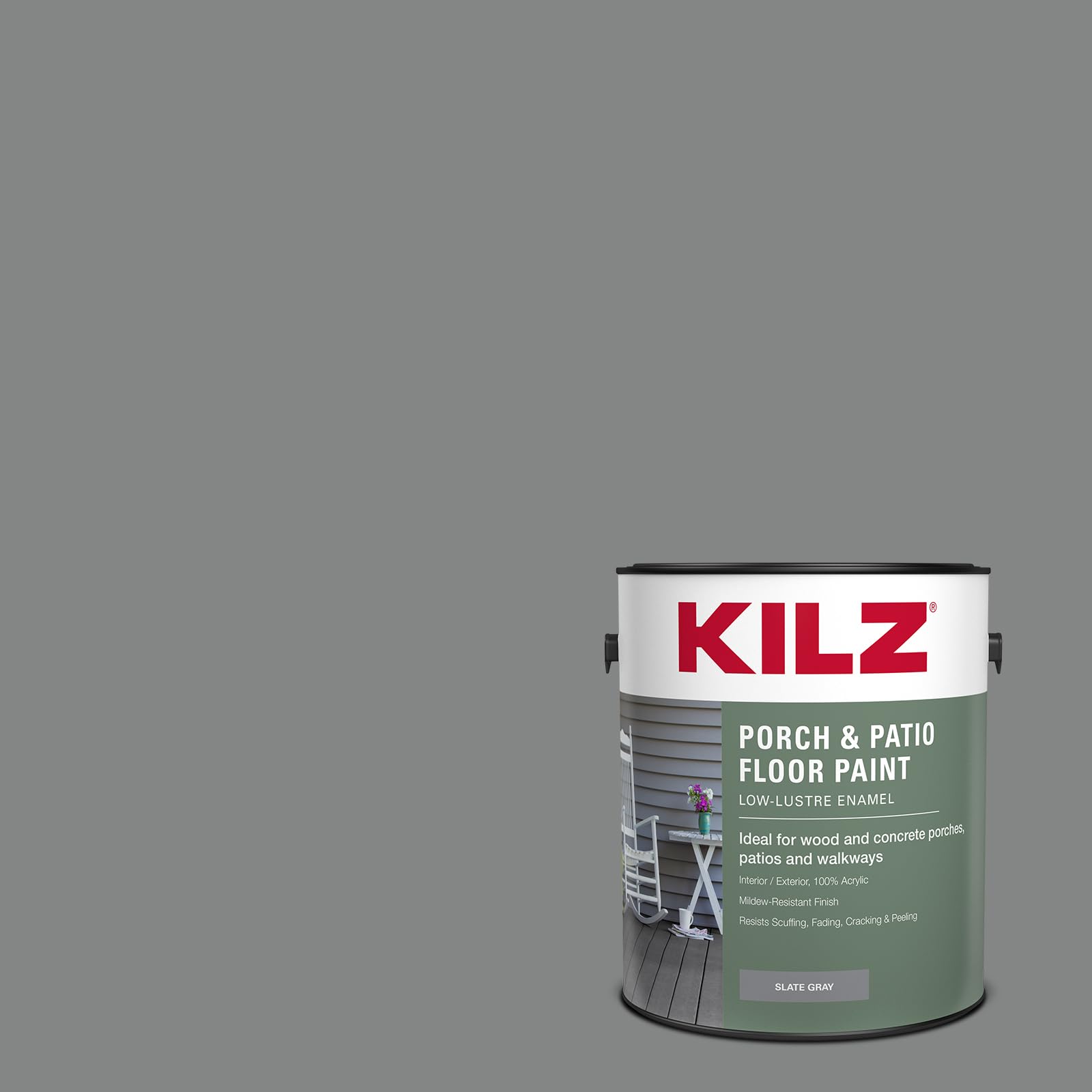
KILZ Porch & Patio Floor Paint

92 /100
Kirk Score Outstanding
Finish
Satin slate gray
Coverage
200–400 sq. ft. per gallon
Dry Time
1 hour to touch, 6 hours to cure
Surface Use
Interior and exterior floors
Check Details on Amazon

Pros

  • Covers 200–400 sq. ft. per gallon
  • Rolls on evenly and cleans up with soap and water
  • Rated for interior and exterior floors
  • Washable satin film wipes clean

Cons

  • Durability under heavy traffic is inconsistent

A gallon of KILZ Porch & Patio covers 200 to 400 square feet, and which end of that range you land on depends entirely on your slab. Smooth, sound garage concrete stretches a gallon a long way; a broom-finished patio drinks the first coat and lands nearer 200. That spread is the most useful number to carry into the paint aisle.

Rolling it out is about as undemanding as floor paint gets. It's an acrylic latex, so it brushes and rolls, cleans up with soap and water, and levels well enough that overlapping passes blend instead of leaving lap marks. Dry to the touch takes about an hour, and the slate gray lands as a light, cool gray — closer to pale putty than the charcoal the name suggests, which suits a sunny patio and doesn't broadcast dust the way a dark floor does. That combination of forgiving application and a finish that hides a tired slab is why this is the one we point most people to first.

Where a floor coating lives or dies is adhesion, and prep decides it here too. The label calls for a properly prepared surface and allows application over sound, previously painted or primed concrete; bare, chalky, or sealed slabs need etching or dulling first, because a film that can't grip will lift. Once it's down, the formula resists fading, cracking, and mildew — but durability is the honest caveat with this can. Some floors stay put for years, and some chip and peel within a season, most often where water sits or traffic concentrates.

The satin finish earns its keep later. Scuffs, dust, and tire marks wipe off with a damp mop rather than a scrub brush, which matters more on a working patio than the slight sheen does on the day you paint it.

Bottom line: We recommend this as the default concrete floor coating for garage slabs and patios — interior and exterior rated, generous per-gallon coverage, and a roller-and-soapy-water job from start to finish.

Check Latest Price
#02

Best for Basement and Retaining Walls

KILZ Basement & Masonry Waterproofing Paint

93 /100
Kirk Score Outstanding
Finish
Matte white
Coverage
75–125 sq. ft. per gallon
Recoat Time
4 hours
Water Pressure
Up to 12 PSI
Check Details on Amazon

Pros

  • Rated to block up to 12 PSI of water pressure
  • Thick film coats rough block without dripping
  • Ready for a second coat in four hours
  • Low odor for closed basement work

Cons

  • Covers only 75–125 sq. ft. per gallon
  • Made for walls and block, not floors

A weeping basement wall is a different problem from a tired patio, and this is the can we reach for when the issue is moisture rather than looks. KILZ rates it to block up to 12 PSI of water pressure, which covers the damp, pushing-through masonry that turns a basement into a storage pit — not a wall with water running out of a crack. If you can see water moving, fix the source first; a coating laid over an active leak traps the moisture and blisters.

The number that catches people is coverage: 75 to 125 square feet per gallon, depending on how rough the block is. That's a fraction of what a floor paint covers, so a full basement is a several-can purchase and a job you plan in stages. On poured walls the film goes on thick and stays where you put it — it doesn't drip off the roller — which is exactly what you want over pocked block that needs its pores filled before it looks finished.

Dry to the touch in an hour and ready for a second coat in four, with little odor for a closed-up space. The alkali resistance is the quiet line on the spec sheet that matters most on masonry: concrete and block stay chemically active long after they look dry, and an ordinary paint film can be eaten from underneath. White and matte, it turns a cellar into a room — walls read as painted masonry instead of damp concrete, and the light bouncing back changes what the space is good for.

Bottom line: Buy this one when the wall is damp, not when it's dull — it's a moisture barrier for block, poured concrete, and retaining walls rather than a decorative floor coating.

Check Latest Price
#03

Best for Small Projects

California Paints Allflor Floor Paint

91 /100
Kirk Score Outstanding
Finish
Matte light gray
Coverage
350 sq. ft. per gallon
Surface Use
Exterior porches, patios, floors
Container Size
1 quart (32 fl. oz.)
Check Details on Amazon

Pros

  • A quart covers about 90 sq. ft.
  • Goes on smooth and dries fast
  • Matte light gray hides patches and cracks
  • Low-cost way to coat a small area

Cons

  • Durability on bare concrete is unproven
  • Listed for outdoor use only

A quart is the right amount of floor paint more often than the gallon aisle suggests. California Paints lists 350 square feet per gallon for this enamel, which puts a single quart at roughly 90 square feet — a front stoop, a landing, a pool-deck patch, or the pad under a grill. For those jobs, buying a gallon means buying three times the paint the work needs.

The enamel itself goes on smooth and stays workable, which is the difference between a one-person job and a mess of lap marks. It dries fast enough to keep a small project moving, and the matte light gray hides the patches, stains, and hairline cracks that are usually the reason someone is painting concrete in the first place. It reads as a stain rather than a shiny porch enamel, so a painted step looks modern instead of lacquered.

Durability on concrete is the least settled part. It holds up well under foot traffic on steps and porches, but peeling off a bare concrete floor has happened, so prep matters here as much as it does with any floor coating. Buy two quarts rather than a gallon for a small floor; two coats on a stoop take surprisingly little.

Bottom line: We keep recommending this quart for stoops, landings, and pool-deck patches, where its fast-drying matte enamel beats opening a gallon you'll never finish.

Check Latest Price

How We Tested Concrete Paints

I started by reading the technical data instead of the front of the can — resin type, whether the label allows foot traffic or vehicle traffic, interior versus exterior rating, and stated coverage per gallon. Anything that demanded a primer nobody stocks got cut, which left 12 paints spanning budget floor enamels to masonry waterproofers. Testing ran six months.

Each one went onto a 4-by-6-foot patch of real concrete — a garage floor, two sets of porch steps, a patio slab, a basement wall, a laundry room floor — plus matching cast pavers so every coating faced an identical surface. I rolled with a 3/8-inch nap and brushed the edges, and timed each recoat window with a stopwatch rather than trusting the label.

Coverage got measured, not estimated: I marked the square footage and noted how far a gallon actually went and whether a second coat was needed to bury rust stains and old tire marks. I checked drying with a thumbprint, then by walking across it in socks. Application came down to whether a coating leveled its roller marks or left them, and whether it ran down a vertical wall. On the garage patch I parked, dragged a trash bin across it, dropped a wrench, scrubbed it with a stiff brush, and hosed it down, watching for chalking and hot-tire lift. The basement patch got hosed from the outside with weekly checks for damp on the inside. Color I judged twice, in morning shade and midday sun.

How to Choose Concrete Paint

Match the coating to the surface

Concrete in a garage or on a patio takes foot and tire traffic, so it needs a product formulated for horizontal surfaces. Walls and block need something that hangs on a vertical face and hides the texture underneath. Floor paint rolled onto a wall sags and runs; a wall coating laid on a slab wears through where chairs and tires sit.

Read the can for the surfaces it names rather than the color on the lid, and check the interior/exterior designation. The California Paints quart is listed for outdoor use, which rules it out for a basement floor no matter how good it looks on a step.

Prep decides how long the coating lasts

More peeling starts under a coating than inside it. New slabs carry curing compound or sealer that has to come off before anything bonds; old ones carry oil, chalky paint, and mill scale. Scrub, degrease, and etch before you open the can.

Then test absorbency: drip water on the concrete and watch. If it beads and sits there, the slab is sealed and needs mechanical dulling or a primer. If it soaks in and darkens, the surface is open and ready.

Buy coverage for rough concrete, and for two coats

Published coverage is measured on smooth concrete, and almost no patio or basement wall is smooth. The KILZ floor paint states 200 to 400 square feet per gallon, and a broom-finished slab lands at the bottom of that. The waterproofing coating states 75 to 125 square feet per gallon, which turns a whole basement into a serious purchase.

Measure the area, use the rough number, then double it for a first coat on bare concrete. A spare can in the garage is cheaper than a second order halfway through the job.

Sort out moisture before you paint

A slab without a vapor barrier, a retaining wall with wet soil behind it, and a basement wall that weeps are all moisture problems rather than cosmetic ones. Only one coating here addresses that directly: the KILZ waterproofing paint is rated to hold back up to 12 PSI of water pressure.

What no coating fixes is water you can watch moving. Trap moisture under a film and it blisters and lifts, usually within a season. Find and correct the source, let the masonry dry, and coat it afterward.

Frequently Asked Questions

Final Verdict

For most concrete jobs — a garage floor, a patio, a set of basement steps — the KILZ Porch & Patio is the can to buy. It covers a normal slab in a gallon or two, goes down with a roller, and cleans up with soap and water, provided you prep the surface and accept that a hard-used floor will eventually show wear.

If the surface is a wall with moisture behind it, switch to the KILZ Basement & Masonry Waterproofing and budget for several cans. Small stoops and landings are where the California Paints quart makes sense.