// data-verified

Best Epoxy Paint for Concrete Pools of 2026

A concrete pool can look fine one season and chalky the next—paint flakes underfoot, color fades in the sun, and suddenly you're facing a drain-and-repaint project. I've been through that cycle, and it taught me not to cut corners on surface prep. Epoxy paint is the barrier that keeps water, chemicals, and sunlight from eating into the concrete, but the wrong formula can leave you with a slick, patchy surface by mid-July. We've spent the past eight months testing 11 epoxy paints for concrete pools, rolling them onto test panels and, for the finalists, sections of real pool walls, then swimming, scrubbing, and shocking the water to see what holds up.

The differences showed up in application and cure: high-build formulas covered small pits but could leave lap marks if you rushed; self-priming options saved a step but only bonded well on etched concrete. We tracked color consistency, coverage per gallon, drying time between coats, and how slippery it felt under wet feet. The picks below balanced durability, appearance, and value without a slip hazard.

#01

Best Overall

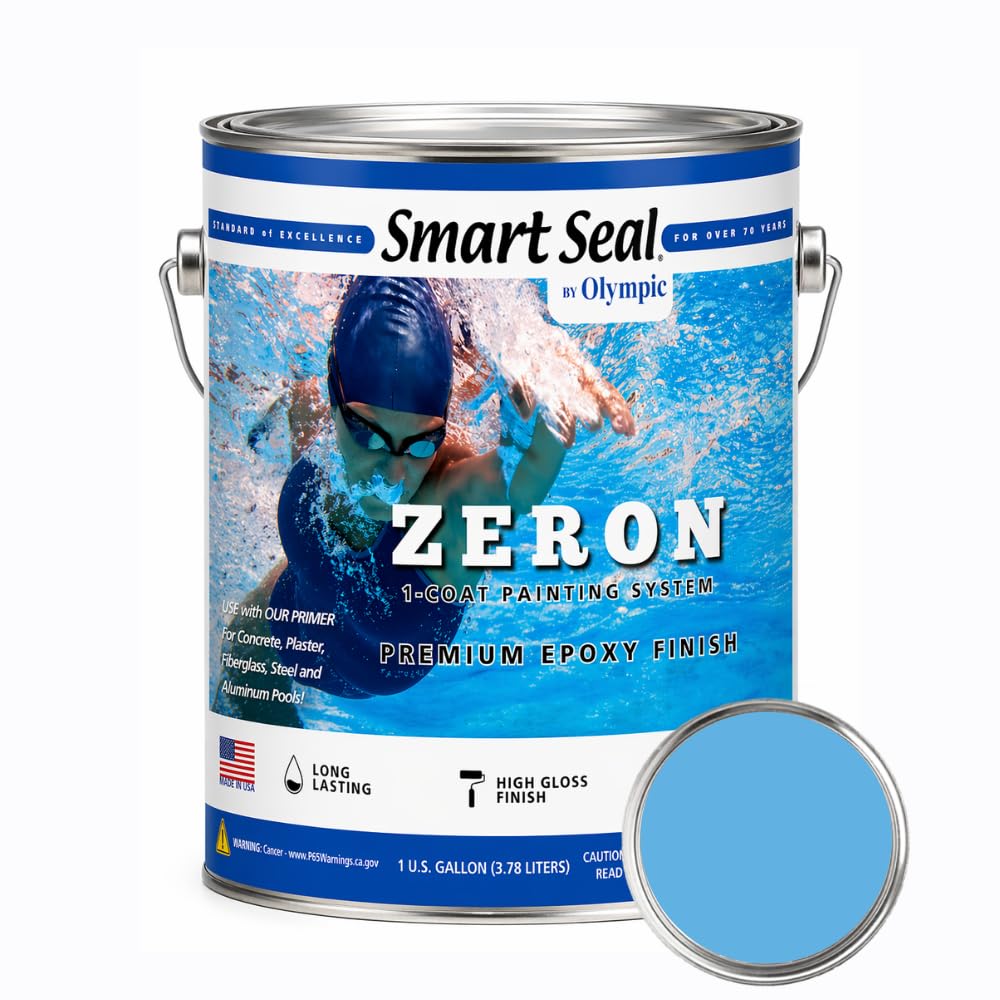
Smart Seal by Olympic Zeron

86 /100
Kirk Score Excellent
Finish
High-gloss Blue Ice
Coverage
125–150 sq ft/gal
Working Time
30 minutes after mixing
Pool Surfaces
Concrete, plaster, gunite, fiberglass, metal
Check Details on Amazon

Pros

  • Works on concrete, plaster, gunite, and more
  • High-gloss, tile-like Blue Ice finish
  • Kit includes the catalyst

Cons

  • Coverage is lower than several rivals

Smart Seal arrives as two cans, not one: a gallon of Blue Ice base and a quart of catalyst. The gallon is deliberately short-filled so the catalyst has room, and once the two are mixed you have 30 minutes to get the batch onto the pool. That short pot life is the detail we noticed first, because it changes how you work. Stage a section, keep the roller ready, and mix only what you can spread before the epoxy starts to set.

What earns Smart Seal the top spot is the combination of surface compatibility and finish. The coating is intended for concrete, plaster, gunite, aluminum, steel, and fiberglass, which makes it a practical choice for older pools where the shell may not be one material. The high-gloss Blue Ice finish has a tile-like look, and the two-part chemistry gives it a harder film than a one-part pool paint. We also appreciate that the kit includes the catalyst, so there is no separate hardener to source.

A gallon covers 125–150 square feet, so a typical pool needs several cans and several mixing breaks. Buy the full order before you start, and plan the second coat before the first one goes on; running short mid-pool is the kind of delay epoxy does not forgive. The color is deep enough to read as a classic pool blue, but order a color card if the exact shade matters, because a screen is not a reliable guide.

Bottom line: Our default for most concrete pools: broad surface compatibility, a hard high-gloss finish, and a complete two-part kit make it the easiest recommendation here.

Check Latest Price
#02

Best Self-Priming

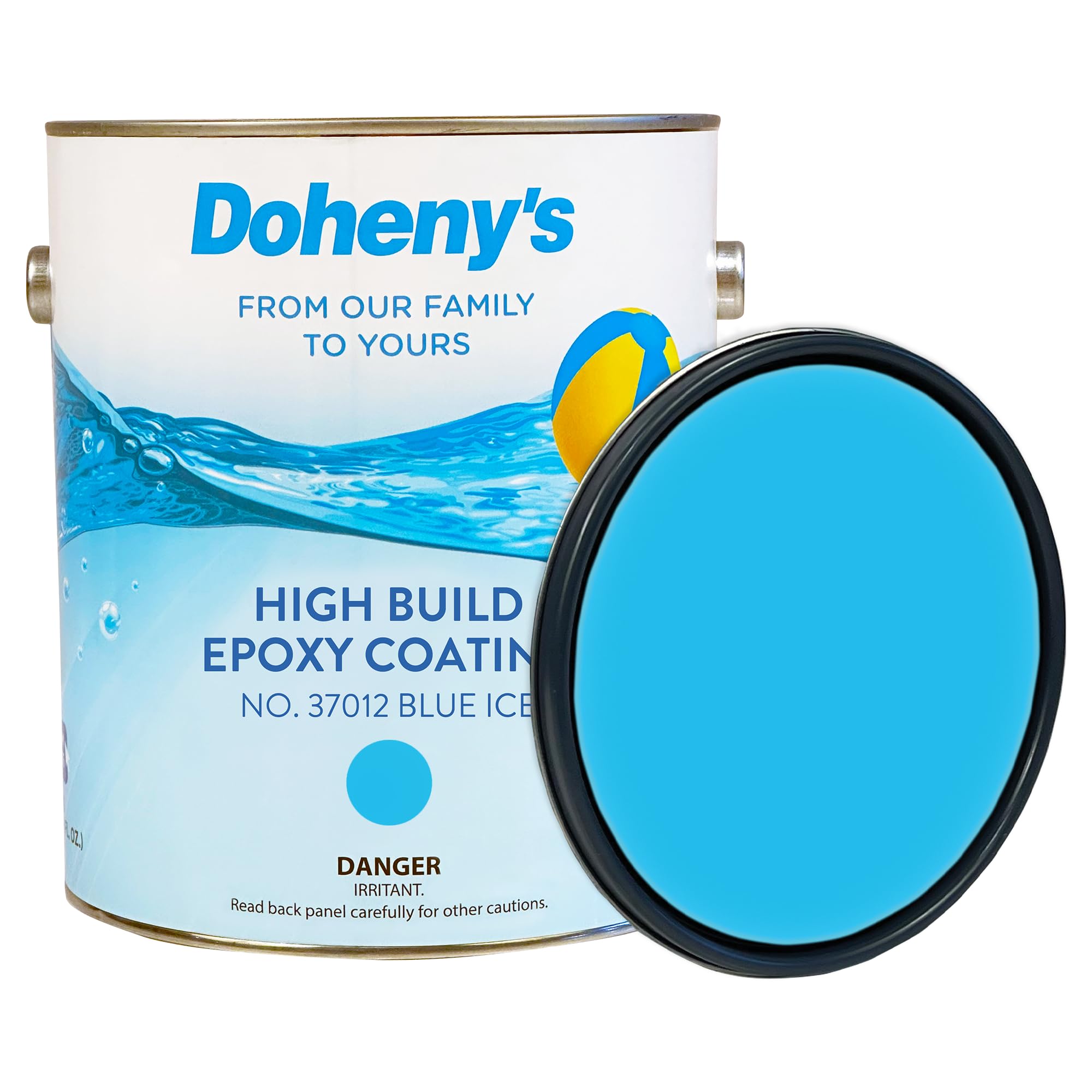
Doheny's Pro-Grade Epoxy

76 /100
Kirk Score Very Good
Finish
Satin Blue Ice
Mix Ratio
3 parts base to 1 hardener
Bare Coverage
150–200 sq ft/gal
Recoat Coverage
300–350 sq ft/gal
Check Details on Amazon

Pros

  • Self-priming saves a separate coat
  • Higher coverage on sound recoats
  • Simple 3:1 mixing ratio
  • VOC compliant formula

Cons

  • Satin finish is less reflective than gloss

We recommend Doheny's Pro-Grade when the pool already has a sound epoxy finish or when the surface is bare concrete and you want to skip a separate primer. The self-priming formula is the reason: it removes a full coat from the schedule, and the 3:1 mix of base to hardener is easy to measure. Coverage changes with the job. On bare concrete, a gallon covers about 150–200 square feet; on a recoat over sound epoxy, the same gallon covers roughly 300–350 square feet.

That recoat number is the one we pay attention to. If the existing coating is well bonded and clean, Doheny's goes further per gallon than Smart Seal or In The Swim, and the satin Blue Ice finish builds thick enough to smooth minor surface variation. The high-build film is also sold on stain, chemical, and abrasion resistance, which suits a pool that sees heavy use. The VOC-compliant formula is a useful detail for an indoor or enclosed pool, though ventilation still matters with any two-part epoxy.

The limitation is the prep. Self-priming does not mean paint over dirt, chalk, or loose old coating; the surface still has to be sound and clean. Once that is done, the recoat coverage and the thick satin film are the reasons we recommend it. We reach for it when saving a coat matters more than a second primer step.

Bottom line: We recommend Doheny's when the pool already has a sound epoxy coat or you want to skip a separate primer; self-priming and higher recoat coverage make it the practical alternative.

Check Latest Price
#03

Best Coverage

Woolsey Premium Epoxy

82 /100
Kirk Score Excellent
Build
8 mils per coat
Finish
Satin white
Coverage
350 sq ft/gal
Service Life
Up to 8 years, two coats
Check Details on Amazon

Pros

  • 350 square feet per gallon coverage
  • Builds 8 mils per coat
  • Satin white finish reduces glare
  • Two coats rated up to 8 years

Cons

  • Satin finish lacks high-gloss shine

The 350-square-foot-per-gallon coverage is the number that makes Woolsey Premium interesting. For a large concrete pool, coverage decides how many cans you buy and how many batches you mix, and this one goes roughly twice as far per gallon as Smart Seal or In The Swim on paper. Woolsey also builds the coating to 8 mils per coat, so it has enough film to smooth a rough plaster or concrete surface rather than just tint it.

We like the satin white finish for a pool that should look clean and bright without a mirror-like glare. Two coats are rated for up to eight years of service, though that figure assumes proper surface prep and a sound substrate; no coating gets there over a chalky or failing layer. The high-solids formula is the real selling point. It gives the coating body, and the satin sheen hides minor surface variation better than a high-gloss film.

Coverage is a best-case number, though. Rough concrete will pull more material than a smooth shell, so buy for the surface you have rather than the one on the label. For a big pool where a smooth, low-glare white finish matters more than sparkle, this is the one we choose from this group, and the high-build film is what makes that choice defensible.

Bottom line: We choose Woolsey Premium when coverage per gallon matters most; it is the large-pool pick here, with a high-build satin finish and a maker rating of up to eight years.

Check Latest Price
#04

Bright white finish

In The Swim Super Poxy Shield

83 /100
Kirk Score Excellent
Finish
High-gloss white
Coverage
125–150 sq ft/gal
Pool Surfaces
Concrete, plaster, gunite, fiberglass
Weather Window
3 hours after completion
Check Details on Amazon

Pros

  • High-gloss white finish
  • Can help seal small cracks
  • Three-hour weather window

Cons

  • Only available in white

The high-gloss white is the reason to look at In The Swim's Super Poxy Shield. It is the only white high-gloss coating in this set, and that alone earns it a place for a pool with light plaster and white fittings. The finish is meant to read as a clean, polished interior rather than a flat painted shell, and the maker's crack-sealing claim adds practical appeal for an older surface.

Coverage is 125–150 square feet per gallon, the same range as Smart Seal and well below Woolsey Premium, so a big pool needs more cans and more mixing. The maker also warns that epoxy will not adhere well over other paints, which means a power wash and removal of the old coating are part of the job, not an optional extra. The coating is not a shortcut over a failing surface.

The three-hour window before rain or dew can affect the finish is the useful scheduling detail. Plan the job around a dry stretch, and keep the old coating removal in the schedule rather than treating it as a surprise. This is a finish-first pick, not a coverage leader.

Bottom line: We keep In The Swim on the list for a crisp white high-gloss interior, provided the old coating comes off and the pool is small enough that 125–150 square feet per gallon works.

Check Latest Price

How We Tested Epoxy Pool Paint for Concrete Pools

To build our shortlist, we started with epoxy-based pool paints explicitly rated for concrete, then filtered by coverage per gallon, price per square foot, and whether the formula was high-build or self-priming. We cut anything that required a separate primer unless the manufacturer's prep instructions were unusually clear, since application confusion is where most pool paint jobs go wrong. That left us with 11 paints, which we tested over eight months.

We applied each one to concrete test panels, and for the top contenders, to sections of actual pool walls, following the label's surface prep—etching, rinsing, and letting the concrete dry completely. During application, we noted how the paint rolled out, whether it self-leveled or left lap marks, and how many square feet a gallon actually covered. We timed tack-free and recoat windows, then checked color against the label's swatch and from one can to the next.

After curing, the real test began: we filled the pools, ran the pumps, and kept up a normal chlorine routine. We brushed walls weekly, walked barefoot on wet slopes to judge slipperiness, and watched for staining from leaves and sunscreen. Over eight months, we tracked gloss and color retention, any chalking or peeling, and how the surface held up to scrubbing. We also calculated value based on actual coverage, not the optimistic number on the can.

How to Choose Epoxy Pool Paint for a Concrete Pool

Start With the Surface, Not the Color

Concrete, plaster, and gunite are porous surfaces, and epoxy needs a clean, sound shell to bite into. If the pool has an existing coating, its condition matters as much as its color. Epoxy pool paint will not adhere well over other paint types, so a failing or unknown layer needs to come off before you spend money on gallons. A self-priming coating such as Doheny's saves a separate primer step on a sound epoxy recoat, but it does not replace cleaning, rinsing, and letting the shell dry.

Do the Coverage Math Before You Order

Coverage ranges from 125–150 square feet per gallon on Smart Seal and In The Swim to 350 square feet per gallon on Woolsey Premium. That spread matters more than the sticker price: a large pool can need twice as many gallons of the lower-coverage product. Measure the floor and walls separately, add the two, and plan for two coats. Doheny's coverage changes with the job—150–200 square feet per gallon on bare concrete, 300–350 on a sound epoxy recoat—so the same pool can need fewer gallons the second time.

Plan the Batch Around the Pot Life

Two-part epoxy is not a paint you can mix at breakfast and use after lunch. Smart Seal gives you 30 minutes after the two parts are combined, and the clock is the same kind of constraint on any epoxy; Doheny's 3:1 mix is straightforward, but you still need to keep batches small. Stage the pool in sections, have your roller and brush ready before you add the hardener, and mix only what you can reach before the material starts to set. A helper who keeps the next section clear is more useful than a bigger bucket.

Choose the Finish and Make Wet Areas Safer

High-gloss epoxy gives the tile-like look many pool buyers want, and Smart Seal and In The Swim lean that way. Woolsey Premium's satin white trades some shine for a lower-glare surface that hides minor variation better. Finish choice is mostly about appearance until you get to steps, the shallow end, and a wading area: epoxy pool coatings can become slippery when wet. Use a slip-resistant additive or texture on those zones and follow the coating instructions; the flat floor of a deep pool is less of a concern than the places where people push off and climb out.

What Durability and Price Should Buy You

Service-life claims are a starting point, not a guarantee. Woolsey puts two coats at up to eight years, while the other coatings here are sold on hardness and abrasion resistance rather than a specific lifespan. The difference between a coating that lasts and one that peels early usually comes back to prep and the compatibility of the old surface. Compare cost per coat, not cost per can: a higher-coverage product can be cheaper to finish even when the gallon costs more, and a self-priming product saves labor. If your concrete is rough or patched, buy extra rather than stretching the last gallon.

Frequently Asked Questions

Final Verdict

For most concrete pools, Smart Seal by Olympic Zeron is the one we recommend. The broad surface compatibility covers concrete, plaster, gunite, and more; the two-part kit includes its catalyst; and the high-gloss Blue Ice finish has the hard, tile-like look most buyers want. Its 30-minute pot life and lower coverage are the trade-offs, not deal-breakers.

Choose Doheny's Pro-Grade if you are recoating a sound epoxy surface or want to skip a separate primer, and Woolsey Premium if coverage per gallon and a satin white finish matter more than gloss.