// data-verified

Best Paint for Glass of 2026

Glass paint has a credibility problem: most of us have watched a hand-painted wine glass go cloudy and flake by the second wash. That's less about bad paint than about the surface — glass is glossy, non-porous, and hostile to anything that wants to stick to it. The coatings that survive split into two camps: enamels you heat-set in a home oven, and acrylics that cure in the air over several days.

We've spent four months with 15 glass paints, sprays, markers, and outliners, using them on stemmed glasses, jam jars, and a bathroom window that needed frosting. What we learned is that opacity is the real fork in the road: a frosted spray buys privacy in one coat but hides whatever's behind it, while a transparent enamel keeps the glass reading as glass. Color payoff, odor, drying time, coverage, and how badly a design bleeds at the edges varied far more between formats than between price points.

The picks below are sorted by what each one is genuinely good at — fine detail, a whole pane, or anything headed for the sink.

#01

Best Overall

Pebeo Vitrea 160 Glass Paint

90 /100
Kirk Score Outstanding
Curing
Bake 40 min at 325°F
Finish
Glossy, transparent
Volume
45 ml (1.5 fl oz)
Cured Finish
Dishwasher and microwave safe
Check Details on Amazon

Pros

  • Baked finish is dishwasher, microwave and UV resistant
  • Transparent color that mimics real colored glass
  • 36 shades across gloss, frosted and shimmer
  • Smooth application; a little goes a long way

Cons

  • Some colors need several coats for full depth
  • Thick bottles need a thinner to flow cleanly

Forty minutes in a 325°F oven is what separates Vitrea 160 from the craft acrylic already in your drawer. The color is water-based and transparent, so it reads as colored glass rather than a painted film, and once the bake is done the finish is rated dishwasher safe, microwave safe and UV resistant. That's the whole argument for buying a glass paint at all: a wine glass you decorated should survive a dinner party and a hot wash, not flake the first time it meets water.

We made it the top pick because it covers the widest spread of what people actually do with glass paint — tinting mason jars, coloring a vase, adding a pattern to a pitcher, restoring color on chandelier prisms. The 45 ml bottle comes in 36 colors, split into 20 glossy, 10 frosted and 6 shimmer, which is enough range to build a matched set instead of settling for one shade. It goes on smoothly, too, and a little covers a lot, so a single bottle handles several small pieces.

The bake is also the constraint, and it's worth taking seriously: a mirror, a coated tumbler, anything with a glued-on fitting can't go in the oven, so this isn't the paint for those. The color also dries fast and turns tacky on the brush, so work in small sections and keep each stroke deliberate — going back over half-dry paint is exactly how streaks end up baked in.

Bottom line: For glass that will actually be used and washed, we think this bottle is the one to buy: transparent color plus a 40-minute bake turns decoration into a dishwasher-safe finish.

Check Latest Price
#02

Best for Window Privacy

Rust-Oleum Frosted Glass Spray

91 /100
Kirk Score Outstanding
Finish
Frosted, semi-transparent
Coverage
7 sq ft
Dry Time
1 hour
Water Exposure
Avoid continual contact
Check Details on Amazon

Pros

  • Obscures the view while daylight still comes through
  • Recoatable any time to build density gradually
  • Stencils read as etched glass

Cons

  • Not for glass that stays wet
  • Sharp solvent smell while spraying and after

A sidelight beside the front door is the kind of glass you stop thinking about until a delivery driver is standing two feet from it. Frosted Glass spray fixes that in an afternoon: it goes on semi-transparent, so daylight still comes through while the shapes on the other side stop resolving into people and furniture. For interior windows, glass door panels and a bathroom window that faces a neighbor, we think it's the fastest, least expensive privacy fix in this set.

One can is rated for 7 square feet, roughly a narrow door panel or a pair of small windows, and it's recoatable at any time, so you can sneak up on the density you want in light passes instead of committing to one heavy coat. That technique is the whole job: thin, even passes from a sensible distance. Heavy passes are where drips and splotchy patches come from, and a drip that sets on vertical glass is difficult to disguise afterward.

What it won't do is color. This is a single milky finish with no hues to mix, so a red vase or a three-shade pattern needs a brush-on paint instead. Stenciling is where the can genuinely shines: hold a stencil flat against the pane and you get a frosted border or motif that reads as etched glass, with the light still moving through it.

Bottom line: If the goal is privacy rather than color, we think this can is the quickest route to frosted glass — just plan on light, even passes and a well-ventilated room.

Check Latest Price
#03

Best for Glass Lettering

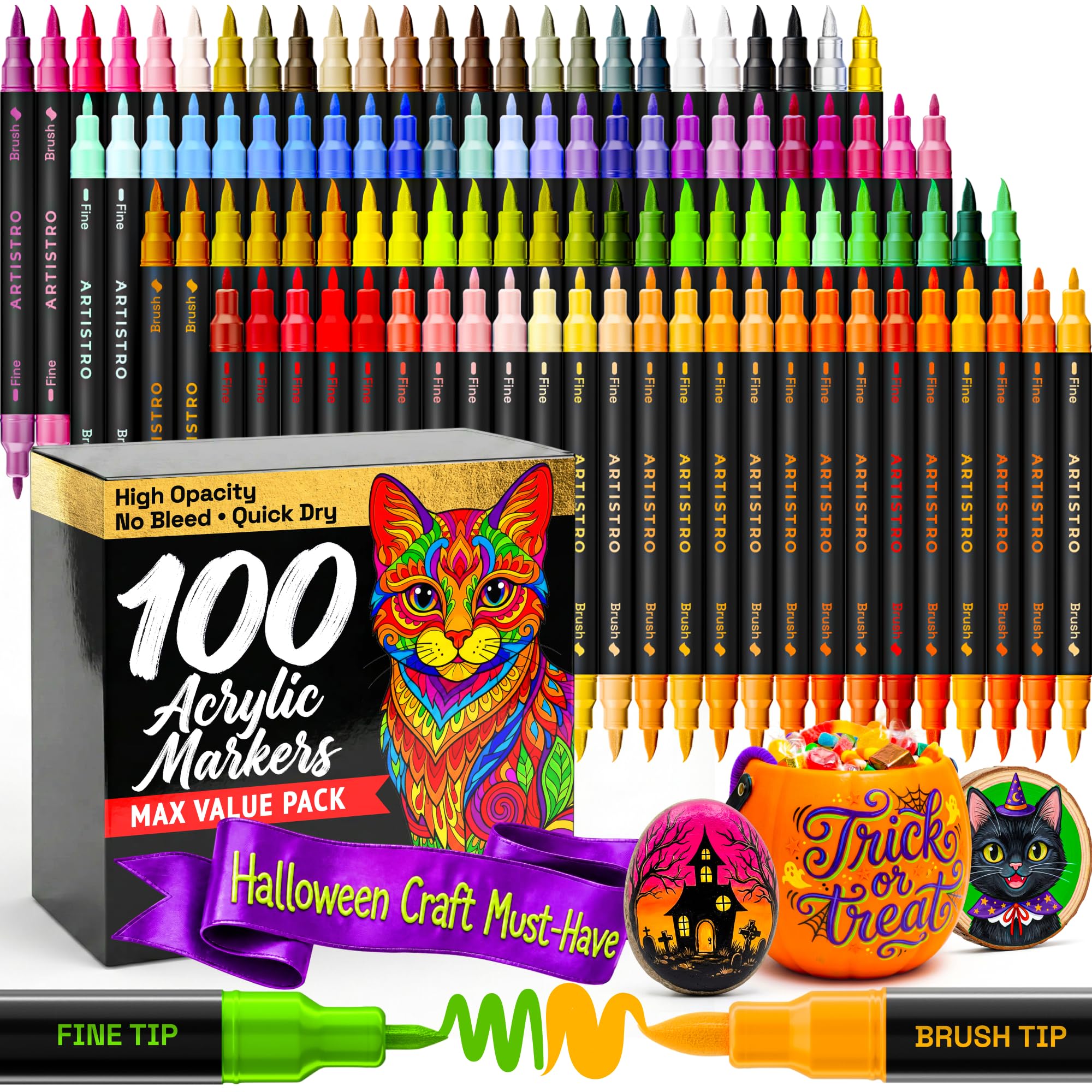
ARTISTRO Glass Marker Pens

91 /100
Kirk Score Outstanding
Ink
Water-based acrylic
Tips
1 mm fine, 1–5 mm brush
Count
100 markers
Surfaces
Glass, ceramic, mirror, wood
Check Details on Amazon

Pros

  • Two tips: 1 mm fine and 1–5 mm brush
  • Pre-activated nibs need no shaking or pressing
  • Opaque acrylic color in a single pass
  • 100 pens cover a crowd of glasses at once

Cons

  • Pens can arrive dry or dry out in storage
  • Bleeds and smears on porous surfaces like rock

A hundred pens is more than any single project needs, and that's the point: this box is built for the night before a party, when six people need their names on six wine glasses and nobody wants to lay out brushes, a palette and a drying rack. Each pen has a 1 mm fine tip at one end and a 1–5 mm brush tip at the other, and the cotton nibs arrive pre-activated — no shaking, no pressing to start the flow, no sacrificial scrap paper first.

The ink is water-based acrylic meant to dry opaque in one pass, which is why we reach for these ahead of a general acrylic set. On glass the fine end handles names, dates and small lettering, the brush end fills a monogram or a simple motif, and the color holds without a second layer. Two things to know: the fine tip writes closer to a full millimeter than to a needle point, and the finish is water resistant rather than waterproof, so hand washing is the habit for anything you want to keep.

For marking glass, this is the most practical pick in the set — no oven, no brushes, no ventilation conversation, and it's the one you can hand to a kid at a craft table. What you give up is permanence: the color sits on the glass rather than fusing to it, and it isn't the coating to choose for a piece that gets scrubbed every week.

Bottom line: For names on wine glasses and quick craft projects, we think this box is the easiest way to get opaque color onto glass with no brushes and no oven.

Check Latest Price
#04

Best for Stained-Glass Windows

Gallery Glass Window Paint Set

91 /100
Kirk Score Outstanding
Finish
Translucent stained-glass look
Application
Painted directly on window
Set Contents
18 bottles, 2 fl oz each
Check Details on Amazon

Pros

  • Eighteen translucent colors, 2 ounces each
  • Paints straight onto the window
  • Doubles for suncatchers and clings

Cons

  • The priciest way into glass painting here
  • Translucent tints only, no solid color

Real stained glass means cutting, grinding and soldering in a workshop. This set skips all of it: eighteen 2-ounce bottles of translucent acrylic that go directly onto the window, building the color and texture of a stained-glass panel right where it will hang. The same paints are pitched at suncatchers and window clings, so you can try the look on something small before committing a whole pane.

We gave it a place here for the project no single bottle handles — a full panel, a seasonal window design, a big piece that needs eighteen colors open at once. That's the real difference between this and one bottle of transparent paint: mixing a palette out of two or three shades is slow, and a stained-glass look depends on distinct translucent hues sitting side by side. For a jar, a vase or a set of glasses, it's far more paint than the job needs.

Worth thinking through before the first brushstroke: you're painting a window you still have to look through. A busy design becomes a permanent filter on the light in that room, and unlike a painted vase it can't be turned to the wall — so sketch the layout on paper, keep the middle of the pane clearer than the border, and start on a small piece to see how the colors layer.

Bottom line: We recommend this set for a full stained-glass window project, where eighteen translucent colors painted in place beat anything a single bottle can do.

Check Latest Price
#05

Outlines and dots

Pebeo Vitrea 160 Outliner

91 /100
Kirk Score Outstanding
Form
Squeeze tube
Curing
Bake at 300°F
Finish
Opaque gloss black
Volume
0.67 fl oz (20 ml)
Check Details on Amazon

Pros

  • Draws raised leading lines, dots and lettering
  • Bakes to a food- and dishwasher-safe finish
  • Opaque black that reads as leading against color

Cons

  • Lines take a steady hand and a guide to stay even

This tube draws; it doesn't fill. The 0.67-ounce outliner lays a raised black line for the leading between color panels, for dots around a rim, for lettering on a glass, and it bakes to the same heat-resistant, food-safe, dishwasher-safe finish as the Vitrea colors it's built to sit beside. If you want to cover an area, it's the wrong purchase. If you want the outline that makes a painted glass look finished, it's the right one.

Where it earns its keep is the curve of a wine glass, where a brush fights you and a marker skates off the swell. The line is opaque enough to read as leading against translucent color, and a cold oven brought up to 300°F sets it so the piece can go through the dishwasher afterward. The working rhythm is the skill: the paint starts skinning at the nozzle while you draw, so wipe the tip and keep moving instead of going back to correct a wobble.

The black is where our expectations shifted. It reads closer to charcoal than to the crisp jet black of a real leaded window, and baking doesn't deepen it — against pale colors that looks intentional and slightly antique, against a dark palette it disappears. That's a look rather than a fault, but it's worth knowing before you build a design around it.

Bottom line: Buy it for lines, dots and lettering rather than fill: we think this tube is the neatest way to finish a piece you're going to bake.

Check Latest Price

How We Chose and Tested Glass Paints

We started by gathering every paint, spray, marker, and outliner sold specifically for glass, then filtered out anything formulated for ceramic or fabric, anything requiring a kiln, and any set too small to finish a single project. That left 15 products, which we used over four months, logging how far each one actually went — how many glasses or how much square footage per ounce — because a cheap bottle that quits after two tumblers isn't cheap.

Testing happened where glass paint really gets used: at the kitchen table on weekend mornings, on a batch of inexpensive stemmed glasses before a dinner party, on jam jars and a vase, and on a bathroom window that needed privacy from the neighbor's driveway. Every product got the same surfaces so we could compare them side by side.

We timed how long each one took to stop feeling tacky, then noted what happened on the second coat — some dragged up the first layer, others laid down clean. On the window we watched for drips and sags and counted coats until light stopped passing through. Odor was judged in a closed room with the door shut. To check bleed, we ran an outliner or tape line and flooded color against it, then held a lamp behind the glass to see how sharp the edge stayed.

Every finished piece got a hand wash with dish soap and a non-abrasive sponge, and the survivors got a second wash a week later to see whether the color dulled or the edges lifted. Some coatings came out of the water unchanged; a few went chalky on contact.

How to Choose Paint for Glass

Start With What the Glass Has to Survive

A painted glass that sits on a shelf and one that goes through the dishwasher are two different purchases. Bake-cure paints like the Vitrea 160 line are the ones that carry a dishwasher rating, and heat is what does it: 40 minutes at 325°F fuses the color to the surface. The catch is the glass itself — a mirror, a coated tumbler, anything with a glued-on fitting can't take that heat and is out of scope.

If nothing will ever wash the piece, an air-dry acrylic or a marker is plenty and far less fuss. If it will hold food or drink, buy for the cure and check the oven temperature before you fall for a color.

Choose the Effect Before the Palette

Glass paint comes in four broad effects and they aren't interchangeable. Transparent color mimics stained glass and lets light through; frosted spray turns clear glass milky for privacy; an opaque outliner draws the lines between panels; and a set of translucent window paints builds a whole stained-glass picture in place. Decide which of those you actually want before comparing palettes, because a frosting can't give you red and a transparent color won't hide a neighbor.

Color range matters most with transparent paints, where mixing is the point. The Pebeo line's 36 shades across gloss, frost and shimmer cover far more ground than a single bottle, while the Gallery Glass set trades range for volume.

Match the Applicator to the Shape of the Job

A spray can is the only sane way to frost a large flat pane. A brush gives control on a curved vase. A marker is what you want when the design is letters, and an outliner is for lines that need to sit proud of the surface. Buying a spray for a wine glass or a brush for a door panel is the most common mismatch in this category.

The trap: markers and outliners are not fillers. A 1 mm tip is for names and borders, and an outliner draws leading — neither will cover an open area, so budget for a color paint alongside them.

Plan for a Short Working Time

Glass is non-porous, so paint sits on top and starts setting almost immediately. Water-based transparent colors turn tacky on the brush within a minute or two, and dragging a brush back over a half-dry patch is how streaks get baked in permanently. Work in small sections, load the brush lightly, and finish one area before starting the next.

Aerosols fail the opposite way: heavy passes give you runs and splotchy density. Several light coats, each one recoatable at any time, build an even frost that a heavy coat never will.

Work Out Cost per Project, Not per Bottle

A 45 ml bottle sounds small until you're painting a rim rather than a whole vase; one bottle covers several small pieces. A set of 2-ounce bottles costs more up front and is the cheaper way to fill an entire window. Note that coverage is quoted differently by format — square feet for a spray can, fluid ounces for a bottle — so compare within a format rather than across it.

For a one-off gift, buy a single color. For a project that will grow, buy the set.

Frequently Asked Questions

Final Verdict

For most people painting glass, the answer is the Pebeo Vitrea 160 glossy paint: transparent color that reads like real colored glass, plus a 40-minute bake that makes it dishwasher and microwave safe. If the piece never gets washed, the ARTISTRO markers get you there faster and without an oven; if the job is privacy on a window, the Rust-Oleum frosting solves it in one can.

Check the glass before you order the paint. Bake-cure products need a surface that can take 300 to 325°F, and a mirror or a coated tumbler can't — which is exactly when a marker or a spray becomes the better buy.