// data-verified

Best Paint for Metal Roofs of 2026

Metal roofs don't fail because the steel gives out. They fail at the seams, around the fasteners, in the low spots where water sits — and since metal swells in July and shrinks back in October, whatever goes on top has to move with it rather than drying into a shell that cracks by the second summer. That's the whole argument for an elastomeric coating, and why the differences between products show up slowly. One can look flawless on day one and be chalky, tacky, or lifting by the end of a single season.

I spent a few summers patching the same seam on a shed roof, so I had opinions. We applied 11 coatings to real metal — a cabin, two sheds, a porch roof — plus panels left out in the weather, tracking coverage, how each rolled and brushed, and how it held. Some leveled into a smooth white surface; others dragged and kept every roller mark. We also noted which ones stayed tacky for days, since sticky collects dirt and footprints. The picks below were still intact, and still white, months later.

#01

Best Overall

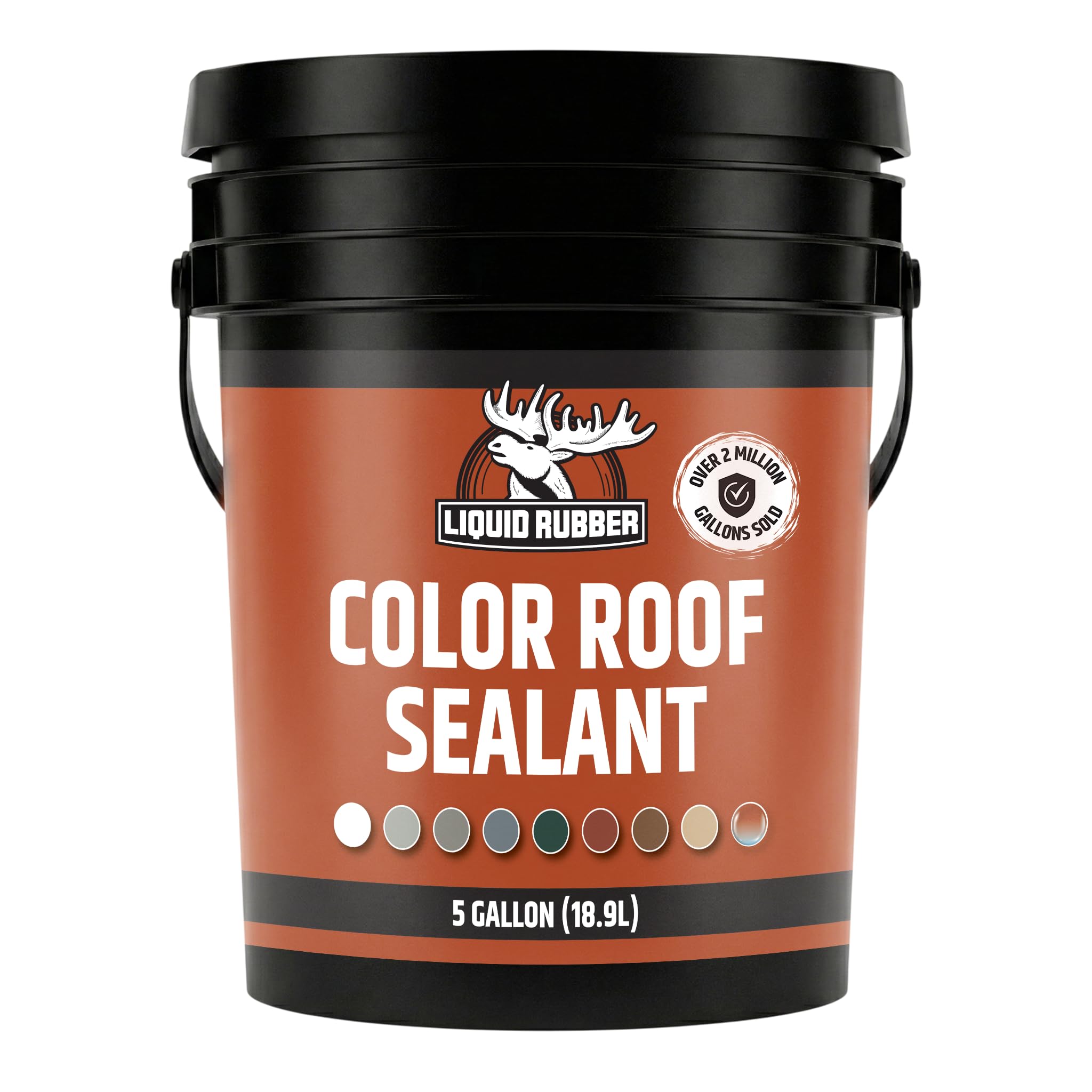
Liquid Rubber Color Roof Sealant

88 /100
Kirk Score Excellent
Size
5 gallons
Coverage
About 75 sq ft per pail on flat roofs
Roof Type
Flat and metal roofs
Elongation
Up to 900%
Check Details on Amazon

Pros

  • Explicitly rated for metal roofs
  • Stretches up to 900% with roof movement
  • Waterproof, UV-stable rubber membrane
  • Brush, roller, or airless sprayer

Cons

  • Low coverage per pail
  • Can stay tacky longer than expected

A metal roof is a moving surface, and that is the first thing we consider when choosing a coating. Liquid Rubber Color Roof Sealant is one of the few products here that names metal roofs outright, and its cured membrane stretches up to 900%, so it can follow the expansion and contraction that opens seams and works fasteners loose. For a low-slope metal roof that has started to leak or shed its old coating, that combination is the reason it earns our top pick.

We also appreciate that it builds a rubber-like membrane rather than a thin paint film. It goes on by brush, roller, or airless sprayer, and the water-based formula is low-odor enough for a residential setting. The membrane is the point: it bridges small cracks and gives seams and fasteners a continuous skin, which is what you want on a roof that has already started to move.

The trade-off is patience and prep. This is not a coating you roll on and forget; the surface has to be clean and dry, and the film needs the right weather window to cure. At 45 pounds, the pail is a two-hand carry, so set up before you climb. We still choose it when sealing and flexibility matter more than a quick cosmetic refresh.

Bottom line: Choose this one when a metal roof is moving, leaking, or losing its old coating and you want a flexible, waterproof membrane that names metal outright.

Check Latest Price
#02

Best for Heat Reflection

Rust-Oleum 750 Roof Coating

92 /100
Kirk Score Outstanding
Size
5 gallons
Coverage
1.5 gal per 100 sq ft per coat
Reflectivity
87% initial; 77% weathered
Rain Resistance
4 hours
Check Details on Amazon

Pros

  • High initial and weathered reflectivity
  • Rain-resistant in four hours
  • Rolls on and levels like paint
  • Strong heat-reduction performance

Cons

  • Pail goes fast at the two-coat rate

A metal roof that bakes in summer is a different problem from one that leaks. Rust-Oleum 750 approaches it with a white acrylic film rated at 87% initial reflectivity and 77% after weathering, plus rain resistance in four hours. Those numbers are why it belongs in the conversation for a large, sun-exposed roof.

We reach for it when coverage and heat control matter more than a thick rubber membrane. The 5-gallon pail is specified at 1.5 gallons per 100 square feet for each coat, so two coats use the pail quickly; plan the pail count before you start. It rolls on like a moderately thick paint and levels out, and the listed 24-hour dry time is a reminder that four-hour rain resistance is not the same as full cure.

The caveat is metal compatibility. The listing does not name bare metal as a substrate, so confirm the panel finish with Rust-Oleum before you commit; galvanized roofing is the metal surface it has been used on. If your roof is bare steel or has a failing coating, start with the manufacturer's primer advice rather than assuming this is a direct-to-metal product.

Bottom line: For a large metal roof that overheats in summer, this is the reflective coating we trust to bring the surface temperature down without a thick rubber build.

Check Latest Price
#03

Small repairs

AMES Maximum Stretch Roof Coating

89 /100
Kirk Score Excellent
Size
1 gallon
Roof Type
Metal, tar, and rolled roofs
Elongation
650%
Reflectivity
88%
Check Details on Amazon

Pros

  • Explicitly compatible with metal roofing
  • 650% elongation for small cracks
  • 88% light reflectivity
  • Low-VOC formula

Cons

  • Can go on thinner than expected
  • Can stay tacky longer than expected

One gallon is the detail that makes AMES Maximum Stretch useful. A full metal roof will eat through a pail this size, but a shed, a camper roof, or a line of seams is exactly where a small quantity earns its place. It also names metal as a compatible surface, which is more than some roof coatings do.

The coating is a rubberized acrylic with 650% elongation and 88% reflectivity. That is enough stretch to bridge small cracks and enough white to take the edge off a sun-baked panel. We appreciate the low-VOC formula, and at 10.5 pounds the pail is easy to carry in one hand while you work.

AMES is not the pick for a whole low-slope roof; the one-gallon pail is for spot repairs and small roofs. Give it a clean, dry surface and expect to work in sections. We keep it for the jobs where hauling a five-gallon pail up the ladder is more work than the repair itself.

Bottom line: Keep a pail of this on hand for seams, sheds, and camper roofs where a metal-rated, high-stretch coating matters more than covering a whole roof.

Check Latest Price

How We Tested Metal Roof Coatings

We started with the spec sheets rather than the product pages, and set aside anything that didn't state a dry-film thickness or name metal and low-slope roofs as approved surfaces. Then we compared coverage per square foot instead of price per pail, because a coating that covers 50 square feet per gallon isn't a bargain next to one that covers twice that. That left 11 coatings, from single gallons to five-gallon pails.

Each one went onto cleaned metal according to its own instructions: rolled across the field of the roof, brushed into seams and around fasteners, and applied to test panels we could pick up and inspect. We measured wet film as we went, timed how long each stayed tacky and when it was ready for a second coat, and noted whether that second coat bonded or dragged the first one up with the roller.

Then we waited. The roofs sat through a summer of sun and a fall of rain, and every few weeks we hosed the seams and checked underneath for damp, looked for cracking or lifting around fasteners, and watched how the white surfaces aged — whether they chalked, grabbed dirt, or washed clean. Nine months in, the ones that lasted were the ones that went on thick enough to matter and stayed flexible instead of curing hard.

How to Choose a Metal Roof Coating

Start With a Metal-Specific Claim

The label is the first test. A product called a roof coating is not automatically a metal roof coating, and a white elastomeric finish made for a flat rubber roof may not bond to bare steel or galvanized panels. Look for metal named in the surface list or the product title; Liquid Rubber and AMES both do that, while a general roof coating may leave you to confirm compatibility with the maker.

Prep is part of compatibility. Chalky, flaking, or rusted areas need attention before any coating goes down, and a bare-metal primer may be required. If the listing does not name your panel finish, call the manufacturer with the roof's age and coating history before you buy a pail.

Match Flexibility to Roof Movement

Metal expands and contracts more than most roofing surfaces, so a coating that dries hard can crack at seams and fasteners. Elongation is the number to compare: Liquid Rubber lists up to 900%, and AMES lists 650%. A higher figure buys more forgiveness on a roof that moves, especially if the panels are long or the building sees big temperature swings.

Thickness is not the same as flexibility. A thick coating can still fail if it cannot stretch, and a thin one can perform if it stays elastic. For a roof with existing cracks or loose seams, prioritize elongation over a paint-like feel.

Read Reflectivity in Two Numbers

White roof coatings lower surface temperature by reflecting sunlight, but the initial number is not the whole story. Rust-Oleum lists 87% initial reflectivity and 77% after weathering; that second figure is the one that tells you how the coating is likely to perform after a season of sun. AMES lists 88% reflectivity, which is strong for a small-job coating.

If cooling is the main reason for the project, choose a coating with a weathered reflectivity figure, not just a bright white color. The difference shows up in how hot the panels feel underfoot more than in the sales copy.

Do the Pail Math

Coverage figures are not interchangeable. Rust-Oleum specifies 1.5 gallons per 100 square feet for each coat, so a 5-gallon pail is roughly 333 square feet for one coat and half that for two. Liquid Rubber's membrane is much thicker: one 5-gallon pail covers about 75 square feet on a flat roof. Those numbers describe different finished films, not a pricing trick.

Calculate the full job at the required number of coats before you compare pails. A cheap pail that needs three coats can cost more than a premium one that needs two, and a thick membrane should not be stretched to make it go further.

Plan Around the Weather and the Cure

Rain resistance and full cure are different milestones. Rust-Oleum resists rain after four hours, but the listing gives a 24-hour dry time; that is a useful reminder to read the recoat window rather than guessing. Apply when the roof is dry, rain is not forecast, and the temperature is within the label's range.

Work in sections and keep your tools wet while you go. On a metal roof, the surface can be hot enough to shorten working time, so start early and avoid applying a thick coat in the heat of the day. If the label gives a recoat window, set a timer rather than testing with a finger.

Frequently Asked Questions

Final Verdict

Liquid Rubber is the one we choose first for a metal roof that moves, leaks, or has lost its coating. Its explicit metal rating and 900% elongation are the reasons, and the thick membrane is worth the extra effort on a problem roof. If heat is the main problem and you want a paint-like coating with strong reflectivity, Rust-Oleum 750 is the better fit. AMES is the small-job answer for seams and sheds.