// data-verified

Best Tile Paint of 2026

Tile paint isn't paint the way you're picturing it. It's a two-part epoxy or acrylic coating that cures into a hard shell over old porcelain and fiberglass, which is why the question everyone asks is the same one: will it peel? I've seen a refinished tub look new three years on, and I've seen one flake around the drain within weeks. The gap rarely comes down to color — it's prep, mixing, and how long you leave it alone afterward.

We spent four months coating tubs, sinks, and shower walls with 12 kits, from single-can brush-ons to two-part systems with a separate hardener. Some leveled out to a factory-glossy finish; others left brush marks you could feel through a rag. Odor varied wildly too, which matters more than you'd think when your only bathroom is closet-sized.

One thing first-timers get wrong: coverage. Those square-footage numbers assume a single smooth coat on a bare tub, and a tub-plus-surround job usually eats two kits. White isn't one thing either — some read bright and cool, others creamy against older fixtures.

#01

Best Overall

Rust-Oleum Tub & Tile 2-Part Kit

88 /100
Kirk Score Excellent
Finish
Gloss white
Formula
Two-part epoxy acrylic
Coverage
110 sq ft
Water Exposure
After 3 days
Check Details on Amazon

Pros

  • Covers up to 110 sq ft per kit
  • Two-part epoxy-acrylic cures hard and glossy
  • Works on ceramic and porcelain tile

Cons

  • Strong solvent fumes need a fan and a respirator
  • Gloss film shows brush and roller texture

A hundred and ten square feet is an odd thing to lead with, but it is the number that earns this kit its place at the top. That is two to four times the coverage the small bottles here claim, which is the difference between one box for a tub and the wall tile around it and a second order arriving mid-job. It is also why we point people here first when the project is a whole surround rather than a single wall.

The formula behind that coverage is a two-part epoxy-acrylic, so it cures to a genuinely hard, glossy white rather than the softer skin a one-part acrylic leaves, and that hardness is what survives a surface that gets scrubbed and steamed every week. A two-part product sets its own schedule, though: once the hardener goes in you have roughly six hours of working life, and the mixture thickens steadily across it, so the last stretch of wall gets a stiffer material than the first. Lay out tape, roller, and a spare brush before you combine anything and work in one continuous pass.

The wait is the part we plan around. The film is dry to the touch long before it is ready for a shower, and the instructions ask for three days before water exposure, so schedule the job for a week when the bathroom is not in demand. Thin coats laid off in one direction give the flattest result; a heavy pass looks fine wet and shows every lap once it cures.

Bottom line: This is the kit we recommend for a full tub-and-surround refinish: the most coverage here in the hardest-curing formula, as long as you can ventilate the room and live without the shower for three days.

Check Latest Price
#02

Best Budget

NZDWZDN Tub & Tile Kit

91 /100
Kirk Score Outstanding
Size
17.6 fl oz
Finish
Semi-gloss white
Coverage
25-30 sq ft
Kit Contents
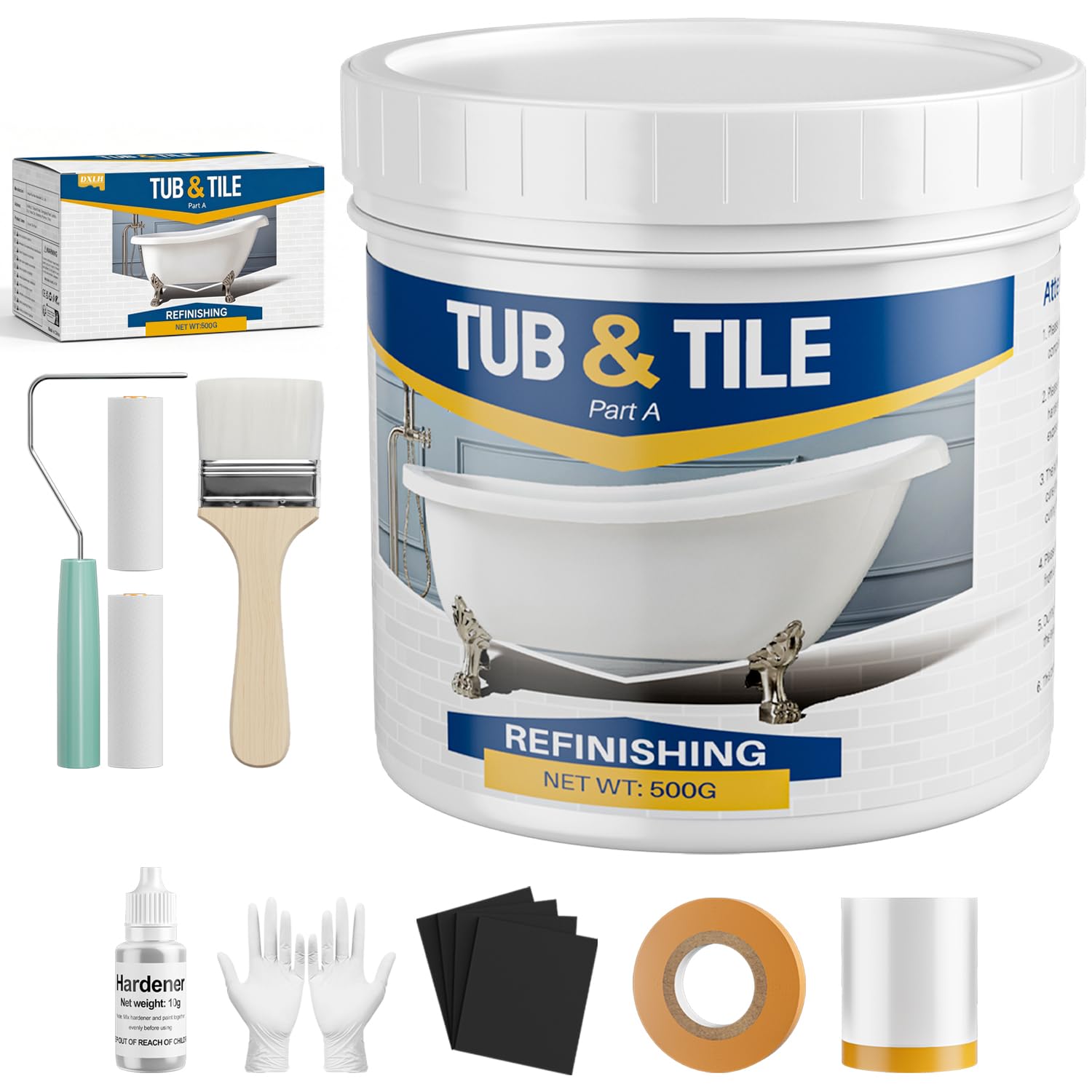
Hardener, brush, 2 rollers, 4 sandpapers, tape, film, gloves
Check Details on Amazon

Pros

  • Brush, rollers, sandpaper, tape, film, and gloves included
  • Low-odor water-based formula, water cleanup
  • Semi-gloss white suits wall tile

Cons

  • Covers only 25-30 sq ft per kit

Open the box and there is a whole job inside: part A, part B hardener, a brush, two rollers, four sheets of sandpaper, masking tape, masking film, and gloves. Of the small tub-and-tile kits here it is the only one that spells out a list that complete, and for a first attempt at tile paint that matters, because nobody wants to be hunting for a roller with hardener already ticking in the cup.

Twenty-five to thirty square feet is the honest limit, so think one tub surround, one short wall, or a backsplash rather than a whole bathroom. What we appreciate is how little ceremony the water-based acrylic demands: low odor, water cleanup, no solvent haze in a small room, and a semi-gloss white that suits wall tile better than a high gloss would. Gloss on old ceramic has a way of pointing at every wavy tile and tired grout line, and semi-gloss skims over them instead.

Keep it to walls and the outside of a tub rather than a shower floor that gets stood on and scrubbed, where the two-part kits earn their extra cost. The listing puts drying at around 24 hours; give it a full weekend before the first shower and treat that figure as the minimum rather than the finish line.

Bottom line: Buy this when you want to try tile paint on one wall without separately buying a roller, tape, or sandpaper, because it is the most complete small kit in this group.

Check Latest Price
#03

Best for Larger Tile Areas

Xmntdo Tub & Tile Kit 33 oz

91 /100
Kirk Score Outstanding
Size
33 fl oz
Finish
Semi-gloss white
Formula
Water-based acrylic
Coverage
50-55 sq ft
Check Details on Amazon

Pros

  • 50-55 sq ft from one bottle
  • Low-odor water-based acrylic
  • One batch covers a whole surround

Cons

  • Coverage stops around 55 sq ft
  • White only, with no color options

Thirty-three ounces is roughly double what the small bottles carry, and the coverage follows it: 50 to 55 square feet, which is a full shower surround with enough left over for the tile behind a vanity. If your project is bigger than one wall, this is the size that means one bottle, one mix, and one continuous finish instead of a second order arriving mid-job.

It is a water-based acrylic with a mild smell and water cleanup, and the finish is semi-gloss, the same middle ground the budget kit takes. The real advantage of the bigger bottle is not the volume but the rhythm of the work: mixing once and drawing from a single batch across an entire wall gives you a more even film than stopping halfway to mix again, and halfway is exactly where lap marks appear.

This beats the smaller version of the same kit for anything larger than a tub apron, and it is the pick over the two-part Rust-Oleum when fumes are the deciding factor, because it is far gentler in a bathroom with one small window. If you have the ventilation and the patience, the two-part still cures harder. If you do not, this covers a real surround without turning the house into a paint booth.

Bottom line: For a full shower surround rather than a single wall, this is the bottle to order: 50 to 55 square feet in a low-odor water-based formula that will not fumigate the house.

Check Latest Price
#04

Best Spray for Edges and Trim

Krylon Tub & Tile Spray

86 /100
Kirk Score Excellent
Size
17 oz
Finish
Gloss white
Formula
Solvent-based aerosol
Coverage
25-30 sq ft per can
Check Details on Amazon

Pros

  • Nothing to mix or clean up
  • Reaches edges and corners a roller misses
  • Gloss reads close to porcelain

Cons

  • Sharp solvent smell while spraying
  • One can covers only 25-30 sq ft

For tile edges, the strip between a backsplash and a counter, and the corners a roller cannot reach, an aerosol is simply the right tool, and this is the can we keep for it. Nothing to mix, nothing to clean out of a brush: shake it, lay two or three light coats, and walk away. Across a whole wall it is the wrong approach, since thin passes from a can take forever over eight feet of tile and the 25 to 30 square feet per can will not stretch to a surround.

Technique decides the result more than anything else about the product. Hold the can too far from the tile and the coating lands as a dry, chalky powder instead of a gloss film; keep it closer and keep it moving, and the finish reads close to porcelain rather than painted ceramic. Two light passes, crossed, beat one wet one every time.

The other thing worth knowing is care. Krylon says no bleach, and to clean the cured surface with non-bleach products, which is not fussiness: a gloss film scrubbed with an abrasive bathroom cleaner dulls in exactly the places you will notice, along the bottom of a backsplash and around a tub rim. Buy it alongside a kit for the field of tile, not instead of one.

Bottom line: We keep a can of this on the shelf for tile edges, trim, and tight corners where a roller cannot go, and treat it as a finisher rather than a whole-wall solution.

Check Latest Price
#05

Gloss finish

Xmntdo Tub & Tile Kit 17.6 oz

91 /100
Kirk Score Outstanding
Size
17.6 fl oz
Finish
Gloss white
Formula
Water-based acrylic
Coverage
25-30 sq ft
Check Details on Amazon

Pros

  • Gloss finish, unusual at this size
  • Water-based, rinses out of a brush

Cons

  • Covers only 25-30 sq ft per kit

Gloss is the reason to pick this one over the other small kits. Most of the tub-and-tile coatings here land on semi-gloss, which is the safer choice on imperfect tile but leaves a soft sheen. This one lists a gloss finish, and on a tub apron or a narrow tile wall that extra shine is what makes an old surface read as new rather than repainted.

It is a 17.6-ounce water-based acrylic at 25 to 30 square feet, so the same one-wall scope as the budget kit, and the formula rinses out of a brush under the tap. It earns the upgrade over that kit only when the finish is the point, because gloss is unforgiving in a way semi-gloss is not: it telegraphs every ridge and dip in old ceramic and every lap mark in your final coat, so thin coats and a light hand matter more here than anywhere else in this group.

Drying runs 24 to 48 hours on the listing with a longer full cure underneath, which fits a weekend project if you start Saturday morning and stay out of the bathroom. For a small wall where you want a surface that looks wiped clean and bright rather than merely recolored, the extra sheen is worth the fussier application.

Bottom line: The gloss option in a set of semi-gloss kits, and the one we point to when a little shine is the whole point on a small tile wall.

Check Latest Price
#06

Single wall projects

IRONABLE Tub & Tile Kit

92 /100
Kirk Score Outstanding
Size
17 fl oz
Finish
Semi-gloss white
Coverage
25-30 sq ft
Dry Time
24 hours
Check Details on Amazon

Pros

  • Mix-ratio batches suit partial jobs
  • Semi-gloss hides imperfect tile

Cons

  • Covers 25-30 sq ft at most

The instructions give the mix as a ratio rather than telling you to combine the whole bottle, and that is the detail that makes this the compact kit we reach for on a partial job. If you are coating a vanity backsplash or the tile behind a single sink, being able to make up a small batch means you are not throwing away most of a two-part mix that has already started to cure in the cup.

Otherwise it is a familiar package: 17 ounces, 25 to 30 square feet, semi-gloss white, low-odor acrylic, 24 hours to dry. The listing names tile, ceramic, glass, acrylic, and marble, so a glass block surround or a stone sill can go in the same pass as the ceramic instead of being taped off and left for another weekend.

Where it lands for us is the small-job option. The bottle is easy to handle one-handed, the semi-gloss is forgiving on older tile, and the low-odor formula will not clear the house out. What it does not have is a decisive edge over the other small kits here, since the coverage and the finish are the same, so the reason to pick it is the partial-batch mixing, and that is a narrow but real one on a single-wall project.

Bottom line: We like this one for a single vanity wall: semi-gloss white, low odor, and a mix ratio that lets you make up only as much as you need.

Check Latest Price

How We Tested the Best Tile Paints

We started by pulling together every tub-and-tile kit we could find, then read through the one- and two-star reviews looking for patterns — peeling at the drain, yellowing, fumes that chased people out of the room. From there we narrowed by formulation (two-part with a hardener versus single-can), stated coverage, tools included in the box, and how clear the cure instructions were, since vague directions are where most DIY refinishing jobs go sideways. We landed on 12 kits and put them to work.

Each one got a real job: a chipped cast-iron tub in a 1950s bathroom, a fiberglass shower pan, a vanity sink, and a section of tiled backsplash. We mixed and applied per the label, brushing the edges and rolling the flats, then noted whether the coating self-leveled or held brush marks, whether it sagged on vertical surfaces, and how long we had before the pot went tacky. We timed recoat and full-cure windows, and sniffed the air in a small, poorly vented bathroom at the one-hour and four-hour marks.

After that, we lived with them. Four months of showers, weekly spray cleaner, a scrub brush, and the occasional dropped shampoo bottle. We checked the drain ring and caulk lines for lifting, held each finish against the original fixture under bathroom light, and compared the coverage claim on the label against how far the kit actually stretched. We also tallied what was in the box, since a kit that includes a usable roller and brush is worth more than one that sends you back to the hardware store.

How to Choose Tile Paint

Two-part, one-part, or aerosol

Two-part epoxy-acrylic kits mix a hardener in and cure to the hardest film in this category, which is what a tub, a shower wall, and anything scrubbed weekly actually need. One-part water-based acrylics are far easier to live with, low odor and water cleanup, and they are fine on wall tile that mostly gets wiped. Aerosols are the finishing tool, not the main event.

Work out which part of your project takes the wear before you buy anything. If the answer is the tub and the shower surround, the two-part kit is the one; if it is a half wall behind a vanity, a one-part kit does the job with less fuss.

Measure before you pick a size

Length times height, minus door and window openings, then add about 10 percent. The small kits here claim 25 to 30 square feet, which is one tub surround or one short wall; the 33-ounce bottle gets you 50 to 55; the Rust-Oleum two-part covers up to 110.

The trap is that coverage figures are sometimes quoted per coat, and dark or patterned tile usually needs two or three. If you land within 20 percent of a kit's stated limit, buy the next size up rather than trying to stretch it.

Plan around the cure, not the dry time

Every coating here is dry to the touch long before it is ready for water. The Rust-Oleum kit asks for three days before water exposure; the water-based kits list 24 to 48 hours of drying with a longer full cure underneath. Treat the longer number as the real timeline.

That means the bathroom is out of service for the better part of a week. Recaulking, rehanging the shower curtain, and the first hot shower all wait, because cutting the cure short is one of the ways a finish that looked perfect on Sunday starts lifting at the edges a month later.

Prep is most of the job

Glazed ceramic is a hostile surface. Soap scum, body oil, and silicone residue are what cause peeling far more often than the coating itself. Scuff the tile with the sandpaper in the kit or an etching product, wash with a degreaser, rinse, and let it dry completely before anything goes on.

Cut out old caulk and redo it after the coating, not before, since fresh silicone will not take paint. If your kit came with masking film, use it: overspray and drips on grout, fixtures, and trim are much harder to remove than to prevent.

Check the room before you check the can

Two-part and solvent-based products need moving air. A bathroom with a window and a running exhaust fan is workable; an interior bathroom with neither is not the place to open a two-part epoxy, whatever the label promises about low VOC.

Water-based kits are the workaround we suggest for apartments, winter projects, and windowless baths. None of them is truly odorless, so keep the door closed to the rest of the house and the room out of service until the cure is done.

Frequently Asked Questions

Final Verdict

If you are coating a tub and the tile around it, buy the Rust-Oleum two-part kit and give the bathroom a week. It covers more per box than anything else here and cures hardest, and the fumes are manageable with a window and a fan. For a single wall, the budget kit with the full supply list is the smarter buy; for edges, trim, and touch-ups, keep a can of the Krylon spray on the shelf.