// data-verified

Best Degreasers for Grills of 2026

There's a moment when a grill stops being fun: the morning after a cookout, when last night's grease has cooled into a hard brown shell on the grates. Cold grease doesn't wipe away — it smears, clings to the sponge, and ends up on your hands. A real degreaser does the work you'd otherwise spend forty minutes scraping, breaking the bond between fat and metal so the mess lifts instead of spreading.

I've scrubbed my share of grates, drip trays, and hood filters, and my team just spent three months working through 15 degreasers. What separates them is dwell time — how long you can walk away before reaching for the brush — and whether the metal comes back clean or chalky. You'll burn through a lot of it, so value counts, and so does scent: something that smells like a hospital corridor hangs around a hot patio. Give any of these a full five minutes before scrubbing. The ones that earn their shelf space are below.

#01

Best Overall

Zep Heavy-Duty Oven & Grill Cleaner

93 /100
Kirk Score Outstanding
Grade
Restaurant-grade formula
Format
12 aerosol cans
Keep Off
Aluminum, copper, chrome, painted surfaces
Labeled For
BBQ and oven grates, drip pans
Check Details on Amazon

Pros

  • Dissolves baked-on carbon, not just fresh grease
  • Labeled for grates, rotisseries, and drip pans
  • Wipes clean with far less scrubbing than a spray

Cons

  • Sold as a 12-can case
  • Strong fumes in a closed space

Carbonized grease is a different problem from the fat that's still soft on the grates after dinner, and most degreasers only handle the second one. This Zep aerosol is built for the first: a restaurant-grade formula that softens baked-on grease and carbon so it lifts instead of fighting back. The label names barbeque and oven grates, rotisseries, drip pans, porcelain, ceramic, and stainless steel, which is close to an inventory of everything on a grill that gets dirty.

What we appreciated most is how little the job asks of you. Spray the grates, give it time to work, then wipe — the scrubbing we expected on a season's worth of buildup mostly didn't happen. The trade-off is a stricter do-not-use list than most cleaners carry. Aluminum, copper, chrome, and painted surfaces are all off-limits, and that covers plenty of grill bodies, side shelves, and hoods, so check what yours is made of before spraying wide. Cast iron, stainless, porcelain, and ceramic are the materials it's built for. Rinse food-contact surfaces thoroughly before the next cook.

The trigger can clog partway through a long job, so keep a second can within reach instead of stopping to clear one mid-scrub. What you get in return is the can we reach for when the grates have gone genuinely bad — the one that works on carbon a ready-to-use spray simply beads off.

Bottom line: For grates caked in carbon, this is the one we hand people — as long as your grill isn't aluminum or painted.

Check Latest Price
#02

Best for Hoods and Lids

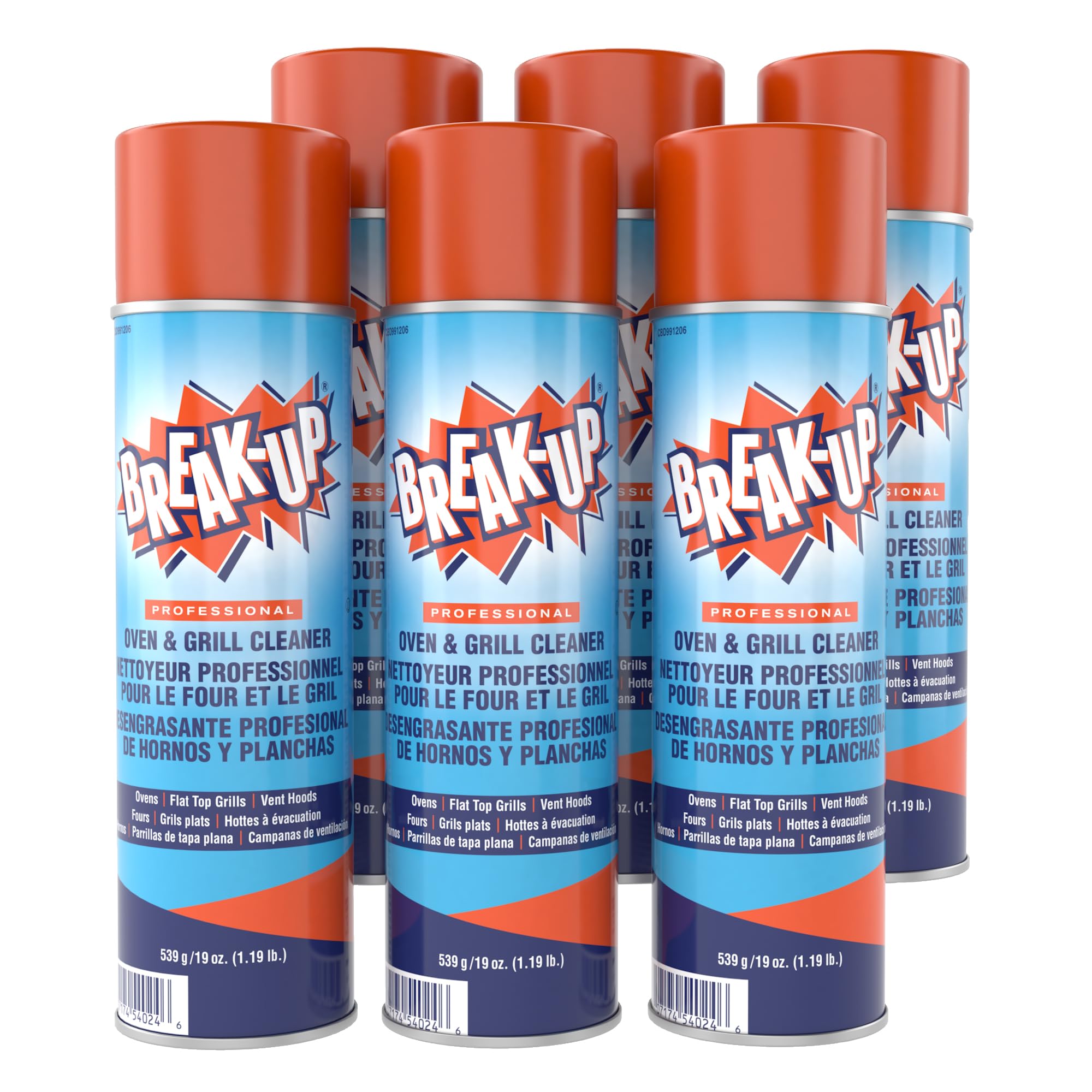
Diversey Break-Up Oven & Grill Cleaner

91 /100
Kirk Score Outstanding
Type
Clinging foam
Format
19 oz aerosol, 6-pack
Works On
Grill grates, vent hoods, fryers, flat tops
Certifications
NSF listed, Kosher certified
Check Details on Amazon

Pros

  • Clinging foam stays on vertical surfaces
  • Works on cold metal with no preheat
  • NSF listed and Kosher certified
  • Grease wipes off with little scrubbing

Cons

  • Stiff cap takes real effort to open
  • Strong fumes on a still day

The grates are the easy part. Lids, vent hoods, the burner box, and the shelf where grease lands are what make grill cleaning miserable, because nothing you spray stays where you put it. Break-Up is the pick for that real estate: a clinging foam that holds on vertical surfaces and works on cold metal, so the inside of a lid cleans up without chasing drips with a rag.

On the grates themselves, the foam rewards patience. We sprayed, left it, and came back to grease that wiped away instead of fighting back — the low-scrub side of this cleaner is what earns it a place in the lineup. It's NSF listed and Kosher certified as well, credentials commercial kitchens need and a sensible reassurance for anyone cleaning the surface they cook on.

Vertical surfaces are also where the foam can skin over before you get to it, leaving a film that a second wipe takes care of. A six-pack is more than most households go through in a year, so plan on storing it. Both are the price of a foam that stays where you put it.

Where it lands: if your grill has a hood, a side burner, and a vent, this handles the awkward real estate better than anything else here. For grates alone, the Zep oven and grill cleaner does the same work with less fiddling; the clinging foam is what you come here for.

Bottom line: Buy it for the hood, the lid, and the burner box, where a foam that stays put saves the most time and swearing.

Check Latest Price
#03

Best Concentrate

Zep Heavy-Duty Citrus Degreaser Concentrate

91 /100
Kirk Score Outstanding
Scent
Citrus
Format
1 gallon concentrate
Keep Off
Glass, acrylic, plastics, auto paint, leather, stone
Works On
Grills, stovetops, stainless steel, concrete
Check Details on Amazon

Pros

  • Gallon concentrate refills your own spray bottle
  • Labeled for grills, stovetops, and stainless
  • Citrus scent instead of a chemical one

Cons

  • Keep off glass, acrylic, plastics, and auto paint

A gallon of concentrate is the least glamorous way to buy a degreaser and, for most households, the smartest. Zep's citrus formula dilutes into a spray bottle for weekly grates, goes full strength on a grill that's been ignored since the last holiday, and it's one of the few here whose label names grills and stovetops outright.

The citrus solvent does the work, and it smells like oranges rather than a chemistry lab, which matters when your head is inside a hot grill lid. Thick buildup needs time — the label itself advises extra dwell around cooking spaces — and we found a few minutes of patience beat a second application every time.

Beyond the grates, the same jug handles the stainless shelf, the concrete pad, and the tools you scraped with. A gallon refills a 32-ounce spray bottle several times over, so shelf space is the main commitment.

Bottom line: The gallon we keep on the shelf for grates, stovetops, and the patio — as long as you keep it off glass and plastic.

Check Latest Price
#04

Best Heavy-Duty Kit

Simple Green Pro HD Cleaner & Degreaser

92 /100
Kirk Score Outstanding
Scent
Unscented
Format
32 oz spray + 1 gallon refill
Dilution
Full strength or diluted
Works On
Grills, ovens, floors, metal
Check Details on Amazon

Pros

  • Full-strength spray plus a gallon refill
  • Non-corrosive and safe on metal
  • Dilutes down for lighter jobs

Cons

Two bottles arrive: one ready to spray at full strength, one gallon to refill it. That's a sensible way to sell a heavy-duty degreaser, because the spray bottle is what you reach for on a greasy grate and the refill is what keeps you from buying another one next month.

Pro HD is the aggressive Simple Green, not the green bottle that lived under the kitchen sink. It's non-corrosive and safe on metal, and it goes after baked-on grease around burners and grill parts rather than just wiping down a countertop. Full strength for carbon, diluted for the hood, the floor, and the tools.

The label carries a California Prop 65 warning, and that's the thing to weigh before you buy. If it's a dealbreaker, the original Simple Green gallon is the gentler route and still a capable degreaser. If it isn't, this is the most useful version of the formula: one product for the grill, the kitchen, and the garage floor, with a spray bottle already in the box.

Bottom line: A heavy-duty two-bottle kit for anyone who wants one cleaner for the grill, the kitchen, and the garage — Prop 65 label and all.

Check Latest Price
#05

Best Fume-Free Spray

Krud Kutter Original Cleaner Degreaser

89 /100
Kirk Score Excellent
Scent
Unscented
Format
32 oz ready-to-use spray
Works On
Appliances, floors, tools, concrete, siding
Certification
EPA Safer Choice
Check Details on Amazon

Pros

  • Low odor, no harsh fumes
  • Water-based, leaves no residue
  • EPA Safer Choice certified

Cons

  • Slower on baked-on, carbonized grease

Grill cleaning happens outdoors, next to food, usually with people standing around. That's the case for a cleaner you can use without holding your breath: Krud Kutter is water-based, essentially odorless, and leaves nothing behind that needs a second rinse.

It cuts fresh grease quickly, which is what most grill messes actually are. Spray it on warm grates, give it a minute, and wipe — the water-based formula lifts oil without the slick residue a solvent leaves behind. It's EPA Safer Choice certified too, so it's the bottle we're comfortable using on the picnic table as well as the grill.

It's also the most flexible spray here. Diluted, it handles the inside of a smoker; full strength, it takes grease off the range hood and the tools you scraped with. A bottle lasts longer than you might expect, and it leaves no film on stainless or painted cabinets.

So the role is maintenance, not rescue: keep it by the grill, use it after most cooks, and carbon never gets the chance to build into a job that needs a respirator and an afternoon. That's a better habit than a stronger can, and it's why this one stays in the rotation.

Bottom line: Keep it by the grill for after-cook wipe-downs — it cuts fresh grease with almost no smell, and that's most of the work.

Check Latest Price
#06

Best Dilution Value

Stanley Home Products Original Degreaser

92 /100
Kirk Score Outstanding
Yield
Up to 32 gallons of solution
Format
32 oz concentrate
Works On
Grills, cookware, broilers, laundry
Check Details on Amazon

Pros

  • Up to 32 gallons from one 32-ounce bottle
  • Works in hard and soft water
  • Low odor, versatile around the house

Cons

  • Needs measuring and mixing for every job

The bottle claims up to 32 gallons of cleaning solution, which puts Stanley's Original Degreaser in a different class from the ready-to-use sprays. It's a concentrate in the old-fashioned sense: mix a batch in a bucket or a spray bottle, then put it to work. The label names grills, cookware, broilers, and laundry alongside the usual countertops and floors.

What we appreciated is the range. It works in hard water and soft, doesn't leave a strong smell behind, and a bucket of it handles the grates, the tools, and the range hood in one pass. Of the concentrates here, this is the one that feels least like a specialty product.

Stanley is a grease cutter rather than a carbon dissolver, so a blackened grate still wants a long soak and a brush. Where it shines is the rest of the outdoor kitchen — tools, hood, side table, the concrete — and the laundry, where a scoop lifts grease stains that detergent alone leaves behind.

Bottom line: Buy it if you want one concentrate for grills, range hoods, and greasy laundry, and you don't mind mixing a batch.

Check Latest Price
#07

Around the grill

Spray Nine Heavy-Duty Cleaner & Degreaser

95 /100
Kirk Score Outstanding
Type
Cleaner, degreaser, disinfectant
Format
32 oz spray
Works On
Stainless steel, vinyl, plastic, rubber
Sanitizes In
10 seconds
Check Details on Amazon

Pros

  • Cleaner, degreaser, and disinfectant in one
  • Fine on stainless, vinyl, rubber, and plastic
  • A little goes a long way

Cons

  • Sharp scent, especially in still air

Spray Nine isn't a grill cleaner, and that's exactly why it earns a spot. It's the bottle that handles everything around the grill — the stainless shelf, the tools, the patio table, the lid — and disinfects while it's at it, which is more than most degreasers here can claim.

The formula is a genuine heavy-duty cleaner: it cuts engine grime and workshop grease, and it's fine on stainless, vinyl, rubber, and plastic, so there's little around a grill it can't touch. It also sanitizes in 10 seconds, which makes it the one here that doubles as a wipe-down for the prep table.

What it won't do is the job this article is about: on carbonized grates it does very little, and a proper grill aerosol is the tool for that. Where it earns its keep is the ten minutes after — tools wiped, shelf clean, table disinfected, one bottle back on the shelf.

Bottom line: The bottle for everything around the grill — tools, shelves, tables, and the patio — rather than the grates themselves.

Check Latest Price
#08

Gentle all-surface cleaning

Simple Green Industrial Cleaner & Degreaser

95 /100
Kirk Score Outstanding
Format
1 gallon concentrate
Dilution
Custom dilution for each task
Works On
Counters, floors, equipment, vehicles
Certification
EPA Safer Choice
Check Details on Amazon

Pros

  • EPA Safer Choice and phosphate free
  • Dilutes for light jobs or full strength for grease
  • Low odor and non-abrasive on surfaces

Cons

  • Mild formula needs a long soak on carbon

Gentle is usually a criticism in a degreaser. Here it's the reason to buy: the gallon of industrial Simple Green is the bottle for surfaces you don't want to risk — the vinyl siding behind the grill, the deck, the patio furniture — and it's the one you can spray without reading the label twice.

The dilution is the point. Mixed per the label it handles counters, floors, and siding; stronger, it takes on grill exteriors and range hoods; and it works in a pressure washer or a bucket equally well. It's EPA Safer Choice recognized and phosphate free, which is why it's the one we don't think twice about using on the siding and the patio.

It is the gallon that handles the whole outdoor kitchen — grill body, deck, tools, siding — and the first bottle we reach for when we don't want to think about what a cleaner might do to a surface. Keeping two on the shelf isn't hoarding; it's how the spray bottle gets refilled without another shopping trip.

Bottom line: The gallon for everything around the grill, and for grates that can soak — gentle enough to use anywhere, patient enough to work.

Check Latest Price

How We Tested the Best Grill Degreasers

We started with the degreasers that keep turning up in restaurant supply aisles, hardware store shelves, and grill forum threads, then cut anything we couldn't confirm was safe for food-contact surfaces. That left 15 formulas, deliberately mixing aerosols with trigger sprays and dilutable concentrates with ready-to-use bottles. Testing ran for three months, from the first warm-weather cookouts through the end of summer, on a gas grill, a charcoal kettle, and a flat-top griddle — plus the oven racks and hood filters that collect the same grease indoors.

Every Saturday we cooked the messy stuff: burgers, skin-on chicken thighs, oiled vegetables. Every Sunday morning we cleaned cold grates, timing a five-minute dwell and then a ten-minute one, and noting how much grease lifted with a single wipe versus a scrub. We sprayed hood filters and the undersides of lids to watch whether a formula foamed and clung to the metal or ran straight down it.

Scent was judged out on the patio rather than in a closed garage, and again an hour later to see what lingered on the grates. For residue, we wiped a dry white paper towel across a cooled, rinsed grate and looked for chalky film or a slick feel that would end up in the next meal. We also tracked the unglamorous details: whether the cap came off with greasy hands, whether a sprayer survived a month of use, and how many ounces each cleaning consumed, since a concentrate that needs a quarter cup per job is no bargain. Everything was measured against the purple jug professional kitchens treat as the default.

How to Choose a Grill Degreaser

Fresh Grease and Baked-On Carbon Are Two Different Jobs

Most grill mess is fat that's still soft, and it lifts with a surfactant spray and a minute of dwell. The black, hard layer on a neglected grate is carbonized: it needs a strong alkaline aerosol, or a long soak, before anything will wipe off.

Buy for both. A ready-to-use spray such as Krud Kutter covers the weekly wipe-down; an aerosol like the Zep oven and grill cleaner handles the seasonal deep clean. A single mild product aimed at carbon is how one cleaning job turns into three.

Read the Do-Not-Use List Before You Spray

Grill degreasers are strong enough to damage the wrong material, and the wrong material is often bolted to the same grill as the grates. Aluminum, copper, chrome, and painted surfaces are commonly excluded from heavy aerosols, which takes in plenty of grill bodies, side shelves, and hoods.

Check the manual before you spray wide, or hold a magnet to the part: steel and cast iron grab it, aluminum doesn't. The grates can be perfectly safe while the lid is not.

Foam, Spray, or Concentrate

Clinging foams hold position on vertical surfaces and cold metal, which is why a hood or the inside of a lid cleans up faster with one. Ready-to-use sprays are the grab-and-go choice for grates, tools, and the ten-minute tidy. Concentrates cost least per clean and let you dial the strength, but you measure every batch and supply the bottle.

Our mix: one aerosol for the hard jobs, one concentrate for volume, and a spray bottle you don't mind refilling.

How Much to Buy

Aerosol grill cleaners often arrive by the case — 12 cans to a box on the Zep, six on the Diversey — and that is more than most households go through in a season. Split a case with a neighbor, or buy one can and put the rest of the budget into a concentrate.

Concentrates take far less shelf space per cleaning and let you mix only what a single job needs, which matters if your storage is a crowded garage shelf.

Frequently Asked Questions

Final Verdict

Start with the Zep oven and grill cleaner if the grates have gone black. It's the strongest carbon remover in this group, it's labeled for the parts of a grill that actually get dirty, and one case covers several seasons of deep cleans — provided your grill isn't aluminum or painted.

For everything around it, buy a concentrate. The Zep citrus gallon handles grates, shelves, tools, and the patio slab, and the Diversey foam is the one for hoods and lids when a spray won't stay where you put it.