// data-verified

Best Drywall Screw Guns of 2026

I've hung drywall with a regular drill, and I don't recommend it. Set the clutch too light and half the screw heads sit proud of the surface; set it too heavy and you punch through the paper face and spend the afternoon patching. A drywall screw gun solves that one problem completely: it stops at the depth you dialed in, screw after screw, so you can move fast without inspecting every head.

Speed gets all the attention — RPM is the number printed biggest on the box — but the nose cone matters more than the motor. We drove screws with 10 guns over eight months, and the models that kept pace were the ones whose depth setting didn't drift. Cordless is a real convenience for a patch job, but a corded tool that never runs flat still earns its place on a full room.

Half of these are sold as bare tools, so budget for a battery and charger if you're not already on that platform. The picks below are the ones I'd hand to a friend finishing a basement.

#01

Best Overall

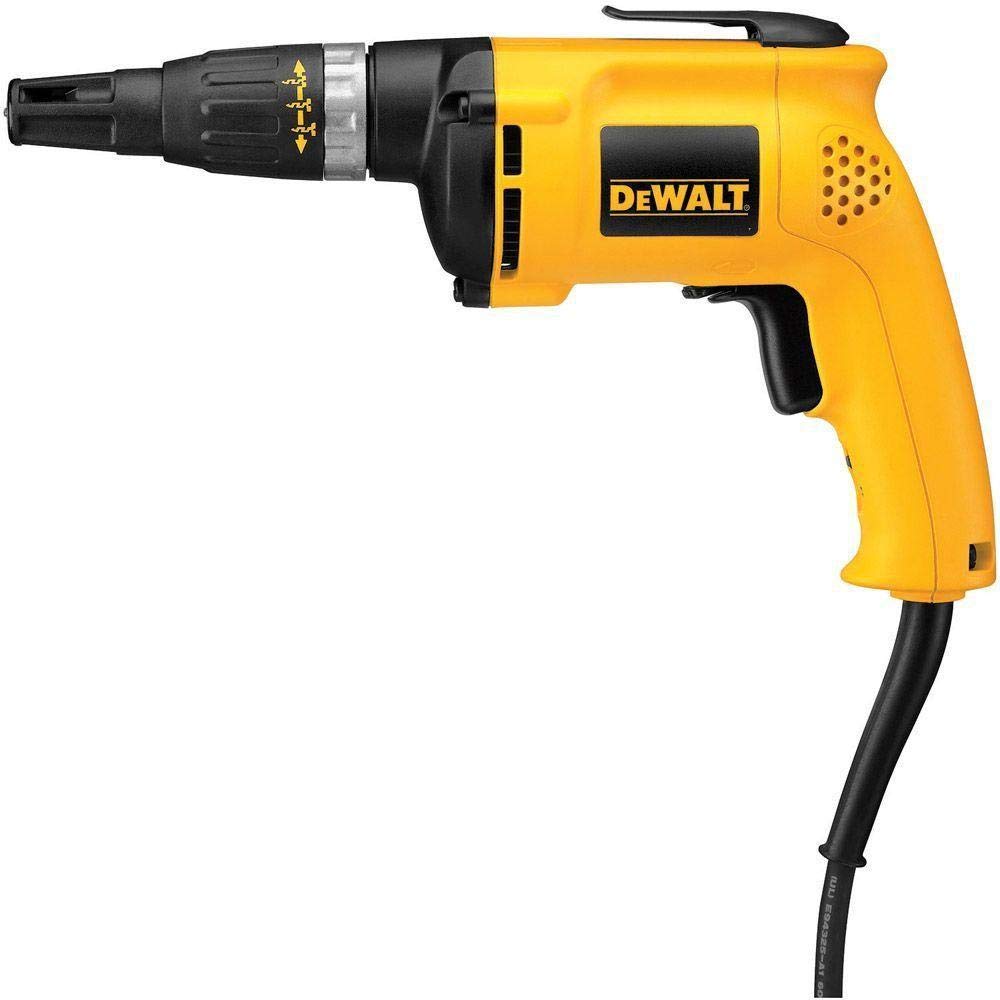
DEWALT DCF620B

94 /100
Kirk Score Outstanding
Speed
4,400 rpm
Weight
2.25 lb
Power Source
20V MAX battery (bare tool)
Depth Control
Locking nosecone
Check Details on Amazon

Pros

  • 4,400 rpm matches corded hanging speed
  • Locking nosecone holds screw depth
  • Just over two pounds for long runs
  • Nose LED for dim closets

Cons

  • Forward/reverse lever is easy to bump

Four thousand four hundred rpm is the whole argument. That's corded drywall-gun speed coming out of a 20-volt battery, and it's why we recommend this DEWALT to anyone already invested in the 20V MAX line: it keeps up with a corded tool without a cord dragging across the drop cloth. The tool itself is a shade over two pounds, so your wrist lasts longer than your patience does, and the brushless motor holds that speed through a room instead of sagging after the first dozen screws.

Depth is where it earns its keep. The locking nosecone sets how far each screw sinks, so once you dial it in on a scrap of board, every screw after that stops at the same point and the paper face stays intact — the difference between a wall you can tape and a wall full of blown-out craters. The nosecone comes off easily for cleaning or for a change of screw length, which matters more than it sounds when you're switching between 1¼-inch and 1⅝-inch screws. There's an LED at the nose, too, and we appreciate it in closets and basements where the work light never quite reaches.

What we keep coming back to is how little there is to think about. Pick it up, drive the screw, the nosecone stops it — no clutch to dial, no mode to remember, and after a hundred screws that simplicity is the feature. It's the easiest of these to hand to someone who has never hung a full room.

Bottom line: We recommend it to anyone already on the 20V MAX platform: corded-class speed without the cord and a nosecone that holds the depth you set.

Check Latest Price
#02

Best Auto-Start Cordless

Milwaukee 2866-20

91 /100
Kirk Score Outstanding
Speed
4,500 rpm
Weight
2.5 lb
Runtime
64 sheets per XC5.0 charge
Power Source
M18 battery (bare tool)
Check Details on Amazon

Pros

  • Motor runs only when the bit meets a screw
  • 4,500 rpm and 124 in-lb of torque
  • 2.5 pounds, balanced for overhead work
  • Up to 64 sheets per XC5.0 charge

Cons

  • Bare tool

Hanging a ceiling teaches you what a screw gun is worth, because one hand is holding the sheet and the other is doing everything else. Milwaukee's answer is a trigger you lock on and then forget: the motor stays quiet until the bit touches the screw, fires on contact, and stops again between fasteners. Less noise, less battery drawn, and one less thing to manage above your head.

We rate that auto start as the most useful single feature on any gun here. The 4,500 rpm is second only to the Ryobi in this group, the 124 in-lb of torque shoulders through heavy-gauge studs without bogging, and at 2.5 pounds it's light enough that a full ceiling doesn't turn into a shoulder workout. Fast, quiet and balanced is the combination that separates a production gun from a converted drill.

It asks for a straight, firm push in return. Until you've driven a few dozen screws, a light touch can feel like the tool isn't responding, which is the auto start doing its job rather than a fault. Battery choice matters more than most people expect, too: Milwaukee rates the compact CP2.0 at 27 sheets per charge and the XC5.0 at 64, so if there's a whole house in front of you, pack the bigger one and save the small pack for punch lists.

Bottom line: For all-day hanging with a board in one hand and a ceiling overhead, this is the gun we reach for.

Check Latest Price
#03

Best for Framing and Subfloor

Makita XSF03Z

90 /100
Kirk Score Outstanding
Speed
4,000 rpm
Weight
3 lb
Drive Mode
Push Drive lock-on
Power Source
18V LXT battery (bare tool)
Check Details on Amazon

Pros

  • One gun for board, subfloor and decking
  • Push Drive cuts noise and battery drain
  • Three pounds with a brushless motor
  • Runs on the 18V LXT platform

Cons

  • Depth adjustment takes fiddling to dial in

Makita lists this gun for framing, subflooring and decking as well as drywall, and that versatility is why it makes our list. A remodeler driving 3-inch screws into plywood in the morning and 1¼-inch board screws in the afternoon doesn't want two tools in the truck; 0–4,000 rpm with a brushless motor covers both, and it does it without the bulk of the bigger guns here.

Push Drive is the part we like most. Lock the trigger on and the motor only spins when a fastener is engaged, so the gun runs quiet between screws and the battery isn't draining while you reposition a sheet. Makita rates the electronically controlled motor for up to 50 percent longer runtime per charge, and once the depth is set, screws go in and stop without you lifting off the trigger.

It isn't the most forgiving gun at the tip. Drive at an angle and the bit can skate off the screw head and through the paper, so start every screw square and let the depth setting do the work. Set up that way, it drives as cleanly as anything here, on LXT batteries you may already own.

Bottom line: Our pick for remodelers already on LXT — one tool that hangs board and drives subfloor screws all week.

Check Latest Price
#04

Best Corded Value

DEWALT DW255

86 /100
Kirk Score Excellent
Speed
5,300 rpm
Weight
4.2 lb
Power Source
Corded, 6.0 amp
Depth Control
Depth-sensitive nosepiece
Check Details on Amazon

Pros

  • 5,300 rpm
  • Set-and-forget nosepiece holds depth
  • Two-finger trigger eases long runs
  • Lowest-priced corded gun in this group

Cons

  • Heaviest gun here at 4.2 pounds

Where your work happens decides more about this tool than any of its specifications. A basement, a garage, a renovation with the power already on — that's the DW255's territory, and in it the gun is hard to beat: 5,300 rpm from a 6-amp motor is the highest spindle speed on this page, so screws sink faster than with anything else here.

The set-and-forget nosepiece is what makes it usable rather than merely fast. Set the depth once and each screw countersinks to the same point, dimpled into the board without tearing the paper, so you stop checking every third screw. The two-finger trigger spreads the pull across two fingers, which sounds like a small thing until the four hundredth screw of the day.

As a value proposition, we think it's the strongest corded package here: the fastest spindle speed in the group, dependable depth control, and the lower price of the two corded guns. What it isn't is a punch-list tool. The moment your work moves from room to room and the outlet is never where you are, the cord becomes the whole story.

Bottom line: We think it's the best-value corded gun here for anyone whose work happens near an outlet.

Check Latest Price
#05

Best for Overhead Work

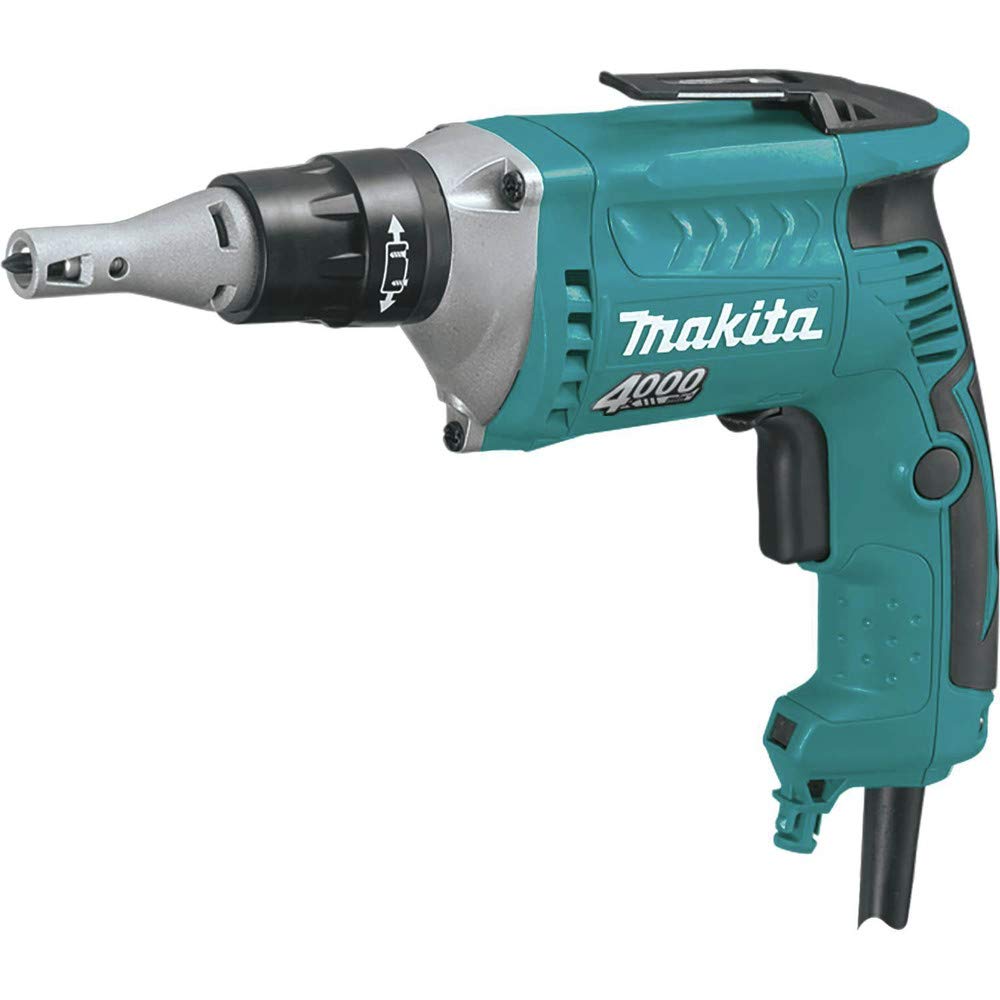
Makita FS4200

91 /100
Kirk Score Outstanding
Speed
4,000 rpm
Weight
3 lb
Lighting
Built-in LED
Power Source
Corded, 6.0 amp
Check Details on Amazon

Pros

  • Three pounds
  • LED and vents aimed at tight, dim spaces
  • Steel-reinforced belt clip

Cons

  • One-year warranty on the tool

Three pounds is what sells this one. Makita's corded gun weighs more than a pound less than the DEWALT DW255, and on a ceiling — arms up, head back, a sheet above you — that pound is the difference between finishing the room and calling it a night.

The details aim at the same problem, and we appreciate all of them: an LED on the nose so you can see a seam in a closet with the power off, vents that push the motor's exhaust away from your face instead of into it, and a steel-reinforced belt clip that survives being hung off a ladder hook. None of it is glamorous, and all of it is the difference between a tool you tolerate and one you keep picking up.

Four thousand rpm is where it gives ground. The DEWALT spins 1,300 rpm faster, and on a whole house with a deadline that shows up in the pace of the work. For a room or two, or for anything above shoulder height, we take the lighter gun and don't think twice about it.

Bottom line: It's the corded gun we choose for ceilings: three pounds, an LED on the nose, and a motor that won't tire your arms before the board runs out.

Check Latest Price
#06

Weekend projects

RYOBI P225

86 /100
Kirk Score Excellent
Motor
Brushless
Speed
4,700 rpm
Weight
2.7 lb
Power Source
18V ONE+ battery (bare tool)
Check Details on Amazon

Pros

  • 4,700 rpm, highest of the cordless guns
  • Brushless motor at a budget price
  • 2.7 pounds and easy to handle
  • Runs on 18V ONE+ batteries

Cons

  • Bare tool

Four thousand seven hundred rpm is the highest spindle speed of any cordless gun on this page, and it comes from the least expensive tool here. That isn't the spec sheet we expected from a budget gun. The P225 is brushless, weighs 2.7 pounds, and runs on the ONE+ batteries that probably already power something in your garage.

It behaves the way a drywall gun should. The motor stays quiet until you push the nose into a screw, so it isn't spinning while you reposition a sheet, and the trigger gives you enough control to sink a screw without burying it. On weekend work — a basement partition, a patch around a new doorway — we think it holds its own against the pricier guns here.

The one habit worth building is keeping the gun square to the screw with steady pressure on the nose. The bit can skate off a screw head, especially overhead where you're working at an angle, and a slipped bit goes straight through the paper. Square and firm, and it settles into a rhythm. For a homeowner hanging two rooms over a winter, that's plenty of gun — and ONE+ runs everything from a drill to a lawn mower, so the packs you buy won't sit idle.

Bottom line: We point budget buyers here first: the least expensive gun here still spins faster than anything else cordless on the page.

Check Latest Price

How We Tested the Best Drywall Screw Guns

We started by pulling every screw gun we could find from the major tool brands — corded and cordless, brushless and brushed, bare tool and kit — then narrowed the field by what actually changes the job: RPM, whether the nose cone adjusts without a tool, weight, and what comes in the box. That left 10 guns, which we bought and put to work.

For eight months those guns lived through a basement finish, a garage ceiling replacement, and a steady stream of patch jobs. We drove screws overhead on ladders, one-handed while holding a sheet with the other, and in long runs along studs where a wandering bit shows up immediately. We noted whether the bit walked off a screw head, whether the heads landed in a straight, evenly dimpled line, and how often we had to reset the nose cone after it drifted mid-run.

We also watched the parts you actually touch: how the variable-speed trigger felt after a few hundred screws, whether the lock-on button was easy to find with gloves on, and whether the bit held a screw by itself while we reached overhead. Durability came from ordinary abuse — off the ladder, into a truck bed, back at it. On the cordless guns we counted screws per charge and logged which ones quit mid-run, and we compared what each box included, since a bare tool isn't much use until you've bought into a battery platform.

How to Choose a Drywall Screw Gun

Corded or Cordless Comes First

Corded guns deliver full power all day for the least money, which is why a production hanger with the power on still reaches for one. Cordless is about never hunting for an outlet, and the better ones save battery by only spinning when the bit meets a screw.

The trap is the box. A bare tool plus two packs and a charger can cost more than the kit version of the same gun, so price both before you commit — and only buy a bare tool on a platform you already own.

Match the Speed to the Material

Board wants speed: 4,000 rpm and up sinks a screw before the paper knows what happened, and every cordless gun here sits in that range. Heavy-gauge steel framing, decking and metal roofing want the opposite — a slower gun with an adjustable clutch, around 2,000 to 2,500 rpm, that slips at a set torque instead of snapping the fastener.

A drywall gun has no clutch to slip, so it will shear a deck screw; a clutch gun will hang board, just slowly. Decide which material fills most of your week before you decide on a brand.

Depth Control Is the Whole Job

Two mechanisms do the same work differently. A nosecone sets depth by contact: the bit stops advancing when the cone meets the board, so every screw dimples to the same point and the paper stays intact. An adjustable clutch sets depth by torque, which suits fasteners that vary in length and material.

For hanging board, the nosecone is what you want — and re-check the setting whenever screw length or board thickness changes. The setting that dimples a 1¼-inch screw will over-drive a 1⅝-inch one.

Weight, Balance and Runtime

A drywall gun gets held above your head for hours, so weight matters more here than on almost any other power tool. Three pounds is comfortable; past four, you feel it by mid-afternoon. Cordless balance shifts with the pack you fit, and runtime shifts even more — a compact pack can deliver well under half the sheets of a full-size one on the same gun.

If a whole house is in front of you, buy the bigger packs before you buy a second gun.

Frequently Asked Questions

Final Verdict

The DEWALT DCF620B is the gun we recommend to most people, because it takes the two things that decide a drywall job — speed and repeatable depth — and puts them on a battery you may already own.

If your packs are red or teal, buy into your own platform instead: the Milwaukee 2866-20 for the quietest, fastest overhead work, or the Makita XSF03Z if the same gun has to drive subfloor screws too. And if every job you take has an outlet within reach, the corded DW255 spends less and drives faster.