// data-verified

Best Electrical Tape of 2026

Nothing derails a five-minute repair like tape that won't stay put. The bargain roll goes on fine, then curls up two days later, slides off a warm wire, and leaves a gummy ring that takes rubbing alcohol and far more patience than the fix was worth. Electrical tape has one job: stick, stretch around a corner without splitting, and come off clean when you have to redo the splice years later.

I've rewired enough lamps and untangled enough extension cord nests in my own garage to have opinions about which rolls do that. Over four months, my team and I worked through 16 rolls, from plain black to multi-color packs, high-temp and waterproof formulations, and the differences were more real than I expected. Thickness matters more than the label admits, both in cold weather and in how much bulk you end up with under a wire nut. So does length: a 26-foot roll disappears fast, while the 66-foot ones kept going. And a color pack earns its keep the moment you need to trace which cord runs to which outlet.

Price barely separates the good rolls from the bad ones here, which is the one mercy of this aisle. Every pick below earned its place the same way: it was still exactly where I put it a month later.

#01

Best Overall

Scotch 700 Vinyl Electrical Tape

95 /100
Kirk Score Outstanding
Pack
5 rolls
Roll Size
3/4 in x 66 ft
Thickness
7 mil
Temperature Rating
Up to 194°F
Check Details on Amazon

Pros

  • Commercial-grade 7-mil vinyl that stretches and conforms
  • 66-foot rolls mean fewer mid-job changes
  • Rated to 194°F for warm attics and panels

Cons

  • Leaves black residue when removed after long service

Five rolls of 3/4-inch by 66-foot tape adds up to 330 feet, which is more wrapping than most people picture when they order tape. That's the first thing we appreciate about Scotch 700: it's the standard roll size, in a pack big enough that you stop rationing it.

It earns the top spot on balance. This is 7-mil commercial-grade vinyl rated to 194°F, and it stretches as you pull so each layer fuses to the one under it instead of sitting on top. We wrapped bundles of shop cords, built up a splice, and worked into the tight corner of a box; the tape held tension without tearing and stayed put at the tail.

Adhesion is where a vinyl tape gets judged, and this one wants a clean, dry surface. On a dusty cord jacket it will curl at the end, so we wipe with rubbing alcohol, let it flash off, and the same wrap holds. The listing is also upfront that it isn't water resistant, which is why ours lives indoors and away from anything that sees rain.

That's the boundary worth knowing. For a garage shelf, a panel, or a cord you're patching inside, this is the roll we hand people who ask. Where the splice lives outdoors or gets cold enough to stiffen cheap vinyl, the Super 33+ below is the better spend.

Bottom line: The roll we tell most households to buy: long 66-foot rolls, commercial-grade 7-mil vinyl, and a grip that holds tension without a premium price.

Check Latest Price
#02

Best for Tough Jobs

Scotch Super 33+ Vinyl Electrical Tape

96 /100
Kirk Score Outstanding
Pack
10 rolls
Roll Size
0.75 in x 66 ft
Voltage Rating
600V
Temperature Rating
0°F to 221°F
Check Details on Amazon

Pros

  • Rated 0°F to 221°F, the widest range here
  • 600V splice insulation rating
  • Rubber-resin adhesive holds under wrap tension
  • Stays pliable in cold instead of stiffening

Cons

  • Sold only as a 10-roll pack
  • Premium price per roll

The number that sets this tape apart is 221 — the top of its Fahrenheit range, paired with a 0°F floor and a 600V splice rating. Nothing else here covers that spread, and it's why we reach for Super 33+ when a splice lives in an unheated garage, under a hood, or anywhere the weather gets a vote.

The premium buys adhesive. A rubber-resin layer on a PVC backing grabs quickly and holds; in our hands it stuck to itself as readily as to the wire, which is what makes a wrap stay wrapped. The quality we noticed most is pliability, because it stays soft instead of drying into a shell and keeps tension where a stiffer tape lifts at the tail.

Cold is the real test. Vinyl that stiffens won't conform to a splice, and tape that won't conform won't hold. Warm or cold, this one wraps the same way, which is why it carries the reputation it does among people who do this for a living.

The catch is the package: ten rolls, with nothing smaller from this listing. That's a sensible buy for a shop, a boat, a trailer, or a house whose wiring keeps needing attention, and it's overkill for one lamp cord. Keep it for the jobs you cover and forget about.

Bottom line: Buy it when the splice lives outdoors or in the cold: it has the widest temperature range here and the most reliable grip, and it's worth the premium for work you won't redo.

Check Latest Price
#03

Best Contractor Pack

3M Temflex 175 Electrical Tape

94 /100
Kirk Score Outstanding
Pack
10 rolls
Roll Size
3/4 in x 60 ft
Thickness
7 mil
Voltage Rating
600V
Check Details on Amazon

Pros

  • Ten rolls cut the per-roll cost below single packs
  • 600V rating with CSA and IEC classifications listed
  • 15.4 lb/in tensile strength resists tearing
  • Firm 7-mil vinyl that conforms without stretching thin

Cons

  • Black only, so no circuit color coding
  • 60-foot rolls are shorter than the 66-foot standard

Ten rolls of 3/4-inch by 60-foot black vinyl is a purchase you make once and then stop thinking about. 3M aims Temflex 175 at the people who buy wire nuts by the box: contractors, maintenance techs, and anyone whose work gets looked at by an inspector.

The paperwork is the point. The listing spells out 600V primary insulation to 176°F, a CSA classification that reaches 1000V at lower temperatures, and an IEC thermal classification, which is the sort of rating a job spec asks for and most tape packaging never prints. Tensile strength is listed at 15.4 pounds per inch, and the tape has the firm, slightly stiff feel of a professional 7-mil vinyl.

Wrapping with it is uneventful in exactly the way you want. It stretches, conforms around a splice, and holds tension without tearing at the edge. The rolls are 60 feet rather than 66, which is the one place it gives ground to the Scotch 700, and the color is black only, so it's no use for marking circuits.

For a shop, a barn, or a house with old wiring, this is the pack we keep. What it does better than any other black tape here is take the guesswork out of the specification, because the voltage, temperature, and tensile figures are all printed and checkable. For a single repair, buy Duck's three-pack instead and save the shelf space.

Bottom line: The pack for a shop, a barn, or a building with old wiring, where printed 600V, CSA, and IEC ratings matter more than a single spare roll.

Check Latest Price
#04

Best Small Pack

Duck Brand Professional Electrical Tape

94 /100
Kirk Score Outstanding
Pack
3 rolls
Roll Size
0.75 in x 50 ft
Thickness
7 mil
Low Temperature Rating
14°F
Check Details on Amazon

Pros

  • UL- and CSA-listed in a small, affordable pack
  • Abrasion-resistant backing protects bundled cable
  • Rated down to 14°F for cold garages

Cons

  • 50-foot rolls run short on long harnesses

Three rolls is the size most of us actually need, and Duck's professional tape is the smallest pack here that still carries UL and CSA listings. If you're buying tape for a first repair or restocking a drawer you open twice a year, that combination is the reason to start here.

The specs are working numbers rather than marketing: 7-mil flame-retardant vinyl, a 0.75-inch by 50-foot roll, an abrasion-resistant backing, and a low-end rating of 14°F. It tears cleanly by hand, conforms around a splice, and holds its shape on a bundle of cables.

Two things to weigh. Fifty feet is 16 feet short of the standard roll, so a long harness eats a roll faster than you expect. And the adhesion is unremarkable on a dirty surface, so clean and dry or the tail lifts. Neither is a problem for a quick indoor repair, and both stop mattering the moment the roll is in your hand and the splice is a small one.

Bottom line: The right first purchase for a small repair: three UL- and CSA-listed rolls at a budget price, as long as you don't need to wrap a whole harness.

Check Latest Price
#05

Best for the Whole House

Amazon Basics Electrical Tape

94 /100
Kirk Score Outstanding
Pack
6 rolls
Material
Vinyl
Roll Size
3/4 in x 60 ft
Check Details on Amazon

Pros

  • Six rolls put a spare in every drawer
  • Tears cleanly by hand and conforms easily
  • Simple black vinyl at a low per-roll cost

Cons

  • Not water resistant, so indoor use only

Six rolls of 3/4-inch by 60-foot black vinyl in one box, at a per-roll cost that makes it easy to keep a spare in the kitchen drawer, the car, and the toolbox at the same time.

That's the honest case for it: this is the pack that puts tape where you need it. We used it for bundling cables, sealing a wire nut, and flagging the ends of a run, and it stretched, tore by hand, and stuck. The adhesive is the variable. It grabbed hard on clean plastic and metal and let go at the tail of a dusty cord jacket, so the clean-and-dry note on the roll isn't optional here.

The 60-foot rolls are shorter than the 66s on most picks here, which matters if you're bundling runs rather than patching cords, since a long job takes more of a roll. For the everyday work a household does with tape, that difference never came up for us.

Bottom line: Six plain black rolls at a low cost per roll, which is why we keep a pack on hand for drawers and cars rather than for critical splices.

Check Latest Price
#06

Best for Color Coding

Lichamp Colored Electrical Tape

92 /100
Kirk Score Outstanding
Colors
10 colors
Listing
UL/CSA listed
Roll Size
3/4 in x 66 ft
Thickness
7 mil
Check Details on Amazon

Pros

  • Ten colors for tracing and labeling circuits
  • UL and CSA listed at a standard 3/4-inch width
  • Colors hold up without fading

Cons

  • Sold only as a 10-roll set

Ten colors, ten rolls, 3/4-inch by 66-foot each, UL and CSA listed. This set solves the one problem black tape can't: telling one run from another.

Color coding is the practical use. Put red on the hot leg you keep tracing, white or gray on a neutral, and dark green on a ground path, and the next person in the panel doesn't have to guess. The colors are saturated enough to read across a dim basement, and each roll comes individually wrapped, so the ones you aren't using stay clean. Under the color it's the same 7-mil vinyl as the rest of this group, rated to 176°F and waterproof.

What we like is that the color doesn't cost you quality. Adhesion held on clean wire, the tape didn't slide when we pulled it through a tight bundle, and a wrap stayed put on a hot afternoon in an attic. Ten rolls is more than one repair needs, which makes it the set for someone chasing wiring through a whole house.

Bottom line: Buy the ten-color set if you've ever traced a circuit with a meter: UL-listed, standard 3/4-inch rolls, and the colors don't cost you any grip.

Check Latest Price
#07

Budget outdoor wrapping

Okxiri Electrical Tape 6-Pack

89 /100
Kirk Score Excellent
Pack
6 rolls
Roll Size
0.67 in x 66 ft
Thickness
7 mil
Water Resistance
Waterproof
Check Details on Amazon

Pros

  • Six 66-foot rolls at a budget price
  • Listed waterproof, flame retardant, and UV resistant
  • Stretches and wraps tightly around bundles

Cons

  • 0.67-inch width takes extra wraps

Six rolls at 66 feet each, near the bottom of this group's price range, which makes Okxiri's pack the inexpensive way to keep long rolls in more than one place.

The claims are bigger than the price: waterproof, flame retardant, oil and UV resistant, rated to 80°C. A budget brand can print anything, so we watched how it behaved instead. It stretched, wrapped tight around a bundle of cables, and held tension at the end of a wrap.

The width is the detail that decides it. At 0.67 inch the rolls are a hair narrower than the 3/4-inch standard, so a fat bundle takes an extra pass, and the tape feels thin and stretchy in the hand even at 7 mil. It also wants a genuinely clean surface, and on a dusty jacket it let go where our better tapes hung on.

Where that leaves us: as the roll in the truck, the shed, or the camping box, it's an easy yes, and the waterproof label makes it reasonable for an outdoor run you check each season. As the only tape in the house, spend a little more for the Scotch 700 and stop thinking about it.

Bottom line: A cheap way to keep 66-foot rolls in the truck and the shed, provided you're wrapping on clean, dry surfaces and checking the work each season.

Check Latest Price
#08

Labeling and small jobs

D-NYX Multi Colored Electrical Tape

90 /100
Kirk Score Outstanding
Pack
6 rolls
Colors
6 colors
Roll Size
0.6 in x 26 ft
Thickness
7 mil
Check Details on Amazon

Pros

  • Six bright colors for labeling runs
  • Small rolls that fit in a pocket
  • Stretchy vinyl that tears by hand

Cons

  • 0.6-inch by 26-foot rolls cover far less
  • Thin vinyl that can tear while unwinding

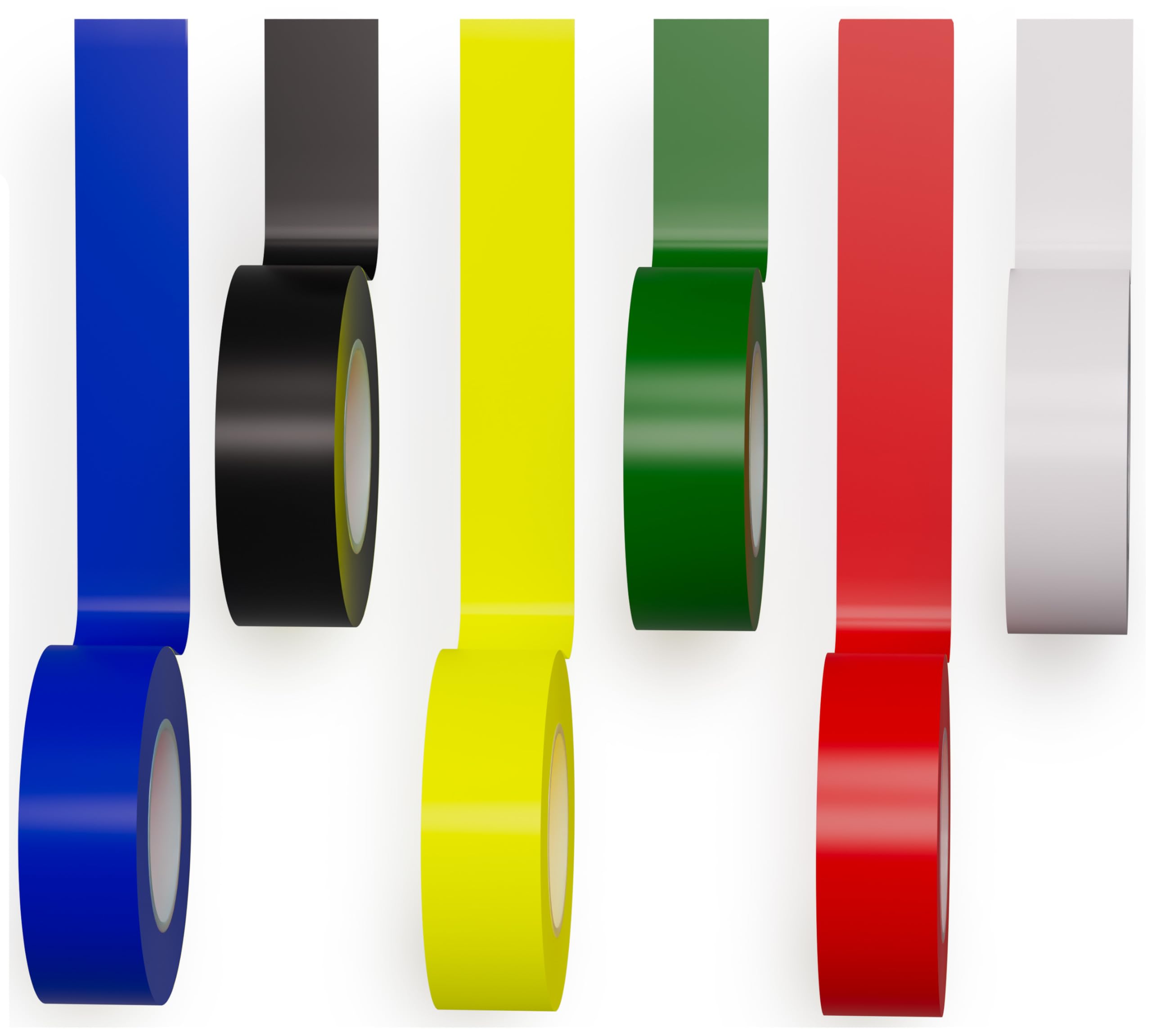
The rolls in the photo look like ordinary electrical tape. They aren't: each is 0.6 inch wide and 26 feet long, roughly a third of the tape on a 66-foot roll and noticeably narrower than the 3/4-inch standard. That one fact decides whether this set is right for you.

For labeling and small jobs it's plenty. Six colors, a stretchy vinyl that tears by hand, and a roll small enough to sit in a pocket while you work through a junction box. We used it to flag breaker positions and finish the ends of short jumper cables, and for that work the small format is a feature rather than a shortcut.

The trade-off is thin vinyl and modest adhesion: the tape goes translucent at the edge, and on a dirty surface it slides. Buy it as the set that happens to insulate, and it earns its shelf space beside a real roll. For anything you'll cover and never look at again, use one of the standard-width picks above.

Bottom line: Treat it as a labeling kit rather than a repair tape: six bright colors on small rolls that earn a place only next to a full-size roll of 3/4-inch tape.

Check Latest Price

How We Tested Electrical Tape: Four Months, Sixteen Rolls

The shortlist came from spec sheets before it came from the shelf. We compared vinyl formulation, thickness, temperature range, roll length, and whether a listing was clear about flame resistance and water resistance, and anything vague about those basics got dropped. That left 16 rolls, which we used for four months in the places tape actually lives: a garage workbench, a lamp I rewired, a breaker panel, and a cord tangle under a desk.

Adhesion got the most attention, because it's where tape fails. I wrapped each roll around a wire bundle, pressed it down, and left it a week, then peeled it back to see whether it lifted at the edges, held its stretch, or left a film behind on the insulation. On a cold morning I repeated the same wrap in an unheated garage to see which rolls stiffened up and refused to conform.

Thickness we judged by hand and by caliper: the 7-mil rolls felt noticeably different from the thinner ones and wrapped a tight corner without splitting. Two rolls spent a month outside on a hose repair and a cable run, through rain and sun, and we checked for curling and shrinkage after each heat cycle on the rolls we pressed near a lamp housing and an engine bay splice.

Color and versatility were simpler. We color-coded cords in a home office and flagged breaker runs in a panel, which showed quickly which colors stayed bright and which went chalky. We also tracked how far each roll actually went, since a long roll and a short one can look like the same buy. Value came down to behavior per foot, not sticker price.

How to Choose Electrical Tape

Check Width and Length Before You Compare Prices

Every listing photo looks like a roll of electrical tape, but the rolls run from 0.6 inch by 26 feet up to 3/4 inch by 66 feet. A 26-foot roll carries about a third of the tape of a 66-foot roll, so a pack that looks cheaper can cost more per foot, and a narrower roll takes more wraps to cover the same splice.

For general wiring work, buy 3/4 inch by 60 to 66 feet. Save the small, narrow rolls for labeling and craft projects, where their size is a convenience rather than a limitation.

Adhesion Is Mostly About Preparation

Vinyl tape doesn't glue itself to copper; it bonds to itself, which is why you stretch it as you wrap so each layer fuses to the one beneath. Dust, oil, and cold all defeat that bond, and no premium roll overcomes a greasy surface.

Wipe the jacket with rubbing alcohol and let it flash off, start the wrap on clean insulation rather than the bare conductor, and finish under tension. If a tail keeps lifting, the surface is usually the problem rather than the tape.

Match the Ratings to Where the Splice Lives

Most household vinyl tape tops out between 176°F and 194°F, and many listings give only that upper number. The cold end is where brands separate: Duck is rated to 14°F, while Super 33+ runs from 0°F to 221°F.

For a splice in an unheated garage, a truck harness, or work that gets inspected, choose the roll whose temperature rating and UL or CSA listing match the spot. For a junction box indoors, that paperwork buys you nothing you'll notice.

Decide How Much Tape and How Many Colors

Black is for insulating; colors are for identifying. If you've ever traced a circuit through a panel with a meter, a ten-color set pays for itself the first time you label both ends of a run. Lichamp's set does it at a standard 3/4-inch width, while D-NYX's smaller rolls suit labeling rather than insulation.

On quantity, a three-pack covers a first repair, a five- or six-pack covers a house, and a ten-roll contractor pack only makes sense if you use tape on a schedule. Buy for the next two years of jobs rather than the next two weeks.

Frequently Asked Questions

Final Verdict

Buy the Scotch 700 five-pack for the house. It covers nearly everything a homeowner does with tape, from bundling cords to insulating a splice to flagging a breaker, and it does it in rolls long enough to finish the job at a midrange price.

Step up to Super 33+ only when the splice lives outdoors, in the cold, or somewhere you won't look at it again, because that's the one case where the premium buys something you'll notice. If you trace circuits, add a color set and stop guessing.