// data-verified

Best Exterior Caulk of 2026

Exterior caulk usually announces itself after the fact: a soft spot by a window frame, a hairline crack that lets in a draft, a bead that pulls away from the siding after one cold snap. The right tube is less about the label and more about where it lands—a sun-blasted window frame, a damp sill, a joint between siding and foundation. What you're buying is a seal that can move with the house and still keep water out.

I've caulked enough bad beads to know that a tube that tools beautifully can still fail in a season. We put 14 exterior caulks—silicone, acrylic, polyurethane, and hybrid formulas—through eight months of weather on window frames, door jambs, siding seams, and a concrete sill. The useful differences showed up in adhesion, drying time, flexibility, and how cleanly each one wiped off a painted surface. The tubes that held up cured without shrinking and kept their grip after rain—those are the picks below.

#01

Best Overall

DAP Dynaflex Ultra

92 /100
Kirk Score Outstanding
Color
Light gray
Material
Advanced latex
Rain-ready Time
1 hour
Maximum Gap Fill
0.5 inches
Check Details on Amazon

Pros

  • Rain- and paint-ready in about an hour
  • Paintable, so trim finishes in one weekend
  • Hydrophobic surface sheds water and dirt
  • Bridges joints up to a half inch

Cons

  • Light gray reads closer to off-white

The hour between laying a bead and the first rain is what sells us on Dynaflex Ultra. DAP rates it paint- and rain-ready 60 minutes after tooling, which turns an exterior sealing job into an afternoon's work instead of a three-day weather watch. That single figure is why it's the tube we recommend first for siding, window casing and door frames.

The rest of the formula is built for the outside. It's a synthetic latex engineered to stay flexible through sun and freeze rather than curing to a brittle ribbon, and the cured surface is hydrophobic: water beads and runs off instead of soaking in, and dirt doesn't cling the way it does to a chalky acrylic. It takes paint too, so you can seal a casing and finish it the same weekend.

One behavior is worth planning around. The skin forms quickly, but a fat bead stays soft underneath well past the one-hour mark, so keep beads modest, tool them while they're fresh, and give the joint a dry day rather than a dry hour. The listed maximum gap fill is half an inch, which covers casing gaps and corner boards and not a great deal more.

For a painted exterior — clapboard, fascia, a door frame facing the weather — we haven't found a reason to reach past it. It isn't the cheapest tube here and isn't trying to be; it's the one that lets you seal, paint and walk away.

Bottom line: Our first choice for painted exterior trim: it takes paint, shrugs off rain within the hour and stays flexible through a freeze.

Check Latest Price
#02

Best Clear Silicone

GE Silicone Caulk Clear

94 /100
Kirk Score Outstanding
Material
100% silicone
Pack Size
2 cartridges
Cartridge Size
10 oz
Rain-ready Time
12 hours
Check Details on Amazon

Pros

  • Clear bead disappears on glass and metal
  • Rain-ready in as little as 12 hours
  • Bonds to glass, metal, tile and stone
  • Two cartridges per pack

Cons

  • Sharp vinegar odor while curing

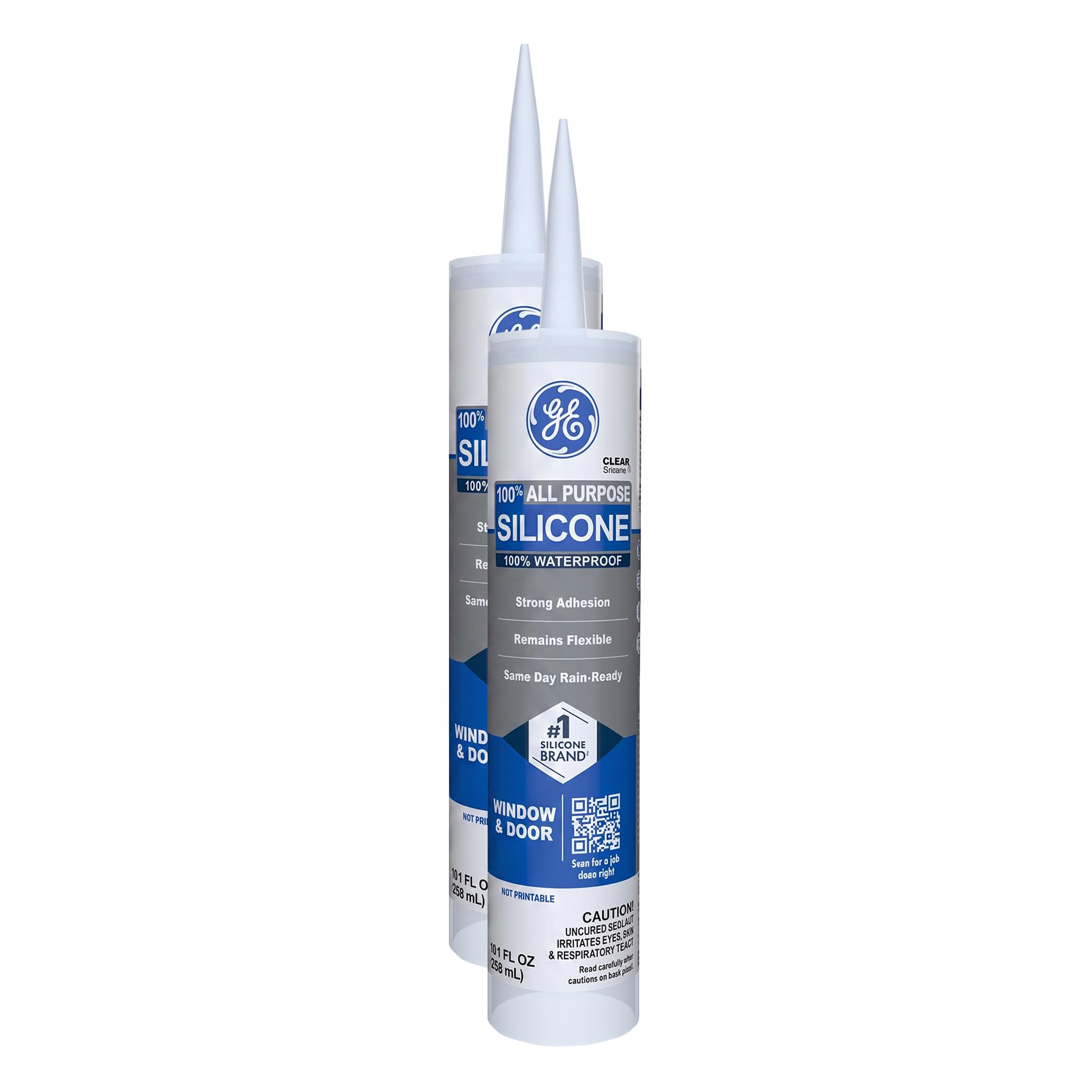
Some exterior joints shouldn't announce themselves: the aluminum frame around a storm window, a metal threshold, the seam where a downspout meets the wall. A clear bead handles those, and clear is what this GE tube does — two 10-ounce cartridges, so there's a spare on the shelf when the next five-minute repair turns up.

It's a plain 100% silicone, and that's exactly what we want for this job. The bead bonds to glass, metal, tile, stone and cement board, stays flexible, and is rated for rain exposure in as little as 12 hours — slower than the fast-cure silicones here, but easy to plan around. We reach for it on bare metal, glass and factory-finished frames, where a colored bead would be the only thing you noticed.

Handling takes a little care. It skins over quickly and stays tacky underneath, so tool it once, early, and then leave it alone; run a finger over it ten minutes later and you'll drag strings across the frame. It's also thick, so let the cartridge come to room temperature before you load it and squeeze steadily rather than hard.

Bottom line: For clear, unpainted joints on metal, glass and factory finishes, this is the silicone we reach for, and the second tube earns its keep.

Check Latest Price
#03

Best Fast-Cure Silicone

Gorilla 100% Silicone

91 /100
Kirk Score Outstanding
Material
Silicone
Joint Standard
ASTM C-920, Class 35
Maximum Gap Fill
0.5 inches
Water-ready Time
30 minutes
Check Details on Amazon

Pros

  • Water-ready in 30 minutes
  • Rated ASTM C-920, Class 35
  • Mold and mildew resistant
  • Resists shrinking and cracking

Cons

  • Cannot be painted once cured

Thirty minutes is the shortest water-ready window in this guide, and Gorilla means it: this silicone tolerates a shower, a gutter leak or an incoming storm half an hour after you tool the bead. If the forecast has already turned and you're sealing something today, that number is the reason to pick up this tube.

What's behind it holds up. It meets ASTM C-920 Class 35, a joint-movement rating rather than a marketing line, and it's mold- and mildew resistant, which makes sills, gutter seams and the shaded side of a porch fair game. Fast cure plus a real joint standard is why we rate it the best white silicone of the ones here.

Fussy is the honest word for the rest. The paste is thick, and pushing it out of a 10-ounce cartridge takes a decent gun and a steady arm; by hand it's miserable. A cold tube is worse, and the base can give way if you lean on the trigger. Let it warm up, load a good gun, and stop pushing the moment the bead stops flowing.

White is the other half of the decision. On painted trim, white doors and vinyl siding it disappears; on clear-finished wood or dark metal it's a stripe you'll be looking at for years. Match the color before you commit, because a cured silicone bead is a job to remove.

Bottom line: When the seal has to hold today, this is the tube: a 30-minute water-ready cure and a real joint-movement standard behind it.

Check Latest Price
#04

Best for Concrete and Masonry

SIKA Sikaflex

91 /100
Kirk Score Outstanding
Type
Self-leveling
Material
Polyurethane
Joint Width
Up to 1/2 inch
Joint Standard
ASTM C-920, TT-S-00230C, Type II
Check Details on Amazon

Pros

  • Self-levels into flat joints
  • Polyurethane stays elastic through freeze-thaw
  • Paintable, stainable and sandable
  • Meets ASTM C-920 and TT-S-00230C

Cons

  • Only works in flat, horizontal joints

Self-leveling is the whole story with Sikaflex. Tip it into a horizontal joint and it flows out, finds its own surface and sits there — no tooling, no finger work, no ridge to sand down. That makes it the tube for driveway cracks, sidewalk slabs, a stoop meeting a wall, a brick ledge or the top of a foundation.

Where it fits, it's very good. The urethane formula stays elastic enough to move with a slab through freeze and thaw, it can be painted, stained or sanded, so a repair can disappear into a floor, and it doesn't stain the surrounding masonry. It also carries ASTM C-920 and TT-S-00230C, the federal specification for this class of joint sealant.

We keep it for masonry and concrete rather than for trim, and we think it's the strongest polyurethane in this set for that work. Nothing else here levels itself, and nothing else is meant to be sanded flush with the surface around it.

Tooling takes more patience than the pour suggests. It's tacky and stringy, it doesn't wipe up with water the way an acrylic does, and the narrow tip that makes placement accurate also makes for slow going. Tape both sides of the joint and pull the tape while the bead is still wet.

Bottom line: For flat concrete and masonry joints, this self-leveling polyurethane is the best answer here: paintable, elastic and rated to a real joint standard.

Check Latest Price
#05

Best Without a Caulk Gun

Flex Caulk Hybrid Polymer

88 /100
Kirk Score Excellent
Material
Hybrid polymer
Full Cure
24 hours
Tube Size
6.6 fl oz
Application
Trigger nozzle, no gun
Check Details on Amazon

Pros

  • No caulk gun required
  • Trigger nozzle controls bead size
  • Seals wet or dry surfaces
  • Snap cap keeps the rest usable

Cons

  • Premium price for a 6.6-ounce tube

No caulk gun, no tube to puncture, no cradle to load: Flex Caulk is a 6.6-ounce tube with a trigger nozzle and a snap cap, and you can seal a window frame with it while standing on a ladder with one hand. For a single small repair — a gutter seam, a vent boot, the joint under a threshold — that convenience is the entire pitch.

The hybrid polymer behind the packaging is the more interesting part. Hybrids grab on surfaces that are damp, which is where silicone and acrylic both struggle, and this one is paintable, won't shrink or crack according to Flex, skins in about 10 minutes and reaches a full cure in 24 hours. At low speed the trigger gives you finer control over bead size than a gun does.

What it isn't is a project tube. At 6.6 ounces it holds about two-thirds of a standard cartridge — plenty for a window frame, nowhere near enough for a run of siding. If you're sealing more than a couple of joints, a cartridge and a gun make more sense.

As a keep-one-in-the-drawer tube for small exterior repairs, we rate it the most convenient option in this guide, and the hybrid chemistry makes it the one to grab when the surface isn't dry. The snap cap matters more than it sounds: the second half of the tube is still usable next spring, which isn't true of a cartridge you've already opened.

Bottom line: The tube to keep for small exterior fixes: no gun, a controllable trigger and hybrid-polymer grip on surfaces that aren't perfectly dry.

Check Latest Price
#06

Painted trim

DAP Alex Plus

93 /100
Kirk Score Outstanding
Material
Siliconized acrylic
Standard
ASTM C834
Maximum Gap Fill
0.5 inches
Paint-ready Time
30 minutes
Check Details on Amazon

Pros

  • Paint-ready in 30 minutes
  • Water cleanup and low odor
  • Smooths easily with a wet finger
  • Lowest price per tube here

Cons

  • Cracks on fully exposed joints

The cheapest tube in this guide is also the one we buy most often — for interior trim, not for the outside of a house. Alex Plus is a siliconized acrylic that tools beautifully, cleans up with water and takes paint in half an hour, and at its price you can run a whole room of baseboard without thinking about it.

What it does well is prep work. A wet finger smooths it, a damp rag lifts the squeeze-out, and thirty minutes later a brush goes over it — which matters when you're caulking a casing and want the finish coat on the same afternoon. Adhesion to wood, drywall, plaster and masonry is solid, and it's low-odor enough to use in a closed room.

Outside, the arithmetic changes. Alex Plus carries an interior/exterior rating and meets ASTM C834, but it's an acrylic at heart: on a joint that takes direct sun, standing water or a gap wider than half an inch, it cures hard, loses its stretch and can crack within weeks.

So it's the value pick for painted trim, sheltered casings under a soffit, and any gap you're about to cover with two coats. For a joint that faces the weather head-on, step up to the Dynaflex Ultra.

Bottom line: For painted trim and sheltered exterior gaps, this is the value pick here: it tools cleanly, cleans up with water and takes paint in half an hour.

Check Latest Price
#07

Brown wood trim

Titebond Pro-Grade Plus

88 /100
Kirk Score Excellent
Material
Siliconized acrylic
Joint Movement
±25%
Maximum Gap Fill
0.25 inches
Paint-ready Time
2 hours
Check Details on Amazon

Pros

  • Handles 25 percent joint movement
  • Paintable in two hours
  • Tools smoothly on trim
  • Budget price for a full tube

Cons

  • Water resistant rather than waterproof

Brown caulk exists for one reason — to disappear against stained or brown-painted wood — and that's the part of this tube to test before you commit. The brown can run red or pink rather than the deep brown on the swatch. Lay a short bead on an offcut of the same trim, let it cure, and look at it in daylight before you open a full tube.

Everything else about it is sensible. It's a siliconized acrylic with plus-or-minus 25 percent joint movement, so it flexes with trim instead of splitting, it tools smoothly, and it's paintable in two hours. Adhesion to wood, metal, vinyl and masonry is good, the price sits near the bottom of this group, and the label even warns that a screen swatch may not match the tube.

We treat it as a color-matching tool: brown fascia, stained handrails, porch door frames, anything under cover and anything you can test first. On that job it earns its place, because it's the only tube here that can make a brown joint look finished.

Bottom line: Worth buying for brown trim you can test first: it flexes, paints in two hours and blends, but check the shade before you run a full bead.

Check Latest Price
#08

Gray trim, RVs

XFasten Gray Silicone

88 /100
Kirk Score Excellent
Material
Silicone, neutral cure
Pack Size
4 cartridges, 10.1 oz each
Tensile Strength
126 psi
Temperature Range
-122°F to +322°F
Check Details on Amazon

Pros

  • Neutral cure, low odor, no acetic acid
  • Wide temperature range
  • Four 10.1-ounce cartridges
  • 100% waterproof once cured

Cons

  • Sold only as a four-tube pack

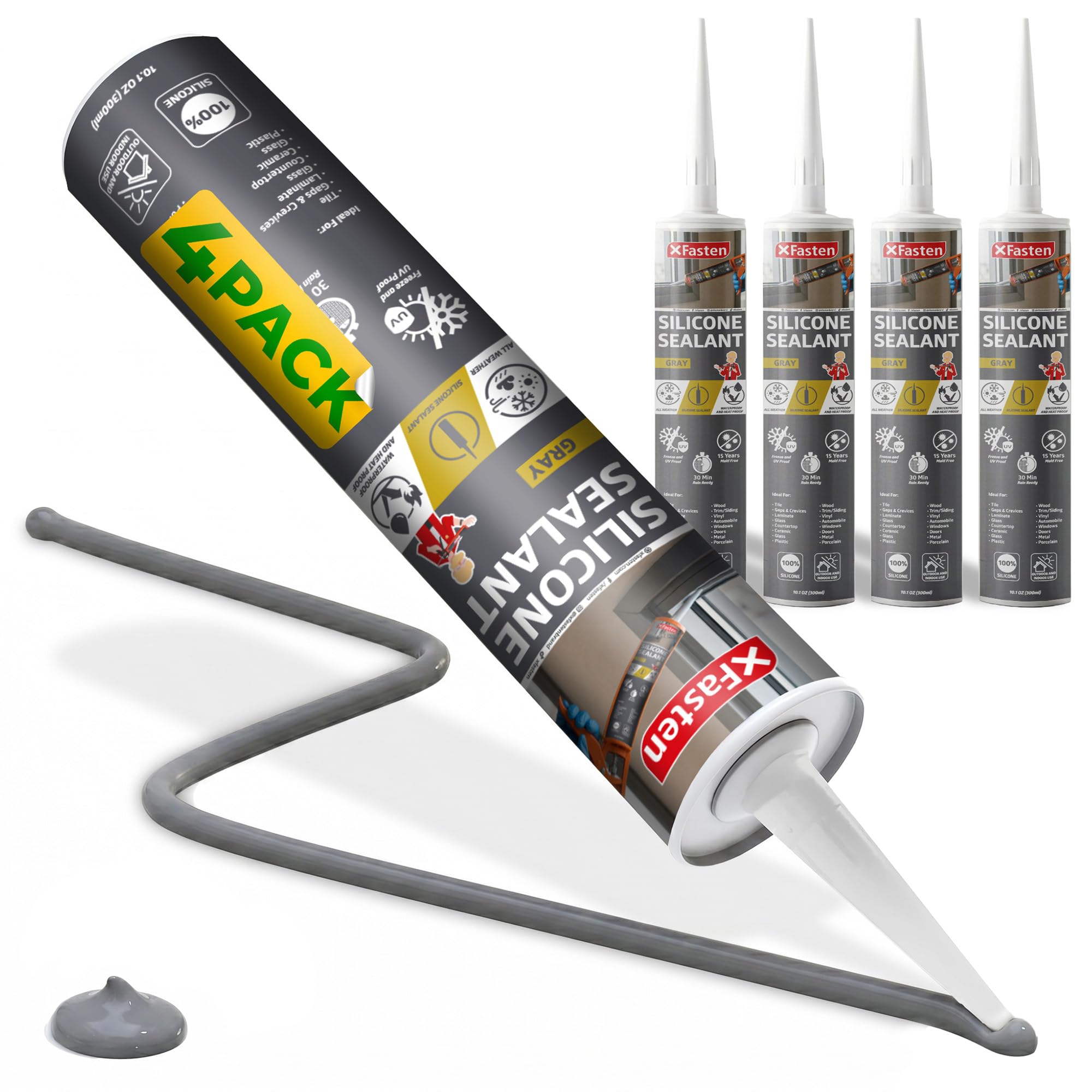
Gray is a color almost nobody stocks, which is why this four-pack exists: it's aimed at RV exteriors, roof vents, gray trim and the weathered metal where a white bead would read as a mistake. It's neutral-cure, so it doesn't give off the acetic acid that ordinary silicone does — worth knowing if the joint is near polycarbonate panels or bare aluminum.

The claims are ambitious. XFasten lists 80 percent elastic recovery, a range from 122 degrees below zero to 322 degrees above, 126 psi tensile strength, a 30-minute tack-free time and a 24-hour full cure, plus low-odor, VOC-free chemistry. On a roof deck in August or an RV panel in January, that temperature window is the number that matters.

Handling takes some care. It smears: over-tool this one and you'll chase a gray film across the siding, so tape the joint, tool once and stop. It can also peel from a surface that wasn't cleaned, so wipe the area down and let it dry before the bead goes on. Gray isn't going to paint out later either, so choose the joints with that in mind.

Set against the other silicones here, we think it's the best value of the lot: four cartridges for less per tube than any single silicone in this guide, provided gray is the color you need and the gaps stay narrow, since the listed fill is just 2 millimeters. For anything wider, or a joint you plan to paint, one of the cartridges above is the better buy.

Bottom line: For RV exteriors, roof vents and gray joints, this neutral-cure silicone is the value pick here, as long as the gaps stay narrow.

Check Latest Price

How We Tested Exterior Caulk Where It Actually Fails

We started by building a shortlist of exterior-rated cartridges and smaller tubes, from clear silicone to paintable acrylic latex, polyurethane, and hybrid formulas. We filtered out interior-only products, skipped tubes that needed a primer or surface prep we couldn't verify, and kept a mix of standard 10-ounce cartridges and smaller tubes. Price came into it only after a tube was rated for exterior use; then we compared listed cure times and coverage and narrowed the field to 14. We tested those 14 over eight months, starting in late spring and revisiting every joint into fall.

I applied each one around south-facing window frames, garage door jambs, siding seams, a concrete foundation sill, and a couple of gutter seams on a shed. On each application day, I noted whether the bead held its shape coming out of the tube, how much tooling it needed, and whether excess wiped off siding and hands without smearing. I timed skin-over and tack-free times, then checked after rain whether water beaded on the caulk or soaked into the joint.

Every few weeks, I pressed a fingernail into each cured bead to see whether it stayed flexible or stiffened, looked for shrinkage and hairline cracks, and tugged at the edges after wet-dry cycles to judge adhesion. On the paintable tubes, I brushed exterior paint over a cured section to see whether it covered evenly or fish-eyed. For removability, I cut and peeled a short cured section to see whether it came away in one piece or crumbled. The tubes that are still sealed without re-tooling are the ones that made the list; the rest pulled away, cracked, or made cleanup a chore. Value came at the end: a tube had to hold up long enough that I wouldn't be redoing the joint next season.

How to Choose an Exterior Caulk

Start With What the Joint Is Made Of

Chemistry decides more than brand. Silicone is the right call for glass, bare metal, factory-finished frames and tile, because it grips slick surfaces and stays flexible. Siliconized acrylic is for painted wood and trim, where it can be coated afterward. Polyurethane handles concrete, brick and masonry, where movement and abrasion are the enemies. Hybrid polymers are the flexible answer for surfaces that are damp or awkward enough that nothing else will grab.

Pick the substrate first and let color and price follow. A great tube in the wrong chemistry is the most common way to waste a Saturday.

Decide Whether the Bead Gets Painted

If the joint will be coated, 100% silicone is out: paint won't bond to it, and a bead that gets painted anyway shows a film that peels. Acrylics and siliconized acrylics are built for coating, so check the paint-ready time, which runs from 30 minutes on Alex Plus to two hours on Titebond. Polyurethane can be painted, stained and sanded.

Outdoor acrylics want that coat of paint. The coating is part of what keeps them weathering, so an unpainted acrylic bead on exposed siding is doing half a job.

Match the Bead to the Gap and the Movement

Every tube lists a maximum joint width, and it's the figure people ignore. A quarter-inch product stretched across a half-inch gap fails no matter how neatly you tool it, because the bead thins at the center and tears. ASTM C-920 ratings describe how much a joint can move, which matters on siding and slabs that expand and contract.

Measure the widest part of the gap, not the average. If you're over the limit, step to a wider-rated sealant or use a backer rod rather than laying a fat bead and hoping.

Plan Around Cure Time and the Weather

Rain-ready times in this group run from 30 minutes to 12 hours, and full cure is usually 24 hours regardless. Application temperature is the constraint that catches people: most of these tubes want surfaces between 40 and 100 °F, which rules out a January afternoon on the north side of a house.

Read the rain-ready figure as time to a light shower, not to a soaking, and give a thick bead longer than the label implies.

Know Your Cleanup Before You Open the Tube

Acrylics clean up with water while wet and tool easily with a finger. Silicone and polyurethane don't: they're tacky, stringy and unforgiving once they skin, and silicone carries a vinegar smell while it cures. Tape both sides of anything visible, pull the tape while the bead is wet, and keep a rag in your back pocket.

It's a two-minute decision at the shelf that saves an hour of scraping later.

Frequently Asked Questions

Final Verdict

Start with the DAP Dynaflex Ultra. It takes paint, tolerates rain within an hour and stays flexible through a freeze, which covers the siding, casing and door-frame joints most of us are actually sealing.

Two exceptions are worth the detour. If the joint is glass, bare metal or a factory finish, the clear GE silicone disappears and holds. If it's a flat concrete or masonry seam, the Sika polyurethane flows into it and can be sanded flush. For painted trim under cover, Alex Plus does the same work for a fraction of the cost.