// data-verified

Best Metal Epoxy of 2026

Metal epoxy makes a simple promise that's easy to get wrong. Mixed correctly, the cured joint can be filed, drilled, and sanded like the metal beside it; mixed wrong, it lets go within a week. The pitch is obvious — a few dollars of adhesive instead of a replacement mower deck, hinge, or aluminum frame.

That's why we've spent the past five months working through 15 metal epoxies — squeeze tubes, syringes, two-can pastes, and kneadable putty sticks — on real failures. A cracked mower deck, a stripped screw hole in a steel gate, a split ax handle, an aluminum storm door, and a dripping PVC joint all got glued back together in my garage.

The thing I'd tell a first-time buyer is that set time and full cure are two different clocks, and the fast stuff usually trades working time for brittleness. Anything that carries load rewards patience and a clamp. The picks below cover both ends of that tradeoff, plus the putty that wins when the gap is a hole rather than a seam.

#01

Best Overall

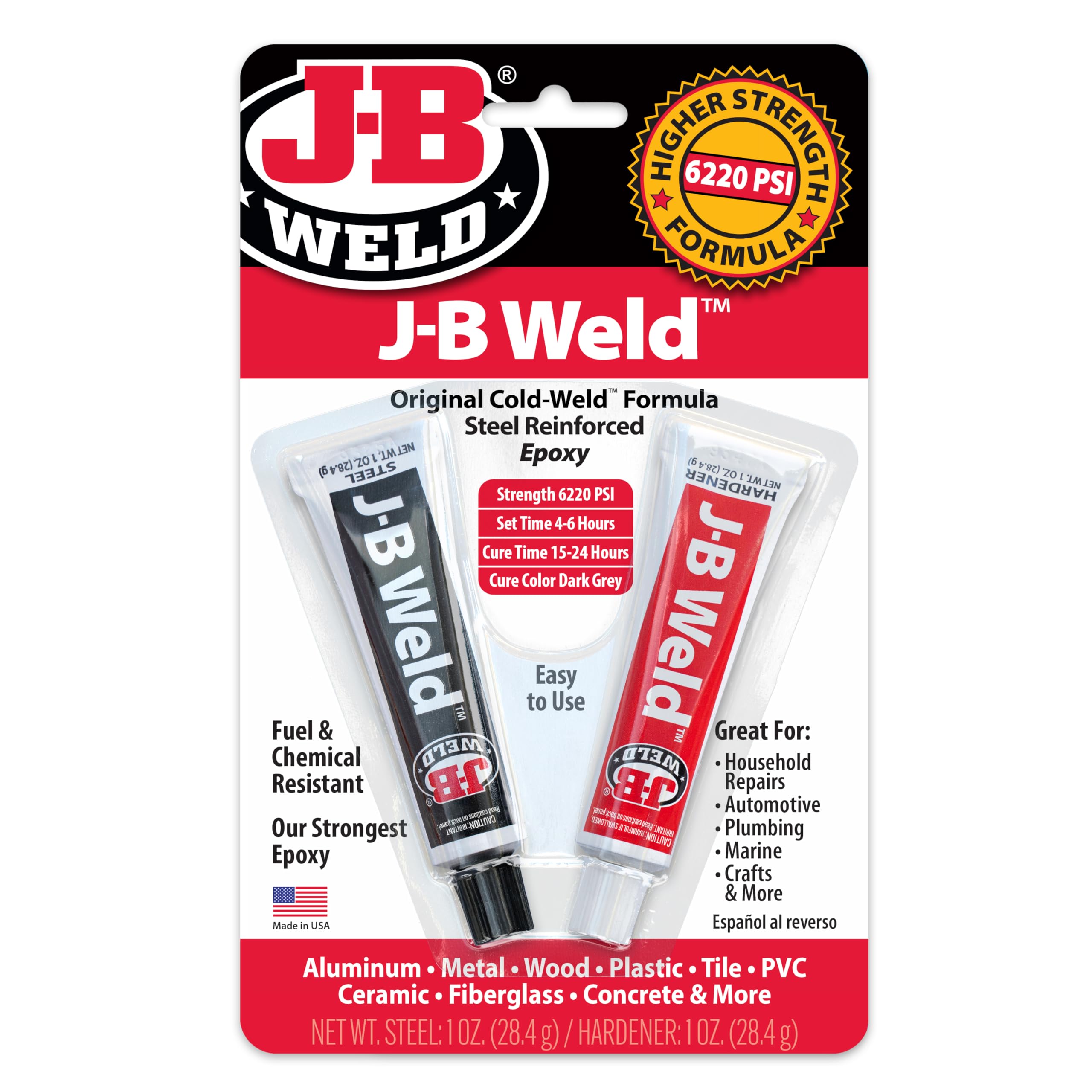
J-B Weld 8265S Original Cold-Weld

95 /100
Kirk Score Outstanding
Volume
2 fl oz
Set And Cure
4-6 hours set, 15-24 hours cure
Heat Resistance
Up to 550°F (287°C)
Tensile Strength
3,960 psi
Check Details on Amazon

Pros

  • Highest heat rating in this set at 550°F
  • Cures hard enough to drill, tap, and sand
  • Separate tubes let you mix only what you need

Cons

  • Hard cure can crack on joints that flex

Fifteen to 24 hours is a long time to leave a repair clamped and untouched, and that is the deal J-B Weld Original asks for. What the wait buys is the highest service temperature on this page, 550°F, plus a steel-reinforced cure with a stated tensile strength of 3,960 psi — which is why this is the tube we keep in the shop for brackets, castings, and anything that lives near an engine. Mix it after dinner and the part is back in service the next evening.

Both parts come in separate metal tubes rather than a syringe, and we came to prefer that for metal work. Squeeze two equal ribbons onto a scrap of cardboard and mix them with a stick: the 1:1 ratio stays honest, nothing sits hardening in a shared nozzle, and the rest of the tube is still usable next month. The tubes are stiff, so measure the ribbons side by side instead of free-pouring and hoping.

On bare, freshly abraded steel it behaves like the cold weld it is named for, and once cured you can drill it, tap it, sand it, and paint it, so a filled hole can take a screw afterward. The 4-to-6-hour set window leaves room to clamp and align without panic. What it will not do is rebuild missing material: a 2-ounce kit is for joints and cracks, and a casting with a corner snapped off wants the paste or the putty stick below.

Bottom line: For steel, iron, and anything that runs hot, this is the metal epoxy we keep on the shelf: the highest heat rating here and a rock-hard cure worth the overnight wait.

Check Latest Price
#02

Best Epoxy Putty for Metal

J-B Weld SteelStik Epoxy Putty

93 /100
Kirk Score Outstanding
Format
Two-part putty stick, 2 pack
Set And Cure
5 minutes set, 1 hour cure
Heat Resistance
350°F continuous, 450°F intermittent
Tensile Strength
4,000 psi
Check Details on Amazon

Pros

  • Stays put on vertical and overhead repairs
  • Sets in 5 minutes and cures in 1 hour
  • No mixing ratio to get wrong

Cons

  • Five-minute set leaves little time to reposition

A leaking pipe joint, an overhead bracket, a rusted-through patch on a mower deck: these are the repairs where a liquid epoxy runs out of the joint before it has a chance to set. J-B Weld SteelStik sidesteps that entirely. It is a two-part putty in stick form, and you cut off a slice, knead it in your fingers until the color is even, then press it into place, where it stays.

Kneading is the whole skill, and it is a forgiving one. We like that you can feel the stick turn from crumbly to uniform under your fingers, and that the timing is honest: five minutes to set, an hour to cure, fast enough to sand and paint the same afternoon. Once cured it is steel reinforced at a stated 4,000 psi and rated to 350°F continuously, 450°F intermittently.

Where it beats a syringe is anything that cannot be clamped or that is missing material — rebuilding a stripped hole, filleting the base of a joint, filling a gouge before paint. It is also the one to hand someone who has never mixed epoxy, because there is no ratio to get wrong and no dispenser to clog. For a tight hairline fracture in a casting, though, a thin epoxy wicks in where putty cannot reach.

Bottom line: Buy this one when the repair will not hold a liquid: a kneaded steel putty that grips a vertical face, cures in an hour, and sands and paints afterward.

Check Latest Price
#03

Best for Large Fills

PC-7 Epoxy Adhesive Paste

92 /100
Kirk Score Outstanding
Volume
1 lb, two cans
Full Cure
48 hours
Tensile Strength
2,150 psi
Temperature Range
35 to 115°F application, -20 to 200°F service
Check Details on Amazon

Pros

  • Trowels into vertical gaps without running
  • Rated for application from 35°F to 115°F
  • Seals tank, plumbing, and masonry leaks

Cons

  • Service temperature tops out at 200°F

A pound of paste in two cans is a different proposition from a 2-ounce syringe, and PC-7 is what we reach for when the job needs volume: a rotted window sill, a gouge in masonry, a chipped step, a hole where a fitting pulled out. It is thick enough to trowel into a vertical gap and stay there, and the high wet grab keeps it from sliding out of an overhead fill while it sets.

The working time is the other half of the appeal. PC-7 stays workable long enough to mix a batch, fill, and then fuss with the shape, and it is rated for application on surfaces from 35°F to 115°F, which matters if you are patching outdoor masonry in November rather than in a heated shop. Full cure takes 48 hours, so plan on leaving it alone for a couple of days before you sand or paint.

What it gives up is outright tensile strength: at 2,150 psi it has the lowest stated figure among the picks here that publish one. For a filler that is the right trade, because you are replacing missing material rather than holding two clean faces under load, and the paste bonds fiberglass, wood, concrete, brick, glass, ceramic, and metal, so it turns up in more places than a metal-only epoxy. It also seals leaks in tanks and plumbing, which is a job no thin syringe does well.

One tub covers a long list of patching jobs, and two cans with no dispenser means nothing clogs between sessions — you mix every batch by hand with a stick. That suits someone working through a punch list over a season rather than bonding one bracket. For two prepared metal faces and nothing else, a steel-reinforced epoxy does it with a fraction of the material and a much shorter cure.

Bottom line: Our pick when the repair is missing material rather than two clean faces: a pound of thick paste that stays where you trowel it and sands to a finish.

Check Latest Price
#04

Best Fast-Set

Permatex PermaPoxy 4 Minute Multi-Metal

86 /100
Kirk Score Excellent
Volume
0.84 fl oz
Set Time
4 minutes, no clamping
Tensile Strength
4,500 psi
Temperature Range
-60°F to 300°F (-51°C to 149°C)
Check Details on Amazon

Pros

  • Holds position without clamping
  • 4,500 psi with a -60°F to 300°F range
  • Can be drilled, sanded, and threaded after cure

Cons

  • Four-minute set leaves no time to reposition
  • 0.84 oz tube covers only small repairs

No clamping is the claim that makes Permatex's four-minute epoxy useful. Plenty of repairs give you nowhere to put a clamp — a knob on a shaft, a fitting inside a housing, a bracket still bolted to the machine — and a fast-setting, gap-filling epoxy that holds its own position solves a real problem there.

Four minutes is quick enough that everything gets laid out before we mix: parts, a stir stick, and something to wipe the tube with. What we did not expect at this size is the strength. At 4,500 psi it carries the second-highest stated figure in this group, ahead of our top pick, and the cured bead can be drilled, sanded, filed, and threaded. The range runs from -60°F to 300°F, so it is as comfortable on a snowblower part as under a hood.

The metals list is unusually broad — aluminum, brass, chrome, copper, iron, stainless, and steel — and the epoxy fills gaps without shrinking, so it grips a pitted or uneven face instead of skating across it. Stainless is the surface to treat with the most care: degrease and abrade it before you mix, because the cured epoxy is unforgiving of a surface that was not clean.

Bottom line: The one to buy for palm-sized metal joints: it sets in about four minutes without a clamp and still reaches 4,500 psi.

Check Latest Price
#05

Best for High Heat

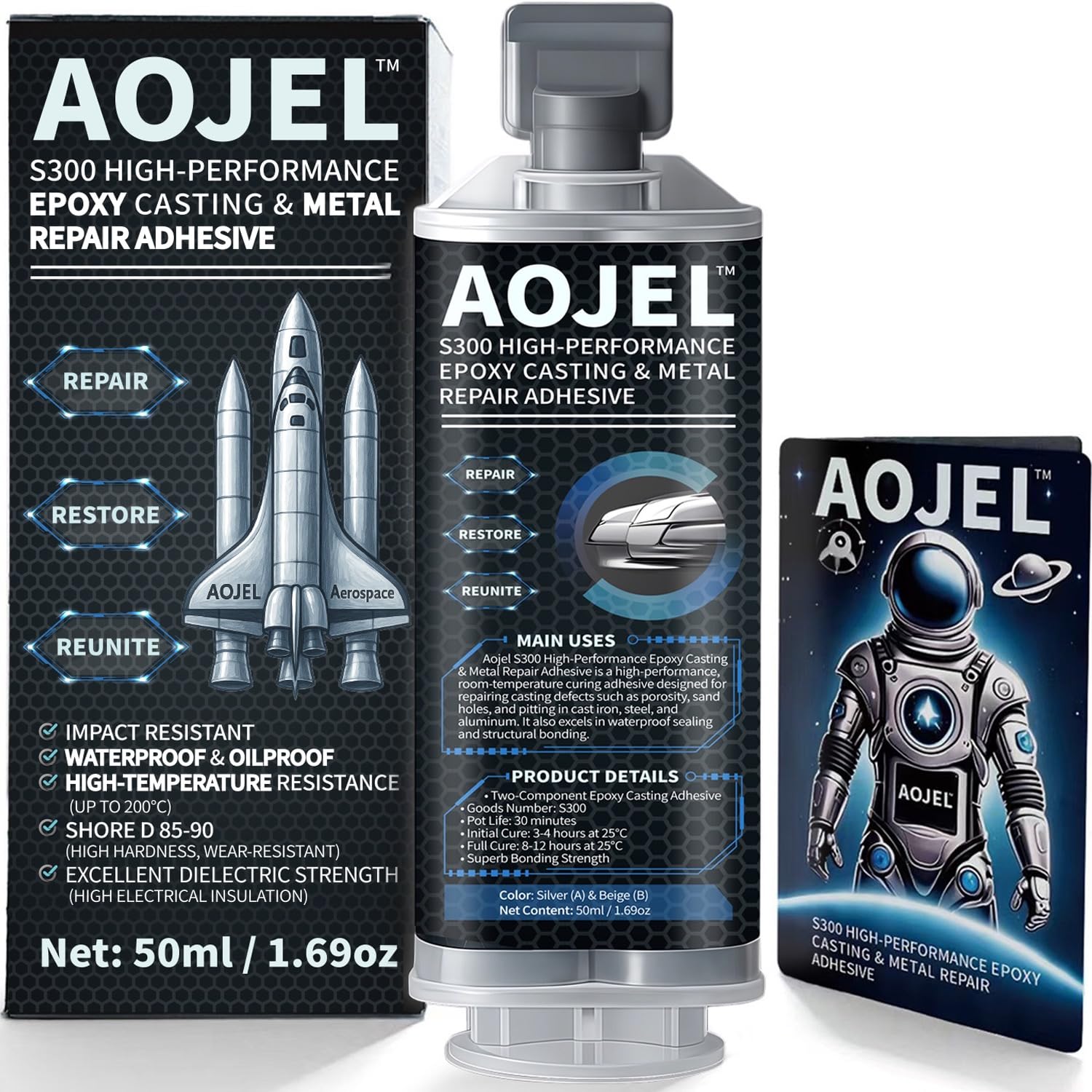
AOJEL S300 Structural Metal Epoxy

85 /100
Kirk Score Excellent
Volume
1.69 oz (50 ml)
Set And Cure
3-4 hours set, 24 hours cure
Working Time
30 minutes at 77°F
Heat Resistance
Up to 392°F
Check Details on Amazon

Pros

  • 30 minutes of working time to align a rebuild
  • Rated to 392°F and waterproof after cure
  • Names aluminum and cast aluminum explicitly

Cons

  • Premium price for a 1.69 oz syringe

Rebuilding a worn bracket or a gouged casting is a different job from gluing two flat faces together, and it needs an epoxy you can still move after you have applied it. AOJEL S300 gives you up to 30 minutes of working time at 77°F before it starts to go — enough to fill, build past the edge of the damage, align, and clamp without working against a clock.

The syringe is the usual 1:1 dual barrel, but the sequence that comes with it is unusually specific: purge until both parts flow evenly, discard the first bit, mix, build, align, clamp, cure. We appreciated the purge step, because the first push from a fresh syringe never comes out even, and an unbalanced first squeeze is a bad start to a job that only gets one attempt.

After full cure it is waterproof, oil resistant, and rated to 392°F — second only to J-B Weld Original here — and it can be drilled, sanded, filed, and painted, so a rebuilt edge can be shaped back to a working profile. Aluminum and cast aluminum are named alongside steel, stainless, and cast iron, so the cast housings and pot-metal parts that other epoxies only half-address are squarely in scope.

Fifty milliliters goes further than it sounds when you are spreading a thin film and much less far when you are building up a lump to reshape. The repairs that justify it are the ones that would otherwise mean a new part: a housing, a mount, a bracket with a broken ear. For two clean faces and a five-minute job, a cheaper syringe does the same work.

Bottom line: Buy this when you are rebuilding metal rather than gluing two faces: 30 minutes of working time, 392°F heat resistance, and a cure you can machine.

Check Latest Price
#06

Best Clear Epoxy

Gorilla 2 Part Epoxy

91 /100
Kirk Score Outstanding
Volume
0.85 oz
Set Time
5 minutes
Full Cure
24 hours
Tensile Strength
3,300 psi
Check Details on Amazon

Pros

  • Clear cure hides itself on visible repairs
  • Capped syringe is reusable between jobs
  • Bonds metal, glass, ceramic, and wood

Cons

  • Water resistant only, so not for wet or outdoor joints

Clear is the whole reason to reach for this one. A chip on a painted metal door, a hinge pin inside a cabinet, a handle you want to look untouched — a clear cure does not announce itself, and Gorilla's syringe is what we keep for those jobs. At a stated 3,300 psi it sits a step below the steel-reinforced picks here, so treat it as a household repair rather than a structural one.

The dual syringe dispenses both parts together, which keeps the 1:1 ratio honest, and the cap lets you put it away between repairs instead of using the whole thing at once. Five minutes to set is quick enough to hold a small part by hand; the 24-hour full cure is the number to remember before you put any load on it. It is also thick enough to bridge a small gap and to stay put on a vertical face, which a thin clear epoxy usually will not.

Smooth, shiny metal is where it can disappoint — it bonds well to a scuffed surface and can let go of a polished or oily one, so degrease and abrade before you mix. We also keep it for mixed-material jobs where the clear cure and the five-minute set do most of the work, like a glass knob back onto a metal stem.

Bottom line: Keep this one for visible household metal fixes: it dries clear, sets in five minutes, and takes a cap so the rest of the syringe survives.

Check Latest Price
#07

Rigid metal repairs

vicpricme Metal Glue 2-Part Epoxy

86 /100
Kirk Score Excellent
Volume
1.76 fl oz
Full Cure
24 hours
Working Time
30 minutes
Tensile Strength
Up to 4,680 psi
Check Details on Amazon

Pros

  • Long 30-minute working time for alignment
  • Highest claimed tensile strength here
  • Waterproof and oil resistant after cure

Cons

  • Not for galvanized or zinc-plated metal
  • Rigid, non-flexing repairs only

4,680 psi is the highest tensile figure claimed by anything on this page, and it comes on a syringe from a brand most people will not recognize. Take the number as a claim rather than a promise — what decides a repair like this is how clean the metal is and whether the 1:1 ratio came out even.

The dual syringe is meant to handle that ratio for you, and when it flows evenly it does. The epoxy comes out thick enough to stay where you put it on a vertical face, and you get 30 minutes of working time before it starts to set, with a full cure at 24 hours. For a bracket, a mower deck, a trailer fender, or a battery tray, that is a comfortable window to line things up and clamp.

This is the budget pick here for metal repair, and what we noticed is that the extra working time, not the headline number, is what makes it useful. Know what it is not for: the maker's list of surfaces it will not bond to is longer than most, and it is worth reading against your part before you buy, because no amount of prep fixes the wrong substrate.

Bottom line: A budget pick with the longest working window here: 30 minutes to line up a repair, and enough volume for more than one.

Check Latest Price
#08

Shaping and patching

Boncart AB Epoxy Putty

89 /100
Kirk Score Excellent
Color
White
Format
Two-part putty, 400 g
Full Cure
24 hours
Finish After Cure
Sandable, drillable, paintable
Check Details on Amazon

Pros

  • Includes gloves, sandpaper, and a scraper
  • Sands, drills, and paints to a finish
  • 400 g tub covers many patches

Cons

  • Not a substitute for a structural metal adhesive

The kit includes gloves, sandpaper, and a scraper, which tells you what kind of product this is: a putty you shape, sand, and paint rather than a syringe you squeeze into a joint. The white color is the practical part — on a chipped enamel sink, a patched panel, or a fiberglass shell, a light filler takes primer and paint without a dark shadow showing through.

Working it is straightforward. Cut equal parts with the spatula, knead until the color is uniform, and press it in. We found the gloves earn their place, because the putty is sticky on bare hands, and it holds its shape once applied, which is what you want on a vertical patch or a corner that needs building back up.

Given the full 24 hours it cures hard enough to sand, drill, tap, and paint, with resistance to water, oil, and corrosion. That combination is why it suits plumbing patches and pool-side repairs as well as cosmetic fills — the cured putty is meant to be shaped, not just stuck.

A 400-gram tub is a lot of putty, and that is the point: this is one to buy when you have a list of patching jobs rather than a single repair. It is at its best on holes, cracks, and missing corners that need to look right afterward, and there is enough in the tub to redo a first attempt without rationing.

Bottom line: The pick for patching, filling, and shaping: white putty that sands and paints, in a tub big enough to work through a whole punch list.

Check Latest Price

How We Tested Metal Epoxies

We built the shortlist by rounding up every two-part epoxy sold for metal — steel-filled pastes, syringe kits, twin cans, and putty sticks — then cut anything that wouldn't state a mix ratio, a cure time, or the surfaces it could bond. That left 15 products, which we worked through over five months.

Every one opened with the same test: dispense and mix. I watched whether a syringe pushed both parts out evenly, whether a can needed stirring to a uniform color, and how long a putty took to knead to a consistent gray. Then I started a stopwatch and kept spreading each batch until it stopped moving, which told us how much working time we actually had.

For adhesion, we bonded steel, aluminum, cast iron, PVC, and hardwood, including a bracket mounted vertically on a steel gate post so we could see which formulas sagged before they set. Cured joints got loaded with a hanging bucket, then filed and drilled near the bond line to check hardness. Anything we trusted with a real repair spent the rest of the test outdoors through rain and two cold snaps.

Value came down to cost per usable repair — how much hardener was left stranded in a tube, how much paste got thrown away, and whether the second half of a two-can kit was still workable a month later.

How to Choose a Metal Epoxy

Match the form to the repair

Syringe and twin-tube liquids flow into a joint and bond two prepared faces; they are the right choice for a crack, a splintered bracket, or a fitting that pulled out. Pastes and putty sticks stay where you press them, so they handle a vertical face, an overhead patch, or a gap you are filling rather than joining.

The trap is buying a thin epoxy for a job that is mostly air. It runs out of a vertical joint before it sets and leaves you a hard puddle on the floor. If material is missing, start with a paste or a putty stick and treat the bond as a bonus.

Separate working time from cure time

The clock on the package is usually the set time, not the day the repair takes load. Gorilla's full cure is 24 hours and PC-7 wants 48, so plan the job so the part sits undisturbed overnight instead of testing it early.

Working time is the other half. J-B Weld Original does not set for 4 to 6 hours, which leaves room to clamp and align a multi-piece repair, while Permatex's four-minute version demands everything laid out before you mix. Buy the window your repair needs, not the fastest one on the shelf.

Strength figures start with preparation

Tensile ratings from 2,150 to 4,680 psi describe prepared, abraded, degreased metal and nothing else. The tube that holds on a sanded bracket lets go on an oily or polished one, so budget more time for cleaning than for gluing: degrease, abrade, degrease again, and keep your fingers off the surface afterward.

It is also worth weighing how a product earns its number. The highest claimed figure here belongs to the least-established epoxy on the page, so read it as a claim while you compare working time, cure, and heat range.

Check heat and water ratings against the part

Service temperature is where these separate: J-B Weld Original is rated to 550°F, SteelStik to 350°F continuously and 450°F intermittently, AOJEL S300 to 392°F, Permatex to 300°F, and PC-7 to 200°F. Gorilla does not publish a figure, so keep it indoors. A bracket near an engine or a heating appliance needs the top of that range; a cabinet hinge does not.

Water splits the same way — waterproof and water resistant are different promises, and joints that stay wet or live outdoors should get a waterproof formulation. Epoxy that cures drillable and sandable lets you shape the repair back to a working surface afterward.

Buy the volume the job needs

Epoxy has a shelf life once opened, and a clogged syringe wastes more than a big tub does. Syringes of 0.85 to 1.76 ounces suit one or two repairs; a pound of paste or 400 grams of putty is for a punch list and keeps you going across several jobs if you seal it.

Cost per repair beats the sticker on the shelf. The cheapest tube here is not the cheapest way to fill a hole, and the one with the highest price per ounce is built for rebuilding rather than bonding two clean faces.

Frequently Asked Questions

Final Verdict

For most metal repairs, the tube we reach for is J-B Weld Original. The 550°F rating is the highest here, the steel-reinforced cure takes drilling and tapping, and it has the longest track record of anything on this page. The wait is the price — mix it in the evening and leave the part alone until the next day.

Two things change the answer. A joint that will not hold a liquid belongs to SteelStik's putty stick, and a rebuild that needs aligning wants AOJEL's 30-minute working time.