// data-verified

Best Parts Washer Solvent of 2026

Anyone who has drained a parts washer knows the tell: fluid gone milky, a refinery smell that follows you into the house, a film coating the pump. I've scrubbed carburetor bodies, valve covers, and one genuinely cursed set of brake calipers, and the difference between a cleaner that lifts grease and one that just wets it shows up in the first ten minutes. Nearly everything sold for this job is a concentrate you dilute yourself, so the ratio printed on the jug quietly sets your cost per cleaning.

We spent five months running 12 of them through a recirculating parts washer, a soak tub, and a spray bottle, watching for the things the labels skip: how they smell in a closed garage, whether they flash-rust bare steel, and how much rinsing it takes before a cylinder head stops feeling slick. Water-based formulas are kinder to your hands and your drain; solvent-heavy ones bite faster and leave a film you'll wipe off twice. Both kinds earned a spot below, including one that cleaned beautifully without stinking up the shop.

#01

Best Overall

Simple Green Pro HD

93 /100
Kirk Score Outstanding
Form
Liquid concentrate
Volume
1 gallon
Parts-washer Use
Parts washing
Metal Compatibility
Safe on metal
Check Details on Amazon

Pros

  • Explicitly labeled for parts washing
  • Safe on metal surfaces
  • Unscented concentrate
  • Works in ultrasonic tanks

Cons

  • Heavy grease may need full strength

The label is the reason Simple Green Pro HD leads this list: it names parts washing and ultrasonic cleaning outright, which is more than most general-purpose degreasers here do. It is a one-gallon concentrate, labeled safe on metal surfaces and non-corrosive, and it is unscented. That combination is what makes it the default for a home or small-shop parts washer: you can fill the basin without wondering whether the fluid is meant for the job.

Because it is a concentrate, you control the mix. We use it stronger for grimy shop tools and lighter for routine maintenance, which stretches a gallon and keeps the cost per cleaning sensible. The unscented formula is a genuine advantage in a closed garage; a parts washer runs for long stretches, and a fragrance that seems mild in the bottle can become tiring in the air.

What we like most is the flexibility: the same jug can feed a parts washer, a dip tank, or an ultrasonic cleaner, so it earns its shelf space even if your setup changes. For a home shop, that adaptability matters more than a marginal gain in stripping power.

Bottom line: Buy this if you want a metal-safe, unscented concentrate that is explicitly labeled for parts washing and ultrasonic cleaning, with enough strength for most shop grease.

Check Latest Price
#02

Best for Metal Protection

WD-40 Specialist Degreaser

90 /100
Kirk Score Outstanding
Volume
1 gallon
Formula
Bio-solvent
Flammability
Nonflammable
Metal Protection
Corrosion and flash-rust protection
Check Details on Amazon

Pros

  • Protects aluminum and copper
  • Nonflammable and low odor
  • Food-processing registered

Cons

  • Heavy grease can need extra work

Corrosion protection is what sets WD-40 Specialist apart in a parts-washer lineup. The formula is a bio-solvent, nonflammable, and low-odor, and the label says it prevents aluminum, copper, and other metals from corroding or flash-rusting. That is a meaningful difference if you clean precision parts or mixed-metal assemblies and do not want to trade grease for oxidation.

We rank it as the low-odor pick for a shop where the washer sits in a corner and runs while you work. The nonflammable formula is easier to keep near a bench than a solvent with a flash point, and the low odor does not take over the room. It is also registered for food-processing areas, which tells you the manufacturer has thought about sensitive settings beyond the garage.

The catch is metal sensitivity: it can discolor some metals in ultrasonic cleaning, so test a scrap piece before committing a finished part. We treat it as a maintenance fluid for lightly oiled parts and a protectant for metals prone to flash rust, not as the first choice for a filthy transmission case.

Bottom line: Choose WD-40 Specialist when low odor, nonflammability, and corrosion protection matter more than raw stripping power on heavy grease.

Check Latest Price
#03

Best for Light Grease

Simple Green Industrial

95 /100
Kirk Score Outstanding
Form
Liquid concentrate
Volume
1 gallon
Dilution
Custom dilution
Certification
EPA Safer Choice
Check Details on Amazon

Pros

  • EPA Safer Choice recognized
  • Custom dilution
  • Low odor

Cons

  • Mild on heavy grease

Simple Green Industrial is the mildest cleaner in this group, and that is exactly why it has a place. It is a one-gallon concentrate recognized by the EPA's Safer Choice program, with a low-odor formula and custom dilution. We reach for it for light grease and routine dip-tank cleaning in a home shop, especially when the washer is near living space and harsh fumes would be unwelcome.

The green tint is not just branding. It lets you see how far you have cut a batch, which is more useful than it sounds when you are mixing by eye for different jobs. A gallon goes a long way at light dilution, and the formula is gentle enough for repeated use on tools and shop surfaces. That makes it a good first fill for someone who is new to a parts washer and does not want a harsh chemistry right away.

For a home shop that cleans lightly oiled tools and occasional engine parts, it is a reasonable first fill. The formula is gentle enough for repeated use on shop surfaces, and the low odor makes it easy to live with. We keep it as the gentle option, not the only option.

Bottom line: This is the gentle, EPA-recognized choice for light grease and routine dip-tank cleaning in a home shop where fumes and harshness are a concern.

Check Latest Price
#04

Best Bulk Value

Zep Industrial Purple

93 /100
Kirk Score Outstanding
Scent
Unscented
Volume
5 gallons
Dilution
Makes up to 128 gallons
Container Weight
47 lb
Check Details on Amazon

Pros

  • Makes up to 128 gallons
  • Unscented concentrate
  • Five-gallon bulk size

Cons

  • 47-pound pail is awkward to handle

Five gallons is a lot of degreaser, and the Zep Industrial Purple pail is clearly aimed at a shop that goes through it. The concentrate makes up to 128 gallons of cleaner, so the math works for a busy garage, a fleet operation, or anyone who fills a large parts washer regularly.

It is unscented and concentrated, which suits a shop where the washer runs for long stretches and you do not want a fragrance hanging in the air. The label lists engine and floor cleaning, and the formula is built for industrial grime rather than a single benchtop task. That breadth is useful when the same pail has to handle parts, equipment, and the floor around the washer.

The pail is the reality check. It takes up serious shelf space, and you need a plan for decanting it into smaller containers so you are not lifting the full pail every time you top off the washer. Decanting also keeps the bulk container clean and makes the concentrate easier to measure.

We recommend it for high-volume shops that have the space and the help to handle it, because the yield is the point. For a home garage that fills a small basin once a month, a one-gallon concentrate is easier to store and less likely to become waste. This is a bulk buy, not a better formula for every job.

Bottom line: High-volume shops should buy the five-gallon Zep pail when they want a low-cost-per-gallon concentrate and have the space and help to handle it.

Check Latest Price
#05

Best Budget Pick

Oil Eater Original

88 /100
Kirk Score Excellent
Form
Liquid concentrate
Volume
1 gallon
Parts Use
Parts cleaning
Certification
USDA approved
Check Details on Amazon

Pros

  • USDA-approved for food service
  • Explicit parts-cleaning use
  • Ultra-concentrated formula

Cons

  • Mixed results on stubborn stains
  • Scent can be strong

Oil Eater is the budget option that actually names parts cleaning on the label. It is a one-gallon concentrate, USDA-approved for food-service use, biodegradable, and noncorrosive. For a home mechanic who wants a dedicated parts-cleaning product without paying a premium, that combination is a sensible starting point.

We rank it as the budget pick for occasional parts cleaning and general shop degreasing. It is at its best on light-to-moderate grease and oily film, and it can handle tools, equipment, and washable surfaces beyond the parts washer. The concentrate gives you room to mix it for the job, so a gallon covers more than a ready-to-use jug.

The USDA approval is a nice vote of confidence for a garage product that may end up near food equipment or a utility sink. We see it as the value option, not the miracle cure.

Bottom line: Oil Eater is the budget pick for occasional parts cleaning, provided you are willing to pre-soak or double up on stubborn grease.

Check Latest Price
#06

Versatile DIY

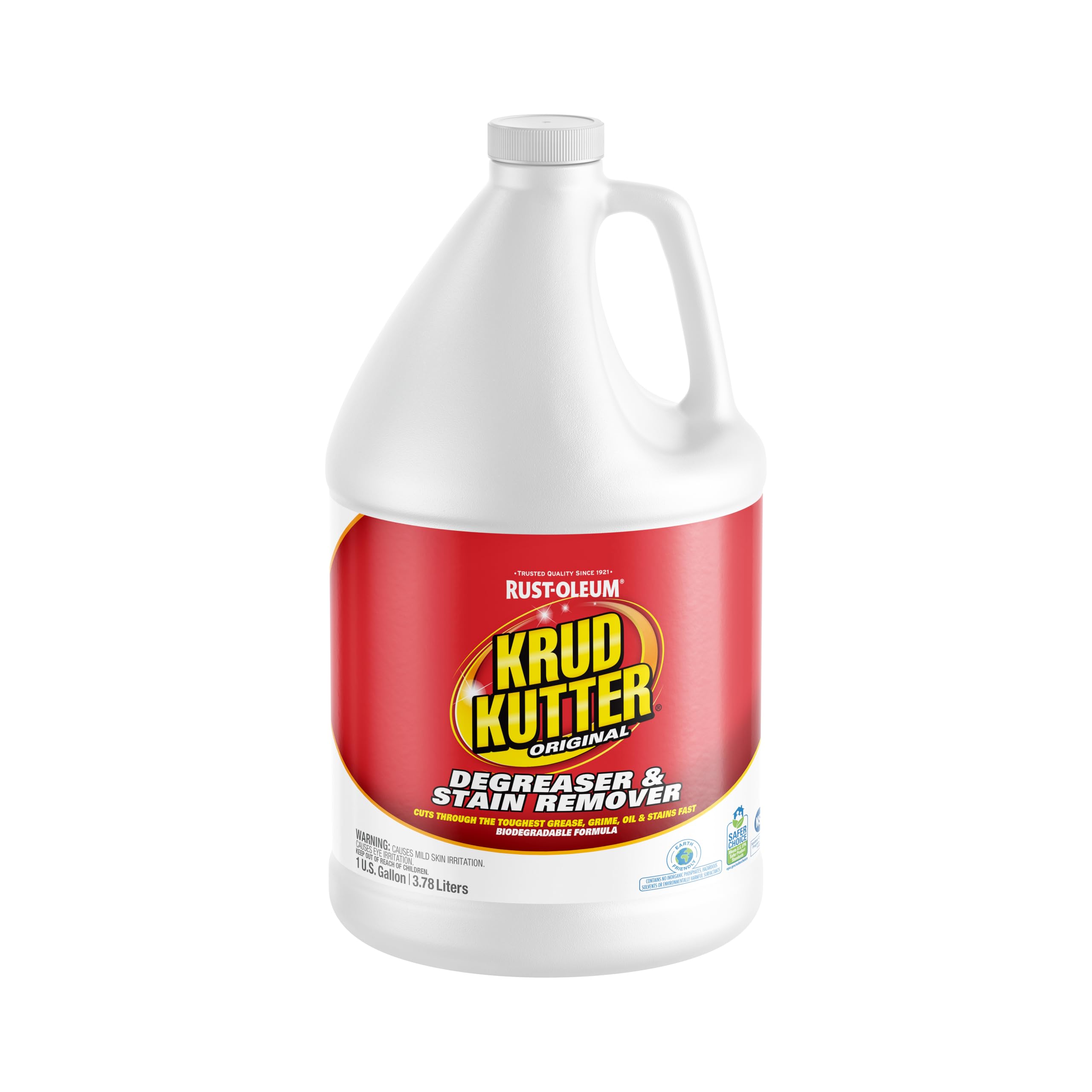
Krud Kutter Original

93 /100
Kirk Score Outstanding
Form
Liquid concentrate
Volume
1 gallon
Residue
Leaves no residue
Solvent Profile
No bleach, ammonia, or hazardous solvents
Check Details on Amazon

Pros

  • No bleach, ammonia, or hazardous solvents
  • Leaves no residue
  • Versatile on tools and household surfaces

Cons

  • Not a dedicated parts-washer fluid

Krud Kutter's water-based formula is the reason it stays on our garage shelf. It contains no bleach, ammonia, or hazardous solvents, leaves no residue, and is designed for tools, engines, and a long list of household surfaces. That makes it a versatile cleaner rather than a single-purpose parts-washer fluid.

The versatility is not just a label claim. It is the kind of cleaner we reach for when a project spills from the garage into the house, and it has a reputation for lifting latex paint from vinyl and other surfaces where a harsh solvent would be overkill. For light grease and general grime, that breadth is useful.

We keep it for DIYers who want one water-based gallon for light garage and household degreasing. It is gentle, low-residue, and easy to live with. That is the trade we accept for the flexibility.

Bottom line: Keep Krud Kutter for DIYers who want one water-based gallon for light garage and household degreasing rather than a dedicated heavy-duty parts-washer fluid.

Check Latest Price
#07

Manual cleanup

Zep Cherry Bomb

91 /100
Kirk Score Outstanding
Scent
Cherry
Volume
1 gallon
Use Areas
Auto, marine, RV, home
Surface Types
Seven material types
Check Details on Amazon

Pros

  • Foams well for manual cleaning
  • Cherry scent neutralizes odors
  • Works across auto, marine, RV, home

Cons

  • Can leave residue

Cherry Bomb is the odd one out here: a cherry-scented, foaming degreaser built for manual auto and shop cleanup. It is a one-gallon liquid for auto, marine, RV, and home surfaces, and the label lists fiberglass, steel, chrome, stainless, painted metal, rubber, and finished concrete. For engine bays, shop tools, and garage floors, that is a useful spread.

The foaming action is the practical part. It clings to the surface long enough to lift grime, and the cherry fragrance is strong enough to neutralize odors in a workspace. That is pleasant for manual cleanup, but it is also why we keep it away from a washer that sits open for hours. The scent lingers, and a long-dwell basin is the wrong place for a fragrance you notice from across the garage.

We recommend it for manual auto and shop cleanup where a foaming, cherry-scented degreaser is welcome. It is not the fluid we fill a parts washer with, because a fragrance that strong belongs on a rag, not in an open basin. Used as a pre-cleaner, it earns its place on the shelf.

Bottom line: Cherry Bomb suits manual auto and shop cleanup where a foaming, cherry-scented degreaser is welcome, but it is not the fluid we fill a parts washer with.

Check Latest Price

How We Tested Parts Washer Solvents

We built the shortlist from spec sheets rather than shelf labels. Only cleaners with a stated dilution ratio for a recirculating parts washer, sold by the gallon or larger, and rated for bare metal made the first cut. From there we dropped formulas that overlapped and kept a mix of water-based, solvent-based, and heavy-duty concentrates, then worked out cost per diluted gallon so a single gallon wasn't competing unfairly with a five-gallon pail.

Twelve of them went into rotation for five months, all in the same garage: a project car's valve covers and oil pan, brake-dust-caked wheels, hand tools, and a bucket of shop rags. Each was mixed at the dilution its maker recommended and run through the same washer, and I scrubbed every part with the same brush for a fixed three minutes before wiping it with a white paper towel to see how much grease actually came off.

The uglier jobs got a soak test — carbonized grease on a valve cover, an oil-soaked rag — with a check every ten minutes to catch the moment the crust started lifting. Bare steel sat out overnight to see whether it picked up a rust blush, and I noted whether the fluid had gone milky, separated, or foamed in the reservoir after a week of sitting. Smell got its own pass: twenty minutes in a closed garage with the washer running, judged by whether I wanted to stay in there.

Versatility came down to how the same jug behaved away from the washer: cut 10:1 on a concrete oil stain, full strength on a range hood filter, a splash on a mower deck. Safety was the boring, important part — gloves on throughout, a note on how skin felt afterward, every flash-point and ventilation warning read before anything ran indoors. I also counted rinses, meaning how many passes it took before water sheeted off a part instead of beading.

How to Choose a Parts Washer Solvent

Start with the grease, not the label

A parts washer is a soak, not a spray-and-wipe, so the fluid has to keep working after the part goes in. Water-based concentrates like Simple Green Pro HD are a good default for light-to-moderate grease and mixed shop debris; they are easier to live with and often safer on metal. A bio-solvent formula such as WD-40 Specialist is the better match when you want low odor, nonflammable handling, and corrosion protection. Neither is a magic stripper: caked grease may need full strength, a pre-soak, or a second pass. Choose based on the worst grease you routinely see, not the cleanest part on the bench.

Check the metals before you fill

Aluminum, copper, brass, and painted parts are the ones to think about first. A cleaner can be fine on steel and still dull or discolor a sensitive alloy, so look for a label that names the metals it is safe on and test a scrap piece before soaking a finished part. WD-40 Specialist is the one here that explicitly promises corrosion and flash-rust protection for aluminum and copper; Simple Green Pro HD says it is safe on metal surfaces. If you clean mixed metals, start with the mildest formula that lifts the grease and pull sensitive parts as soon as they are clean.

Concentrate or ready-to-use?

Concentrates are the better value if you have room to mix and store them, but they ask you to measure. A one-gallon concentrate suits a home shop; the five-gallon Zep Industrial Purple makes up to 128 gallons, which is a shop-scale commitment, not a shelf-stocking convenience. The trade-off is handling: a 47-pound pail is awkward to lift and store. Buy bulk only if you will actually use it before it ages or gets contaminated. For occasional cleaning, a one-gallon jug is easier to manage and less likely to become waste.

Plan for odor, residue, and cleanup

Odor matters more in a parts washer than in a spray bottle because the fluid sits open. An unscented formula like Simple Green Pro HD is easier to live with in a closed shop; a cherry-scented cleaner like Zep Cherry Bomb is pleasant for manual cleanup but not what we want in a long-dwell washer. Residue is the other issue: some formulas leave a film that needs a rinse before assembly or painting. Test a part, rinse if the label calls for it, and keep the washer covered when it is not in use.

Frequently Asked Questions

Final Verdict

For most home and small-shop parts washers, we recommend Simple Green Pro HD. It is the rare concentrate that names parts washing and ultrasonic cleaning, stays unscented, and is labeled safe on metal surfaces, so it covers the routine greasy-parts job without turning the shop into a chemical cloud. Use it at full strength for heavier grime and dilute it for light maintenance cleaning.

If low odor and corrosion protection matter more than stripping power, WD-40 Specialist is the alternative we point to. For a high-volume shop with the space for a five-gallon pail, Zep Industrial Purple is the bulk choice.