// data-verified

Best Ultrasonic Cleaners of 2026

An ultrasonic cleaner doesn't scrub anything. A transducer vibrates the tank tens of thousands of times a second, and the bubbles that form and collapse against the surface lift away the grime a brush can't reach — plaque off a retainer, the film inside a ring setting, the varnish in a carburetor jet. That's the promise, and it's a real one. The catch is that a palm-sized pod and a 30-liter benchtop machine make the exact same claim on the box.

I've had twelve of them on my bathroom counter, kitchen sill, and garage bench over the past six months, and the gap between one that works and one that just buzzes comes down to a few unglamorous things: how much power actually reaches the tank, whether there's any heat, and whether the basket keeps your rings off the transducer. Noise matters more than the listings admit, too — a couple of the pod-style units are loud enough that I stopped running them while anyone was on a call.

What first-time buyers get wrong is reading the frequency number as a score. It isn't. Forty and forty-eight kilohertz clean differently, and neither is better until you know what's going in the tank — a delicate opal wants something different from a greasy carburetor jet. The picks below are grouped by what each one is genuinely good at.

#01

Best Overall

VisiClean Ultrasonic Cleaner

89 /100
Kirk Score Excellent
Weight
3.51 lb
Frequency
42 kHz, dual transducers
Lid And Cord
Removable lid; detachable cord
Tank Capacity
800 ml (27 oz)
Check Details on Amazon

Pros

  • 800 ml tank fits glasses, guards, and parts
  • Two transducers clean the full tank floor
  • Removable lid and detachable cord
  • Cooling fan suits longer sessions

Cons

  • No heater; cold cleaning only

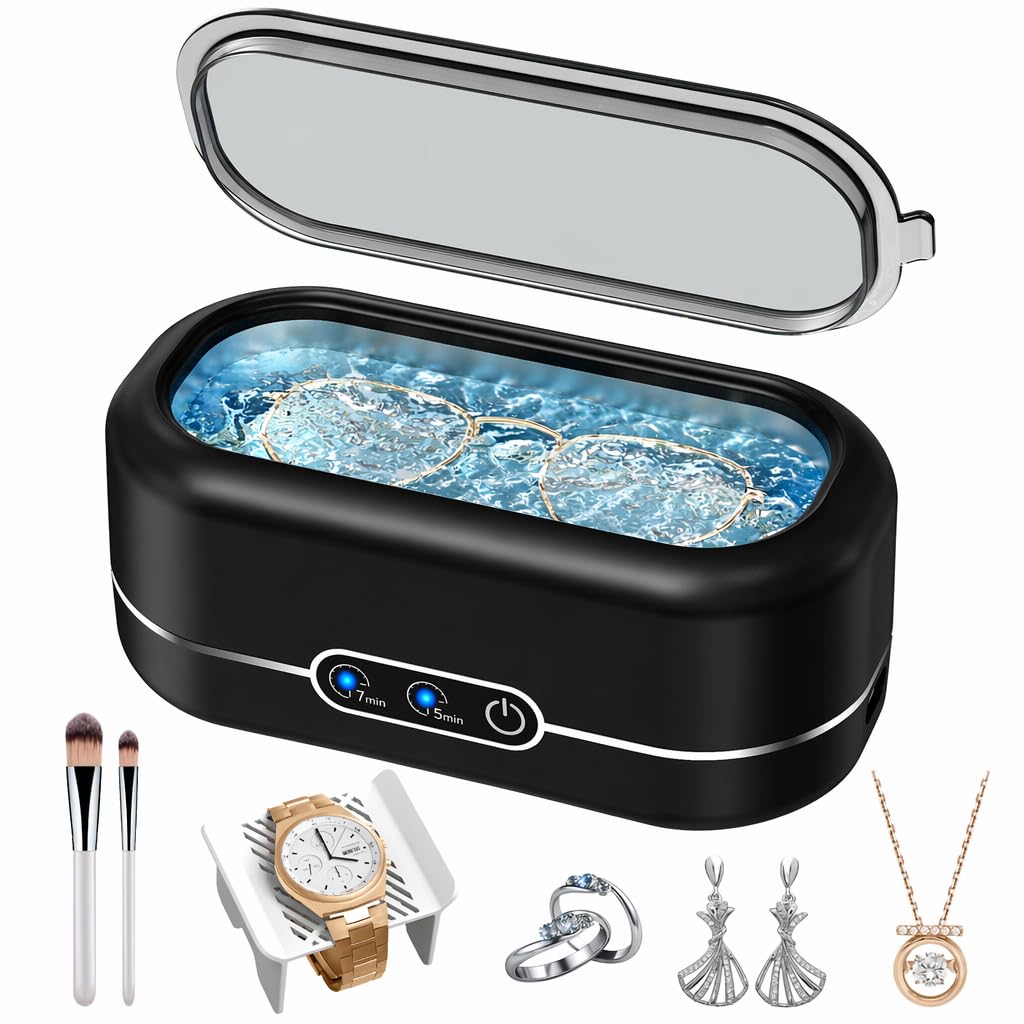
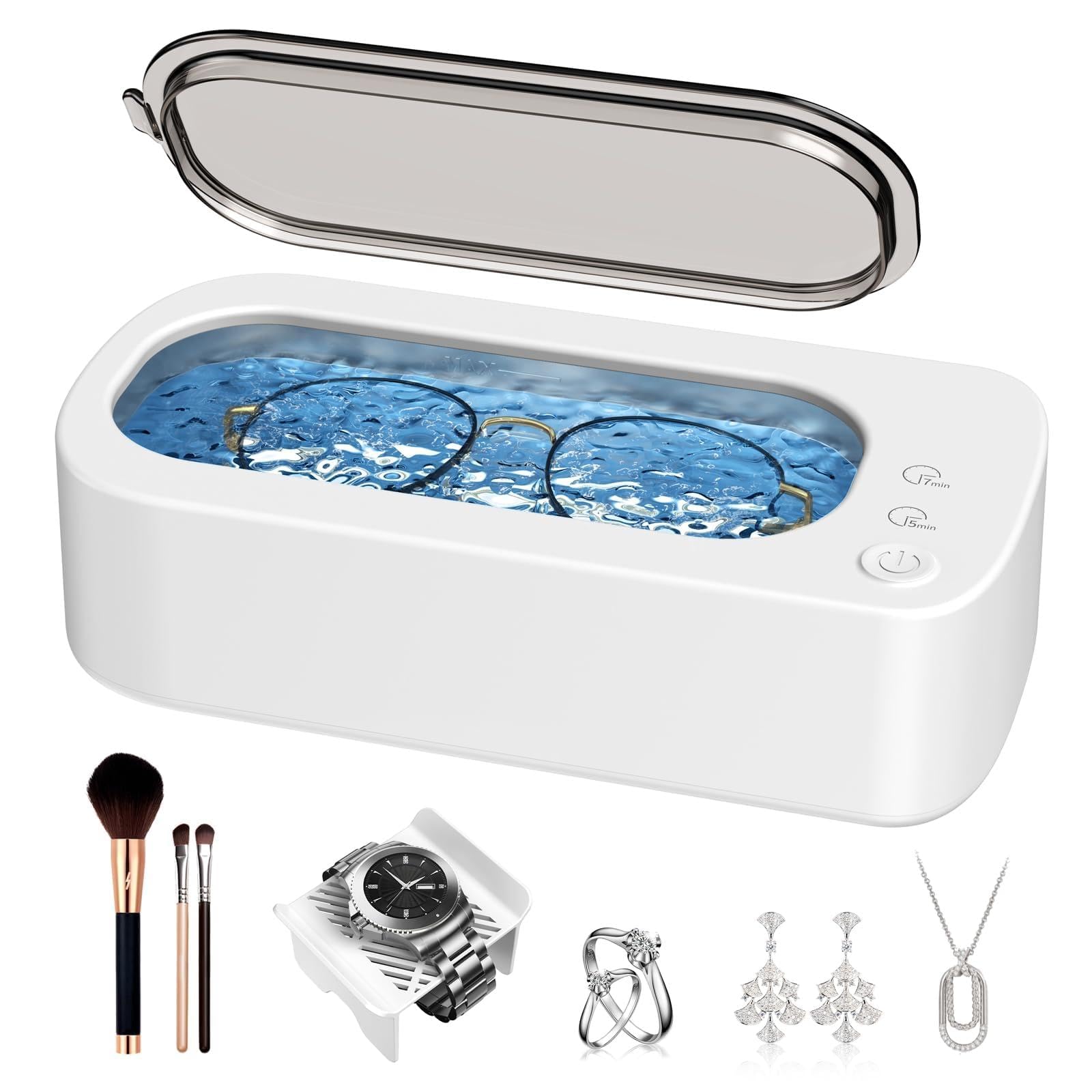
Eight hundred milliliters is the number that decides this one. The tank is long enough to lay a pair of eyeglasses flat and deep enough for a night guard or a watch bracelet, and the unit still earns its shelf. Two transducers drive the 42 kHz cavitation instead of one, so the far end of the tank cleans about as well as the middle.

That combination is why it's our default for most households. Glasses, rings, a retainer, and a grubby watch band all came out looking markedly better, and we never needed a second machine for a bigger load. Two details we came to appreciate: the lid lifts off completely, so you can fill it at the sink without dribbling, and the cord unplugs from the back so the whole thing stows away between uses.

There's no heater, and for this kind of load that's correct. The instructions warn against hot water, and heat is what distorts a thermoplastic retainer and clouds a polished surface; cold water with a drop of dish soap is the whole recipe for rings, glasses, dentures, and a night guard. A carburetor is a different problem — that wants heat and a much larger tank.

The accessories earn their place too. The basket and watch holder lift out in one piece, so you can rinse everything under the tap without fishing around in the tank, and a bracelet sits spread open instead of clamped against itself. It's a small thing that decides whether a cleaner gets used weekly or stays in the drawer.

Bottom line: Our default for most households: an 800-milliliter tank that takes glasses, a night guard, and a handful of rings, with two transducers working the whole floor. One machine covers jewelry, dental gear, and small parts.

Check Latest Price
#02

Best for Retainers and Aligners

Zima Dental Pod

89 /100
Kirk Score Excellent
Modes
Standard and Max Clean
Warranty
12 months
Footprint
5.79 x 5.31 x 5.2 in
Frequency
42–47 kHz, auto-adjusting
Check Details on Amazon

Pros

  • Designed specifically for oral appliances
  • Auto-adjusting 42–47 kHz range
  • Twelve-month warranty
  • Standard and deep-clean cycles

Cons

  • Premium price for a single-purpose pod

It costs more than any other small cleaner here, and it's the only one built for a single job: oral appliances. That trade is worth it if a retainer, aligner, night guard, or denture is what you'll be cleaning every night, because the gentle frequency range and the short cycles are designed around that job rather than adapted to it.

The frequency is the part worth understanding. It moves between 42 and 47 kHz on its own, which lets it treat a soft aligner more gently than a fixed-frequency desktop pod, and the standard cycle is short enough to run while you're brushing your teeth. The Max Clean cycle is there for the week you get home from a trip and the guard has been sitting in its case since Tuesday.

A stated twelve months of coverage is the other reason it holds a spot — the only warranty of that length among these picks, in a category where a machine can quit inside the first year. What you give up is range: this is a dental machine, not a jewelry or eyeglasses machine, and if you want one tank for the whole house, the VisiClean is the better buy.

Bottom line: If a retainer, aligner, or denture is the nightly job, this is the machine built for it — gentle auto-adjusting frequency and the longest stated warranty here. It's a specialist, and priced like one.

Check Latest Price
#03

Best for Greasy Shop Parts

VEVOR 15L Ultrasonic Cleaner

90 /100
Kirk Score Outstanding
Weight
20.8 lb
Frequency
40 kHz, 360 W
Heater Range
0-110°C
Tank Capacity
15 L
Check Details on Amazon

Pros

  • 15-liter tank takes a whole carburetor
  • Heats to 110°C for grease and wax
  • 304 stainless tank and basket
  • Digital timer and temperature control

Cons

  • Loud enough to hear through a door
  • Heater can drift from the set temperature

Fifteen liters of heated water is a different category of cleaning. Set the temperature, drop a carburetor body or a tray of oily fittings into the basket, and come back to parts that look like they went through a parts washer, because that's essentially what this is. The thermostat runs from 0 to 110°C, hotter than anything else on this list.

At 40 kHz and 360 watts it isn't gentle, and that suits the work. Steel, aluminum, and brass don't mind aggressive cavitation, and a warm bath with a degreaser does the rest. The 304 stainless tank and basket are the right materials for the job, and the machine is built to sit in a corner until you need it.

If most of what you clean is metal and grease, this is our pick in the set. Heat is what makes the difference — cold cavitation loosens dirt, warm water and a degreaser actually strip it — and 15 liters means a disassembled carburetor goes in as one load instead of three. Jewelry works too on a low setting, and the basket keeps small pieces from rattling against the tank.

Measure the bench before it arrives. The machine is 16 inches across and about 21 pounds empty, so it wants a shelf or a workbench rather than a cabinet, and it's happier near a utility sink than in a kitchen. Once it has a home, the routine is fill, run, and tip it out, which is easier with a pitcher going in than carrying the unit to a tap.

Bottom line: The pick for carburetors, tools, and anything caked in grease: a heated 15-liter tank that does what no desktop pod can, for less than the 30-liter machines.

Check Latest Price
#04

Best Budget

Miorcols Ultrasonic Jewelry Cleaner

88 /100
Kirk Score Excellent
Modes
Two presets
Frequency
48 kHz
Dimensions
7.6 x 3.8 x 3.3 in
Tank Capacity
12 oz
Check Details on Amazon

Pros

  • Stainless tank that wipes clean
  • Two one-button presets
  • Non-slip pads hold it steady
  • 1.1 pounds and easy to stash

Cons

  • Holds one or two small items at a time

At 7.6 inches long and about a pound, this is the one that disappears onto a crowded bathroom ledge. The tank is 12 ounces of 304 stainless, which wipes clean with a paper towel and doesn't hold onto hard-water film the way plastic does.

One button runs two presets: a five-minute cycle for the ring you wear every day and a longer one for the watch band that's been against your wrist all summer. There's nothing to program, which is the right amount of control for a machine you'll run for a couple of minutes at a time, and the four rubber pads underneath keep it from drifting across a wet counter.

It's the second cleaner we keep coming back to — the one that lives by the sink for a ring before dinner while a bigger machine stays in a cabinet. It won't heat and it won't take a carburetor, and for a jewelry drawer and a retainer neither matters.

Bottom line: The least expensive cleaner worth buying: a stainless 12-ounce tank, two one-button presets, and enough punch to bring rings and retainers back. Best as the machine you leave by the sink.

Check Latest Price
#05

Night guards, dentures

UMPOPO Retainer Cleaner

87 /100
Kirk Score Excellent
Modes
Four, with UV-C
Weight
1.17 lb
Frequency
48 kHz
Tank Capacity
200 ml
Check Details on Amazon

Pros

  • Four modes with a UV-C cycle
  • Pulse-flow cycle for heavy buildup
  • Compact footprint for a small sink

Cons

  • 200 ml tank takes one appliance per cycle

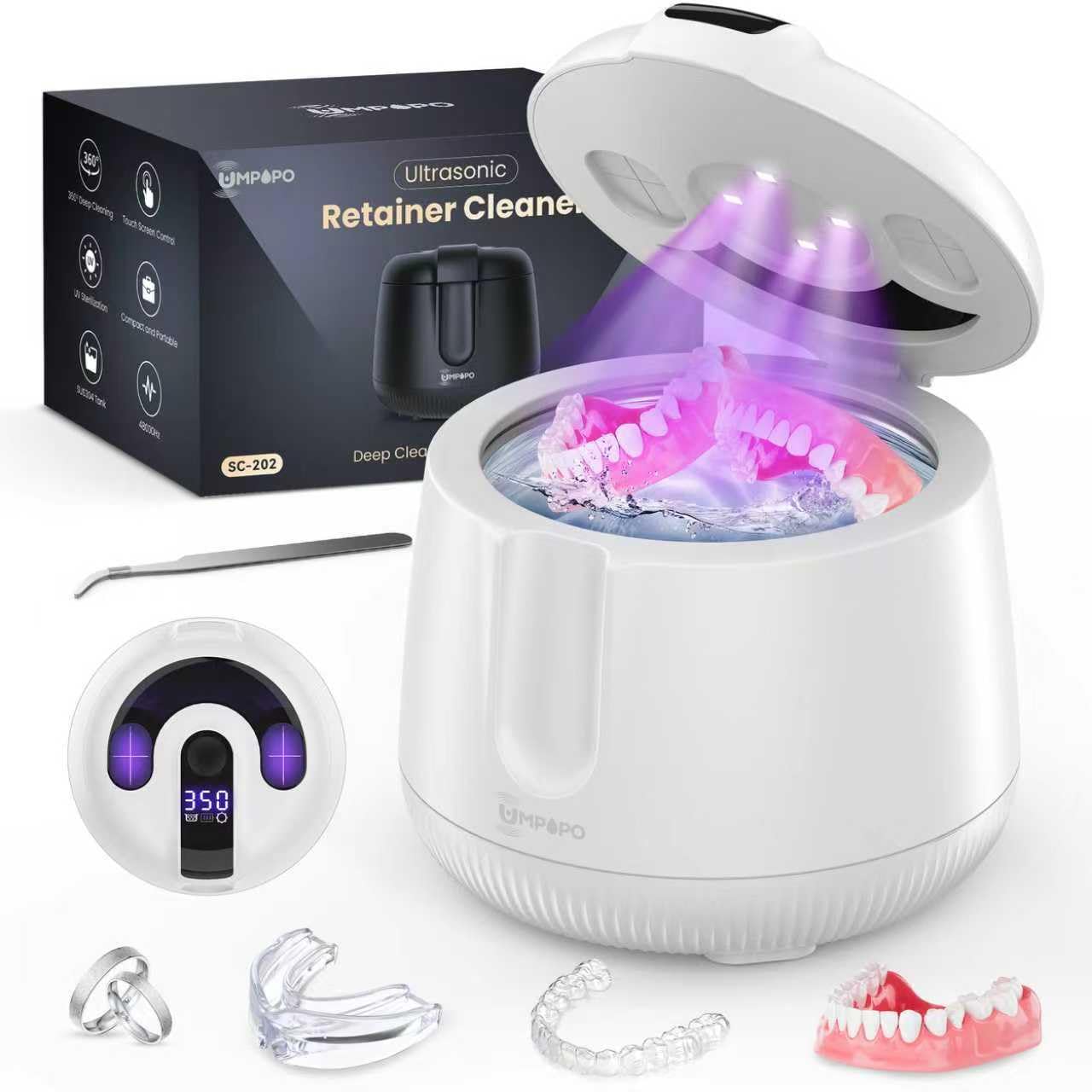
Four modes and a UV-C lamp is more control than most dental pods offer, and the lamp is the least important part of that. What actually cleans a night guard is cavitation, a drop of soap, and enough time; UV-C is a bonus you can run when you want it, not the reason the appliance comes out clean.

The rest of the package suits a bathroom shelf. The modes let you match the cycle to how grubby things are, the long pulse-flow cycle alternates short bursts of cleaning with pauses for heavier buildup, and the footprint is small enough to leave out next to the sink.

One caution belongs here. Coated dental appliances vary, and a custom guard that comes out cloudy or starts to lift at the edge is not something you can undo, so run an older or spare appliance through a first cycle before committing a new one. That holds for every machine on this list, and it's worth saying out loud for the expensive ones.

Bottom line: A retainer and denture cleaner for a small budget: four modes, a UV-C lamp, and a footprint that fits a bathroom shelf. Treat the lamp as a bonus, not the cleaning.

Check Latest Price
#06

Jewelry and eyeglasses

OSLTWI Ultrasonic Jewelry Cleaner

87 /100
Kirk Score Excellent
Weight
1.28 lb
Frequency
48 kHz
Tank Capacity
350 ml
Tank Material
304 stainless steel
Check Details on Amazon

Pros

  • 350 ml stainless tank for jewelry and glasses
  • 48 kHz cleaning in a 1.28-pound body
  • One-button operation
  • Cord stores inside the housing

Cons

  • Oversized frames won't fit the tank

The cord detaches and stows inside the housing, which sounds like a minor spec until you've tried to put a cleaner away in a bathroom drawer with three feet of cable trailing behind it. At 1.28 pounds it moves from the bathroom to the kitchen without a thought, and the tank is 350 milliliters of stainless steel.

For jewelry and eyeglasses that covers the essentials: 48 kHz cleaning, one button, and a cycle you don't have to think about. There's no timer to set and no temperature to manage, and a full fill takes a few seconds at the tap. It's the machine we hand to someone who wants clean rings without reading a manual.

The limits are physical. Frames that go over a pair of regular glasses won't fit, and a watch bracelet has to be coiled rather than laid flat. If your cleaning is mostly oversized sunglasses or chunky bracelets, a longer tank — the VisiClean, or one of the VEVORs — saves the fiddling.

Bottom line: A light, tidy 350-milliliter cleaner for jewelry and eyeglasses, with a cord that packs into the body. A good second machine, or a gift for someone who won't read a manual.

Check Latest Price
#07

Large parts batches

VEVOR 30L Ultrasonic Cleaner

88 /100
Kirk Score Excellent
Frequency
40 kHz, 600 W
Heater Range
0-80°C
Tank Capacity
30 L
Tank Material
304 stainless steel
Check Details on Amazon

Pros

  • 30-liter tank for batch loads
  • Dedicated degassing mode
  • Heats to 80°C
  • 304 stainless tank and basket

Cons

  • Weighs 25 pounds and takes 30 liters per fill

The degassing mode is the detail worth understanding. Fresh solution holds dissolved air that softens cavitation, so the first cycle in a new batch never cleans as well as the second; this machine has a dedicated degas setting that strips the air out first. It's a feature aimed at people who clean parts for a living, and the rest of the machine is built to match.

Thirty liters is the other half of the argument. Parts laid out on the basket clean better than parts stacked on each other, and a tank this size lets you spread a batch out instead of running three loads. It heats to 80°C, enough for most degreasers, and 600 watts of ultrasonic power is what it takes to move that much water.

The costs are physical. Thirty liters is a lot of water to heat and then get rid of, filling it from a pitcher takes a few minutes, and a utility sink nearby turns the whole routine from a chore into a habit.

Most home shops don't need it. If your parts fit in a 15-liter basket — and a disassembled carburetor usually does — the smaller VEVOR costs less and takes up half the room. Buy the 30-liter when your batches are big enough that the smaller tank would mean a second and third cycle.

Bottom line: For batch cleaning of big, greasy parts, the 30-liter tank and its degassing mode earn the bench space. Most home shops get the same results from the 15-liter model for less.

Check Latest Price

How We Tested 12 Ultrasonic Cleaners

We started with the two crowds who actually buy these — people cleaning aligners, retainers, and dentures, and people degreasing carburetor parts, brass fittings, and shop tools — and pulled every model with a real following in either camp. Then we cut anything without a timer, anything we couldn't confirm had a stainless tank, and anything from a seller with no track record. Twelve made the cut, and they ran for six months.

Testing happened where these machines live rather than on a lab bench: on a bathroom counter beside a retainer case, next to the kitchen sink for rings, eyeglasses, and watch bands, and on a garage bench with a disassembled carburetor and a jar of pocket change. We ran each one per the manufacturer's instructions first, then with plain water and a drop of dish soap, and noted whether the water clouded evenly, which parts came out clean on the first cycle, and which still needed a toothbrush. Anything that needed a second run got one.

Noise got its own test — we stood next to each machine mid-cycle while on a phone call and logged which ones made us leave the room. On heated models we checked water temperature with a thermometer at five-minute intervals to see whether the heat held or spiked and faded, and we plugged the larger tanks into a wall meter to see what they actually drew. Footprint was measured against a dinner plate. Every pod ran daily for a month and was checked at the seams, lid, and basket for weeping, hairline cracks, or a transducer that started to rattle.

Ease of use came down to whether we could fill, load, and start a unit one-handed without the manual. By the end, value had little to do with how many modes a machine listed — the ones we kept reaching for were the ones that held their temperature and didn't need a second cycle to finish the job.

How to Choose an Ultrasonic Cleaner

Tank Size Comes First

A cleaner can only work on what fits inside it, fully submerged, with water moving around it. A pair of glasses wants a tank roughly six inches long; a retainer or a night guard will sit in almost anything. If you're cleaning carburetor bodies or tools, compare the part to the tank's working dimensions rather than the capacity in liters — VEVOR publishes a maximum workpiece size of 10.6 by 8.7 by 4.1 inches for its 15-liter model, which tells you far more than the number on the box.

Watch the word compact. In a listing it usually means the machine fits a shelf, not that it fits your items, and a pod that can't take a pair of frames tends to end up in a drawer. Buy the smallest tank that swallows your largest item, then confirm you have somewhere to keep it.

What Frequency Actually Changes

Frequency is not a quality score. Around 40 kHz produces larger, more energetic bubbles that hit hard and suit metal; 45 to 48 kHz produces finer bubbles that are gentler on plated jewelry and soft plastics but slower on heavy grime. A dental pod at 48 kHz isn't better than a shop tank at 40 kHz — they're aimed at different dirt.

The other half is how many transducers are bonded to the tank and how much power they get. Two transducers under an 800-milliliter tank mean most of the floor is active; one small transducer in a big tank leaves quiet corners. Treat a stated frequency as half the story until you know how many transducers are pushing it.

Heat Separates Jewelry Cleaners From Parts Cleaners

Heat is what turns cavitation into a degreaser. Wax, carbon, and old oil soften as the water warms, which is why every serious parts machine has a heater and a thermostat; 60 to 80°C is the working range for most of them, and the VEVOR 15-liter goes to 110°C.

Cold is the right answer for the bathroom. Heat is what distorts a thermoplastic retainer, and VisiClean tells you outright not to use hot water in its tank. If you need both routines, buy the heated machine and run it cool for delicate items rather than buying two machines.

Controls, Baskets, and Where It Lives

Presets are fine for jewelry and dental appliances: one button, five or ten minutes, done. Adjustable time and temperature matter when you're dialing in a process for a particular part. A basket matters more than either — it keeps items off the tank floor and lets you lift everything out of hot water at once — and a lid that comes completely off makes filling a two-second job.

Plan for noise and placement before you buy. Every one of these buzzes, and a 15-liter tank full of cavitating water is loud enough to clear a room; a bathroom counter suits a pod, a garage bench suits a parts machine. Put it somewhere that can get wet, near an outlet you can reach with dry hands.

How Long It Lasts, and What a Warranty Buys

These are sealed appliances with no serviceable parts, and when one fails it's usually the cord, the switch, or a transducer rather than the tank. That's not a reason to avoid the category; it's a reason to buy from a brand that states a warranty and to keep the receipt in the box.

A year of coverage — Zima states twelve months, the longest among these picks — is worth more than an extra mode you'll use twice. Register the product when it arrives, unplug it by the plug rather than the cord, and don't run a heated tank dry.

Frequently Asked Questions

Final Verdict

One machine for most households: the VisiClean. The 800-milliliter tank is big enough for glasses, a night guard, and a handful of rings, two transducers work the whole floor, and the removable lid and detachable cord mean it goes back in the cabinet instead of living on the counter.

If the nightly job is a retainer or a denture and you want a warranty behind it, the Zima is the specialist worth the premium. The moment grease and metal parts enter the picture, go to the VEVOR 15-liter.