// data-verified

Best Glass Cleaners of 2026

The window looks fine all day. Then around five o'clock the sun drops low, rakes across the glass, and every swirl and dried drip lights up like a road map. That's usually the moment we go looking for a better glass cleaner — not because the glass is dirty, but because we can suddenly see exactly how we cleaned it. The right one cuts the film, lifts fingerprints and dog nose prints, and flashes off fast enough that you're not chasing streaks with a second cloth.

Most streaks, I've learned, come from using too much product, not too little — and format matters as much as formula. A thick foam sits where you spray it and gives road film time to loosen; a fine mist covers a big pane in a few passes but drips if you get greedy. Ammonia-free formulas have also become the safer default around tinted glass and screens. We worked through 16 bottles over three months, and a few of those triggers quit before the liquid did — which is one reason the list below is short.

#01

Best Overall

Sprayway Foaming Glass Cleaner

96 /100
Kirk Score Outstanding
Size
19 oz, pack of 6
Scent
Fresh fragrance
Formula
Aerosol foam
Ammonia-free
Yes
Check Details on Amazon

Pros

  • Foam clings to vertical glass instead of running
  • Dries clear without a second buff
  • Ammonia-free and fine around tinted film
  • Also lifts grease from stovetops and stainless

Cons

  • Sold only as a six-can case
  • Fresh scent is noticeable while you spray

Foam that stays where it lands is the whole trick. Sprayway comes out of the can thick enough to sit on a vertical pane instead of running down into the frame, so you can coat a window, work the edges, and come back to the middle without a puddle on the sill. Of everything here, this is the one we trust to finish a pane in a single pass, and that holds on mirrors, on the inside of a storm door, and on the glass front of a stove.

Streak-free is the claim every bottle makes, and it is where most of them come apart. Two things put this one ahead of the rest of the set. It is ammonia-free and built on perfume-grade alcohol, which flashes off instead of leaving the faint film that sends you back with a second cloth. The other is dwell time: because the foam does not evaporate on the way to the glass, it gets to soften a greasy fingerprint before you ever wipe.

It handles more than glass, which is why it lives on the counter rather than in the cupboard: stainless appliances, granite, the black glass front of a stove. One short burst covers a section and you are not chasing runoff down the frame. A can also goes further than you expect, since so little of it ends up on the sill instead of the window.

Where the format really earns its keep is big glass. Sliding doors and picture windows are where a trigger spray turns into a race against drips; with the foam you work in sections, top to bottom, at your own pace, and the cleaner waits for you. For a house with a lot of glass, that is the difference between a job and a chore.

Bottom line: We keep reaching for this one because the foam waits for you: coat a pane, work the edges, and it still finishes clear.

Check Latest Price
#02

Best for Large Windows

Invisible Glass Home Cleaner

95 /100
Kirk Score Outstanding
Size
32 fl oz
Formula
Trigger spray
Ammonia-free
Yes
Added Soaps, Scents, Dyes
None
Check Details on Amazon

Pros

  • No soaps, dyes or added fragrance to leave a film
  • Dries clear on glass and tinted film
  • Fine-mist trigger covers a big pane fast
  • Generous 32-ounce bottle

Cons

  • Solvent smell reads sharp to sensitive noses

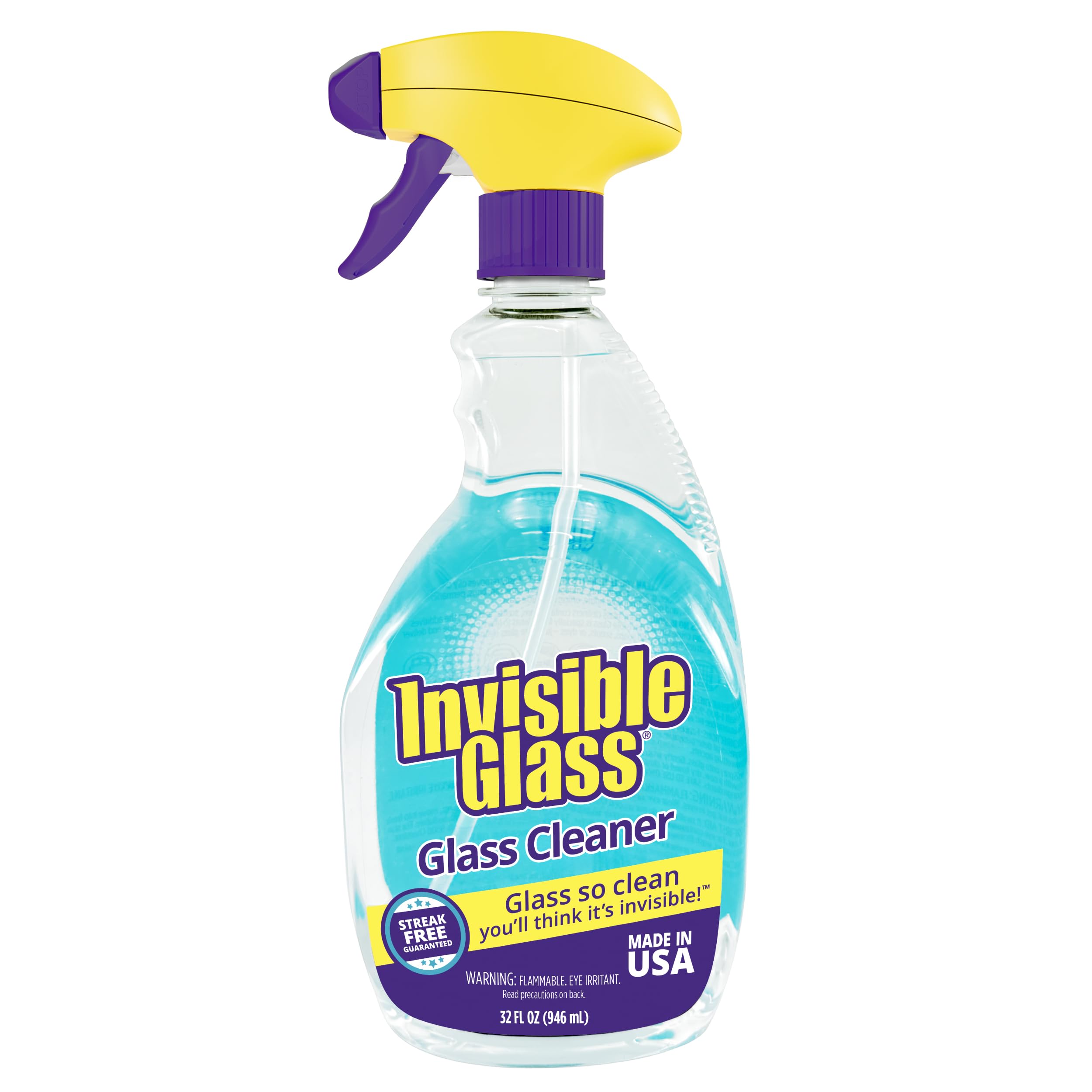
Read the back of most glass cleaners and you find something added to persuade you it worked: a lemon note, a blue dye, a soap meant to lift dirt that instead leaves a haze for you to buff away. Invisible Glass Home takes the other route. No soaps, no dyes, no added fragrance — just a clear, thin liquid and, on a clean dry cloth, nothing at all left on the glass.

That is why it is our pick for large home glass. On a full sliding door or a run of panes, the trigger lets you mist a section and wipe it in one motion, and there is no film left to catch the light at an angle — a finish that reads genuinely invisible. Against the Sprayway foam it is a different tool rather than a better one: less dwell on a baked-on mark, more speed across a lot of glass.

The 32-ounce bottle is one of the better values in this set, and the trigger is a proper fine mist rather than a jet, which is exactly what keeps it from running down the pane. Being ammonia-free means tinted film and a coated monitor screen are both fair game, and there is no fragrance to announce that you have been cleaning.

Bottom line: For big windows and anyone who would rather not smell their cleaner, this is the trigger we hand over: nothing added, nothing left behind.

Check Latest Price
#03

Best Refill

Hope's Perfect Glass Cleaner

96 /100
Kirk Score Outstanding
Size
67.6 fl oz
Format
Refill bottle
Ammonia-free
Yes
Tinted Glass
Safe to use
Check Details on Amazon

Pros

  • Refill size covers whole-house window days
  • Ammonia-free and safe on tinted film
  • Dries fast, so one pass clears the haze
  • Works on granite, stainless and shower doors

Cons

  • Sold as a refill with no sprayer included

Sixty-seven ounces is a lot of glass cleaner, and that is the pitch. Hope's arrives as a refill with no trigger of its own, meant to be poured into the sprayer you already own and trust. If you have a house with a lot of windows, a sunroom, or a car you actually wash, one bottle covers a run of cleaning days instead of a single afternoon.

The formula earns the size. It is ammonia-free, so tinted film and car glass do not haze, and it is one of the fastest-drying cleaners here — you wipe once and the film does not creep back as it flashes off. It also handles the surfaces around the glass: granite counters, stainless appliances, and shower doors clouded with soap scum.

Hope's advertises eleven strokes to clear a window where other cleaners take seventeen to seventy. Numbers like that come from the marketing department, but the useful part of the claim is not wrong: this is one of the least work-intensive cleaners in the set, and a big bottle means you stop rationing it. Pour it through a funnel, label the bottle, and keep one upstairs and one down.

Bottom line: Buy this if you go through glass cleaner fast: the refill size is the whole point, and the fast-drying, ammonia-free formula earns it.

Check Latest Price
#04

Best for Car Glass

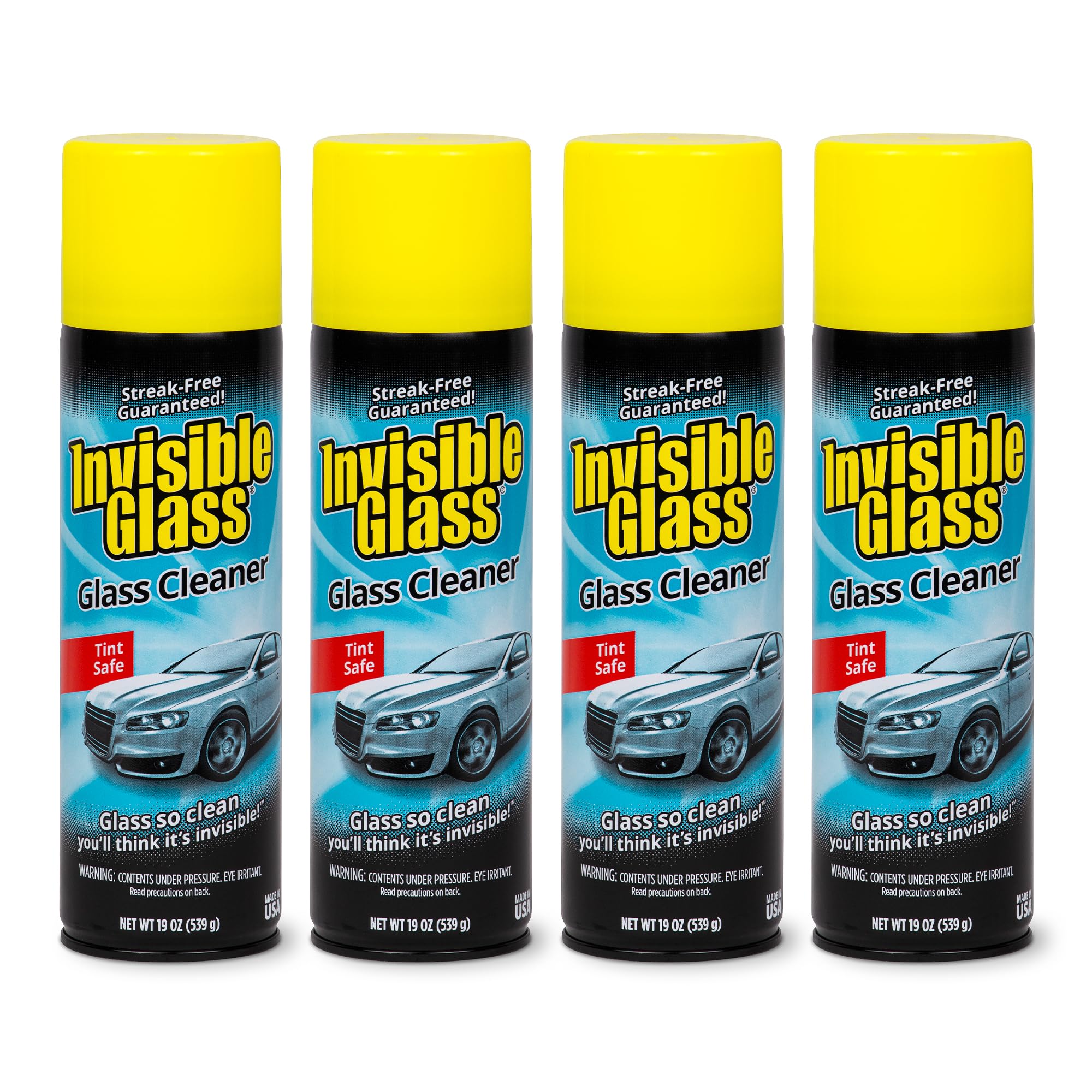
Invisible Glass Foaming Auto Cleaner

95 /100
Kirk Score Outstanding
Size
19 oz, pack of 4
Formula
Aerosol foam
Tint-safe
Yes
Ammonia-free
Yes
Check Details on Amazon

Pros

  • Foam clings to vertical auto glass
  • Tint-safe and ammonia-free
  • Cuts road film and interior haze
  • Works on mirrors and stainless too

Cons

  • Four cans is more than one car needs
  • Strong smell in a closed cabin

Windshield film is not dirt. It is the haze that builds up on the inside of auto glass from plasticizers, exhaust and sun, and a thin mist tends to push it around rather than lift it. This foam goes on thick, sits long enough to soften that layer, and wipes away in one direction instead of smearing in circles.

Tint is the other reason we keep a can of it around. It is ammonia-free and tint-safe, so film is not a worry, and the foam does not run down into door seams or window channels the way a liquid does. Outside the car it behaves like a perfectly ordinary glass cleaner: mirrors, a glass table, the stainless front of a dishwasher.

It is a finisher, not a stripper. On glass with real grit, tree sap or a winter of road salt, wash the worst off first and let the foam do the part that matters. A microfiber cloth is what turns the foam into a clear pane; a paper towel leaves the lint that makes people blame the cleaner.

For auto glass this is our pick, and it is not close: the cling, the tint safety and the way it cuts interior haze are exactly what a household trigger spray is bad at. The one thing to plan for is the smell — it is stronger than a home cleaner and it hangs in a closed cabin until the glass dries.

Bottom line: For a car, this is the can we keep in the garage: the foam stays on the glass, the formula leaves tint alone, and one pass does the work of two.

Check Latest Price
#05

Best for Quick Touch-Ups

Windex Original Glass Cleaner

96 /100
Kirk Score Outstanding
Size
23 fl oz
Formula
Trigger spray
Surfaces
Glass, mirrors, stovetops, doors
Check Details on Amazon

Pros

  • Starts lifting fingerprints on contact
  • Handles stovetops and doors, not just glass
  • Narrow bottle is easy to hold up high
  • Available anywhere, including on a grocery run

Cons

  • Needs a second buff on large or sun-warmed panes

Windex Original is the bottle most people already own, and the reason is simple: it starts breaking down fingerprints before the cloth arrives, it handles stovetops and chrome as happily as glass, and it is on every shelf in the country. As a general-purpose spray it is hard to argue with. As a window finisher it sits mid-pack in this set, and that is the honest summary.

Streaking is the arguable part. On a cool interior pane with a clean, dry microfiber, the classic blue finishes clear. On glass that is warm from the sun, or with a paper towel that is already damp, you will see haze — and haze is what turns a one-minute job into three. The cloth matters as much as the formula here, arguably more.

The bottle itself is made from recovered coastal plastic, a nice thing to see on something this ordinary, and 23 ounces is easy to hold at the top of a ladder. Where it loses ground to the picks above is scale: a picture window usually takes a second buff, where the foams and the additive-free trigger do not.

Bottom line: We still keep a bottle under the sink for fingerprints and stovetops; for a full window, keep a dry microfiber handy and expect a second buff.

Check Latest Price
#06

Screens and plastics

Glass Plus Glass Cleaner

96 /100
Kirk Score Outstanding
Size
32 fl oz, pack of 2
Ammonia-free
Yes
Clear Plastic
Safe to use
Computer Screens
Safe to use
Check Details on Amazon

Pros

  • Cleared for computer screens, plastic and plexiglass
  • Ammonia-free formula
  • Wipes streak-free on mirrors and monitors
  • Two large bottles per pack

Cons

  • Not for varnished surfaces

Glass Plus is unusually specific about what it is safe on beyond glass: computer screens, clear plastic, fiberglass and plexiglass. That matters more than it sounds. A monitor, a plastic storm-door panel and a fiberglass shower surround are exactly the surfaces people ruin by reaching for the nearest spray under the sink.

We rate it as the pick here for screens and plastics. It is ammonia-free, which is the property that matters on a coated panel, and the streak-free finish is strong — on a mirror or a monitor it wipes clear without the swirl a soapy general-purpose spray leaves behind. The scent is mild and a little sweet, and it fades fast.

The label carries one warning worth remembering: keep it off varnished surfaces, which rules out a lacquered table or a finished wood door frame. Otherwise it behaves like the rest of a sensible lineup — two 32-ounce bottles per pack, a trigger that mists rather than streams, and enough cleaner that you stop being stingy with it.

Bottom line: For monitors, plastic panels and plexiglass, this is the bottle we reach for — just keep it off anything varnished.

Check Latest Price
#07

Tinted windows

Windex Ammonia Free Glass Cleaner

96 /100
Kirk Score Outstanding
Size
23 oz
Scent
Crystal Rain
Formula
Trigger spray
Ammonia-free
Yes
Check Details on Amazon

Pros

  • Ammonia-free, so tinted film is safe
  • Soft Crystal Rain scent that fades
  • Dries quickly without residue
  • Goes on glass stovetops and shower doors

Cons

  • Sold as a single 23-ounce bottle

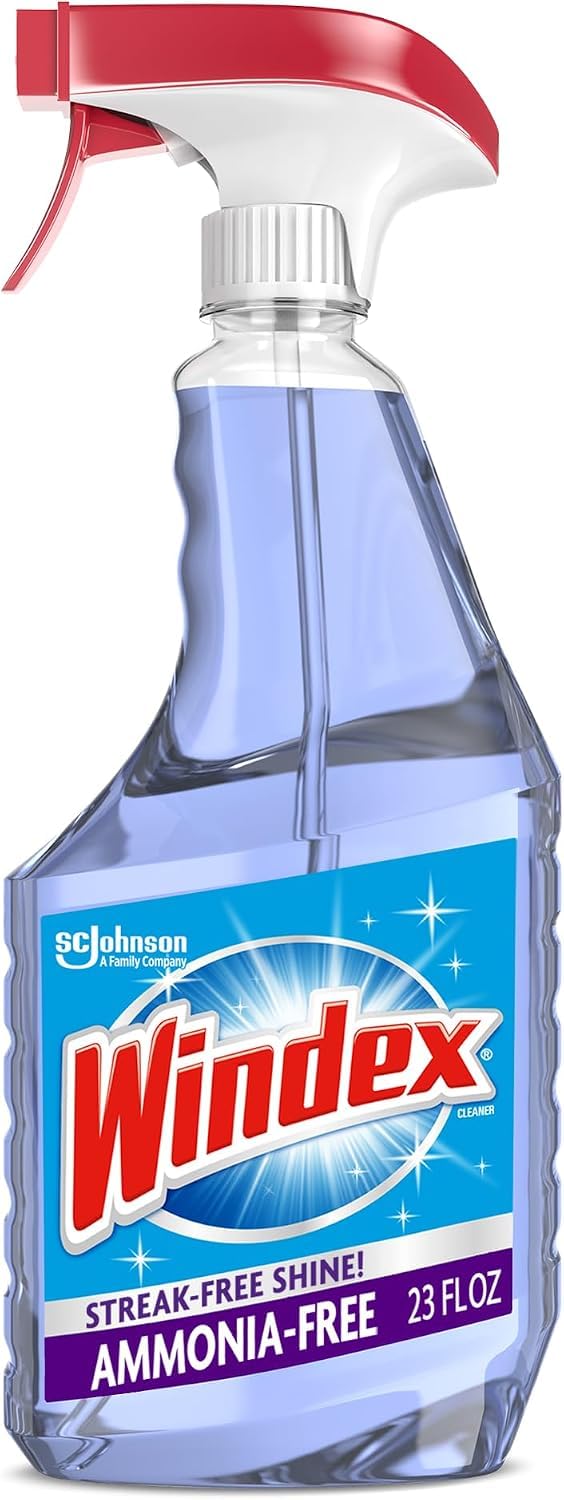
Two kinds of people end up with ammonia-free Windex: the ones who cannot stand the sharp smell of the original, and the ones cleaning tinted film or a coated screen where they would rather not risk it. It answers both. The Crystal Rain scent is soft and slightly sweet rather than chemical, and it fades quickly once the glass is dry.

Performance sits close to the classic and is a little better behaved on the surfaces that matter: mirrors and tinted glass come up clear without haze, and it dries fast enough that you are not standing there waiting for the film to flash off. A little goes a long way, so a bottle outlasts what the 23 ounces suggest.

Where it gives ground to the picks above is scale. It comes as a single 23-ounce bottle, so a house with a lot of glass will be reordering, and there is no bigger format to step up to. As the bottle that lives in the bathroom cabinet, or the one you can replace on a grocery run, it is the easiest ammonia-free option here to live with.

Bottom line: The ammonia-free Windex we keep in the bathroom cabinet: soft scent, quick dry, and gentle enough for tinted film and a car's interior glass.

Check Latest Price

How We Tested the Glass Cleaners

We started by rounding up the bottles people actually reach for — the familiar blue spray, foaming aerosols, ammonia-free formulas, a concentrate refill, and a couple labeled safe for tinted glass — then narrowed by claims we could check: streak-free, fast-drying, multi-surface. Sixteen bottles went into the cart and lived in our homes for three months. Testing happened where glass actually gets dirty: kitchen windows and a patio door a dog uses as a lookout, bathroom mirrors after hot showers, a shower door caked in hard-water film, car windshields covered in road film and bug splatter, and the occasional phone screen.

Each pane got taped into strips with painter's tape, one product per strip, all wiped with the same clean microfiber. We counted how many sprays it took to cover a pane, watched whether the mist landed where we aimed or drifted onto the frame and dripped, and checked every strip afterward at a low angle in direct sun, where haze and swirl marks show up. A dry-cloth buff on half of each strip told us whether a formula needed a second pass to finish clean. For value, we tracked how many panes a bottle got through before it ran out.

Sprayers got their own scrutiny: we noted triggers that dribbled down the neck, nozzles that clogged, and bottles that quit half full, and we left a few in a hot garage to see how the hardware held up. Scent was judged with the bathroom door closed — pleasant and gone beat sharp and lingering. And because a clean window that hazes over again in two days isn't really clean, we left half of several mirrors untouched and watched which ones stayed clear longer.

How to Choose a Glass Cleaner

Foam, Trigger Spray, or Refill

A clinging foam buys you time. On vertical glass — an exterior window, a windshield, the mirror over a bathroom sink — foam sits and softens the mark while you work, and it does not run down into frames or door seams. A trigger spray is faster across a lot of flat glass and gives you finer control of how much goes down, which is why it suits sliders and a bank of panes. Refills are the cheapest way to buy the liquid, but they assume you already own a sprayer you like.

Match the format to the glass you actually have. A house with storm doors, sliders and a sunroom justifies both a foam and a trigger. An apartment with four mirrors and a car window gets by with one bottle. If you clean windows twice a year, buy the small format and skip the case.

Streaks Are Usually Technique

Every cleaner here claims a streak-free finish, and nearly all of them can streak. The usual culprits are a cloth already damp with dirty cleaner, glass warm from direct sun, and paper towels that shed lint into the film. Two microfiber cloths — one to wet, one to buff dry — fix most of it. Working in shade fixes the rest.

What is in the bottle matters too. Formulas built around soaps, dyes or added fragrance have more to leave behind. A plain liquid like Invisible Glass Home has almost nothing that can dry into a haze, which is why it behaves so predictably on a big pane in full daylight.

When Ammonia-Free Matters

Ammonia is a strong degreaser and a sharp smell. On tinted film, coated screens and some plastics, an ammonia-free formula removes the risk of clouding or lifting an edge, which is why nearly every pick here is ammonia-free. What you give up is a little bite on baked-on grease — for a kitchen hood or a crusted stovetop, a dedicated degreaser does more than any glass cleaner.

If scent decides it, narrow to the additive-free bottles. If you like a fragrance, most mainstream formulas here carry one and it fades quickly once the glass is dry.

Sizes, Cases, and Storage

Glass cleaner is mostly water and solvent, so a big part of what you pay for is packaging and shipping. A case of aerosol cans is a garage purchase, a 32-ounce trigger is a cupboard purchase, and a 67-ounce refill is a commitment that only pays off if you genuinely clean windows more than once a year.

Check your storage before buying big. Aerosols want a spot away from heat and sun, refill bottles want a shelf where they will not get knocked over, and a case of six takes up more room than most people picture.

Frequently Asked Questions

Final Verdict

Sprayway's foam is the one we hand most people. It stays on the glass instead of running off it, finishes clear without a second buff, and handles the stainless and stovetop around the window as well as the pane itself — which is what makes it the default rather than just a good window cleaner.

If aerosols and a scent do not appeal, Invisible Glass Home is the trigger we buy instead: nothing added, nothing left behind, and a fine mist that covers a big pane in one motion. For a car, take the Invisible Glass foam — the tint-safe formula and the cling are worth the four-can case.