// data-verified

Best Grill Cleaners of 2026

A grill cleaner fails in one of two ways. The harsh kind cuts through baked-on grease but leaves your eyes watering and your hands stinging; the gentle, nice-smelling kind turns a ten-minute job into twenty minutes of scrubbing. What you want is the middle — something that loosens a summer of carbonized drippings on its own, without damaging stainless or cast iron.

My team and I worked through 14 grill cleaners over four months, from aerosol heavyweights to citrus sprays, on grates that had genuinely cooked all summer. What first-time buyers miss: a formula's strength matters less than whether it clings to the grate or runs straight off into the drip tray. Dwell time does most of the work — the brush just finishes it.

A few of these smelled like a chemistry lab, and more than one gentle formula gave up on cold grease. The ones that made the cut did the same thing: turned a half-hour chore into a five-minute wipe-down. Below are picks for gas grates, pellet smokers, flat tops, and stainless steel.

#01

Best Overall

Weber Grill Cleaner & Degreaser

89 /100
Kirk Score Excellent
Form
Ready-to-use spray
Size
16 fl oz
Formula
Non-corrosive, phosphate-free
Grate Materials
Stainless steel, porcelain enamel, cast iron
Check Details on Amazon

Pros

  • Safe on stainless, porcelain enamel, and cast iron
  • Non-corrosive, phosphate-free formula
  • Easy spray-and-wipe routine

Cons

  • May need a second pass on heavy carbon
  • Pricier per ounce than bulk liquids

For the ordinary mess after burgers or chicken, the Weber spray is the one we keep closest to the grill. It is made for cooking grates, including stainless steel, porcelain-enameled, and cast iron, and the formula is non-corrosive, non-flammable, and phosphate-free. That combination matters because a cleaner can cut grease and still leave a finish dulled or a grate needing a rinse you did not plan for.

What makes it our top pick is the balance of cleaning power and low drama. The spray wets a wide grate quickly, and the residue wipes away without the heavy chemical smell of a restaurant-grade aerosol. We used it as the default for weekly upkeep and saved the stronger foams for the spring teardown. It is the easiest of these to live with.

The 16-ounce bottle stores on a shelf without taking over, and the spray is easy to aim at the grate rather than the whole inside of the grill. For a backyard cook who wants one bottle for routine cleaning, this is the straightforward choice. The bottle and trigger feel ordinary, but ordinary is what you want when you are cleaning up after dinner.

Bottom line: For routine grate cleaning, the Weber is the spray we hand to a backyard cook first: it is easy to aim, safe on common grate finishes, and strong enough for everyday grease.

Check Latest Price
#02

Best for Burnt-On Grease

Diversey Break-Up Oven & Grill Cleaner

91 /100
Kirk Score Outstanding
Form
Clinging foam
Size
19 oz aerosol
Uses
Ovens, grills, broilers, vent hoods, fryers, griddles
Certifications
NSF listed, kosher certified
Check Details on Amazon

Pros

  • Clinging foam sticks to vertical surfaces
  • Cuts baked-on carbon with less scrubbing
  • NSF listed and kosher certified
  • 19 oz can covers a full grill

Cons

  • Cap can be stiff to remove

When the grate has a ridge of black carbon that a routine spray only polishes, the Diversey Break-Up is the can we pull out. It is a heavy-duty foaming degreaser for ovens, grills, broilers, vent hoods, fryers, and griddles, and the foam is designed to cling to vertical and hard-to-reach surfaces instead of running off. That is exactly where baked-on grease hides.

The foam does the work with less scrubbing than a thin spray, and the 19-ounce aerosol gives you enough coverage for a full grill rather than a single grate. We treat it as the deep-clean option: spray, let it sit, then wipe. It is NSF listed and kosher certified, which makes it a sensible choice for food equipment, not just a backyard grill.

This is a commercial-style cleaner, so we use it outdoors or with the garage open. For a grill that needs a reset, the extra power is worth the caution. It is not the bottle we reach for after every quick cook, but it is the one that makes a neglected grate look cared for again.

Bottom line: Our pick for baked-on carbon is the Diversey Break-Up, whose clinging foam does the heavy lifting on a grill that needs a full reset.

Check Latest Price
#03

Best Low-Fume Formula

Citrusafe BBQ Grill Cleaner

88 /100
Kirk Score Excellent
Size
16 fl oz
Formula
Citrus d-limonene
Application
Cool surfaces only
Grill Types
Gas, charcoal, pellet grills, smokers, griddles
Check Details on Amazon

Pros

  • Citrus d-limonene formula
  • Pleasant scent without harsh fumes
  • Works on gas, charcoal, and pellet grills
  • Leaves no greasy residue

Cons

  • Struggles with heavy carbon
  • 16-ounce bottle goes quickly on large grills

Citrusafe is the cleaner we reach for when the grill is already cooling and we want something that smells like orange peel rather than a chemistry lab. It uses d-limonene, a citrus solvent, and it is made for gas, charcoal, and pellet grills, smokers, and griddles. The citrus scent is the first thing you notice, but the formula is doing the real work.

The directions are specific: apply to a cool surface only, wait about a minute, then wipe. That makes it a post-cook or next-morning cleaner, not a hot-grate product. It is also phosphate-free and sold as a non-toxic alternative, which is the reason to choose it over a caustic foam when the mess is ordinary grease rather than a carbon ridge.

We like it for routine maintenance and for cooks who are sensitive to harsh fumes; the citrus smell stays pleasant rather than turning sharp. It is the low-fume option we are happiest using without a mask, and it leaves the grate ready for the next cook. The bottle feels less industrial than a restaurant aerosol, which is part of the appeal.

Bottom line: We reach for Citrusafe when the grate is cool and the smell of a harsh cleaner is the thing we want to avoid.

Check Latest Price
#04

Best for Frequent Grillers

Zep Heavy-Duty Oven & Grill Cleaner

93 /100
Kirk Score Outstanding
Form
Aerosol spray
Pack
12 cans
Uses
Ovens, grills, grates, drip pans
Not For
Aluminum, copper, chrome, painted surfaces
Check Details on Amazon

Pros

  • Restaurant-grade formula cuts baked-on carbon
  • Works on grills, grates, drip pans, and ovens
  • Good value in a 12-can pack
  • Wipes away grease with little scrubbing

Cons

  • Not for aluminum, copper, chrome, or painted surfaces
  • 12-can pack is more than casual cooks need

The Zep case is a restaurant supply in a box: twelve cans of a formula built to dissolve baked-on grease and carbon on grills, grates, drip pans, and oven interiors. It is the opposite of a single-purpose boutique spray, and that is the point.

We rank it as the best value here for someone who cleans often or has more than one grill, because the restaurant-grade formula has real power and the multi-pack keeps you supplied. It sprays where you need it and wipes away grease with little scrubbing. The formula is also built for ovens, grills, pot and pans, porcelain, ceramic, stainless steel, rotisseries, grates, and drip pans, so it earns shelf space beyond the barbecue.

The compatibility list is the part to read before ordering, because this is a restaurant-grade formula rather than a universal spray. If your grill fits the label's limits, the case is a practical way to keep a strong cleaner on hand. It is the pick for the person who would rather buy once and work through a box than shop for a new can every month.

Bottom line: Buy the Zep case if you clean often and want restaurant-grade power without hunting for a can; check the finish restrictions before you start.

Check Latest Price
#05

Best for Large Jobs

Quality Chemical Eliminator Oven & Grill Cleaner

88 /100
Kirk Score Excellent
Size
1 gallon
Not For
Aluminum, copper, galvanized metal, painted surfaces
Includes
Two empty quart bottles, two sprayers
Application
Spray or brush, 5-10 minute soak
Check Details on Amazon

Pros

  • Gallon kit includes two sprayers
  • Dilutes 1:1 for lighter jobs
  • Cuts grease on grills, ovens, and fryers
  • Ready to use at full strength

Cons

  • Not for aluminum, copper, galvanized metal, or painted surfaces
  • ⚠️ Can irritate skin; gloves are essential

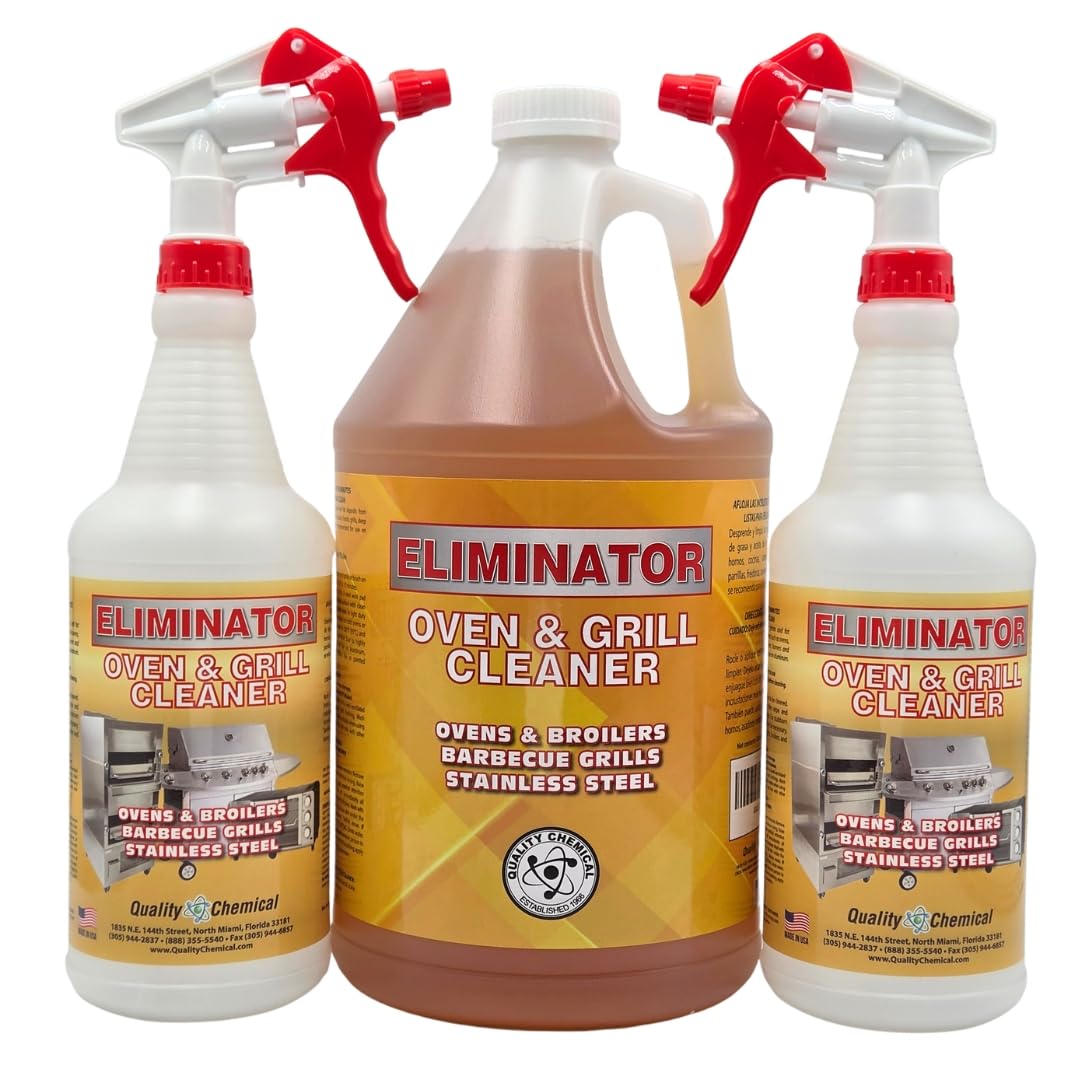
Quality Chemical sells the Eliminator as a gallon of ready-to-use cleaner with two empty quart bottles and trigger sprayers, which tells you it is meant to be decanted, stored, and used over a season. For someone who cleans several grills or a large smoker, that is more useful than another small aerosol.

It loosens grease and fat in minutes, and you can spray or brush it on, let it sit five to ten minutes, then wipe and rinse. For light jobs it can be diluted 1 to 1 with water; for heavier soil, use it full strength. It is aimed at ovens, broilers, barbecue grills, hoods, stoves, deep fryers, burners, and grates, so it covers more than a grate-only spray.

The gallon kit is the reason to choose it: you mix only what you need, and the included sprayers keep it practical. It is not the cleaner for a single grate and a quick wipe; it is for someone with a bigger cleaning routine. The bottle feels like a workshop supply, and the two quart bottles make it easier to keep one upstairs and one by the grill.

Bottom line: The Eliminator makes sense for a household with several grills and a place to store a gallon, as long as gloves and surface checks are part of the routine.

Check Latest Price
#06

Flat-top griddle cleaning

3M Scotch-Brite Griddle Cleaner

91 /100
Kirk Score Outstanding
Pack
40 x 3.2 oz packets
Clean Time
3-5 minutes
Application
Hot or cool griddle
Certification
Green Seal GS-53
Check Details on Amazon

Pros

  • Pre-measured 3.2 oz packets
  • Cleans hot or cool griddles
  • Green Seal GS-53 certified
  • Three-step system cleans in 3-5 minutes

Cons

  • 40-pack is more than occasional cooks need
  • Requires a separate scrubber and squeegee

The 3M Scotch-Brite packets are not for the grate of a gas grill; they are for a flat-top griddle, and that focus is exactly why they earn a place here. Each 3.2-ounce packet is a pre-measured dose of liquid cleaner for a hot or cool griddle, so there is no bottle to aim or dilute.

The system is squirt, scour, squeegee: apply the liquid, work it with a pad, then pull the residue off. The stated clean time is three to five minutes, and the liquid is designed to bubble and lift burnt-on food and carbonized grease on contact with a hot surface. Green Seal GS-53 certification is a meaningful plus for a cleaner used around food.

We like the packets for a flat-top because they remove the guesswork and the box stores neatly. For a dedicated griddle, it is a fast, controlled way to clean. The product feels more like a restaurant supply than a backyard accessory, which is appropriate for a flat-top that sees real volume.

Bottom line: For a flat-top griddle, the 3M packets are the cleaner we trust to be pre-measured, fast, and certified for food-contact surfaces.

Check Latest Price
#07

Clinging gel cleaning

Goo Gone Grill & Grate Cleaner

88 /100
Kirk Score Excellent
Form
Gel
Size
24 oz total, 2-pack
Formula
Biodegradable
Not For
Aluminum, faux stainless steel
Check Details on Amazon

Pros

  • Gel clings to angled and vertical surfaces
  • Biodegradable formula
  • Works on carbon, grease, and baked-on deposits
  • Two bottles in the pack

Cons

  • Not for aluminum or faux stainless steel
  • Narrow stream makes wide grates slow to coat

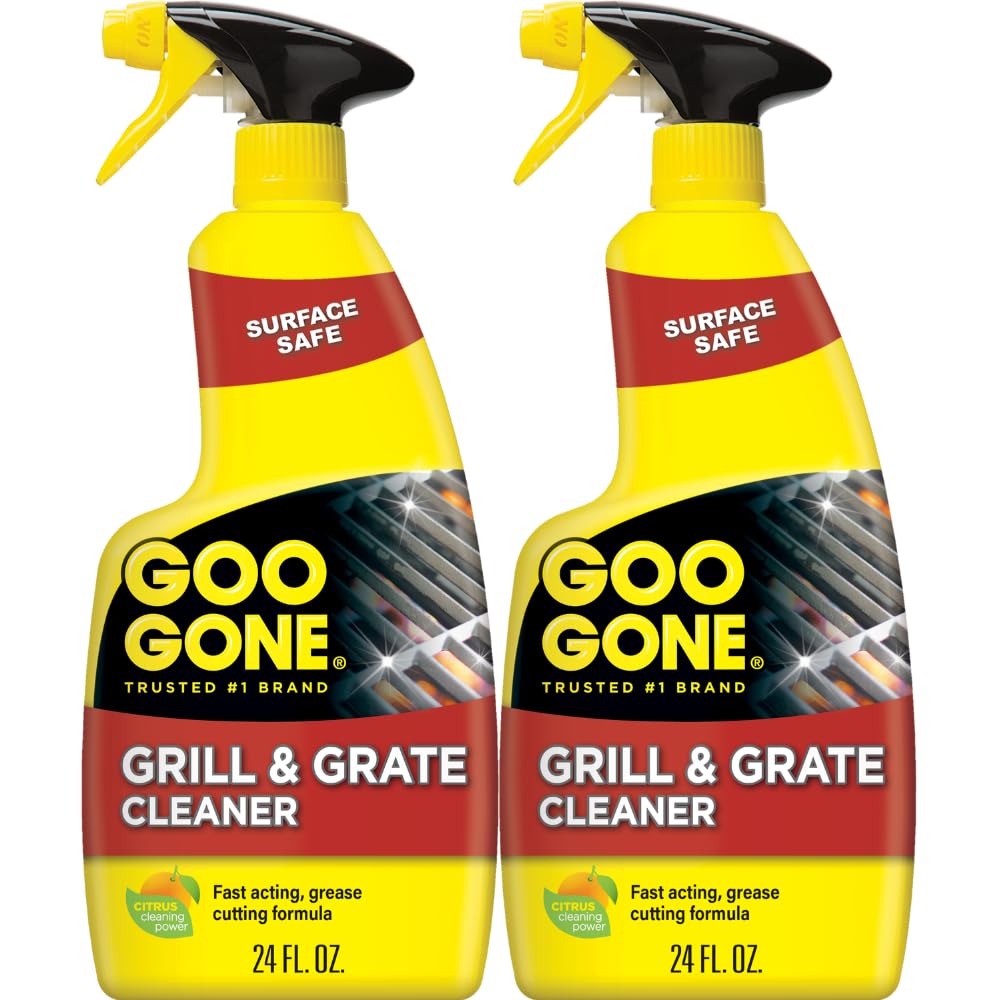
Goo Gone's grill cleaner is a gel, not a spray, and that texture is the reason to consider it: it stays where you put it on a tilted grate or a vertical interior panel instead of running straight off. The two-bottle pack is a gel formula aimed at caked-on food, baked-on deposits, carbon, and grease.

It is biodegradable and made for metals, cooking grates and racks, drip pans, and the interiors and exteriors of many popular grill brands. That makes it more versatile than a grate-only spray. The gel also gives you more control than a mist when you are trying to keep cleaner out of burners and off the deck.

A little goes a long way on a rack, and the gel can be worked into corners with a brush. The staying power is the point: it keeps working where a thin liquid runs off before it has a chance to lift the residue. It is the cleaner we reach for when the shape of the grill matters as much as the grease.

For a grill with a lot of vertical surfaces or a grate you cannot remove, we like the gel's staying power. It is not the fastest cleaner in the set, but it is the one that stays on the mess long enough to do something. That trade-off is worth it on a kettle lid or a smoker door.

Bottom line: Goo Gone's gel earns its spot in our kit for angled grates and vertical panels, where a thinner spray runs off before it works.

Check Latest Price

How We Tested the Best Grill Cleaners

I built the shortlist from spec sheets and surface-safety claims before I ever picked up a bottle, sorting roughly 30 formulas by what they're cleared for (cast iron, stainless, flat-top steel), whether they arrive as an aerosol, a trigger spray, or a concentrate, and what they cost per ounce. Anything that demanded heavy gloves just to open, or that only worked on a screaming-hot surface, got cut.

That left 14 cleaners, which we tested over four months against the same dirty grates. Saturday mornings after a Friday cookout were the main event — cold, tacky grease on cast iron — plus a flat-top griddle after a bacon breakfast, a pellet smoker's racks, and one oven interior that hadn't been touched since spring.

For each one, I sprayed a marked six-inch section of grate, timed the dwell, then wiped once with a paper towel before reaching for a brush; that single pass told me more about scrubbing-free performance than any label. I noted whether the foam clung or beaded off into the drip tray, whether the spray came out as an even mist or a spitting stream, and whether the nozzle clogged by the third use. After rinsing, I looked at the grates in raking light for leftover carbon shadow and for any dulling of the stainless.

Odor got its own check — I cleaned with the lid open in still air and noted whether the smell cleared in a minute or hung around. I also handled each formula bare-handed once to see which ones stung, counted how many full grates a single can or bottle covered, and left every trigger and aerosol cap in the garage all season to see which survived being knocked around.

How to Choose a Grill Cleaner

Match the Cleaner to the Grate Material

Grate material is the first filter, not a footnote. Stainless steel, porcelain-enameled cast iron, and bare cast iron tolerate many spray cleaners; aluminum and some painted or faux-stainless finishes do not. A cleaner that names your grate material on the label is a safer bet than one that only says grill. We treat a compatibility list as a hard stop: if a product warns against aluminum, it does not go on an aluminum grate no matter how well it cuts grease. The Weber names stainless, porcelain enamel, and cast iron; Goo Gone explicitly excludes aluminum and faux stainless.

Pick a Format You Will Actually Use

Sprays and aerosols are fastest for a wide grate; foams cling longer on vertical surfaces; gels stay where they are put but can be slower to spread; liquids and packets suit repeated or commercial-style cleaning. The best format is the one that gets used after a cook, not the one with the strongest claim. We keep a ready-to-use spray for weekly maintenance and switch to a bulk liquid or a heavy foam for a deep clean. If a spray trigger or nozzle is the weak point, a gel or a pour-and-brush liquid avoids that failure entirely.

Separate Routine Grease From Burnt-On Carbon

Most grill cleaning is fresh grease and a little char, which a mild spray can loosen in a minute or two. A thick carbon ridge is a different job: it needs a heavy-duty formula, a longer dwell, and usually a scraper or stiff brush. No cleaner turns a neglected grate into a new one without some mechanical work. For a flat-top griddle, use a product made for that surface; the pre-measured griddle packets in this guide are not a grate spray, and a grate spray is not the right tool for a wide flat plate.

Plan for Fumes, Gloves, and Ventilation

Heavy-duty cleaners earn their power from chemistry that can also sting skin and overwhelm a closed garage. Check the label for glove and ventilation instructions before you spray, and keep the grill outdoors or open the doors. A citrus or low-fume formula is a better fit for routine cleaning; save the restaurant-grade aerosol for the seasonal teardown. We also keep a dedicated rag or paper towel for the wipe-down so the residue leaves the grate instead of getting pushed around.

Buy for the Number of Grills You Clean

A single bottle is the right size for one backyard grill used a few times a week. A 12-can case, a 40-packet box, or a gallon kit only saves money if you will actually use it before it separates or gets lost in the garage. Count your grills and your cleaning sessions, not the shelf space. The best value is the format that matches your routine; for most households that is a mid-size spray plus one stronger bottle for the dirty jobs.

Frequently Asked Questions

Final Verdict

Start with the Weber if you want one bottle for routine grate cleaning. It is the easiest of these to live with: safe on common grate finishes, simple to spray, and strong enough for everyday grease. If you are staring at a thick carbon ridge, step up to the Diversey Break-Up; if you cook on a flat-top, the 3M packets are the better tool.

The Weber stays our default because it handles the weekly mess without turning grill cleaning into a ventilation project.