// data-verified

Best Reverse Osmosis Systems of 2026

A reverse osmosis system is the one thing in your kitchen that runs unattended for hours, holds gallons of water under pressure, and sits directly above whatever you store under the sink. So the first thing I check isn't filter count — it's whether the fittings hold. The second is whether the water still tastes like water afterward, because a system that strips everything out and leaves it flat has solved one problem and created another.

We spent the past eight months installing and living with nine of these, from tankless units that mount flat against the cabinet wall to old-style tanked systems and a countertop model that skips plumbing altogether. What separated them wasn't on the box: how long the install actually took, how fast a pot filled, and how much water each one sent down the drain to make a gallon of drinking water.

Here's what nobody tells a first-time buyer: gallon-per-day ratings assume near-ideal pressure, so cold winter tap water slows any of them down. The nine below are the ones that held up — and held water — through all of it.

#01

Best Overall

iSpring RCC7AK-BN

93 /100
Kirk Score Outstanding
Stages
6, with alkaline
Capacity
75 GPD
Filter Life
6 months
Certification
NSF/ANSI 58, whole system
Check Details on Amazon

Pros

  • Certified to NSF/ANSI 58 as a whole system
  • Alkaline stage restores minerals and pH
  • Faucet installs entirely from above the counter
  • Clear first-stage housing shows filter load

Cons

  • Feed water capped at 750 ppm and about 70 psi

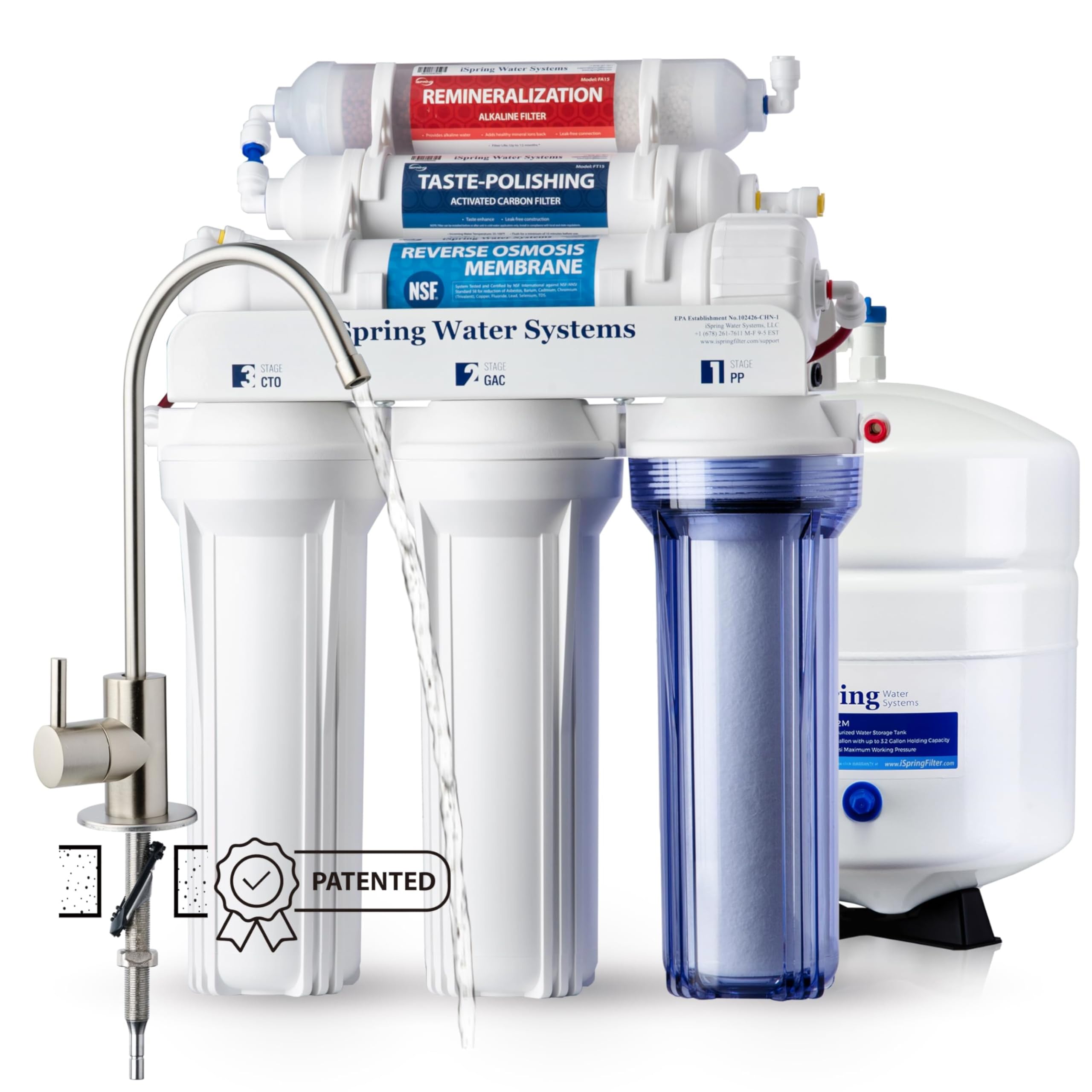
The fastener on this iSpring's faucet threads down from above the countertop, so the whole faucet install happens standing at the sink instead of lying on your back in the cabinet with a basin wrench across your face. We have fought enough faucet nuts to call that the most useful single thing about the RCC7AK-BN: it turns the step people abandon halfway through into ten minutes of work.

The rest of the package holds up. It is a six-stage system with an alkaline remineralization stage, certified to NSF/ANSI 58 as a complete system rather than piece by piece, rated at 75 gallons per day. Whole-system certification, mineral balance, and a midrange price is a combination nothing else here matches, which is why it is our default.

Flat, faintly acidic water is the standard complaint about reverse osmosis, and the AK stage exists to fix it — minerals go back in after the membrane and the pH comes up with them. We also appreciate the clear first-stage housing: you can see the sediment load building without opening anything, which makes the six-month filter cadence something you judge by eye rather than by calendar reminder.

The faucet is the weak point on this line. The same design that spares you the under-sink contortions can develop a drip or a pinhole leak, and the cure comes as a replacement part through iSpring's support rather than from the box. Feed water matters too: stay under 100 F and 750 ppm, and expect to want roughly 70 psi for the membrane to hit its rating — heavy sediment or a weak pump points you to the RCC7P-AK instead.

Bottom line: For most homes this is the system to buy: whole-system NSF certification, a mineral stage that fixes flat RO taste, and a faucet you can install from above the counter.

Check Latest Price
#02

Best Budget

Express Water RO5DX

0 /100
Kirk Score Fair
Tank
4 gallons
Capacity
50 GPD
Certification
NSF/ANSI 58 and 372
Feed-water Ceiling
300 ppm
Check Details on Amazon

Pros

  • Spare filter set and leak detector included
  • Least expensive complete system here
  • Four-gallon tank keeps flow fast at the tap
  • Color-coded tubing simplifies the install

Cons

  • Feed water limited to 300 ppm TDS

The box is what sells this one. Alongside the five-stage system you get a spare filter set and a leak detector, and the whole package costs less than any other complete system we recommend. For a first RO purchase, or a rental kitchen where you would rather not spend much on someone else's plumbing, that is a hard combination to argue with.

Underneath the extras it is a conventional, capable unit: 50 gallons per day, a four-gallon storage tank, NSF/ANSI 58 and 372 certification, and color-coded tubing that makes the plumbing easier to follow than most. The tank is the part people underestimate — it is what lets you fill a pot at full speed instead of waiting on the membrane to catch up.

Two things worth knowing. The feed-water ceiling is 300 ppm, the lowest in this group, so hard well water will chew through the filters early and this is not the system for that water. The chrome faucet is the budget piece of the kit, and drips at the base are the annoyance to watch for; a replacement faucet costs little and takes minutes to swap, so we would not let it change the decision.

Bottom line: Buy it if you want a complete, certified RO system for the least money here and your water sits under 300 ppm — the spare filters and leak detector seal it.

Check Latest Price
#03

Best Tankless With Remineralization

Frizzlife PD600-TAM3

92 /100
Kirk Score Outstanding
Capacity
600 GPD
Drain Ratio
2:1 pure to drain
Certification
NSF/ANSI 58, 53, 42, 372
Remineralization
Alkaline third stage
Check Details on Amazon

Pros

  • Alkaline stage restores minerals and taste
  • 600 GPD with a 2:1 pure-to-drain ratio
  • Display shows live TDS and filter life
  • Tankless housing frees under-sink space

Cons

  • Costs more than any tank-based pick here
  • No reserve tank, so flow stays near 0.41 gpm

Tankless systems trade a storage tank for a pump, and they usually trade taste away with it: with no mineral stage, the water arrives flat and slightly acidic because the membrane takes the calcium and magnesium out along with everything else. Frizzlife's answer is an alkaline cartridge in the third position of the stack, putting minerals back before the water reaches the faucet.

The hardware is genuinely compact — 14.7 by 5.3 by 15.5 inches, nothing to find room for — and rated at 600 gallons per day, which works out to about 0.41 gallons a minute at the tap. A 2:1 pure-to-drain ratio means two gallons made for every one sent down the drain, and the LED panel reports live TDS plus the remaining life of each cartridge.

Of the tankless units here, this is the one we reach for first, and the remineralization is why. It is the difference between water that tastes like nothing and water you want to drink straight from the tap, and you do not hand over your under-sink storage to get it. The filter changes need no tools, which matters more than it sounds once the cabinet is full of dishwasher hose.

The connections deserve attention at install. The push-fit elbow and the faucet base are the two spots that can weep, so seat the elbow fully and check both with a dry paper towel after the first few draws. Filters swap in seconds, and the display takes the guesswork out of when.

Bottom line: The tankless pick for people who care what the water tastes like: minerals go back in, the display tells you the truth, and no tank eats your cabinet.

Check Latest Price
#04

Best for Low Water Pressure

iSpring RCC7P-AK

93 /100
Kirk Score Outstanding
Stages
6, with alkaline
Capacity
75 GPD
Booster Pump
Included
Feed-water Ceiling
2000 ppm
Check Details on Amazon

Pros

  • Booster pump holds output on low pressure
  • Alkaline stage balances taste and pH
  • 2,000 ppm feed-water ceiling
  • Twelve months between filter changes

Cons

  • Prefilter housing can develop hairline cracks

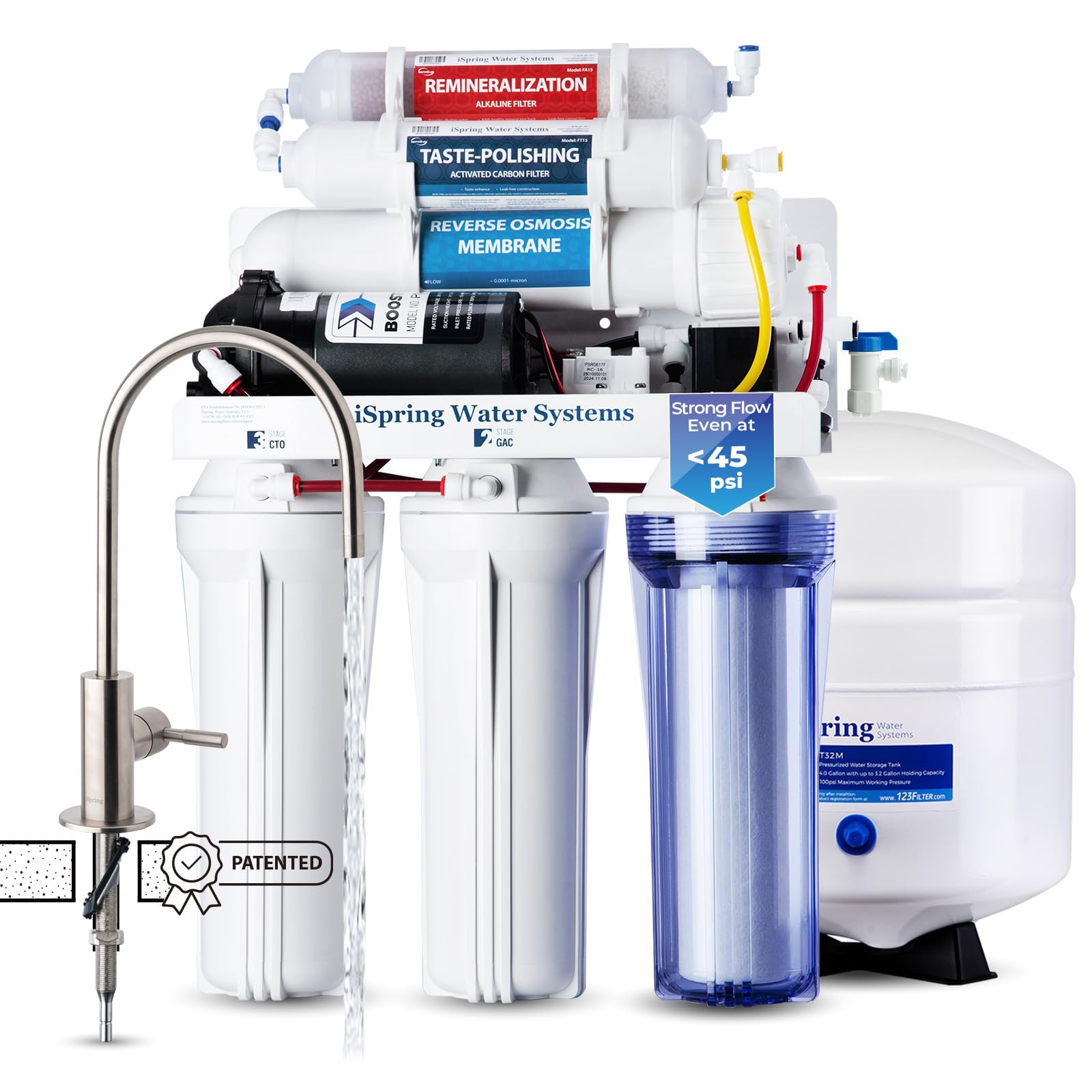
A booster pump is the difference between an RO system that works and one that dribbles. The RCC7P-AK puts an electric pump ahead of the membrane so a house on a well, or one with limp pressure at the kitchen tap, still fills a tank instead of producing a trickle that never catches up with the day's drinking water.

Everything else follows the iSpring formula: six stages with the alkaline remineralization filter, 75 gallons per day, a 12-month filter interval, and a feed-water ceiling of 2,000 ppm that only the APEC below matches. It weighs about 20 pounds and wants a 15 by 8 inch footprint plus an outlet for the pump's 100 to 240 volt adapter.

That pump brings hardware with it: another cord, another pair of connections to check for drips, and a bit of noise when it kicks on in a quiet kitchen. In exchange the membrane keeps working at pressures where a pumpless system slows to a crawl and stretches every gallon you draw across a longer wait.

Put together, the pump and the alkaline stage make this the strongest choice here for a house with weak pressure, and the 12-month filter interval means you are not paying for that convenience twice a year. If your tap already runs at full force, the standard RCC7AK does the same job with less hardware.

Bottom line: For a well or a weak kitchen tap, this is the one: the booster pump keeps a 75 GPD membrane at full output, and the alkaline stage protects the taste.

Check Latest Price
#05

Best for Tight Under-Sink Spaces

Waterdrop G2

90 /100
Kirk Score Outstanding
Capacity
400 GPD
Footprint
17.3 x 5.9 x 14 in
Drain Ratio
1:1 pure to drain
Certification
NSF/ANSI 372
Check Details on Amazon

Pros

  • Cheapest tankless unit we recommend
  • Narrow housing fits beside a disposal
  • Filters change quickly with no tools

Cons

  • Certified to NSF/ANSI 372 only, not 58
  • 1:1 pure-to-drain ratio wastes more than 2:1

Tankless RO usually costs the most in a lineup like this. The G2 does not. It is the least expensive tankless unit we recommend, and it still gets the storage tank out of your cabinet, which is the entire point of going tankless in the first place. If space is the problem you are solving, this solves it for the smallest outlay.

Four hundred gallons per day, seven stages, and a footprint of 17.3 by 5.9 by 14 inches — narrow enough to slide in beside a disposal and shallow enough to leave the back of the cabinet usable. Waterdrop reckons about 12 seconds to fill a cup, which is honest about what a tankless unit can do at the faucet.

The pump makes itself heard when it cycles, and that is the trade for having no tank: in an open-plan kitchen you will notice it, while a closed cabinet softens most of it. Flow is the other thing to picture — steady and adequate rather than forceful, so filling a big pot is a slower job than it is with a tank model.

Bottom line: The budget route to tankless: no tank, a narrow housing, and 400 gallons a day for less than the other tankless picks here.

Check Latest Price
#06

Best Countertop, No Installation

Bluevua RO100ROPOT

91 /100
Kirk Score Outstanding
Footprint
10.9 x 15.4 x 14.3 in
Filter Life
12 to 24 months
Installation
Countertop, no plumbing
Certification
WQA and NSF
Check Details on Amazon

Pros

  • No plumbing or drilling required
  • Remineralization filter included
  • Borosilicate glass carafe instead of plastic
  • Filters rated for 12 to 24 months

Cons

  • Fills one carafe at a time, no big volumes
  • Carafes have stopped short of full on some units

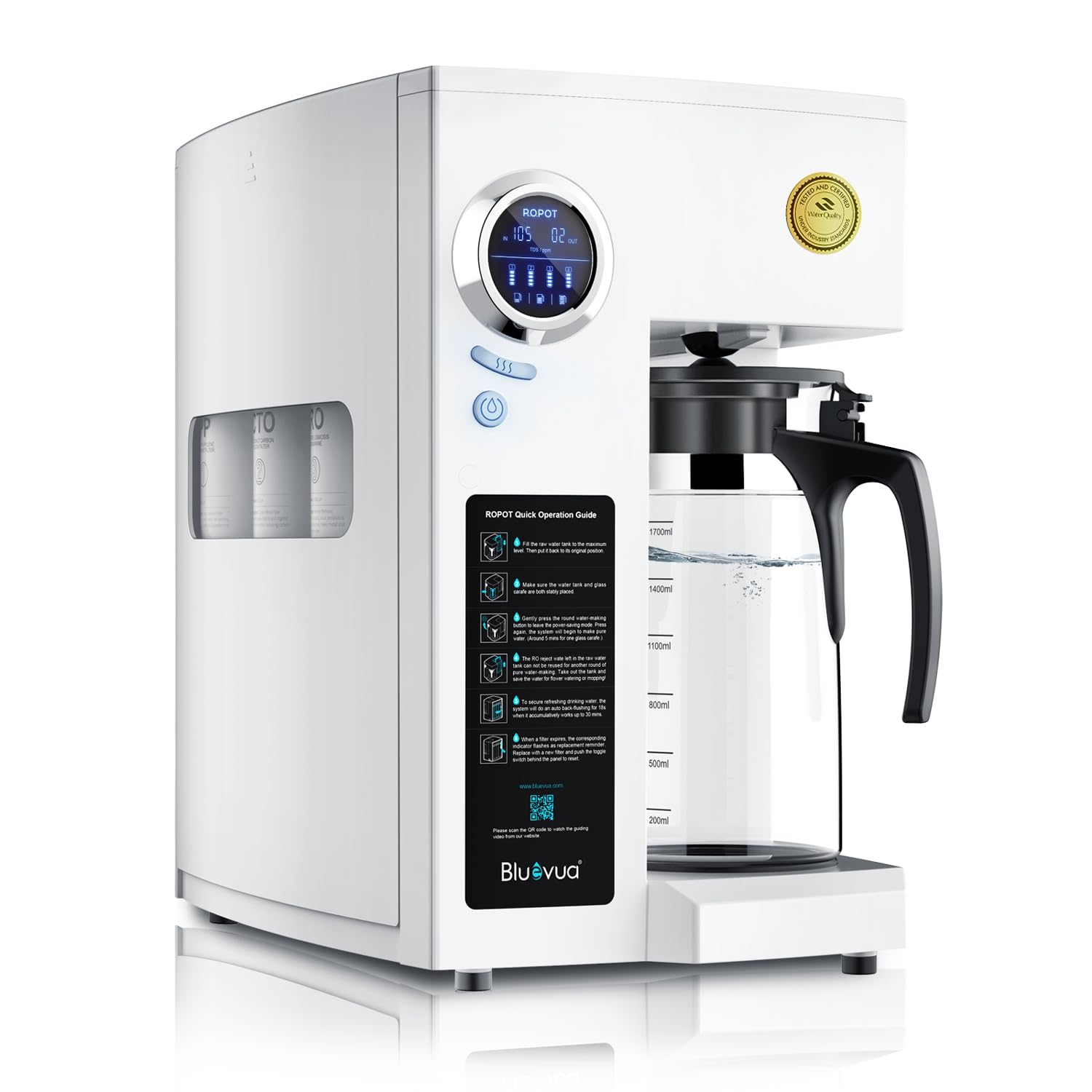
No plumbing, no drain saddle, no hole in the counter — the RO100ROPOT sits on the counter and makes its own water, and what it fills is borosilicate glass rather than another plastic pitcher destined for the fridge door. For a rental, a small apartment, or a kitchen where nobody is drilling through the countertop, that is the whole argument in one box.

Inside, five stages including a remineralization filter, a feed-water ceiling of 1,000 ppm, and a 0.26 liter per minute production rate. Filters are rated for 12 to 24 months, long enough that the upkeep feels closer to owning a pitcher than to owning an appliance. It weighs about 11 pounds and measures 10.9 by 15.4 by 14.3 inches, so plan on giving it real counter space.

We like it for the people the under-sink options cannot help: renters, small kitchens, anyone whose landlord has opinions about holes. It asks nothing of your plumbing or your tools, the mineral filter keeps the water from tasting stripped, and the water that comes out holds up against the plumbed picks in this guide. It is priced like a premium under-sink system despite making less water at a time, and that premium is what you pay for zero installation.

Bottom line: For renters and anyone who can't drill, this is the system to get: no plumbing, a glass carafe, and water that tastes like the plumbed picks.

Check Latest Price
#07

Water-quality monitoring

Waterdrop G3P600

91 /100
Kirk Score Outstanding
Faucet
Smart TDS display
Capacity
600 GPD
Drain Ratio
2:1 pure to drain
Certification
NSF/ANSI 42, 53, 58, 372
Check Details on Amazon

Pros

  • Live TDS readout on the faucet
  • NSF/ANSI 42, 53, 58 and 372 certified
  • 2:1 pure-to-drain ratio
  • Tankless housing frees cabinet space

Cons

  • Highest price in this group
  • Internal connections can develop drips

The faucet reads out TDS every time you draw a glass, which sounds like a gimmick until a membrane starts failing quietly and nobody notices for a month. You see the number move, and you know before the water starts tasting off or the ice cubes go cloudy.

That readout is the feature we appreciated most, and it sits on the broadest certification set in this group — NSF/ANSI 42, 53, 58, and 372 — with eight stages, a 2:1 drain ratio, and a 1,500 ppm feed ceiling. On paper it is the most complete tankless system here, and the filter changes take seconds with no tools and nothing to move out of the way.

Where it gives ground is in the living-with-it details. The pump is audible while it runs, and a glass fills more slowly than a 600-gallon-per-day rating suggests, so the number on the box does not translate into a torrent at the faucet. The 87 psi rating and the 1,500 ppm ceiling do mean it tolerates worse water than the budget tankless pick.

Bottom line: If you want to watch your water quality in real time and you have the budget for it, this is the most fully certified tankless system here.

Check Latest Price
#08

High-TDS wells

APEC ROES-50

91 /100
Kirk Score Outstanding
Capacity
50 GPD
Certification
NSF/ANSI 58 and 372
Feed-water Ceiling
2000 ppm
Operating Pressure
40 to 85 psi
Check Details on Amazon

Pros

  • 2,000 ppm feed-water ceiling
  • Push-connect fittings and color-coded tubing
  • Certified to NSF/ANSI 58 and 372

Cons

  • Plastic filter housings can crack

Two thousand parts per million. That is the feed-water TDS ceiling APEC lists for the ROES-50, and in this group only the iSpring pump model matches it. If your well tests high and someone has told you a reverse osmosis system cannot cope with it, this is the listing to read next to your test results.

Fifty gallons a day, five stages, NSF/ANSI 58 and 372 certification, and an operating range of 40 to 85 psi. The fittings are push-connect with colored tubing, which is why this one has the reputation it does as an easy afternoon install, and at 15.5 by 5.25 by 17 inches with a shipping weight around 25 pounds it is manageable for one person under a sink.

Fifty gallons is the slowest recovery here, which sounds worse than it lives: the storage tank means you draw at full pressure while the membrane refills in the background, so the number only bites when the house empties the tank faster than it can catch up. Everything else about the install is friendly — labeled parts, push fittings, no threading pipe.

What keeps it out of the higher tiers is what you give up: no mineral stage and no top-mounted faucet, the two conveniences the iSpring brings for about the same money. What it does have is a tolerance for difficult water and plumbing that is hard to get wrong, and for a house on a mineral-heavy well that trade reads the other way around.

Bottom line: For a high-TDS well, this is the system to shortlist: a 2,000 ppm ceiling and push-fit plumbing make it forgiving of bad water and easy to install.

Check Latest Price

How We Tested the Best Reverse Osmosis Systems

We started by pulling every under-sink and countertop system we could find that had third-party certification behind its claims — NSF/ANSI 58 for the membrane itself, plus 42, 53, and 372 where the listing backed them up — then cut anything with murky filter pricing or a footprint too wide for a standard cabinet. That left nine: five-stage setups, tankless units, and one countertop model, some with a remineralizing stage and a smart faucet, some deliberately basic.

Every unit went into a real kitchen, including a 1950s house with hard water where the shutoff valve had to be replaced before anything could be connected. We timed each install solo with a stopwatch, counted the trips to the hardware store, and noted where the manual diverged from what the fittings actually required.

For two weeks after each install, I laid a dry paper towel under the system every morning and checked it again before bed, then weekly after that. Flow got measured the way you'd use it: how long a quart took, whether a stockpot was full before the pasta water boiled, whether the tank ran dry refilling a coffee maker mid-brew. I also stood beside each one during a work call to hear whether the pump carried into the next room.

Water quality was the part we argued about. We took TDS readings from the tap, straight out of the system, and after the remineralizing stage, then ran blind side-by-side tastes against tap and bottled water. We totaled a year of replacement filters and divided by the gallons we actually drew, and at the end of eight months we checked every fitting for seeping, housings for cracking, and filter-change reminders for accuracy.

How to Choose a Reverse Osmosis System

Start With Where It Can Live

Under-sink systems come in two shapes. Tank models pair a membrane with a pressure tank, and the tank is what eats the cabinet; check the unit's listed dimensions and your cabinet's interior height before ordering, because several of these run 17 to 18 inches tall. Tankless units drop the tank but not the plumbing — they still need a feed line, a drain connection, and, unlike the tank models, a power outlet inside the cabinet.

The trap is the word compact. A tankless housing that saves most of the under-sink space still needs somewhere to plug in, and if your only outlet sits behind the disposal you'll want an electrician or a different unit. Countertop models like the Bluevua skip the cabinet entirely, at the cost of throughput.

Read Gallons Per Day Correctly

The GPD number is a daily production rating, not a faucet speed. A 50-gallon system with a four-gallon tank fills a glass as fast as your plumbing allows because the water is already waiting and the membrane catches up later. A 600-gallon tankless unit makes water as you draw it, which works out to something under half a gallon a minute: fine for a glass or a pot of coffee, slower on stockpot night. Match the number to your peak draw, not to the total you drink in a day.

Certification, Stages, and Minerals

NSF/ANSI 58 is the standard that covers a whole reverse osmosis system, and the word whole is doing the work — a listing that certifies a single component tells you less than one that certifies the system. NSF/ANSI 372, which appears on nearly every unit here, only covers lead-free materials and says nothing about what the membrane removes.

Then there's what gets taken out and put back. The membrane strips calcium and magnesium along with the contaminants, so an alkaline or remineralization stage is the difference between flat water and water you look forward to. We think it's worth having, which is why both of our top under-sink picks include one.

Pressure, Waste, and Running Costs

Two numbers decide how the system behaves in your house. Feed pressure drives the membrane: most of these want 40 to 85 psi, and a well or a weak tap is exactly where a booster pump like the one in the iSpring RCC7P-AK earns its money. The pure-to-drain ratio decides how much water you send down the drain per gallon made, and 2:1 is twice as efficient as 1:1.

Then budget for cartridges every 6 to 12 months. The sediment and carbon stages go first; the membrane lasts years. A leak detector puck under the cabinet costs little and is the one accessory we suggest to every buyer.

Frequently Asked Questions

Final Verdict

The iSpring RCC7AK-BN is the system we recommend to most people because it does the three things that matter at once: whole-system NSF/ANSI 58 certification, an alkaline stage so the water doesn't taste flat, and a faucet you install from above the counter instead of underneath it.

If your pressure is weak or your water comes from a well, the RCC7P-AK is the same idea with a pump bolted on. If you can't drill, the Bluevua does the job from the countertop.