// data-verified

Best Spray Foam Insulation Kits of 2026

I noticed it first at the rim joist in my basement: a cold seam of air that no amount of fiberglass batts would stop. Spray foam is the fix for exactly that leak, expanding into the gap and curing into a solid layer that seals and insulates in one pass. Over the past six months, my team and I have worked through 10 kits, from single-gun two-part sets to 24-can bundles, in basements, attics, and around windows and doors.

The thing first-timers get wrong is the coverage math. A kit's board-foot rating assumes a specific depth, so a bundle claiming 480 square feet may hit that only at an inch thick — go deeper and you run short mid-wall. Closed-cell foam also gives you roughly double the R-value per inch of open cell, and a Class A fire rating is worth checking if the foam lands near an attic or mechanical room. The picks below are the ones that got the math, the adhesion, and the cleanup right.

#01

Best Overall

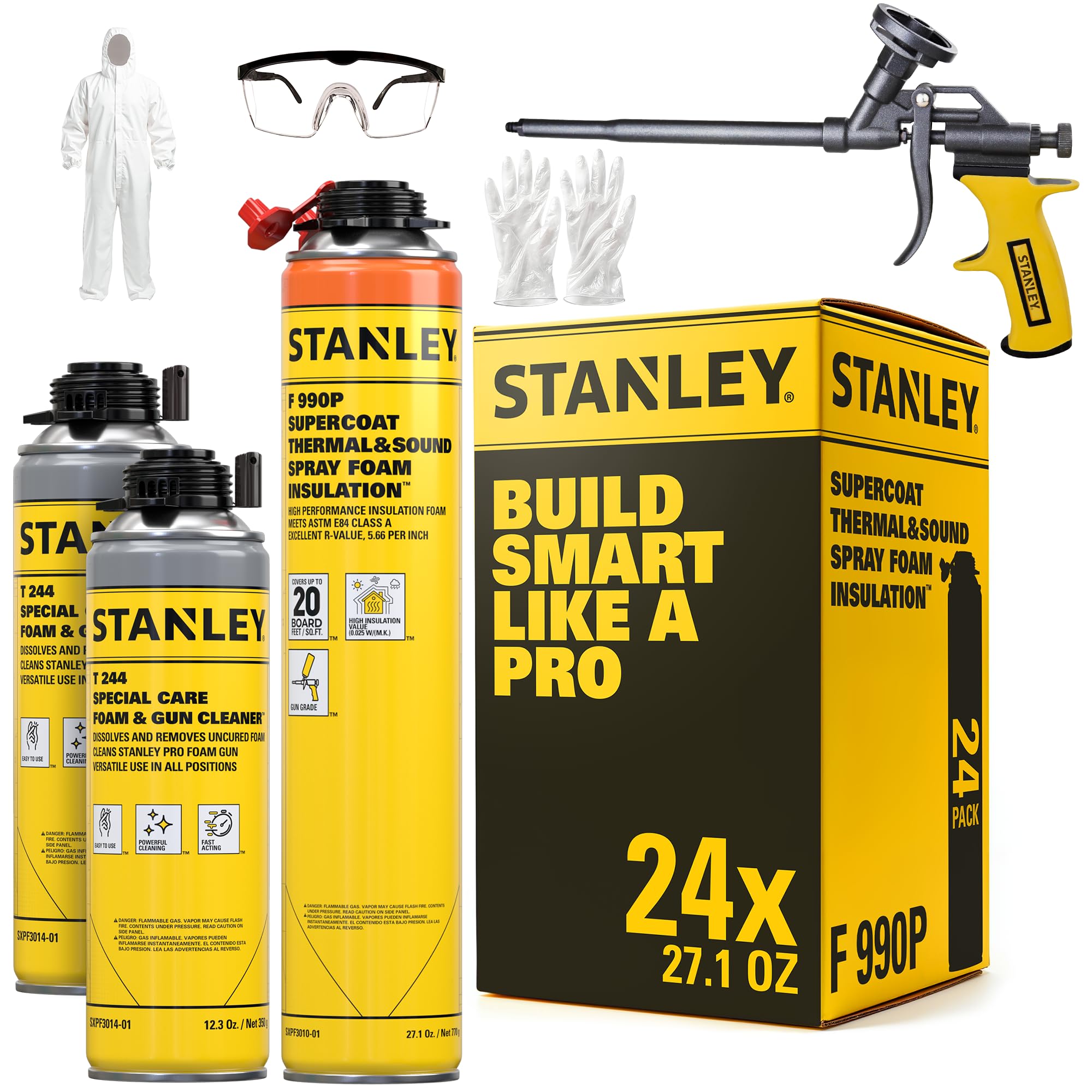
STANLEY F 990P Supercoat 24-Pack

84 /100
Kirk Score Excellent
R-Value
11.32 at 2 in
Coverage
Up to 480 sq ft
Fire Rating
Class A (ASTM E84)
Kit Contents
24 cans, gun, 2 cleaners, PPE
Check Details on Amazon

Pros

  • R-11.32 at two inches, among the highest here
  • Class A fire rating per ASTM E84
  • Gun, two cleaners, and full PPE in the box
  • 24-can format lets you spray in stages

Cons

  • Coverage claim is not tied to a spray depth

R-11.32 at two inches is the figure that settled this one. Two other kits here reach the same number, and neither arrives with as complete a box: 24 cans at 27.1 ounces, an applicator gun, two cans of foam cleaner, gloves, glasses, and a suit. Open it, read the sheet, and you are spraying.

The gun matters more than the can count, and it is the part we check first, because a clogged gun ends a job as surely as an empty can. Two cans of cleaner for 24 cans of foam is enough to flush between fills and again at the end, which is how a box gets finished without a second trip. The Class A rating per ASTM E84 covers the fire question, and the listed surfaces run from walls and ceilings to basement and roof — roughly where a homeowner actually sprays.

Where it earns its place is a two-inch application: a garage wall, a run of rim joist, an attic floor between joists. That is the depth the R-value is quoted at, and the depth where closed-cell foam does the air-sealing work that batts cannot do on their own.

Do the arithmetic before you order. Twenty-four cans at 27.1 ounces is a fixed quantity of foam, and at two inches it covers roughly half the area the front of the box suggests, so a two-car garage ceiling is a multi-box job. That is true of every kit on this page rather than a knock on this one — it is just cheaper to discover on paper than at the end of the third case.

Bottom line: The kit we point most DIYers to for a wall or attic: R-11.32 at two inches, Class A rated, and a box that already contains the gun and the cleaners.

Check Latest Price
#02

Best Two-Component Kit

Froth Pak 630 Two-Component Kit

83 /100
Kirk Score Excellent
Format
Two tanks, 15 ft hose, applicator
R-Value
6.2 per inch
Coverage
630 board ft at 1 in
Fire Rating
Class A up to 2 in
Check Details on Amazon

Pros

  • 6.2 per inch, the best R-value here
  • 630 board feet at an inch, the most coverage
  • Applicator, 15 ft hose, and 12 nozzles included
  • Cures in about 30 seconds; re-entry in an hour

Cons

  • Highest cost in this set by a wide margin
  • 630 sq ft is a one-inch figure; two inches halves it

This is the only kit on the page that is not a case of aerosol cans. Two pressurized tanks, A and B, feed a single applicator through 15 feet of hose, which means the tanks stay by the door while you work the gun into the cavity.

That format buys the best thermal performance here: R-6.2 per inch, or 12.2 at two inches, against 11.32 for the can kits. It also buys speed, with the foam curing in about 30 seconds and re-entry allowed in an hour with proper ventilation. For a crawl space or a room you need back the same day, that is the entire argument.

The hardware is a step up too. Four fan nozzles and eight cone nozzles let you move from a broad pass on a wall to a narrow bead in a gap without improvising, and the hose keeps the tanks out of the space you are spraying — a detail that matters more than it sounds once you have held a can overhead for an hour.

It costs more than anything else here, and the tanks ship with a signature required, so plan to be home the day they land. For a whole attic or a crawl space you want finished in one push, though, the per-square-foot maths holds up and the Class A rating carries to two inches.

Bottom line: Buy this when the job is big enough to do in one continuous push and you want the best R-value per inch here plus a cure you can walk back into within the hour.

Check Latest Price
#03

Best Complete Kit

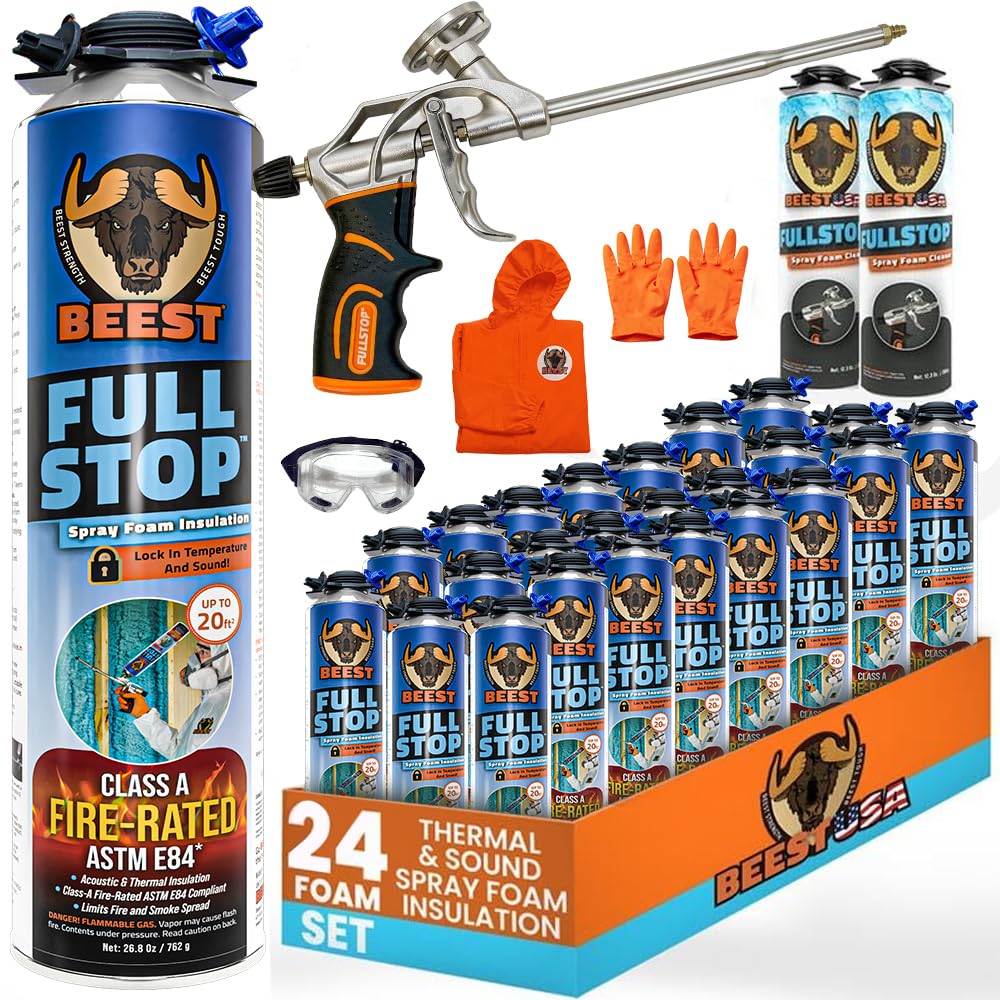
BEEST FullStop 480 Kit

85 /100
Kirk Score Excellent
Coverage
480 board ft
Case Weight
53.2 lb
Fire Rating
Class A (ASTM E84)
Kit Contents
24 cans, gun, 2 cleaners, PPE
Check Details on Amazon

Pros

  • Flame-spread index of 0, Class A rated
  • Gun, two cleaners, and full PPE included
  • 480 board feet across 24 cans
  • Bonds to wood, metal, drywall, and masonry

Cons

  • No R-value figure published

Everything needed to start is in the box, down to the coverall: 24 cans, a gun, two cans of cleaner, gloves, glasses, and a full suit. That is the detail that makes this the kit we hand to someone who has never held a foam gun before.

The foam is a moisture-cured polyurethane that bonds to wood, metal, drywall, concrete, and brick, with 480 board feet across the case. It is Class A per ASTM E84 with a flame-spread index of 0 and a smoke developed index of 120 — the flame-spread number is the one worth quoting, and zero is as low as the scale goes.

Expansion is the variable to plan around. This foam goes where you put it rather than puffing far past the bead, so on a deep void lay in two passes and let the first set before adding the second, instead of expecting one pass to fill the bay. The listed application window is 68°F to 77°F, which means a warm room rather than a cold garage in November.

The case is 53 pounds, so carry it in two trips and stage cans beside the work area rather than dragging the box up a ladder. Where it sits ahead of the cheaper 24-can kits is that start-to-finish completeness: mask up, load a can, go, and a pause does not cost you a gun.

Bottom line: The kit we hand someone who has never held a foam gun: everything from the gun to the coverall is in the box, and the flame-spread index is zero.

Check Latest Price
#04

Best for Big Attics

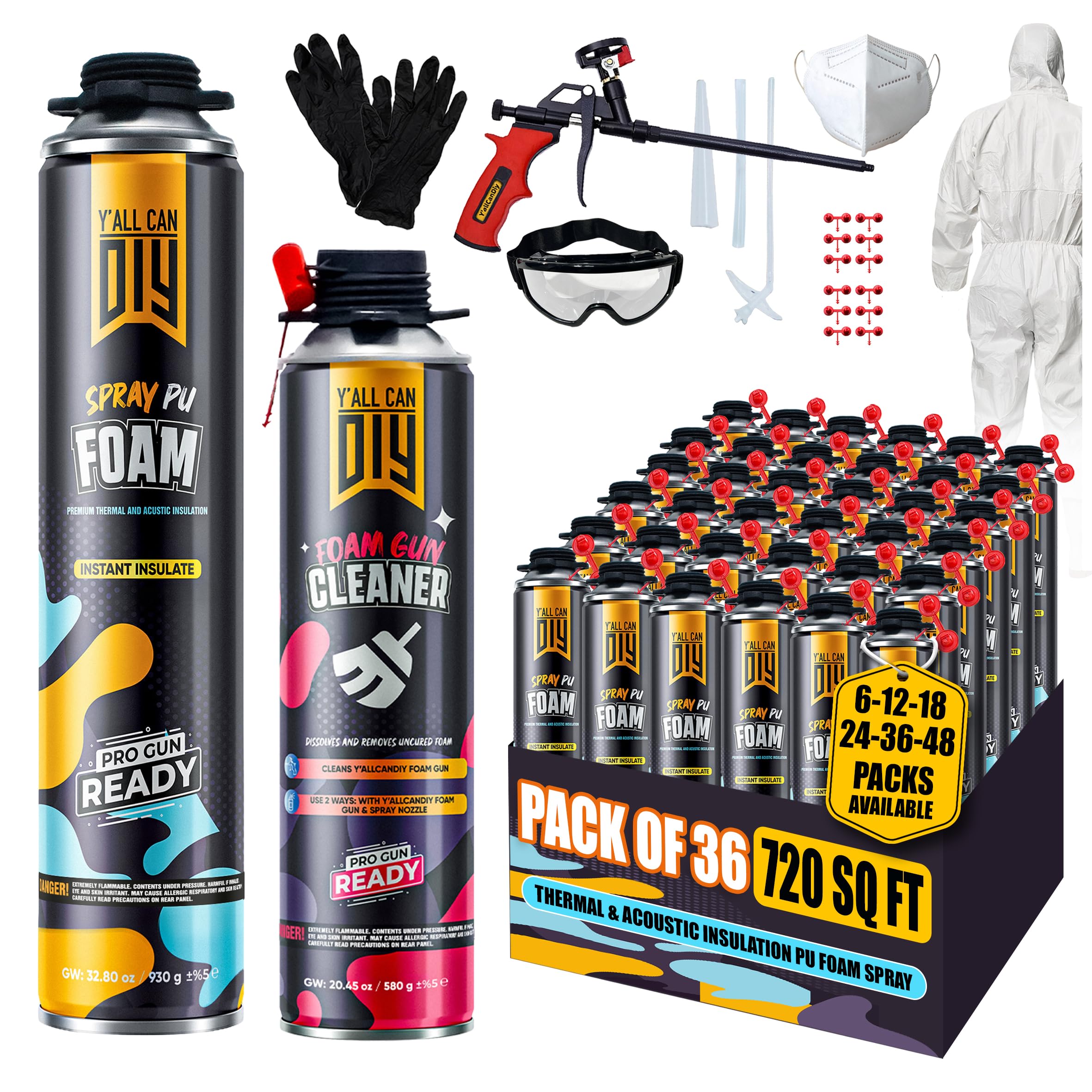
Y'allCanDiy 36-Can Kit

83 /100
Kirk Score Excellent
R-Value
R-8 at 2 in
Coverage
720 board ft
Case Weight
97 lb
Kit Contents
36 cans, gun, cleaner, safety gear
Check Details on Amazon

Pros

  • 720 board feet, the most coverage here
  • Each can has its own straw and spreader
  • Gun, cleaner, and safety gear included
  • Strong adhesion list including OSB and metal

Cons

  • R-8 at two inches is the lowest here
  • 97-pound case needs two people

Half again as much foam as our top pick — 36 cans, 720 board feet — and the lowest R-value per inch in this set. Those two facts are really one fact: this is a hybrid formula built to give you volume rather than thermal density.

R-8 at two inches is the number to sit with. Our top pick reaches 11.32 at the same depth, so in a 2x4 cavity where two inches is all the room you have, you are giving up real insulating value. In a deep attic bay where you are stacking depth regardless, the extra 240 board feet is what finishes the job without a second order — and that is the job this kit is for.

Each can carries its own straw and spreader, which sounds like small stuff until you have spent a morning swapping nozzles between cans. The gun, cleaner, and safety gear are in the box, and adhesion covers the usual list: wood, concrete, brick, metal, OSB, drywall.

Two practical notes. The case is 97 pounds, so get help bringing it in and stage cans by the work area. And give the first can to a sheet of scrap — the gun has a learning curve, and the place to learn it is not the ceiling of a finished room.

Bottom line: Choose this for a deep attic where you are stacking insulation anyway; the 720 board feet is the most here, and the lower R per inch costs you nothing in an open bay.

Check Latest Price
#05

Best for Small Jobs

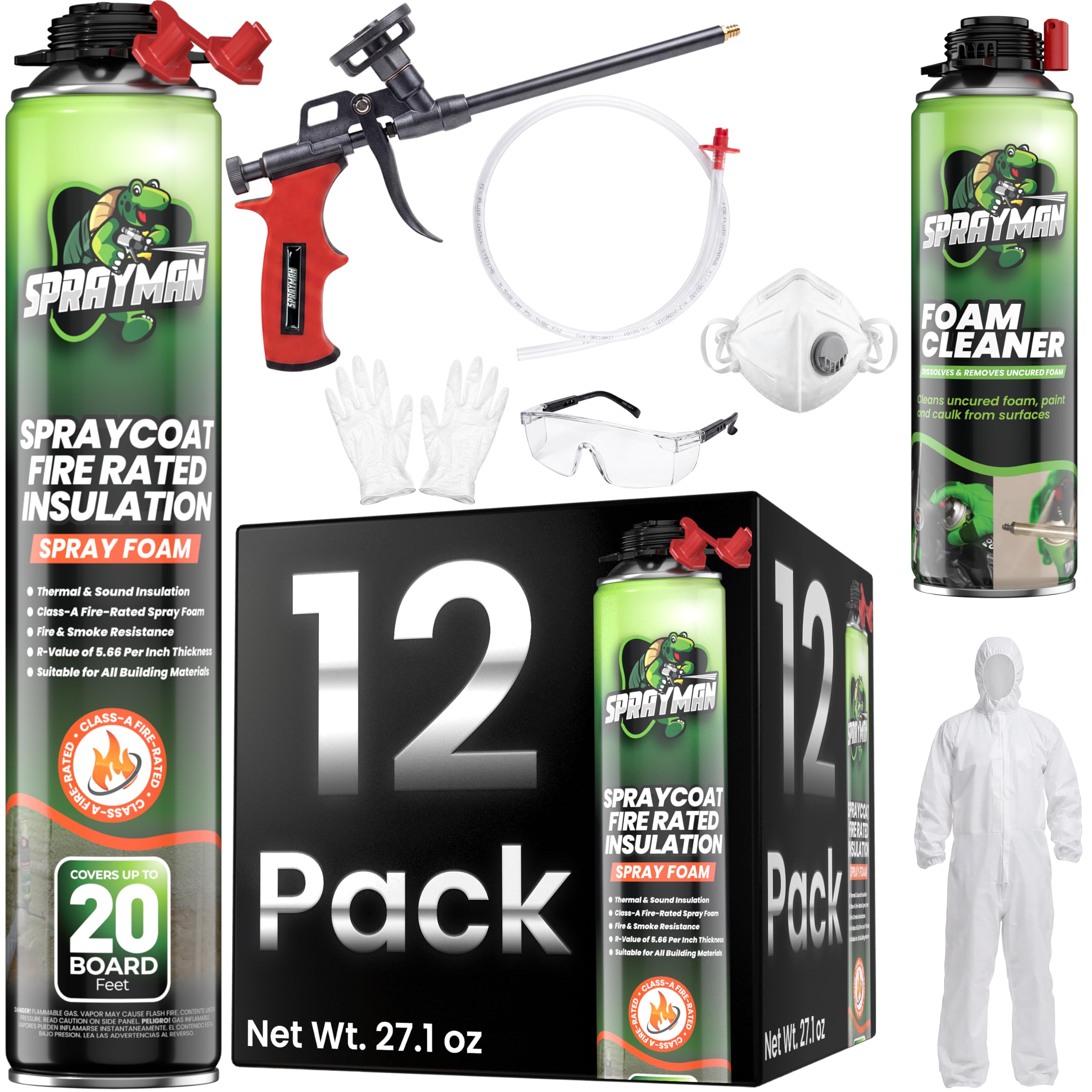
Sprayman Spraycoat 12-Pack

81 /100
Kirk Score Excellent
R-Value
11.32 at 2 in
Coverage
240 sq ft at 1 in
Fire Rating
Class A (ASTM E84)
Kit Contents
12 cans, gun, cleaner
Check Details on Amazon

Pros

  • R-11.32 at two inches in a 12-can kit
  • Two nozzles, one for walls, one for ceilings
  • Lightest case here at 29 pounds
  • Class A rated per ASTM E84

Cons

  • Smallest yield here; 240 sq ft goes quickly

Twelve cans and 240 square feet at an inch: this is the smallest kit here, and for plenty of jobs that is the point. Rim joists, a band board, one bay of a wall, a shed — you do not want two dozen cans sitting in the garage between projects.

It carries the same R-11.32 at two inches as our top pick and the same Class A rating per ASTM E84, which is what makes the small size a choice rather than a compromise. The two interchangeable nozzles cover the directions that matter: one for a vertical wall, one for a ceiling.

One can of gun cleaner for twelve cans is tight, so pick up a spare before you start, especially if you plan to pause between cans. The case is 29 pounds, light enough to carry up a ladder in one hand and small enough to store on a shelf afterward.

Where it will not serve you is a whole attic. At 240 square feet on a one-inch pass it does not go far, and running out mid-project means a second order and a second warm-up. Buy it for the job you can finish in an afternoon.

Bottom line: Buy the twelve-can kit for a rim joist run, a shed, or one room; it holds the same R-value and fire rating as our top pick in a case you can finish in an afternoon.

Check Latest Price
#06

Value closed-cell

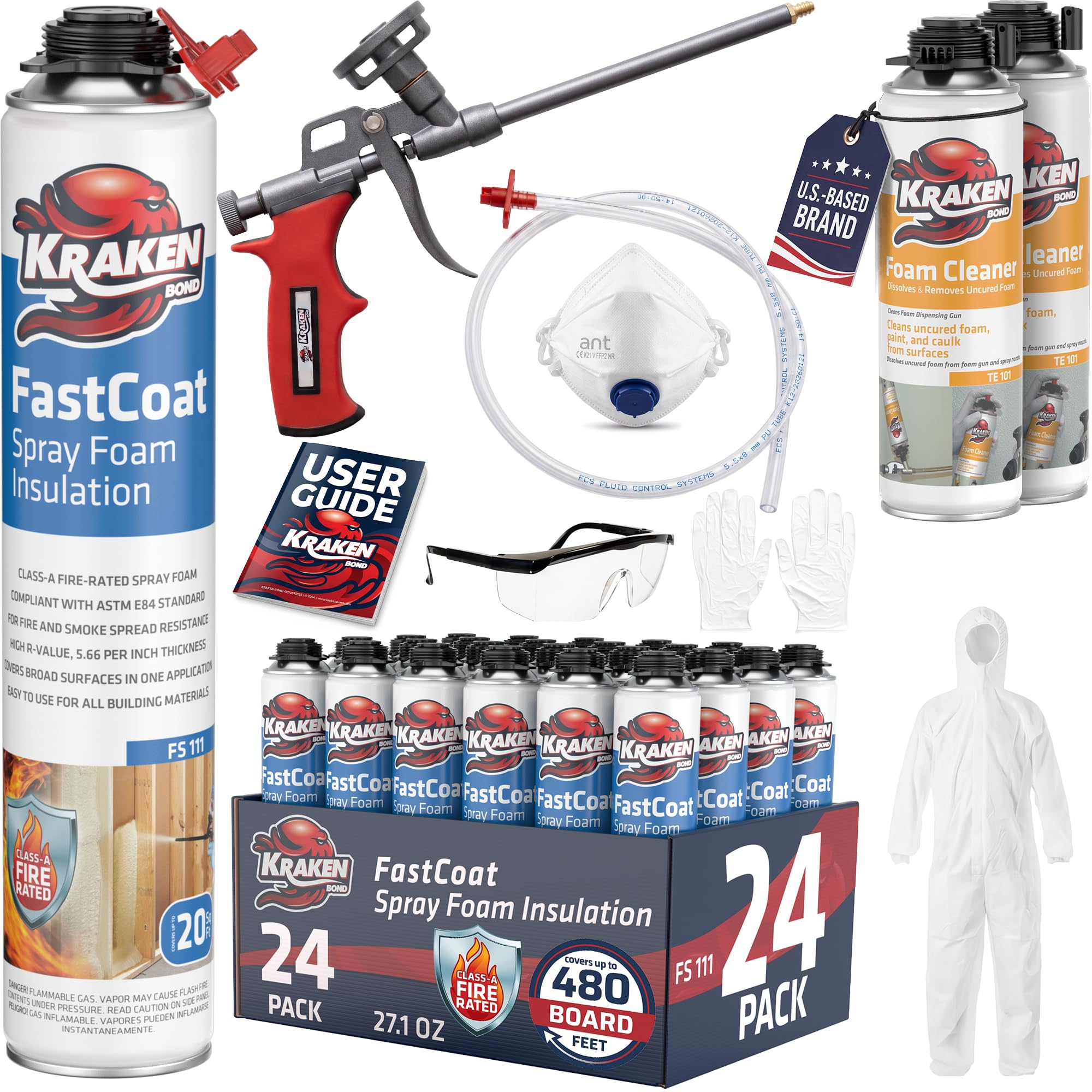
Kraken Bond Fastcoat 24-Pack

79 /100
Kirk Score Very Good
R-Value
11.32 at 2 in
Coverage
288 sq ft at 2 in
Fire Rating
Class A (ASTM E84)
Kit Contents
24 cans, gun, 2 cleaners, safety gear
Check Details on Amazon

Pros

  • R-11.32 at two inches with a Class A rating
  • Coverage quoted at the two-inch depth
  • Gun, two cleaners, and safety gear included
  • Costs less than our top pick

Cons

  • Foam can sputter and blow around instead of fanning

Same 24 cans, same R-11.32 at two inches, less money than our top pick. What keeps it out of the top tier is what happens at the nozzle: foam that trickles, spatters, or blows around instead of laying down a fan.

The good part is honest math. Kraken quotes coverage at the depth that matters — 288 square feet at two inches, R-11.32 — which is the only way to plan a job properly, and a couple of kits here could learn from it. Class A per ASTM E84, a gun, two cleaners, and safety gear are all in the box.

A few things make the difference on application: cold cans, spraying off vertical, and foam left sitting in the gun between passes. Warm the cans overnight, keep the can upright, clear the nozzle between fills, and start on scrap so a bad can shows up somewhere harmless.

At this price it is worth running a box on a small area before committing to a whole attic. If it lays down cleanly for you, you have top-pick performance for less; if it sputters, you have spent one box finding out rather than a whole attic's worth.

Bottom line: Worth trying if you want our top pick's R-value for less money and are willing to slow down at the nozzle and test a can before you commit a whole bay to it.

Check Latest Price
#07

Simple wall jobs

amptern 24-Can Kit

79 /100
Kirk Score Very Good
Foam Type
Closed cell
Kit Contents
24 cans, gun, 2 cleaners, straws, gloves
Working Range
41°F–86°F
Can Preparation
Warm to 68°F before use
Check Details on Amazon

Pros

  • 24 cans, gun, nozzle, straws, and two cleaners
  • Wide 41°F to 86°F working range
  • Closed-cell foam bonds to a long material list

Cons

  • No coverage figure or R-value published

Every other kit here quotes board footage. This one does not, and it does not give an R-value either, which makes it the single pick on the page you are buying from a description rather than from numbers you can check.

What the listing does cover is the practical side: 24 cans of closed-cell foam, a gun, an adjustable nozzle, disposable straws for tight gaps, two cans of cleaner, and gloves. The compatible-material list is as long as any here — wood, concrete, brick, stone, metal, PVC, glass, MDF.

Temperature guidance is better than most. Warm the cans to about 68°F, and the working range runs 41°F to 86°F, a wider window than the 68°F to 77°F BEEST quotes. That matters if your work area is an unheated garage or a crawl space in a shoulder month.

Where that leaves us: a complete 24-can kit at about the money the better-documented kits ask, with no way to compare its yield on paper. Get a board-foot figure from the seller before ordering if you can; otherwise aim it at a defined job small enough that you will see the area run out and can reorder.

Bottom line: A complete 24-can closed-cell kit with the widest working temperature range here, but order it only if you can pin down the yield first, because the listing will not tell you.

Check Latest Price

How We Tested Spray Foam Insulation Kits

The shortlist started with research, not a shopping cart. We pulled every kit that stated a cell type, an R-value per inch, a fire rating, and a yield, and dropped anything that hid those numbers or shipped without a gun, cleaner, or basic safety gear — if you need three more purchases before you can start, it isn't a kit. That left 10, which we ran over six months.

We tested each one twice: first on clean scrap plywood, then in the places these kits actually get used — a basement rim joist, a garage attic deck, and the gaps around window and door rough openings. We timed how long a full set took to spray, noted whether the gun sputtered or clogged between passes, and watched how the foam set up on wood that wasn't perfectly clean or dry.

Expansion we measured rather than eyeballed: foam went into cavities of known depth, and we recorded how far it rose before it skinned over and how much had to be trimmed back. For coverage, we tallied board feet actually delivered against the label's promise — the cheapest kit per can often yields the least foam, which is where value for money really gets decided. After each set we pulled a cured chunk free to see how it had bonded, then flushed the gun with the included cleaner to see whether it survived to the next job.

How to Choose a Spray Foam Insulation Kit

Read the Yield in Board Feet, Not Square Feet

A board foot is one square foot at one inch thick, so the same can of foam covers half the area at two inches. Froth Pak's 630 board feet at an inch is roughly 315 square feet at the two inches that get you R-12.2; Sprayman's 240 square feet at an inch is 120 at two. Kraken Bond is the one here that states its coverage at two inches — 288 square feet — and that is the format worth looking for.

Measure the area, multiply by the depth in inches, add about 10 percent for overspray and waste, and compare that total to the kit rather than to the headline. Buy slightly more than the maths says; running dry halfway through a ceiling means a second order and a second warm-up.

Two-Component Tanks or a Case of Cans

The two formats do different jobs. A two-component kit like Froth Pak meters the two parts at the gun, which gives consistent foam from the first pass to the last, and it arrives as one unit with 15 feet of hose that keeps the tanks outside the work area.

Aerosol cases are incremental: spray a wall, clean the gun, come back next weekend with the rest of the case. That suits a project that happens in evenings. The trade is more gun cleaning, more cans to keep warm, and the occasional can without propellant — test each one on scrap before you commit it to a cavity.

Match R-Value per Inch to the Cavity You Have

R-value per inch sets how deep you have to spray, and the spread here is wide: Froth Pak reaches 6.2 per inch, the kits rated 11.32 at two inches work out to about 5.7, and Y'allCanDiy's R-8 at two inches is 4 per inch.

In an open attic, where you control the depth, that is mostly a volume question. In a 2x4 wall, two inches is the entire budget and the higher number wins. Check the cavity before you check the price tag.

Temperature, Moisture, and Masking the Room

These foams are temperature-sensitive. Most want cans at about 68°F and an ambient range in the sixties to high seventies; amptern publishes the widest window at 41°F to 86°F. Cold foam comes out thick, yields less, and grabs poorly, so move the case into a warm room the night before.

Then mask. Overspray is sticky, travels further than you expect, and does not wipe off cleanly once it skins, so cover floors and anything you cannot move and plan to throw the drop cloths away. On a dry, dusty substrate, a light mist of water helps a moisture-cured foam bond.

Check the Fire Rating at the Thickness You Will Spray

Class A per ASTM E84 appears on most of these kits, but a rating belongs to a tested thickness — Froth Pak's holds up to two inches. If the assembly has to satisfy an inspector, the thickness you actually spray and the rating you claim have to match, and a fatter pass than the listing covers is a different assembly.

Ask before you cover it up. It is a five-minute question now and an expensive one after drywall.

Frequently Asked Questions

Final Verdict

Buy the STANLEY F 990P Supercoat kit for a wall, garage, or attic job. It carries the R-value, the Class A rating, the gun, the cleaners, and the PPE in one box, and 24 cans means you can stop at the end of a Saturday and pick the work up again.

If the project is a whole attic or a crawl space you want sealed in one push, Froth Pak's two-component tanks justify the step up in cost with more R per inch and a 30-second cure. For a rim joist and a shed, the twelve-can Sprayman kit is the sensible size.