// data-verified

Best Hard Hat Lights of 2026

For years my flashlight lived between my teeth. Then I started clipping a light to the front of my hard hat and stopped unclenching my jaw every twenty minutes. What won me over wasn't raw brightness — it was fit: a light that mounts solidly, sits just above eye level, and disappears on your head.

We've spent the past seven months with 12 of these, from helmet-clip models to wide-beam lights with rear safety LEDs, and mounting matters more than the lumen number on the box. Most buyers over-buy brightness and under-think beam shape: a narrow spot throws light down a corridor but leaves your hands in shadow, while a broad flood lights the panel in front of you and not much past it. Weight counts too — an ounce up top feels like three by the end of a shift.

Check what the light attaches to first. A strap meant for a bare forehead doesn't always clear a plastic shell, and clips that fit one hard hat won't fit another. The picks below survived all of that.

#01

Best Overall

Coast XPH30R

95 /100
Kirk Score Outstanding
Runtime
6.75 hours high, 28 hours low
Mounting
Head strap and hard hat strap included
Light Output
1200 lumens turbo, 500 high, 46 low
Water Resistance
IP54
Check Details on Amazon

Pros

  • Focus ring goes from flood to spot
  • Body detaches and sticks magnetically
  • Hard hat strap and headband both included
  • Lifetime warranty

Cons

  • Heavier on the brim than plastic lamps
  • IP54 only, so not for washdown

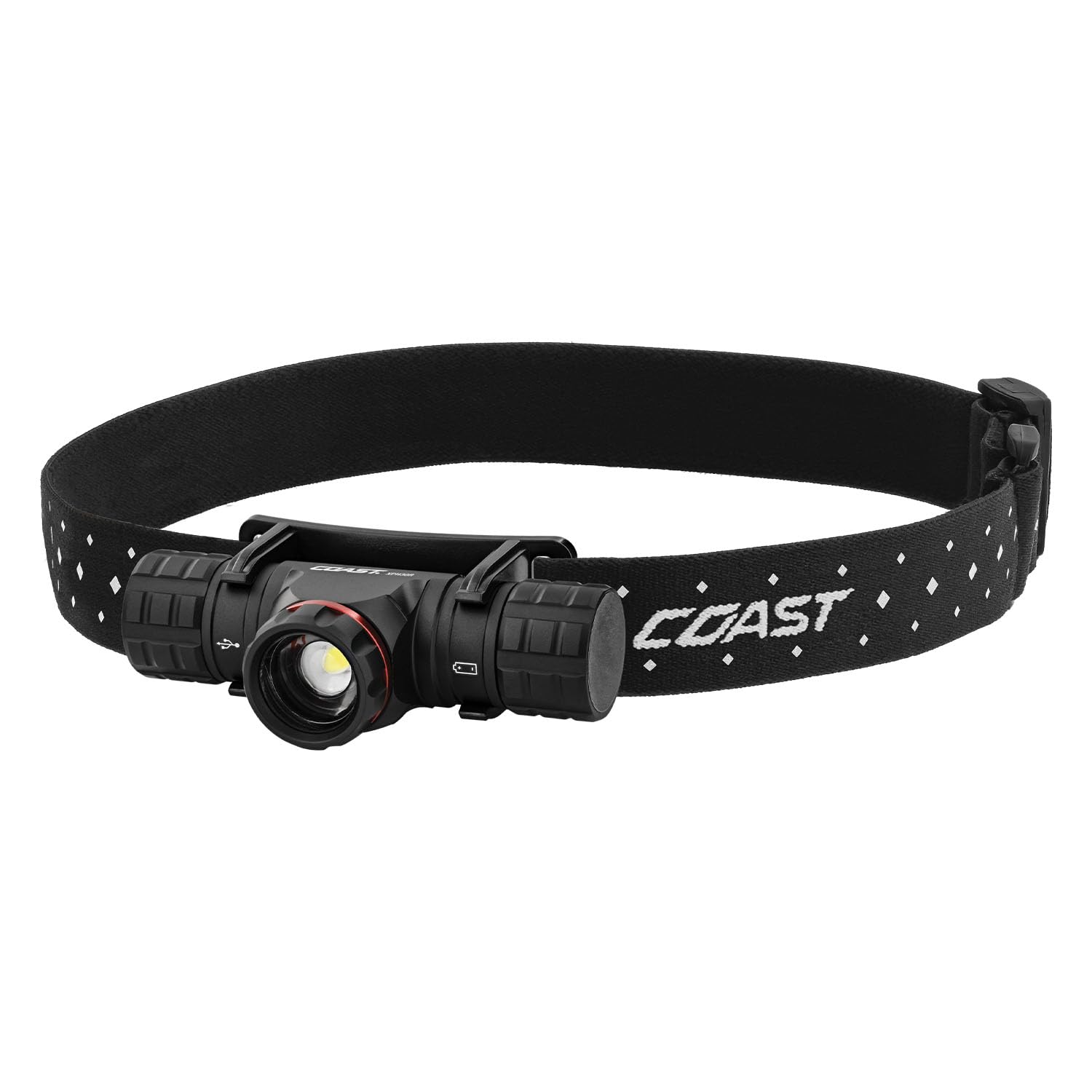
Twist the ring around the Coast XPH30R's lens and the beam pulls in from a wide wash that fills a room to a tight spot you can aim down a corridor. That single control is why this is the light we recommend first for hard hat work: most lamps in this group make you choose between seeing your hands and seeing ahead. It's rated 1,200 lumens on turbo, 500 on high and 46 on low, with quoted runtimes of about 6.75 hours on high and 28 hours on low.

The lamp body lifts off the bracket, and its base is magnetic, so it can be stuck to a panel, a lift arm, or the underside of a hood and left there while both hands are busy. We ended up using it that way on wiring and duct work more often than we wore it. Charging is over USB-C, and the runtime figures give you enough to plan a day around: medium gets you through a shift, and low is there for walking and reading.

Fitting it to a hard hat is a two-part job. A helmet strap comes in the box alongside the headband, and the bracket clamps the brim without any drilling. The trade is weight. This is one of the heavier lamps here, and with the brim tipped down for a long stretch you feel it across the forehead — the aluminum body that survives a one-meter drop and a knock against framing is what you're carrying.

Where it pulls ahead of the budget lamps is the low end. Forty-six lumens is enough to read a panel or cross a dark floor without wrecking your night vision, and 28 hours of it means you can leave the light switched on for a whole shift and stop thinking about the battery. Add Coast's lifetime warranty and the case for spending more here is straightforward.

Bottom line: For one light that handles a dark crawl space and a long sight line, this is the one we hand people first — the twist focus and detachable magnetic body earn it.

Check Latest Price
#02

Best for All-Day Wear

SLONIK Rechargeable Headlamp

93 /100
Kirk Score Outstanding
Body
Aero-grade aluminum
Weight
4 oz
Light Output
1000 lumens
Water Resistance
IPX4
Check Details on Amazon

Pros

  • 4 ounces, barely noticeable on a brim
  • Aluminum body rather than plastic
  • Head detaches as a handheld light
  • Six brightness levels plus SOS

Cons

  • Plastic strap bracket is the first part to fail
  • Short 180-day warranty

The SLONIK is a 4-ounce aluminum cylinder with a swivel mount and a nylon band, and it ships with hooks for hanging it on a hard hat. Output is rated 1,000 lumens across six brightness levels plus an SOS strobe, it recharges over USB, and the head lifts off the band so it can be pocketed and used as a flashlight.

Being light enough to forget is the whole pitch, and it holds up. On ladder work and equipment checks we stopped noticing it was there, which is more than we can say for the nine-ounce lamps in this group, and the beam is a clean white spot with enough spill to see your feet.

Plan on charging it at lunch. The listed runtime is about four hours, and the higher settings eat into that, so a cable in the truck matters on a double shift. The head still pops off the band to work as a handheld, which is the part we used most once the helmet came off.

Bottom line: The lightest serious option here — a 4-ounce aluminum lamp for ladder work and inspections, as long as you can charge it midday and go easy on the strap fitting.

Check Latest Price
#03

Best Budget

Blukar K9116 Headlamp

93 /100
Kirk Score Outstanding
Beam
Zoomable
Runtime
18 hours
Light Modes
5
Water Resistance
IPX6
Check Details on Amazon

Pros

  • Zoom beam from flood to spot
  • IPX6 sealed battery compartment
  • Long 18-hour quoted runtime

Cons

  • Front-heavy 9.7 ounces on a hard hat
  • Bulkier housing than the bar lamps

If you're buying light for a crew on a budget, this is the Blukar we point to. Five modes, a zoom ring that pushes the beam from a close flood to a hard spot, three emitters, and a sealed battery compartment rated IPX6 — it does more than its place in this lineup suggests. Charging is USB-C, the quoted runtime is 18 hours, and the warranty runs a year.

The zoom is the useful part. Wide open, it lights a whole stairwell or the underside of a hood; twisted in, it throws a spot far enough to walk a dark lot. The head rotates through 90 degrees, so you can aim it without craning your neck, and a charge has carried us through several evenings of chores without a top-up.

It is also 9.7 ounces, and that weight sits at the front of your head. On a hard hat with the band snug it's manageable; on a bare head it's noticeably front-heavy, and the housing is bulkier than the flat bar lamps here. For a light that hangs on a peg and gets used a job at a time, none of that matters much.

Bottom line: Our budget pick: a zoomable, IPX6 lamp with an 18-hour quoted runtime that does a shift on a charge, as long as a front-heavy 9.7 ounces doesn't bother you.

Check Latest Price
#04

Best for Fire Helmets

Streamlight Vantage II

95 /100
Kirk Score Outstanding
Runtime
2.25 hours
Mounting
Helmet bracket with rear safety LED
Light Output
350 lumens
Water Resistance
IPX7
Check Details on Amazon

Pros

  • Purpose-built helmet bracket mount
  • Rear safety LED for visibility
  • IPX7 and 3.68 ounces
  • Lifetime warranty

Cons

  • Mount can let the light work loose
  • About 2.25 hours per cell

The Vantage II isn't a headband lamp at all. It's a compact aluminum light that clamps to a fire or rescue helmet's bracket and runs on a single CR123A cell. Rated 350 lumens with a rear safety LED, IPX7, and 3.68 ounces — small enough that it doesn't foul a face shield or a mask.

The beam is built for the inside of a structure rather than the end of a driveway: wide, close-range, and consistent as the cell drains instead of fading away. Worn on a helmet, it points exactly where your head turns, which is the entire argument for a bracket mount, and the rear LED marks you from behind in smoke or on a roadside.

We think it's the right answer for anyone wearing a structural fire helmet, where a secure bracket and a rear marker matter more than output. The switch is big enough to find with a glove on, which sounds like a small thing until you're doing it in the dark with your hands full.

Runtime is the compromise: about 2.25 hours on a cell, short for a long incident but easy to fix. A CR123A in a pocket is a ten-second swap, and none of the sealed rechargeables here can say that at hour three of a call.

Bottom line: For a fire or rescue helmet, this is the light we choose: a low-profile bracket mount with a rear safety LED and a cell you can swap in seconds.

Check Latest Price
#05

Best Battery-Powered

Lepro Battery Headlamp 2-Pack

91 /100
Kirk Score Outstanding
Power
3 AAA per light, not included
Light Output
200 lumens
Beam Distance
120 meters
Water Resistance
IPX4
Check Details on Amazon

Pros

  • Runs on AAA batteries you can buy anywhere
  • Two lamps per pack
  • Red mode preserves night vision
  • 120-meter beam from a 1.94-ounce lamp

Cons

  • 200 lumens is modest for open ground
  • Batteries not included

Three AAA batteries per light, six modes, a 45-degree tilting head and a 200-lumen beam that reaches about 120 meters. The Lepro pair is the least technical light here, and that's the appeal: two lamps in the box, batteries not included, and a band that comes off to be washed.

This is the pair we keep in the truck. There's no charging routine to remember and no sealed cell to die quietly — when a light goes dim you open the door and drop in three AAAs from a gas station. For a glovebox, a power-outage drawer, or a hard hat that comes out a few times a month, that reliability of supply is worth more than brightness.

Two hundred lumens won't light a field, but it's plenty for close work, a walk to the truck, or reading a panel, and the red mode saves your night vision. Runtime is quoted at up to 22 hours on low with a good deal less on high, and alkalines fade in the cold, so keep a spare set in your coat.

Bottom line: Our battery-powered pick: two lamps, no charging routine, and light that comes back to life with three AAAs from anywhere.

Check Latest Price
#06

Best Wide Beam

POKISEED Wide Beam Headlamp

92 /100
Kirk Score Outstanding
Beam
230 degrees wide
Battery
5000 mAh rechargeable
Light Output
1500 lumens
Water Resistance
IPX6
Check Details on Amazon

Pros

  • 230-degree beam covers your whole view
  • Red tail light for visibility
  • 5,000 mAh rechargeable battery
  • Simple three-mode switch

Cons

  • Heavy at 9.5 ounces on a brim
  • Sealed cell can stop holding a charge

Thirty-one LEDs behind a curved bar, 230 degrees of coverage, and a red tail light on the back of the band. The POKISEED is built for the kind of work where a spotlight is the wrong shape. Output is rated 1,500 lumens, the battery is a 5,000 mAh cell charged over USB-C, and the housing is IPX6.

A bar puts light across your whole field of view instead of a circle in the middle of it. In an attic, a crawl space, or under a dashboard, that means you stop turning your head to find the edge of things, because the light is already there. The tail light is a genuine addition too: switch it on and whoever is behind you sees you.

We like it best for enclosed work, where peripheral light beats throw. What we don't like is the weight. At 9.5 ounces it's one of the heaviest lamps here, and on a hard hat brim you'll feel the front of the helmet pull down by mid-afternoon. If your work is overhead in a ceiling void for twenty minutes at a time, that's a fair trade; if it's all day, it isn't.

Three modes and one button mean no cycling through seven settings with a glove on, and the red tail light has its own switch. Clips for a hard hat come in the box, which is the detail that makes it a work light rather than a running lamp.

Bottom line: Our wide-beam pick: 230 degrees of light for attic and crawl-space work, with the honest caveat that 9.5 ounces pulls on a hard hat brim.

Check Latest Price
#07

Zoom plus marker

DanForce Bold-S Headlamp

91 /100
Kirk Score Outstanding
Weight
8.8 oz
Charging
USB-C
Warranty
90 days
Light Output
1080 lumens
Check Details on Amazon

Pros

  • Zoom ring plus a rear safety light
  • Aluminum body
  • Secondary red light
  • USB-C charging

Cons

  • 8.8 ounces sits forward on the brim
  • 90-day warranty is the shortest here

At 8.8 ounces with a 90-day warranty, the DanForce Bold-S asks you to accept two things before you see what it does. It's an aluminum-bodied work lamp rated 1,080 lumens, with a zoomable beam, a secondary red light, and a rear safety light — the only lamp here that pairs a zoom ring with a marker on the back.

The zoom is the reason to pick it over a plain flood lamp. Twisted in, it throws a narrow beam down a trench or across a site; opened up, it covers a workbench. The red secondary light is there for close work when you don't want to lose your night vision, and the Type-C port means one cable in the truck covers it and your phone.

On the head it's a lump. The lamp sits forward on the band and the weight is obvious, especially with the helmet tipped; a rear-mounted pack would have balanced it better. The swivel is the part that takes the knocks on a site, so treat it as the joint to check rather than the shell to worry about.

We rate it as a hard-hat-first work light for someone who wants zoom and a rear marker in one unit and will trade comfort for output. Buy it as a workhorse, not as a lamp you'll wear for eight hours straight.

Bottom line: A hard-hat work light with zoom and a rear marker in one body — heavy on the head, and the shortest warranty here, but built for site work.

Check Latest Price
#08

Crew packs

WopkDupk 5-Pack Headlamp

91 /100
Kirk Score Outstanding
Battery
1200 mAh per light
Mounting
Hard hat clip included
Pack Size
5 lights
Light Output
350 lumens
Check Details on Amazon

Pros

  • Five lights with hard hat clips
  • Motion sensor works with gloves
  • Flat 2.47-ounce bar doesn't snag
  • Folds into a pocket

Cons

  • Some units stop taking a charge
  • IPX4 only

Five lights, five charging cables, and a hard hat clip for each: the WopkDupk pack is priced and packaged for a crew rather than one person. Each lamp is a flat silicone bar rated 350 lumens with a 230-degree beam, a 1,200 mAh cell, five modes and a motion sensor, and each weighs 2.47 ounces.

The motion sensor is the feature that earns its place on a job. Wave a hand in front of the lamp and it switches on or off without you hunting for a switch with a glove full of sealant. The flat bar also sits low against the shell, so it doesn't catch when you duck through a doorway or under a duct.

Charging is where the pack is a gamble. Some units stop taking a charge, and the ones that keep going are the ones your crew will fight over — five lights is a hedge, not a guarantee. Weather sealing is IPX4, which is fine in rain and not for washdown.

As a crew purchase we think it makes sense: hand one to each person, keep the fifth in the truck, and expect to lose one. It's also the easiest lamp here to fold into a pocket and forget about until you need it, which counts for a lot at the end of a shift.

Bottom line: A five-light crew pack with hard hat clips and a genuinely useful motion sensor — buy it to equip a team, not as one good lamp.

Check Latest Price

How We Tested Hard Hat Lights

We started with a long list of headlamps sold for job-site and mechanical work and cut anything that only worked on a bare head. If a light couldn't attach to a hard hat — through helmet clips, a bracket, or a strap that actually clears a plastic shell — it was out. From there we narrowed by power source, beam style, and price, and bought 12 to live with for seven months.

Every light went onto real hard hats, front brim and side slots both, and got the head-tilt test: chin to chest, a hard shake, then a walk across gravel to see if it crept out of position. We wore them over gloves and alongside ear protection, adjusted them one-handed the way you would on a ladder, and logged where each one pressed after six hours. On arrival we also checked fit and finish — stitching, hinge play, plastic that creaked — since a light that rattles loose by week three is a reliability problem, not a nitpick.

For beam quality we lit a wall three feet away and the far end of a 40-foot corridor, noting hotspots and whether a wide beam washed out detail up close. We timed every light on its highest setting until it dimmed, recorded charge times on the USB models, and tried swapping batteries with work gloves on. Rear red lights were judged at dusk on a walk back to the truck, and each light got dropped from ladder height onto concrete, then dusted and rained on, to see what still worked.

How to Choose a Hard Hat Light

Fit the mount to the helmet you actually wear

A strap-on lamp sits over the shell, which is how most of the lights here are worn, and it works when the band is snug and the lamp is light. A bracket is a different proposition: it needs the helmet's own mounting point, the way the Streamlight Vantage II fits a fire helmet, and it won't transfer to a plain construction shell. A clip needs a brim with enough lip to grip.

The trap is improvisation. Drilling a shell or gluing a mount on the wrong surface can cost you the protection the helmet was certified for, so pick a light whose fitting matches your helmet rather than making the helmet fit the light. If your site supplies the helmet, ask before you attach anything.

Beam shape matters more than the lumen number

A spot throws light down a corridor; a flood fills the space around your hands; a 230-degree bar does the second job with no hot spot in the middle. Lumens tell you how hard the emitter is driven, not whether the shape suits the work, and a well-aimed 350 can beat a brighter lamp pointed at nothing.

If most of your tasks happen within arm's reach — panels, attics, under a hood — buy coverage, which is where the POKISEED's bar and the Blukar's zoomed-out setting earn their place. If you walk, inspect, or drive between tasks, buy throw, and a focus ring like the Coast's lets you have both on one lamp.

Match runtime to your shift, not to the box

The long runtime on a listing is measured on the lowest setting. High modes drain a cell in a few hours: the Streamlight runs about 2.25 hours, the SLONIK about four, and the Coast manages roughly 6.75 on its high setting against 28 on low. Sealed rechargeables can't be swapped mid-shift, so a long day means either a charging stop or a light with a replaceable cell.

For most people a USB-C lamp and a cable in the truck covers the week. If you work twelves, in the cold, or away from power, the Streamlight's CR123A or the Lepro's AAAs are the difference between finishing the shift and finishing in the dark.

Weight is what you notice at hour eight

Two and a half ounces rides on a hard hat without complaint. Nine ounces tips the brim forward and pulls at the back of your neck, and the tighter band you need to fix it becomes its own ache by mid-afternoon. Front-heavy lamps are worst on a helmet because the weight sits ahead of the suspension.

The lightest picks here — the Lepro, the WopkDupk bar, the SLONIK at 4 ounces — are the ones you forget about. The heaviest — the POKISEED, the DanForce, the Blukar — buy you output or coverage with that weight. If you're head-down in a panel for an hour at a time, it costs little; if the light lives on your helmet all day, weigh it before you buy it.

Controls you can work with a glove on

The switch is the part you touch most and the part listings describe least. One large button cycling three or four modes is easier to operate blind than a small multi-button panel, and a twist ring you can find by feel, like the Coast's, is easier still when your hands are full or filthy.

Motion sensors are genuinely useful with gloves, which is why the WopkDupk pack leans on one, but treat it as a bonus rather than the only way in. Whatever you choose, you should be able to turn the light on without looking at it — that's the test that matters in a dark stairwell.

Frequently Asked Questions

Final Verdict

For most people who need light on a hard hat, we point to the Coast XPH30R. The twist focus covers close work and distance on the same lamp, the body comes off the strap and sticks to steel, and the low mode runs long enough to leave on all shift. It's heavier than the plastic lamps here, and on a brim you'll feel that by the afternoon.

Two changes move the answer. Outfitting several people, or working to a tight budget? The Blukar K9116 gives up comfort rather than output, and the WopkDupk five-pack covers a crew. Wearing a fire or rescue helmet? The Streamlight Vantage II is the only light here built for that bracket, and its swappable cell is worth more on a long incident than another few hundred lumens.