// data-verified

Best Winter Work Gloves of 2026

Winter work gloves ask you to pick a side. The pairs that keep your fingers alive at 20 degrees are usually too bulky to tie a knot or pick up a screw, and the ones with enough feel to run a saw tend to go numb the first time the wind picks up. What you actually want is warmth without mittens for hands, plus a shell that stays dry once the job turns wet — cold hands are almost always wet hands first.

I've worked outside through enough winters to be skeptical of any label that promises both, so this fall my team and I started putting pairs through real work: shoveling, firewood, freezer shifts, wet rope in the rain. Fourteen pairs and five months later, the pattern is clear. The insulation gets all the marketing, but the shell decides whether you're comfortable — a modest lining in a leather palm beats a heavier one in a glove that soaks through by lunch. The picks below are the ones that kept our hands dry, warm, and actually useful, whether you need grip, cut protection, or a fingertip that works on a phone screen.

#01

Best Overall

Kinco 1927KW Insulated Gloves

93 /100
Kirk Score Outstanding
Back
Striped cotton-blend canvas
Care
Do not wash
Palm
Premium grain pigskin
Insulation
Heatkeep thermal lining
Check Details on Amazon

Pros

  • Pigskin palm stays soft and grippy when damp
  • Heatkeep lining traps warmth and wicks moisture
  • Reinforced knuckle strap, fingertips, and wing thumb
  • Knit wrist with a reinforced leather pull tab

Cons

  • Do not wash

Pigskin is why the Kinco 1927KW is our top pick. Wet weather is where it earns its place: where a dipped glove turns slick, this palm stays soft enough to close around a shovel handle or a tow strap, and it keeps its grip while it's damp. The striped cotton-blend back does the other half of the job, letting heat escape so you aren't stewing by the time you come back inside.

The Heatkeep lining is the warm part: a soft inner layer that traps heat, wicks what your hands put out, and doesn't bunch when you make a fist. Look at where the leather sits — knuckle strap, fingertips, wing thumb, and the welts along the high-wear seams — and you're looking at the places that wear through first on a cheaper pair. There's a leather pull tab at the cuff too, which stops mattering right up until you're hauling a glove on with one hand while the other holds a ladder.

Sort the size before you order. The pattern runs large, so if you normally take a large, take the medium, and check that the knit wrist sits snug against skin rather than riding up your forearm. The leather is water resistant rather than waterproof, so a long, wet session eventually soaks through — work a little wax into the palm at the start of the season and it holds up longer.

Break-in is measured in afternoons, not weeks: a couple of days of real work and the palm has taken the shape of your hand. That's the quiet appeal here — no liner to fish out, no coating to peel, nothing to adjust mid-job.

Bottom line: We hand the Kinco 1927KW to anyone heading out for a long, cold shift: the pigskin palm grips wet handles, the Heatkeep lining holds warmth, and the canvas back breathes.

Check Latest Price
#02

Best for Wet, Messy Work

SHOWA 451 Insulated Gloves

93 /100
Kirk Score Outstanding
Back
Uncoated fabric
Lining
Insulated knit
Palm Coating
Rough-grip latex
Check Details on Amazon

Pros

  • Pebbled latex grips wet, slimy, icy surfaces
  • Most durable pair we are recommending here
  • Uncoated back breathes during hard work
  • Flexible enough to use hand and power tools

Cons

  • Premium price for a single pair
  • Warmth needs a liner in a hard freeze

Run a thumb across the palm of the SHOWA 451 and you can feel why it works: the latex is pebbled rather than smooth, so a wet handle, an icy rope, or a slimy rock has something to bite into instead of sliding across. That texture is the whole argument for spending more than you would on a plain leather pair.

Where it separates from everything else here is durability. Cold, wet, abrasive work is what destroys gloves, and this is the pair in this guide whose durability holds up best — the coating stays put, the seams stay closed, and the snug cut doesn't bag out at the fingertips after a month. The back is uncoated fabric rather than dip, which breathes during hard work and gives you something to wipe your brow with that isn't a wet rubber palm.

Warmth is honest rather than heroic. It's insulated and comfortable in a cold workshop or on a raw, wet day, but the coating over the fingertips is thin, and a genuine cold snap will find it. A cheap liner fixes that — size up if you plan to wear one, because these run snug.

What we keep coming back to is how little you have to think about them. Rinse the mud off, let them dry, and they're ready for the next shift, which is more than you can say for a leather glove that's been in a wet bucket all week.

Bottom line: Wet, gritty work is where the SHOWA 451 earns its premium: pebbled latex that bites a wet handle, and the best durability in this group.

Check Latest Price
#03

Best for Wet Snow

Carhartt A511 Insulated Glove

93 /100
Kirk Score Outstanding
Cuff
Knit cuff
Insulation
Thermal insulation
Waterproofing
Waterproof insert
Check Details on Amazon

Pros

  • Warmth holds up when you aren't moving
  • Waterproof insert keeps wet snow out
  • Knit cuff seals the wrist without a strap
  • Sturdy build for plow and shovel work

Cons

  • Runs small
  • Waterproof insert traps sweat and dries slowly

Standing still in the cold is a different problem from working in it. Plowing a driveway, running a lift, waiting on a crew cutting in a roof — your hands aren't generating heat, and that's the job the Carhartt A511 is built for: insulation through the back of the hand and fingers, a waterproof insert, and a knit cuff that seals the wrist.

It's the glove here that behaves most like a winter boot. The waterproof layer keeps slush and wet snow on the outside where they belong, and the knit cuff means there's no strap to fiddle with when your fingers are already numb — it slides up under a jacket sleeve and stays there.

The insert cuts both ways. Because it's a barrier, sweat has nowhere to go, and a glove that gets wet from the inside stays damp and cold for the rest of the day. For hard, continuous work where you're generating heat, a breathable leather glove is the better call; for stop-and-go work in real cold, the trade is worth making.

Treat the shell as the durable part and the fit as the variable: the pattern is cut close through the fingers, so the size you pick decides whether you get the warmth the insulation promises or a glove you fight all morning.

Bottom line: For wet snow and long hours standing in the cold, the Carhartt A511 is the warmest, best-sealed glove here — a waterproof, heavily insulated shell that shrugs off a plow day.

Check Latest Price
#04

Best Fully Waterproof

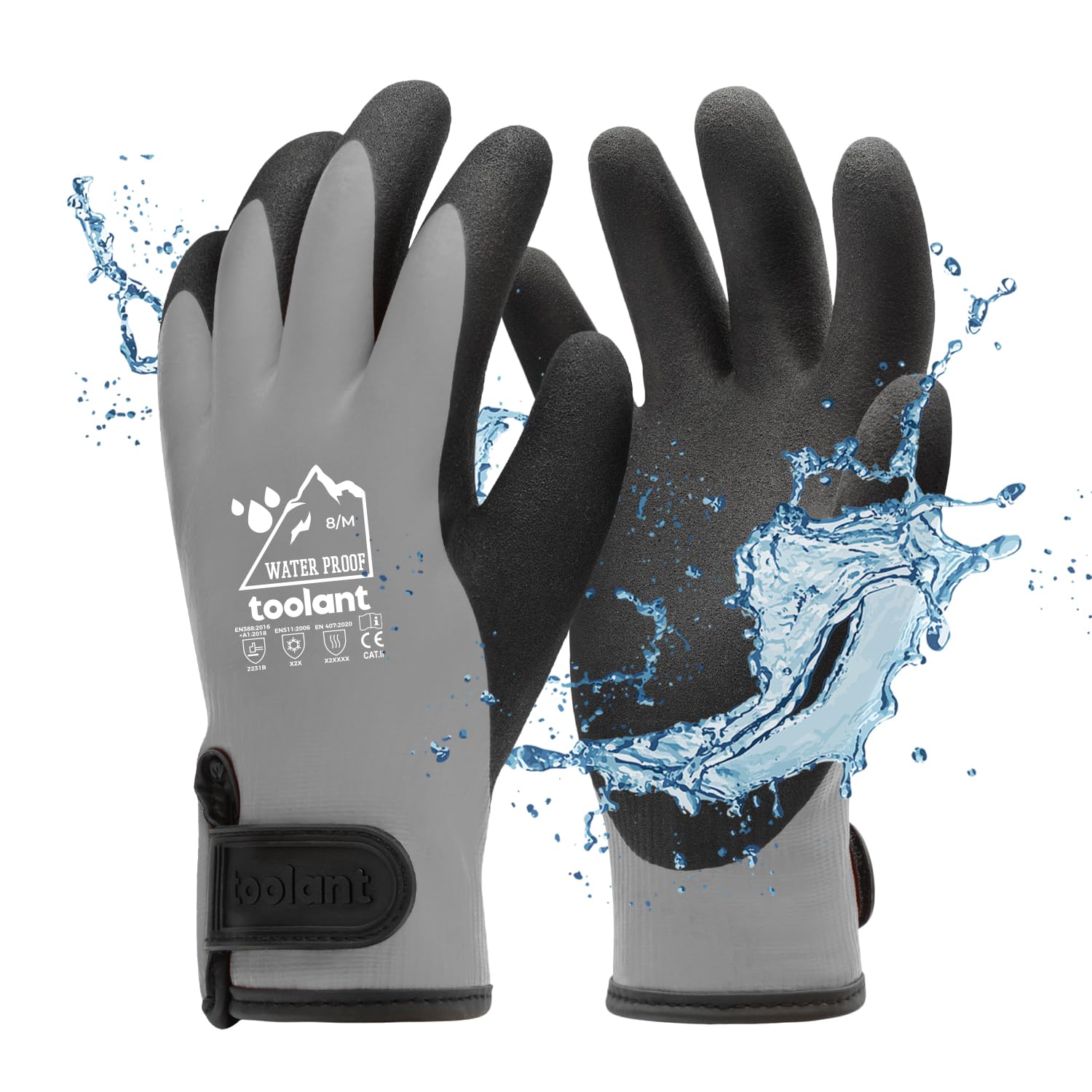
toolant 100% Waterproof Gloves

89 /100
Kirk Score Excellent
Palm
Sandy dipped rubber
Lining
Brushed fleece
Touchscreen
Yes, through graphene in palm dip
Waterproofing
Double latex dip, 100% waterproof
Check Details on Amazon

Pros

  • Double latex dip keeps water out
  • Sandy palm grips wet tools and handles
  • PU skirt stops water at the wrist
  • Touchscreen works through the palm dip

Cons

  • Not breathable
  • Warmth stops well short of deep cold

There's a particular kind of cold that comes off a hose in late fall. The water is cold enough to ache through a glove, it finds every seam, and by the second bucket your hands are done. That's the job this toolant pair was built for, and it's the one place in this guide where nothing else comes close.

Two full latex dips do the work: water runs off the back of the hand instead of wicking in, and the sandy texture on the palm holds a wet hose, a pressure-washer wand, or a slick bucket handle. We were also impressed by the small stuff — there's a PU skirt at the wrist to stop water running down toward your sleeve, and graphene in the palm dip means the glove works a phone screen through the palm rather than the fingertip.

What it isn't is a deep-winter glove. The fleece lining is comfortable on a raw, wet day and thin enough that you keep your dexterity, but this is a waterproof glove first and a warm one second. Sizing runs small, and a dipped shell doesn't give, so go up a size rather than hoping it stretches.

Bottom line: When the work itself is wet — hoses, pressure washing, wet stock — the toolant pair keeps hands dry at a price that makes a second set easy.

Check Latest Price
#05

Best Budget

DeWalt Thermal Insulated Glove

90 /100
Kirk Score Outstanding
Grip
Grip-focused palm
Design
2-in-1 knit shell and dip
Insulation
Thermal insulated
Check Details on Amazon

Pros

  • Thin shell keeps small hardware workable
  • Grip palm holds slippery boxes and bundles
  • Warm enough for active work in cool weather
  • Least expensive pair in this group

Cons

  • Palm coating wears through under daily abrasive use

The test we run on any work glove is small hardware: can you pick up a nut, a nail, or a screw with it on? The DeWalt 2-in-1 passes. The knit shell is thin enough that your fingers still work, and the grip palm hangs on to a slick box or a bundle of shingles without you clamping down until your forearm aches.

Warmth is real but modest. The thermal lining is enough for an active job in cool weather, and once you stop moving it isn't — this is a three-season glove that stretches into winter for work that keeps you moving. That's the honest trade for the dexterity, and for the money it's a good one.

The coating is what wears first. On a light dipped glove, daily abrasive work thins and splits the palm at the fingertips; for weekend shoveling, framing, and yard work this pair holds up fine, and for eight-hour days on concrete the dip is the part that gives out. It also runs a touch large, which is handy if you want a thin liner underneath.

Bottom line: The DeWalt 2-in-1 is the pair to buy when dexterity matters more than warmth: light, grippy, and cheap enough to keep a spare in the truck.

Check Latest Price
#06

Best Lightweight Leather

toolant Leather Thinsulate Gloves

92 /100
Kirk Score Outstanding
Cuff
Adjustable wrist strap
Lining
3M Thinsulate
Material
Leather
Check Details on Amazon

Pros

  • Thinsulate liner is warm without bulk
  • Soft leather needs almost no break-in
  • Adjustable wrist strap seals out cold air
  • Costs less than our leather top pick

Cons

  • Wrist strap stitching is the weak point
  • Sizing runs small

Set this pair next to our top pick and the difference is obvious straight out of the bag: the leather is thinner, the cut is closer, and there's a 3M Thinsulate liner where the Kinco has Heatkeep and a canvas back. That's less a downgrade than a different job — this is a glove for handling, not for heaving.

It's warm for how little there is of it. The Thinsulate insert does the insulating, and because the leather is pliable from day one, you can feel what you're holding on the first morning rather than the fifth. For loading a truck, running a snowblower, or working with hand tools where you need feedback through the palm, that's the combination we want.

Where it gives ground is at the wrist. The adjustable strap is the part that cinches cold air out, and it's also the part most likely to be sewn badly, so check the stitching before the return window closes. Sizing runs small — take a size up from your usual and the fit lands where you want it.

Bottom line: The toolant leather pair is what we hand someone who wants warm leather without bulk: soft, quick to break in, and easy on the wallet next to our top pick.

Check Latest Price
#07

Everyday winter chores

HANDLANDY 3M Thinsulate Gloves

89 /100
Kirk Score Excellent
Care
Machine wash
Palm
Reinforced anti-slip
Insulation
3M Thinsulate
Waterproofing
Full waterproof bladder
Check Details on Amazon

Pros

  • 3M Thinsulate liner is warm for the weight
  • Machine washable, unlike the leather picks
  • Reinforced palm adds grip and wear resistance
  • Clean enough to wear off the clock

Cons

  • Waterproof layer gives out in sustained wet
  • Sizing runs small

Most winter work gloves look like winter work gloves. This one doesn't. The shell is clean, the cuff sits close, and nothing about it announces a job site — which matters more than it should, because it's the pair you leave on when you run into the hardware store for a box of screws.

Underneath there's a 3M Thinsulate liner inside a waterproof bladder, over a reinforced anti-slip palm. Warmth is the strength: the Thinsulate insert is warm for how thin the glove feels, and the plush lining means you can wear them bare-handed without that clammy synthetic sensation.

The waterproofing is the part we trust least. A bladder between liner and shell keeps snow out while it's intact, but in sustained wet the water finds its way in, and once that liner is damp the glove turns heavy and cold. Sizing runs small as well, so order up rather than assuming they'll loosen.

The detail we appreciate most is the care line: these are machine washable, which almost nothing else in this guide is. Muddy chores, a wash, an air dry, and they're back in rotation — that's a real advantage for a glove that's going to see yard work and slush.

Bottom line: The HANDLANDY pair is a solid everyday winter glove — warm, machine washable, and tidy enough to wear off the job site.

Check Latest Price
#08

Freezer and barn work

LOCCEF Winter Work Gloves, 2 Pairs

89 /100
Kirk Score Excellent
Use
Freezer and cold-weather work
Pack
2 pairs
Insulation
Thermal
Check Details on Amazon

Pros

  • Two pairs in every pack
  • Grip holds without losing dexterity
  • Comfortable in constant freezer cold
  • Fits a wide range of hand sizes

Cons

  • Wears through at the fingertips with heavy use
  • Thin once wind and wet are involved

Two pairs in one pack is the entire reason to look at the LOCCEF gloves, and it's a good reason: one pair on, one pair drying, and you're never caught short halfway through a job with a wet hand and a cold drive home.

The gloves themselves are better than the pack price suggests. Grip is the standout — the palm hangs on to a metal rail or a feed bucket without costing you the ability to bend your fingers, which is exactly the balance you want for chores. The fit is forgiving across a wide range of hands, and the palms are water resistant enough for wet bucket handles and sloppy ground.

Where the pack shows its price is warmth in wind and wear at the fingertips. In constant cold — a freezer aisle, a barn at dawn — they're comfortable; standing in a wet wind, they're thin, and hard daily use has a way of opening the fingertips. If you're the person who burns through a pair every season anyway, that's an easy trade to make.

One quirk worth knowing: wash them and the liner can turn inside out. Work it back over your fingers before they dry, or the glove never sits right again.

Bottom line: Two pairs, decent grip, and enough warmth for freezer aisles and barn chores: the LOCCEF pack is the practical buy if you go through gloves fast.

Check Latest Price
#09

Sharp-edged material

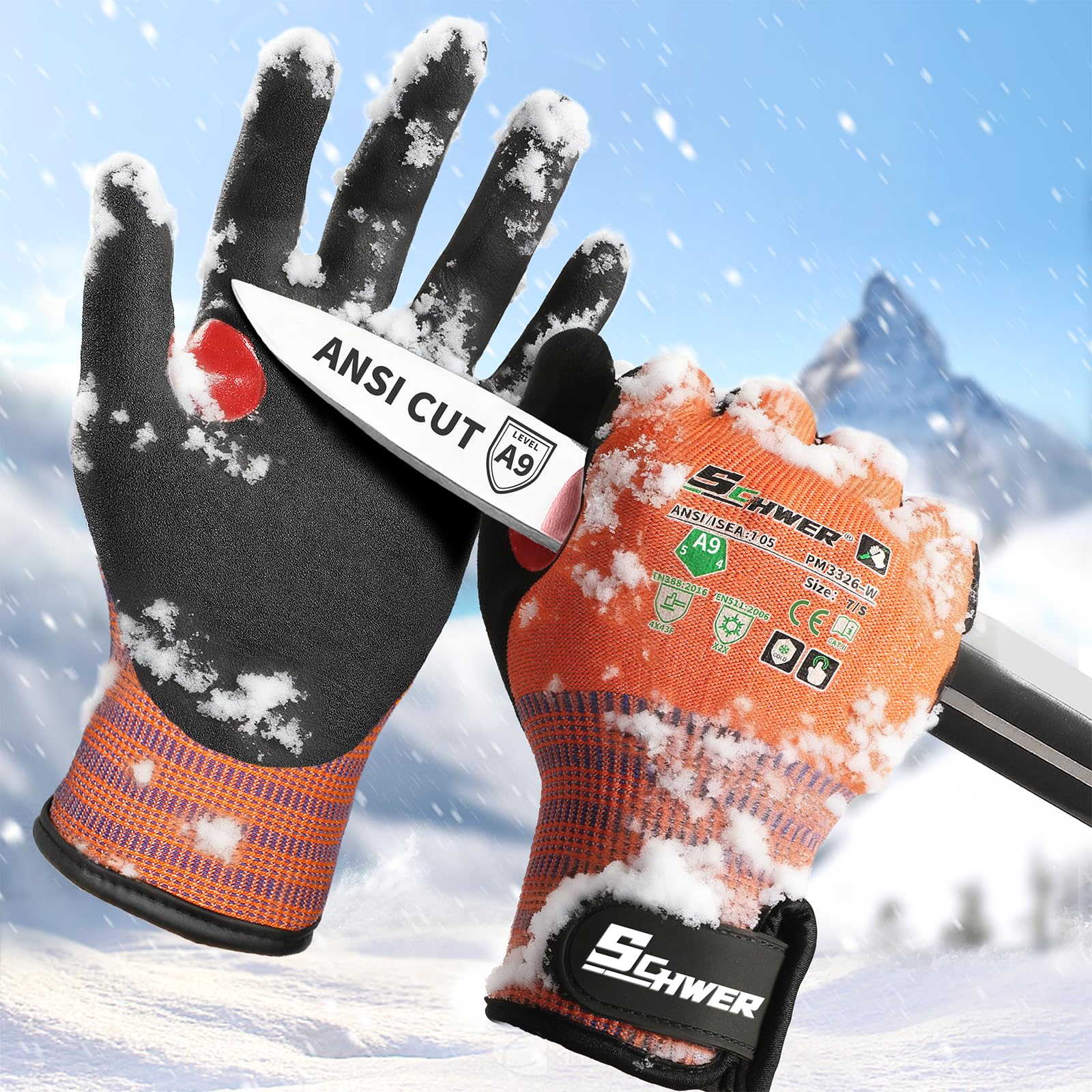
Schwer FreezeGuard-X A9 Gloves

89 /100
Kirk Score Excellent
Palm
Nitrile foam coated
Lining
Acrylic terry
Cut Resistance
ANSI A9
Water Resistance
Not water resistant
Check Details on Amazon

Pros

  • ANSI A9 cut resistance
  • Nitrile foam palm grips wet, greasy metal
  • Acrylic terry liner adds warmth
  • Snug fit keeps dexterity

Cons

  • Not water resistant
  • Modest warmth when you're standing still

ANSI A9 is the highest cut rating a work glove carries, and the FreezeGuard-X is the only glove in this guide that claims it. If you're handling sheet metal, glass, wire, or anything that has already bitten you once, that's the number to look for.

It's a genuinely good cold-weather glove as well as a protective one. The acrylic terry liner is warm against the hand, the nitrile foam palm holds wet, greasy metal without slipping, and the fit is snug enough that you keep the dexterity to use your fingers — which matters, because cold hands are slow hands and slow hands get cut. The fingertips even work a phone screen, which is more than we expected from a glove built around protection.

Two limits to be clear about. It isn't water resistant, so rain, slush, and soaked material go straight through, and its warmth is modest once you're standing still. It's the glove for cold, dry, sharp work — a demolition trailer, a scrap pile, a sharpening bench — rather than a wet January shift outdoors.

Bottom line: If the job brings sharp edges as well as cold, the Schwer FreezeGuard-X is the only A9-rated glove here — just don't count on it to keep you dry.

Check Latest Price

How We Chose and Tested Winter Work Gloves

We started by pulling every winter work glove we could find that had a real shell — a leather palm, a latex or nitrile coating, a knit or elastic cuff — then read through the one- and two-star reviews looking for patterns. Anything that came up repeatedly as stiff, sweaty, or shot by February got cut. That left 14 pairs in men's and women's sizes, half from brands our crew already wears on job sites and half from names we'd never tried.

Testing ran from October through February. Every pair went through the same rotation: a 25-degree morning loading a truck bed and stacking firewood, a 45-minute shift in a walk-in freezer handling frozen boxes, a driveway of heavy wet snow, and a rainy afternoon dragging wet rope and hose. We noted when fingers first went numb and how quickly feeling came back in a warm cab, since a glove that rebounds fast is worth more than one with a slightly better warmth rating.

Water resistance got its own test: two minutes under a running faucet, then a full dunk to the wrist, then a squeeze of the fingers to see whether the liner felt damp. For dexterity we picked up screws, tied bowlines, and tried answering a phone without pulling a glove off. Durability was honest abuse — lifting rough lumber, hauling concrete, dragging a tarp — with a look at palm seams, thumb crotches, and fingertips after each session.

Fit and comfort were the tiebreakers. Everyone on the team has different-size hands, so we logged where a cuff gaped, where a liner bunched, and whether a liner slid off with a sweaty hand. We checked that the cut level printed on the label matched the reinforcement we could actually see, then wore those pairs on sheet metal and glass edges where it mattered. Value had the final word, and more than once a mid-priced pair outlasted a pricier one.

How to Choose Winter Work Gloves

Match the insulation to how hard you're working

Insulation is only half the warmth story; the other half is you. Continuous work like shoveling, hauling, or framing generates heat, and a heavily insulated glove will have your hands stewing by the second hour, which ends up colder than starting light. Stop-and-go work, or standing on a lift watching a crew, needs the loft.

Look at what the liner is: 3M Thinsulate and Kinco's Heatkeep are both thin, warm inserts that don't bunch when you close your hand, while fleece and acrylic terry are softer and bulkier. If you plan to wear a thin liner underneath, buy one size up rather than hoping the glove stretches.

Decide between waterproof and water-resistant

A fully dipped glove — latex or nitrile over a knit shell — is genuinely waterproof, and it's the right answer for hoses, pressure washers, wet stock, and slush. The cost is breathability: nothing gets in, so nothing gets out, and sweat sits against your skin.

Leather goes the other way. It's water resistant at best, but it stays soft and grippy when damp and it breathes, which makes it the better choice for dry cold and abrasive handling. A glove built around a waterproof insert sits between the two, and those inserts dry slowly once they're wet.

Read the palm before anything else

Grip is where a winter glove earns its keep, and the palm tells you what the glove is for. Pigskin and goat leather hold a wet handle, resist abrasion, and stay flexible in the cold. A rough or sandy latex dip bites slick, slimy, icy surfaces. Smooth nitrile sheds oil and grease instead of soaking it up.

That's the fork in the road for most buyers: leather for dry cold and hard handling, a dip for water and mess, and a reinforced palm where you'll be dragging abrasive material all day.

Fit, cuffs, and the sizing lottery

Sizing between brands is close to meaningless. The Kinco runs large enough that a medium fits plenty of people who normally take a large, while several pairs here run small. Judge the model, not your usual size, and read the sizing note on the specific glove.

A knit wrist seals out snow, chips, and sawdust and slides under a jacket sleeve; an extended or adjustable cuff covers more wrist and closes with a strap. Whichever you choose, make a fist before you commit — you want room to bend without a gap past the fingertips.

Reinforcement, seams, and the wear points

Gloves fail at the seams and the high-wear points, so look for leather welts, a wrap-around index finger, an angled wing thumb, and reinforcement at the thumb crotch and fingertips. Those are the places a maker expects the glove to give out, and comparing them tells you more than any warmth rating on the package.

Cut protection is a separate question. If you handle sheet metal, glass, wire, or sharp tooling, an ANSI-rated glove adds margin — but the rating covers cuts alone, so check the water and warmth specs separately.

Frequently Asked Questions

Final Verdict

The Kinco 1927KW is the pair we point most people to. The pigskin palm stays soft and grippy when everything else stiffens, the Heatkeep lining is warm without turning your hands into a sweatbox, and the price lands in the middle of this group. Order a size down.

If your winter work is wet rather than merely cold, the SHOWA 451's pebbled latex grip and durability are worth the step up, and the DeWalt 2-in-1 is the smart buy when dexterity matters more than warmth.