// data-verified

Best Waterproof Work Gloves of 2026

A glove that keeps water out and a glove you can actually work in are rarely the same glove. The truly waterproof ones tend to be stiff and clammy; the soft leather pair you love is usually only water-resistant, fine for a damp morning but no match for a shovel handle dripping meltwater. The right pair closes that gap — dry hands through an afternoon of cold, wet work, with enough dexterity to pick up a screw you dropped in the snow.

My team and I spent five months wearing 14 pairs through snow shoveling, cold hose work, and a few genuinely miserable mornings. Construction decided most of it: a rubber-dipped shell is close to submersible, while treated leather sheds splashes and then slowly gives up. Cuff length matters more than shoppers expect, and too much insulation turns clammy in wet-but-mild weather.

Fit is the other place people go wrong — a size off means bunching at the knuckles, cold fingers, and palms that wear through sooner than a cheaper pair that actually fits. Below are the pairs that earned a spot by the door, sorted by the kind of cold, wet work you're doing.

#01

Best Overall

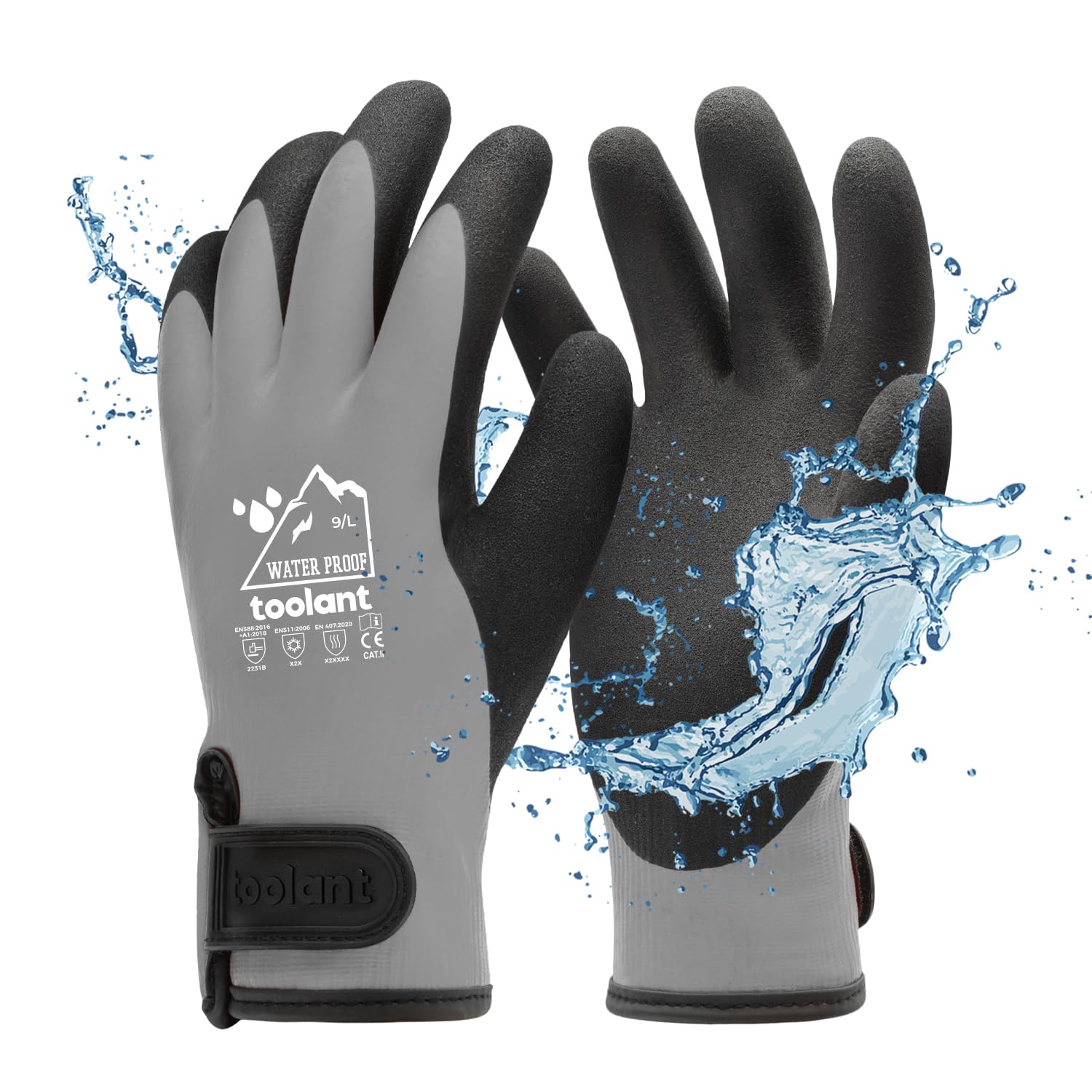
toolant Waterproof Winter Work Gloves

89 /100
Kirk Score Excellent
Cuff
Extended, hook-and-loop wrist
Lining
Brushed fleece
Touchscreen
Yes
Waterproofing
Double-dipped latex
Check Details on Amazon

Pros

  • Double-dipped latex seals the whole shell
  • Sandy palm grips wet handles
  • Touchscreen fingertips that actually work
  • Fleece lining and extended cuff for cool mornings

Cons

  • Runs small; size up between sizes
  • Not warm enough for a hard freeze

A glove labeled waterproof is usually water-resistant with better marketing. The toolant pair is the real thing: two layers of latex are dipped over the whole shell, so there's no knit, seam, or leather for water to soak into. That's why it's our top pick — on a wet, chilly job it's the difference between finishing the last hour and quitting early with numb hands.

The palm is where it earns a second look. The sandy latex dip grips a wet shovel handle or a slick pipe instead of skating across it, and graphene in the dip makes the fingertips work on a phone screen — a feature we were ready to dismiss until we were standing in the rain trying to read a message with our gloves on. The extended cuff and hook-and-loop wrist close the gap where water usually finds a way in.

What it isn't is a winter glove. The brushed fleece lining is comfortable on a cold morning, not through a February shift, so treat these as wet-work gloves that happen to be insulated. Sizing runs small and narrow, and hand washing is the only care instruction — a machine cycle will shorten their life.

Bottom line: We recommend it as the default for wet, cool work: the dipped shell genuinely seals water out and the palm still grips a wet handle. Size up, and don't expect deep-winter warmth.

Check Latest Price
#02

Best for Snow and Ice

Schwer Waterproof Winter Work Gloves

89 /100
Kirk Score Excellent
Lining
Acrylic terry
Quantity
2 pairs
Waterproofing
Full latex coating
Cut Resistance
ANSI A2
Check Details on Amazon

Pros

  • Two pairs, so one dries while you work
  • ANSI A2 cut resistance at a budget price
  • Full latex dip keeps hands dry in slush
  • High-visibility orange shell

Cons

  • Fingertips go cold on long shifts
  • Fit runs small

Two pairs is the detail that sold us on the Schwer set. Wet gloves don't dry overnight in a cold garage, so a second pair means you start the next morning dry instead of pulling on something damp and stiff.

The waterproofing holds up. The latex coating covers the whole shell, hands stay dry through slush, wet rope, and a soaking driveway, and there's no leather to go crunchy afterward. We were also struck by the ANSI A2 cut rating, which is unusual in a work glove at all and genuinely useful if you're handling sheet metal, glass, or frozen branches. The acrylic terry liner is warmer than the fleece in our top pick, and the orange shell is easy to spot in a snowbank.

Wet grip is the other thing that works: the foam latex palm holds a shovel handle or a wet tow strap without slipping. The soft spot is the fingertips, where the coating thins under abrasive work — which is one more argument for owning two pairs.

Bottom line: Buy these for snow, ice, and cold wet work where a cut-resistant palm earns its keep — two pairs means you always have a dry one waiting.

Check Latest Price
#03

Best for Bitter Cold

Carhartt Waterproof Insulated Glove

93 /100
Kirk Score Outstanding
Cuff
Knit
Model
A511
Insulation
Insulated
Waterproofing
Waterproof
Check Details on Amazon

Pros

  • The warmest glove in this guide
  • Waterproof barrier keeps hands dry in sleet
  • Knit cuff and flexible back for real hand movement

Cons

  • Fit runs small with short fingers

If you're choosing between cold and wet and cold is winning, start here. This is the warmest glove in the guide by a clear margin — the insulation is thick, the knit cuff closes around the wrist, and it's the one we hand out when someone is going to be standing still in freezing weather.

It handles water too. A waterproof barrier sits between the lining and the shell, and hands stay dry through sleet, wet snow, and a long morning outdoors. The catch is that the same barrier keeps sweat in: when you're working hard, the inside goes damp and stays damp, and a glove that gets soaked from the inside takes a day or more to dry out again.

So we rate it as a cold-weather glove that deals with wet weather, not a glove for putting your hands in water. For plowing, shoveling, stacking wet firewood, or standing on a roof in a sleet storm, the warmth and the knit cuff are worth more than the last increment of waterproofing. For anything involving a bucket, reach for a dipped glove instead.

Where it still beats a rubber glove is feel. The knit back and cuff move with your hand, so you can drive, work a zipper, and load a truck without pulling them off — which is most of what we ask of a winter glove.

Bottom line: Our pick when the cold is the bigger enemy: the warmest glove here, and it keeps hands dry through sleet, though it's a poor choice for hands-in-water jobs.

Check Latest Price
#04

Best for Chemicals and Mess

Wells Lamont PVC Chemical Resistant Gloves

94 /100
Kirk Score Outstanding
Cuff
Gauntlet
Grip
Textured palm
Length
12.8 inches
Material
PVC
Check Details on Amazon

Pros

  • Thick PVC handles hot water and cleaners
  • Gauntlet cuff keeps splashes off the forearm
  • Durable enough to keep for years of washing up

Cons

  • Stiff fingers with no feel for small parts

Thick is the whole story. The PVC coating here is heavier than anything else in this guide, and the gauntlet cuff flares wide enough to send drips past your sleeve instead of down it.

That makes it the pair we reach for when the water is hot or dirty: washing up, stripping wallpaper, scrubbing a bilge, emptying a holding tank. The textured palm holds on a soapy dish or a slick bucket rim, and the coating stands up to repeated wet use better than most of the lighter dips here. Protection is the priority with this glove, and it shows.

The trade-off is your hands' intelligence. Thick PVC has no feel, so picking up a screw or working a small fitting is out of the question. It's also cut generously, and smaller hands will swim in it. For wet, messy work done at arm's length, neither of those costs you anything.

Bottom line: For hot water, harsh cleaners, and filthy jobs, we think this thick PVC pair protects more than anything else here — provided your hands are big and the work is coarse.

Check Latest Price
#05

Best Budget

G & F Waterproof Winter Work Gloves

89 /100
Kirk Score Excellent
Palm
HPT coating
Model
1628
Insulation
Insulated
Waterproofing
Waterproof
Check Details on Amazon

Pros

  • Keeps water out on a tight budget
  • Soft fleece feel inside
  • Textured palm grips well when wet

Cons

  • Coating can peel and let water through

There's a version of this purchase where you need a waterproof glove today and don't want to think hard about it. The G & F pair is that glove: insulated, windproof, and dry through wet snow and a soaking morning in the garden, at budget money.

The fleece lining is softer than the price suggests — smooth, almost velvety against the skin — and the HPT palm coating grips well when it's wet. The insulation is real but thin. Hands stay comfortable on a cold, wet morning and start to chill once the temperature slides toward freezing, which makes this a shoulder-season glove rather than a deep-winter one.

Buy two. A pair in the truck and a pair on the hook by the door covers wet mornings without wrecking your good gloves, and giving a damp pair a full day to dry is what keeps the lining from going sour.

Bottom line: A sensible glove to buy in twos and keep in the truck: it keeps water out on a budget, as long as you don't expect much warmth or a long life.

Check Latest Price
#06

Ponds and tanks

Haiou 25-Inch Long Rubber Gloves

92 /100
Kirk Score Outstanding
Cuff
Elbow length
Length
25 inches
Weight
12.4 oz
Material
Rubber
Check Details on Amazon

Pros

  • 25 inches of coverage, fingertip to above the elbow
  • Cold water doesn't come through the rubber
  • Rinses clean for chemical and tank work

Cons

  • Water comes in over the top on deep plunges
  • Cuff pinches on larger upper arms

Twenty-five inches is a strange-sounding glove until you have a reason for it. These run from fingertip to above the elbow, and that length is the entire point: they're for jobs where your forearm goes into the water, not just your hands.

Pond clearing, tank cleaning, aquarium liverock, a bucket of chemical mix — anything where a splash or a plunge would otherwise land on bare skin. The rubber is thick enough that cold water doesn't register, and the smooth surface rinses clean in seconds, which matters when the last thing you handled is something you don't want on your sleeve.

We keep a pair for the jobs where a short glove would leave us with a wet forearm and a decision about whether to keep going. As a barrier they do exactly what they claim: water stays out, the cold doesn't come through, and nothing shorter here matches the coverage.

Two limits. The top of the cuff is open, so plunge past the elbow and water comes in — true of every gauntlet glove, and it surprises people anyway. The upper arm is also the tight spot, since the cuff doesn't stretch much. Neither matters for the pond and tank work these were built for, where the alternative is a soaked sleeve.

Bottom line: We keep these for pond, tank, and chemical-splash work where a wet forearm is the problem — nothing shorter in this guide covers that.

Check Latest Price
#07

Damp grip work

Wells Lamont HydraHyde Leather Gloves

92 /100
Kirk Score Outstanding
Back
Spandex
Closure
Adjustable wrist
Material
HydraHyde leather
Water Resistance
Water-resistant
Check Details on Amazon

Pros

  • Soft leather that dries without going crusty
  • Adjustable wrist holds the glove in place
  • Good protection and grip for brush and firewood

Cons

  • Soaks through in steady rain
  • Runs snug across the palm

Every other glove in this guide is a rubber glove in one form or another. This one is leather, treated to repel water rather than seal it out, and that makes it a better glove for a different kind of wet.

The HydraHyde palm is soft, and the softness is the reason to buy: the leather wraps a handle instead of fighting it, the spandex back keeps the glove from bagging, and the adjustable wrist closure holds the cuff where you set it. Thorns, splinters, and rough firewood stay on the outside, and you can still pick up a small fitting without taking them off.

Where it parts company with the dipped gloves is standing water. Damp brush, wet firewood, a drizzly morning — all fine. Steady rain or a soaked glove and the leather takes on water, goes slick, and stops being useful for grip. The consolation is what happens next: it dries soft rather than hardening into a crust, so a wet day doesn't ruin the pair.

We choose it for damp work with something sharp in it — clearing brush, hauling limbs, splitting and stacking — and we choose a dipped glove when the water itself is the job. If your wet work is mostly overhead branches and wet wood rather than buckets, this is the more comfortable glove by a wide margin.

Bottom line: Choose this leather pair for damp brush, wet firewood, and sharp loads where you want feel; it repels water rather than sealing it out, so it isn't a bucket glove.

Check Latest Price
#08

Cold-weather dexterity

HANDLANDY Winter Work Gloves

89 /100
Kirk Score Excellent
Care
Machine wash
Weight
4.8 oz
Closure
Pull on
Insulation
3M Thinsulate
Check Details on Amazon

Pros

  • Thinsulate warmth without much bulk
  • Enough dexterity to handle small parts
  • Machine washable
  • Pull tabs for one-handed on and off

Cons

  • Sizing runs small; go up a size

Thinsulate is the reason to look at these. The insulation is thin enough that you keep most of the feeling in your fingers — you can pick a screw out of a tray, work a knot, or handle a small tool without pulling the glove off, which is not something we can say about the heavier insulated pairs here.

Warmth is decent for the bulk: under five ounces on the scale, with a plush lining that makes a cold morning comfortable without turning your hands into mittens. The pull tabs let you get them on one-handed, the palm and fingertips are reinforced for grip, and they're machine washable — the last one matters more than it sounds, because cold-weather gloves get sour fast.

Water is where they get shaky. A waterproof bladder sits between the lining and the shell, and it works while it's intact: snowy shoveling, wet slush, a cold morning on a boat. Push them into all-day meltwater, though, and the waterproofing gives out, and a soaked lining is worse than no lining at all.

So we place them as a cold-weather glove for work that's wet at the edges rather than soaked through. The machine wash is our favorite detail: run them through and they come back ready to wear, which is rarer in this category than it should be.

Bottom line: We rate these for cold work that's wet at the edges — shoveling, snow blowing, cold mornings — where dexterity matters more than a sealed shell.

Check Latest Price

How We Tested: Soaked, Frozen, and Put to Work

We started by pulling together every waterproof and water-resistant work glove we could find across a few dozen listings, then narrowed by construction: dipped and coated shells, treated leather, elbow-length rubber, and combinations of those. Anything without a usable size chart, or with a vague water-resistance claim, got cut early. That left 14 pairs, including multi-packs, which we rotated through five months of real work rather than a bench.

Water resistance got the hardest test. We sank each glove to the wrist in a bucket of ice water for five minutes, then checked fingertips, backs of hands, and cuffs for dampness. Next came a wet snowfall: 45 minutes of shoveling for each pair, with notes on when cold first reached our fingers, whether the liner shifted when we pulled a wet hand out, and how long hands took to rewarm afterward. The longer-cuffed pairs also went into hose work and equipment washing, where water runs straight down a sleeve.

For grip and functionality, we hauled wet rope, carried sopping firewood, and picked up small screws and nuts with each pair on. Comfort came down to clamminess and knuckle bunching after an hour of wear, plus whether the sizing matched the chart or ran small and long in the fingers. Durability meant wringing each glove out repeatedly, letting it dry, and re-inspecting the coating and seams for cracking or separation. Most failures showed up at the cuff or the seam, not the palm, and value came down to whether a pair still felt usable after all of it.

How to Choose Waterproof Work Gloves

Shell First: Dipped, Coated, or Leather

A fully dipped latex or PVC shell is the only construction here that seals the whole hand, and it's what we look for when the job means putting your hands into water — pressure washing, pond clearing, a bucket of cleaner. The cost is breathability: a sealed shell holds sweat, so on a long job your hands end up damp from the inside.

Water-resistant leather sits at the opposite end. It handles damp brush and wet firewood and gives you far more grip and feel, but steady rain goes straight through it. Work out which kind of wet you're in before you compare anything else.

Cuff Length Sets Your Water Line

Water runs downhill, so the cuff is where most waterproof gloves actually fail. A knit cuff sits close to the wrist and is comfortable under a jacket sleeve, but it soaks and holds that water against your skin. A flared gauntlet sends drips past your sleeve and is the right shape for washing, stripping, and chemical work.

If your forearm is going in, nothing short of an elbow-length glove will do — that's the whole case for the 25-inch Haiou pair, and the bulk is the price you pay for it.

Insulation, Sweat, and Cold Hands

Insulation only earns its place when the shell keeps wind and water out; a wet liner is worse than no liner, because it pulls heat away from your fingers. Fleece and acrylic terry are the two linings in this guide, and both are comfortable down to a chilly morning.

For hard cold, more insulation wins — the Carhartt is the warmest glove here. But once you're working above a cool morning, heavy insulation makes your hands sweat, and sweat turns cold the moment you stop moving. If your work is wet and cool rather than freezing, a lighter fleece is the better balance.

Fit: Measure, Then Size Up

This is the category where sizing goes wrong most often. Most of the gloves in this guide run small, and a tight glove is a cold glove — it restricts blood flow and presses on your fingertips. Measure around your palm at the knuckles and use the maker's chart instead of your usual size, and when you land between two, take the larger.

Finger length matters as much as width. If the tips are cramped, you lose the dexterity you bought the glove for, and you'll be pulling them off for every small task.

Grip and Dexterity

Palm texture does more wet-weather work than thickness does. A sandy or foam latex dip bites into a wet shovel handle and a soapy pipe; a smooth dip slides. Thicker palms last longer and protect more, but they cost you feel, which matters if you're driving screws or sorting small fittings.

Match the palm to the tool: textured and thick for handles and rough material, thinner and more flexible for anything you have to hold precisely.

Frequently Asked Questions

Final Verdict

The toolant pair earns the top spot because it's the one glove here that combines a genuinely sealed shell with grip you can trust on a wet handle. If your wet work happens in a hard freeze, the Schwer set gives you two insulated, cut-resistant pairs so one is always dry.

And if the cold matters more than the water, the Carhartt is the warmest glove in this guide — just go up a size.