// data-verified

Best Knee Pads of 2026

Knee pads rarely fail on the first kneel. They fail twenty minutes in, when the pad has crept down your shin and you're hitching it back up one-handed while the other hand holds a trowel. Cushioning is the easy part — staying put is what separates a pair you forget about from one you fight all afternoon.

We've spent four months with 16 pairs: hard-shell work pads for construction, flooring, roofing, and gardening, plus low-profile sleeves for the volleyball court. A pattern emerged — most slipping complaints traced back to a single narrow strap sitting behind the knee, while pairs with a second strap anchored above the calf held through hours of crawling. Gel also resists packing down in cold better than plain foam.

Sizing trips people up more than anything else. Measure your thigh a few inches above the kneecap instead of guessing from your pant size, and treat velcro as a wear part — it fuzzes up and loses grip long before the padding dies. Below are the pairs that held up on both counts.

#01

Best Overall

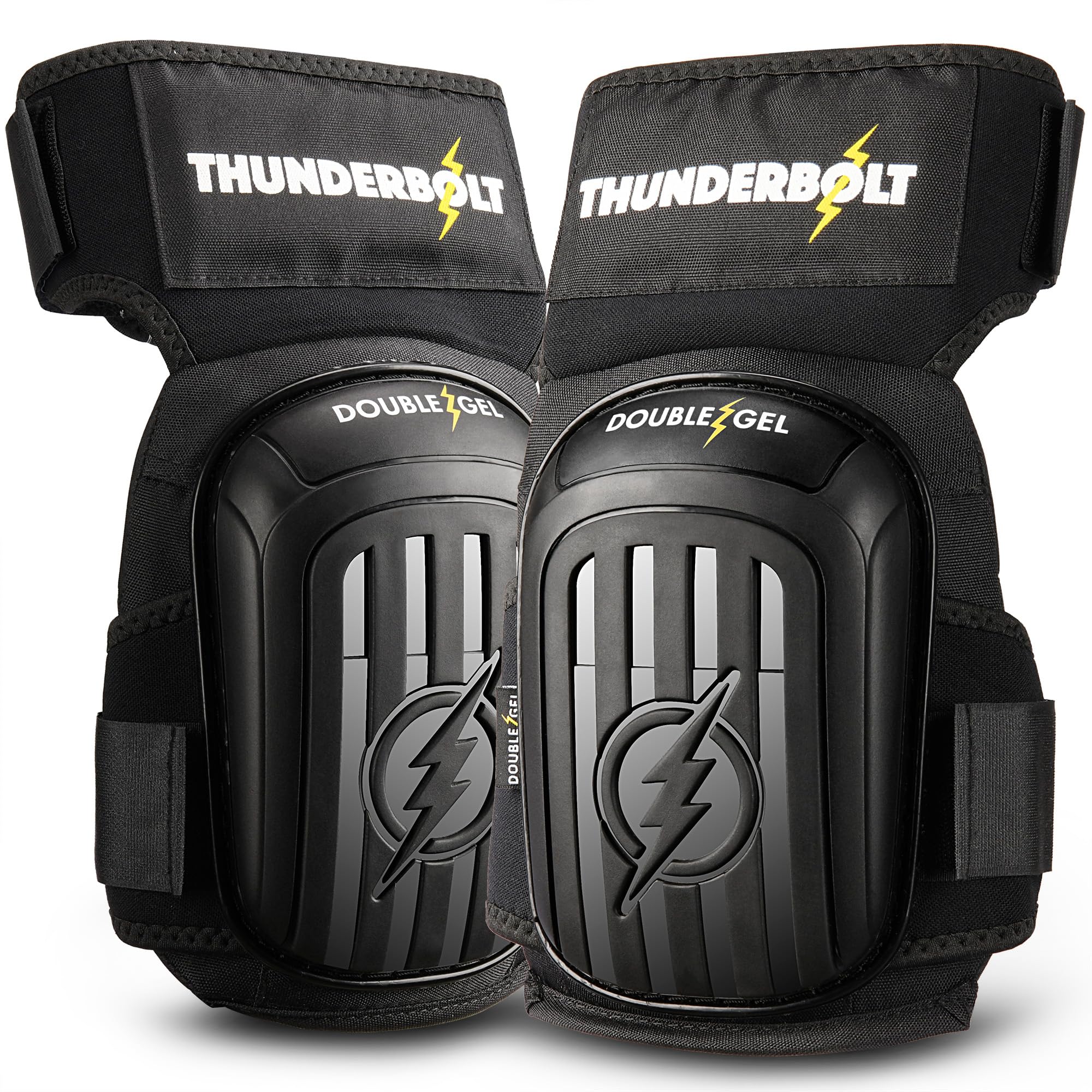
Thunderbolt Knee Pads

93 /100
Kirk Score Outstanding
Weight
1.6 lb
Closure
Adjustable fasteners with 7-inch extension straps
Pad Face
Heavy-duty non-slip shield
Cushioning
Double gel over thick foam
Check Details on Amazon

Pros

  • Hard shield and gel layer in one pad
  • Stays square through up-and-down work
  • Extension straps widen the fit
  • Padding above and below the knee

Cons

  • Heavy at 1.6 pounds for the pair
  • One size only, so fit depends on the straps

Every pad on this page makes a trade between a hard face and a soft one; this pair refuses to choose. Under the heavy-duty non-slip shield sits a double gel layer over thick engineered foam, the seams are stitched with Kevlar thread, and the fasteners are backed up by a set of 7-inch extension straps for wider legs.

That combination is why it takes the top spot. On gravel or a roof deck the shield takes the point of contact, and on concrete the gel spreads the load instead of letting the kneecap carry it. We wore these through a morning of mixed surfaces, pavers and then a garage slab, and stopped thinking about the ground underneath, which is the highest compliment a knee pad earns. They also sit square through stand-up, kneel-down cycles rather than climbing the thigh, and that is the strap layout doing the work, not the foam.

Comfort held up better than we expected for something this structured. The padding runs above and below the knee as well as over it, so the shell does not dig into the top of the shin when you stand, and the foam core is firm enough to kneel across a joist without feeling every edge of it.

The extension straps are the detail nobody mentions and the one that decides whether these fit. They are what lets a single size work across a range of legs, and they are worth keeping in the tool bag rather than losing in the box. If the pads feel tight straight out of the packaging, you have not finished setting them up.

Bottom line: If your knees meet concrete, gravel, and roof decking in the same week, these are the pads to buy: a hard shield over double gel, held square by straps that stay put.

Check Latest Price
#02

Best Hard-Shell Pad

Sellstrom KneePro Ultra Flex

93 /100
Kirk Score Outstanding
Weight
1.2 lb
Closure
Quick-clip buckles with double straps
Padding
Triple-layer 3/4-inch foam
Pad Face
Flexible hard plastic shell
Check Details on Amazon

Pros

  • Hinged shell follows the knee
  • Quick-clip buckles for fast on and off
  • Ventilated three-quarter-inch foam
  • Light for a hard-shell pad

Cons

  • Runs tight on larger legs

The hinge is the whole idea here. Instead of one rigid cap, the Sellstrom KneePro uses a flexible hard plastic shell that pivots with the knee, so the pad tracks the kneecap rather than levering away from it every time you stand. In a category where most pads are a cushion strapped to a leg, it is the most convincing piece of design on this page.

Behind the shell sits a triple-layer foam pad three-quarters of an inch thick, punched with ventilation holes so a summer roof does not turn into a sauna. At 1.2 pounds it is light for a hard-shell pad, the double straps sit above and below the knee rather than across the back of it, and the quick-clip buckles let you take the pads off without rethreading anything.

Where it earns its keep is a full shift: on the ground, up, back down, forty times before lunch. The clips are quick enough that you actually remove the pads when you should not be kneeling, which does more for your knees than any amount of extra foam. For roofing, framing, and heavy maintenance work, this is the pair we point to after the top pick.

Bottom line: For trade work with constant up-and-down, the hinged shell keeps the pad tracking your knee where a soft pad slides off, and the clips make you willing to take them off.

Check Latest Price
#03

Best for Finished Floors

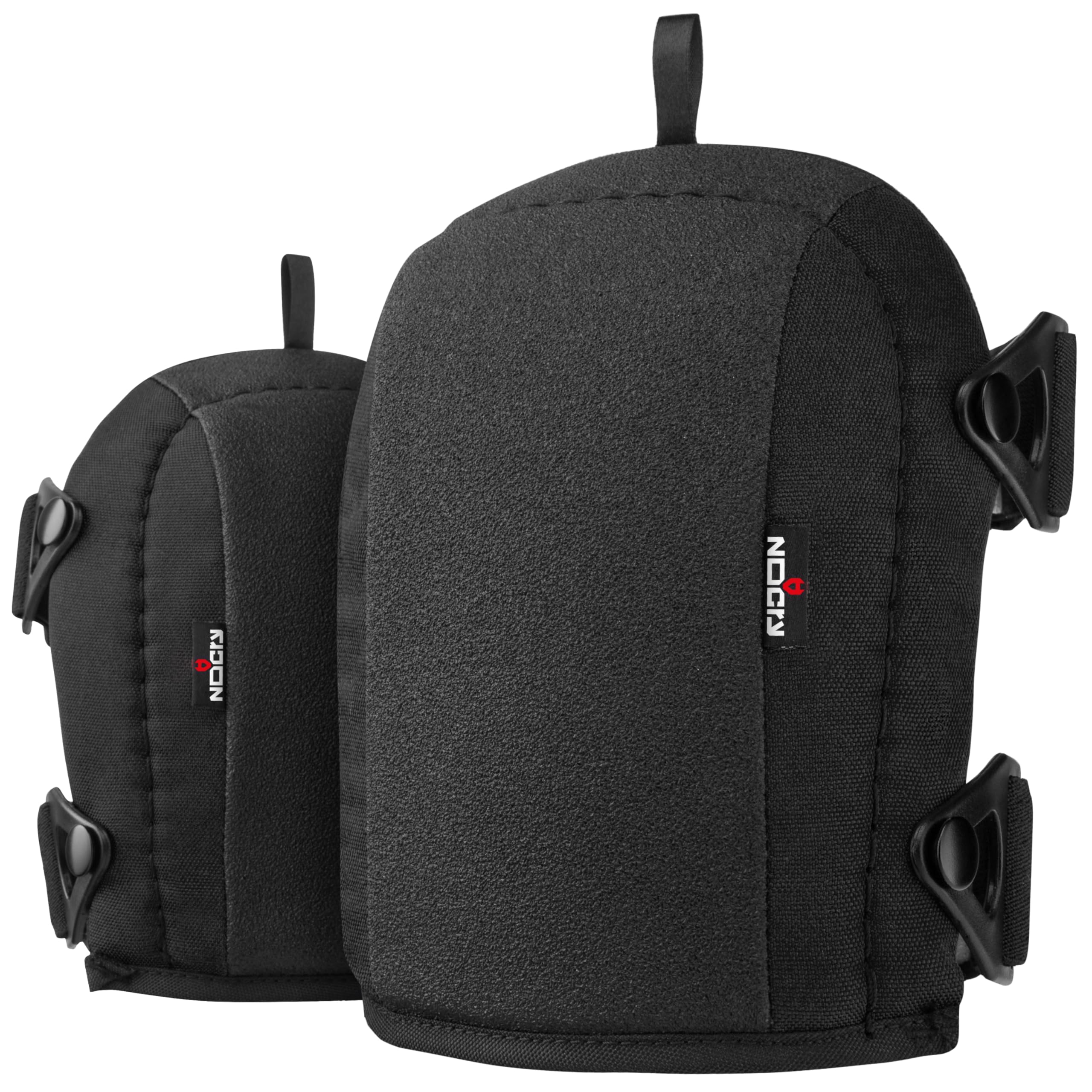
NoCry LightGuard+ Knee Pads

91 /100
Kirk Score Outstanding
Fits
Adult knees up to 22 inches
Weight
10.2 oz
Closure
Slip buckles
Pad Face
Anti-skid leather
Check Details on Amazon

Pros

  • Leather face won't skid-mark finished floors
  • Buckle clips hold without hook-and-loop
  • Fits knees up to 22 inches
  • Light at 10.2 ounces

Cons

  • No hard cap for nails and debris

The first thing we check on an indoor pad is what it leaves behind. A scuff on a finished floor is a rework bill, and the LightGuard+ answers it with a leather face instead of a plastic one: it slides over vinyl, laminate, and metal roofing without the skid marks a hard cap can leave.

That leather face is why this is the pair we keep for interior finish work. At 10.2 ounces they are light enough to wear up a stepladder, the buckles have teeth that bite into the strap instead of depending on hook-and-loop, and the rivets are the military-grade sort NoCry uses across its range. Cushioning is the one place they are merely good: soft EVA foam is comfortable for a long day, but it is not the gel-and-foam stack the top pick carries.

The fit range is unusually generous, adult knees up to 22 inches, so these suit the widest spread of legs here. Where they stop is anything with debris on it. On a tear-off roof or a demo site, leather slides across grit but it will not stop a screw, and that is the point at which you want a shell.

Bottom line: Buy these when the job is indoors and the floor is finished: the leather face protects the surface as much as your knees, and 10 ounces is light enough to forget.

Check Latest Price
#04

Best Value

REXBETI Gel Knee Pads

93 /100
Kirk Score Outstanding
Weight
1.7 lb
Closure
Hook-and-loop straps with thigh support
Pad Face
Heavy-duty PVC shell
Cushioning
Gel and high-density foam
Check Details on Amazon

Pros

  • Thigh strap anchors the pad
  • Moulded shell glides over tile and gravel
  • Gel over high-density foam
  • Cheaper than the other work rigs

Cons

  • Hook-and-loop straps wear out
  • Heavy at 1.7 pounds

At the cheaper end of the work pads here sits a pair that does not look it. The REXBETI has a moulded PVC shell, a gel cup over high-density foam, and a second strap that rides high on the thigh, a feature most pads here do not have.

That thigh strap is the reason it holds. Two bands around the calf can only do so much; bringing one up onto the thigh anchors the pad against the direction it actually slides. We noticed it most going from kneeling to standing and back down again, where the pad resettles over the kneecap instead of drifting south.

The shell is the other thing you feel. It is moulded rather than flat, so it stands slightly proud of the kneecap, and on tile or gravel the pad skates along the surface instead of grabbing at it. Over a long flooring day that is a more comfortable arrangement than it sounds, and the foam is thick enough that grout lines do not announce themselves.

For a first pair, a spare set for the truck, or a project that lasts a week and then stops, this is the sensible buy: shell, gel, and thigh strap without top-of-set money. It is also what we hand someone who is not yet sure knee pads are worth the fuss, because at this price the argument makes itself.

Bottom line: The value pick: a moulded shell, a gel cup, and a thigh strap that keeps everything where it belongs, for noticeably less than the top pick.

Check Latest Price
#05

Best for Comfort

SuperSoft Leatherhead Knee Pads

94 /100
Kirk Score Outstanding
Size
Large
Closure
Wide single band with hook-and-loop
Material
Faux leather and neoprene
Check Details on Amazon

Pros

  • Soft enough for prefinished flooring
  • Wide band doesn't cut behind the knee
  • Holds its shape through a long day

Cons

  • Single band lets the pad rotate

One wide band, no buckles, no rivets, and the highest price in this group: on paper the Leatherhead looks like the least pad for the most money. Then you kneel in them. The band sits low on the calf instead of behind the knee, and the pad is soft enough that you can drop onto prefinished oak without wincing or leaving a mark.

The build is faux leather over neoprene with a premium foam inside, and it is the most comfortable pad here by a distance. The cushioning holds its shape through a long day instead of bottoming out after an hour, nothing cuts into the back of the knee, and the whole thing is water resistant and washable, which matters if you wear them with shorts in summer.

What they are is a finishing pad: baseboards, cabinet installs, auto detailing, anything where you are down on a surface you cannot scratch. If you want one pair to do that and a roof tear-off, it is not this pair. The leather face is built for care, not for debris.

Bottom line: For finished floors and long days, these are the softest, most forgiving pads here, and worth the premium if the surface under your knees costs more than the pad.

Check Latest Price
#06

Best for Volleyball

Mizuno T10 Plus Kneepad

95 /100
Kirk Score Outstanding
Sizing
Fits 12 to 17.5 inch knee circumference
Weight
3.53 oz
Closure
Pull on
Padding
High-density foam
Check Details on Amazon

Pros

  • Slides on with no straps to adjust
  • Wicking blend stays dry through play
  • Cushioning for court dives

Cons

  • One size runs large on smaller legs

Not everyone needs a rig. When the kneeling happens on a court, a mat, or a studio floor, a pull-on sleeve is less fuss than two straps and a buckle, and this is the sleeve we hand to most players. It goes on like a sock, the universal sizing covers a 12- to 17.5-inch knee circumference, and a pair weighs 0.1 kg.

The foam is high-density and the outer sleeve is a polyester-rayon-elastic blend, cut to slide on a gym floor rather than grip it, which is exactly what you want in a dive. The wicking fabric is the part that keeps it wearable: by the second game a cotton pad would be a wet band around your leg.

For rec volleyball, dance, and floor work, these do the job for less than any other pad here, and the fit is forgiving enough to hand a pair to a teenager without a sizing conversation. We keep coming back to them for the player who wants protection without a system strapped to each leg.

Bottom line: For volleyball, dance, and any kneeling that happens on a smooth floor, this is the sleeve to buy: light, wicking, and it stays on through a dive.

Check Latest Price
#07

Competitive volleyball

Mizuno LR6 Kneepad

93 /100
Kirk Score Outstanding
Sizing
Medium
Closure
Pull on
Padding
VS-1 padding in high-impact zone
Coverage
Patella, lateral, and medial
Check Details on Amazon

Pros

  • Covers patella, lateral, and medial sides
  • VS-1 padding in the impact zone
  • Sized for a closer fit

Cons

  • Sleeve only, no hard face for rough ground

Coverage is what separates the LR6 from the other sleeves here. Mizuno builds VS-1 padding into the high-impact zone and shapes the pad to cover the patella plus the lateral and medial sides of the knee: three faces of the joint rather than one.

That extra wrap matters at the edges of a game, the sprawling sideways landings where a plain sleeve has nothing under the side of the joint. The fabric is the same polyester-rayon-elastic blend as the T10, so it pulls on, breathes, and comes through the wash without drama.

It is sized rather than universal, which is the trade: closer to a real fit than a one-size sleeve, but the range is narrower and these run small against the chart. Order up if you are between sizes, since that is the difference between a sleeve that stays over the kneecap and one that rolls down mid-rally.

For a player who dives hard and plays more than a season, the extra coverage and the real sizing are worth stepping up for. It is the pad that comes back out of the bag after the wash, and the one we point competitive players toward.

Bottom line: For competitive volleyball, the three-face coverage and sized fit make this the sleeve to step up to, and going a size larger than you expect is the smart move.

Check Latest Price
#08

Weekend projects

BALENNZ Knee Pads

91 /100
Kirk Score Outstanding
Weight
10 oz
Closure
Double straps with adjustable clips
Cushioning
Soft gel core and EVA foam
Check Details on Amazon

Pros

  • Light at 10 ounces
  • Soft gel over EVA foam
  • Adjustable clips hold the double straps

Cons

  • Straps loosen as you stand and kneel
  • Seams give out under daily use

At 10 ounces this pair weighs well under half what the hard-shell pads here do, and that is the pitch: a soft EVA-and-gel pad that goes on in seconds and takes up no room in a tool bag.

You get more than the weight suggests. A soft gel core sits over EVA foam, double straps with adjustable clips hold it in place, and the cushioning is good enough that a morning of baseboards or a crawl under the house does not leave you stiff. We came away surprised by how little knee soreness a pad this light prevented.

For weekend projects, a first pair, or anyone who is not yet sure knee pads are worth owning, this is plenty of pad for very little money. Where it beats the sleeves here is range: these go over trousers, they do not mind a rough garage floor, and nobody will ask why you are wearing volleyball pads to tile a bathroom.

Bottom line: For a weekend of baseboards or a season of light gardening, these pads do the job at the low end of the price range: light, soft, and quick to put on.

Check Latest Price

How We Put 16 Pairs of Knee Pads Through Their Paces

We started by gathering the pads people actually buy for two different jobs: hard-shell work pads for construction, tiling, roofing, and gardening, and slimmer sleeves for indoor and outdoor volleyball. From that pool we cut anything with a single narrow strap behind the knee, anything without a stated size range, and anything whose padding visibly flattened in buyer photos after a few weeks. That left 16 pairs, which we used for four months.

The work pads went onto a bathroom tile job, a paver patio, two garden beds, and a weekend of garage-floor repairs. We wore each pair for full 90-minute sessions and counted how many times we had to reach down and re-hitch a strap. We noted where the edges bit in, whether the backing fabric bunched behind the knee, and whether a long kneel left a deep red imprint. The hard caps got dragged over gravel and concrete edges to see how they scuffed.

For fit, three testers with thighs measuring 15 to 24 inches tried every pair and compared what the listed sizes promised to what they got. On the velcro, we opened and reclosed each strap 50 times and left pairs sitting in a dusty garage, then checked the hooks for fuzz and the stitching for fraying. The sleeves went through a season of volleyball — two gyms, wood floors, six players rotating through each pair — the fastest way we know to find out whether a pad stays on the kneecap or ends up around the shin. Value came down to one question: after four months, would you still trust these straps on a ladder?

How to Choose Knee Pads

Match the face to the surface

Hard shells are for anything that can puncture: roofing granules, broken tile, gravel, a dropped screw. A moulded cap spreads the load and stops a sharp edge before it reaches you. Soft foam and leather-faced pads are for surfaces you cannot damage, such as prefinished hardwood, vinyl, laminate, or car paint, and for anyone who wants to feel planted rather than skate across the floor. Sleeves are for courts and mats, where the contact is a slide.

Buy for the worst surface you kneel on regularly, not the one you kneel on once. A soft pad that feels lovely on a mat becomes a liability on a tear-off roof.

The strap system decides whether it stays put

Padding is easy; retention is the hard part. A single wide band is comfortable and fast to put on, but there is less to stop the pad rotating as you change direction. Double straps, especially one that sits above the knee or up on the thigh, anchor the pad against the direction it actually slides, which is why the work pads we rate highest all use that layout. Crossing the straps behind the knee also helps on a pad that keeps dropping.

On the closure, buckles and clips outlast hook-and-loop, which stretches and collects lint long before the foam gives out. If you will wear the pads daily, pay for the buckle.

Read the range, not the size name

One-size pads are not one size; they are a range, and the range is stated in inches. The two spans in this group are 12 to 17.5 inches and up to 22 inches, and that difference decides whether a pad suits a large leg or a small one. Measure around the knee and compare the number to the stated span rather than trusting the name on the packet.

Sleeves are the exception, since they are sized more like clothing and the ones here tend to run small. On a court sleeve, going up a size is almost always the right call.

Weigh bulk against how long you wear it

A 10-ounce sleeve and a 1.7-pound rig are built for different days. If you kneel for an hour and then stand for three, light wins; if you are down for six hours, the weight buys you a shell and cushioning that do not collapse under you.

Think about the transitions too. Bulky pads make ladder work and crawls awkward, which is why a quick clip is worth as much as another half-inch of foam.

Frequently Asked Questions

Final Verdict

Buy the Thunderbolt pair if you kneel on more than one kind of surface. The shield handles gravel and roof decking, the double gel handles concrete, and the extension straps mean a single size fits. It is the set that makes the fewest compromises.

If your work is indoors on finished floors, the NoCry LightGuard+ is the better tool: a leather face that will not skid-mark vinyl, at 10 ounces you forget you are wearing. And if you want a hinged hard shell that tracks the knee through a long shift, the Sellstrom is the one to try.