// data-verified

Best Auto-Darkening Welding Lenses of 2026

The fixed-shade glass in my pipeliner never lied to me. It just made me flip the hood up for every tack and every restart. An auto-darkening lens ended that: both hands stay on the stinger, you see the joint before you strike, and your eyes are covered the instant the arc lands.

Here's what nobody tells a first-time buyer: the shade number on the box is the least interesting thing about a lens. What separates a good one is how it behaves at low amperage — a filter that won't hold dark at 5 amps is useless on thin TIG — and what the puddle looks like through it. We've run a dozen lenses through six months of shop work and pipe jobs, and the gaps in clarity, color, and durability are real.

Spending more should buy a cleaner puddle view and a filter that doesn't flash at the end of a bead, not a fancier logo. Some picks are fixed shade, some adjustable; some drop into pancake and pipeliner hoods, others fit full-size helmets. Yours is in there.

#01

Best Overall

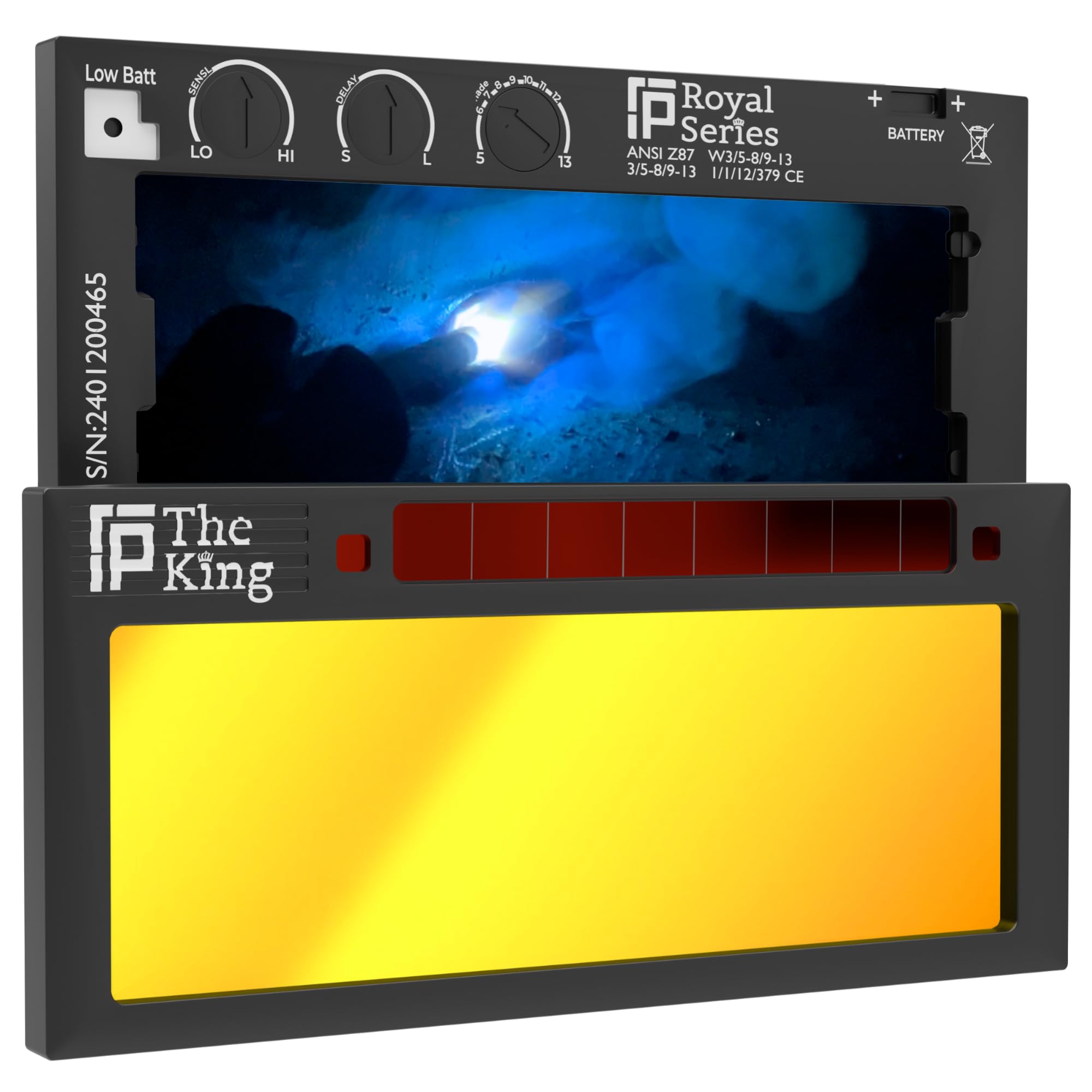
Tefuawe 2x4 Shade 10 Lens

89 /100
Kirk Score Excellent
Shade
10 fixed
Thickness
0.19 in
TIG Rating
5 amps
Cartridge Size
2 x 4 1/4 in
Check Details on Amazon

Pros

  • Holds a stable arc down to 5 amps TIG
  • 0.19-inch body drops into slim pancake hoods
  • True-colour view with a bright 2.5 light state

Cons

  • One-year warranty, against three on the ArcOne

Two figures decided this lens for us: 0.19 inches of body and a 5-amp TIG rating. The first is what lets it slide into a pancake or sugar scoop hood without anyone reaching for a file. The second is the number that separates cartridges which hold an arc at low current from the ones that blink out halfway down a bead.

For most people upgrading a hood, that pairing is the reason to buy this one. You give up the shade dial, but you get low-amp stability, a genuinely slim body and a true-colour view for mid-range money, and nothing else in this group balances those three as cleanly. It is the first lens we reach for in a pipeliner that will see equal parts TIG and stick.

The view itself is the cool blue these lenses give, with a light state of 2.5 — bright enough to line up a joint before you strike. We paid close attention to the housing, too. A cartridge that warps under spatter stops switching cleanly, and heat is the failure that shows up most often in this category, so the high-temperature body is doing real work rather than filling a bullet point.

One installation note that is easy to miss: the hood's rubber seal can sit across an arc sensor if it was trimmed for a thicker lens, and a covered sensor looks exactly like a lens that has failed. Seat the cartridge fully, check that both sensors see the arc, and then it becomes a lens you stop thinking about.

Bottom line: This is the lens we hand most people: it holds a stable arc at 5 amps, slips into a thin hood, and gives a true-colour view for mid-range money.

Check Latest Price
#02

Best for Stick Welding

ArcOne T240-10 Tradesman

92 /100
Kirk Score Outstanding
Shade
10.5 fixed
Warranty
3 years
Arc Sensors
2
Cartridge Size
2 x 4.25 x 0.2 in
Check Details on Amazon

Pros

  • Three-year warranty, the longest in this group
  • Amber view shows the joint before you strike
  • Simple two-sensor design that suits stick work

Cons

  • Locked at shade 10.5 with no adjustment

If the hood lives behind the truck seat and comes out for stick work, the Tradesman is the lens to put in it. It is a dead-simple cartridge — fixed dark state, two independent sensors, an amber view you can see the joint line through before the arc starts — and the simplicity is the point.

Two sensors is where it gets interesting. In the open, both see the arc and the lens does exactly what it should. Jammed under a pipe or welded into a corner, one sensor gets blocked and the shade can drop for a split second: enough to notice, and over a shift, enough to matter. Keep both sensors pointed at the work and it stops being an issue; weld positional all day and it will find you.

The amber tint is easy on the eyes over a long shift, and the three-year warranty is the longest on any lens here — worth more than a dial you will not use when the cartridge rides around in a toolbox. For stick, flux-core and general shop work at ordinary amperage, we take the amber view and the warranty and never miss the extras.

Bottom line: Buy it for a work hood that sees stick welding and abuse — the amber view is easy on the eyes, provided you keep both sensors pointed at the arc.

Check Latest Price
#03

Best Variable Shade

Tefuawe Gold 5813

85 /100
Kirk Score Excellent
Shade
Variable, multiple settings
Thickness
0.19 in
TIG Rating
2 amps
Cartridge Size
2 x 4 1/4 in
Check Details on Amazon

Pros

  • Adjustable shade covers TIG, MIG and plasma
  • 2-amp TIG rating, the lowest claim here
  • Rechargeable battery, no coin cells to buy
  • Gold coating and stainless frame shed heat

Cons

  • Blue-tinted puddle is not to everyone's taste

There is no coin cell to hunt for in the Gold 5813. It runs on a rechargeable battery, and that single choice changes how you own it: instead of dying quietly in a drawer and sending you out for a battery on the morning of a job, it takes a charge before a shift and gets on with it.

The rest of the package aims squarely at TIG. A 2-amp rating is the lowest claim in this group, the gold coating reflects radiant heat away from your face, and the stainless frame helps keep the body cooler through a long bead. The hand-gesture weld-to-grind switch is genuinely handy on a bench where you are going back and forth, though the listing itself adds a note steering some users away from it, so treat that as a bonus rather than a reason to buy.

If one hood has to cover TIG, stick and the odd bit of grinding, this is the lens we point people to. The trade is the battery: it does not top itself up from the arc, so a dead cell is your own doing, and a charging cable in the hood bag settles it. Clarity sits near the top of this group, and the blue cast is a matter of taste rather than a fault.

Bottom line: We recommend it when one hood covers TIG, stick and grinding — the adjustable shade and rechargeable battery make it the most versatile lens in this group.

Check Latest Price
#04

Best Budget

Preruner Core Series

81 /100
Kirk Score Excellent
Shade
10 fixed
Thickness
0.2 in
Response Time
0.01 ms
Cartridge Size
2 x 4 1/4 in
Check Details on Amazon

Pros

  • Budget price with a gold-coated blue puddle
  • 0.2-inch body suits pancake and sugar scoop hoods
  • Dual arc sensors with a fast response

Cons

  • Flashing can start after time outdoors

A budget lens has to earn its place a different way. The Core Series gives you a gold-coated shade 10 with a cool blue puddle, dual arc sensors, a 0.01 ms response claim and a 0.2-inch body slim enough for pancake and sugar scoop hoods — and it does it at the bottom of this group's price range.

For a second hood, a backup behind the seat or a lid you hand to a helper, that is a sensible trade. Dual sensors and a fast response are more than the job usually needs at this price, and the gold front is why the puddle reads blue instead of the green wash of an old passive lens. It is the lens you do not worry about.

Bottom line: A sensible second lens: the least expensive way here to get a gold-coated puddle view, and slim enough for the hoods others fit badly.

Check Latest Price
#05

Best for Production TIG

Ridge King 2.0

84 /100
Kirk Score Excellent
Shade
10 fixed
Weight
3.52 oz
Coating
Gold plated
TIG Rating
20 amps
Check Details on Amazon

Pros

  • Top-tier clarity with a deep blue puddle
  • Rated stable down to 20 amps on TIG
  • Gold plating and reinforced internal cells

Cons

  • Pricier than adjustable lenses that do more

It is the priciest fixed-shade lens here, and Ridge is unapologetic about what that buys: a gold-plated shade 10 built on reinforced internal cells and aimed at TIG welders who cannot afford a lens that quits mid-root. For a hood that pays the mortgage, we think the premium is defensible.

The view is where it earns the money. Clarity sits right at the top of this group, the puddle comes through a deep blue that reads cleanly against mill scale, and the delay is quick enough that you are not waiting on the shade when you lift. It is rated to 20 amps on TIG, which covers most of the low-amp work a shop produces.

The limitation is focus: one shade, no dial. Move between TIG at 60 amps and flux-core at 200 and you are paying premium money for a lens that cannot follow you, while the adjustable Tefuawe above does more for less. For the welder who wants one lens, one shade and no fuss, that is the trade we recommend.

Bottom line: Worth the premium if TIG is what your hood earns its keep on — the clearest puddle in this group, in a single shade you never have to think about.

Check Latest Price
#06

Variable shade clarity

Lincoln KP3775-1

87 /100
Kirk Score Excellent
Lens
Liquid crystal
Warranty
2 years
Shade Range
8-13
Cartridge Size
2 x 4 in
Check Details on Amazon

Pros

  • Variable 8-13 shade switches between TIG and stick
  • Neutral liquid-crystal view with no green cast
  • Two-year manufacturer warranty

Cons

  • The priciest lens in this group

Power is the first thing to understand about this lens. The low-battery light comes on and off well before the cells are done, the drain outpaces what the solar panel puts back, and a lens that dims its own warning is a lens you stop trusting. Keep a card of spares in the hood bag and change them on a schedule rather than on the light.

What you get for the trouble is one of the clearest views in this group: a liquid-crystal lens with no green cast, no amber wash, just the colours you would see without a lens in the way. Welders who move between processes in a shift get real value out of that neutrality.

The dial is the other reason to consider it. Shade 8 for a light TIG pass, 11 or 12 for stick, all from one cartridge, with a two-year warranty behind it. Nothing else here spans that range as smoothly, and the adjustability is the sort you notice most when a job changes halfway through.

We still recommend it to a welder who wants that neutral view and will manage the batteries. If you would rather not think about power at all, the Tefuawe Gold 5813 gives you an adjustable shade you charge instead of feed.

Bottom line: The view justifies the price for some welders, but plan on feeding it batteries — that is the trade we keep coming back to.

Check Latest Price
#07

Adjustable shade value

Ridge King 1.0

83 /100
Kirk Score Excellent
Power
Solar + 2 batteries
Coating
Gold
Thickness
0.33 in
Cartridge Size
2 x 4.25 in
Check Details on Amazon

Pros

  • Adjustable shade for well under premium money
  • Gold front gives a blue puddle and reflects heat
  • Solar panel with two batteries in reserve

Cons

  • Maker advises against TIG below 90 amps

For a stick and MIG welder who wants to dial the shade without paying Lincoln money, the King 1.0 is the obvious stop. It is an adjustable-shade gold lens in a standard 2x4 body, and it sells for a good deal less than the premium cartridges here.

The view has a following for a reason: a gold front, a blue puddle, and clarity that holds up against lenses costing far more. The shade dial covers the range most shop work needs, and the solar panel paired with two batteries in reserve means it is not leaning on either one alone.

The body is 0.33 inches thick, the thickest cartridge in this group, and a standard hood channel will notice. Ours went in with persuasion; a shallow pancake hood may need the opening eased before the lens sits flat. Measure the channel depth before you order, not after.

For stick and MIG in a hood with room for it, we think it is a strong buy — the dial, the colour and the money all land in the right place. TIG welders should look at the King 2.0 or the Tefuawe instead, because this one is not built for that work.

Bottom line: A good dial-a-shade lens for stick and MIG work in a hood with a deep lens channel; TIG welders should look at the King 2.0 instead.

Check Latest Price
#08

Wide-window helmets

TRQWH Solar Lens

83 /100
Kirk Score Excellent
Power
Solar + CR2032
Standards
ANSI Z87.1, EN379, CSA Z94.3
Arc Sensors
2
Filter Size
4.33 x 3.54 in
Check Details on Amazon

Pros

  • Lists ANSI Z87.1, EN379 and CSA Z94.3
  • Adjustable 9-13 shade with sensitivity and delay knobs
  • Solar plus a replaceable CR2032

Cons

  • Light state 4 is dark for setup work

Start with the size, because it decides everything: this is not a 2x4 cartridge. The TRQWH is a 4.33 by 3.54-inch filter for a full-size helmet window, so if you are holding a pipeliner or a pancake hood, stop reading and go back to the Tefuawe.

For an old wide-window helmet, though, it is a lot of lens for very little money. Shade adjusts from 9 to 13, there are sensitivity and delay knobs, the power comes from a solar panel plus a replaceable CR2032, and it is the only lens here that lists ANSI Z87.1, EN379 and CSA Z94.3 on the spec sheet — exactly the sort of thing you want to see on eye protection.

It suits a backup helmet or reviving an old one rather than production work, where its darkening is the least settled part of the package. As a second hood or a first auto-darkening lens on a tight budget, adjustable shade and a listed certification are a fair swap for the money.

Bottom line: Only worth it if your helmet takes a wide filter — then it is the least expensive route here to adjustable shade and a certified lens.

Check Latest Price

How We Tested Auto-Darkening Welding Lenses

We started by narrowing to filters that fit what people actually weld with: the standard 2 by 4 1/4 size that drops into pancake, sugar scoop, and pipeliner hoods, plus a few larger filters for full-size helmets. From there we filtered by amperage rating, by fixed versus adjustable shade, and by price so the list covered a real spread of value rather than one bracket. Twelve lenses made the cut and stayed in rotation for six months — shop booth, pipe work, and outdoors at midday.

Every lens got the same first test: strike an arc and watch the switch. I noted how quickly it went dark, whether it flickered or flashed at low amperage on thin stainless, and whether the shade held steady through a long bead instead of pulsing lighter. Clarity I judged by what I could see before the arc started — a good filter lets you line up the joint with the hood already down — and by whether the puddle edge stayed distinct once I was welding.

Color got its own pass. Gold and cool-blue filters promise a truer puddle, so I noted whether I could tell the puddle apart from the surrounding plate or whether it all smeared into one dark shape. Brightness got checked twice, under shop fluorescents and outside at noon, because a lens that's comfortable in the booth can wash out in the sun. And for battery life and durability, the solar filters sat in a dark toolbox for weeks to see if they'd still fire on the first arc, then took spatter, grinding dust, and a drop on concrete.

By the end, the things I cared about were boring: darkens before I notice, holds steady through the bead, never makes me think about it again.

How to Choose an Auto-Darkening Welding Lens

Fit the cartridge to the hood before anything else

Nearly every pipeliner, pancake, sugar scoop and flip-front hood takes a 2 x 4 1/4-inch cartridge, and that is what most of this group is. A 4.33 x 3.54-inch filter is a different product for a full-size helmet window, and buying one for a 2x4 hood is the most common way to waste an order.

Depth matters as much as the opening. A 0.19-inch body drops straight in; the 0.33-inch Ridge King 1.0 can need the channel eased before it sits flat. Measure the opening and the depth, not just the width.

Decide whether you want a dial

A fixed shade 10 or 10.5 handles stick and MIG at ordinary amperage and costs less. An adjustable lens earns its premium when you move between processes inside one shift — TIG at 60 amps one hour, flux-core at 200 the next — because you can match the shade to the work instead of squinting or running too dark.

Our rule is simple: one hood that does everything gets a dial, and a dedicated stick hood does not need one. The Tefuawe Gold 5813 is what that looks like when it is done well; the Ridge King 1.0 is what it looks like on a budget.

Understand what actually makes a lens flash

Most dropouts are not a broken cartridge. They are a sensor that cannot see the arc — blocked by a seam, a pipe, or the hood's own seal sitting over it — or an arc too small to hold the lens dark at low TIG amperage.

Before you replace anything, seat the cartridge fully, check that both sensors have a clear line to the work and turn the sensitivity up. If it still flashes in open, flat welding, then the lens is the problem.

Know where the power comes from

Solar-assisted lenses with coin cells are the norm, and the cells are what fail first — the Lincoln KP3775-1 and its low-battery light are the cautionary tale of this group. Solar-only designs have nothing to swap out, but they can be slow to wake after a week in a bag.

A rechargeable lens such as the Tefuawe Gold 5813 has to be charged on purpose, because it does not top itself up from the arc. Whichever of the three you buy, know which one you own before the power matters.

Pay for clarity in the colour you can actually read

Amber shows the joint line beautifully before the arc starts, a gold-coated lens throws a blue puddle that reads well against mill scale, and a neutral true-colour lens shows what is genuinely there. None of them is more accurate than the others — this is a preference, and the only way to learn yours is to weld with one for a week.

Spend on clarity if you are on thin material chasing a joint line. Save it if you are running bead after bead on plate, where shade range buys you more than tint.

Frequently Asked Questions

Final Verdict

The Tefuawe 2x4 shade 10 is the lens we point most people to. It fixes the two things that send cheap cartridges back to the shelf — a shade that drops out at low amps, and a body too thick for a slim hood — without charging premium money for the privilege.

If one hood has to cover TIG, stick and grinding, step up to the Tefuawe Gold 5813 and its adjustable shade. Just put the charging cable in the hood bag.