// data-verified

Best Flux Core Welding Wire of 2026

Flux core wire is the reason a lot of us can weld in a garage: no gas cylinder, no regulator, just a spool in a small MIG machine and a ground clamp. The tradeoff is that the wire has to shield its own puddle, so a poor spool can fight you with kinked feed, heavy spatter, and beads that hide poor penetration. A good one makes the process feel boring, which is what you want when you're patching a trailer fender or fixing a lawn mower deck.

Over the past four months, my team and I ran 16 spools through 110-volt MIG welders, from two-pound rolls to larger spools. We compared wire quality, arc stability, spatter, weld appearance, and how much usable wire each spool gave us — this is a consumable, after all, and value only counts if the spool doesn't rust in a damp garage between projects. Some wire fed smoothly but laid down ugly beads; some looked great in photos but spattered across the bench. The picks below kept the puddle predictable and the cleanup reasonable.

#01

Best Overall

YESWELDER E71T-GS 0.030 in, 2 lb

95 /100
Kirk Score Outstanding
Diameter
0.030 in
Material
Mild carbon steel
Spool Size
2 lb
Classification
AWS E71T-GS
Check Details on Amazon

Pros

  • Steady arc with little spatter for the money
  • Feeds smoothly in small 110-volt machines
  • Sealed packaging keeps the wire clean
  • Slag brushes off without grinding

Cons

  • Single-pass E71T-GS only
  • 2-pound spool goes fast on bigger jobs

A 0.030-inch wire on a 2-pound spool is the format most home flux-core welders are built around, and this is the least fussy example of it we loaded. It is AWS E71T-GS mild carbon steel, the general-purpose self-shielded class, so it runs with no gas cylinder and does not care about a breeze. The wire sits on a sturdy ABS hub and arrives sealed in an airtight bag, which matters more than it sounds: wire that spent months in a damp warehouse feeds worse than wire that did not.

What kept us coming back was the arc. In a 110-volt machine it strikes without the popping that has you fiddling with wire speed on cheaper spools, and the bead wets out flat instead of sitting up in a rope. Spatter is low for gasless wire, not absent, and the slag lifts in flakes under a wire brush rather than needing a grinder. On 1/8-inch steel it will run a hot, sound bead all day, and that is the work this wire is for.

If your machine's hub is built around 8-inch rolls, you will want an adapter to run a 2-pound spool, so check that before you order. Otherwise this is the spool we hand a beginner and keep on the shelf for ourselves: nothing about it asks you to learn the machine before you can weld.

Bottom line: This is the spool we drop into a 110-volt gasless machine without a second thought: it feeds evenly, holds a steady arc, and leaves less spatter than the wire it replaces.

Check Latest Price
#02

Best for Clean Beads

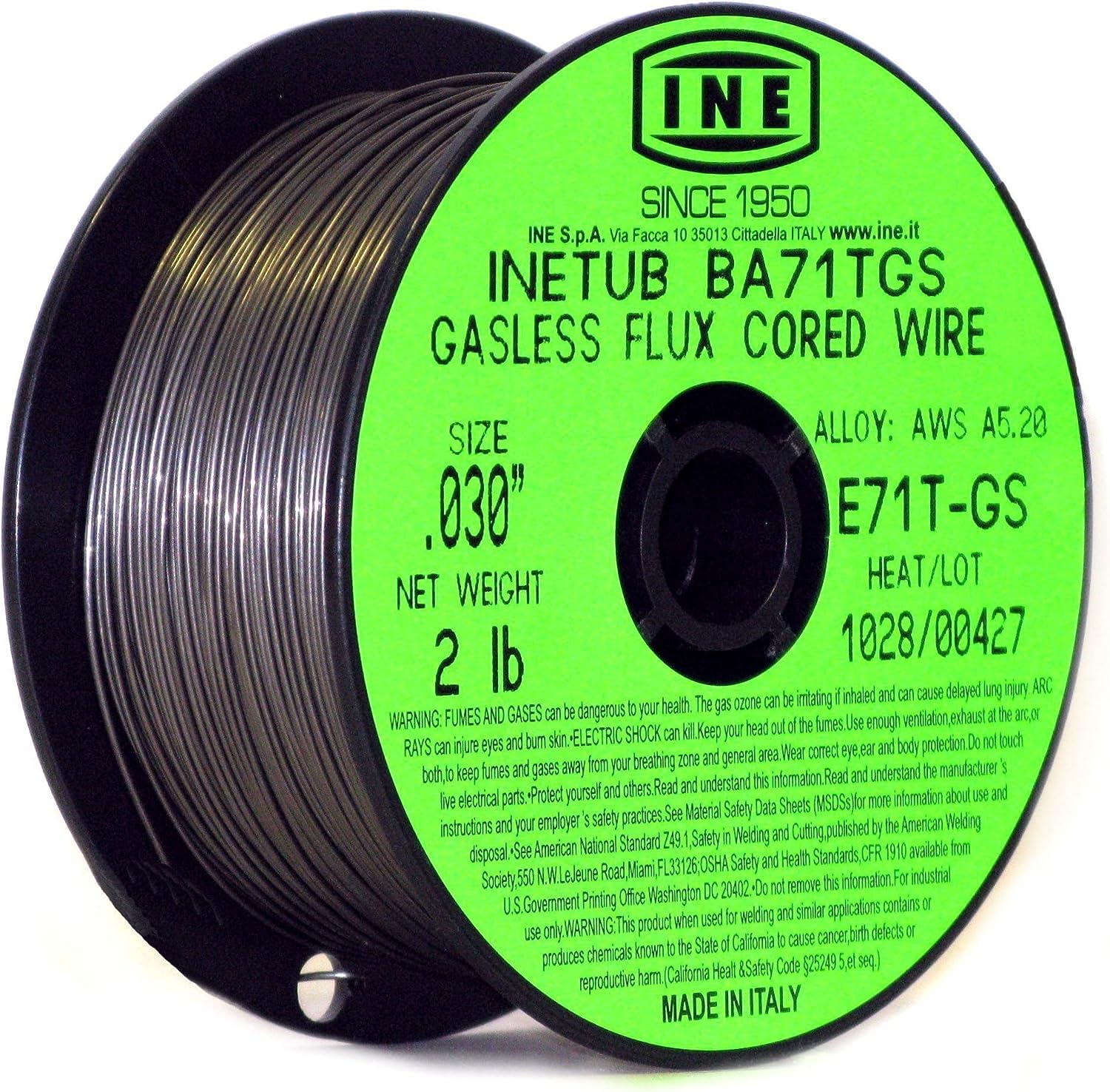
INETUB BA71TGS 0.030 in, 2 lb

95 /100
Kirk Score Outstanding
Origin
Made in Italy
Diameter
0.030 in
Spool Size
2 lb
Classification
AWS A5.20 E71T-GS
Check Details on Amazon

Pros

  • Cleanest bead finish of the spools here
  • Uniform flux fill keeps the arc steady
  • Light smoke keeps the puddle visible
  • Rated all-position and runs in most 110-volt machines

Cons

  • Premium price for a 2-pound spool

Against the YESWELDER, this Italian-made spool buys a cleaner bead and lighter smoke. INE has been drawing wire since 1950, and the process control shows at the arc: the flux fill runs uniform along the length of the spool, so the arc does not surge and fade partway through a bead, and the slag lifts in thin glassy sheets instead of chunks you chase with a chipping hammer.

We ran it in a 90-amp 110-volt machine on 16- and 18-gauge sheet and it was the smoothest of the group there, hot enough to fuse and light enough not to blow through, with a puddle that stayed where we put it. It is rated all-position, flat through overhead, and it runs in Harbor Freight, Lincoln, Hobart, Forney, and Eastwood machines without drama.

Same two pounds as the top pick, and no multi-pass rating either, so this is not the spool for building up thick joints. It is the one for a gate, a handrail, or a repair you would rather not grind, and the finishing time it saves is the reason to spend more on it.

Bottom line: If the weld is going to be looked at, this is the spool we load: the tidiest beads of the two-pound wires here, with smoke light enough to watch the puddle.

Check Latest Price
#03

Best Bulk Value

SONNLER E71T-GS 3-Pack, 2 lb

94 /100
Kirk Score Outstanding
Diameter
0.030 in
Spool Size
2 lb each
Classification
AWS E71T-GS
Spools Per Pack
3
Check Details on Amazon

Pros

  • Three individually vacuum-sealed spools
  • Clean burn with no popping in 120-volt machines
  • Slag chips off in one piece
  • Costs about what one premium spool does

Cons

  • Six pounds up front before you try the wire

Each of the three spools comes vacuum-sealed on its own, and that is the detail that decided it for us: you open one, run it dry, and the other two stay sealed against the humidity that sours flux-core wire. Six pounds also changes how you weld, because you stop rationing wire and start practicing with it.

In a 120-volt gasless machine it burned with a clean hiss instead of the pop and spit that cheap wire does, laid a bead that held on 1/8-inch carbon steel, and left slag that came off in one piece. Spatter stayed low enough that a wire brush and a minute handled the cleanup.

The economics are the argument. Three spools run about what a single premium one does, and nothing about the way this wire welds feels like a compromise, because wire you fight with costs more in grinding time than it saves. It is the bundle we keep under the bench.

Bottom line: Three vacuum-sealed spools that burn clean and feed evenly in a 120-volt gasless machine, and the practical way to keep wire on hand all season.

Check Latest Price
#04

Best for Big Projects

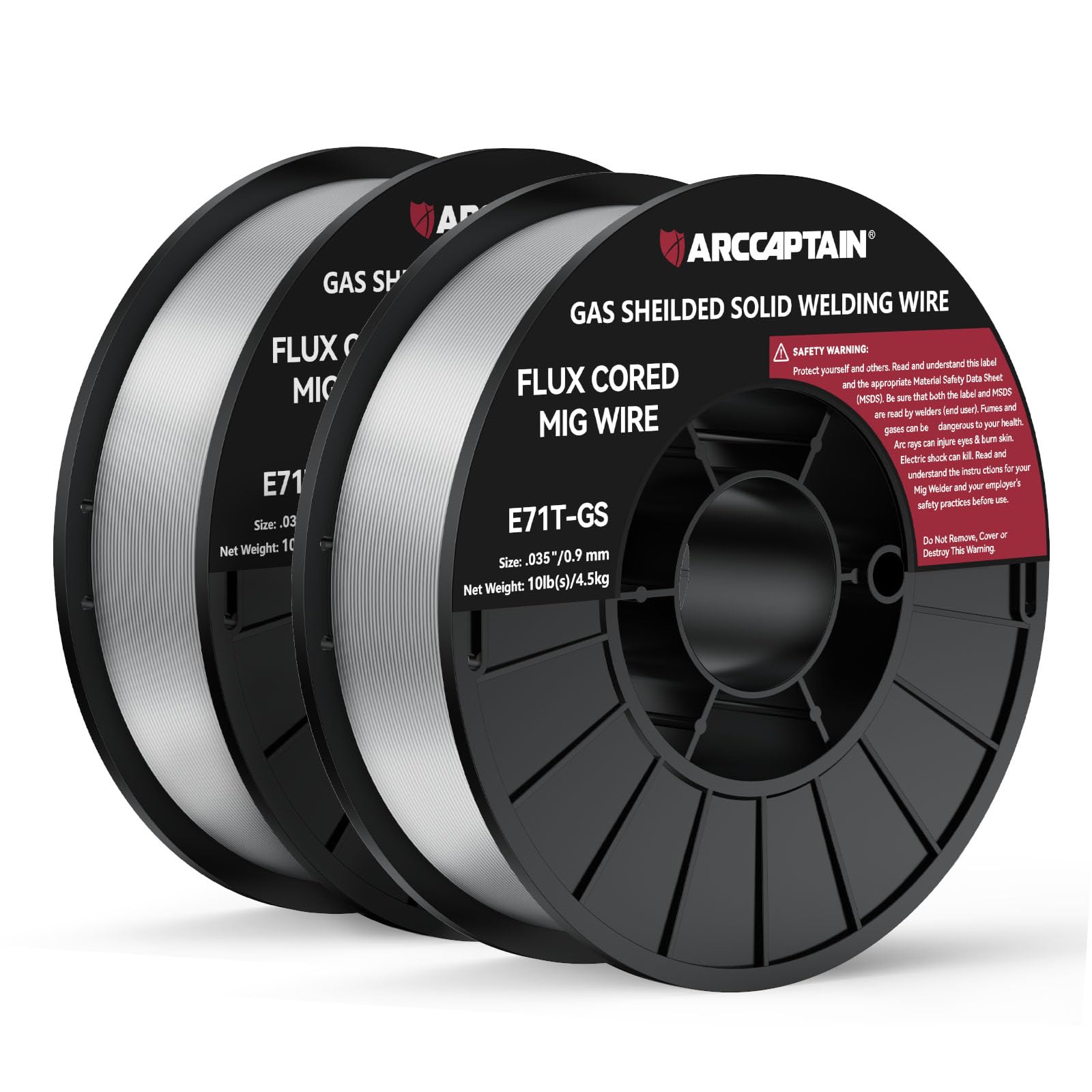
ARCCAPTAIN E71T-GS 0.035 in, 20 lb

94 /100
Kirk Score Outstanding
Spools
2 x 10 lb
Diameter
0.035 in
Net Weight
20 lb
Certification
TÜV tested
Check Details on Amazon

Pros

  • Best cost per pound of the spools here
  • 0.035 lays more metal per pass on thick stock
  • TÜV-tested batch consistency
  • Feeds smoothly through the liner

Cons

  • Ten-pound spools need a machine that accepts them

Twenty pounds arrives as two ten-pound spools, which tells you most of what you need to know: this is wire for a shop or a serious home setup, not for someone welding a mower deck once a year. What the bulk buys is one batch and one diameter, so there is no switching spools mid-project and no mixing lots on a long job.

On thick stock it makes sense. The 0.035-inch diameter carries more current than the 0.030 wire most of these spools use, so it puts down more metal per pass on 1/8-inch and up, on trailer frames, gate hinges, and implement repair, and the arc holds steady when you turn the voltage up rather than going soft at the top of the dial.

It feeds evenly through the liner and burns like a general-purpose gasless wire: spatter you chip, not spatter you grind. The TÜV test mark on the box is not something we could feel at the gun, but it is a fair signal about consistency across a batch this size, and batch consistency is where cheap bulk wire usually falls down.

Where it earns its place is volume, because nothing else here covers this much welding for the money. Where it does not is thin sheet, where 0.035 runs hot enough to burn through 20-gauge auto body, and the 0.030 top pick is the better call there. If you have the machine and the work, buy the box.

Bottom line: Two ten-pound rolls for anyone whose welder earns its keep: 0.035 wire that lays down more metal per pass and does not flinch at thick stock.

Check Latest Price
#05

Best for Multi-Pass Work

Blue Demon E71T-11 0.030 in, 2 lb

90 /100
Kirk Score Outstanding
Diameter
0.030 in
Polarity
DCEN
Spool Size
2 lb
Classification
AWS E71T-11
Check Details on Amazon

Pros

  • Rated for multi-pass work
  • Even wind feeds without binding
  • Clean slag between passes
  • Forgiving of rust and mill scale

Cons

  • Sold only in 2-pound spools

E71T-11 is the classification that separates this spool from everything else on the page. Where the E71T-GS wires here are single-pass formulations, this one is classified for multi-pass work, so you can lay a root, chip it, and come back over it without inviting the porosity and cold lap that single-pass wire tends to leave. It runs on DCEN, and it does not need bright, clean steel to work.

It behaves like a good general-purpose wire the rest of the time. The spool is wound evenly enough that it does not bind on the way off, the arc starts without a fight, and the slag comes up clean between passes, which is exactly what you want from a wire you are about to run over again.

For anything you are building up, whether a hitch, a bracket, or stock thicker than one bead should carry, this is the spool we reach for, and the extra it costs per pound is easy to justify against cutting out a weld and starting over. One setup note: if your machine has been running gas wire, swap the leads for DCEN before you strike an arc, or you will fight spatter and poor fusion and blame the wire.

Bottom line: The only wire here rated for multi-pass work, so it is the spool to buy when a joint needs a second bead rather than one pass and out.

Check Latest Price
#06

Rusty, dirty metal

Forney 42300 E71TGS 0.030 in, 2 lb

95 /100
Kirk Score Outstanding
Diameter
0.030 in
Material
Mild steel
Spool Size
2 lb
Classification
E71T-GS
Check Details on Amazon

Pros

  • Welds over rust, paint, and mill scale
  • Runs hot enough to punch through crud
  • All-position, including overhead
  • Modest spatter once settings are dialed in

Cons

  • Spools can arrive with a cracked flange

Forney sells this as wire that works on rusty, dirty, and painted steel, and that is the reason to keep a spool around: farm gates, trailer beds, exhaust hangers, the repairs where grinding back to bright metal is not happening. It is self-shielded E71T-GS, so wind that would blow a gas shield away does not bother it.

The bead comes out better than the prep deserves. It sits flatter than budget wire we have run, spatter stays modest, and the arc runs hot, which is what lets it punch through crud. It is rated all-position and it is happiest at a fast travel speed: this is a wire for tacking and running, not for laying a long, slow, show bead.

The one thing to watch is the wind on the spool. It is wound tight, and the wire will spring off in a coil if you let go of the tag end while loading, so hold tension until it is through the drive rolls and into the liner and you will not have a problem. That aside, this is the roll that earns shelf space the first time you weld a bracket you could not clean.

Bottom line: The wire for repairs you cannot prep properly: it runs over rust, paint, and mill scale and still lays a usable bead in the wind.

Check Latest Price
#07

Small-spool machines

Lincoln ED031448 NR-211 0.030 in

93 /100
Kirk Score Outstanding
Series
NR-211
Diameter
0.030 in
Material
Mild steel
Item Weight
1.2 lb
Check Details on Amazon

Pros

  • Fast-freezing arc suits gappy fit-up
  • Smooth, uniform bead appearance
  • Light spool for compact machines

Cons

  • Small spool runs out quickly on bigger jobs

The reason to buy this one is the spool, not the spec sheet: a light roll for welders whose hub and brake are built around one, and for anyone who wants a couple of known-good beads without committing to two pounds of wire. It is Lincoln NR-211 innershield flux-core in 0.030 inch, and Lincoln rates it to freeze quickly, which is what makes it forgiving on thin, gappy repair work where the parts do not quite meet.

At the same diameter as the top pick it covers the same thin-to-1/8-inch range, and the bead it leaves is smooth and uniform. Bead appearance is what Lincoln leads with on this wire, and it holds up in practice, with cleanup that is a wire brush and a minute rather than a grinder.

Nothing here claims a multi-pass rating, so structural build-up is not its job, and the Blue Demon E71T-11 is the pick for that. What this spool does is get a small machine welding with wire you do not have to think about, and for a lot of home shops that is the entire requirement.

Bottom line: Lincoln's innershield wire on a light spool: the pick when your machine will not take a bigger roll, and an easy way to run a name brand.

Check Latest Price
#08

Stocking up cheaply

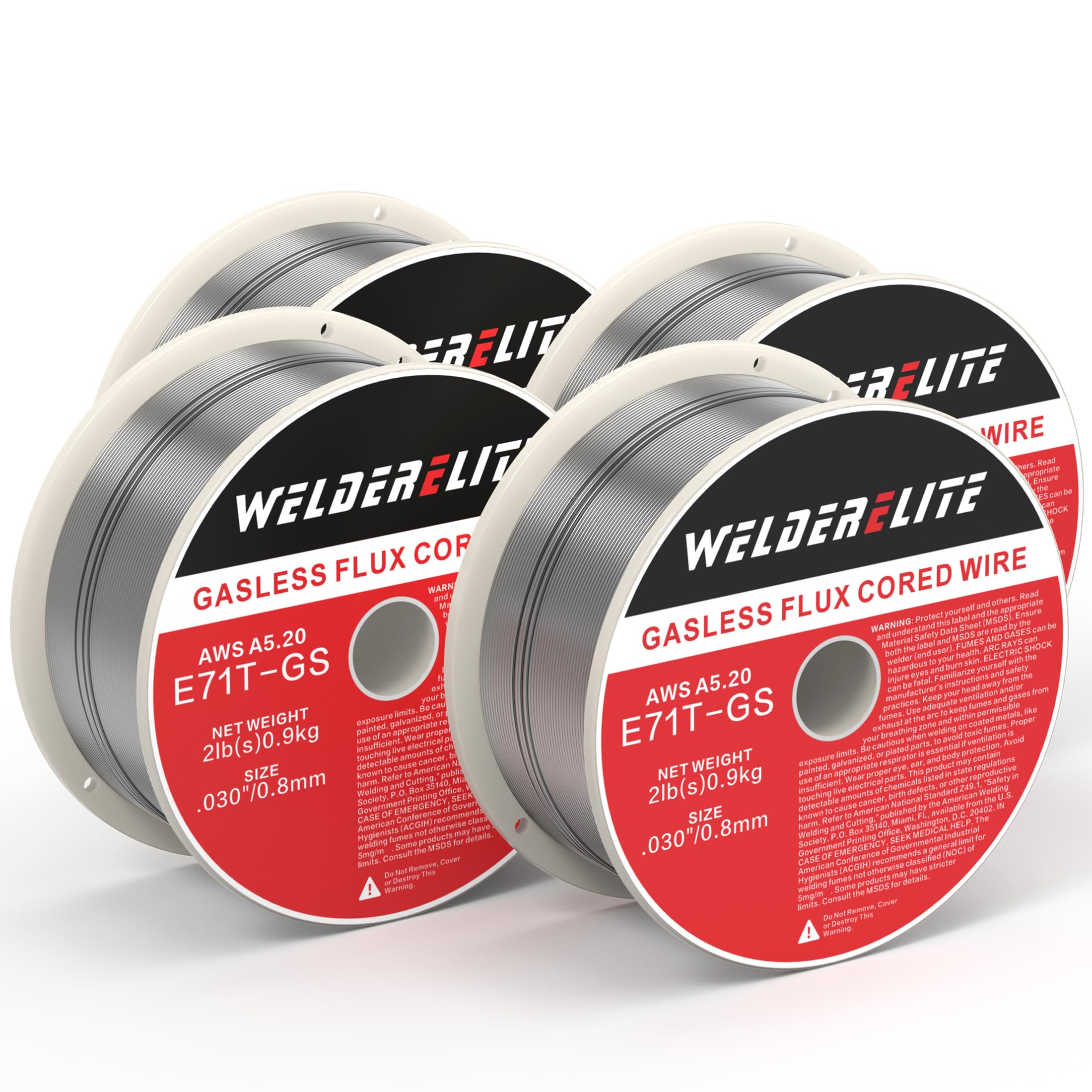
WelderElite E71T-GS 4-Pack, 2 lb

92 /100
Kirk Score Outstanding
Spools
4 x 2 lb
Diameter
0.030 in
Total Wire
8 lb
Classification
AWS E71T-GS
Check Details on Amazon

Pros

  • Most wire for the money here
  • Feeds cleanly in 110-volt machines
  • Individually vacuum-sealed spools

Cons

  • Not Prime-eligible, so shipping takes longer

Eight pounds in four vacuum-sealed spools is the most wire you get for the money on this page, and for a hobby welder running a 110-volt machine, that arithmetic is most of the decision. The wire is AWS E71T-GS, 0.030 inch, the same general-purpose gasless class as the top pick.

We ran a spool through a small 110-volt unit on light-gauge sheet and box tube. It fed without kinking, started easily, and left a bead that cleaned up with a brush. Nothing about it announced itself as budget wire: no bird-nesting at the drive rolls, no hunting for a sweet spot on the wire-speed dial.

Sealed packaging matters more in a four-pack than in a single spool, because three of them will sit for months before you get to them. That is the shape of the deal: buy once, weld for a season, open a fresh spool when the last one runs out.

Against the SONNLER bundle you get two more pounds for a slightly lower cost per pound, in exchange for a much shorter track record, since this is a newer listing with fewer welders behind it, and spatter is the one result we could not call consistently. For light-duty work on thin steel it is an easy yes; for anything thicker or structural, the top pick or the ARCCAPTAIN box is the better spend.

Bottom line: Four sealed two-pound spools of 0.030 wire: a season of hobby welding in one order, and it runs like wire that costs more per pound.

Check Latest Price

How We Tested Flux Core Welding Wire

We started by narrowing the field to gasless, self-shielded wires in the two diameters most home welders use — .030 and .035 inch — and the spool sizes that fit small MIG machines, from two-pound rolls to larger spools. We read spec sheets, checked compatibility with common 110-volt units, and set aside listings that were vague about diameter, polarity, or shielding method. That left 16 spools to test over four months.

Testing happened where the wire actually gets used: a garage bench, a driveway, and a breezy backyard, since self-shielded wire is often chosen for outdoor repairs. We ran beads on scrap mild steel, thin auto-body panels, and a lawn mower deck, then tried out-of-position passes on angle iron. We watched how each spool loaded and fed, noting kinks, birdnesting, and whether the arc stayed steady as the spool emptied.

For spatter, we laid a sheet of cardboard beside each coupon and counted the spots that landed on it, then compared how much cleanup a wire needed before the bead looked presentable. Weld quality got checked by cutting a few coupons and looking at penetration, not just the bead's appearance. Because this is a non-renewable consumable, we weighed each spool before and after a fixed set of passes to see how far it really went. We also left a few exposed spools in the humid garage for a couple of weeks and checked for rust and feeding problems before the next session.

How to Choose Flux Core Welding Wire

Diameter and spool size come before brand

Your machine decides two things before any brand argument matters: the drive roll, liner, and contact tip it is set up for, and the spool hub it can hold. Most small gasless welders run 0.030-inch wire on 2-pound spools. Step up to 0.035 and the liner, tip, and drive roll should follow, or the wire drags and the arc runs cold. As a rule, 0.030 covers sheet metal up to about 1/8 inch, and 0.035 is the better choice from 1/8 inch upward where you want more metal per pass.

Then check the hub. A box of two ten-pound rolls like the ARCCAPTAIN needs an 8-inch spool mount and a brake strong enough to hold it. If your machine takes a 2-pound roll, that box is not a bargain, it is ballast.

Single pass or multi-pass: read the classification

E71T-GS is the wire most gasless machines are sold with: general purpose, single pass, happy outdoors. E71T-11, like the Blue Demon spool here, is classified for multi-pass work, so you can run a root, chip it, and come back over it without the porosity that single-pass wire tends to leave behind. If every joint you weld is one bead and done, buy GS and pocket the difference. If you build up brackets, hitches, or anything thicker than a single bead should carry, the T-11 classification justifies its extra cost per pound. Buying GS for multi-pass work is the mismatch that bites hardest.

Spatter, slag, and smoke: what good wire changes

Every gasless wire spatters and smokes. The differences are how long you spend with a chipping hammer and how well you can see the puddle while you weld. Wire with uniform flux fill and a consistent diameter, the INETUB being the clearest example here, holds a steadier arc, so it throws less spatter and leaves a thinner slag that lifts in sheets instead of chunks.

Before you blame a spool, check the basics. Too much stick-out, wire speed that is off, or a liner full of grit will make good wire spatter like bad wire. Run a bead on scrap and change one setting at a time.

How much wire you actually need

A 2-pound spool is a couple of evenings of hobby welding; a multipack is a season. Bulk is cheaper per pound, but only if the rolls fit your machine and your storage. Individually vacuum-sealed spools, which both the SONNLER and WelderElite packs use, are worth a small premium because you open them one at a time rather than exposing the whole purchase to the air in your shop.

Be honest about volume. Twenty pounds of wire in the wrong diameter is worse value than two pounds in the right one, and a size you cannot run is worth nothing at any price.

When gasless wire is the right call

Self-shielded wire exists for the jobs where gas cannot go: outdoors in wind, over dirty or painted steel, and anywhere you do not want to haul a cylinder. It also runs on the small 110-volt machines most home welders own, which is why flux-core is where most people start.

What it will not do is match a gas MIG bead on clean, thin steel. A flux-core weld has more spatter and more cleanup, every time. If your work is thin, clean, and indoors, solid wire and gas will look better; if it is repair, fabrication, and fence posts, gasless is the practical answer.

Frequently Asked Questions

Final Verdict

For a 110-volt gasless machine and general repair work, the YESWELDER 0.030 spool is the one we point people to. It feeds cleanly, keeps the arc steady, and leaves less spatter than the budget wire it usually replaces, all on a roll that barely shows up in the cost of a project.

Step up to the INETUB if the bead is going to be seen, to the Blue Demon E71T-11 if joints get a second pass, or to the ARCCAPTAIN 0.035 box if your machine takes ten-pound rolls and you weld often enough to burn through them.