// data-verified

Best Automatic Wire Strippers of 2026

An automatic wire stripper makes one motion do the whole job: you close the handles, the jaws clamp the insulation at a set depth, and the pull happens as you keep squeezing. Everything that separates a good one from a drawer ornament lives around that squeeze — whether the jaws bite the copper underneath, whether the same tool handles solid and stranded wire, and whether the nose can reach a wire already jammed into a box with three others. I've stripped plenty of wire the slow way, with a utility knife and a prayer, and I don't miss it. What I want now is a strip that comes off clean on the first try and a tool that tells me the truth about which gauges it can actually handle.

Here's what first-time buyers tend to miss: the AWG ranges printed on the package are usually two different numbers. Ten-gauge solid, twelve-gauge stranded — they don't line up, and a stripper that's honest about its limits beats one that claims 8 through 24 and slips at both ends. Over four months, my team and I put nine automatic strippers through real work — lamp rewires, a basement junction box, low-voltage runs — and the differences showed up fast. The ones that made the list are the ones that kept the strip clean, stayed comfortable after the fiftieth squeeze, and justified their price. The picks are below.

#01

Best Overall

Klein Tools 11063W

96 /100
Kirk Score Outstanding
Weight
12 oz
Strip Length
Up to 1 inch
Stripping Range
8-20 AWG solid; 10-22 AWG stranded
Integrated Cutter
Up to 8 AWG solid
Check Details on Amazon

Pros

  • One squeeze grips and strips cleanly
  • Self-opening handles speed repeat work
  • Integrated cutter handles up to 8 AWG
  • Solid, planted feel in the hand

Cons

  • Stops at 20 AWG solid
  • Bulkier than the compact picks

One squeeze is all this Klein needs: the jaws close on the insulation, grip the wire, and pull the slug free as the handles spring open. That self-opening action is what we came back to, because it turns a row of outlet pigtails into a rhythm instead of a hand workout. The 11063W is rated for 8-20 AWG solid and 10-22 AWG stranded, which covers the branch-circuit and fixture wire most of us meet.

The built-in cutter is more useful than we expected. It handles up to 8 AWG solid, so you can cut and strip without swapping tools, and the stripping holes remove up to an inch of insulation in one step. At 12 ounces it has enough heft to feel planted, though it is not the tool we reach for when a wire is buried behind a tight box.

What keeps it our top pick is how little thought it demands on common wire. We got clean, repeatable strips on 12 and 14 AWG solid, and stranded wire came out without the stray strands that make a terminal fussy. The limit is at the small end: 20 AWG solid is as far as it goes, so electronics work below that belongs with the Jokari or Knipex. For everything above, this is the one we hand people first.

Bottom line: For most home and auto wiring, this is the automatic stripper we recommend first: fast one-handed stripping, a useful cutter, and a size range that covers common solid and stranded wire.

Check Latest Price
#02

Best for Repeat Terminal Work

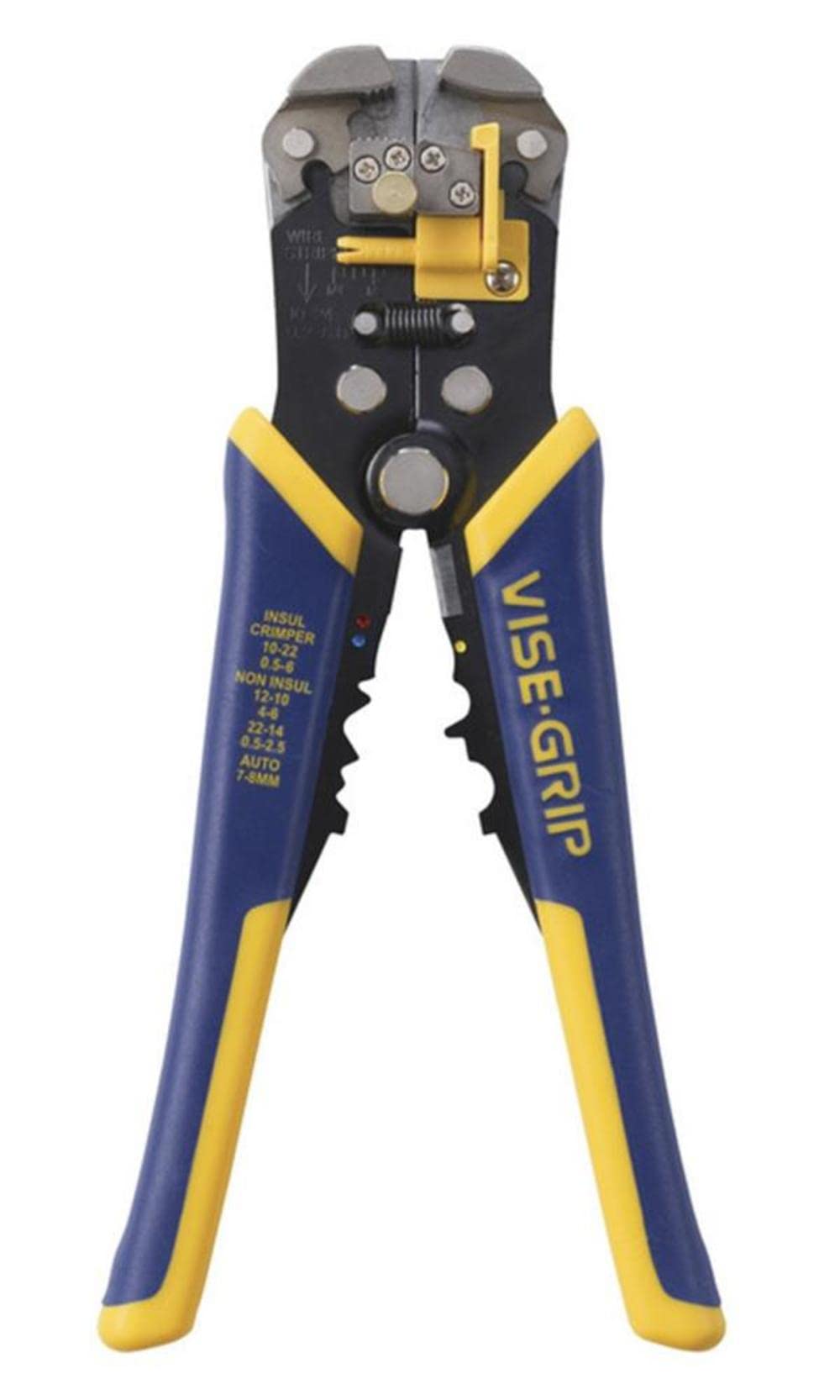
IRWIN Vise-Grip 2078300

93 /100
Kirk Score Outstanding
Jaw Width
2 inches
Strip Length
Adjustable stopper
Crimping Range
10-22 AWG; 7-9 mm ignition
Stripping Range
10-24 AWG
Check Details on Amazon

Pros

  • Adjustable stopper for repeat strips
  • Wide 10-24 AWG stripping range
  • Built-in crimper for terminals
  • Comfortable ProTouch handles

Cons

  • Large frame crowds tight spaces

Repeat work is where the IRWIN earns its keep: set the adjustable stopper, squeeze, and the tool strips to a consistent depth without you measuring every wire. The self-adjusting jaw covers 10-24 AWG, and the built-in crimper handles insulated and non-insulated terminals plus 7-9 mm ignition connectors. That combination is aimed at car audio, low-voltage, and terminal-block jobs where you are stripping and crimping in the same session.

We like the two-inch jaw for those batches. It gives you something substantial to squeeze, and the ProTouch handles stay comfortable through a run of connections. The IRWIN is a bigger tool than the compact strippers here, though, so it is not our first choice for a crowded box or a tight fixture. It wants a little elbow room.

The catch is strip quality at the edges of its range. The stopper is a guide, not a caliper, and a little trial and error on scrap wire pays off before you commit to a harness. Once set, the one-squeeze action is quick and the crimper is genuinely handy. If you mostly need clean fine strips in tight places, the Knipex is the better fit; if you want one tool for repetitive terminal work, this IRWIN is easy to like.

Bottom line: A fast, comfortable choice for repeat terminal work, with an adjustable stop and a crimper that save tool changes; skip it if you need a compact tool for tight boxes.

Check Latest Price
#03

Best for Romex

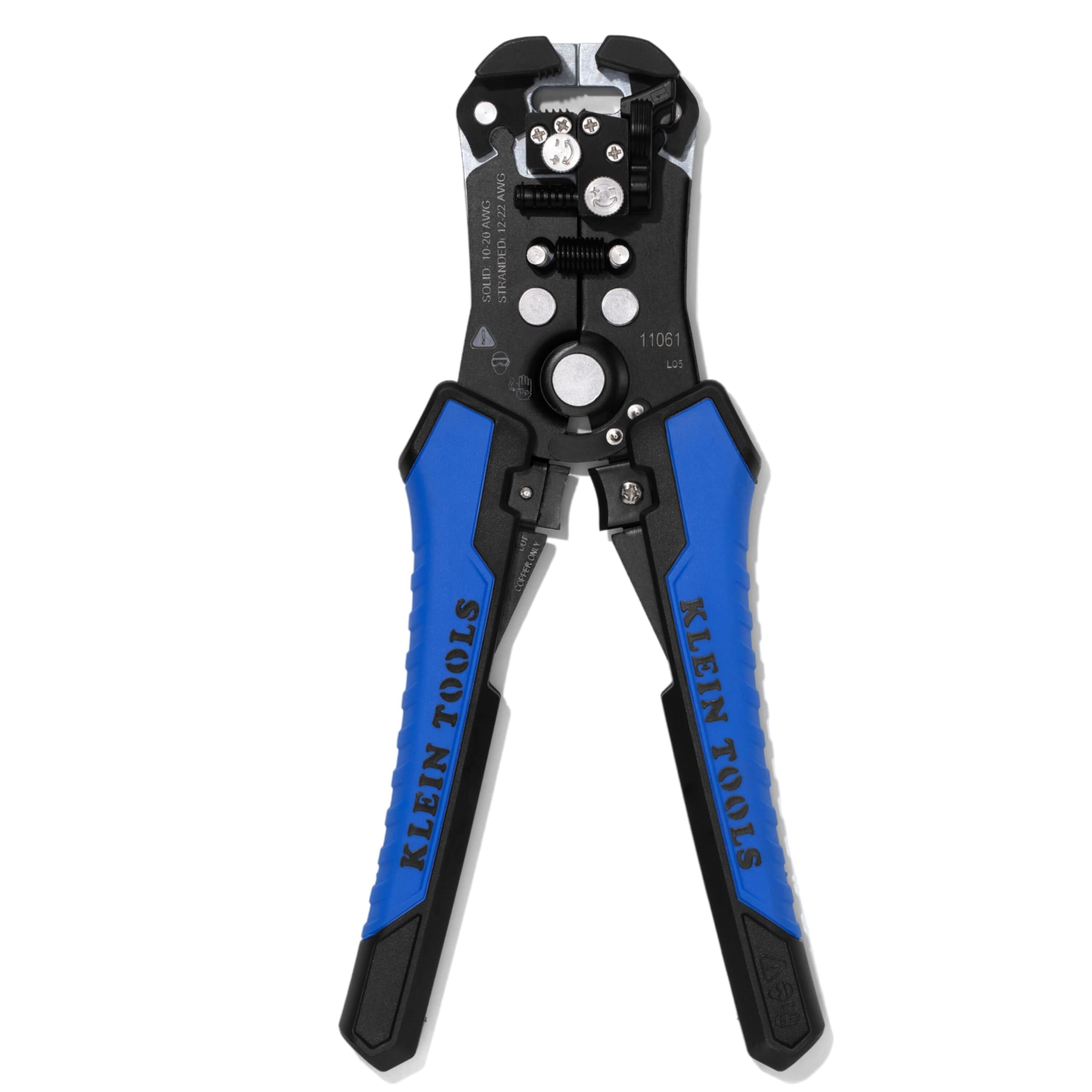
Klein Tools 11061

93 /100
Kirk Score Outstanding
Adjustments
Tension dial and length stop
Romex Capacity
12/2 and 14/2 NM-B
Stripping Range
10-20 AWG solid; 12-22 AWG stranded
Integrated Cutter
Up to 8 AWG solid
Check Details on Amazon

Pros

  • Strips 12/2 and 14/2 NM-B Romex
  • Tension dial and length stop
  • Integrated cutter to 8 AWG
  • Comfortable eight-inch frame

Cons

  • Less clean on fine stranded wire
  • Fussy initial adjustment

The 11061 is the Klein we reach for when the wire has a jacket on it. It is set up for 12/2 and 14/2 NM-B cable, so it can strip Romex sheathing as well as the individual conductors, a two-step job that usually means reaching for a utility knife. The integrated cutter takes up to 8 AWG solid, so it stays useful after the cable is opened.

The tension dial is the detail that makes it more than a one-trick tool. You can adjust the grip for different wire sizes and set the stopper for a consistent strip length, which matters when you are terminating a panel or replacing a row of receptacles. We found the separate adjustments worth the extra setup on mixed wire; they let us tune the bite instead of accepting whatever the spring gives.

It is not as clean on fine stranded wire as the Jokari, and the adjustment screw can be fussy to set the first time. But for house wiring, the combination of Romex capacity, a cutter up to 8 AWG, and a comfortable eight-inch frame is the most complete package in this group. If your work is mostly sheathed cable and 12-14 AWG conductors, start here.

Bottom line: The best pick here for Romex and household cable: it strips sheathing and conductors, with tension and length adjustments for repeat work.

Check Latest Price
#04

Best for Fine Wire

Jokari 20050 Super 4 Plus

91 /100
Kirk Score Outstanding
Blades
Spare blades available
Wire Cutter
Up to 14 AWG
Strip Length
Adjustable stopper
Stripping Range
0.2-6 mm²
Check Details on Amazon

Pros

  • Fine 0.2-6 mm² range
  • Adjustable length stop
  • Replaceable blades
  • Compact lockable handle

Cons

  • Cutter limited to 14 AWG
  • Not for 12/2 Romex or heavy cable

Small wire is where most automatic strippers get clumsy, and the Jokari is the one in this group that feels happiest there. Its 0.2-6 mm² range reaches down to the fine conductors in control panels, LED work, and electronics, and the adjustable length stop helps you repeat a short strip without counting millimeters. It is a precision tool first, not a general-purpose demolition crew.

We appreciate the plier-style handle and lockable grip more than we expected. The tool is light, closes into a compact package, and the lock keeps it from flopping open in a drawer. Spare blades are available, which matters because a dull blade is the usual end of a stripper's useful life; being able to replace it stretches the tool's working life instead of sending it to the back of the bench.

The trade-off is that it is a specialist. The cutter is rated only to 14 AWG, and the 0.2-6 mm² range puts it at its best on small cable rather than 12/2 Romex or heavy feeder wire. On fine stranded wire, though, the automatic jaw grips without mauling the conductor, and the strip length stays consistent. If your bench work is mostly small gauge, this is the pick we keep closest.

Bottom line: For electronics and small-gauge control wire, the Jokari's fine range, light handle, and replaceable blades make it the most satisfying specialist here.

Check Latest Price
#05

Best Premium Compact

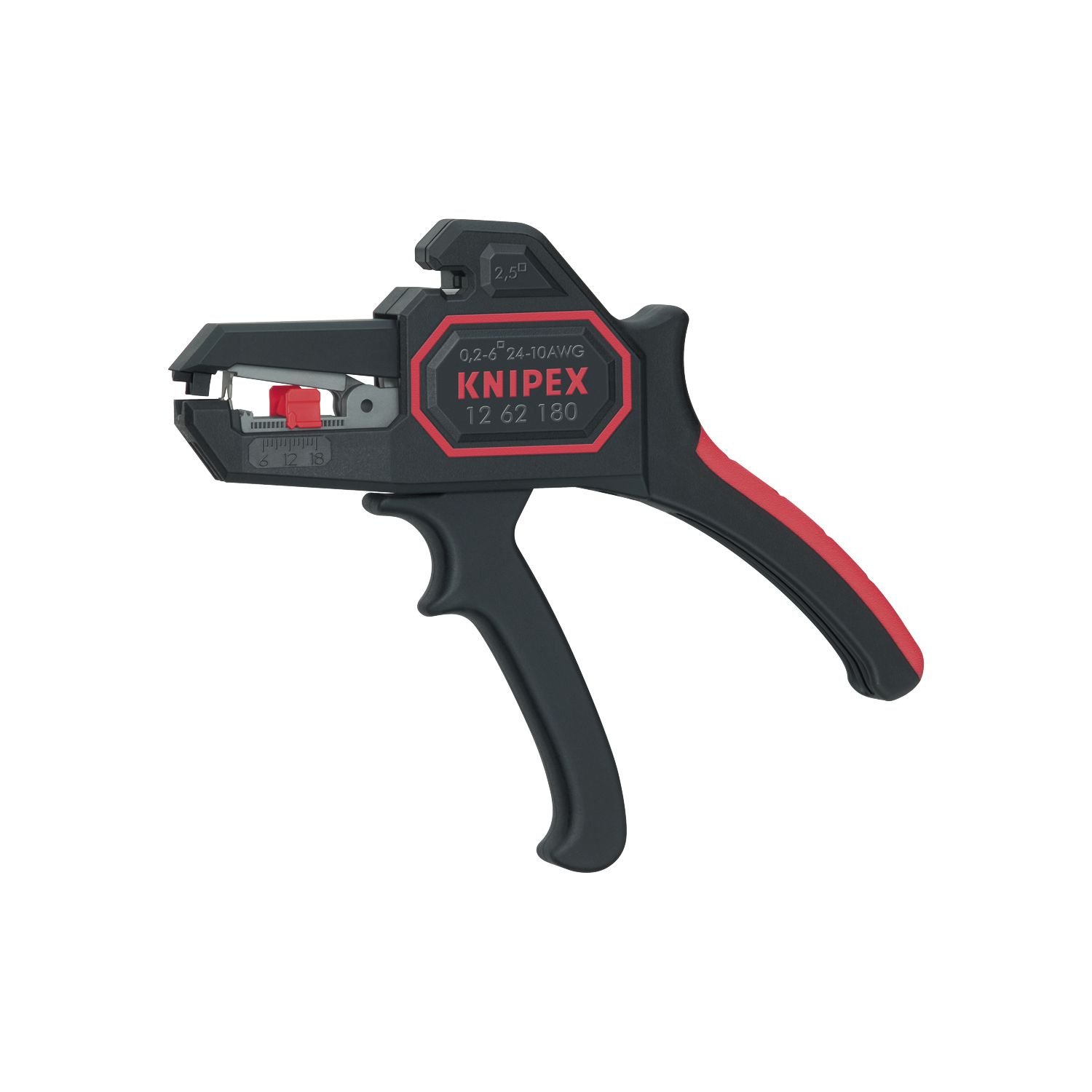
Knipex 12 62 180

91 /100
Kirk Score Outstanding
Length
7.09 inches
Weight
5.33 oz
Cable Types
Single, multiple, fine stranded
Stripping Range
0.2-6 mm²
Check Details on Amazon

Pros

  • Compact 7.09-inch frame
  • Automatic 0.2-6 mm² adjustment
  • Precise on fine stranded cable
  • Comfortable for long sessions

Cons

  • Premium price among these picks
  • Lighter build feels less rugged

The Knipex is the premium compact in this group, and it earns that place with control rather than raw capacity. Its 0.2-6 mm² range covers small and medium cable, and the automatic jaw adapts to single, multiple, and fine stranded conductors without a gauge dial. The 7.09-inch frame is easy to keep close in a pouch or work near a terminal.

We found the stripping action deliberate rather than snappy. That is a good thing on fine wire: the tool eases into the insulation instead of biting through it, and the grip is comfortable enough for a long bench session. It is the pick we reach for when the wire is small, the access is awkward, and a clean strip matters more than speed. The plastic handles keep it light, but the tool does not feel as rugged as the cast-alloy Klein.

The caveat is value. This is the premium pick here, and the lighter build has less of the planted, heavy-tool feel that some jobs call for. If you need one tool for occasional household wiring, the Klein 11063W covers larger solid wire and costs less. If you spend your day in tight panels and care about strip quality more than raw capacity, the Knipex earns its place.

Bottom line: A premium compact stripper for precise work in tight spots; choose it for control and fine-cable range, not for the largest household wire.

Check Latest Price
#06

Best for Precise Strip Length

WEICON No. 5

91 /100
Kirk Score Outstanding
Side Cutter
Up to 2 mm diameter
Strip Length
5-12 mm
Certification
TÜV certified
Stripping Range
0.2-6 mm²
Check Details on Amazon

Pros

  • Side cutter up to 2 mm
  • Adjustable 5-12 mm stop
  • 0.2-6 mm² stripping range
  • TÜV-certified German build

Cons

  • Plastic body less suited to rough handling

The WEICON's side cutter is the detail that separates it from the other precision strippers here. It handles cable up to 2 mm in diameter, so you can trim a conductor and strip the next one without swapping tools. The adjustable stop runs from 5 to 12 mm, which is a useful range for terminal blocks and control work.

We like the way the tool is set up for bench work: the automatic jaw adapts across 0.2-6 mm², the handle is comfortable for long sessions, and the strip-length stop is easy to set and repeat. The Solingen steel blades and TÜV certification are reassuring details, though they do not make it a substitute for a proper cable cutter on larger conductors.

The weak spot is ruggedness. The body is glass-fibre-reinforced polyamide, and the tool feels more at home in a drawer or on a bench than in a bag full of heavier tools. For a professional panel builder who wants precise strips and a built-in side cutter, that trade-off is reasonable. For rough site work, the Klein feels more planted.

Bottom line: A precise bench stripper with a useful side cutter and a 5-12 mm length stop; best for control work, not the roughest job site.

Check Latest Price
#07

Tight access

Capri Tools 20011

89 /100
Kirk Score Excellent
Weight
5.64 oz
Profile
Narrow
Stripping Range
24-10 AWG
Integrated Cutter
Up to 12 AWG
Check Details on Amazon

Pros

  • Narrow head reaches tight areas
  • Strips 24-10 AWG
  • One-squeeze compound action
  • 10-year warranty

Cons

  • Build feels less rigid than premium picks
  • Spring durability is a question for daily use

If the wire is tucked behind a fixture or down a narrow channel, the Capri's slim head is the reason to pick it up. It strips 24-10 AWG and cuts up to 12 AWG, and the compound action grips and strips in one squeeze rather than making you reposition the tool. The narrow profile is the feature, not a cosmetic touch.

We found it especially handy for small-gauge repair work, where a full-size stripper can block your view of the terminal. The light ABS body and narrow profile make it easy to keep in a pouch, and the 10-year warranty is generous for a tool at this level. It is not the most refined stripper in the hand, and the build feels lighter and less rigid than the Klein or WEICON, but it gets the job done in places the bigger tools cannot reach.

The trade-off is longevity. The spring and the plastic body are the parts we watch, and this is a tool we keep for occasional jobs and tight spots rather than constant stripping. For a homeowner or low-voltage installer who needs access more than capacity, it is a sensible, inexpensive choice. For daily production work, spend more on a metal-framed pick.

Bottom line: A slim, light stripper for tight access and occasional repair work; it trades some ruggedness for reach and a low price.

Check Latest Price
#08

Light-duty repairs

VCELINK Wire Stripper

91 /100
Kirk Score Outstanding
Weight
7.41 oz
Functions
Strip and cut
Jaw Shape
Eagle nose
Stripping Range
14-24 AWG
Check Details on Amazon

Pros

  • Compact 210 g body
  • 14-24 AWG stripping range
  • Eagle nose for tight spaces
  • Pressure adjustment knob

Cons

  • Limited to 14-24 AWG
  • Light-duty mechanism

The VCELINK is the one we reach for when the job is a couple of speaker wires or a low-voltage connector and the big stripper is overkill. It is compact, light at 210 grams, and the eagle nose gets into places a full-size frame will not. The 14-24 AWG range covers small stranded and solid wire, and the pressure knob lets you tune the bite for insulation that is softer or tougher.

The two-in-one design is simple: strip with the automatic jaw, cut with the blade, and use the spring-loaded handle to keep the cycle quick. We like it for bench repairs and quick automotive splices, where you are not stripping a whole panel. The thumb knob is a useful touch on a tool this small, because light wire is exactly where a fixed jaw can chew through strands.

It is not a daily-driver stripper. The body and mechanism feel light-duty, and the 14-24 AWG range leaves out the 12 AWG household cable that many whole-house jobs depend on. Keep the VCELINK for occasional small-gauge jobs and it makes a lot of sense, especially as a spare in a toolbox. Just do not ask it to replace a full-size stripper on a panel full of outlets.

Bottom line: A handy compact auto stripper for 14-24 AWG and tight spots; keep it as a light-duty spare, not a whole-house tool.

Check Latest Price
#09

Occasional use

Amazon Basics Self-Adjusting

86 /100
Kirk Score Excellent
Jaw Width
2 inches
Strip Length
Adjustable stopper
Crimping Range
10-22 AWG; 7-9 mm ignition
Stripping Range
10-24 AWG
Check Details on Amazon

Pros

  • Lowest cost in this set
  • 10-24 AWG stripping range
  • Built-in crimper
  • Adjustable stopper

Cons

  • Inconsistent grip and strip depth
  • Less precise than premium picks

As the least expensive pick here, the Amazon Basics stripper is best understood as a spare or occasional-use tool. It strips 10-24 AWG, crimps insulated and non-insulated terminals, and has an adjustable stopper for repeat strip lengths. That is a lot of function for the money, and the two-inch jaw gives you a familiar full-size feel.

We found it works fine on common 12-18 AWG wire when the jaws are set correctly, and the crimper is a convenience for quick terminal repairs. But the mechanism is not as consistent as the Klein or IRWIN: the strip can miss, the adjustment can wander, and the tool feels less precise in the hand. It is the one we treat as a backup, not the one we carry for a whole day of wiring.

For a homeowner who needs to fix a lamp cord or add a receptacle once in a while, that trade-off can be worth it. For anyone stripping dozens of connections, the extra consistency of the top pick is money well spent. The Amazon Basics earns a place as a low-cost second tool, not as the first one out of the box.

Bottom line: A low-cost backup stripper and crimper for occasional household repairs; step up to the Klein or IRWIN if you strip wire regularly.

Check Latest Price

How We Tested Automatic Wire Strippers

We built the shortlist from every automatic stripper we could find that listed a real AWG range and a self-adjusting jaw, then filtered on range coverage, whether solid and stranded were rated separately, whether a cutter or crimper was built in, handle shape, and price. Nine made the cut, from compact pocket-sized models to full-length 8-inch tools.

Testing ran for four months, in the places wire actually gets stripped: my basement workbench, a half-finished garage circuit, and a stack of lamps and small appliances that needed new cord. We kept spools of 14/2 and 12/2 Romex, loose solid and stranded scrap in every gauge the tools claimed, plus thermostat wire and a car speaker harness for the thin end of the range.

Each stripper did the same jobs in the same order. We cut and stripped ten connections inside a crowded junction box and timed it, since a self-adjusting jaw only earns its keep if it beats the knife. Every strip got a look under a bright work light for nicked copper and stray strands — that's where gauge accuracy either holds or quietly doesn't. We pulled each tool through the full range it advertised and noted where it started to slip, then flipped between 18 and 12 AWG a dozen times to see whether adjustability meant a dial, a lever, or a fight.

Reliability and durability got their own abuse. Fifty strips in a row told us whether the grip or the spring gave out first, twenty repeats on a single gauge showed whether the strip depth drifted, and a waist-high drop onto concrete answered the durability question faster than any spec sheet. Finally, we weighed what each one cost against what it actually did — a clean strip, a real cutter, and a handle you can live with.

How to Choose an Automatic Wire Stripper

Match the range to your wire, including the extremes

Automatic strippers are rated in AWG for solid and stranded wire, or in square millimeters for metric cable, and those ranges are not interchangeable at the edges. A tool that lists 10-24 AWG may be flawless at 18 AWG and fussy at 24; a house-wiring model may be happiest on 12 and 14 AWG solid. The Klein 11063W covers 8-20 AWG solid and 10-22 AWG stranded, which is a sensible center for home and auto work, while the Jokari and Knipex reach down to 0.2 mm² for electronics.

Pick a range that brackets the wire you use most, then test the smallest and largest sizes on scrap before you trust it. If you work with Romex, look for a tool like the Klein 11061 that names 12/2 and 14/2 NM-B; a generic 10-24 rating does not promise clean sheathing removal.

The grip is the automatic part

Self-adjusting jaws work by clamping the insulation, biting through it, and pulling the slug off as the handles close. If the jaw slips, the widest range in the world will not save the strip. Look for a compound action, a strong spring return, and jaws that meet squarely; those details matter more than a long list of functions. Stiff insulation and very fine wire are the usual tests, because that is where a loose grip shows up as a chewed conductor or a half-pulled strip.

Try the tool on the wire in your scrap bin before you commit to a project. A clean strip leaves bright copper without nicks; if you see rings or gouges, the jaw is biting too deep or the wire is not seated.

Strip length, cutters, and crimpers

An adjustable stopper is the difference between a one-off strip and a repeatable one. Set it once for the terminal block or outlet you are wiring, then squeeze without measuring each end. The IRWIN and WEICON make this a headline feature; the Klein 11063W relies on fixed stripping holes and removes up to an inch in one step, which is fast but less adjustable.

An integrated cutter saves a tool change, but check its capacity separately from the stripping range. The Klein models cut up to 8 AWG solid while the Jokari's cutter stops at 14 AWG; a crimper is convenient for terminals, but it does not turn a stripper into a dedicated crimping tool.

Fit, access, and what wears out

Automatic strippers are hand tools, so bulk matters. A 12-ounce full-size frame feels planted on a bench but can crowd a tight box; the Knipex, Capri, and VCELINK are easier to place where the wire disappears into a fixture. If you strip all day, prioritize a metal frame, comfortable handles, and replaceable blades; if you reach for one occasionally, a lighter plastic body can be a fair trade.

Springs and blades are the wear parts. A tool with spare blades available, like the Jokari, can stay in service longer; a budget model with a sealed mechanism is a backup, not a lifetime purchase. Keep the jaws clean and test a scrap wire after any change in wire type.

Frequently Asked Questions

Final Verdict

The Klein 11063W is the automatic stripper we recommend first for most home and auto wiring: one squeeze grips, strips, and self-opens, and the built-in cutter handles up to 8 AWG solid. If your work is mostly fine electronics wire, the Jokari 20050's small-gauge control and replaceable blades make it the better specialist.