// data-verified

Best Wire Connectors of 2026

Halfway to the boat ramp, one trailer light went dark — and the culprit was a crimp I'd made myself, one that looked fine and let go anyway. Wire connectors are the cheapest part of a job and the sneakiest place for it to fail. A good one grips the copper, seals out moisture, and disappears into the loom; a bad one turns a five-minute repair into a lost Saturday.

I've rewired trailer harnesses, shop lights, and old lamps for years, and over the past four months my team and I worked through 15 connector kits, from lever-nuts to adhesive-lined heat-shrink terminals. The count printed on the box tells you almost nothing. Two specs decide whether a splice survives: the shrink ratio, which governs how tightly the tubing closes over the wire, and whether the adhesive actually melts and flows. Color coding matters too — but only if the colors line up with the gauges you actually own.

Some of these are built for stranded wire under a truck; others are meant for solid wire in a wall box. The picks below are sorted by the job at hand.

#01

Best Overall

WAGO 221-412 Lever-Nuts

96 /100
Kirk Score Outstanding
Pack Size
100 connectors
Wire Range
24–12 AWG
Connector Type
Two-conductor lever nut
Electrical Rating
20 A, 450 V AC
Check Details on Amazon

Pros

  • Tool-free lever opens and recloses
  • Clear body shows the wire seated
  • 24–12 AWG coverage with 20 A rating
  • Compact enough for crowded boxes

Cons

  • Only two conductors per connector
  • 100-piece box is overkill for one repair

The little orange lever is the whole argument for the WAGO 221-412: lift it, push in a wire, and close it again. There is no twisting, no crimping, and no guessing whether the joint is tight. We used these on solid and stranded conductors and kept coming back to how easy it is to undo a connection when a circuit changes.

The transparent housing is more useful than it sounds. You can see the conductor land where it should before the lever closes, which is the kind of check that prevents a loose splice in a crowded box. The 24–12 AWG range covers most household lighting and receptacle circuits, and the 20 A, 450 V AC rating means this is not just a low-voltage gadget. We also appreciate how compact they stay compared with a bundle of wire nuts.

The trade-off is the box: a hundred connectors is a serious commitment for one repair, and the price is high against basic crimp kits. This is the pick for someone wiring a room, a panel, or a series of fixtures rather than joining two wires once. If you need a three-way splice, look to the same family’s multi-conductor versions.

Bottom line: For splices you may need to reopen or inspect, the WAGO 221-412 is the connector we reach for first.

Check Latest Price
#02

Best Heat-Shrink Butt Kit

haisstronica 330-Piece Butt Connectors

96 /100
Kirk Score Outstanding
Pack Size
330 connectors
Wire Range
26–10 AWG
Shrink Ratio
3:1, adhesive-lined
Connector Type
Heat-shrink butt splice
Check Details on Amazon

Pros

  • 330 pieces across four size groups
  • Covers 26–10 AWG
  • 3:1 adhesive-lined waterproof seal

Cons

  • Butt splices only, no terminals
  • Case feels flimsy

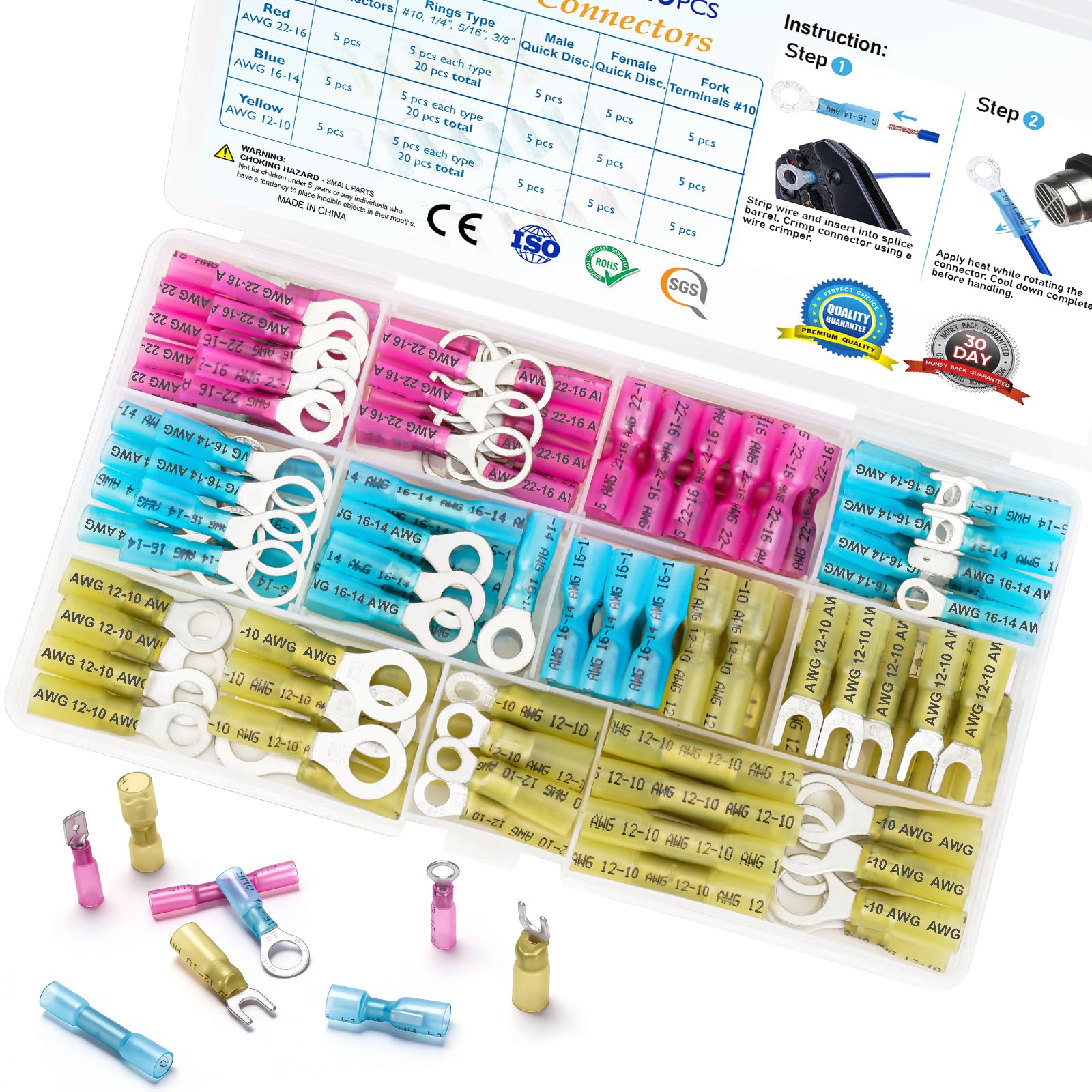
Most heat-shrink kits make you choose between small-gauge coverage and the bigger wire you need for a trailer or a battery run. This one covers 26 through 10 AWG in four color-coded groups, with 330 connectors in the box. We like that the 22–16 and 16–14 sizes are stocked heavily enough for a lot of control and accessory wiring, while the 12–10 group is there for the heavier runs.

The 3:1 adhesive-lined tubing is the part that makes these worth buying over plain butt connectors. When it shrinks, the adhesive fills around the insulation and the built-in wire stop keeps the conductor from sliding past the barrel. We found the seal reassuring for trailer and marine-adjacent work, where a joint that only looks tight is not enough.

What you give up is variety: these are butt splices only, so ring, fork, and spade terminals are a separate purchase. The plastic case is also not the reason to buy this kit; it does the job of keeping sizes apart but feels light. Neither issue matters if your projects are mostly joining wire end to end.

Bottom line: If butt splices are the job, this is the heat-shrink assortment we want within reach.

Check Latest Price
#03

Best Terminal Variety

TICONN 120-Piece Terminal Kit

93 /100
Kirk Score Outstanding
Pack Size
120 connectors
Wire Range
22–10 AWG
Shrink Ratio
3:1, adhesive-lined
Connector Types
Ring, fork, spade, butt
Check Details on Amazon

Pros

  • Ring, fork, spade, and butt in one kit
  • Covers 22–10 AWG
  • 3:1 adhesive-lined marine seal
  • Color-coded by wire gauge

Cons

  • Uneven counts make large-gauge jobs run short
  • Case is flimsier than the connectors

A 120-piece kit that stopped at butt splices wastes drawer space; this one earns its place by covering the terminals too. There are ring, fork, spade, and butt connectors in red, blue, and yellow, spanning 22–10 AWG, with the 3:1 adhesive-lined tubing TICONN uses across its heat-shrink line. We found the ring-terminal selection especially practical for battery and bus-bar work because the common stud sizes are represented.

The seal is the second reason it stays in the bag. Heat the tubing until the adhesive flows, and the connection is protected against moisture and salt spray, which is why this kit reads as marine-ready rather than just automotive. We also like that the color coding makes a quick gauge check possible when the light in a bilge or engine bay is not good.

The catch is the mix. The larger yellow connectors are not stocked as generously as the small ones, so a project with several 10-gauge runs can run out before the box does. Crimp feel also varies with the tool and the size; a ratcheting crimper made for insulated terminals gives the most consistent result. If you only need butt splices, the dedicated kit above is the cleaner buy.

Bottom line: When the job needs ring, fork, or spade terminals as much as splices, this TICONN kit is the one we pack.

Check Latest Price
#04

Best for Tapping Wires

Nilight T-Tap Quick Splice Kit

91 /100
Kirk Score Outstanding
Warranty
2 years
Pack Size
60 pairs
Connector Type
T-tap with male disconnect
Maximum Voltage
24 V
Check Details on Amazon

Pros

  • No cutting or stripping existing wire
  • 60 matched T-tap pairs
  • Locking male disconnects
  • Two-year warranty

Cons

  • Housing can crack if over-squeezed
  • Not for high-current or safety circuits

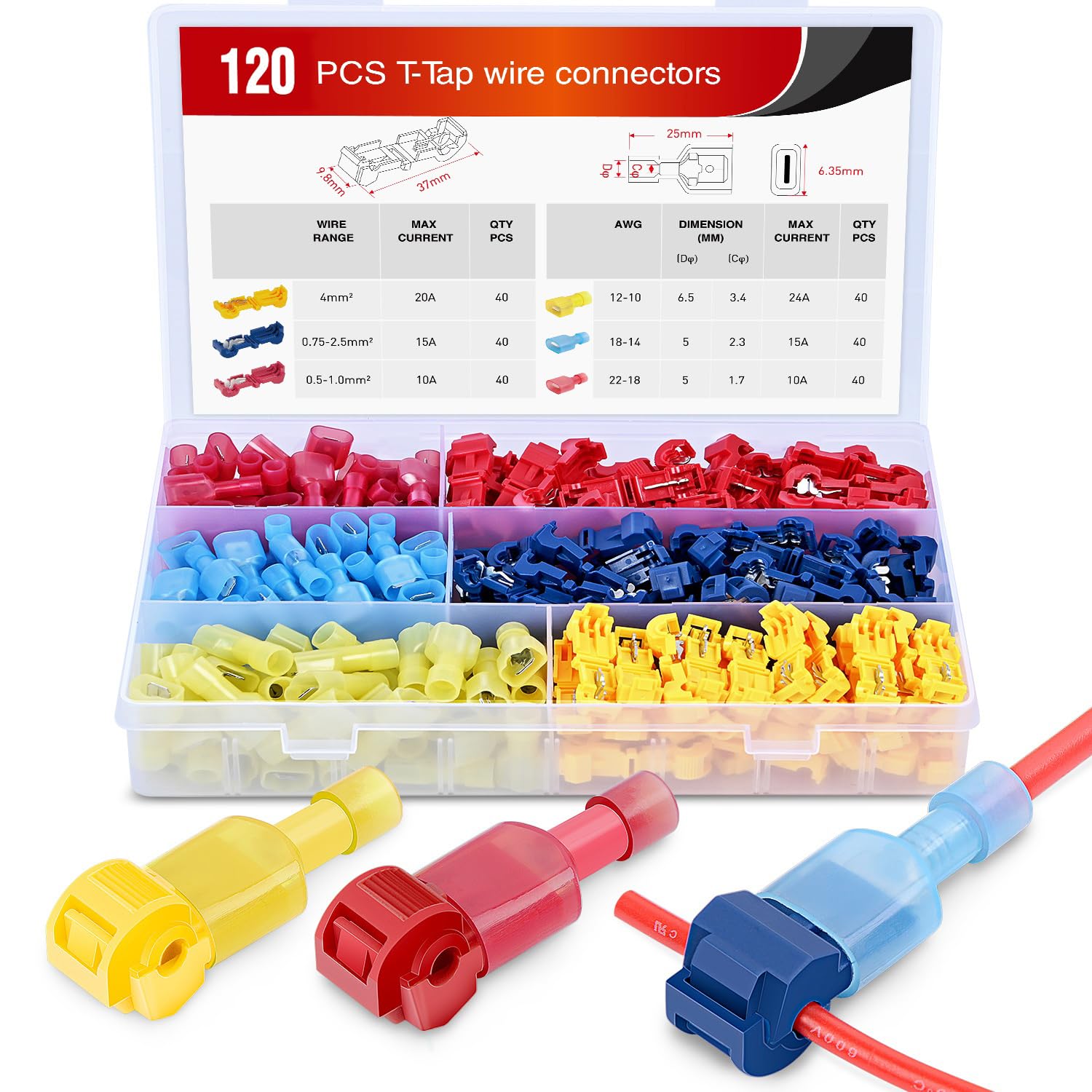
Adding a dash camera, light bar, or radio to a factory harness is exactly the job a T-tap is built for. The Nilight kit gives you 60 T-taps and 60 matching male quick disconnects, so you can tap an existing wire without cutting it or stripping a section bare. The housing snaps over the wire, and the male disconnect pushes on with a lock that is meant to stay put.

What we appreciate is the speed: the connection is made at the wire, not at a bench, and you can pull the accessory side apart later without undoing the tap. That is a real convenience in a vehicle where you may want to remove a radio or a light without disturbing the harness. The two-year warranty is also a useful vote of confidence.

The weakness is mechanical. The housing is not armored, and it can crack if you crush it with pliers while trying to force the tap closed; a firm, straight squeeze is better than a hard one. We also treat T-taps as an accessory-circuit convenience, not as a substitute for a full splice in a high-current or safety circuit. Used within that boundary, they save a lot of cutting and re-taping.

Bottom line: For adding an accessory circuit without cutting the factory wire, the Nilight T-tap kit is the one we keep handy.

Check Latest Price
#05

Bulk marine kits

Oiojuct 600-Piece Connector Kit

92 /100
Kirk Score Outstanding
Pack Size
600 connectors
Wire Range
22–10 AWG
Connector Types
Ring, fork, spade, butt
Maximum Voltage
24 V DC
Check Details on Amazon

Pros

  • 600 pieces across four terminal types
  • 22–10 AWG coverage
  • Heat-shrink seal for marine use

Cons

  • Stiff barrels need a firm, full crimp
  • Overkill for a single household repair

Six hundred pieces is not a gimmick if you are chasing a wiring fault through a trailer or adding a bank of accessories to a boat. The Oiojuct kit puts ring, fork, spade, and butt connectors in one box, with heat-shrink insulation that is meant to seal out moisture. We found the size range broad enough to cover the usual 22–10 AWG work.

The heat-shrink side is the reason to choose it over a bin of plain crimp terminals. Once the tubing is heated and the adhesive flows, the joint is sealed against splash and damp, which is exactly what marine and automotive work needs. We also like having ring and spade terminals in the same kit as butt splices, because a single project often needs both a splice and a termination.

Crimp feel is the trade-off. The barrels are stiff enough that a light squeeze can leave the wire loose; use a crimper sized for insulated terminals and close it fully before you reach for the heat gun. This is also a lot of connectors if you mostly do household repairs, and the count includes sizes you may not touch for months. For a busy garage or a boat owner, that bulk is the point.

We keep this one in the category of kits to buy when you know you will use the volume, not as a starter set for one repair. The connectors are not the most refined crimp we handled here, but the combination of count, terminal variety, and sealed connections makes it a practical bulk choice.

Bottom line: For a trailer, boat, or vehicle project that will eat connectors all season, this 600-piece Oiojuct kit is the bulk buy we reach for.

Check Latest Price
#06

Midrange assortment

Kuject 320-Piece Connector Kit

89 /100
Kirk Score Excellent
Warranty
90 days
Pack Size
320 connectors
Insulation
Adhesive-lined polyolefin
Connector Types
Ring, fork, spade, butt
Check Details on Amazon

Pros

  • 320 pieces across four terminal types
  • Adhesive-lined translucent tubing
  • 257°F temperature rating

Cons

  • 90-day warranty is short

The Kuject 320-piece kit sits between the small specialty packs and the bulk boxes: more pieces than a starter set, less bulk than the 600-piece Oiojuct. The mix includes ring, fork, spade, and butt connectors, and the tubing is translucent, adhesive-lined polyolefin so you can see the wire seated before you shrink it. That is a useful combination for a garage that handles a bit of everything.

We like the clarity of the translucent sleeve, especially on smaller wire where a missed strand is hard to spot. The adhesive lining is the feature that matters for outdoor or vehicle work, and the 257°F temperature rating gives the tubing room to shrink without instantly collapsing. The 320-piece count also means fewer mid-project trips for a common terminal.

The warranty is the main reservation: 90 days is short for a kit that may sit on a shelf between projects. The 320-piece mix is broad enough for a mixed garage, but it does not replace the dedicated butt kit when every splice is the same size. That makes it a good middle choice rather than the first box for a specialist.

Bottom line: A sensible middle kit for someone who wants terminals and splices in one box without buying the biggest assortment here.

Check Latest Price
#07

Low-voltage projects

JOXICOL Push-In Wire Connectors

81 /100
Kirk Score Excellent
Housing
PA66 flame-retardant nylon
Pack Size
100 connectors
Wire Range
22–18 AWG
Connector Type
Push-in double plug
Check Details on Amazon

Pros

  • No stripping or soldering
  • Locking buckle holds the pair
  • Flame-retardant nylon housing

Cons

  • Only 22–18 AWG wire
  • Not for line-voltage wiring

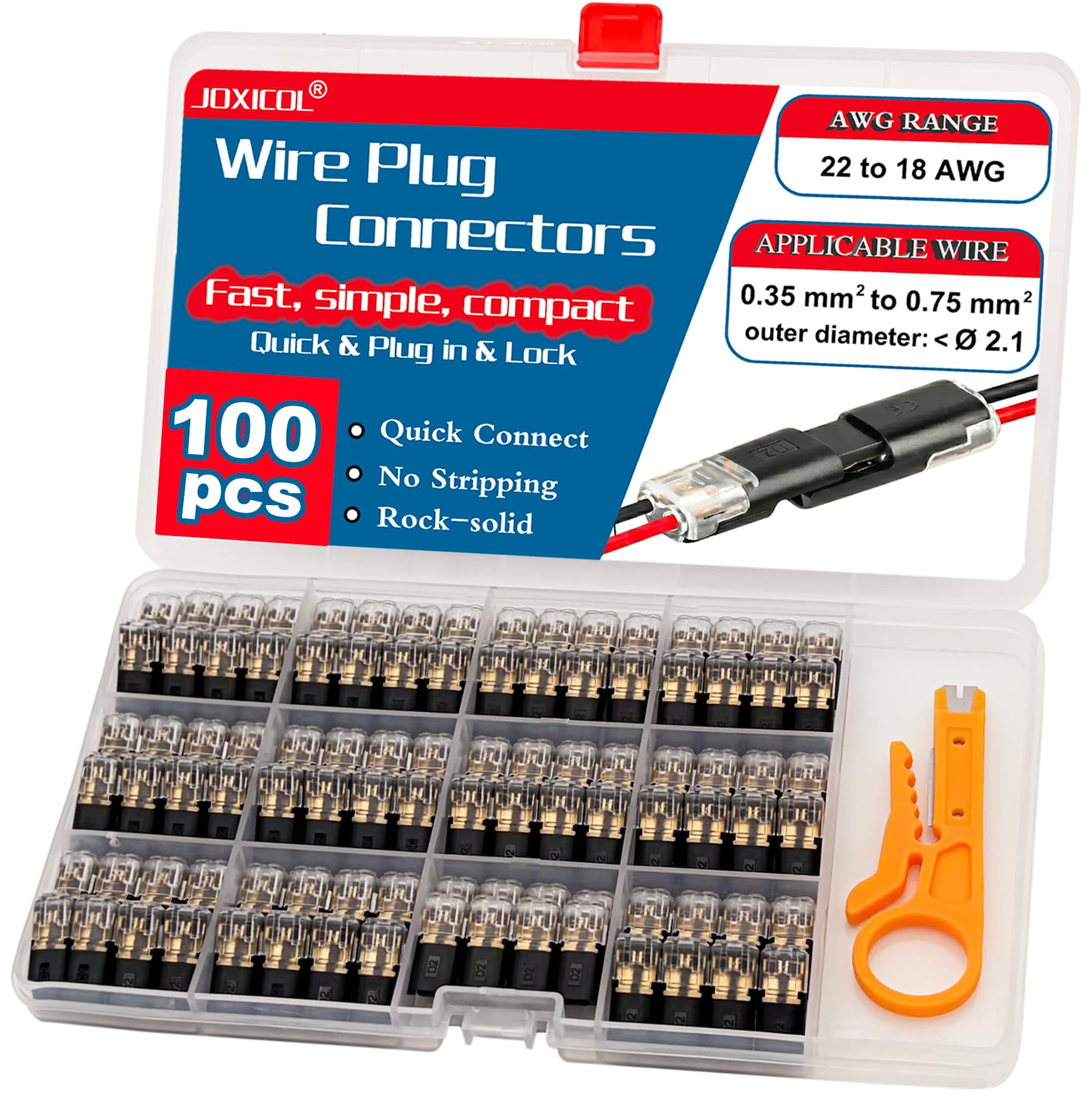
This is not the connector for a wall circuit, and JOXICOL does not pretend otherwise. The push-in plugs are made for low-voltage projects, with a locking buckle that holds two wires together after you open the cap, insert the conductor, and snap it shut. There is no stripping or soldering, which is the appeal for bench wiring and small accessories.

We like the speed for LED strips and speaker runs: the connection is clean and easy to take apart when a layout changes. The PA66 flame-retardant nylon housing gives the plug a solid feel, and the locking tab is more reassuring than a friction-fit connector. For a low-voltage project where you are making a lot of joins, the hundred-piece count is useful rather than excessive.

The limitation is the wire range. These are for 22, 20, and 18 AWG only, so they will not help with thicker low-voltage cable or any line-voltage splice. If your project is all small-gauge control wire, that is a fair trade for the tool-free install. If the wire size is mixed, buy a connector with a broader gauge range instead.

Bottom line: For low-voltage LED, speaker, or accessory wiring in 22–18 AWG, these push-in plugs make a neat connection without stripping.

Check Latest Price

How We Chose and Tested Wire Connectors

We started by pulling every connector style we could find in stock — lever-nuts, adhesive-lined heat-shrink terminals, quick-splice T-taps, push-in plugs — and narrowed to 15 kits that covered a usable spread of wire gauges without forcing us to buy three boxes to finish one job. Price per usable connector, not per box, was the first filter: a giant kit with 40 connectors worth keeping isn't a bargain.

Testing happened where these things live — a driveway trailer rewire, a shop lamp with a frayed cord, a bilge-pump circuit on a friend's boat, and a bench session with a heat gun and scrap wire from 22 to 12 gauge. We timed single-handed installs, noted whether levers opened cleanly and push-in plugs locked with an audible click, and checked that each barrel accepted the gauge printed on the package without paring strands or leaving a gap. Then we pulled every joint, straight and at an angle, hard enough to test the crimp rather than the wire. Heat-shrink got hit with the gun until the tubing relaxed, and we watched for adhesive beading out both ends and for any sleeve that crept back and left copper showing.

Durability was the slow part: a set of splices rode on a truck bumper through two months of rain and road spray, and we checked them for green copper and loose sleeves; a few went into a damp basement junction. Kits that shed connectors to cracked nylon or refused to release a wire got marked down regardless of how good the first install felt.

How to Choose Wire Connectors

Start with the job, then the connector

The first question is whether you are joining two wires permanently, adding a terminal, tapping an existing run, or making a connection you expect to take apart. Lever nuts such as the WAGO 221-412 are the easiest to reopen, while heat-shrink butt splices are better for a sealed, permanent joint. Ring, fork, and spade terminals solve a different problem: they land on a stud or disconnect. T-taps are for adding an accessory without cutting the original wire. A mixed kit makes sense only if your projects genuinely cross those jobs.

Match gauge and stud size before anything else

A connector’s gauge range is the first hard limit. Heat-shrink kits here span 26–10 AWG or 22–10 AWG, but a given connector inside the kit is usually color-coded to a narrower slice. The wire must fit the barrel, and the terminal must fit the stud: a ring terminal for a #10 screw will not fit a 3/8-inch battery post. Check both the wire gauge and the fastener size before you crimp. If you are between sizes, choose the connector whose published range includes your wire rather than forcing the next size up.

Decide how much sealing you need

Adhesive-lined heat-shrink is worth paying for when the joint will see moisture, salt spray, vibration, or temperature swings. The tubing shrinks around the insulation and the adhesive fills the gap, which is why marine and automotive kits lean on 3:1 connectors. A plain nylon-insulated terminal or a lever nut is fine in a dry, protected box, but it is not a waterproof joint. If you choose heat-shrink, plan on a heat gun; an open flame can burn the tubing before the adhesive flows.

Budget for the crimper and the heat gun

The connector is often the cheap part. A ratcheting crimper made for insulated terminals gives a repeatable crimp on heat-shrink barrels, and a heat gun is the only sane way to shrink a whole kit’s worth of tubing. If you do not own those tools, a lever nut or a no-strip push-in connector can be the lower-friction choice for the right low-voltage job. Factor the tools into the first purchase instead of discovering the gap halfway through a harness.

Buy for the mix you will use

Large kits look like value until half the box is a size you never touch. Count the sizes you actually use: a trailer project may want more 16–14 and 12–10, while bench electronics may want 26–24 and 22–16. The haisstronica 330-piece kit is built around butt splices, the TICONN 120 leans toward terminal variety, and the bigger boxes make sense for a garage that does repeat vehicle or boat work. Storage matters too; a flimsy case that spills mixed sizes costs time.

Frequently Asked Questions

Final Verdict

Start with the WAGO 221-412 if you want the most reassuring everyday splice: it is reusable, inspectable, and rated for the wire sizes most household circuits use. The haisstronica 330-piece kit is the better buy for permanent automotive or marine butt splices, and the TICONN 120-piece kit covers you when the job needs ring, fork, and spade terminals in the same box.