// data-verified

Best Wire Strippers of 2026

A nicked conductor is a slow failure: the wire looks fine, then a strand breaks inside the insulation months later. The right wire stripper removes insulation cleanly, without shaving copper, and does it on the first squeeze. I've made do with a utility knife on enough late-night outlet swaps to know the difference—a good pair turns a fiddly job into a two-second motion, whether you're landing 12-gauge Romex or trimming 24-gauge thermostat wire.

We spent the past four months with 16 wire strippers, from simple stamped models to forged multi-tools with crimpers and reaming jaws. Differences show up fast: a clean strip versus a chewed conductor, a lock that stays shut in a pouch versus one that pops open, a grip that holds with sweaty hands, a pivot that stays tight after a drop. One thing buyers miss is that the gauge range on the handle only matters if the slots actually match the wire—several models skip sizes or fudge the labels. These picks earned their place by being easy to use, versatile, and worth the money.

#01

Best Overall

Klein 11063W Katapult

96 /100
Kirk Score Outstanding
Strips
8-20 AWG solid, 10-22 AWG stranded
Weight
12 oz
Operation
Automatic, self-opening
Built-in Cutter
Up to 8 AWG solid
Check Details on Amazon

Pros

  • One squeeze strips without matching a hole
  • Cutter takes solid wire up to 8 AWG
  • Removes up to an inch in one step
  • Nothing to calibrate or adjust

Cons

  • Solid wire range stops at 20 AWG
  • Heavier and bulkier than a manual pair

One squeeze is the whole idea, and it works the way the design promises: the jaws close on the insulation, the blades cut, and the wire pulls free in a single motion. No hunting for the right hole, no second hand steadying the wire. The internal spring opens the handles again by itself, a detail you appreciate around the twentieth tail in a crowded box.

What earns it the top spot is how much of the job it swallows. It strips 8-20 AWG solid and 10-22 AWG stranded, takes up to an inch of insulation in one step, and the built-in cutter handles solid wire to 8 AWG. That covers 14 and 12 AWG branch circuits, fixture whips, and the 10 AWG you meet on a dryer or an AC disconnect, so most of a rewire happens without putting the tool down. We also like that there is nothing to calibrate — no tension dial, no stopper screw, nothing that drifts between one strip and the next. Given how many automatic strippers turn fussy after a season, that counts for a lot.

Build is the other half of the argument. The body is cast rather than stamped, the pivot feels tight, and the coated handles stay put in a dry palm. Set it beside the dial-and-stopper designs and the appeal is the absence of adjustment: fewer parts to set, fewer parts to get wrong.

Bottom line: For house and vehicle wiring rather than circuit boards, this is the stripper we point people to: one squeeze, 8-20 AWG solid, and a cutter that saves the swap.

Check Latest Price
#02

Best Budget

Irwin Vise-Grip 2078309

95 /100
Kirk Score Outstanding
Crimps
Insulated and non-insulated terminals
Strips
10-22 AWG
Weight
3.04 oz
Overall Length
8 inches
Check Details on Amazon

Pros

  • Strips, cuts, crimps, and shears bolts
  • Plier nose pulls and loops wire
  • Covers the 10-22 AWG household sweet spot
  • Induction-hardened cutting edge

Cons

  • Hard handles with little give over long sessions

Four jobs for roughly the cost of one is the entire case for this Irwin, and it is a good case: strip, cut, crimp, and shear a bolt from the same pair of handles. For a homeowner wiring a basement or a hobbyist building a control panel, that is the difference between one tool in the bag and four.

The ratings are unremarkable and that is fine — 10-22 AWG covers 14 and 12 AWG house wire, 16-18 AWG fixture and automotive wire, and most of what sits in a low-voltage box. The plier nose pulls and loops wire, the induction-hardened cutting edge holds up, and the crimper takes insulated and bare terminals. We reach for it more than any other manual stripper in this guide precisely because there is no reason to put it down between steps.

The fixed holes are the part that takes practice. On the sizes you use daily the squeeze is obvious; on 22 AWG it rewards a light hand, and a heavy one will notch strands. The crimper sits between the handles rather than at the tip, so crimping inside a crowded box means turning the tool sideways. Neither is a dealbreaker at this money, and both stop mattering once the technique settles.

Bottom line: We think it is the least expensive way to get four jobs in one hand: 10-22 AWG stripping, terminal crimping, wire cutting, and clean bolt shearing.

Check Latest Price
#03

Best for Heavy Cable

Knipex 13 72 8

96 /100
Kirk Score Outstanding
Cuts
Cable, NM-B, BX and MC
Strips
10-20 AWG solid and stranded
Weight
9.76 oz
Screw Cutting
6-32 and 8-32
Check Details on Amazon

Pros

  • Shear blades open NM-B, BX, and MC quickly
  • Screw cutters work from either side
  • Locating ridges make holes findable by feel
  • Strips 10-20 AWG solid and stranded

Cons

  • Most expensive pick in this guide
  • No crimper

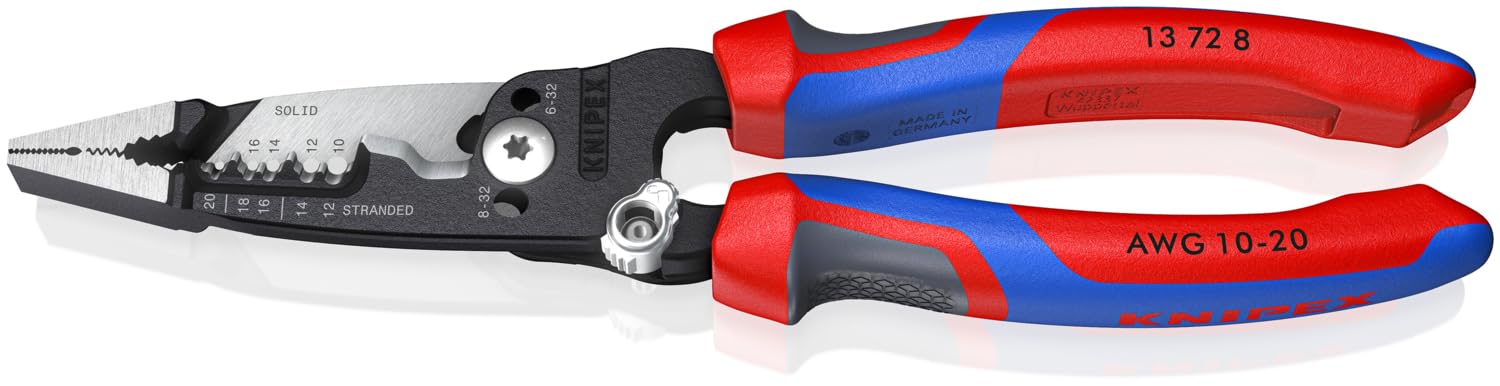
The cutters are what separate this Knipex from everything else here. The jaws are forged and the blades shear instead of pinching, so 12/2 NM-B, BX, and MC open with one firm squeeze rather than a rocking, three-bite struggle. On a day of making up boxes, that is the difference between finishing and still cutting.

Stripping is just as deliberate. Locating ridges let you find the right hole by feel instead of squinting at stamped numbers, and the holes run 10 to 20 AWG in both solid and stranded. The screw cutters take 6-32 and 8-32 from the front or the back, with no threading a screw in first — a small thing until you have done it the other way a hundred times.

Where it gives ground is on cost and on breadth. It is the most expensive tool in this guide by a wide margin, and unlike the multi-tools it will not crimp a terminal. We think that trade makes sense only if you cut cable most days: for lamps and occasional outlets the Irwin does the same work for a fraction of the money, while for daily trim-out the Knipex is the one that never slows you down.

Bottom line: For anyone cutting MC, BX, or NM-B regularly, we think these forged jaws and shear blades earn their keep; the premium is the only real argument against them.

Check Latest Price
#04

Best for Small-Gauge Wire

Klein 11057

95 /100
Kirk Score Outstanding
Strips
20-30 AWG solid, 22-32 AWG stranded
Weight
5.1 oz
Wire Looping
Holes for looping and bending wire
Screw Shearing
6-32 and 8-32
Check Details on Amazon

Pros

  • Handles 20-30 AWG solid, 22-32 stranded
  • Precision-ground holes for clean small strips
  • About five ounces and pocketable
  • Shears 6-32 and 8-32 screws

Cons

  • No 12 or 14 AWG branch circuit wire

Twenty-six gauge is where most strippers give up. This one is built for it: 20 to 30 AWG solid and 22 to 32 stranded, in ground holes sized for wire you can barely see, in a five-ounce body that disappears in a pocket. If your work is alarm cable, thermostat wire, or the inside of a control panel, this is the pick, and the general-purpose strippers here cannot follow you there.

Precision is the point. The stripping holes are ground rather than punched, so 26 or 28 AWG comes away with clean insulation and intact strands instead of a stretched, half-cut mess, and the jaws close squarely enough to work in tight spaces. We found the serrated nose pulls and bends small wire without crushing it, and the shears take 6-32 and 8-32 screws, which is handy when you are mounting a small enclosure.

The trade is coverage, and it is a real one. This is not a stripper for a house; 12 and 14 AWG branch wire simply is not in its range, and if you alternate between Romex and 26 AWG control wire you need two tools rather than one compromise. For a bench that is mostly small-gauge, though, buying a general-purpose pair means fighting wire with holes that were never meant for it, and that is the worse trade.

Bottom line: If your wire is alarm, thermostat, or electronics gauge, this is the one we hand you: 20-30 AWG solid, 22-32 stranded, and holes nothing else here has.

Check Latest Price
#05

Occasional DIY jobs

WGGE WG-015

93 /100
Kirk Score Outstanding
Crimps
Insulated and non-insulated terminals
Strips
10-22 AWG solid and stranded copper
Material
High-carbon alloy steel
Overall Length
8 inches
Check Details on Amazon

Pros

  • Strips and crimps 10-22 AWG
  • Comfortable rubber grip
  • Cheapest of the picks here

Cons

  • Center rivet can fail under sustained use

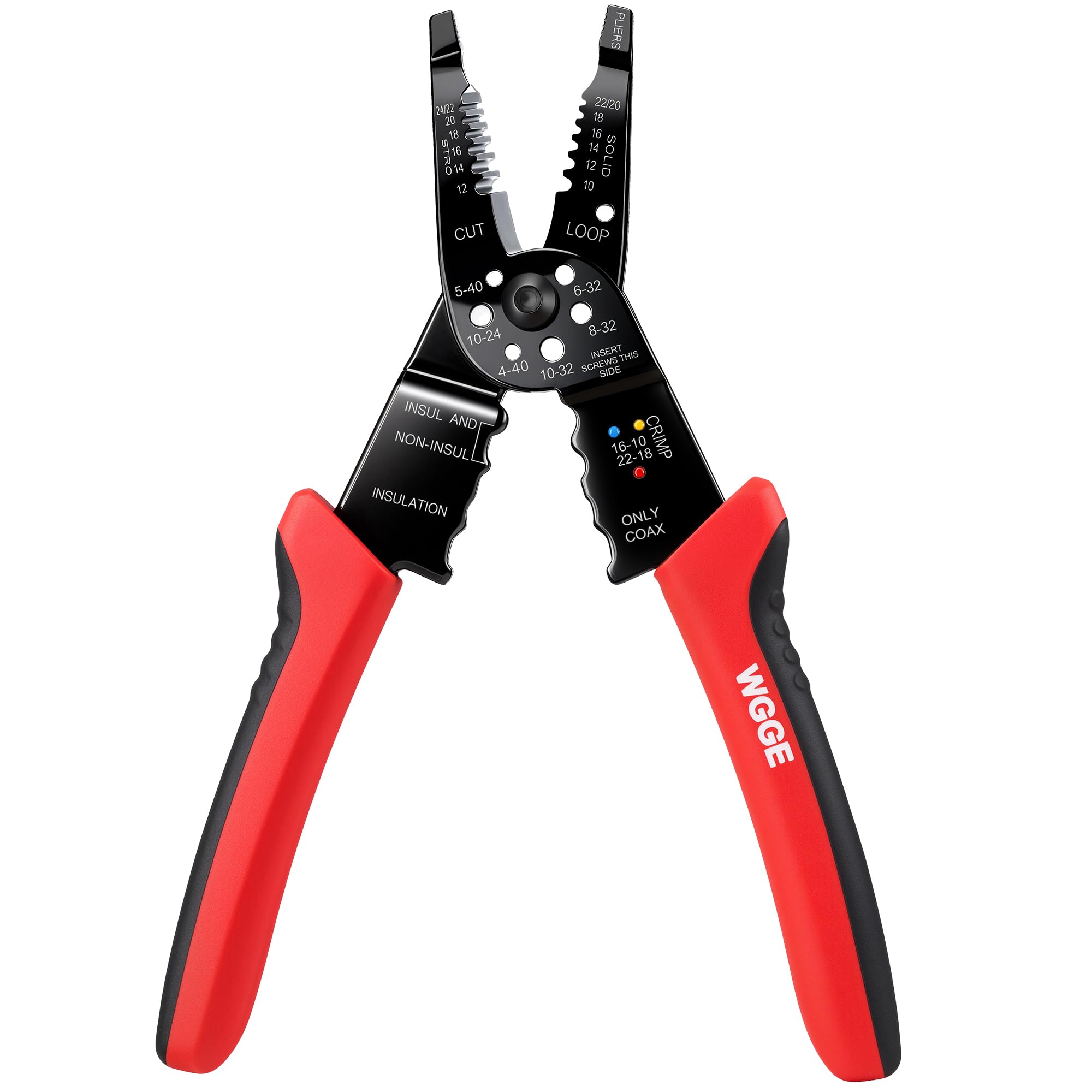
Put it beside the Irwin and the family resemblance is unmistakable: same eight-inch pattern, same jaw layout, same 10-22 AWG markings stamped on the jaw. The difference is in the steel and in the pivot, and that is where the money went.

For light work it is genuinely useful. The stripping holes cut cleanly, the crimper takes insulated and bare terminals, and the curved handle under a rubber grip is comfortable in a way cheap tools usually are not. For a first apartment, a hobby bench, or a bag you lend out, it does the job without drama, and it does it for less than anything else in this guide.

What we keep coming back to is the role rather than the tool. This is the pair that stays in the garage drawer, takes the abuse, and does not make you wince when a neighbor borrows it. Judged that way it is good value; judged as the only stripper you own, it is a compromise.

Bottom line: We like it as a spare: it strips and crimps 10-22 AWG cleanly and sits in the hand better than the price suggests, for light and occasional work.

Check Latest Price
#06

Service calls

Milwaukee 48-22-3079

95 /100
Kirk Score Outstanding
Strips
8-18 AWG bare, 10-20 AWG stranded
Weight
10.2 oz
Reaming
1/2 to 1 inch pipe
Bolt Cutting
#6 and #8 bolts
Check Details on Amazon

Pros

  • Strips 8-18 AWG bare, 10-20 stranded
  • Long serrated jaws pull and twist wire
  • Reams 1/2 to 1 inch conduit
  • Cuts #6 and #8 bolts

Cons

  • Rubber grips can work loose with use

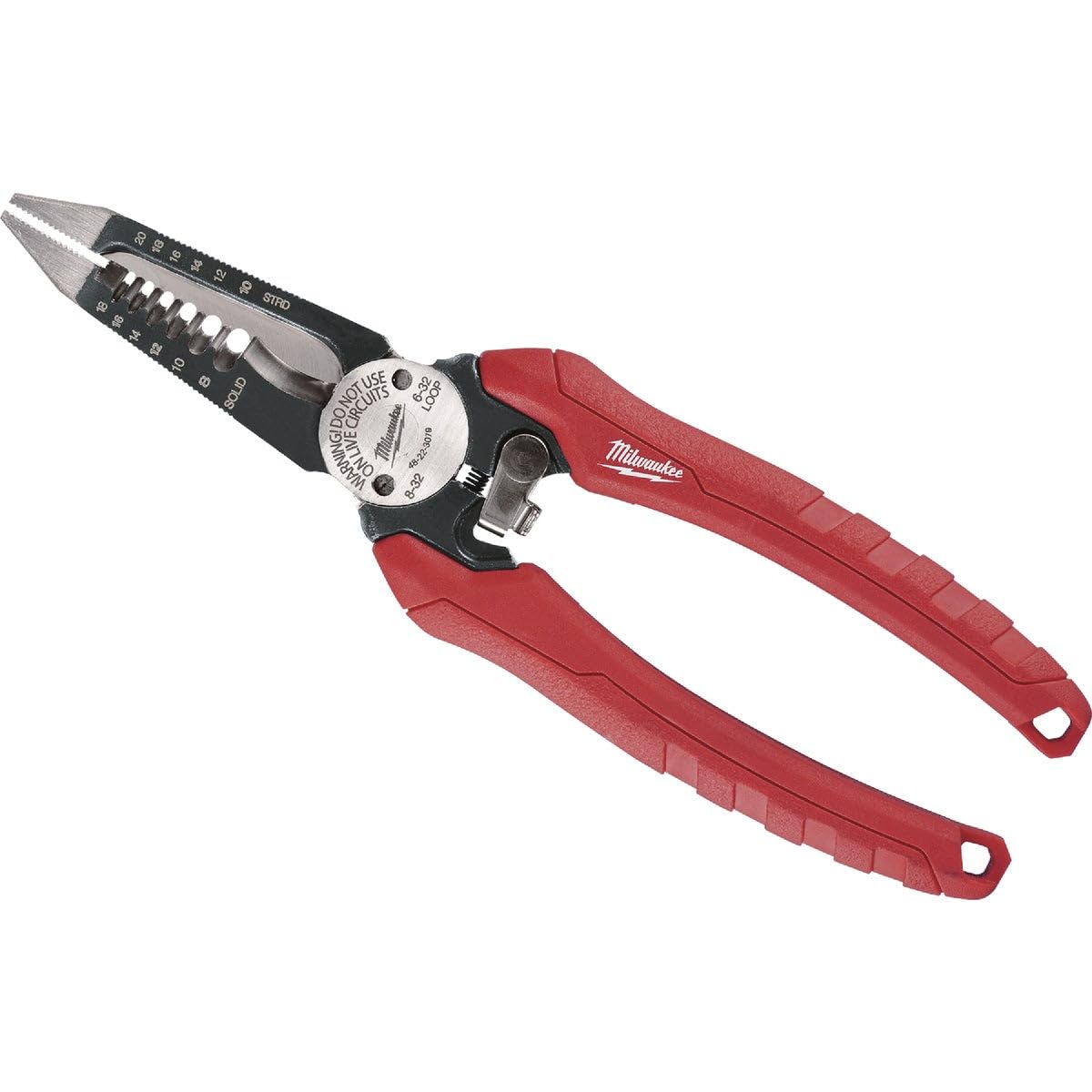
This is a plier first. The stripping holes are one function on a tool whose main job is grabbing, bending, and cutting, and it makes more sense once you think of it that way — a needle nose with a reamer behind the jaw and a stripper in the middle.

As a plier it is very good. The jaws are long and serrated, so pulling wire through a box or twisting a splice is easy, and the curved cutting blade bites heavier cable than the stamped holes suggest. Two holes in the middle form loops for 6-32 and 8-32 grounding screws, and the reamer smooths the edge of half-inch to one-inch conduit — the thing you are glad to have when a fitting will not seat.

The stripping is where it is merely competent. It covers 8-18 AWG bare and 10-20 AWG stranded, the gauge markings are small enough to need a second look, and the fixed holes want a steady, even squeeze. For a receptacle here and a fixture there that is plenty, and it is why we keep it on the belt for service work: one tool up the ladder beats three in the bag. For a full day of trimming out, a dedicated stripper is still faster.

Bottom line: Think of it as the plier that also strips: we get 8-18 AWG holes, a reamer, and bolt cutting in one belt tool — not a dedicated stripper's equal.

Check Latest Price

How We Tested Wire Strippers

We started by pulling together every wire stripper we could find that claimed to handle the wire sizes most home and auto jobs actually use—from 8 through 32 AWG—then sorted them by build style, handle shape, and whether they added crimping or reaming. From that shortlist, we bought 16 and put them to work for four months on a basement bench, a kitchen table with a lamp rewiring project, and a garage session replacing a trailer harness.

For the core test, I stripped 20 wires in each gauge I had on hand, both solid and stranded, then looked at every conductor under a magnifier and flexed it between my fingers to catch nicks or stray strands. I timed the first ten strips with each tool to see how quickly the gauge markings translated into a clean result, and I checked whether the slot labeled 12 AWG actually fit 12-gauge wire without chewing it. We also crimped terminals where the tool offered it, cut cable, and reamed conduit ends to see whether the extra functions were usable or just there for the packaging.

Grip and locking got their own rough treatment: I wore nitrile gloves with a little hand oil, stripped another dozen wires, and noted whether the handles slipped or dug into my palm. Each pair got opened and closed one-handed, shaken in a tool pouch, and dropped onto concrete from workbench height. At the end, we compared what each tool could do against what it cost and kept the ones that still felt tight, locked securely, and stripped cleanly without fuss.

How to Choose a Wire Stripper

Match the range to the wire you actually pull

House wiring lives at 14 and 12 AWG solid, with 10 AWG on dryers, ranges, and AC disconnects. Automotive and low-voltage work lives at 16-22 AWG stranded, and electronics below 22. A stripper covering 10-22 AWG handles the first two, which is why it is the range most of us should buy.

The trap is the bottom end: a tool that stops at 20 AWG solid will not touch thermostat or alarm wire, and a small-gauge specialist is useless on Romex. If you work both ends, plan on two tools instead of shopping for one that claims everything.

Automatic, self-adjusting, or fixed hole

Automatic strippers such as the Klein 11063W work on one squeeze and need no gauge matching, which is what you want with forty tails to strip. Self-adjusting designs add a tension dial or a strip-length stopper — more capability, and more that can drift out of setting. Fixed-hole manual pairs are the cheapest and the most tactile: you feel the blade land, which matters on stranded or expensive wire.

Automatic does not mean infallible, though. At the edge of the rated range a jaw can nick a strand or leave insulation behind, so make a test strip on scrap of the same wire before you commit to a panel.

The rest of the jaw: cutters, crimpers, shears

A built-in cutter is the most useful extra, but read what it is rated for. Solid conductor to 8 AWG is a wire cutter, not a cable cutter — NM-B sheathing and BX armor want a shear blade or a knife. Crimpers on a stripper are handy for terminal work and rarely the equal of a dedicated crimper, especially the ones set between the handles rather than at the tip. Screw shears for 6-32 and 8-32 sound like a gimmick until you are mounting a box with nothing but a hacksaw nearby.

Handles, weight, and reaching into the box

You strip more wire in a session than you expect, so handle shape earns its keep. Curved handles spread the load across the palm where a straight pair digs in, and a spring return saves you from opening the tool by hand several hundred times.

Weight is a real trade: a five-ounce manual pair disappears in a pocket, while a twelve-ounce automatic is a tool you notice on your hip. Cutters mounted ahead of the pivot reach into a crowded box, which is where half your strips happen.

What wears out first

Strippers die at the blade and at the pivot. Blades dull and begin tearing insulation instead of slicing it; a loose pivot lets the jaws cross and stop meeting squarely, and that is the end of clean strips. Two habits buy years: strip only inside the printed range, and keep the stripping holes away from hard screws and armored cable. If a model takes replacement blades, that is worth knowing before you buy rather than after the edge goes.

Frequently Asked Questions

Final Verdict

The Klein 11063W is the stripper we tell people to buy, because it covers the wire most of us actually handle — 14 and 12 AWG branch circuits, 10 AWG appliance runs, and the 16-22 AWG stranded that turns up in vehicles and low-voltage boxes — on one squeeze, with no adjustment to babysit.

If your work is mostly below 22 AWG, get the Klein 11057 instead. If you open MC and BX every day, the Knipex 13 72 8 earns the step up. Everyone else can stop here.