// data-verified

Best Brad Nailers of 2026

A brad nailer has one job: drive an 18-gauge nail into trim, casing, or a cabinet face and pull it flush without splitting the wood, so you can keep moving while the glue behind it dries. The catch is that the category splits cleanly in two. Pneumatic models are light, inexpensive, and never run out of power, but you're dragging a hose behind you all afternoon. Cordless ones cut the cord and hand you a battery to think about instead.

I've hung enough shoe molding in my own hallway to know which of those I reach for on a Saturday. Over the past six months, my team and I put a dozen brad nailers — air and battery — through baseboard, casing, and cabinet work, and two things separated them fast: the depth adjustment, since a nail set a hair too deep leaves a crater that putty can't hide, and whether you're buying a bare tool or a kit that arrives with a battery and charger.

What follows is the short version of what survived: tools that fire predictably, jam rarely, and still feel manageable when you're reaching overhead on a ladder. Any of them I'd hand to a friend starting a trim project.

#01

Best Overall

DeWalt DCN680B Cordless Brad Nailer

96 /100
Kirk Score Outstanding
Motor
Brushless
Setup
Tool-free depth and jam release
Weight
3.97 lb
Power Source
20V MAX battery (tool only)
Check Details on Amazon

Pros

  • No compressor, hose, or gas cartridge
  • Brushless motor; a 5Ah pack lasts a full day
  • Micro nose for accurate placement
  • Tool-free depth and jam release

Cons

  • Heavy at 1.8 kg for overhead work
  • Bare tool; pack and charger cost extra

The first thing you notice about the DCN680B is what isn't there: no compressor cycling in the driveway, no hose hooked over your shoulder, no gas cartridge on the shopping list. DeWalt builds this as a 20-volt cordless brad nailer, driving 18-gauge brads off a battery pack instead of an air line. If you're trimming out an upstairs room while the compressor sits in the garage, that single difference is the entire argument.

It's the nailer we point most people to first. The brushless motor makes a charge go a long way — a 5Ah pack covers a full day of baseboard and casing — and if you already run DeWalt 20V MAX tools, you're buying the bare tool and nothing else. The micro nose earns its keep: it's cut back far enough that you can see the spot the brad is headed for, which matters when you're lining up a reveal by eye. Depth and jam release are both tool-free, so a misfire costs seconds rather than a walk back to the bench.

Weight is where the tool divides people, and the honest answer is that it's heavy — the listed weight is 1.8 kg, and a long run of crown molding overhead makes that known. We'd take the trade for no hose, but if your work is all above shoulder height, a two-pound pneumatic is the kinder tool. Feeding deserves a note too: the last nails in a strip won't always fire, and butting a fresh strip against a partial one is what actually causes most jams. Load a full strip and it runs clean.

At the premium end of this set and sold as a bare tool, it's the most expensive route into the category once you add a pack and charger. What you're paying for is a nailer that goes anywhere and shares batteries with the rest of your kit. If your garage already looks like that, the arithmetic works.

Bottom line: Our default recommendation: the DCN680B handles trim and light woodworking without a compressor, hose, or gas cartridge, and it runs on the DeWalt 20V packs you may already own.

Check Latest Price
#02

Best Pneumatic

Bostitch BTFP12233 Smart Point Brad Nailer

95 /100
Kirk Score Outstanding
Nose
Smart Point
Weight
5.16 lb
Warranty
7-year limited
Nail Length
5/8 to 2-1/8 in
Check Details on Amazon

Pros

  • Smart Point nose places brads precisely
  • Oil-free operation won't stain finished trim
  • Accepts brads up to 2-1/8 in
  • Seven-year limited warranty, longest here

Cons

  • Heaviest pneumatic here at 5.16 lb

If there's already a compressor in your shop, buy this one instead of a cordless and put the difference into brads. The BTFP12233's Smart Point nose is smaller than a conventional brad nailer's, and that is the whole reason it earns a place here: you can see the exact spot the nail will land on a narrow reveal, and it sits flat in corners where a bulkier gun rocks. It's the most precise-feeling tool in this set, and the only one whose nose you forget about while you're working.

It runs oil-free, which matters more than the spec suggests — no oil in the exhaust means no chance of a stain working its way out through fresh paint. It also accepts brads up to 2-1/8 inches, longer than most of the tools here, so the occasional long fastener doesn't send you shopping for a second nailer. There's even a pencil sharpener built into the magazine, the kind of detail you laugh at until you're marking cut lines with a dull pencil.

Five and a quarter pounds and a bulky body are the cost. That's heavier than the little Metabo HPT, and someone nailing crown overhead all afternoon will feel the difference by the end. Set against it: a seven-year limited warranty — the longest coverage in this guide — a hard case, spare no-mar tips, and a price well under the cordless picks.

Bottom line: Buy the Bostitch if your shop already has air: its narrow Smart Point nose places brads more precisely than anything else here, and it costs a fraction of a cordless kit.

Check Latest Price
#03

Best Lightweight Pneumatic

Metabo HPT NT50AE2 Brad Nailer

92 /100
Kirk Score Outstanding
Weight
2.2 lb
Trigger
Selectable bump or sequential
Warranty
5-year
Nail Length
5/8 to 2 in
Check Details on Amazon

Pros

  • Lightest nailer here at 2.2 lb
  • Selectable bump or sequential firing
  • Five-year warranty

Cons

  • Stops at 2-inch brads

Two point two pounds is the whole case for the NT50AE2, and it's a good one: this is the lightest nailer in the guide by a wide margin, light enough that a long run of crown molding overhead stops being an arm workout. Metabo HPT gets there with a compact body, and the result handles more like a tool you point than one you carry up a ladder.

What you give up is capacity. It takes 5/8- to 2-inch brads, fine for casing, baseboard, and paneling but not the 2-1/8-inch fasteners the Bostitch swallows. The selective actuation switch is a welcome thing to find at this price — bump fire when you're moving fast, sequential when you want one nail at a time — and the depth dial adjusts without a tool. The no-mar tip, air fitting, and safety glasses all come in the case.

We'd put this in the hands of someone doing trim occasionally rather than daily. It sits at the budget end of the set, and its five-year warranty is longer than the three-year coverage on the Makita, which counts for something when you're spending this little. If your work is light, spread out, and often above shoulder height, the weight saving is worth more than the extra eighth-inch of fastener length.

Bottom line: For overhead trim and occasional projects, the 2.2-pound NT50AE2 is the one our arms vote for: a light, well-mannered pneumatic backed by five-year coverage.

Check Latest Price
#04

Best for Tight Spaces

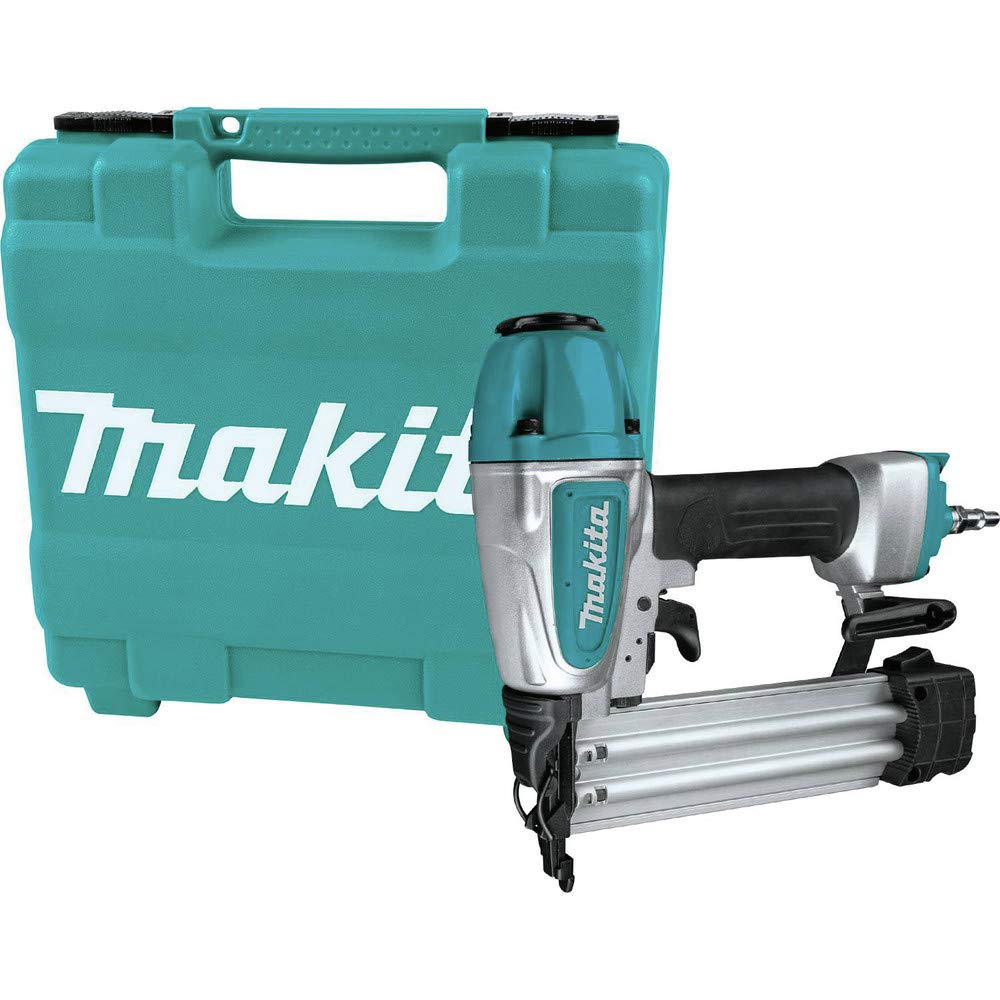
Makita AF506 18-Gauge Brad Nailer

94 /100
Kirk Score Outstanding
Weight
2.9 lb
Warranty
3-year limited
Air Duster
Built-in
Nail Length
5/8 to 2 in
Check Details on Amazon

Pros

  • Built-in air duster clears the work surface
  • Narrow nose reaches tight corners
  • Aluminum body keeps it to 2.9 lb
  • Complete kit with case and no-mar tips

Cons

  • Three-year warranty, shortest of the air tools here

There's a small nozzle on the front of the AF506 that blows compressed air across the surface you're working on, and it's the sort of feature you dismiss until you're setting baseboard over a floor you just swept and the drill chips keep landing exactly where the next nail goes. The aluminum body, magazine, and cylinder hold it to 2.9 pounds, and the nose is narrow enough to sit flat in a corner where a wider gun rocks off the wall.

We rate it the best of the pneumatics here for fitting work in tight spots, and the package backs that up: tool case, two no-mar tips, air fitting, pneumatic oil, and safety glasses, plus a three-year limited warranty. Depth is a tool-free dial, quicker to fine-tune mid-run than a stiff wheel, and the 5/8- to 2-inch range covers standard trim work.

Two things to know. It stops at 2-inch brads, so the long 2-1/8-inch fasteners the Bostitch accepts are out — check your assemblies before you commit. And on dense material, set the depth on an offcut first; get the dial right and the heads sit consistently below the surface. It sits in the middle of the price range, and it's the pneumatic for someone who does a bit of everything and values access over capacity.

Bottom line: For corners, closets, and work against a wall, we reach for the AF506: the narrow nose and built-in air duster make fiddly trim easier, and the kit is complete out of the box.

Check Latest Price
#05

Best Cordless Value

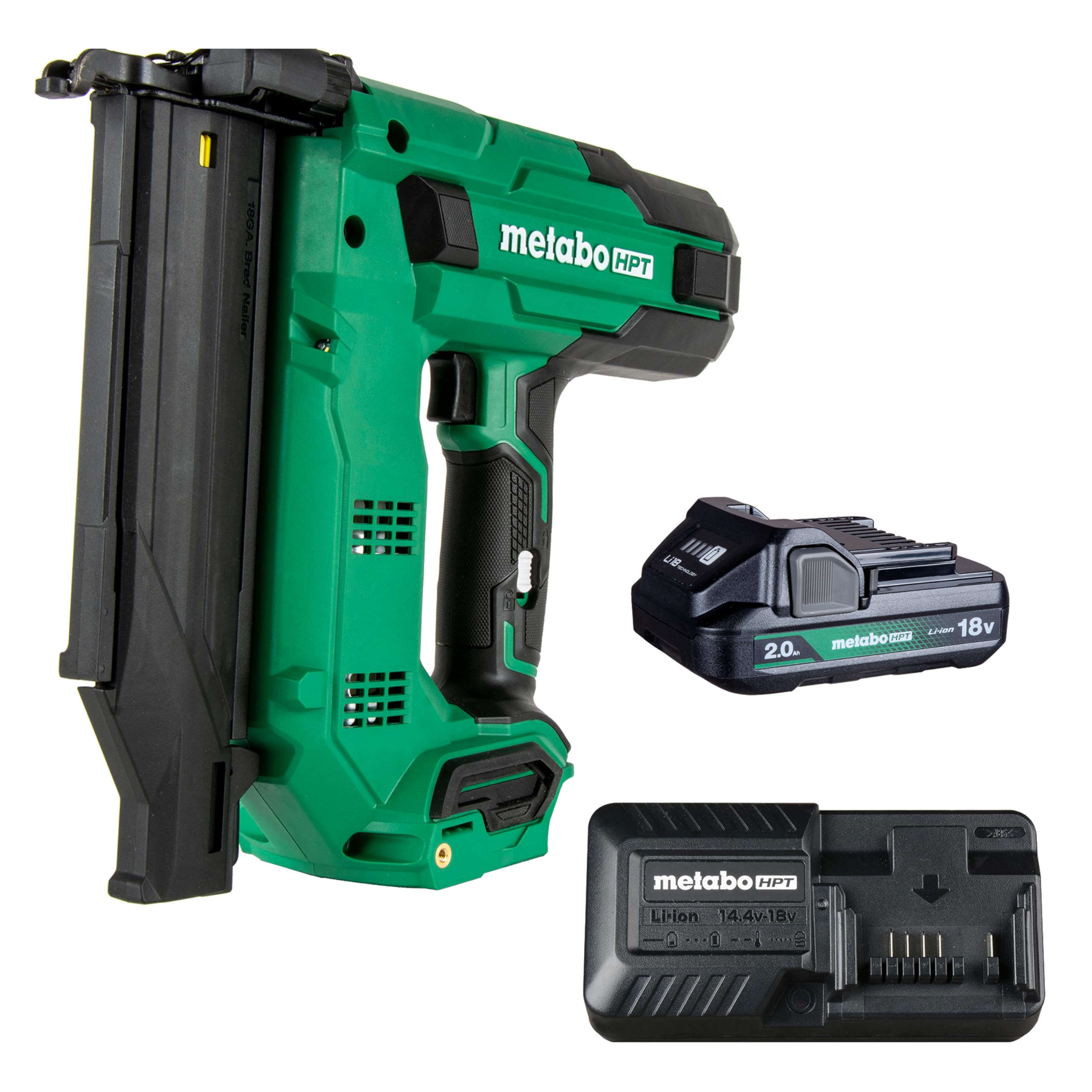
Metabo HPT NT1850DG Cordless Kit

92 /100
Kirk Score Outstanding
Weight
5.5 lb
Nail Length
5/8 to 2 in
Power Source
18V battery and charger included
Shots Per Charge
700
Check Details on Amazon

Pros

  • Battery and charger in the box
  • 700 nails per charge from a 2.0Ah pack
  • LED light and low center height

Cons

  • Won't always sink 2-inch brads in dense lumber
  • 5.5 lb, heavy at the top of a door frame

This is the cordless nailer for someone who wants to leave the compressor behind but can't justify premium-brand money. Metabo HPT sells the NT1850DG as a complete kit — 18-volt 2.0Ah battery, charger, no-mar nose caps, belt hook, safety glasses — at a price well below what the big cordless names charge for the tool alone.

The drive is a mechanical spring rather than the nitrogen cylinder Milwaukee uses, and the number that matters is 700 shots per charge from the 2.0Ah pack. That's enough baseboard for a medium-sized house on one battery, with a fuel gauge on the pack so you know where you stand before you climb the stairs. The center height is low, the nose is compact for tight spots, and the LED light earns its keep inside a cabinet.

Power is the trade-off and it's worth being straight about it: this nailer doesn't always bury a 2-inch brad in dense lumber at maximum depth. On pine casing and MDF it's fine. It's also 5.5 pounds, which you notice at the top of a door frame after the fourth or fifth one.

Where it lands for us is value: a complete cordless setup — battery, charger, case, hook — with build quality that holds up over long runs, for less than the bare-tool names. If your work is interior casings and panels and you want to stop dragging a hose through the house, this is the sensible spend.

Bottom line: The cordless pick for anyone who isn't already on a battery platform: battery, charger, and 700 shots per charge included, at a price below the bare premium tools.

Check Latest Price
#06

Best for M18 Owners

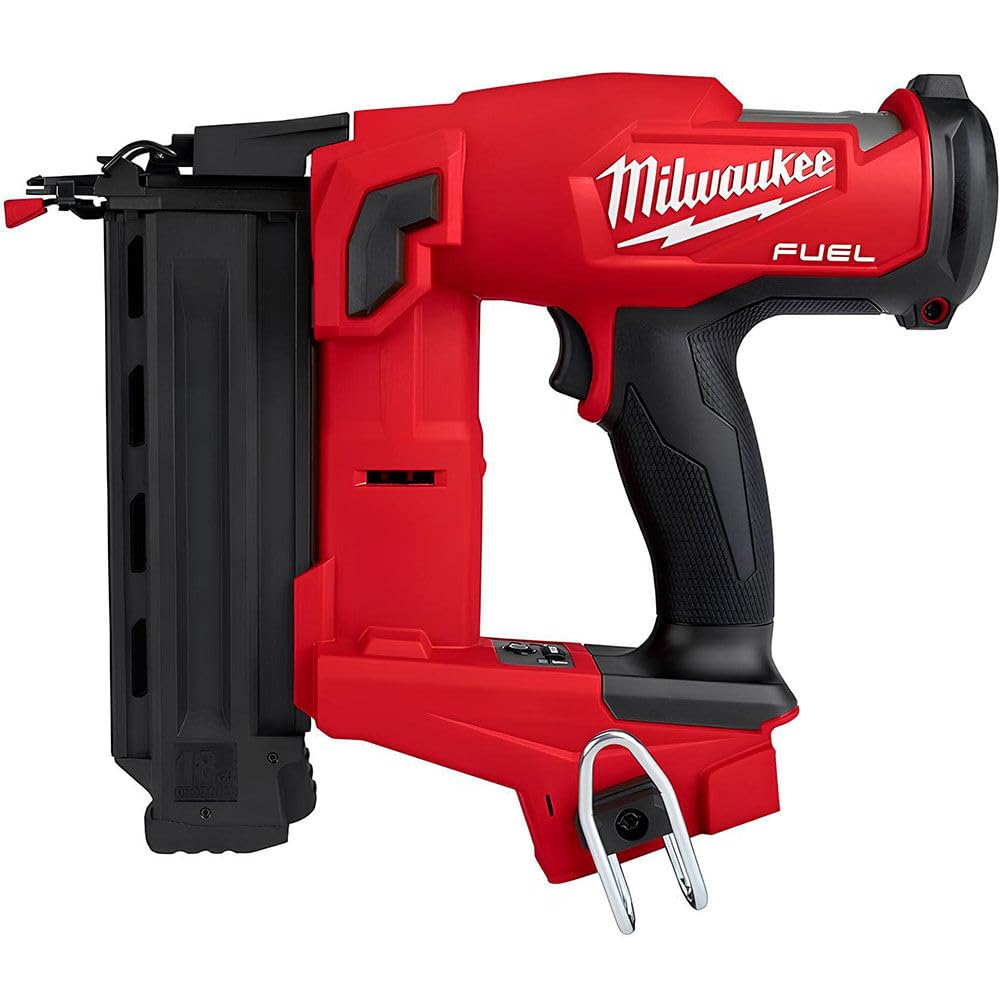
Milwaukee M18 Fuel 2746-20 Brad Nailer

90 /100
Kirk Score Outstanding
Drive
Nitrogen air spring
Weight
6.5 lb
Firing Modes
Sequential and contact
Power Source
M18 battery (tool only)
Check Details on Amazon

Pros

  • Zero ramp-up between shots
  • Sinks nails cleanly in hard and soft wood
  • Shares M18 batteries with other Milwaukee tools

Cons

  • Heaviest nailer here at 6.5 lb
  • No battery or charger in the box

Milwaukee's answer to the air hose is a nitrogen-filled cylinder in place of a spring or a flywheel, and what it buys is response: there's no ramp-up between nails, so the tool fires as fast as you can pull the trigger. For production trim — running casing around a whole floor without stopping — that rhythm is the difference between a nailer that keeps up and one that makes you wait.

Depth adjustment is tool-free, both firing modes are there, sequential for one-at-a-time control and contact for speed, and the POWERSTATE brushless motor and REDLINK electronics are the same hardware Milwaukee puts in the rest of its M18 Fuel line. An 8Ah pack runs a full day of finish work, which means one battery and one charger cover the nailer and everything else on the truck. Brads go in clean in hard and soft wood alike, with holes small enough to fill and forget.

It is 6.5 pounds, the heaviest nailer in this guide, and that is the honest cost of the mechanism. Crown molding overhead will wear on you in a way the 2.2-pound Metabo HPT won't. The tool is also sold bare — no battery, no charger — so the real cost is the nailer plus whatever packs you don't already own.

Which is precisely who this is for. If your truck already carries M18 packs and you do finish carpentry for a living, the 2746-20 is the brad nailer that keeps pace with your other tools and never asks you to buy into a second battery system. For one room of baseboard in your own house, the money is better spent lower down this list.

Bottom line: If your kit is already M18, this is the brad nailer to add: zero ramp-up and clean, consistent depth in hard and soft wood, at a weight you'll feel by the end of the day.

Check Latest Price
#07

First nailer

WEN 61723K Brad Nailer Kit

90 /100
Kirk Score Outstanding
Magazine
106-nail capacity
Nail Length
3/8 to 2 in
Air Pressure
60 to 115 PSI
Fasteners Included
2,000 assorted brads
Check Details on Amazon

Pros

  • Includes 2,000 brads and a carry case
  • Runs 3/8-inch brads for small work
  • Steel magazine and tool-free nose latch

Cons

  • Sampler brad pack; you'll still buy full boxes

Open the box and there are two thousand brads inside — five hundred each of 3/8-, 3/4-, 1-, and 2-inch — plus a carry case. For a first nailer that's the difference between buying a tool and buying a working setup: you can hang paneling the day it arrives without a separate trip for fasteners.

The gun itself is more capable than the price suggests. It's the only nailer here that runs 3/8-inch brads, which is the length you want for thin plywood, small trim returns, and craft work where a 5/8-inch brad would blow straight through. The magazine holds 106 nails, the exhaust rotates so it doesn't blow dust back in your face, and the nose latch flips open without tools when something jams. The magazine is steel rather than plastic — not something you can say for every budget nailer.

Two inches is the ceiling for fastener length, and it wants a compressor running 60 to 115 PSI. Neither is unusual at this level, but together they define the buyer: a homeowner or hobbyist who already has air, wants one box that covers trim and small assemblies, and won't miss the 2-1/8-inch capacity. We think that's a smart buy, and at the bottom of the price range an easy one to justify.

Bottom line: For a first nailer, the WEN kit is the simplest way in: 2,000 brads and a case in the box, and the only tool here that runs 3/8-inch fasteners for small work.

Check Latest Price
#08

ONE+ battery owners

Ryobi P321 Airstrike Brad Nailer

87 /100
Kirk Score Excellent
Weight
6 lb
Warranty
30-day limited
Power Source
18V ONE+ battery (tool only)
Check Details on Amazon

Pros

  • Runs on ONE+ batteries you already own
  • No compressor or hose needed
  • Simple depth and power adjustment

Cons

  • 30-day warranty, shortest in this guide
  • Bare tool; battery and charger sold separately

If you already own Ryobi ONE+ batteries, this is the cheapest way into cordless nailing — the bare tool costs less than most of the pneumatics here and needs no charger to get working. We'd call it the right first cordless nailer for a ONE+ household, and the wrong one for someone who needs a gun to run every working day.

For the money it's a genuinely usable trim gun. Baseboards, door casing, and paneling go in without a compressor, the depth and power adjustments are simple enough to set by eye on a scrap, and an afternoon of trim work fits inside a single charge. At six pounds it sits in the middle of the cordless field here, and the handle is comfortable enough that you're not readjusting your grip every few nails.

Two things hold it back. The warranty runs 30 days — by far the shortest coverage in this guide — which tells you Ryobi built this as a light-duty tool. It's also sold bare, so the price only makes sense if ONE+ packs are already on your shelf. For weekend remodeling around your own house both are manageable; for daily paid work they aren't.

Bottom line: For anyone already on the ONE+ platform, the P321 is the lowest-cost way to leave the compressor at home — a light-duty trim gun at a light-duty price.

Check Latest Price

How We Picked and Tested Brad Nailers

We built the shortlist from spec sheets and current listings for 18-gauge brad nailers, then filtered hard. A model had to drive the full 5/8-inch to 2-inch range, offer depth adjustment without hunting for a wrench, and be clear about whether it's a bare tool or a kit — a cordless body that needs a separate battery and charger isn't the same purchase as one that arrives ready to fire. That left 12, which we tested over six months.

The work happened where these tools actually live: 400 linear feet of baseboard and casing in a basement, a hallway of shoe molding, a set of shop-built cabinet face frames, and a cedar closet lined with quarter-inch paneling. Every model worked each scene. We counted jams per 100 nails and noted what it took to clear one — a flipped latch and an opened nose on most, a hex key on a few — then judged nail placement by eye against the pencil line and, afterward, by how much putty the hole needed.

We recorded weight with a battery loaded or a hose attached, because both change the balance once you're working overhead. Cordless models ran until the battery cut out; we counted shots and compared how the last twenty nails sank against the first twenty, which is where a few of them fell apart. Ease of use came down to small things — a nose narrow enough to see past, a magazine that loaded cleanly one-handed, a belt hook that didn't dig in — and value to what you had to buy before the first nail went in.

How to Choose a Brad Nailer

Air or Battery Sets the Real Cost

Pneumatic brad nailers are lighter, simpler, and cheaper to buy, and they'll run all day off a compressor that's already in your shop. The catch is the compressor itself: if you don't own one, a small compressor and hose can easily cost more than the nailer, and you'll be hauling both through the house. Cordless costs more up front and frequently ships as a bare tool, so budget for a pack and charger unless you're already inside that maker's battery system.

Decide by where the work happens. A basement shop with air gets a pneumatic every time; a finished second floor with carpet and furniture gets a cordless, because dragging a hose up a staircase costs more in time and scuffed paint than the tool saves.

Weight Matters Most Overhead

Trim work lives above your head, and a nailer's weight compounds with every nail. The range in this set runs from 2.2 pounds to 6.5, and the difference is obvious by the third length of crown molding. Pneumatics are the light option because the compressor carries the work; cordless tools carry their own battery, and the bigger the pack, the more you feel it at full extension.

If most of your work is casing, baseboard, and crown, favor the lighter tool and accept slightly less fastener capacity. If you're nailing paneling at chest height, weight barely registers and you can buy on other grounds.

The Nose Is Where Precision Lives

A brad nailer is aimed, not drilled, so the nose decides how accurate you are. A small nose — Bostitch calls its version Smart Point, DeWalt calls it a micro nose — lets you see the contact point on a narrow reveal and sit flat inside a corner. A bulky nose forces you to guess, and guessing on a finished piece of casing is expensive.

Depth control belongs in the same conversation. A tool-free dial you can nudge mid-run beats a wheel that needs a hex key, and on dense hardwood set the depth on an offcut before you commit to the face of the trim.

Fastener Range, Jams, and the Last Inch of a Strip

Most 18-gauge nailers take brads from 5/8 inch to 2 inches; a few go to 2-1/8. The extra eighth matters if you're nailing thicker assemblies, but two inches covers standard casing and baseboard.

Jams are usually a loading problem rather than a tool problem. Brads come in strips, and butting a fresh strip against the last few nails of an old one is the most common cause of a misfire — drop the partial strip out, load a full one, and keep good-quality brads in the magazine. A tool-free nose latch turns the occasional jam into a ten-second job instead of a bench visit.

Think Twice About 2-in-1 Nailer/Staplers

A combination gun that fires both 18-gauge brads and crown staples looks like twice the tool for the money, and it's a reasonable buy if you genuinely need staples for upholstery, house wrap, or crates. The compromise is at the nose: a driver wide enough to strike a staple leaves a wider mark than a brad head, and on finished trim that mark needs filling.

If your work is trim and light assembly, a dedicated brad nailer leaves a cleaner hole and is worth the narrower job description.

Frequently Asked Questions

Final Verdict

We'd buy the DeWalt DCN680B. It does exactly what this search is asking for — 18-gauge brads into casing, baseboard, and paneling — without a compressor, a hose, or gas cartridges, and its weight is the only real tax on that freedom.

If there's already a compressor in your shop, the Bostitch BTFP12233 is the better buy: a narrower nose, a longer warranty, and enough savings left over to fill a drawer with brads. Those two cover most buyers; the rest of this list exists for the cases they don't.