// data-verified

Best Table Saw Blades of 2026

The blade that ships with a new table saw is a placeholder. It will get you through a first project, but it dulls quickly, burns its way through hard maple, and leaves fuzz on the edge of every crosscut. Put a real blade on that same saw and the machine feels like a different tool — smoother feed, cooler cuts, joints that close without a fight.

Blades are also where a lot of shoppers spend in the wrong direction. More teeth isn't automatically better, thin kerf isn't a gimmick, and a bargain blade that's razor sharp out of the box can go dull in a single weekend of oak. Over the past six months, my team and I ran 12 blades through rip cuts, crosscuts, and sheet goods, watching for burn marks, tearout, and how much vibration each one sent through the table.

Which one belongs on your arbor depends on what you cut most — a low-tooth ripper for thick stock, a high-tooth combination blade if you'd rather not swap every time the job changes. These are the ones that earned a hook on the wall.

#01

Best Overall

Diablo D1050X 50-Tooth Combination

96 /100
Kirk Score Outstanding
Kerf
0.098 in
Arbor
5/8 in
Teeth
50
Diameter
10 in
Check Details on Amazon

Pros

  • Rips and crosscuts on one arbor
  • Edges need barely any sanding
  • Runs smooth and quiet, without wobble
  • Non-stick coating wipes clean

Cons

  • Neither the fastest rip nor the finest crosscut

Fifty teeth in a 15-degree ATB grind is the number that makes this blade worth leaving on the arbor. There are enough of them to shear a crosscut clean, and the .098-inch kerf with that hook angle still lets the blade rip a board without turning the cut into a wrestling match. That balance is the whole argument for a combination blade.

What we kept noticing was how little the saw complained. The .071-inch plate and its laser-cut expansion slots run smooth and quiet, and the Perma-Shield coating wipes clean instead of letting pitch bake onto the teeth. In hardwood and plywood the edges came off needing a light pass with a sanding block rather than a belt sander, which is what we ask of the blade that stays mounted.

Scorching is the one thing to manage, and it behaves like a feed-rate problem rather than a blade defect. Stalled in the cut, or pushed through damp pressure-treated stock, this blade will leave a burn that a steadier pass would not. Keep the feed moving, clean the coating when it gums up, and it stays a clean cutter.

Against the rest of this group it sits in the middle by design. The CMT has the heavier plate for sheet goods, and the two Freud rip blades beat it at their single job. What none of them do is cover a Saturday's worth of cuts without a swap, and that is worth more than a tenth of an inch of kerf.

Bottom line: The blade we leave on the saw: it rips, it crosscuts, and it leaves an edge that needs almost no sanding, so most home shops can stop swapping blades.

Check Latest Price
#02

Best for Ripping

Freud LU87R010 24-Tooth Rip

95 /100
Kirk Score Outstanding
Kerf
0.094 in
Teeth
24
Diameter
10 in
Tooth Grind
Flat
Check Details on Amazon

Pros

  • Feeds thick hardwood without stalling the saw
  • Straight rip edges with almost no burn
  • Thin kerf saves stock and motor load

Cons

  • Rip-only grind is wrong for crosscuts and sheet goods

This is the blade for the saw that is smaller than the wood. A 24-tooth flat-top grind with a 20-degree hook angle and a .094-inch kerf clears thick hardwood quickly, and the thin plate asks so little of the motor that a 1-hp contractor saw stops bogging down in 8/4 stock. We reach for it before resawing anything.

The rips come off straight and cool. Freud's ripping blend of carbide and the Perma-Shield coating hold an edge through oak and ash without the burn marks a tired general-purpose blade leaves, and the flat teeth produce a surface close to glue-ready on the first pass.

One thing to watch: at .071 inch the plate is thin, and in a tall resaw cut it can flex and leave a stepped kerf. A blade stabilizer, or a slower feed through the deep cuts, keeps it running true. On ordinary 4/4 stock you will never notice the difference.

Bottom line: Buy this one if your saw is small and your stock is thick, since 24 flat-top teeth clear hardwood fast and the thin kerf spares the motor.

Check Latest Price
#03

Best Budget Fine-Finish

WEN BL1060 60-Tooth Fine-Finish

94 /100
Kirk Score Outstanding
Kerf
1/10 in
Arbor
5/8 in
Teeth
60
Diameter
10 in
Check Details on Amazon

Pros

  • Clean finish with almost no sanding
  • Thin kerf suits a low-power saw
  • A fraction of what the premium blades here cost

Cons

  • Edge life falls short of the premium blades here

Nothing else on this page asks so little for a finish cut. Sixty carbide teeth on a 10-inch plate, a 5/8-inch arbor, a 6,000 RPM rating and a kerf that measures a tenth of an inch. The spec sheet reads like a blade from a much more expensive drawer.

Sixty teeth is the trim-and-plywood count, and it behaves like one. Casing and baseboard come off with clean shoulders, cabinet-grade plywood shows very little tearout on the underside, and the thin kerf is kind to a jobsite saw that does not have power to spare.

Where this blade earns its place is in the difference between a rough cut and a finished one. A saw that has been fighting a general-purpose blade suddenly looks like a better machine. At this money that is a serious upgrade, and we would spend it before we spent anything on the saw itself.

Sixty teeth also want a light feed. Push this through 8/4 maple and it will heat up, slow down and burn, so leave the thick ripping to WEN's 40-tooth blade on this page. Trim, sheet goods and crosscuts are where it belongs.

Bottom line: Our budget answer for trim and plywood: 60 teeth leave paint-ready edges, and the thin kerf suits a saw with little power to spare.

Check Latest Price
#04

Best Two-Blade Set

DEWALT DW3106P5 2-Blade Combo

96 /100
Kirk Score Outstanding
Arbor
5/8 in
Teeth
32 and 60
Blades
Two
Diameter
10 in
Check Details on Amazon

Pros

  • Two blades cover ripping and finish cuts
  • Thin kerf is easy on a small motor
  • The 60-tooth also fits a 10-inch miter saw

Cons

  • The 32-tooth blade can arrive warped

Two blades arrive in the pack, and the split is the sensible one. Thirty-two teeth for ripping and rough crosscuts, 60 teeth for trim, plywood and anything that will show. Both are thin kerf, both run a 5/8-inch arbor, and the computer-balanced plate is there to keep vibration out of the cut.

We found the pair covers more ground than any single blade here. The 60-tooth does finish work that would leave a 40-tooth blade sanding for an hour, and the 32-tooth gets through framing lumber without complaint. The cost is the swap between jobs, which takes a minute and buys you two blades doing two jobs properly instead of one doing both badly.

Before you mount the 32-tooth blade, lay it flat on a straightedge. A warp shows up as a wobble you can see by eye, and flat it rips well. The 60-tooth also fits a 10-inch miter saw, so the spare earns its keep on two machines.

Bottom line: Two blades beat one for a small shop, and this pair splits the work sensibly: 32 teeth to rip, 60 to finish.

Check Latest Price
#05

Best for Plywood and Cabinet Work

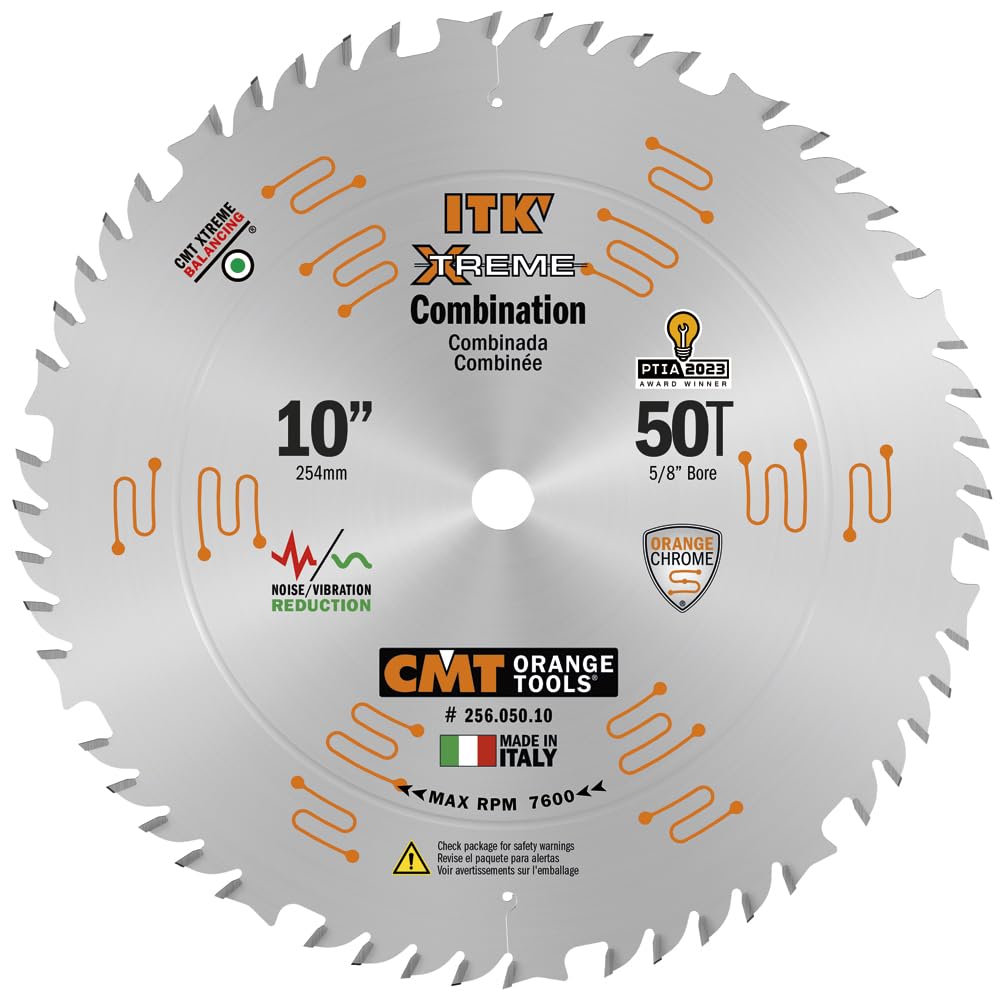
CMT 256.050.10 50-Tooth Combination

94 /100
Kirk Score Outstanding
Kerf
0.102 in
Plate
0.071 in
Teeth
50
Diameter
10 in
Check Details on Amazon

Pros

  • Clean faces on veneered plywood
  • Heavy plate runs true and quiet
  • Holds an edge through hardwood

Cons

  • Wider kerf loads a low-power saw harder
  • Costs more than the budget blades here

Set next to the Diablo combination blade, this CMT is the heavier, quieter tool. The plate measures .071 inch and the kerf .102 inch, wider than the thin-kerf blades here, and that extra steel and carbide is exactly why it runs so true through a sheet of veneered plywood.

Fifty teeth in an ATB grind with a flat raker does general-purpose work to a high standard. Three-quarter and half-inch plywood crosscuts come off clean on both faces, red oak goes through without bogging a mid-size motor, and the edge held up longer than we expected. It is also noticeably quieter than a thin, whippy plate, which matters in a basement shop.

The wider kerf is the cost. On a genuinely underpowered saw, or in thick hardwood, a thin-kerf blade will feel easier and leave you more stock at the end of the cut. For cabinets and sheet goods, where clean faces matter more than feed pressure, that stiffness is the reason to pay for it.

Bottom line: Pick the CMT when your work is cabinets and veneered plywood; the heavier plate and 50 teeth leave sheet goods clean and run quiet doing it.

Check Latest Price
#06

Best for Glue-Line Rips

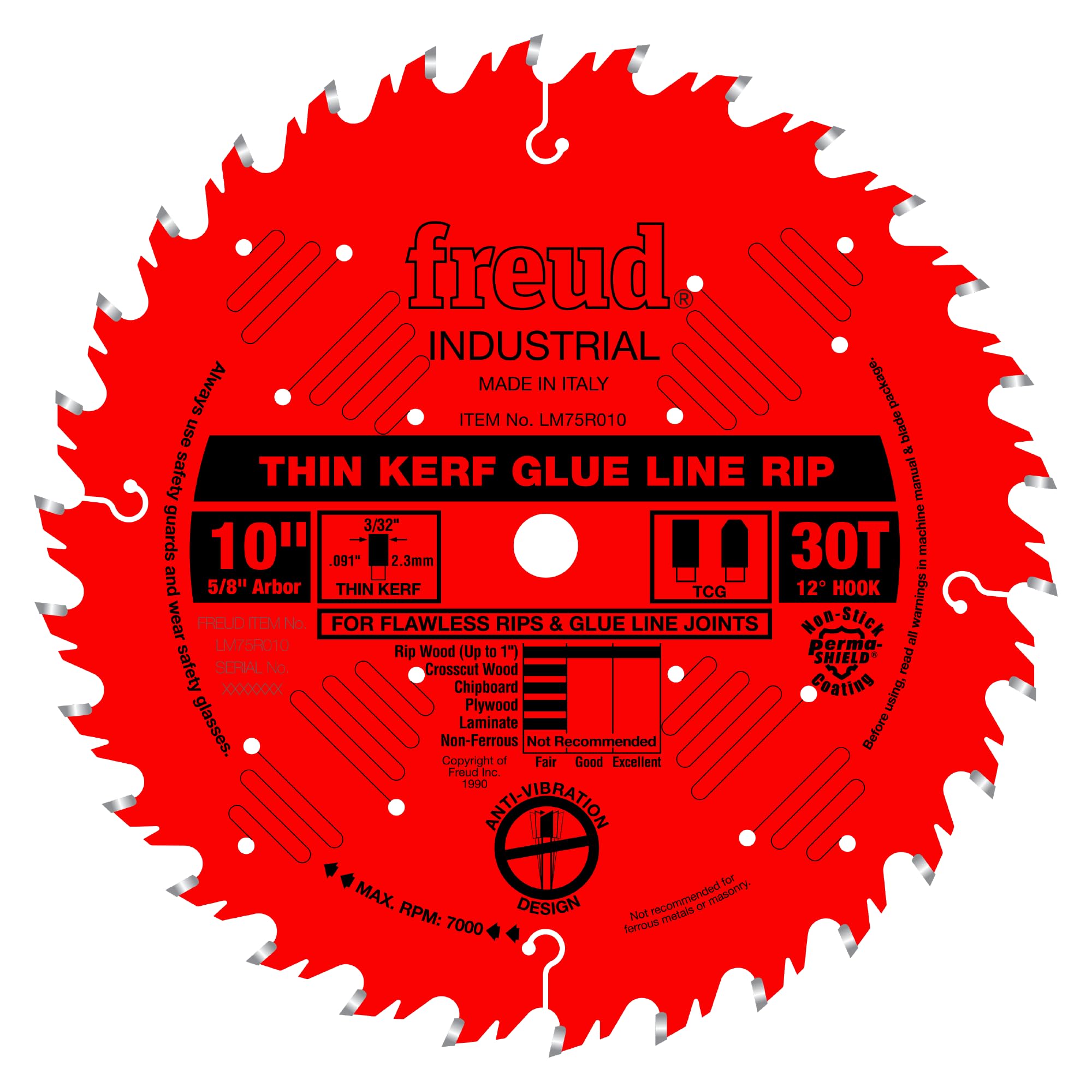
Freud LM75R010 Glue-Line Rip

94 /100
Kirk Score Outstanding
Kerf
0.091 in
Teeth
30
Diameter
10 in
Tooth Grind
TCG
Check Details on Amazon

Pros

  • Rip edges come off ready to glue
  • Runs cool, with no burn in hardwood
  • Thin kerf works on a 1-hp motor

Cons

  • Premium price for a single-purpose blade

A glue-line blade makes a promise you can check with two boards and a clamp. Thirty teeth in a triple-chip grind, a 12-degree hook angle and a .091-inch kerf describe a blade built to leave an edge flat enough to glue without a pass over the jointer.

In maple and oak the rip edges came off flat and burn-free, and the laser-cut anti-vibration slots keep the cut quiet. The 12-degree hook is doing the invisible work: it pulls stock through steadily instead of snatching at it, which is why the blade behaves on a 1-hp motor that would struggle with a more aggressive rip blade.

It is not a blade to leave mounted. Thirty triple-chip teeth will not crosscut worth a darn and will chip veneered plywood, and the thin plate wants a stabilizer once you are into deep cuts in tall stock. Change blades for sheet goods. That is not a compromise, it is the job.

What you pay for is the step it removes. If you build panels, boxes and furniture that go together straight off the saw, skipping the jointer on every rip edge is worth the premium several times over. If you mostly break down construction lumber, the 24-tooth Freud on this page is the faster and more forgiving choice.

Bottom line: For panel work where the rip edge goes straight to glue, nothing else here comes as close, since the triple-chip grind leaves a joint-ready surface.

Check Latest Price
#07

Jobsite spares

WEN BL1040 40-Tooth General-Purpose

94 /100
Kirk Score Outstanding
Kerf
1/10 in
Arbor
5/8 in
Teeth
40
Diameter
10 in
Check Details on Amazon

Pros

  • Cuts clean while the edge is fresh
  • Cheap enough to replace instead of sharpen
  • Thin kerf suits a small saw

Cons

  • Dulls faster than the premium blades here

Forty teeth is the count that sits between a rip blade and a finish blade, and at this price that middle ground is the whole point. Ten-inch plate, 5/8-inch arbor, a tenth-inch kerf, 6,000 RPM. The same fit as everything else here, for the least money on the page.

Fresh out of the wrapper it cuts clean. Softwood and plywood came through without splintering, hardwood flooring went down without chipping its edges, and the thin kerf is easy on a saw with little motor to spare. It is the blade for decking, framing and jobsite work where a hidden fastener might be waiting to take a tooth off.

We treat this one as a consumable, and that is not a criticism. A fresh blade at this money costs less than having a tired one ground, so the sensible move is to keep one on the shelf and swap it in. The blade you use for finish work deserves better carbide; this is the one you use when the wood might be hiding a nail.

Bottom line: The one to keep as a spare: it cuts clean while fresh, costs little enough to replace rather than sharpen, and handles lumber you would not feed a good blade.

Check Latest Price

How We Tested Table Saw Blades

We started with research rather than a shopping cart, filtering 10-inch blades by arbor size, kerf, tooth count, and hook angle, then checking each listing's numbers against what a contractor or cabinet saw would actually ask of it. Price mattered, but only as half of a value calculation — a blade that costs twice as much and lasts four times as long is the cheaper blade by the end of the year. Twelve made the cut and spent six months on my saw and a friend's.

Testing followed the work, not a lab bench. I ripped 8/4 hard maple and walnut, crosscut white oak for rails and stiles, broke down plywood, and ran the finer blades on a miter saw for trim. Out of the box we checked each plate for flatness and listened for wobble on startup, then after every session looked for burn marks on the cut, fuzz on the offcut, and whether two jointed edges could be glued straight off the saw.

For sharpness and durability, I kept a running count of linear feet each blade cut before it started fighting back — slowing the feed, scorching, or needing extra pressure to push through. Vibration got its own attention: I watched for offcuts creeping away from the fence mid-rip, felt for shimmy through the table, and listened for the motor bogging in thick stock, which usually means the blade is asking for more power than the saw has to give.

How to Choose a Table Saw Blade

Tooth Count Decides the Job

Twenty-four to thirty teeth clear waste fast and belong to ripping. Forty to fifty is the combination range that will rip and crosscut acceptably. Sixty and up is trim, plywood and anything with a face you will look at. Buy the count for the cut you make most, not the one you make once a year.

If you will own one blade, buy in the combination range; the Diablo stays mounted here for exactly that reason. If you will own two, a 24-tooth rip blade plus a 60-tooth finish blade covers more ground than any single 40-tooth compromise, which is the logic behind the DEWALT pair.

Thin Kerf or Full Kerf

The kerf is the width of the slot the blade cuts, and it is the number that decides how hard your saw has to work. Thin-kerf blades run around .09 to .10 inch: they waste less stock and let a low-power jobsite saw cut thick hardwood without stalling, which is what the Freud rip blades are built around. A wider plate, like the CMT at .102 inch, is stiffer and runs truer in deep cuts.

If you resaw or work 8/4 hardwood regularly, favor the heavier plate, or add a stabilizer to a thin one. If your saw is small and your stock is thick, thin kerf is the more useful kind of compromise.

Check Arbor, RPM and Riving Knife First

Most U.S. table saws take a 10-inch blade on a 5/8-inch arbor, so fit is rarely the surprise; the ratings on the nameplate are. The blade's maximum RPM has to be at least the saw's no-load speed, and a 6,000 or 7,000 RPM rating covers most of them. Compare the kerf to your riving knife as well: a knife noticeably thicker than a thin-kerf blade will bind in the cut.

Read the Grind Before You Buy

Flat-top teeth chisel straight across the bottom of a rip and clear waste quickly; alternate top bevel teeth score the edges of a crosscut and leave a cleaner face; triple-chip teeth handle laminates and abrasive stock without chipping. The Freud rip blade here is flat-top, the CMT is an ATB grind with a flat raker, and the Freud glue-line blade is triple-chip.

Pick the grind for the material you cut most and accept that the rest of the work will come off rougher.

Frequently Asked Questions

Final Verdict

If we were buying one blade for a home table saw, it would be the Diablo D1050X. Fifty teeth let it rip and crosscut without a swap, and the edges come off clean enough that sanding becomes a formality.

Two situations change the answer. If you rip thick hardwood on a modest saw, the Freud LU87R010 makes that work feel easy. If your saw mostly makes trim and plywood cuts, the WEN BL1060 does it for very little money.