// data-verified

Best Circular Saw Blades of 2026

A circular saw blade is a compromise you make before you squeeze the trigger. More teeth leave a smoother edge but cut slower; fewer teeth rip through framing lumber fast and clear chips while they do it. I keep a 24-tooth on the saw for deck boards and swap to a 40-tooth for plywood shelving and trim, and that one habit has saved me more re-cuts than any jig I own.

The trouble is that blade quality stays invisible until it doesn't. A cheap blade cuts beautifully through a dozen feet of pine, then starts burning its way across oak and dragging your saw's motor down with it, and by then you're mid-project. Over the past four months, my team and I ran 16 blades through framing lumber, plywood, melamine, and composite decking — plus a couple of boards with buried nails — and the pattern was consistent: the ones worth buying stayed sharp and stayed flat.

What separated them was never the sticker on the package. It came down to how the carbide held its edge and whether the plate was still true after a few weeks in a tool bag, and the blades below are the ones I'd put back on my own saw without thinking about it.

#01

Best Overall

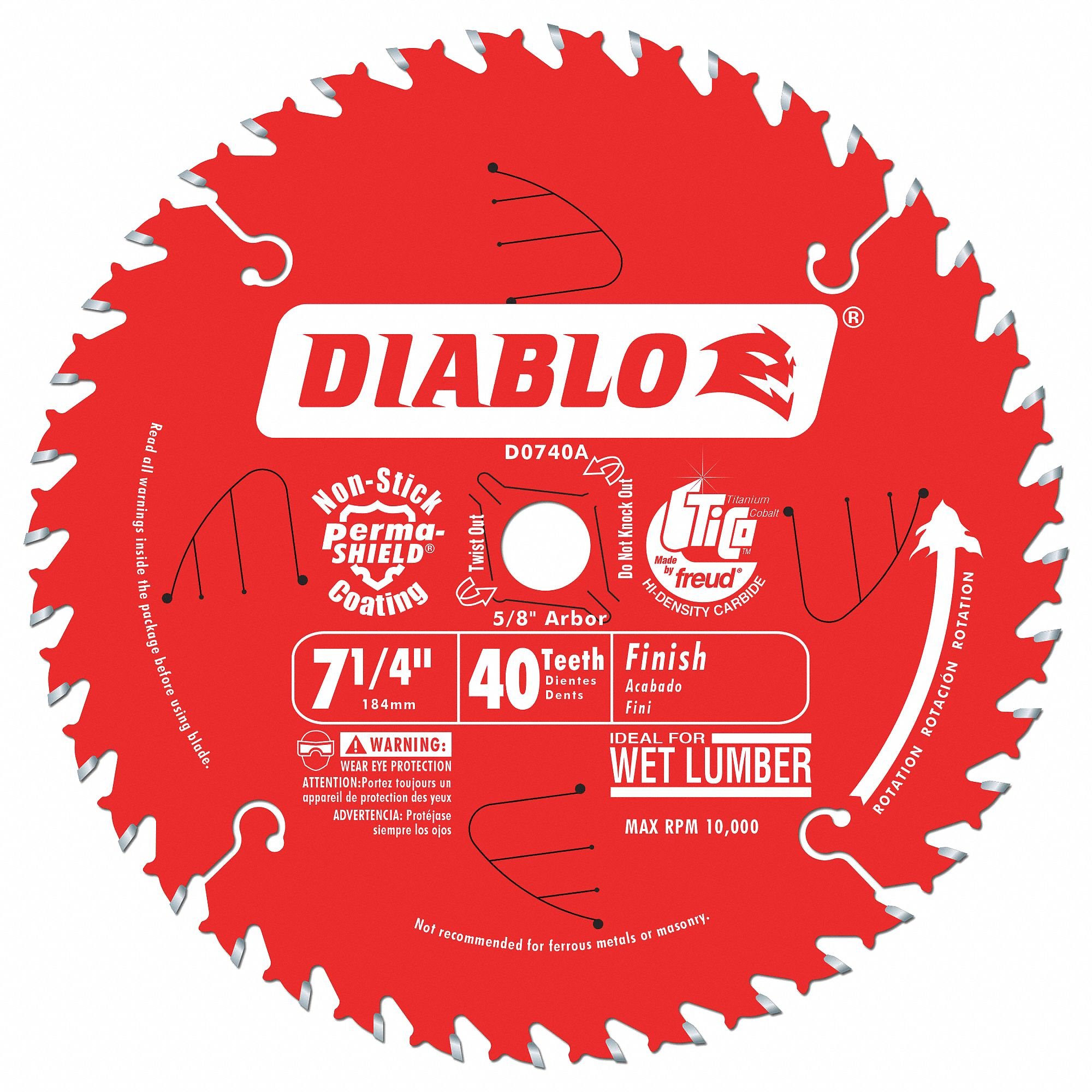
Diablo 7-1/4 in. 40-Tooth Finish Blade

96 /100
Kirk Score Outstanding
Arbor
5/8 in. with diamond knockout
Teeth
40 ATB
Diameter
7-1/4 in.
Max Speed
8,000 RPM
Check Details on Amazon

Pros

  • Splinter-free crosscuts in plywood and trim
  • Thin 0.09 in. plate keeps the saw moving
  • Anti-stick coating sheds pitch and sap
  • Fits round and diamond-knockout arbors

Cons

  • Finish grind, not for nail-heavy demolition lumber

Crosscut a sheet of plywood with the blade that came in the box and you get a fuzzy edge that needs a sanding block. Swap in this 40-tooth Diablo and the same saw leaves an edge you can install. That swap is the entire argument for owning a second blade, and it's why this is the one we recommend first to anyone with a 7-1/4-inch saw.

Forty teeth in an alternate-top-bevel grind slice wood fibers instead of tearing them, which is the difference you see on veneered plywood, melamine, and trim. The plate is thin at 0.09 inch, and we appreciate that on a saw already working hard in thick stock: less steel in the kerf means less drag on the motor and a faster feed. The Perma-Shield coating is a small thing that becomes a bigger one over a season, because pitch and sap wipe off instead of baking on, and a clean blade runs cooler.

Fit is where a lot of blade purchases go wrong, and this one covers the common setups: a 5/8-inch arbor with a diamond knockout, so it seats on saws with a round arbor shoulder and on the diamond-shaped ones. It's rated to 8,000 RPM, which you should check against the no-load speed printed on your saw before mounting anything.

What it won't do is demolition. Forty teeth in lumber full of nails or wet 4x4 posts is the wrong tool, and you'll chip teeth and slow yourself down proving it. Keep a 24-tooth blade for that work and this one for everything that shows.

Bottom line: This is the blade we tell friends to buy for a 7-1/4-inch saw: 40 teeth, a thin kerf, and edges that need no sanding.

Check Latest Price
#02

Best for Compact Saws

DEWALT 6-1/2 in. 18T/24T Combo Pack

95 /100
Kirk Score Outstanding
Kerf
Thin kerf
Teeth
18 and 24, two blades
Carbide
High-density tungsten carbide
Diameter
6-1/2 in.
Check Details on Amazon

Pros

  • Two blades: 18T for fast rips, 24T for crosscuts
  • Reinforced shoulders shrug off nail hits
  • Thin kerf and anti-stick coating run cool

Cons

  • 6-1/2-inch only, no use on full-size saws
  • 18-tooth blade leaves a rough, splintery edge

Two blades in one pack is a small idea that fixes a real annoyance: 18 teeth for fast rips and rough framing, 24 for crosscuts, and neither pretending to do the other's job. If your saw takes 6-1/2-inch blades, this kit gets you through most of a weekend's work without a trip back to the store.

We reach for the 24-tooth first. It's the generalist, and in 2x material it leaves an edge clean enough for framing and decking. The 18-tooth is the one that changes how the saw feels: bigger gullets clear chips faster, so a pressure-treated 2x8 rips without the motor laboring. Both blades carry DEWALT's reinforced shoulder behind the carbide, which is the detail that matters when you're cutting pallets or reclaimed lumber with hidden nails.

Thin kerf and the Tough Coat finish do the same job they do on any good blade here: less material removed, less friction, cooler running, and a cordless saw that finishes the cut. The pair weighs about 11-1/2 ounces, so there's no penalty in the tool bag.

The limit is diameter. Six and a half inches is compact-saw territory, and this won't go near a full-size 7-1/4-inch saw. DEWALT lists it for its own saws, so match the arbor against your manual before ordering, because the blade can't tell you whether it fits.

Bottom line: If your saw takes 6-1/2-inch blades, this pair covers rough rips and everyday crosscuts and keeps a spare in the case.

Check Latest Price
#03

Best Everyday 24-Tooth Blade

DEWALT 7-1/4 in. 24-Tooth Blade

95 /100
Kirk Score Outstanding
Kerf
Thin kerf
Teeth
24
Diameter
7-1/4 in.
Tooth Shoulder
Reinforced for nail-embedded wood
Check Details on Amazon

Pros

  • Cuts 2x lumber and sheathing fast
  • Reinforced shoulder survives nail hits
  • Thin kerf suits cordless saws

Cons

  • 24 teeth leave tear-out in plywood veneer

Twenty-four teeth is the count that comes on most new 7-1/4-inch saws, and there's a reason for it: enough speed in framing lumber, not so rough that every cut needs cleaning up. This DEWALT is a direct replacement for that blade, built sturdier than the one in the box.

The reinforced shoulder behind each carbide tip is the part worth paying for. Cutting reclaimed lumber, or a pallet with a hidden nail, is where a blade earns or loses its place in the shop, and the extra braze material buys margin before a tip chips and the cut goes ragged.

Where this one earns its spot in the group is simplicity. The kerf is thin enough to keep a cordless saw moving, the anti-stick coating keeps pitch from building up, and at 9 ounces it adds nothing noticeable to the tool. Put it on, cut 2x stock and sheathing, and stop thinking about it.

It is still a 24-tooth blade, so plywood veneer and finish trim will show tear-out along the cut. That's the tooth count doing its job rather than a flaw, and if the edge is going to be seen, this isn't the blade for it.

Bottom line: A sensible one-blade answer for framing, sheathing, and pallet lumber on a full-size saw, as long as clean plywood edges aren't the goal.

Check Latest Price
#04

Best Budget Multi-Pack

Revvstark 6-1/2 in. 24T 10-Pack

93 /100
Kirk Score Outstanding
Arbor
5/8 in. (15.8 mm)
Teeth
24
Blades
10
Diameter
6-1/2 in. (165 mm)
Check Details on Amazon

Pros

  • Ten blades at a low per-blade cost
  • Thin laser-cut kerf cuts fast on cordless saws
  • Noise-reducing perforations and anti-kickback teeth

Cons

  • 24-tooth only, so no finish cuts
  • Dulls faster than premium carbide

Ten blades in one box changes how you treat a saw. When a fresh one is sitting in the case, you stop coaxing a dull blade through one more cut, and that habit alone is worth something.

The arithmetic is the real appeal. Per blade, these cost a fraction of what a premium single does, and they hold up better than that suggests: the 24-tooth grind took pressure-treated 2x and composite decking without chip-out in our cuts, with the thin laser-cut kerf keeping a battery saw from bogging down. Diameter, arbor, and speed are all spelled out at 6-1/2 inches, 5/8 inch, and 8,000 RPM, which are the first three things to check on any budget blade.

Each blade gets noise-reducing perforations and an anti-kickback tooth design, details that matter more on a light saw than on a worm drive. What the box doesn't have is a finish blade, since there's no 40- or 60-tooth option, so trim, melamine, and cabinet work still need a second purchase.

The honest trade is edge life. These go dull faster than premium carbide, and you feel it as burning and a slower feed before any tooth chips. For a crew working through decking and fencing, that's a fair exchange. For someone cutting a few boards a month, one good blade will outlast the whole pack.

Bottom line: Buy the ten-pack if you go through blades on decks, fences, and framing; the low cost per blade makes reaching for a fresh one easy.

Check Latest Price
#05

High-volume framing

Diablo 7-1/4 in. 24T 10-Pack

93 /100
Kirk Score Outstanding
Kerf
.059 in.
Teeth
24
Blades
10
Diameter
7-1/4 in.
Check Details on Amazon

Pros

  • Ten-blade pack brings the per-blade cost down
  • Thin .059 in. kerf suits cordless saws
  • Stabilizer vents and tracking tooth hold a line

Cons

  • Locks you into a single tooth count

Ten blades in one purchase is a commitment, and this pack earns it: a .059-inch kerf, laser-cut stabilizer vents, and a tracking-point tooth that Diablo builds for straight cuts under load. For someone framing a shed or decking a porch, it's the cheapest way to keep a sharp 24-tooth on the saw all season.

The .040-inch plate is what matters on cordless tools. Less steel in the cut means less drag, and Diablo's own figure for these blades is up to 30% more cuts per charge. Even allowing for some marketing in that number, a thin plate on a battery saw is the right call for a long day of crosscutting.

The tracking-point tooth sits at the front of the sequence and scores the outside corner of the kerf before the rest of the teeth follow, which is Diablo's answer to the wander a thin blade shows at speed. The stabilizer vents handle the other half, breaking up the vibration that makes a thin plate ring and drift in deep cuts.

What you give up is variety. Ten blades in one tooth count means you're set for framing and rough crosscuts and nothing else, so plywood, melamine, and trim still want a 40-tooth blade alongside the pack. Buy it for volume, not for range.

Bottom line: For deck builds, framing, and crews that burn through 24-tooth blades, buying ten at once is the sensible way to do it.

Check Latest Price

How We Tested: 16 Blades, Four Months, One Very Full Cutoff Bin

The shortlist started with every 6-1/2- and 7-1/4-inch blade we could find running a 5/8-inch arbor, then got filtered by tooth count (18, 24, and 40), carbide type, and price per blade. We priced multi-packs per blade rather than per pack, since a five- or ten-pack changes the value math considerably for anyone who dulls blades regularly. That left 16 blades, which we used for four months.

Testing happened where blades actually live: sawhorses in a driveway, a garage shop, and a half-built deck. Each blade crosscut 2x4s and 2x10s, ripped 3/4-inch plywood, and trimmed melamine shelving, run on both a corded 7-1/4-inch saw and a smaller cordless 6-1/2-inch one so we could see how each handled less torque.

On the first cut, we watched whether the blade tracked straight or wandered, and whether plywood veneer tore out at the exit edge. Sharpness was judged by feel as much as by eye — how much forward pressure a blade needed by its twentieth crosscut in pressure-treated lumber, and whether cuts started smoking or scorching. Every plate got checked against a straightedge out of the box and again after a month of riding around in a tool bag.

Durability took the longest to assess. We kept cutting until a blade noticeably slowed us down, and we deliberately ran a few through reclaimed boards with buried nails to see how the teeth held up. At the end we weighed what each blade cost against how many clean cuts it delivered — the number that actually decides whether a cheap blade is a bargain or a false economy.

How to Choose a Circular Saw Blade

Fit first: diameter, arbor, and RPM

Diameter is a hard limit. A 7-1/4-inch blade will not fit a 6-1/2-inch saw, and dropping a smaller blade into a full-size saw costs you depth of cut. Arbor size and shape are the second gate: the full-size blades here run a 5/8-inch arbor, and the Diablo D0740A adds a diamond knockout so it seats on saws with either a round arbor shoulder or a diamond-shaped one.

Then compare the blade's maximum RPM with the no-load speed printed on your saw's label. A blade rated below the saw's speed is a hazard, not an inconvenience, and 8,000 RPM covers the blades in this group comfortably.

Match tooth count to the cut

Twenty-four teeth clear chips fast and suit framing lumber, sheathing, and pallets. Forty teeth leave a crosscut clean enough to install. Sixty teeth and up is trim and veneer territory. The counterintuitive part is that more teeth means a slower, hotter cut, so a fine blade pushed through wet 2x4s will burn and gum long before it dulls.

A two-blade kit such as the DEWALT 18T/24T pair covers rough and general work in one purchase. Add a 40-tooth finish blade and most home projects are handled without another trip.

Kerf, plate, and how a thin blade behaves

Kerf is the width of the slot the blade cuts; plate is the steel behind the teeth. Thin kerf, roughly .059 to .09 inch on these blades, removes less material, so the saw works less and a cordless battery lasts longer — the Diablo framing pack is built around exactly that trade.

The cost is stability. A thin plate has less meat to hold it steady in a deep cut, so let the blade set its own pace instead of pushing. Fed steadily, a thin kerf tracks as true as a full one and leaves you more cuts per charge.

Carbide, brazing, and what a blade survives

Two things separate a blade that lasts from one that doesn't: the grade of carbide and how the tip is attached. Hi-density carbide holds an edge longer, and tri-metal or reinforced-shoulder brazing keeps tips on the blade when you clip a nail.

No wood blade enjoys nail-embedded lumber, but the reinforced-shoulder designs here, both DEWALTs and the Diablo framing blades, are built with that in mind. Dropping a blade on concrete is the other classic killer: carbide chips long before steel bends.

Singles, pairs, and ten-packs

One blade is enough if you cut occasionally and want the best edge for the money. A pair makes sense when your work spans rough and general cutting. A ten-pack only pays off if you genuinely go through blades — decking, fencing, framing, more than one pair of hands.

What a bulk pack never does is replace a finish blade. Ten 24-tooth blades will frame a shed and still tear plywood veneer, so budget for one good 40-tooth alongside the pack and stop fighting tear-out.

Frequently Asked Questions

Final Verdict

The Diablo D0740A is the blade we point to first because it upgrades the saw most people already own: a 40-tooth finish grind that turns a ragged crosscut into an edge ready to install, on a thin plate that doesn't slow the motor down.

If your saw is a 6-1/2-inch compact, start with the DEWALT 18T/24T pair, which covers rough and general cutting in one purchase. If you're framing at volume, the Diablo ten-pack is the cheaper way to keep a sharp 24-tooth on the saw all season.