// data-verified

Best Miter Saw Stands of 2026

A miter saw is the easy part of the shopping trip. The stand has to do two opposite jobs at once: hold a 40-pound saw dead steady while you push a 2x10 through it, then fold down and roll out of the way so you can park in the garage again. I spent years cutting trim with the saw on the floor, and I don't recommend it. Over the past seven months, my team and I have set up, folded, and lived with 11 stands, and the same traits kept separating the good ones from the aggravating ones.

The thing first-time buyers overlook is mounting. Rails that accept only one brand's base lock you in for as long as you own the stand, which is why universal rails turned up on most of the picks below. Height adjustment is the other quiet factor: a stand a few inches too low turns an afternoon of baseboard into a backache.

We weighed all of it against price, since a stand shouldn't cost more than the saw sitting on it. What follows runs from bare-bones folding tables to rolling rigs built for long stock.

#01

Best Overall

DEWALT DWX723 Miter Saw Stand

94 /100
Kirk Score Outstanding
Weight
29 lb
Mounting
Universal, all saw brands
Load Capacity
500 lb
Material Support
Up to 16 feet
Check Details on Amazon

Pros

  • 500-pound capacity with 16 feet of support
  • Aluminum frame weighs 29 pounds
  • Legs fold flat and locks set up fast
  • Work supports double as repeat-cut stops

Cons

  • Fixed-height legs need shimming on uneven ground

Sixteen feet of material support on a frame that weighs 29 pounds is the balance most stands get wrong — you can have the reach, or you can have something one person can carry, but rarely both. DeWalt's DWX723 does both. The 5-1/2-foot beam slides out to hold stock up to 16 feet, the aluminum frame is rated for 500 pounds, and at 29 pounds it goes into a truck bed without a second pair of hands. For trim, casing, and anything long enough to need support at both ends, this is the one we hand people.

The job-site details are all in place. Leg lock levers snap into position and the legs fold under the stand so it lies flat in the bed. The two convertible work supports double as end stops, which is what turns a stand into a repeat-cut station: set the stop once and every piece of casing lands in the same place. What we watched closest was stability at full extension, because a stand that walks mid-cut ruins the piece and makes you nervous about the blade. The leg locks and side supports hold the frame planted.

The one practical catch is transport length. It folds flat, but flat still means a package over six feet long, so it rides in a truck or a van rather than behind the seat of a hatchback; measure your cargo space before you assume otherwise. If rolling beats carrying for you, the DWX726 below is the same idea on wheels, at the cost of 200 pounds of rating.

Bottom line: We tell most buyers to start here: 16 feet of support, a 500-pound rating, and an aluminum frame light enough to carry alone.

Check Latest Price
#02

Best Wheeled

DEWALT DWX726 Rolling Miter Saw Stand

93 /100
Kirk Score Outstanding
Setup
Three-position pneumatic assist
Weight
25 lb
Load Capacity
300 lb
Material Support
Up to 8 feet
Check Details on Amazon

Pros

  • Rolls on wide rubber-grip wheels
  • Pneumatic assist raises the table
  • Folds to store vertically against a wall
  • Rails adapt to nearly any miter saw

Cons

  • 300-pound rating is the lowest of the DeWalts here

This is the stand for the person who leaves the saw mounted and moves the whole assembly — garage to driveway, truck to site. DeWalt hangs the DWX726 on two wide rubber-grip wheels and pairs them with a three-position pneumatic raise-and-lower, so the table swings up to working height instead of being lifted there. It carries 300 pounds across 8 feet of material, which is enough for any 12-inch compound saw.

The assist is also the part that decides how you will feel about it. Pneumatic or not, that table still has a saw's weight on it on the way down, and lowering a 12-inch compound saw is a deliberate two-handed job rather than a one-finger drop. Rolling is the easy half: the wheels are big enough to cross a shop floor and a door sill, and with the saw clipped on you can reposition between cuts instead of carrying boards to the saw.

What the wheels cost you is some planted feel. A stand you can roll is a stand that shifts, and with a slider aboard it moves under a heavy board sooner than a fixed-foot design does. Set it down with the saw's weight centered over the frame and the wheels clear of a slope, and it behaves.

Storage is where it earns its place in a small shop. It folds and stands vertically against a wall, taking up a sliver of floor — but take the saw off first. A folded stand with a compound saw still bolted up carries that weight well above the wheels, and it will tip. Two minutes of unclipping is the price of parking it.

Bottom line: For anyone who keeps the saw bolted on and rolls the whole rig between jobs, this is the one we point to.

Check Latest Price
#03

Best Budget

BORA PM-4000 Miter Saw Stand

92 /100
Kirk Score Outstanding
Saw Fit
Up to 12 inches
Load Capacity
500 lb
Working Height
36 inches
Material Support
114 inches
Check Details on Amazon

Pros

  • 500-pound rating at a budget price
  • 114 inches of material support
  • Quick-release mounts swap the saw for other tools
  • 36-inch working height suits most users

Cons

  • Frame welds can crack under steady use
  • Extension supports develop play

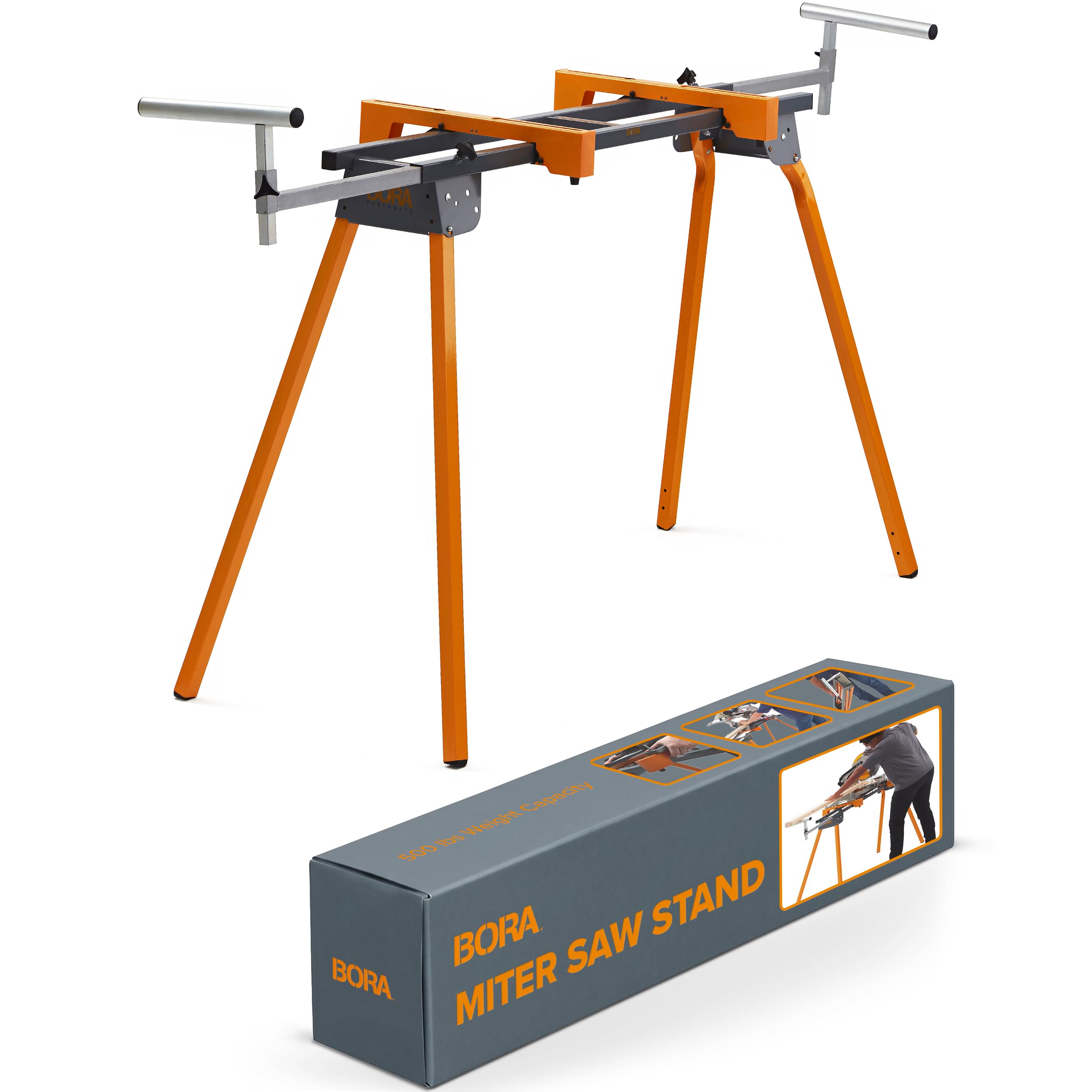
The PM-4000 is the cheapest way in this group to get a 500-pound rating and 114 inches of material support. It stands 36 inches tall — counter height, which suits most people cutting trim — and it takes saws up to 12 inches. Folded, it is a manageable package that leans in a corner or lies across a trunk.

The quick-release mounts are what earn it a place beyond the price. Squeeze two levers and the saw comes off, leaving a flat table you can bolt a planer or a tile saw to. In a one-bench garage where every tool competes for the same square foot, that is real estate rather than a gimmick, and it is the reason we keep this one in the roundup at all.

What you are buying is a table, not a lifetime purchase. The mounts and the working height are the two things that make it pleasant day to day, and both hold up. It is the right pick when the saw shares a bench with other tools and the budget has a ceiling; if the stand is going to be loaded and unloaded five days a week, the DeWalts are the ones that keep their shape.

Bottom line: The budget answer for someone who wants a 500-pound table and a saw that comes off in seconds.

Check Latest Price
#04

Best for Small Workshops

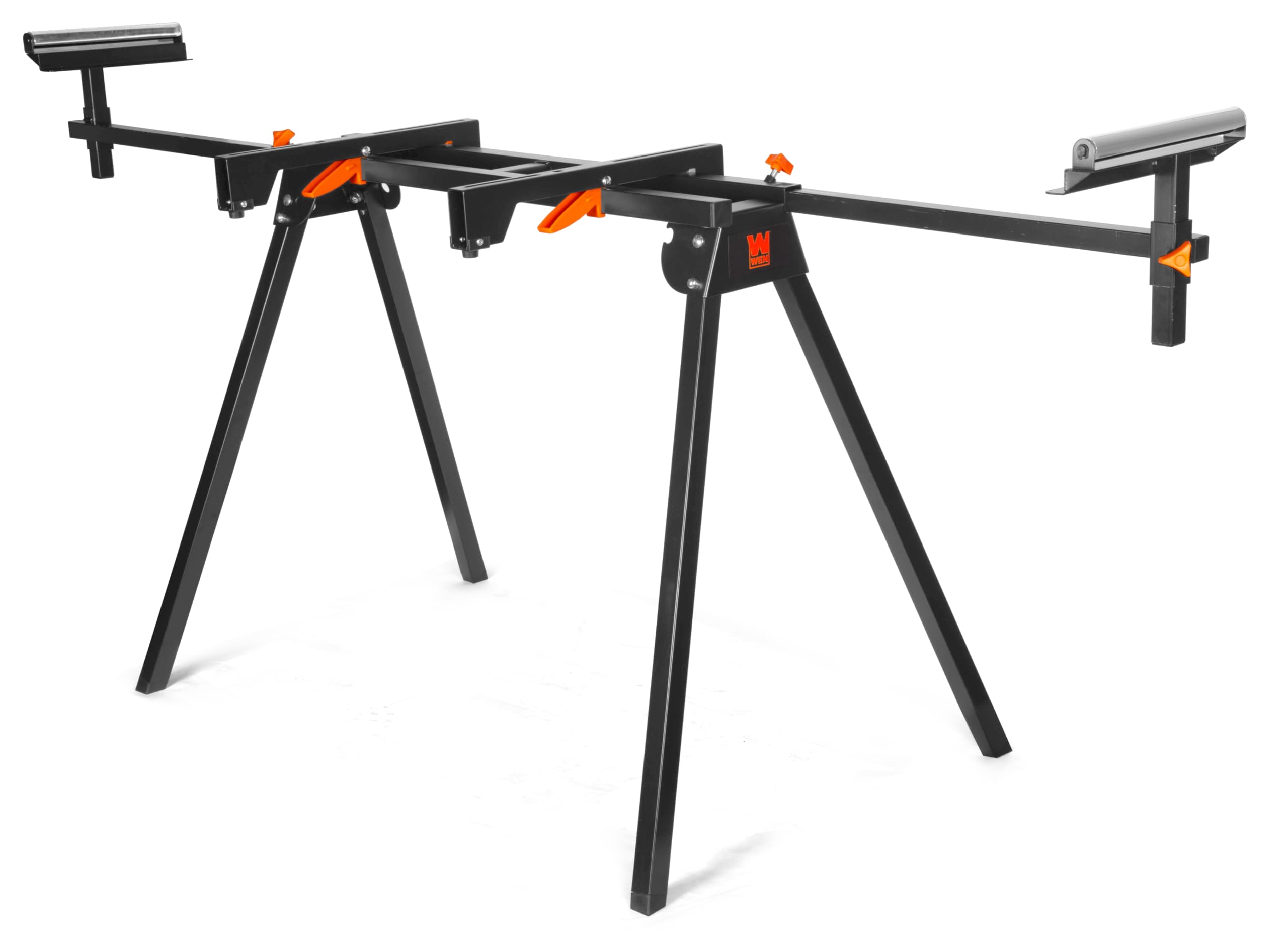
WEN MSA200 Collapsible Miter Saw Stand

89 /100
Kirk Score Excellent
Arm Extension
36 to 80 inches
Load Capacity
350 lb
Working Height
31 inches
Material Support
Up to 8 feet
Check Details on Amazon

Pros

  • Folds flat for narrow storage
  • Arms extend from 36 to 80 inches
  • Quick-release brackets fit most saws
  • Lowest cost of the stands here

Cons

  • No wheels
  • 31-inch height is low for tall users

There is no pretending the MSA200 is a contractor's stand. It carries 350 pounds, its arms support 8 feet of stock, and there are no wheels — the folded frame is something you pick up and carry. For a garage shop cutting trim, flooring, and the odd 2x4, none of that is a problem, and the directions are simple enough that assembly is an evening's job rather than a weekend's.

What we appreciate is how little room it asks for. The steel frame lifts the saw 31 inches off the floor and the arms slide out from 36 to 80 inches, with two height-adjustable rollers and quick-release brackets that take most saws. It is the least expensive way here to stop cutting on the ground, and for a homeowner working through one remodel at a time, that is the entire purchase.

The arms are its weak spot. They slide through their collars with more friction than they should, so changing the reach means working an arm back and forth rather than easing it out, and an arm that arrives bent will never run smooth. It is the difference between a stand you set once and one you negotiate with every time a longer board shows up.

Bottom line: A sensible buy for a home shop that cuts trim now and then and needs the stand out of the way the rest of the time.

Check Latest Price
#05

Rolling, with power

WEN MSA330 Rolling Miter Saw Stand

89 /100
Kirk Score Excellent
Weight
38 lb
Load Capacity
330 lb
Onboard Power
Three 15A outlets
Material Support
Up to 10.5 feet
Check Details on Amazon

Pros

  • Three onboard 15A outlets at the saw
  • Large 8-inch wheels roll a loaded saw
  • Reaches 10.5 feet of material

Cons

  • Folded stand will not stand upright with a saw on

Three 15-amp outlets built into a saw stand sounds like filler until you are set up in a driveway with one cord running back to the house. WEN puts them on the MSA330 alongside two 8-inch never-flat wheels, arms that reach from 32 to 79 inches, and a frame that holds 330 pounds and lifts the saw 33 inches off the ground. We think the outlets are the reason to look at this one, and we also think they are mounted in the wrong place.

They sit on the end of the stand, which is exactly where a long board wants to be, and the included cord is light enough to work loose from the outlet. Both are fixable: run a short heavy-duty cord and plug in at the stand rather than the wall. Where it is genuinely good is mobility — the big wheels roll a loaded saw out of a garage and over a curb, and the quick-release brackets get the saw on and off without tools.

The frame is where the money went missing. At 330 pounds it sits near the bottom of this group, and the steel has more give in it than the DeWalts do. Check the mounting clamps before every cut as well, because the saw can sit slightly loose in them, and a saw that shifts mid-cut ruins the piece at best. As a second stand for a deck build or a rental property it earns its space; as the only stand you own, it is a compromise.

Bottom line: Worth a look if you want power at the cut and a stand that rolls, as long as you accept a lighter frame.

Check Latest Price

How We Tested Miter Saw Stands in Garages, Driveways, and Basements

We started with about 30 stands pulled from manufacturer spec sheets and the complaints people leave in reviews, then narrowed that list by price, mounting style, and whether the thing genuinely folds flat. Eleven made the final round, and each one spent seven months in rotation.

Every stand got the same saw mounted on it, a 10-inch sliding compound miter saw, and every stand spent a week in my garage, a week in the driveway breaking down deck boards, and a weekend of trim work in a half-finished basement. We timed how long one person needed to go from folded to making a cut, and we counted how many tools the out-of-box assembly actually demanded.

Stability we checked the blunt way: push a 2x10 through a crosscut and watch for rock, then lean on the far end of a fully extended support arm and see how much it sags. To test mounting, we pulled the saw off and reattached it to each stand's rails, noting whether the brackets needed shims, whether the holes lined up, and how long the swap took. Durability came from folding and unfolding each stand at least a dozen times over the months and watching for loosened hardware, stripped knobs, or a latch that had started to stick.

Weight and adjustability got the same treatment: we rolled each stand across a garage floor, over a door threshold, and up a short gravel slope, then lifted it into a truck bed alone. Last, we set what each stand cost against what it actually did, because a few of the pricier ones added a feature and not much else.

How to Choose a Miter Saw Stand

Match the stand to the saw you actually own

A 500-pound rating is not 500 pounds of saw. It is the saw plus the leverage of a long board hanging off one arm, and that leverage is what walks a light stand across the floor. A 12-inch sliding compound saw is the heaviest machine in most shops, and it is the one that makes a 300-pound stand feel like a compromise.

Be honest about the job. If the saw lives on the stand and cuts trim, casing, and the occasional deck board, 330 to 350 pounds is plenty. If it rides in a truck and cuts long stock all day, buy the higher rating — it is the cheapest insurance against a table that shifts mid-cut.

Reach tells you how much help you get

Advertised reach runs from 8 feet on the WEN MSA200 to 16 feet on the DWX723, and it describes how much stock the arms can hold up, not how long a board you can cut. Eight feet covers trim and most remodel work if you handle the offcut end yourself. Past that, the longer beam starts earning its money on every piece of crown you run.

Rollers and end stops are what turn reach into repeatable cuts. Set the roller level with the saw's table so a board runs flat from the arm to the blade; if the roller sits high or low, the stock dives at the saw and the cut wanders. End stops save you measuring the same length twice.

Stability is a setup problem as much as a frame problem

Four legs with locking levers on level ground beat a heavier stand perched on a slope. Fixed-length legs — the DWX723's included — need a shim under one foot on gravel or a crowned driveway. A wheeled stand needs its wheels squared away before you lean on a long board, because a stand that rolls also creeps.

Before you blame the saw for a drifting cut, check that all four feet are loaded and the saw's base is tight in the brackets. In our experience most wandering cuts are the stand moving, not the blade flexing.

Weight and folded length decide whether it travels

A stand that lives in the shop can weigh whatever it likes. One that travels needs a number you can lift onto a tailgate: 25 to 30 pounds is a one-person job, and the heavier stands are the ones that quietly stay home. Wheels change that math, but only if you have somewhere flat to roll them.

Folded length matters more than weight if you drive a car or a small SUV. The long-beam stands fold into a package over six feet, so measure the cargo space against the listed dimensions instead of assuming it slides in behind the seat.

Pick a working height you can stand behind

The stands here put the saw table between 31 and 36 inches off the floor, and a standard kitchen counter is 36. Stand at the saw the way you will stand to feed a board: hands around waist height is right, a rounded back is not. Taller users should aim for the top of that range.

Leg height is mostly not adjustable, so get this right before you assemble and mount the saw. A stand that fits your height is the difference between an afternoon of casing and an afternoon of your lower back.

Frequently Asked Questions

Final Verdict

Buy the DEWALT DWX723. It is the only stand here that gives you 16 feet of material support without asking you to wrestle a heavy frame, and 500 pounds will hold any miter saw you are likely to own plus the board hanging off the end.

If the saw never leaves the shop, the WEN MSA200 covers trim and flooring for far less money with 8 feet of reach. If moving the whole rig is the daily problem, the DWX726's wheels and spring assist earn their keep.