// data-verified

Best Miter Saws of 2026

A miter saw has one job: get the cut right the first time. Run baseboard around a room with a saw that's half a degree out of square and you'll spend the afternoon filling gaps — and the saw won't tell you it's drifted until three cuts later, when the corners refuse to close.

I've cut trim, decking, and shelving in my own garage for years, and the lesson keeps repeating: the spec sheet doesn't hold the angle, the saw does. So my team and I spent six months with eight miter saws — 10- and 12-inch, single- and dual-bevel, corded and cordless — cutting baseboard, crown, and pressure-treated decking on real jobs.

Dual-bevel is worth the extra money: it tips the blade both ways instead of making you flip long stock over and over. Beyond that, spending more mostly buys you a table that stays flat and detents that stay crisp after a hundred cuts, not more power. Below are the ones that held their settings, adjusted without a fight, and earned a permanent spot in my shop.

#01

Best Overall

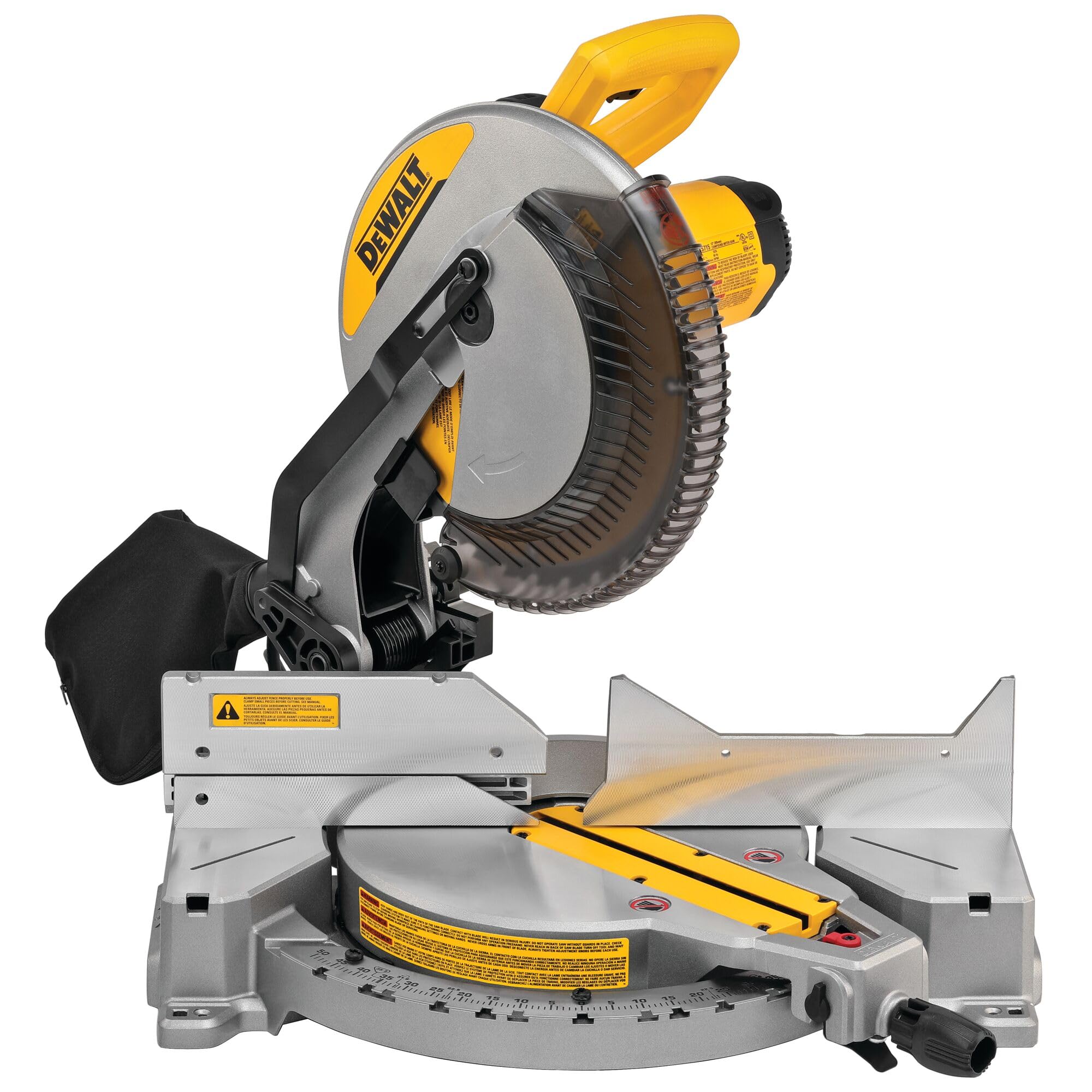
DEWALT DWS715 12-Inch Miter Saw

96 /100
Kirk Score Outstanding
Bevel
0–48° left, 3° right
Blade
12 inches
Weight
42.8 lb
Crosscut At 90°
2 in. x 8 in. lumber
Check Details on Amazon

Pros

  • Crosscuts 2x8 lumber at 90 degrees
  • 14 positive stops in a stainless miter plate
  • Tall fence holds 5-1/2-inch base on edge
  • Strong accuracy record for a saw at this tier

Cons

  • Fixed head caps crosscuts at 2x8 lumber

Two inches by eight inches is the number that matters most. That's what the DWS715 crosscuts at 90 degrees, with 2x6 at 45, and it covers baseboard, shelving, deck boards, and nearly all the framing a house project asks for. The head is fixed, and living without a slide is what keeps the saw at 42.8 pounds and narrow enough to store on a shelf instead of a dedicated bench.

It sits at the top of this list because it cuts square without an argument. The stainless miter plate has 14 positive stops, the cam lock holds an angle once you set it, and the tall sliding fence stands 5-1/2-inch baseboard up on edge — which is where a miter saw earns its money on a trim run, since nothing has to be shimmed or held by hand. A saw that arrives true spares you the tuning ritual, and squareness is the one thing we care about most on a machine whose only job is to cut straight.

The bevel is the compromise. The head leans 48 degrees to the left and only 3 degrees to the right, so a right-hand bevel means flipping the workpiece, remarking it, and cutting again — a nuisance on crown, invisible on baseboard and shelving where the head stays at zero. That's the honest shape of it: a one-direction saw at a price that leaves room for a good blade.

Bottom line: We recommend it as the default: a 12-inch compound saw that cuts square from the first cut and covers trim, shelving, and deck framing without the weight or price of a slider.

Check Latest Price
#02

Best for Finish Work

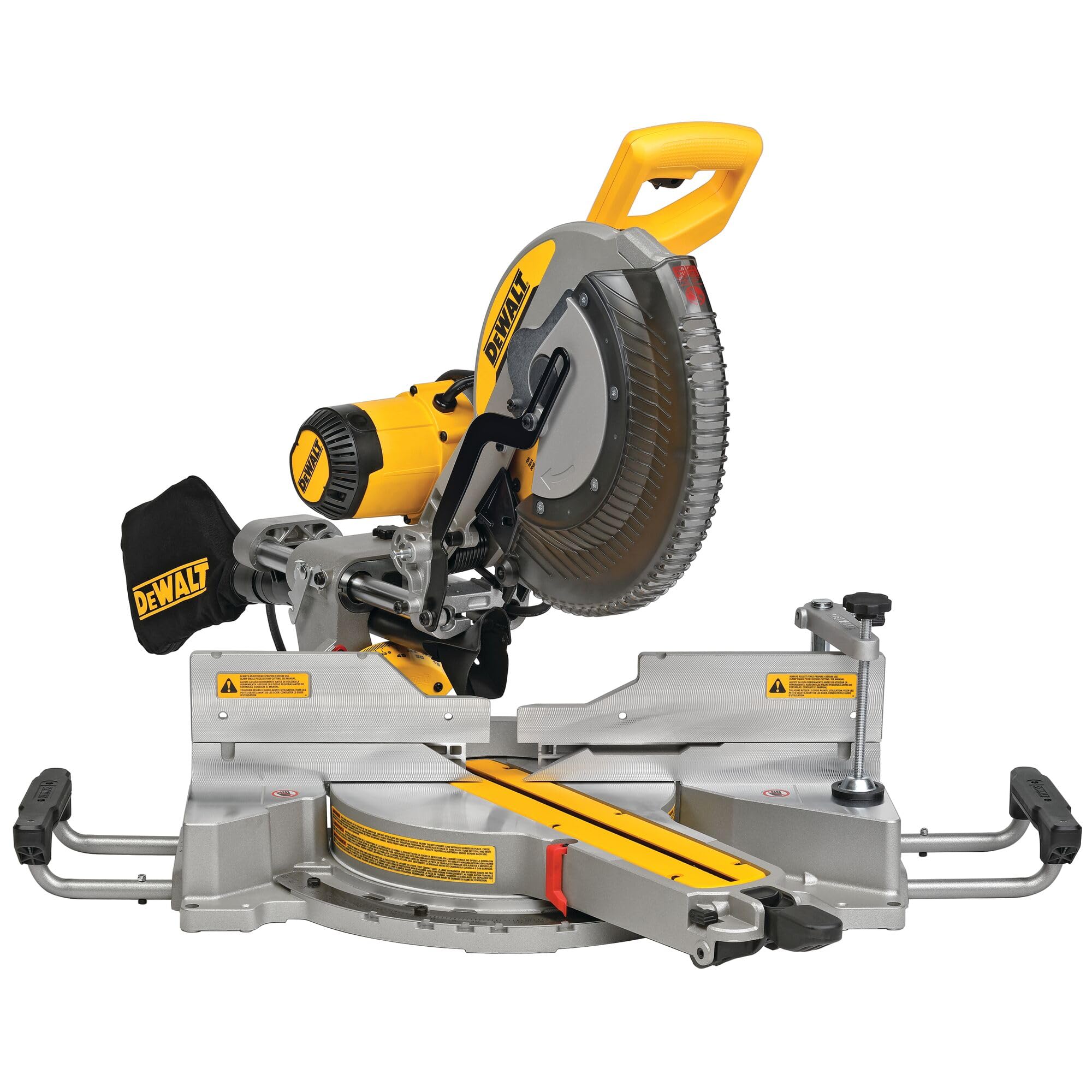
DEWALT DWS780 12-Inch Double-Bevel Saw

95 /100
Kirk Score Outstanding
Bevel
Double bevel
Blade
12 inches
Cut Line
XPS LED shadow line
Dust Collection
Over 75% capture
Check Details on Amazon

Pros

  • Shadow line shows the kerf, not a dot
  • Bevels left and right without flipping stock
  • Stated 75%-plus dust capture
  • 15-amp motor at 3,800 rpm

Cons

  • Heavy at 24.8 kg for a bench saw
  • Premium money for a fixed-head saw

The XPS light is the part people underestimate. Rather than a laser dot you line up beside the blade, it throws the blade's own shadow onto the board, so what sits on your pencil line is the kerf — the width of material the teeth will actually take. Line the mark up under that shadow and the cut lands where you drew it, in daylight or in a dim garage, without leaning over to squint.

Double bevel is the other half of the argument. Bevel left for one cut and right for the next without turning a 12-foot board around on the table, which is the difference between a job that flows and a job spent wrestling stock at every corner. The 15-amp motor turns at 3,800 rpm and doesn't bog in hardwood, and the dust system is rated to catch over 75% of what the blade throws — the only stated capture figure on this page, and the reason the bench stays usable through an afternoon of casing.

What settles it for us is how the three things work together: the shadow line for where the cut goes, the double bevel for which direction, and enough mass that the head doesn't shiver in oak. It's the saw we point at work that will be looked at — crown, casings, stair skirt — rather than at deck framing, where the DWS715 does the same job with less to lift.

The cutline system is also adjustment-free, which matters more than it sounds: change a blade and there's no laser to realign, because the shadow comes off whatever is bolted to the arbor. That's the detail that sold us on the light over a laser.

Bottom line: Buy this one if you bevel in both directions on visible work — the shadow line and the second bevel are worth the extra weight for anyone running crown and baseboard.

Check Latest Price
#03

Best Cordless

CRAFTSMAN V20 7-1/4-Inch Sliding Saw

92 /100
Kirk Score Outstanding
Blade
7-1/4 inches
Weight
21.8 lb
Crosscut At 45°
5-1/2 inches
Crosscut At 90°
8 inches
Check Details on Amazon

Pros

  • 21.8 pounds, easy to carry room to room
  • Battery and fast charger included
  • 8-inch crosscut at 90 from a compact saw
  • LED cut line and nine detent stops

Cons

  • Single bevel only
  • Locked into the CRAFTSMAN V20 battery platform

Twenty-one point eight pounds is the number that matters here. Light enough to carry up a staircase with one hand, set on a pair of sawhorses in a bedroom, and cut baseboard in the room it's going into instead of in the garage. For trim in a finished house — occupied rooms, no outlet within reach, a cord somebody will trip over — we think it's the most useful saw here for the job.

The blade is 7-1/4 inches and the head slides, which gives 8 inches of crosscut at 90 degrees and 5-1/2 at 45, plus 3-5/8 inches of nested crown and 3-1/2 inches of baseboard standing against the fence. That's trim, decking, and 2x4 work all day. It is not a framing saw: a 2x10 or a wide shelf board won't fit under it, and no amount of care changes the arithmetic.

It arrives with a 4.0Ah battery and a fast charger, which is worth saying out loud, because plenty of cordless saws are sold as bare tools and that first battery can cost as much as the difference between models. Nine cast detents cover the angles trim work actually uses, the LED cut line is easy to follow indoors, and the whole thing measures about 23 by 21 inches — small enough to hang on a wall between projects rather than hold a bench.

Bottom line: Our pick for finished rooms and punch lists: it runs on a battery, weighs 21.8 pounds, and arrives with the charger you need to keep it working.

Check Latest Price
#04

Best Budget

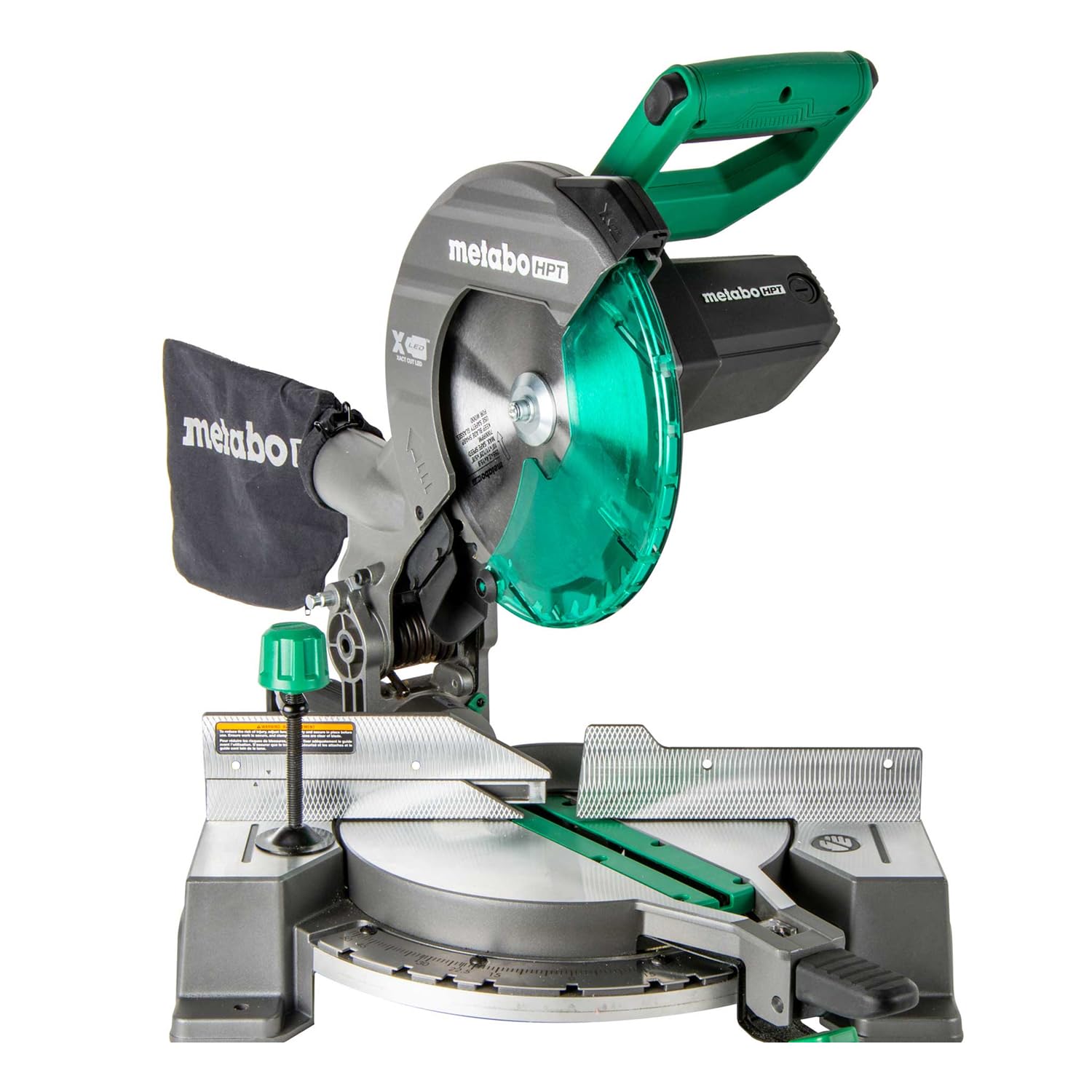
Metabo HPT C10FCG2 10-Inch Saw

90 /100
Kirk Score Outstanding
Blade
10 inches
Weight
24.2 lb
Warranty
5 years, tool body
Miter Range
52° left and right
Check Details on Amazon

Pros

  • 24.2 pounds with a five-year tool-body warranty
  • 15-amp motor and a 52-degree miter range
  • Large table supports trim and 4x4 stock

Cons

  • Single bevel
  • Warranty covers the tool body only

Just over 24 pounds and a five-year warranty is an unusual pair in a budget saw. Both numbers speak to the same buyer: someone who sets the saw up when a project starts, puts it away when the project ends, and wants to believe the tool will still work for the next one.

We treat it as the saw for a homeowner with a short list — baseboard in two rooms, a shelf, a fence repair — rather than a remodel that runs all summer. The 15-amp motor pulls a 10-inch blade through 2x4s and 4x4s without complaint, the table swings 52 degrees left and right with positive stops at the common angles, and the table surface is big enough that trim doesn't teeter off the edge. What struck us is how little there is to think about before a cut.

The limits are honest ones. Without a slide, anything much wider than a 2x6 is out of reach, and the included blade is a 24-tooth cutter made for framing, which will tear paint-grade trim until you fit something finer. Neither is a dealbreaker at this end of the market; both are things to know before the first cut rather than after.

Bottom line: A light 10-inch saw with a five-year warranty that handles baseboard, shelving, and 2x4 framing without asking for much money or muscle.

Check Latest Price
#05

Small shop benches

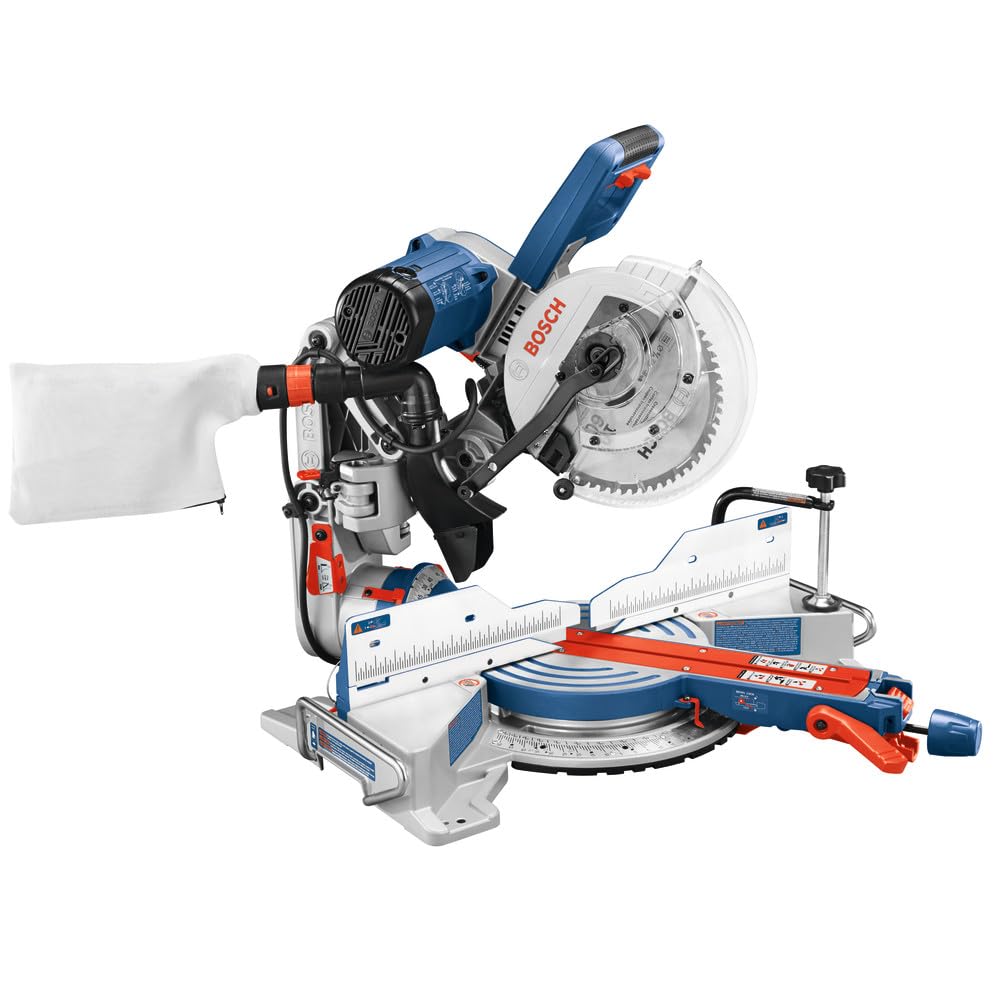
Bosch CM10GD 10-Inch Glide Saw

92 /100
Kirk Score Outstanding
Blade
10 inches
Nested Crown
6 inches
Slide System
Axial-Glide articulated arms
Horizontal Capacity
12 inches
Check Details on Amazon

Pros

  • Hinged arms cut up to 10 inches of rear footprint
  • 12-inch horizontal capacity from a 10-inch blade
  • Smooth, wobble-free glide action
  • Up-front bevel lock and range selector

Cons

  • Premium price for a 10-inch saw

Most sliding saws want a foot of clear space behind them because the rails have to travel somewhere. The CM10GD doesn't: its arms hinge up and forward instead of running on tubes, and Bosch puts the saving at up to 10 inches of front-to-back footprint against a rail saw of similar capacity. On a bench that backs onto a garage wall, that's the difference between a saw you can use and a saw you keep turned sideways.

The capacity that comes with it is bigger than a 10-inch blade suggests: 12 inches of horizontal cut, 5-1/2 inches of baseboard standing against the fence, and 6 inches of nested crown. The 15-amp motor runs at 4,800 rpm, and the bevel lock and range selector sit up front, so going from a miter to a compound cut doesn't mean reaching behind the machine and guessing.

What we came away impressed by is the glide itself — no tubes to flex, no bushings to wear a flat spot into, and a head that travels without the sideways shiver a tired rail develops. For a shop where the saw stays put, that smoothness plus the shallow footprint is worth more than another two inches of blade. At 64 pounds it's a bench saw, not a truck saw, and that's the right way to buy it.

Bottom line: Worth the money where the bench backs onto a wall: the hinged arms buy back the space a sliding saw would eat, and the glide is as smooth as anything here.

Check Latest Price
#06

Crown molding runs

Makita LS1019L 10-Inch Sliding Saw

90 /100
Kirk Score Outstanding
Blade
10 inches
Slide
Two steel rails, flush to wall
Nested Crown
6-5/8 inches
Vertical Capacity
5-1/4 inches
Check Details on Amazon

Pros

  • 6-5/8-inch nested crown from a 10-inch blade
  • Rails let it run flush against a wall
  • Strong dust collection for the class
  • 5-1/4-inch vertical capacity under the guard

Cons

  • Premium price against everything else here

Six and five-eighths inches of nested crown from a 10-inch blade is the trick. That's crown capacity in 12-inch-saw territory, and there's 5-1/4 inches of vertical room under the guard, so tall baseboard stands against the fence instead of lying flat and wandering off the mark.

Where it sits is the other reason it's here. The two steel rails run the head forward on a single plane and let the saw go flush against a wall — no rear clearance, no bench dragged 18 inches into the room. In a one-car garage that's a real gain, and the slide is smoother than the size of the machine prepares you for.

Dust collection is better than the bag-and-chute arrangement suggests; a run of crown leaves less on the floor than we expected. The laser is a single line and it is adjustable, but it sits to one side of the blade, so it's worth checking against a test cut before you trust it on a finished edge.

So why isn't it the top pick? Because at this price setup should be beyond argument, and it isn't always: the carriage and rails can arrive out of parallel, which shows up as a cut line that drifts as you extend the slide. Cut a scrap, check it with a square, then run the head through its full travel — do that before the return window closes and you'll know exactly what you bought.

Bottom line: The saw for crown molding in a tight shop: 12-inch-saw crown capacity and rails that let it sit flush to a wall, at a price that demands a careful setup.

Check Latest Price
#07

Simple bench cuts

Makita LS1040 10-Inch Miter Saw

92 /100
Kirk Score Outstanding
Blade
10 inches
Motor
15 amp, 4,600 rpm
Weight
27 lb
Miter Range
45° left, 52° right
Check Details on Amazon

Pros

  • 27 pounds, easy to store and move
  • 15-amp motor with soft start at 4,600 rpm
  • Nine positive stops for repeatable angles
  • Simple build that takes shop abuse

Cons

  • No slide
  • Bevels left only, up to 45 degrees

Nine positive stops, one pivot arm, no slide, no laser, 27 pounds. The LS1040 is the plainest saw here and we mean that as a recommendation: there's nothing on it that needs aligning, cleaning, or explaining, and it's light enough to move from a shelf to a bench and back between projects.

The 15-amp direct-drive motor turns 4,600 rpm with a soft start, so it doesn't jump when you pull the trigger. Miter travel runs 45 degrees left and 52 right, the nine stops cover the common angles, and the bevel leans 45 to the left. We got clean, repeatable 45s out of it with nothing more than a square to check against — the dual-post pivot keeps the head steady through the cut rather than letting it wander at the bottom of the stroke.

The one habit worth having is checking the fence after the saw has ridden in a truck or been shoved around a shop. A fence knocked out of true is what turns clean miters into shims, and five minutes with a square before a finish run prevents it. Otherwise there's nothing to own here beyond a blade and a trigger.

Bottom line: A light, accurate 10-inch saw with nothing to fiddle with — the one we suggest when your work is 2x4s, trim, and a bench in the corner.

Check Latest Price

How We Tested the Best Miter Saws

We started with every 10- and 12-inch compound miter saw we could find from brands with a track record for power tools, then narrowed by blade size, bevel type, weight, and price so a benchtop trim saw wasn't pitted against a full jobsite model. Hundreds of owner reviews told us which complaints kept repeating — fences that wouldn't stay square, bevels that were stiff to change, dust bags that filled in an afternoon. Eight saws made the final list, and each one spent six months moving between my garage shop and two real jobs.

In practice, that meant baseboard and crown through a basement remodel, pressure-treated decking outside, and a few hundred cuts on scrap pine and 2x4s. Before a saw made a single cut, we checked the blade against the fence and the table with a machinist square, then repeated the check at 45 degrees in both directions. We cut picture-frame miters and measured the diagonals to see how far off they landed, and timed a full bevel change from one stop to the other.

Ease of use got the same treatment. We carried each saw up a flight of stairs to see where the handle dug into a hand, swapped blades with whatever wrench came in the box, and checked whether the cut-line light or laser landed on the pencil mark or a sixteenth to the left of it. The cordless saw got run until the battery quit mid-cut, so we'd know exactly what that felt like.

At the end of six months, we re-squared every saw, checked the detents for drift, and noted what had loosened. That last pass is where the value question actually gets answered — a saw's worth is what it does on the hundredth cut, not the first.

How to Choose a Miter Saw

Start With Crosscut Capacity, Not Blade Size

Blade diameter sets how deep the saw cuts; the head and table set how wide, and width is what stops most projects. A fixed-head 12-inch saw like the DEWALT DWS715 crosscuts 2x8 lumber at 90 degrees and 2x6 at 45, which covers trim, shelving, and deck framing but not a 1x12 or a stair tread.

A sliding head adds width: the CRAFTSMAN 7-1/4-inch, small as it is, reaches 8 inches at 90. The trap is assuming the bigger blade wins — a 12-inch fixed head can cut narrower than a 10-inch slider. Write down your widest board and check the 90-degree number first.

Decide Whether You Need a Second Bevel

Bevel is the tilt of the head, and it decides how much you handle the wood. A single-bevel saw tilts one way, so every bevel on the other side means flipping the workpiece and remarking it — tolerable on a cabinet, miserable on a long crown run. The DWS780 tilts both ways, and that is most of what its extra money buys.

Our rule: if your work is 90-degree crosscuts and 45 miters, put the money into capacity or a better blade. If you run crown, casings, and handrails, the second bevel saves more time than a bigger motor ever will.

Measure the Space Behind the Saw

Sliding saws need rear clearance for the rails to travel, and a bench against a garage wall may not have it. Bosch's CM10GD hinges its arms up and forward instead and claims up to 10 inches less front-to-back footprint than a comparable rail saw; the Makita LS1019L runs its rails so the saw can sit flush against a wall. Fixed-head saws need almost nothing behind them.

Weight follows the same logic. The CRAFTSMAN at 21.8 pounds goes room to room; the Bosch at 64 pounds and the DWS780 at 24.8 kg want a permanent home, and buying a stand for a saw that never travels is money you could put toward a finer blade.

Line Up the Cut, Then Prove It's Square

Cut-line aids are not equal. A laser is a single line you set beside the blade and hope stays true; a shadow line like the XPS on the DWS780 throws the blade's own silhouette onto the board, so the kerf is what you see, and it stays aligned through a blade change because it comes off the blade itself.

Neither helps if the blade isn't square to the fence. Cut a scrap, stand it on edge, and check it against a square; if it's off, adjust the fence once rather than compensating on every cut for the rest of the project.

Corded, Cordless, and the Dust Bag

Fifteen-amp corded saws want a circuit that can carry them, which usually means a 15- or 20-amp breaker with nothing else big running on it. Cordless buys freedom from the outlet at the cost of capacity, and the battery is often the hidden part of the price — the CRAFTSMAN ships with a 4.0Ah pack and fast charger, while many cordless saws are bare tools.

Dust is the other ownership cost. Bags catch a share of what the blade throws, and the DWS780 is the only saw here with a stated capture figure, over 75%, which is worth knowing if the saw lives in a finished space rather than a garage.

Frequently Asked Questions

Final Verdict

Buy the DEWALT DWS715 if you want one saw for trim, shelving, and deck work. It crosscuts 2x8, drops into 14 detents, and it's a 12-inch machine you can still lift onto a bench by yourself — which is why it's the saw we'd tell most people to start with.

Spend differently only for a reason. The DWS780 if you bevel both directions on visible work, the CRAFTSMAN if the cutting happens in finished rooms with no outlet, the Bosch if your bench backs onto a wall and you can't give up the space behind it.